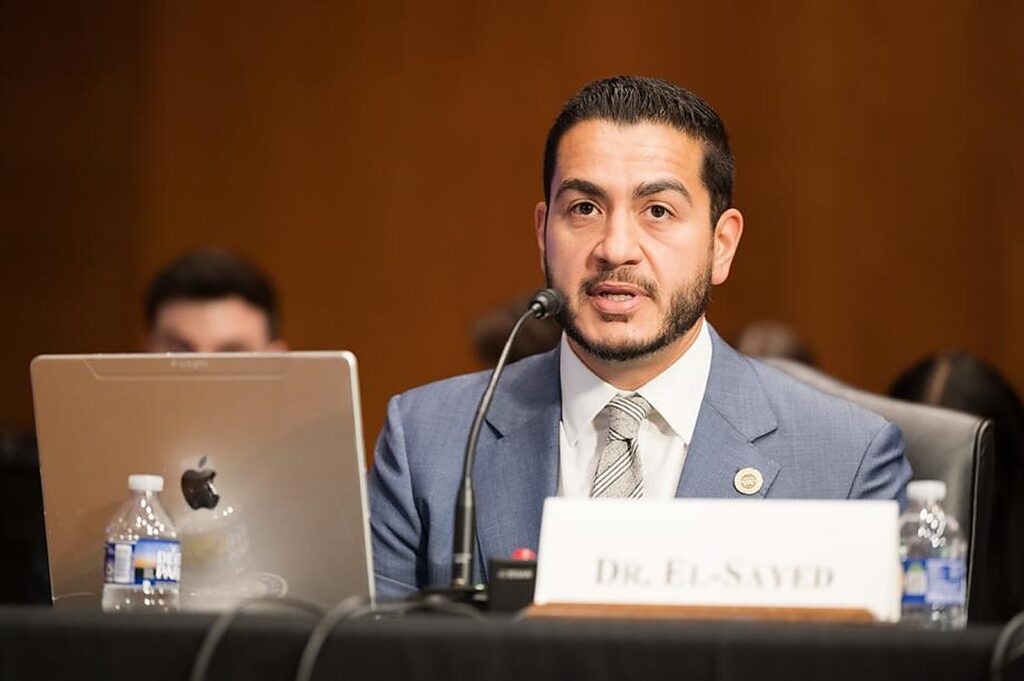
He is an exceptional regular guy who will lead in Washington, not run Uniparty errands.
Scott Ortkiese | Throughline Synthesis | Houston, August 9, 2026
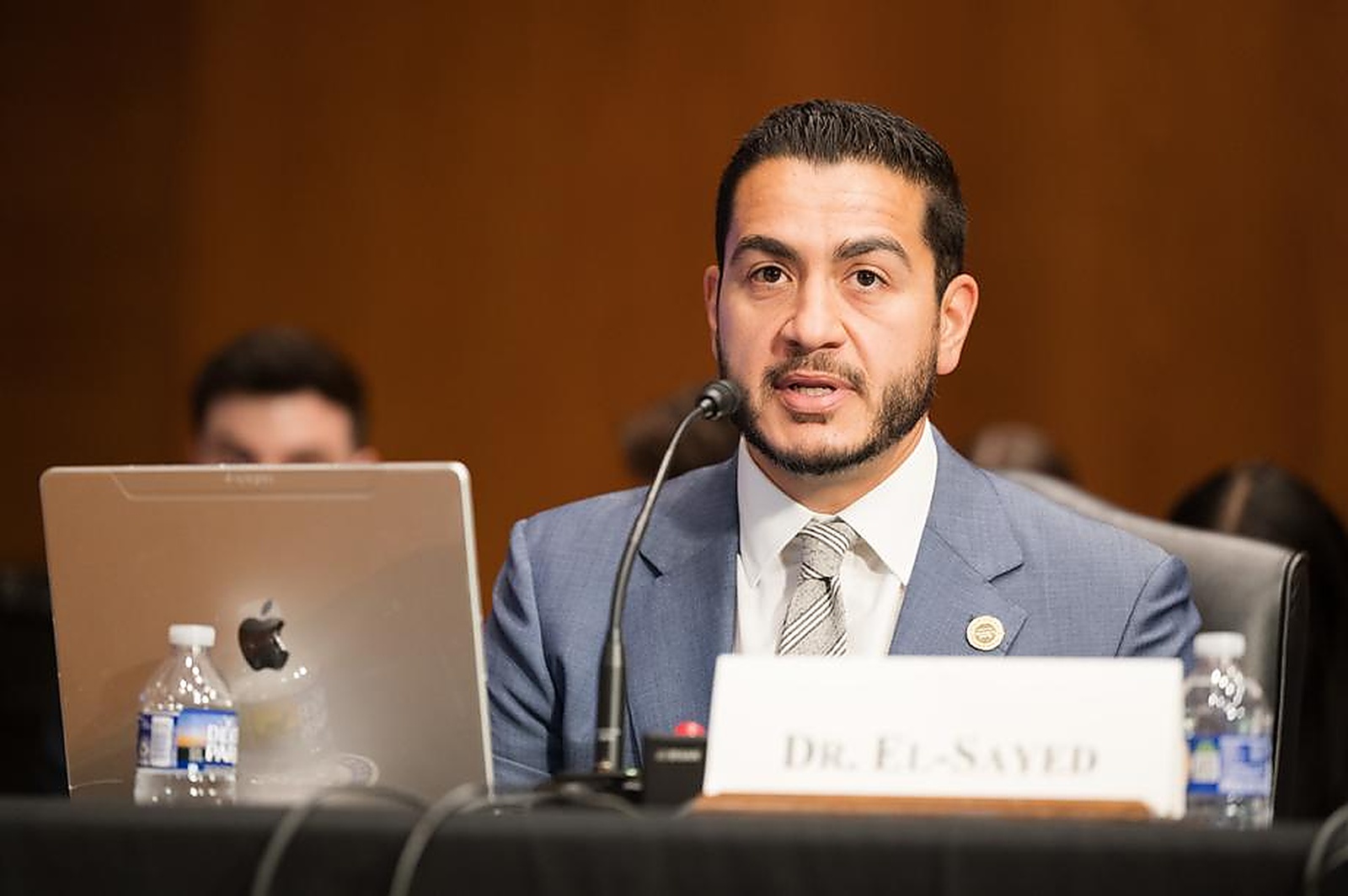
On August 4, 2026, Abdul El-Sayed won the Democratic nomination for the United States Senate seat in Michigan by roughly fifteen thousand votes out of more than 1.5 million cast. The certified count gave him 742,017 votes, or 48.48 percent, against Representative Haley Stevens at 727,091, or 47.51 percent.1 Turnout was the highest in a Michigan Senate primary in recent memory. He carried thirty of the state’s eighty-three counties, including Wayne, Washtenaw and Ingham, and he did it after being outspent by a factor of roughly eleven to one.2
That last number deserves to be read twice. This was the most expensive Democratic Senate primary in American history, with total advertising spending near $98.2 million by AdImpact’s count.3 The American Israel Public Affairs Committee, working through its super PAC, the United Democracy Project, put more than $30 million into defeating one candidate in one primary in one state. It was the largest single-race investment that organization has ever made.4 Add the other outside committees and the money spent to stop Abdul El-Sayed ran somewhere between $60 million and $70 million. His own campaign raised about $14.5 million, took no corporate political action committee money, and reported an average online contribution of $49.15.5
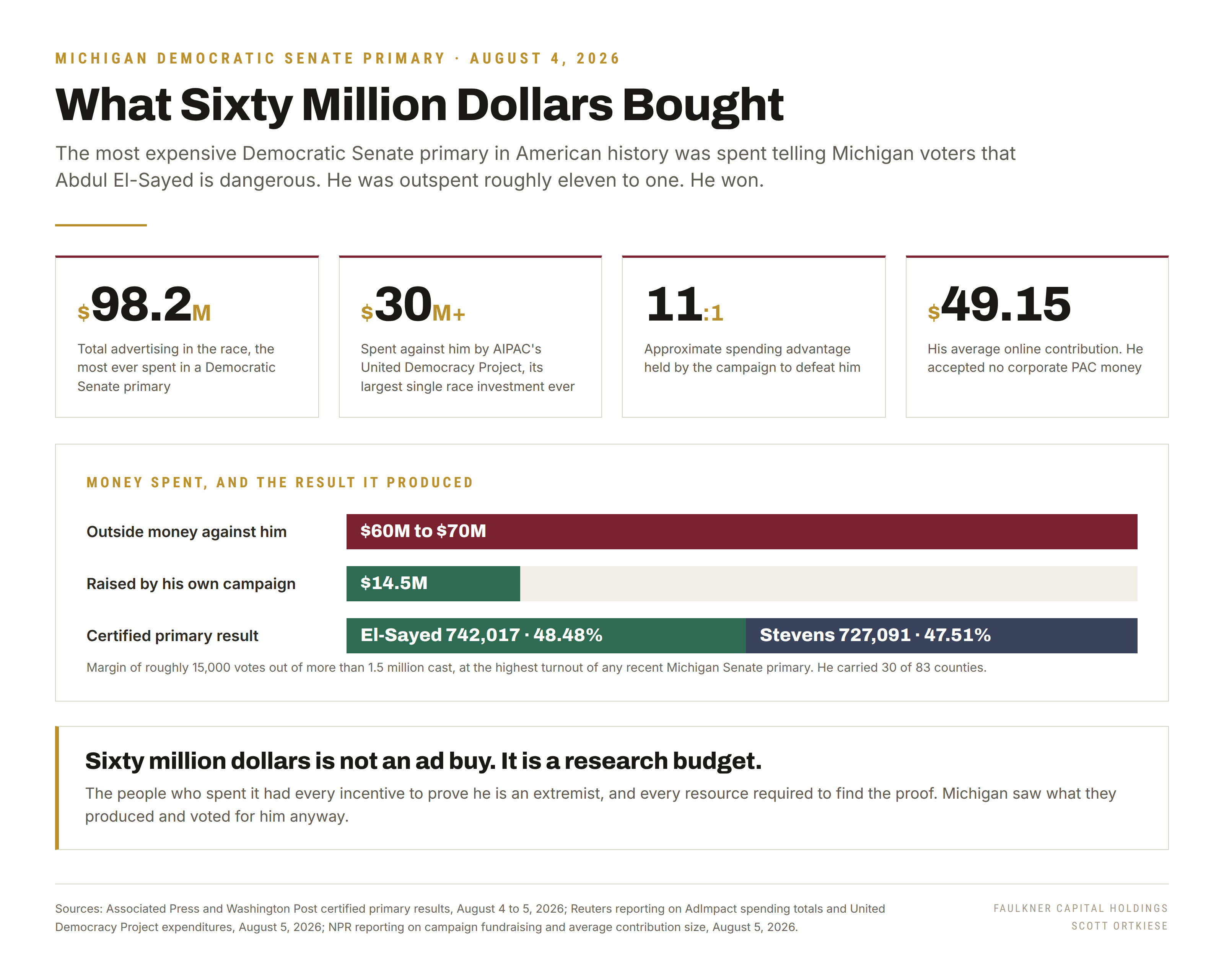
Sixty million dollars was spent to convince Michigan Democrats that this man is dangerous. Michigan Democrats looked at him and decided he is not. I want to explain why they were right, and I want to do it with the receipts, because the general election against Mike Rogers on November 3 will be fought with the same money and the same accusations, and the people making them are counting on nobody checking.
The ledger he came from
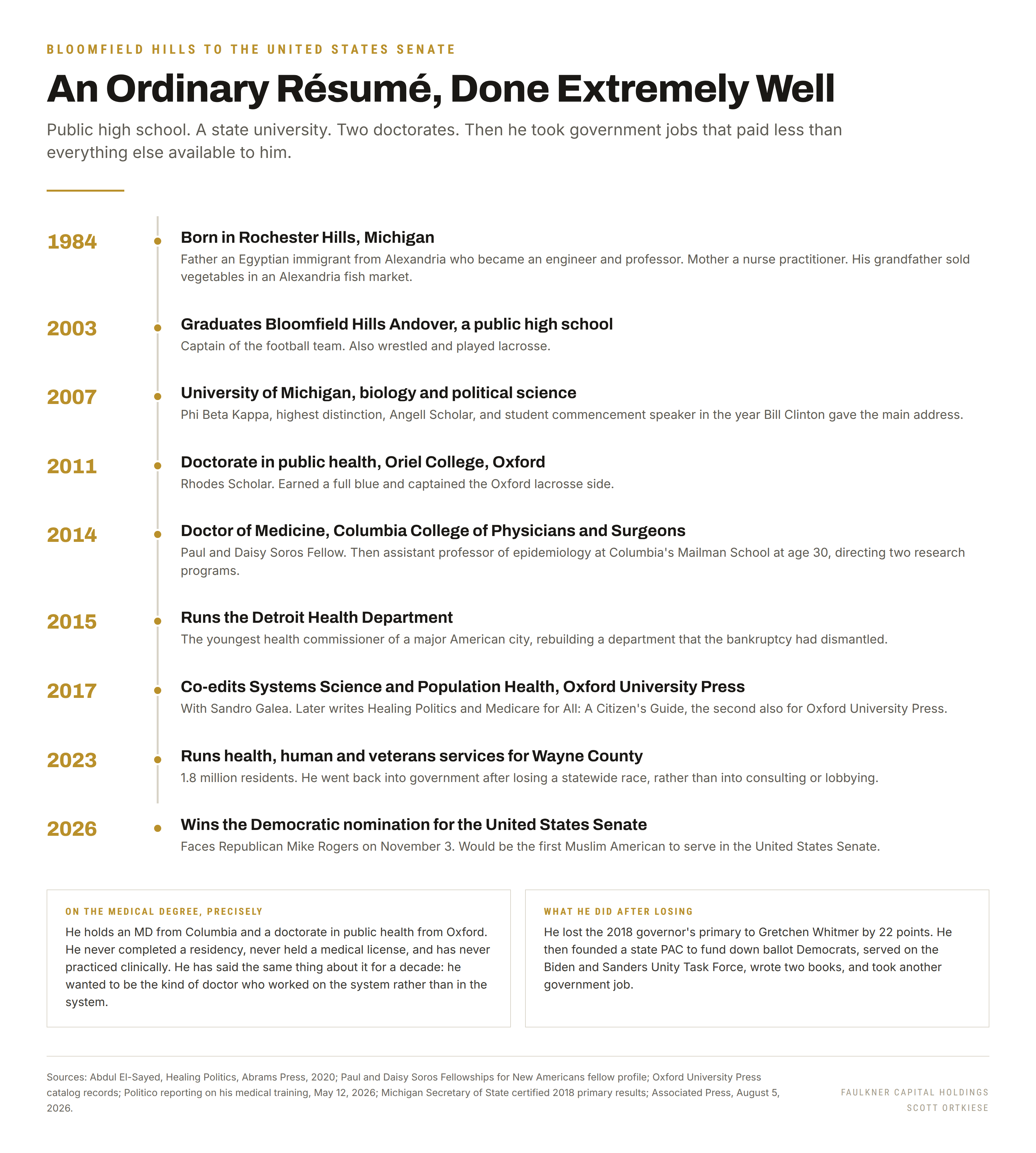
Abdulrahman Mohamed El-Sayed was born on October 31, 1984, in Rochester Hills, Michigan, and raised mostly in Bloomfield Hills.6 His father, Mohamed El-Sayed, emigrated from Alexandria, Egypt, and became an engineer and a professor. His grandfather sold vegetables in an Alexandria fish market. His grandmother raised six children in a one-bedroom apartment.7 His mother, Fatten Elkomy, also Egyptian, worked as a nurse practitioner. His parents divorced. His father remarried a white Michigander named Jacqueline, from Gratiot County, and El-Sayed grew up with a stepmother’s family, including a Presbyterian deacon he calls Grandma Judy, folded into the same household as a part-time imam father and an Egyptian grandmother named Teta Soad who never learned to read and who buried two infant children.8
The mythology industry has already tried to make this biography into something exotic. It is not exotic. It is a Michigan story of the standard kind, one generation off the boat, public schools, and a large complicated family with more than one religion in it at Thanksgiving. He did not attend Brother Rice or any other private academy. He graduated from Bloomfield Hills Andover, a public high school, in 2003, where he captained the football team and wrestled and played lacrosse.9
He went to the University of Michigan and graduated in 2007 with degrees in biology and political science, Phi Beta Kappa, highest distinction, an Angell Scholar, and the student commencement speaker in the year Bill Clinton gave the main address and praised him from the podium.10 He played club lacrosse. Then he went to Oxford as a Rhodes Scholar in 2009, took a doctorate in public health at Oriel College in 2011, and earned a full blue and the captaincy of the Oxford lacrosse side while he was there.11
What kind of doctor
Here I want to be precise, because imprecision on this point is the single easiest way to hand ammunition to people looking for it.
El-Sayed holds a Doctor of Medicine degree from Columbia University’s College of Physicians and Surgeons, awarded in 2014, where he was a Paul and Daisy Soros Fellow.12 He also holds the Oxford doctorate in public health. He never completed a residency, never obtained a medical license, and has never practiced clinical medicine.13 Opponents have used this to suggest something dishonest. It is not dishonest, and he has explained the choice consistently for a decade: “I wanted to be the kind of doctor who worked on the system rather than in the system.”14
That is a defensible thing to want, and he did it. At thirty he was an assistant professor of epidemiology at Columbia’s Mailman School of Public Health, where he directed the Global Research Analytics for Population Health program and the systems science program.15 In 2017 Oxford University Press published Systems Science and Population Health, which he co-edited with Sandro Galea, then the dean at Boston University’s school of public health.16 That is the academic record of a working epidemiologist, not a résumé decoration.
The relevant point for a Senate seat is not whether he can set a bone. It is whether he understands, at the level of the mathematics, how disease and cost move through a population of ten million people. He does. There are one hundred senators and almost none of them can say that.
Detroit
In 2015 Mayor Mike Duggan hired him to run the Detroit Health Department. He was thirty years old, which made him the youngest health commissioner of a major American city.17
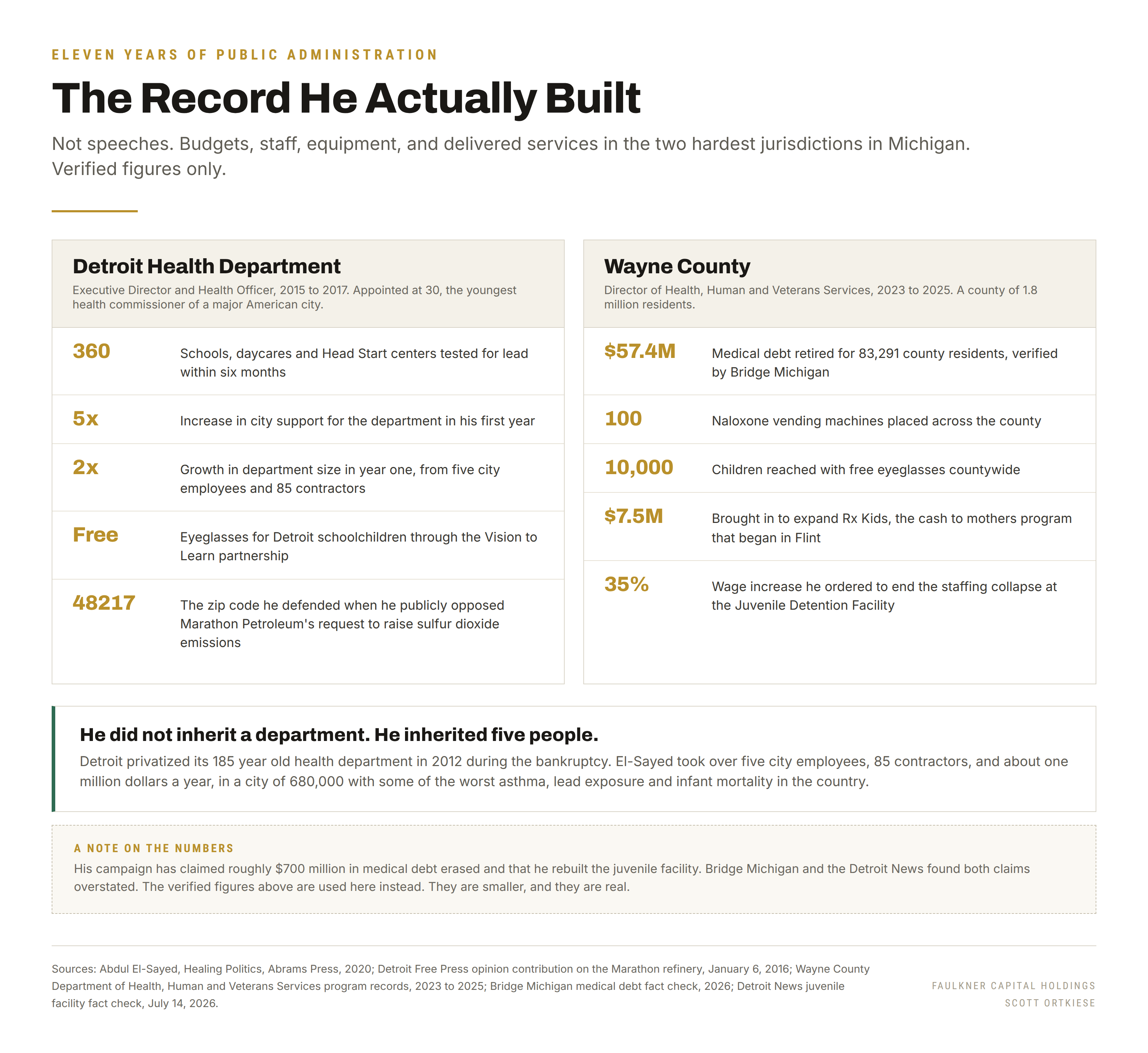
Understand what he was handed. Detroit had effectively privatized its 185-year-old health department in 2012 during the bankruptcy. When El-Sayed arrived, the department consisted of five city employees, eighty-five contractors, and about $1 million a year.18 A city of 680,000 people with some of the worst asthma, lead exposure and infant mortality numbers in the country had essentially no public health capacity at all.
In his first year the department more than doubled in size and city support increased roughly fivefold.19 The specific work is more instructive than the budget lines:
He put lead testing into 360 Detroit schools, daycares and Head Start centers inside of six months.20 He launched a partnership with Vision to Learn that put free eyeglasses on Detroit schoolchildren who had never had an eye exam.21 He built SisterFriends, a maternal health mentorship program pairing pregnant Detroit women with volunteer mentors, in a city where infant mortality was running at rates comparable to parts of the developing world.22 He rebuilt Animal Control, which had been a genuine public safety failure.
And he took on Marathon Petroleum. When the refinery in southwest Detroit sought state permission to increase its sulfur dioxide emissions, El-Sayed publicly opposed it and wrote about it in the Detroit Free Press, on the straightforward grounds that the children in the 48217 zip code already carried the highest asthma burden in Michigan.23 A thirty-year-old political appointee picking a fight with the largest taxpayer in his jurisdiction is not the behavior of a careerist. Crain’s Detroit named him to its 40 Under 40. The Michigan League of Conservation Voters named him Public Official of the Year.
Losing, and what he did afterward
He resigned in February 2017 to run for governor. He lost the 2018 Democratic primary to Gretchen Whitmer, 52.0 percent to 30.2 percent. Along the way he had to beat back a challenge to his eligibility, which Michigan’s Bureau of Elections resolved in his favor after establishing he had been continuously registered to vote in Michigan since 2003.24
What he did next is the part I find most persuasive about his character. Losing candidates in this country typically become consultants, lobbyists or cable furniture. El-Sayed founded a state political action committee, Southpaw Michigan, to fund down-ballot Democrats. He served on the Biden-Sanders Unity Task Force in 2020, which is not the assignment you give an ideologue who cannot sit in a room with people he disagrees with.25 He wrote Healing Politics, published by Abrams in 2020, and then Medicare for All: A Citizen’s Guide, published by Oxford University Press in 2021 with Micah Johnson, with forewords from Bernie Sanders and Pramila Jayapal.26 He built a podcast, America Dissected, and a newsletter, and became a CNN contributor.
Then, in March 2023, he took a job again. Wayne County Executive Warren Evans made him director of health, human and veterans services for a county of 1.8 million people, and he held it until April 2025.27
The Wayne County record is concrete. He stood up a county air quality monitoring network in a place that badly needed independent data. He placed one hundred naloxone vending machines across the county. He partnered with Undue Medical Debt to retire medical debt for county residents. He expanded Vision to Learn countywide, reaching roughly ten thousand children with glasses. He brought $7.5 million to expand Rx Kids, the cash-to-mothers program that started in Flint. And when the Wayne County Juvenile Detention Facility went into crisis, he ran the incident command and raised staff wages by about 35 percent to fix the staffing collapse underneath it.28
On the medical debt and the juvenile facility, his campaign trail language has run ahead of the documentation, and I am going to say so plainly rather than let an opponent say it first. He has claimed roughly $700 million in medical debt erased; Bridge Michigan’s review put the verified figure at $57.4 million for 83,291 residents.29 He has said he “rebuilt” the juvenile jail; the Detroit News documented that this overstates a stabilization effort.30 Those are ordinary campaign exaggerations of the kind every officeholder in America commits, and I would rather cite the smaller true numbers. Fifty-seven million dollars of medical debt lifted off eighty-three thousand people is a real achievement. It does not need inflation, and inflating it is the only thing about it that can be used against him.
The positions
The instruction I gave myself in writing this was to illuminate where he actually stands, in his own published words, on every major question. Here it is.
Health care. He supports Medicare for All, including vision, dental and hearing coverage. His plan does not outlaw supplemental private or union-negotiated coverage, which is the distinction that most coverage of him omits.31 Short of that, he supports expanding Medicare’s authority to negotiate drug prices and banning pharmacy benefit managers, the middlemen who sit between manufacturers and patients and extract margin without adding care. He has organized a substantial part of his economic platform under the heading “Break Up Big Medicine,” meaning antitrust enforcement against consolidated hospital systems, insurers and pharmacy chains.32
Labor and the economy. He backs the Protecting the Right to Organize Act, a $17 federal minimum wage phased in, and a billionaire tax with capital gains taxed at parity with wage income. He would lift the payroll tax cap on Social Security so that income above the current threshold is taxed.33 On trade, and this matters for the extremism question, he does not support blanket tariffs. He supports targeted tariffs tied to industrial strategy, which is close to the position of a large number of Michigan manufacturing economists and nowhere near the maximalist position his opponents assign him.34
Housing and cost of living. He would ban corporate and private equity speculation in single family housing and prohibit algorithmic rent-setting software, which is currently the subject of federal antitrust litigation against RealPage.35 This is an anti-monopoly position, not a redistributive one.
Money in politics. He would overturn Citizens United, ban super PAC and 501(c)(4) spending in elections, and move federal campaigns to public financing.36 He accepted no corporate PAC money. Having just been on the receiving end of $60 million in outside money, he has more standing on this question than any incoming senator in years.
Immigration. He supports abolishing Immigration and Customs Enforcement as an agency while maintaining a secure border and creating a legal pathway to status. The abolition of ICE is the line the attack ads used most, and it is worth stating what it means and does not mean: it is a proposal to dissolve an agency created in 2003 and return its functions to other departments, which is an organizational argument, not an open borders argument. He says explicitly that he supports enforcement of the border.37
Climate, energy and water. One hundred percent renewable electricity with union labor standards attached. Shut down Enbridge Line 5 under the Straits of Mackinac. Corporate accountability for PFAS contamination. Every lead service line in the country replaced by 2030 and a federal guarantee of water as a right, which is the direct inheritance of Flint and Detroit.38
Reproductive rights. Codify Roe through the Women’s Health Protection Act and repeal the Hyde Amendment.39
Democracy and the courts. Abolish the filibuster. Term limits for Supreme Court justices. Nonpartisan federal redistricting, which Michigan already has and which he can defend from experience. Pass the John Lewis Voting Rights Advancement Act.40
Education. Tuition-free public college pathways, a $60,000 national minimum teacher salary, full federal funding of the Individuals with Disabilities Education Act, which Congress has promised and underfunded since 1975, and opposition to vouchers.41
Veterans. Expand the Veterans Health Administration rather than privatize it. He ran veterans services in Wayne County, so this is not theoretical for him.42
Artificial intelligence and data centers. He wants a dedicated federal regulator for artificial intelligence modeled on the Food and Drug Administration, and a set of “terms of engagement” for data centers covering their water use, their electricity draw and what they pay ratepayers.43 Given what data center construction is currently doing to utility bills in the Midwest, this is one of the few genuinely forward positions in the 2026 cycle.
Foreign policy. He supports Ukraine against the Russian invasion.44 He opposes the war with Iran and supports a return to negotiated nuclear limits on the JCPOA model. He opposes a confrontational posture toward China while supporting the onshoring of semiconductor manufacturing. He supports an arms embargo on Israel and opposes what he calls blank-check military funding to Israel, Egypt, Saudi Arabia and the United Arab Emirates.45
That last position is the one that drew the $30 million. Notice that it is a position about American appropriations. It is a claim that Congress should attach conditions to weapons transfers, which was the standing position of American foreign policy under multiple administrations and remains the written position of a substantial share of the Senate Democratic caucus. Whatever one thinks of it, it is a budget argument conducted in public. It is not extremism. Calling it extremism is a way of avoiding having the argument.
The charge, examined
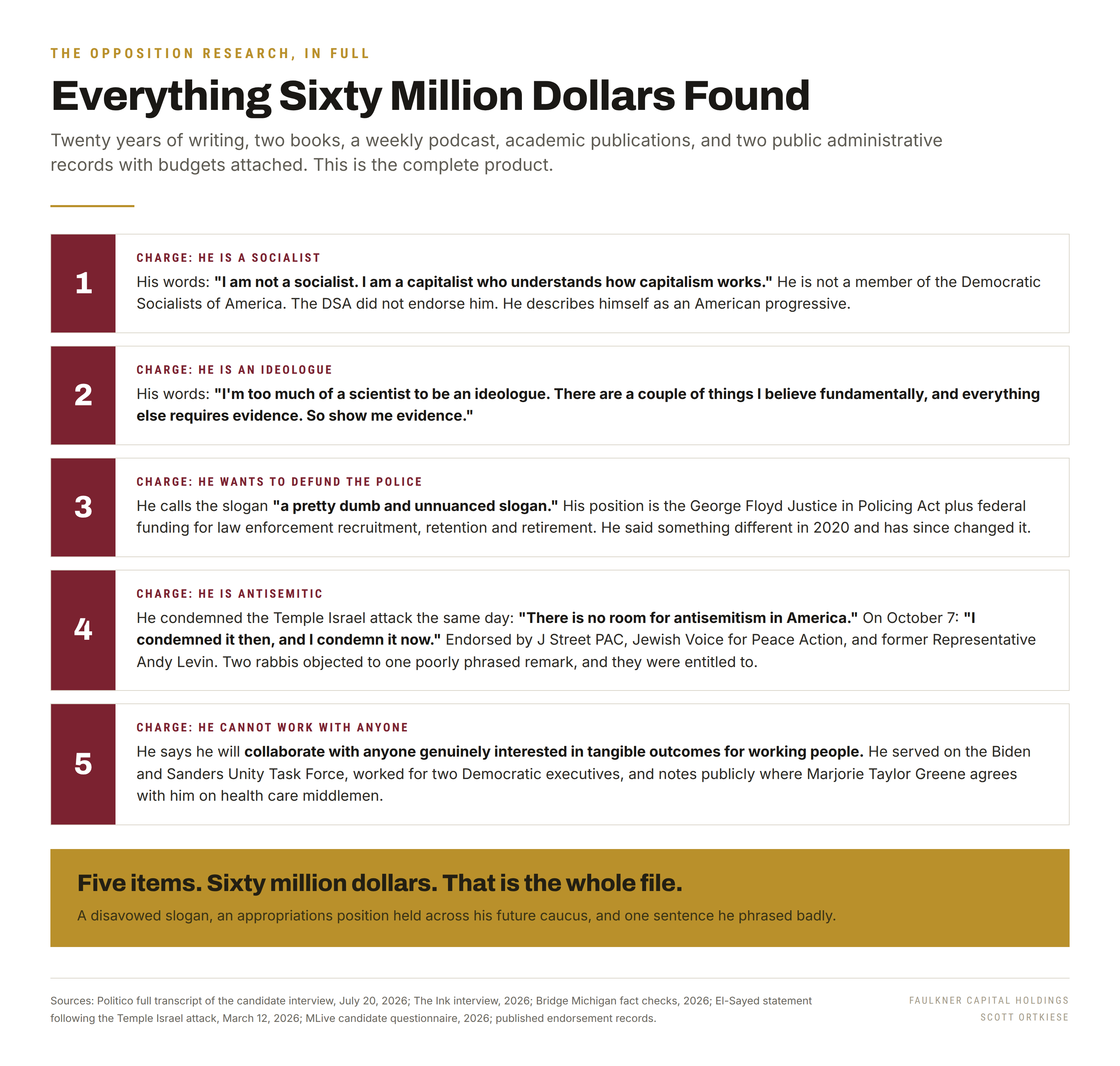
Now to the accusation itself, because the general election will consist largely of it.
He is not a socialist, and he has never claimed to be. His formulation: “I am not a socialist. I am a capitalist who understands how capitalism works.” Elsewhere he sharpened it: “I’d rather think of myself as a capitalist who’s actually read about capitalism,” and then pointed out that Adam Smith’s actual worry was monopoly.46 He is not a member of the Democratic Socialists of America. The DSA did not endorse him. He describes himself as an American progressive. You can disagree with the anti-monopoly framework, but you cannot honestly relabel it.
He is not an ideologue, by training or temperament. “Anybody who knows me knows I’m not an ideologue. I’m too much of a scientist to be an ideologue. There are a couple of things I believe fundamentally, and everything else requires evidence. So show me evidence.”47 I have read a great deal of campaign rhetoric and that is an unusual sentence to find in it.
He rejected the defund slogan. He has called “defund the police” “a pretty dumb and unnuanced slogan.” His actual position is passage of the George Floyd Justice in Policing Act combined with federal funding for law enforcement recruitment, retention and retirement benefits.48 Here too I will not overstate on his behalf: when he claimed during the primary that he had never called for defunding, Bridge Michigan found statements from 2020 that complicate the denial.49 The honest version is that he said something in the summer of 2020 that he has since concluded was wrong, and now funds police. That is a person updating on evidence, which is what he said he does.
On antisemitism, the record is unambiguous and it is documented. When Temple Israel was attacked on March 12, 2026, he condemned it the same day: “There is no room for antisemitism in America.” He followed it with: “There is never a justification for attacking innocent people or houses of worship. Never.”50 He has said of October 7: “I condemned it then, and I condemn it now.”51 After the primary he put it in the terms available to him: “My commitment to Jewish safety is the same commitment that I have to the safety of my own daughters.”52
He has also given his critics something to work with, and I am not going to pretend otherwise. His observation that “hurt people do hurt people” was heard by Rabbi Jen Lader of Temple Israel and Rabbi Aaron Starr as contextualizing an attack on a synagogue, and they said so forcefully.53 I think they were entitled to hear it that way and I think he should have said it differently. What follows from that is a question of judgment about a sentence, not a conclusion about a man. And the countervailing testimony is substantial: former Representative Andy Levin, who is Jewish and whose family has been in Michigan Democratic politics for three generations, endorsed him. J Street’s political action committee endorsed him. Jewish Voice for Peace Action endorsed him. A group of Michigan Jews organized as Jews for Abdul specifically to answer the charge.54 Thirty million dollars was spent telling Michigan Jewish voters that this man is a threat to them, and a meaningful number of them campaigned for him anyway.
He works with people who disagree with him. Asked in an MLive questionnaire about bipartisanship, he answered that he is “willing to collaborate with anyone genuinely interested in achieving tangible outcomes for working individuals.”55 In his victory speech he addressed Trump voters directly. He has noted publicly, without embarrassment, that Marjorie Taylor Greene agrees with parts of his agenda on health care middlemen and corporate consolidation. That is not the conduct of a militant. That is the conduct of someone who intends to pass something.
And he served in two appointed administrative jobs under two Democratic executives, one of them a mayor who ran against the left, and delivered budgets, vending machines, eyeglasses, air monitors and wage increases. Militants do not take civil service jobs and fix animal control.
The man he is running against
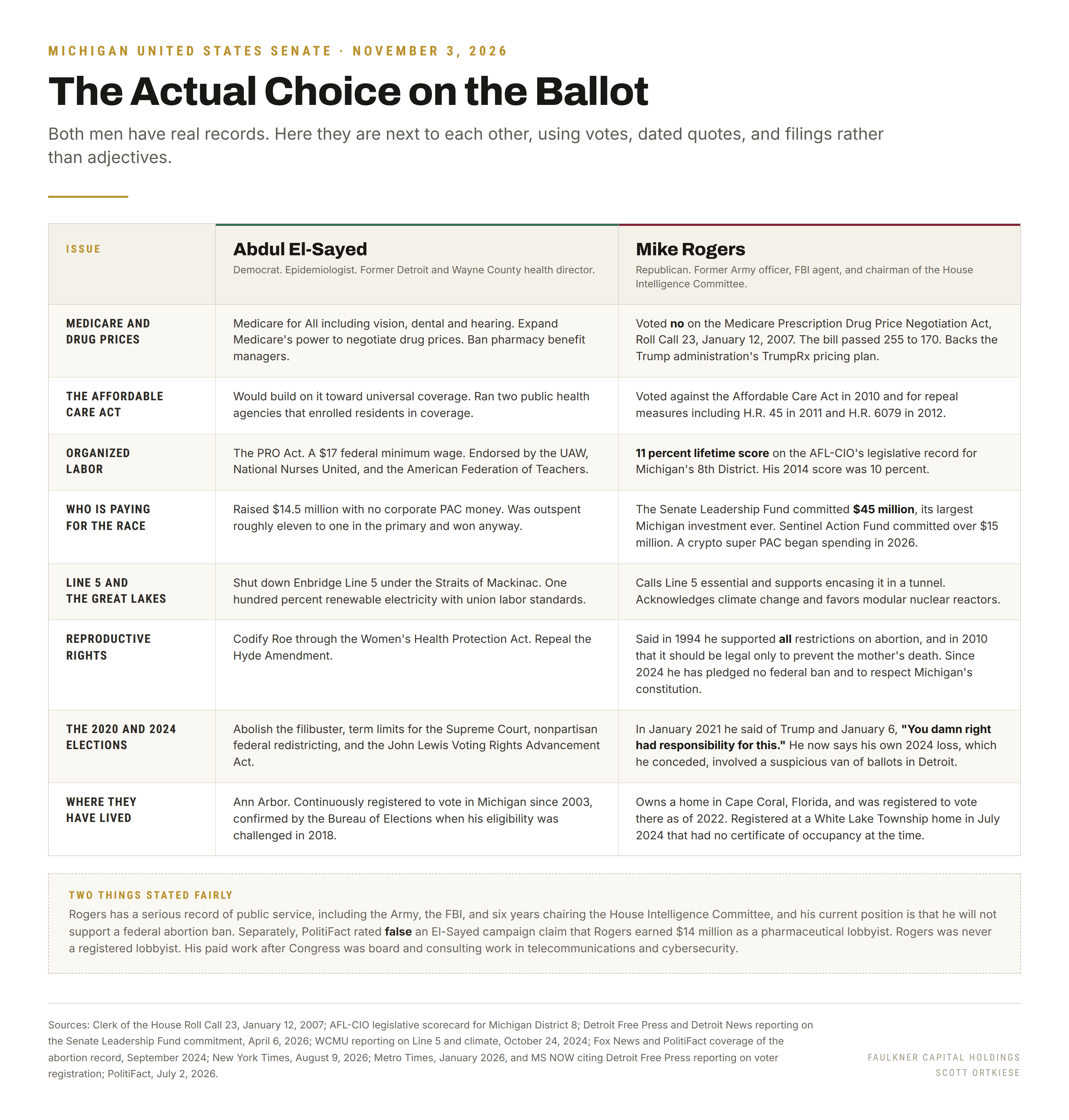
Michigan does not get to choose between Abdul El-Sayed and an abstraction. On November 3 it chooses between El-Sayed and Mike Rogers, and I want to state Rogers’s record accurately, including the parts that are creditable, because the case for El-Sayed does not require anyone to lie about his opponent.
Rogers is not a lightweight. He served in the Army, worked as an FBI special agent in Chicago, sat in the Michigan Senate, represented Michigan’s 8th District in Congress from 2001 to 2015, and chaired the House Permanent Select Committee on Intelligence for his final six years.56 That is a real career. He also has never been a registered lobbyist. When El-Sayed’s campaign claimed during the primary that Rogers had earned $14 million as a pharmaceutical lobbyist, PolitiFact rated the claim false, and it was false.57 Rogers’s post-congressional income came from board seats at MITRE and IronNet Cybersecurity, consulting work for AT&T, Nokia and Telefónica, and paid commentary at CNN. I am not going to repeat a fact-checked falsehood in order to help a candidate I would rather see win. The actual record is damaging enough without embellishment, and embellishment is how you lose an argument you should win.
So here is the actual record.
On January 12, 2007, the House passed the Medicare Prescription Drug Price Negotiation Act, which would have required the Secretary of Health and Human Services to negotiate drug prices for the Medicare Part D program. It passed 255 to 170. The House Clerk’s roll call for that vote records Rogers of Michigan voting no.58 Nineteen years later, prescription drug costs are the single issue El-Sayed has campaigned on most consistently, and the man opposing him voted against the government’s power to bargain over them when he had the chance to cast that vote.
Rogers voted against the Affordable Care Act in 2010 and for repeal measures in the years after, including H.R. 45 in 2011 and H.R. 6079 in 2012.59 His current health care position is support for TrumpRx, the Trump administration’s drug pricing plan, which he described at a Marquette campaign stop in June 2026.60
On labor, the numbers are not close. The AFL-CIO’s legislative scorecard gives Rogers a lifetime rating of 11 percent across his House career representing Michigan’s 8th District, and a 10 percent rating for 2014, his final year.61 El-Sayed supports the Protecting the Right to Organize Act and a $17 federal minimum wage, and he is endorsed by the United Auto Workers, National Nurses United and the American Federation of Teachers.62 In a state where the labor movement built the middle class, an 11 percent lifetime score is not a nuance. It is the record.
On abortion, I am going to be precise, because imprecision here has already been penalized. In 1994 Rogers said, “I support all restrictions on abortions.” In 2010 his stated position was that abortion should be legal only to prevent the death of the mother. Since 2024 he has said repeatedly that he would not support a federal ban and that he will respect the vote of the people of Michigan, who wrote reproductive rights into the state constitution in 2022.63 When Elissa Slotkin’s 2024 campaign ran an ad that presented the old positions as his current one, PolitiFact rated it mostly false.64 The fair statement is that Rogers held a near total anti-abortion position for most of his public career and has publicly abandoned the federal ban since. Voters can weigh a conversion. They are entitled to know it is a conversion.
Then there is the matter of elections, which I think is the most serious thing in his file, because it is the one that changed most recently and the one he cannot attribute to a shifting consensus.
In January 2021, after the Capitol was stormed, Rogers said of Donald Trump, “You damn right had responsibility for this,” and dismissed the 2020 fraud claims as “conspiracy and hearsay.”65 He was right, and saying so cost him something in his own party. Then he ran for Senate in 2024 and lost to Slotkin by 19,006 votes, and he conceded. And then, over the following two years, he began describing that loss as suspicious, telling audiences about a van in Detroit and a “voter fraud scheme right here in Michigan.”66 At a Milford rally on July 27, 2026, Trump told the crowd, “They rigged the election on you,” and Rogers did not correct him.67
I want to be careful about what that does and does not prove. It does not prove Rogers believes it. It proves the opposite of something more important: that a man who in 2021 was capable of telling his own party an unwelcome truth about an election is, in 2026, no longer willing to. The question a Senate seat asks is what someone does under pressure from his own side. Rogers has now answered it twice, and the second answer contradicts the first.
Finally, residency, which is small but real. Rogers owns a home in Cape Coral, Florida, and was registered to vote there as of 2022. On July 2, 2024, he registered at a home in White Lake Township, Michigan, which had not yet received a certificate of occupancy.68 El-Sayed has been continuously registered to vote in Michigan since 2003, a fact confirmed by the Bureau of Elections in 2018 when a challenge to his gubernatorial eligibility was filed and resolved in his favor.69
That is the choice. Not a militant against a statesman. A public health administrator with two doctorates and a documented record of running agencies, against a career intelligence Republican with an 11 percent labor score who voted against Medicare drug negotiation and who has stopped saying out loud the thing he knew was true in 2021.
Round two, and who is paying for it
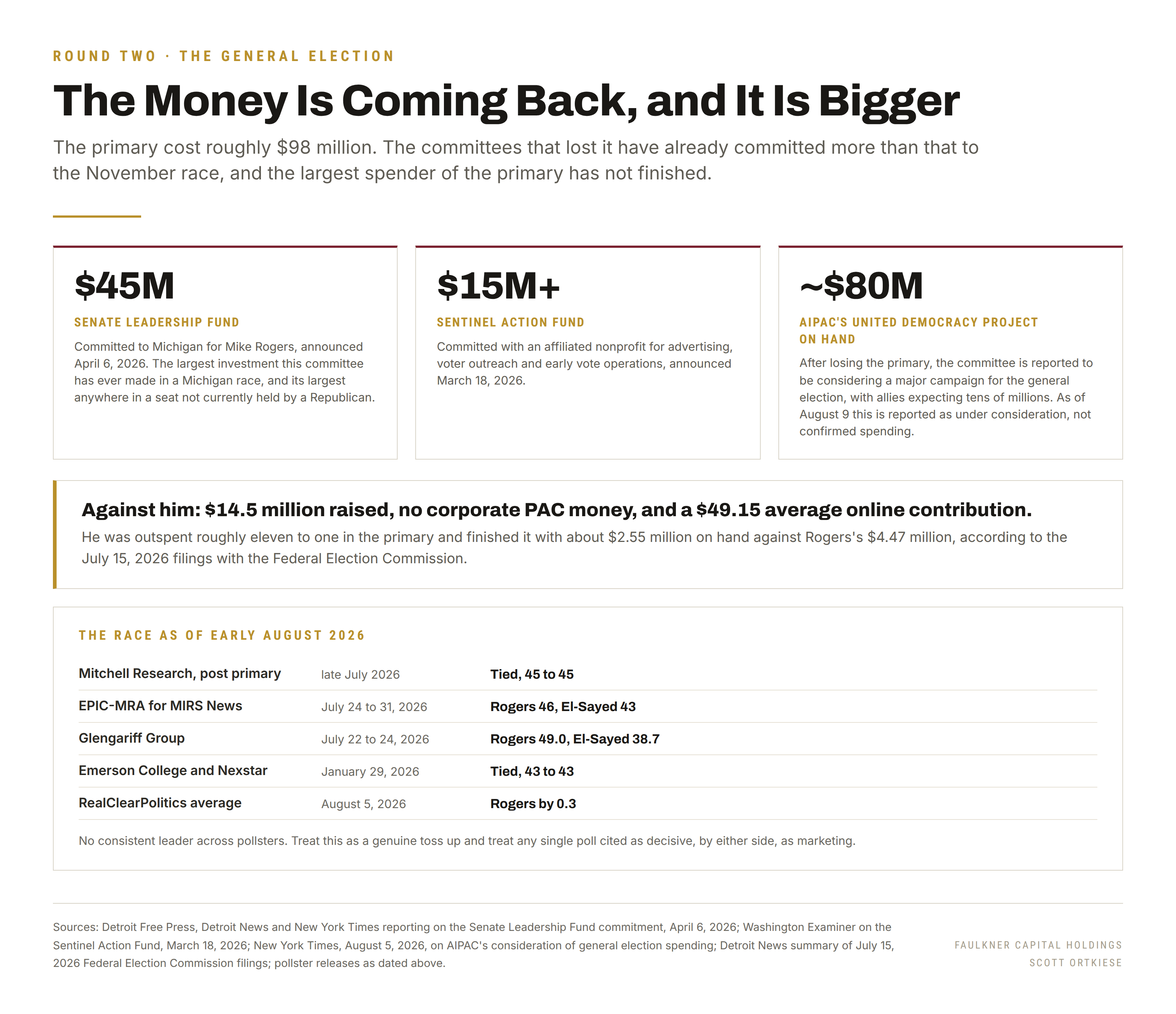
The primary was the most expensive Democratic Senate primary ever run. The general election will be larger, and the commitments are already public.
The Senate Leadership Fund committed $45 million to Michigan for Rogers on April 6, 2026, the largest investment that committee has made in a Michigan race and its largest anywhere in a seat not currently held by a Republican.70 The Sentinel Action Fund, with an affiliated nonprofit, committed more than $15 million in March 2026 for advertising, voter outreach and early vote operations.71 A crypto industry super PAC began spending in the race in 2026.72 And the United Democracy Project, having lost the primary, is reported to be sitting on roughly $80 million and weighing a general election campaign in Michigan, with allies expecting tens of millions. As of this writing that is reported as under consideration, not as confirmed spending, and I am flagging it as such.73
Against that, El-Sayed raised $14,528,335 for the cycle, spent $11,975,573 of it winning the primary, and reported $2,552,762 on hand as of the July 15, 2026 filings. Rogers raised $10,898,177, spent $6,680,643, and reported $4,473,237.74 Rogers’s own campaign reports 28,416 donors and an average contribution of $28.72, and I will note that plainly rather than pretend the small dollar argument runs entirely one way.75 What does run one way is the outside money, and it is not close.
The polling says none of this is settled. Mitchell Research had the race tied at 45 after the primary. EPIC-MRA had Rogers up 46 to 43 from July 24 to 31. Glengariff had Rogers up 49.0 to 38.7 from July 22 to 24. Emerson College and Nexstar had it tied at 43 in January. The RealClearPolitics average on August 5 had Rogers ahead by 0.3.76 There is no consistent leader. Anyone citing one of those numbers as decisive is selling something.
What Washington gets
The word for El-Sayed’s actual profile is not radical. It is unusual. He is a Michigan public school kid with an Oxford doctorate and a Columbia medical degree who chose administration over income, ran two health agencies in the two hardest jurisdictions in his state, lost a statewide race, went back to work rather than to K Street, and then beat the largest single-race outside spending campaign in the history of an organization that specializes in winning them.
He will be, if he wins in November, the first Muslim American in the United States Senate.77 That fact will be the lead in every profile written about him and it is the least interesting true thing about him.
The race against Mike Rogers is a genuine toss-up, and the polling summarized above says so.78 Nobody should cite a single survey here as if it settled anything.
What I will say is this. The people who spent sixty million dollars calling him dangerous had every incentive to produce evidence of it and every resource required to find it. What they produced instead was a slogan he had already disavowed, a foreign aid position held by a large share of his future caucus, and a sentence about hurt people that he phrased badly. That is the whole file. If that is the worst that $60 million can assemble about a man who has been in public life since he was thirty, the answer to the question in the title is that nobody serious is afraid of him.
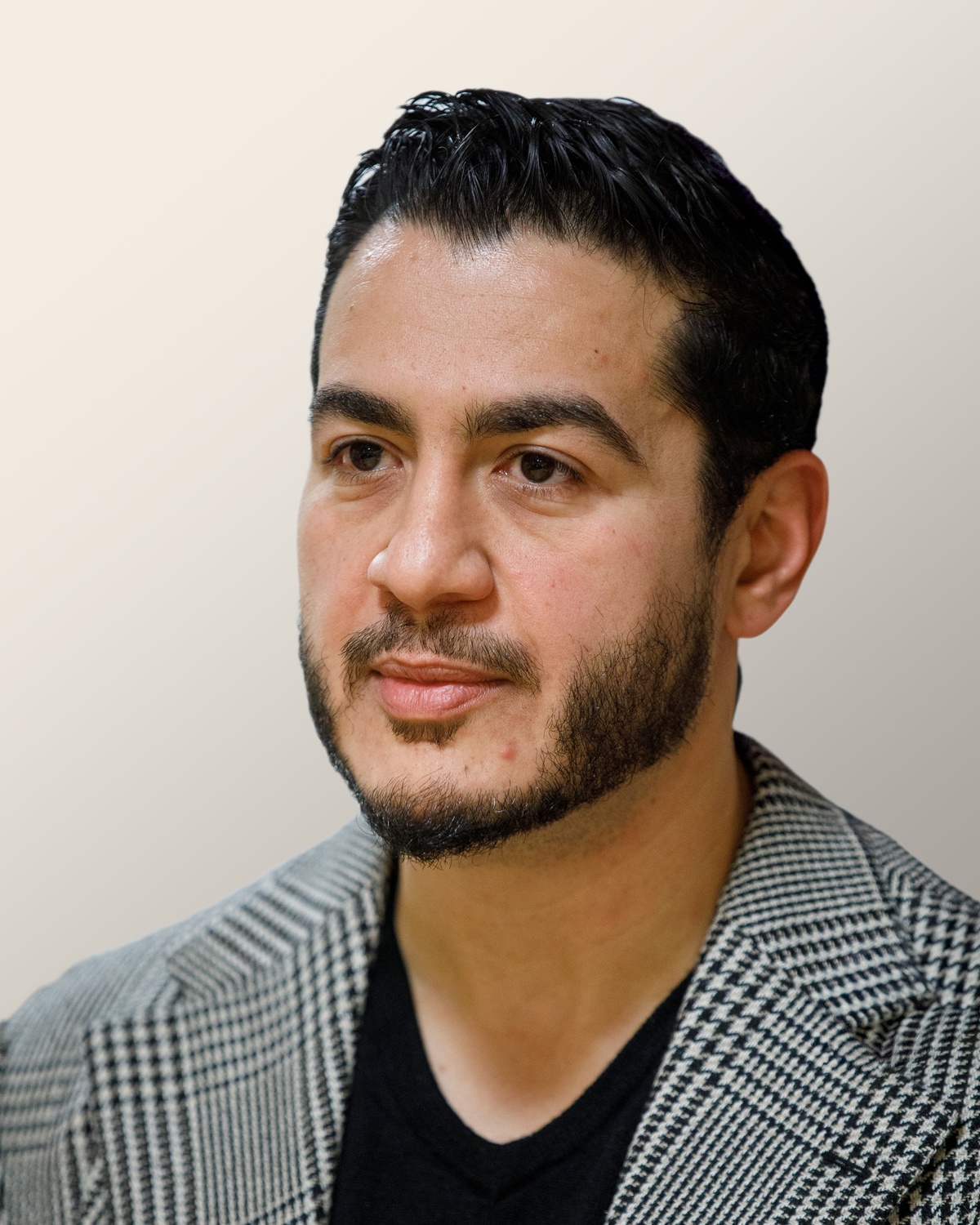
The people who bought the ads are afraid of what he will not do for them. That is a different thing entirely, and Michigan already figured it out.
Notes
- Associated Press, “Abdul El-Sayed wins Michigan Democratic Senate primary,” August 5, 2026, https://apnews.com/article/michigan-primary-senate-elsayed-stevens-60c79349b60ffbf24a34d60b76e130ed. ↩
- Washington Post, “Michigan Senate primary election results,” August 4, 2026, https://www.washingtonpost.com/elections/2026/08/04/michigan-senate-primary-election-live-results-2026-abdul-el-sayed-faces-haley-stevens/. ↩
- AdImpact spending totals as reported in Reuters, “Progressive El-Sayed wins Michigan primary in jolt to Democrats,” August 5, 2026, https://www.reuters.com/world/us/progressive-el-sayed-wins-michigan-primary-jolt-democrats-us-media-project-2026-08-05/. ↩
- Ibid.; see also NPR, “El-Sayed defeats Stevens in Michigan Senate primary,” August 5, 2026, https://www.npr.org/2026/08/05/nx-s1-5920403/michigan-senate-el-sayed-stevens-democrats. ↩
- Campaign fundraising figures reported in NPR, ibid., and Reuters, ibid. ↩
- Biographical detail as recounted in Abdul El-Sayed, Healing Politics: A Doctor’s Journey into the Heart of Our Political Epidemic (New York: Abrams Press, 2020). ↩
- Ibid. ↩
- Ibid. ↩
- Ibid.; campaign biography, Abdul for Senate, https://abdulforsenate.com. ↩
- University of Michigan spring commencement, 2007; see Healing Politics, ibid. ↩
- Rhodes Trust scholar record, 2009; Oriel College, University of Oxford, DPhil in public health, 2011. ↩
- Columbia University Vagelos College of Physicians and Surgeons, MD, 2014; Paul and Daisy Soros Fellowships for New Americans, fellow profile, https://www.pdsoros.org/meet-the-fellows/abdul-el-sayed. ↩
- Politico, “Abdul El-Sayed calls himself a doctor. He has never practiced medicine,” May 12, 2026, https://www.politico.com/news/2026/05/12/abdul-el-sayed-doctor-physician-00916389. ↩
- Ibid. ↩
- Columbia University Mailman School of Public Health, faculty appointment, 2014. ↩
- Abdul M. El-Sayed and Sandro Galea, eds., Systems Science and Population Health (New York: Oxford University Press, 2017). ↩
- City of Detroit, appointment of health officer, August 2015. ↩
- Departmental staffing and budget at the time of appointment, as documented in Healing Politics, ibid. ↩
- Ibid. ↩
- Detroit Health Department lead testing initiative, 2016. ↩
- Vision to Learn Detroit program launch, 2016, https://visiontolearn.org. ↩
- Detroit Health Department, SisterFriends Detroit, 2016. ↩
- Abdul El-Sayed, “Marathon refinery expansion puts Detroit kids at risk,” Detroit Free Press, January 6, 2016, https://www.freep.com/story/opinion/contributors/2016/01/06/marathon-refinery-detroit/78350138/. ↩
- Michigan Bureau of Elections determination on candidate eligibility, 2018; 2018 Michigan Democratic gubernatorial primary certified results, Michigan Secretary of State. ↩
- Biden-Sanders Unity Task Force membership roster, 2020. ↩
- Abdul El-Sayed and Micah Johnson, Medicare for All: A Citizen’s Guide (New York: Oxford University Press, 2021). ↩
- Wayne County, Michigan, Department of Health, Human and Veterans Services, director appointment announcement, March 2023. ↩
- Wayne County DHHVS program records, 2023 to 2025; Rx Kids expansion announcement, Michigan State University College of Human Medicine. ↩
- Bridge Michigan, “Fact check: Abdul El-Sayed overstates claim he erased $700M in medical debt,” 2026, https://bridgemi.com/michigan-government/fact-check-abdul-el-sayed-overstates-claim-he-erased-700m-in-medical-debt/. ↩
- Detroit News, “El-Sayed overstates claim he rebuilt troubled Wayne County juvenile jail,” July 14, 2026, https://www.detroitnews.com/story/news/politics/2026/07/14/el-sayed-overstates-claim-rebuilt-troubled-wayne-county-juvenile-jail/90822568007/. ↩
- Abdul for Senate, health care platform, https://abdulforsenate.com; see also Medicare for All: A Citizen’s Guide, ibid. ↩
- Abdul for Senate, “Break Up Big Medicine,” https://abdulforsenate.com. ↩
- Abdul for Senate, economy and labor platform, https://abdulforsenate.com. ↩
- Ibid.; see also Politico, “Full transcript: Michigan Democratic Senate candidate Abdul El-Sayed,” July 20, 2026, https://www.politico.com/blogs/politico-press/2026/07/20/full-transcript-michigan-democratic-senate-candidate-abdul-el-sayed-01004833. ↩
- Abdul for Senate, housing platform, https://abdulforsenate.com. ↩
- Abdul for Senate, democracy platform, https://abdulforsenate.com. ↩
- Ibid.; Politico full transcript, ibid. ↩
- Abdul for Senate, climate and water platform, https://abdulforsenate.com. ↩
- Abdul for Senate, reproductive rights platform, https://abdulforsenate.com. ↩
- Abdul for Senate, democracy platform, https://abdulforsenate.com. ↩
- Abdul for Senate, education platform, https://abdulforsenate.com. ↩
- Abdul for Senate, veterans platform, https://abdulforsenate.com. ↩
- Abdul for Senate, technology and artificial intelligence platform, https://abdulforsenate.com. ↩
- Politico full transcript, ibid. ↩
- Abdul for Senate, foreign policy platform, https://abdulforsenate.com; Politico full transcript, ibid. ↩
- Politico full transcript, ibid. ↩
- The Ink, “Abdul El-Sayed makes his case,” 2026, https://the.ink/p/interview-abdul-el-sayed-makes-his. ↩
- Ibid.; Abdul for Senate, public safety platform, https://abdulforsenate.com. ↩
- Bridge Michigan fact check on defunding statements, 2026, https://bridgemi.com. ↩
- Statement of Abdul El-Sayed following the attack on Temple Israel, March 12, 2026. ↩
- Politico full transcript, ibid. ↩
- Post-primary remarks, August 5, 2026, as reported by NPR, ibid. ↩
- Statements of Rabbi Jen Lader, Temple Israel, and Rabbi Aaron Starr, as reported in Michigan press coverage, March 2026. ↩
- Endorsement records: J Street PAC; Jewish Voice for Peace Action; former Representative Andy Levin; Jews for Abdul. ↩
- MLive Senate candidate questionnaire, 2026, https://www.mlive.com. ↩
- Aspen Institute biography of Mike Rogers, https://www.aspeninstitute.org/people/mike-rogers/; Rogers for Senate campaign biography, https://rogersforsenate.com/meet-mike. ↩
- PolitiFact, “Mike Rogers was not a $14 million pharma lobbyist,” July 2, 2026, https://api.politifact.com/factchecks/2026/jul/02/abdul-el-sayed/mike-rogers-14-million-pharma-lobbyist-michigan/. ↩
- Office of the Clerk, United States House of Representatives, Roll Call 23, 110th Congress, 1st Session, January 12, 2007, https://clerk.house.gov/Votes/200723. ↩
- Health Reform Votes, congressional voting record for Mike Rogers of Michigan, https://www.healthreformvotes.org/congress/400342, recording his vote against H.R. 3590 in 2010 and for repeal measures including H.R. 45 in 2011 and H.R. 6079 in 2012. ↩
- Mining Journal, “Senatorial candidate Mike Rogers visits Marquette,” June 24, 2026, https://www.miningjournal.net/news/front-page-news/2026/06/senatorial-candidate-mike-rogers-visits-marquette/. ↩
- AFL-CIO Legislative Scorecard, member record for Mike Rogers, Michigan District 8, https://aflcio.org/scorecard/legislators/mike-rogers-0. ↩
- Abdul El-Sayed for Senate, issues platform, https://abdulforsenate.com; endorsement announcements of UAW Region 1, National Nurses United and the American Federation of Teachers, 2026. ↩
- Fox News, “Rogers addresses abortion as Slotkin attacks,” September 2024, https://www.foxnews.com/politics/rogers-addresses-abortion-slotkin-attacks-michigan-voters-already-decided. ↩
- PolitiFact, “US Rep. Elissa Slotkin ad skews opponent Mike Rogers’ abortion record,” September 30, 2024, https://www.politifact.com/factchecks/2024/sep/30/elissa-slotkin/us-rep-elissa-slotkin-ad-skews-opponent-mike-roger/. ↩
- Contemporaneous Rogers remarks, January 2021, as reported in Michigan and national coverage and revisited in The New York Times, August 9, 2026, https://www.nytimes.com/2026/08/09/us/politics/mike-rogers-michigan-senate-elections.html. ↩
- The New York Times, August 9, 2026, ibid.; Yahoo News, “Mike Rogers claims he lost 2024 race amid fraud,” https://www.yahoo.com/news/articles/mike-rogers-claims-lost-2024-185838453.html. ↩
- Remarks of Donald Trump, Milford, Michigan rally, July 27, 2026, as reported in The New York Times, August 9, 2026, ibid. ↩
- MS NOW, “Key GOP Senate candidate faces new carpetbagger accusations,” https://www.ms.now/rachel-maddow-show/maddowblog/key-gop-senate-candidate-faces-new-carpetbagger-accusations-rcna174318; Metro Times, “Michigan Senate candidate Mike Rogers campaigns from Florida as carpetbagger questions return,” January 2026, https://www.metrotimes.com/news/politics-elections/michigan-senate-candidate-mike-rogers-campaigns-from-florida-as-carpetbagger-questions-return/. ↩
- Michigan Bureau of Elections determination on the 2018 gubernatorial eligibility challenge to Abdul El-Sayed, and Michigan qualified voter file registration history. ↩
- Detroit Free Press, “Senate Leadership Fund commits $45 million to Michigan for Mike Rogers,” April 6, 2026, https://www.freep.com/story/news/politics/elections/2026/04/06/mike-rogers-senate-campaign-funding-michigan/89486573007/. ↩
- Washington Examiner, “Mike Rogers wins Sentinel Action Fund endorsement,” March 18, 2026, https://www.washingtonexaminer.com/news/campaigns/congressional/4494797/mike-rogers-sentinel-action-fund-endorsement/. ↩
- Federal Election Commission filings of First Principles Digital, 2026 cycle, https://www.fec.gov. ↩
- The New York Times, “AIPAC weighs a major campaign in the Michigan general election,” August 5, 2026, https://www.nytimes.com/2026/08/05/us/politics/aipac-michigan-general-election.html. ↩
- Detroit News, “El-Sayed leads Michigan Senate field in fundraising,” July 16, 2026, https://www.detroitnews.com/story/news/politics/2026/07/15/abdul-el-sayed-haley-stevens-mike-rogers-michigan-senate-race-fundraising/90933599007/, summarizing filings covering the period ending June 30, 2026. ↩
- Rogers for Senate, “Rogers reports strongest quarter yet,” July 15, 2026, https://rogersforsenate.com/news/rogers-reports-strongest-quarter-yet. ↩
- Mitchell Research and Communications post-primary survey, late July 2026; EPIC-MRA survey for MIRS News, July 24 to 31, 2026; Glengariff Group survey, July 22 to 24, 2026; Emerson College Polling and Nexstar, January 29, 2026, https://emersoncollegepolling.com/michigan-2026-poll-crowded-democratic-senate-primary-remains-wide-open/; RealClearPolitics polling average, August 5, 2026, https://www.realclearpolling.com. ↩
- NPR, ibid. ↩
- Cook Political Report Senate race ratings, 2026, https://www.cookpolitical.com; Glengariff Group and Mitchell Research public surveys, 2026. — ↩
Bibliography
AFL-CIO. “Legislative Scorecard: Mike Rogers, Michigan District 8.” https://aflcio.org/scorecard/legislators/mike-rogers-0.
Aspen Institute. “Mike Rogers.” https://www.aspeninstitute.org/people/mike-rogers/.
Associated Press. “Abdul El-Sayed Wins Michigan Democratic Senate Primary.” August 5, 2026. https://apnews.com/article/michigan-primary-senate-elsayed-stevens-60c79349b60ffbf24a34d60b76e130ed.
Bridge Michigan. “Fact Check: Abdul El-Sayed Overstates Claim He Erased $700M in Medical Debt.” 2026. https://bridgemi.com/michigan-government/fact-check-abdul-el-sayed-overstates-claim-he-erased-700m-in-medical-debt/.
Cook Political Report. “2026 Senate Race Ratings.” 2026. https://www.cookpolitical.com.
Detroit Free Press. “Senate Leadership Fund Commits $45 Million to Michigan for Mike Rogers.” April 6, 2026. https://www.freep.com/story/news/politics/elections/2026/04/06/mike-rogers-senate-campaign-funding-michigan/89486573007/.
Detroit News. “El-Sayed Leads Michigan Senate Field in Fundraising.” July 16, 2026. https://www.detroitnews.com/story/news/politics/2026/07/15/abdul-el-sayed-haley-stevens-mike-rogers-michigan-senate-race-fundraising/90933599007/.
Detroit News. “El-Sayed Overstates Claim He Rebuilt Troubled Wayne County Juvenile Jail.” July 14, 2026. https://www.detroitnews.com/story/news/politics/2026/07/14/el-sayed-overstates-claim-rebuilt-troubled-wayne-county-juvenile-jail/90822568007/.
El-Sayed, Abdul, and Micah Johnson. Medicare for All: A Citizen’s Guide. New York: Oxford University Press, 2021.
El-Sayed, Abdul. Healing Politics: A Doctor’s Journey into the Heart of Our Political Epidemic. New York: Abrams Press, 2020.
El-Sayed, Abdul M., and Sandro Galea, eds. Systems Science and Population Health. New York: Oxford University Press, 2017.
El-Sayed, Abdul. “Marathon Refinery Expansion Puts Detroit Kids at Risk.” Detroit Free Press, January 6, 2016. https://www.freep.com/story/opinion/contributors/2016/01/06/marathon-refinery-detroit/78350138/.
Emerson College Polling. “Michigan 2026 Poll: Crowded Democratic Senate Primary Remains Wide Open.” January 29, 2026. https://emersoncollegepolling.com/michigan-2026-poll-crowded-democratic-senate-primary-remains-wide-open/.
Fox News. “Rogers Addresses Abortion as Slotkin Attacks: Michigan Voters Already Decided.” September 2024. https://www.foxnews.com/politics/rogers-addresses-abortion-slotkin-attacks-michigan-voters-already-decided.
Health Reform Votes. “Congressional Voting Record: Mike Rogers, Michigan.” https://www.healthreformvotes.org/congress/400342.
Metro Times. “Michigan Senate Candidate Mike Rogers Campaigns from Florida as Carpetbagger Questions Return.” January 2026. https://www.metrotimes.com/news/politics-elections/michigan-senate-candidate-mike-rogers-campaigns-from-florida-as-carpetbagger-questions-return/.
Mining Journal. “Senatorial Candidate Mike Rogers Visits Marquette.” June 24, 2026. https://www.miningjournal.net/news/front-page-news/2026/06/senatorial-candidate-mike-rogers-visits-marquette/.
MLive. “2026 Michigan Senate Candidate Questionnaire.” 2026. https://www.mlive.com.
MS NOW. “Key GOP Senate Candidate Faces New Carpetbagger Accusations.” https://www.ms.now/rachel-maddow-show/maddowblog/key-gop-senate-candidate-faces-new-carpetbagger-accusations-rcna174318.
New York Times. “AIPAC Weighs a Major Campaign in the Michigan General Election.” August 5, 2026. https://www.nytimes.com/2026/08/05/us/politics/aipac-michigan-general-election.html.
New York Times. “Mike Rogers, Who Once Blamed Trump for January 6, Now Questions His Own Defeat.” August 9, 2026. https://www.nytimes.com/2026/08/09/us/politics/mike-rogers-michigan-senate-elections.html.
NPR. “El-Sayed Defeats Stevens in Michigan Senate Primary.” August 5, 2026. https://www.npr.org/2026/08/05/nx-s1-5920403/michigan-senate-el-sayed-stevens-democrats.
Office of the Clerk, United States House of Representatives. “Roll Call 23, 110th Congress, 1st Session.” January 12, 2007. https://clerk.house.gov/Votes/200723.
Paul and Daisy Soros Fellowships for New Americans. “Abdul El-Sayed, 2011 Fellow.” https://www.pdsoros.org/meet-the-fellows/abdul-el-sayed.
Politico. “Abdul El-Sayed Calls Himself a Doctor. He Has Never Practiced Medicine.” May 12, 2026. https://www.politico.com/news/2026/05/12/abdul-el-sayed-doctor-physician-00916389.
Politico. “Full Transcript: Michigan Democratic Senate Candidate Abdul El-Sayed.” July 20, 2026. https://www.politico.com/blogs/politico-press/2026/07/20/full-transcript-michigan-democratic-senate-candidate-abdul-el-sayed-01004833.
PolitiFact. “Mike Rogers Was Not a $14 Million Pharma Lobbyist.” July 2, 2026. https://api.politifact.com/factchecks/2026/jul/02/abdul-el-sayed/mike-rogers-14-million-pharma-lobbyist-michigan/.
PolitiFact. “US Rep. Elissa Slotkin Ad Skews Opponent Mike Rogers’ Abortion Record.” September 30, 2024. https://www.politifact.com/factchecks/2024/sep/30/elissa-slotkin/us-rep-elissa-slotkin-ad-skews-opponent-mike-roger/.
Reuters. “Progressive El-Sayed Wins Michigan Primary in Jolt to Democrats.” August 5, 2026. https://www.reuters.com/world/us/progressive-el-sayed-wins-michigan-primary-jolt-democrats-us-media-project-2026-08-05/.
Rogers for Senate. “Meet Mike.” https://rogersforsenate.com/meet-mike.
Rogers for Senate. “Rogers Reports Strongest Quarter Yet.” July 15, 2026. https://rogersforsenate.com/news/rogers-reports-strongest-quarter-yet.
The Ink. “Abdul El-Sayed Makes His Case.” 2026. https://the.ink/p/interview-abdul-el-sayed-makes-his.
Washington Examiner. “Mike Rogers Wins Sentinel Action Fund Endorsement.” March 18, 2026. https://www.washingtonexaminer.com/news/campaigns/congressional/4494797/mike-rogers-sentinel-action-fund-endorsement/.
Washington Post. “Michigan Senate Primary Election Results.” August 4, 2026. https://www.washingtonpost.com/elections/2026/08/04/michigan-senate-primary-election-live-results-2026-abdul-el-sayed-faces-haley-stevens/.
Corrections and source files: so@throughlinesynthesis.com