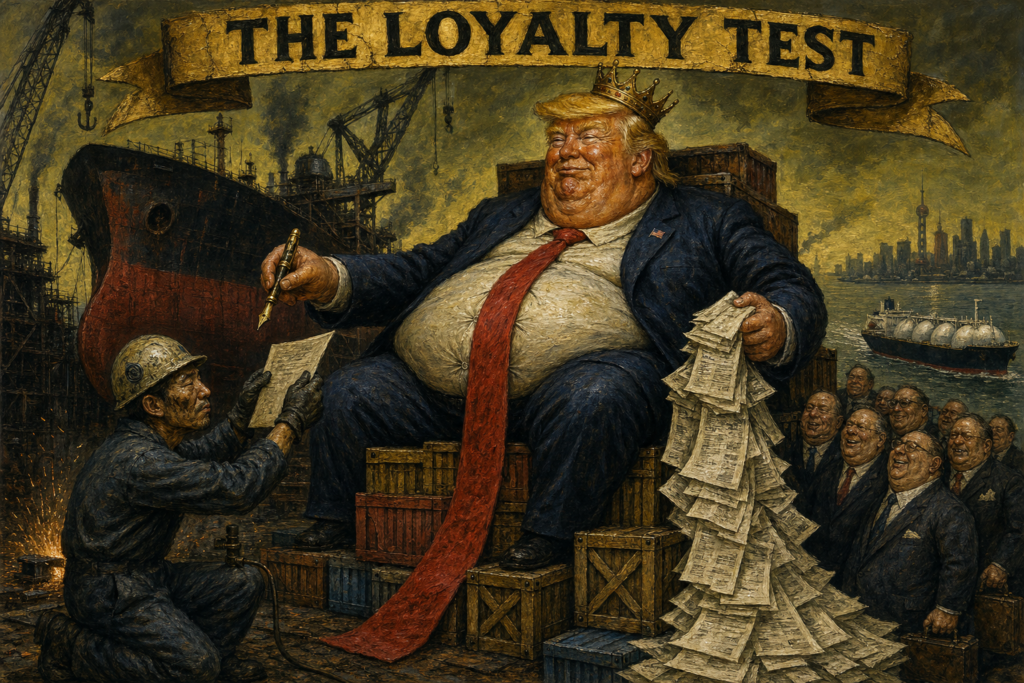
Part 1 of 5. Six icebreaking tankers sit finished and unpaid at Geoje while the cargo they were built to carry moves to China on other hulls. Russian gas production never stopped, so the only thing the sanction still measures is whether an ally will eat a billion dollar loss to prove it obeys Washington. Hanwha Ocean obeyed. It is now being sued for a billion dollars by the sanctioned company, which is separately negotiating to buy the same ships cheap. The Supreme Court ruled in February that Donald Trump never had the power to impose the tariffs running alongside all of this. He rebuilt them in four days under other statutes.
This is the first of five installments. Part 1 sets out the instrument: how a secondary sanction actually reaches a company in a third country, who wrote the policy and who directed them, what the Supreme Court did to it, and what the same instrument is now doing to the Republicans who have to stand for election in November. Part 2 prices what it cost American households. Part 3 goes to the capitals that walked. Part 4 follows the money to the people who were not taxed. Part 5 takes the Iran war from the order on February 28 to the interest rate on an American mortgage.
I. The exhibit
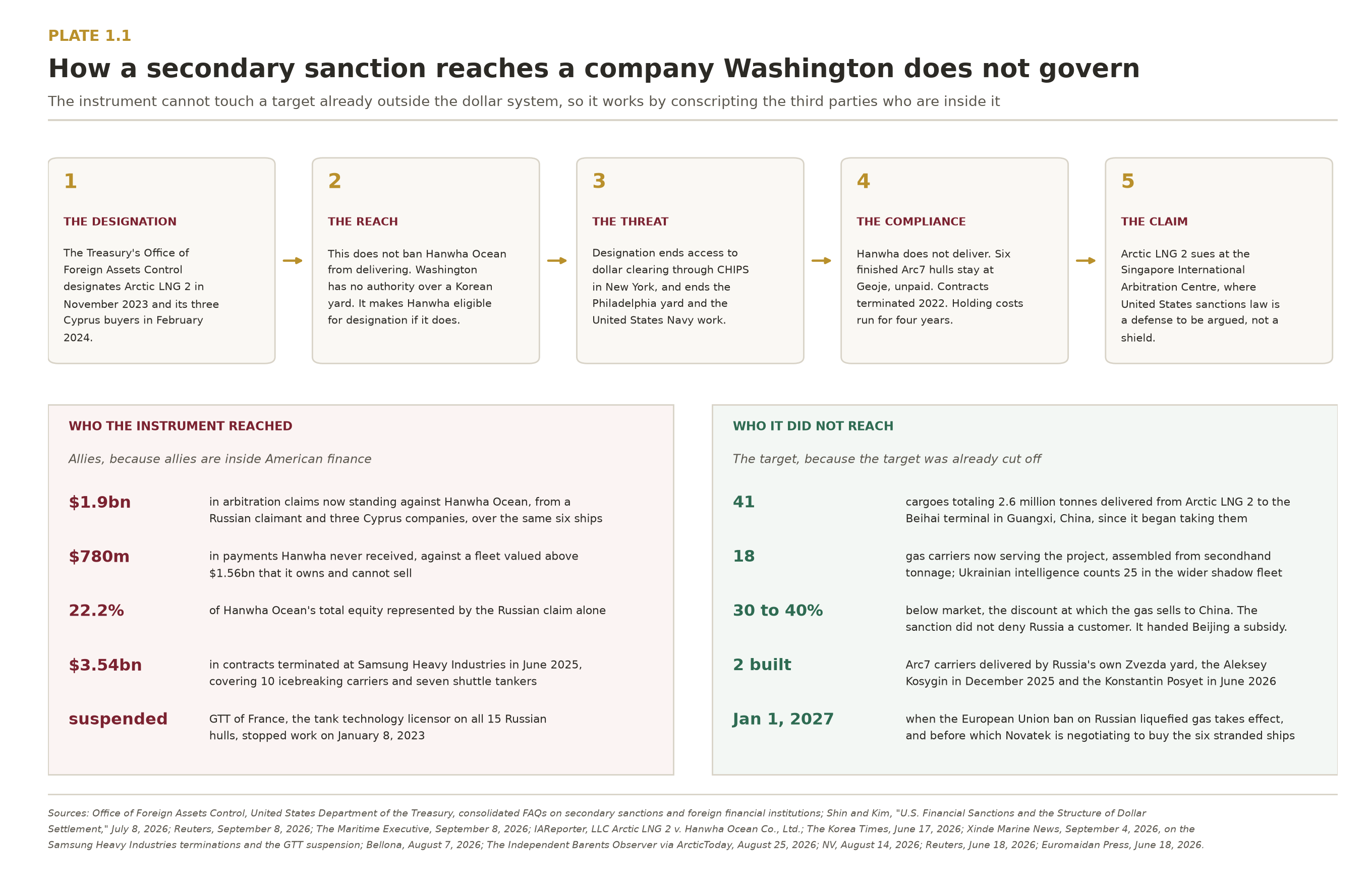
On September 3, 2026, Hanwha Ocean, the South Korean shipbuilder formerly called Daewoo Shipbuilding and Marine Engineering, told the Korea Exchange that it had been served with an arbitration claim at the Singapore International Arbitration Centre. The claimant was LLC Arctic LNG 2, the Russian liquefied natural gas venture 60 percent owned by Novatek. The amount was 1.3703 trillion won, about $1.02 billion at the September 8 rate of 1,341.96 won to the dollar. The stated basis was breach of what the contracts call Step-In Agreements, the clauses that let a project sponsor take over a shipbuilding contract when the nominal buyer walks away. Hanwha Ocean’s total equity at the end of 2025 was 6.175 trillion won. The claim is 22.2 percent of it. Reuters reported the filing from Moscow, The Maritime Executive reported it from the exchange disclosure, and the case is docketed as LLC Arctic LNG 2 v. Hanwha Ocean Co., Ltd. at IAReporter.
Here is what the Korean yard did to earn the claim.
In October 2020 it took orders for six Arc7 ice class LNG carriers, vessels built to break through Arctic sea ice while carrying liquefied gas, worth roughly $850 million. Three were for Sovcomflot, the Russian state shipping company, contracted through three Cyprus registered shell companies named Elixon, Azoria, and Glorina. Three were for Mitsui O.S.K. Lines, the Japanese carrier, under long term charters to the same project. Delivery was due starting July 2023.
Then the United States Treasury sanctioned Arctic LNG 2 in November 2023 and sanctioned the three Cypriot shells in February 2024. The buyers could not legally take the ships or pay for them. The contracts were terminated between May and November 2022. Hanwha Ocean finished all six hulls anyway, at its own cost, because a half built ice class LNG carrier is scrap and a finished one is an asset.
Be precise about who owns what here, because precision is what makes the charge stick. Those designations were signed under Joe Biden. Everything after January 20, 2025 belongs to Donald Trump, and by then the central fact was already visible to anyone who wanted to look: the gas was moving. Trump could have ended this file with a piece of paper. The Office of Foreign Assets Control issues specific licenses authorizing transactions that are otherwise prohibited, and it has issued general licenses on Russian energy repeatedly, including for wind downs and for safety and environmental transactions. Scott Bessent’s Treasury could have licensed the delivery of six finished hulls, or licensed their sale to a third party, or authorized a wind down that let the yard recover its costs. The six ships are still in Geoje. That is the answer to whether any such license was granted.
So the policy stopped being a measure against Russia at some point in 2025 and became something else. A sanction that cannot reach its target and is maintained anyway is no longer leverage on the target. It is a test of the third party’s obedience, and the third party is the only one who can fail it.
The Sovcomflot trio are named Zhores Alferov, Peter Kapitsa, and Lev Landau. The Mitsui trio are named Ilya Mechnikov, Nikolay Semyonov, and Nikolay Basov. Six Russian and Soviet scientists, three of them Nobel laureates, sitting in a Korean yard, unpaid.
The Korea Times put the unreceived payments at a minimum of $780 million, the fleet value at over $1.56 billion, and the holding costs at hundreds of millions of dollars. Four Arc4 vessels from the same program, named North Moon, North Light, North Ocean, and North Valley, sit idle off Indonesia at over $50,000 a day. A separate arbitration, filed in May 2023 by the three Cypriot owners, seeks roughly $862 million from the same yard over the same ships.
So Hanwha Ocean is defending two claims, from two directions, totaling close to $1.9 billion, over vessels it built, owns, cannot sell, cannot deliver, and did not want.
And Hanwha is not the largest casualty in its own industry. Samsung Heavy Industries had contracts terminated in June 2025 covering 10 icebreaking LNG carriers and seven ice class shuttle tankers, worth 4.85 trillion won, about $3.54 billion at the time, as documented in the Zvezda program history compiled by Xinde Marine News. Samsung had also supplied the hull sections for the first five vessels Russia was building at its own Zvezda yard. GTT, the French company whose membrane technology lines the cargo tanks on all 15 of those Russian hulls, suspended its work on January 8, 2023.
Add it up and the American sanctions program removed something on the order of $5 billion in contracted work from South Korean shipyards. That is the ally. That is the country Washington spent 2025 telling to bet its industrial future on American policy.
II. What a secondary sanction actually is, and why it lands on the ally instead of the target
Most people hear the word sanction and picture a border closing. That is not what happened here, and the distinction decides who pays.
A primary sanction prohibits Americans from doing something. An American bank may not process a payment for a designated Russian entity. An American company may not sell it equipment. The jurisdiction is obvious and the reach is limited to people the United States actually governs.
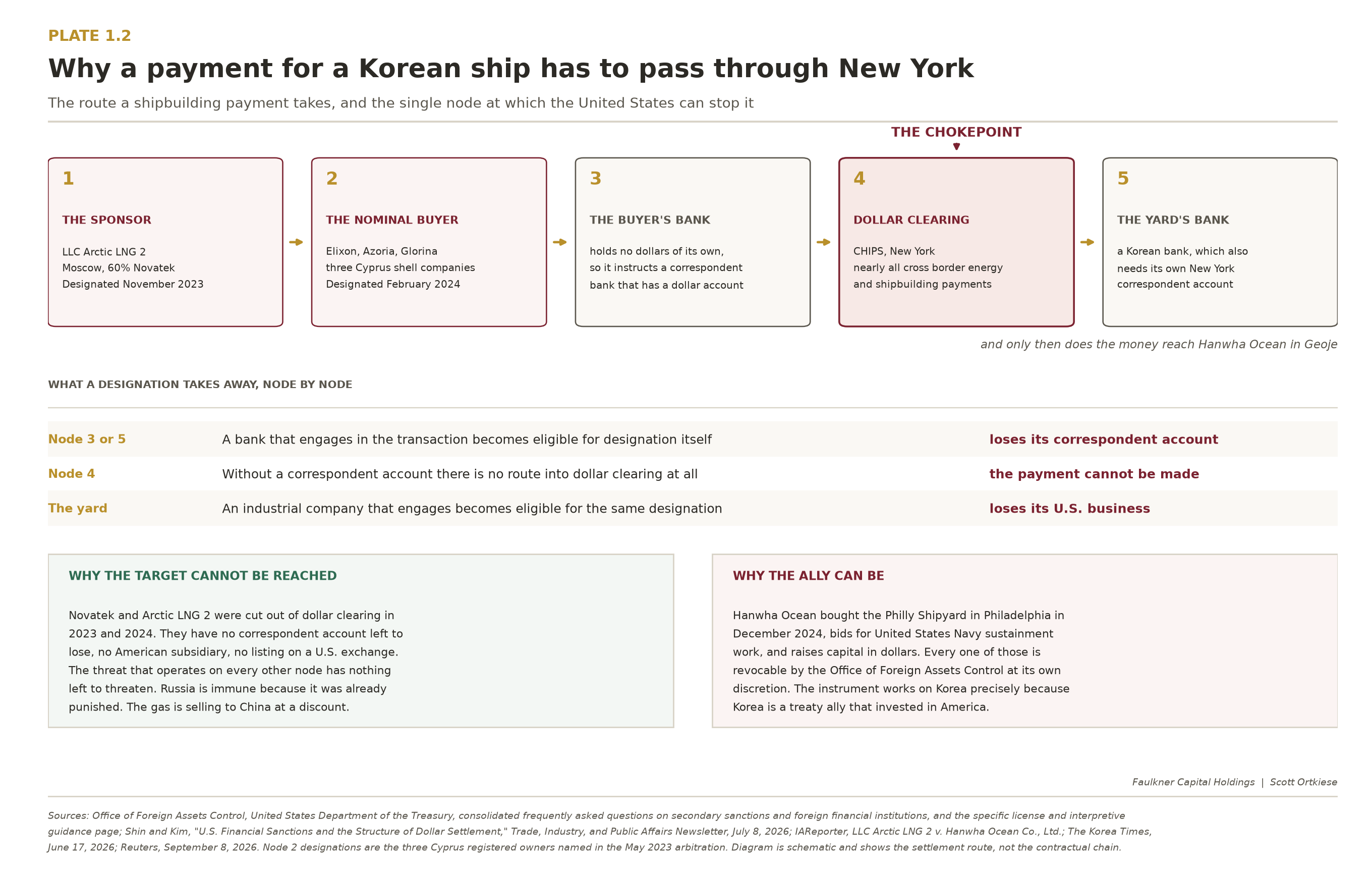
A secondary sanction is aimed at everyone else. It does not prohibit a Korean shipyard from delivering a ship to a Russian buyer. It cannot. Washington has no authority over a contract between a company in Geoje and a company in Cyprus performed in Korean waters. What it does instead is announce that any foreign firm or bank that engages in the transaction becomes eligible for designation itself, at the discretion of the Office of Foreign Assets Control at the Treasury Department.
Designation means being added to the Specially Designated Nationals list. For a bank, the practical consequence is losing the correspondent account that lets it clear United States dollars. Nearly all cross border energy and shipbuilding payments settle in dollars, and dollar settlement runs through the Clearing House Interbank Payments System in New York. A bank cut out of that system cannot function in international trade. For an industrial company, designation means losing its American subsidiaries, its American contracts, and its access to American capital markets. Hanwha Ocean bought the Philly Shipyard in Philadelphia in December 2024 and has been bidding for United States Navy sustainment work. It has a great deal to lose.
So the mechanism is not a prohibition. It is a menu with one item. The Korean yard was told, in effect: you may deliver these ships, and if you do, we will end your ability to bank in dollars and your business in the United States. That is a choice in the way that a mugging is a negotiation.
This is why the cost lands where it lands. The target of the sanction, Novatek, is already outside the dollar system and has nothing further to lose. The instrument therefore cannot touch it directly. It works only by conscripting third parties who do have something to lose, which by definition means allies, because allies are the ones integrated into American finance. Russia is immune to the threat precisely because it has already been cut off. Korea is vulnerable precisely because it is a treaty ally with a shipyard in Philadelphia.
Then comes the part the drafters at Treasury do not price. The Korean company, having complied, is now in breach of a commercial contract. The counterparty sues. It sues in Singapore, under English law, before an arbitral tribunal, because that is what the contract specified. And in that forum, United States sanctions law is not a shield that automatically holds. It is a defense to be argued, under doctrines like frustration, force majeure, and illegality, and its success depends on the exact wording of the clauses, the governing law, and whether the tribunal accepts that a foreign state’s regulation excuses performance of a contract that has nothing to do with that state.
Washington wrote the rule. Seoul is paying the penalty. Moscow is collecting. And the gas is in Guangxi.
That is the loyalty test in one sentence: Trump kept in force an instrument that could not touch Novatek, whose only remaining function was to find out whether a Korean company would absorb a billion dollars in claims rather than displease him. Hanwha passed the test. It is being billed for passing.
III. The gas moved. Here is the address.
The purpose of denying Arctic LNG 2 its icebreaking tankers was to strand the gas. Price the result.
Arctic LNG 2 is producing and exporting. A fleet of at least 18 gas carriers now serves it, assembled from older secondhand tonnage bought quietly through opaque intermediaries, as documented by The Independent Barents Observer. Ukrainian military intelligence puts the Russian liquefied gas shadow fleet at 25 vessels in 2026, having added at least eight used carriers and two new Zvezda builds in six months, per reporting in NV.
Every cargo goes to China. The Beihai terminal in Guangxi has handled 41 cargoes totaling 2.6 million tonnes since it started taking them, per Bellona. In 2026 alone, through late August, 31 shipments carried 2.3 million tonnes to Beihai. PipeChina is opening a second terminal at Longkou before October, adding 5 million tonnes a year of capacity for the same trade. The gas sells at an estimated 30 to 40 percent below market.
Read that discount carefully, because it is the only part of the sanction that worked, and it did not work the way it was sold. The policy did not deny Russia a customer. It transferred a large and permanent price concession from Russia to China. Beijing is the beneficiary of American sanctions policy. Every cargo that moves at 35 percent off benchmark is a subsidy from Novatek’s shareholders to Chinese industrial gas consumers, arranged by the United States Treasury at no cost to Beijing.
Meanwhile Russia built its own. The Zvezda yard in Bolshoy Kamen delivered the Aleksey Kosygin to Sovcomflot on December 22, 2025, years late and assembled from sections and equipment imported before the sanctions closed. It named the Konstantin Posyet on June 18, 2026, with Prime Minister Mikhail Mishustin attending, as Reuters reported. Vladimir Putin visited the yard on September 4, 2026, where the third of a five ship group is preparing for sea trials. The Aleksey Kosygin has been on the Treasury’s designated list since June 2024. It loaded its first Arctic LNG 2 cargo in the Gulf of Ob on January 28, 2026 and sails anyway.
This is what happens when an export control is applied to a state with a shipbuilding industry, a captive customer, and a 20 year time horizon. The control does not prevent the capability. It relocates it, badly and expensively, inside the sanctioned country, where it is permanent and where no future American administration can reach it. Korea lost the orders. Zvezda gained the program. GTT lost the license revenue and the design will be reverse engineered.
The one American objective that is actually being achieved is the destruction of a Korean industry that Washington simultaneously spent 2025 demanding Korea expand.
IV. Trump, and the men who worked for him
Name them, because the policy was not weather. And put them in the right order, because the usual account of this program has the order backwards. The advisers did not capture a passive president. They supplied intellectual cover for a preference he has held in public for 40 years and has never once submitted to a vote.
Donald Trump called the tariff the “most beautiful” word in the dictionary, and wrote in a Wall Street Journal opinion piece in January 2026 that “it was the tariff that made America strong and powerful in generations past and it is tariffs that are making our country stronger, safer and richer than ever before,” as The Guardian recorded. He signed Executive Order 14326 setting the country schedule. He signed Executive Order 14389 four days after losing at the Supreme Court, ending the unlawful tariffs and replacing them the same week. He personally traded away the one measure that would have moved shipbuilding orders to Korea, in a deal with Xi Jinping on October 30, 2025. On the Korean investment package he was explicit about who decides: under the memorandum, per the Korea Economic Institute of America, “Trump will select investments that are recommended and deemed commercially reasonable by an investment committee established by the president and chaired by the U.S. secretary of commerce,” after which Korea provides the money in tranches. He posted on January 26, 2026 demanding to know why Seoul had not yet passed the law to start funding him. And in February 2026 he warned that “any Republican that votes against tariffs will seriously suffer the consequences,” which settles the question of whether the policy was economics or discipline. Part 3 takes up what Seoul agreed to. What matters here is the pronoun. Selected by him. Directed by him. Suffer the consequences from him.
The rest served at his pleasure and said what the job required.
Stephen Miran, chairman of the Council of Economic Advisers, wrote “A User’s Guide to Restructuring the Global Trading System,” the paper that supplied the architecture: tariffs as leverage to force currency and security concessions from allies, with the dollar’s reserve status treated as a burden to be renegotiated rather than an asset to be defended.
Scott Bessent, Treasury Secretary, sold the program as revenue paid by foreigners. He said in April 2025 that the point was to “have the foreigners pay that.” On February 4, 2026 he said “I was also incorrect when I indicated that tariffs could lead to inflation,” and in the same breath called tariff induced inflation “the dog that didn’t bark.” He retracted the concession while making it.
Howard Lutnick, Commerce Secretary, said on May 23, 2025 that “there is no pain,” and on July 20, 2025 that “this is going to pay off our deficit,” a claim PolitiFact rated False. What it produced was $166 billion in refunds ordered by a federal court.
Peter Navarro, senior counselor for trade and manufacturing, said on August 23, 2025: “We’ve proven, once again, that tariffs don’t cause inflation. They cause growth.” Manufacturing payrolls fell in the same year.
Kevin Hassett, director of the National Economic Council, responded to a Federal Reserve Bank of New York study finding that roughly 90 percent of tariff costs were borne domestically by calling it, on February 18, 2026, “the worst paper I’ve ever seen in the history of the Federal Reserve system,” and adding that “the people associated with this paper should presumably be disciplined.” That is not a methodological objection. That is a demand that central bank researchers be punished for publishing a price index.
Jamieson Greer, United States Trade Representative, described the strategy on December 5, 2025 as “concentric rings going out from China.” That is a candid admission that the tariffs on Korea, Japan, Canada, and the European Union were never about Korea, Japan, Canada, or the European Union. They were about pressuring third parties into a containment perimeter. The third parties noticed. Part 3 covers what they did about it.
Not one of these men was elected to anything. Every one of them was appointed by Trump, serves at his discretion, and can be dismissed by him on any afternoon. When Hassett demanded that Federal Reserve researchers be “disciplined” for publishing a finding about who pays a tariff, he was not freelancing. He was performing the loyalty that the program runs on.
V. 18 months of escalation, and one reversal that mattered
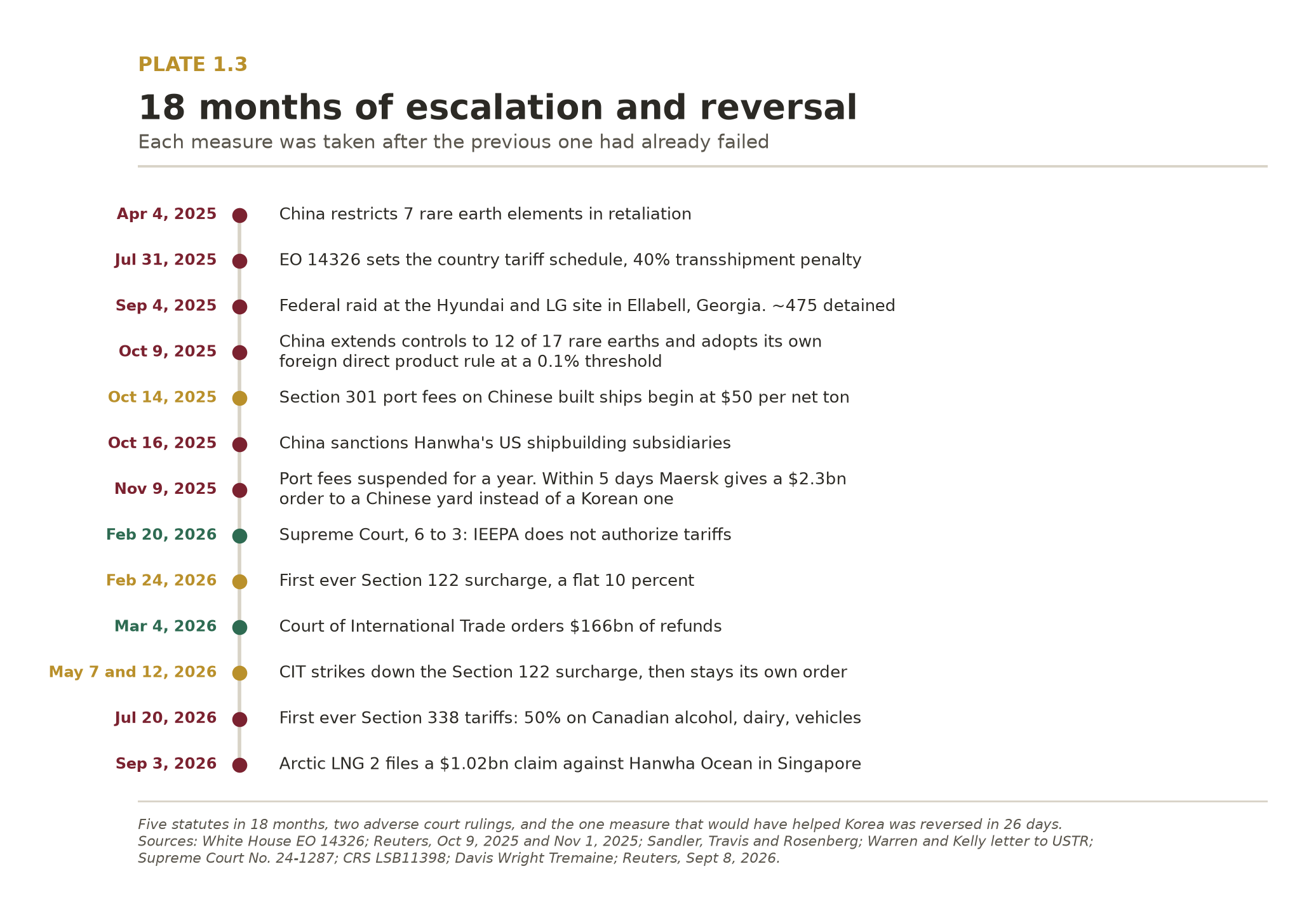
The sequence matters, because each step was taken after the previous step had already failed.
April 4, 2025. China imposes export controls on seven rare earth elements in retaliation for the first tariff round. Rare earths are the 17 metals that make the permanent magnets inside electric motors, guidance systems, and wind turbines. China holds roughly 70 percent of world mining, 90 percent of separation capacity, and 93 percent of magnet production.
May 11 and June 11, 2025. A 90 day truce in Geneva, then a framework in London. Washington treats a pause as a win.
July 31, 2025. Executive Order 14326 sets the definitive country tariff schedule, effective August 7, with a 40 percent penalty on transshipment, per the White House order.
September 4, 2025. Federal agents raid the Hyundai and LG battery plant construction site in Ellabell, Georgia, and detain roughly 475 people, most of them Korean nationals building a factory in the United States in response to American industrial policy.
October 9, 2025. China expands rare earth controls to 12 of 17 elements and, for the first time, applies a foreign direct product rule: from December 1, any magnet made anywhere in the world containing 0.1 percent or more Chinese heavy rare earths falls under Chinese licensing. Defense end users are denied outright. Reuters reported the measure. Washington had spent five years telling allies that extraterritorial export controls were a legitimate instrument. Beijing agreed and copied the statute.
October 14, 2025. Section 301 port fees on Chinese built vessels take effect at $50 per net ton, scheduled to rise to $80 in April 2026 and $110 in April 2027, per Sandler, Travis and Rosenberg. The stated purpose is to move commercial shipbuilding orders away from Chinese yards toward American and allied ones.
October 16, 2025. China sanctions Hanwha’s American shipbuilding subsidiaries, explicitly to coerce Seoul, per Reuters. The same yard is now squeezed by Washington’s sanctions, Beijing’s sanctions, and Moscow’s lawyers at once.
October 30 and November 1, 2025. Trump and Xi agree a one year pause. China suspends the October controls and issues general licenses for rare earths, gallium, germanium, antimony, and graphite, per Reuters.
November 9, 2025. The port fees are suspended for a year. Chinese shipyard orders, which had fallen 23.5 percent in the first nine months of 2025, rebound with backlogs up 25 percent. Within five days, Maersk awards a $2.3 billion contract to a Chinese yard instead of the South Korean builder it had been considering. Senators Elizabeth Warren and Mark Kelly documented the sequence in a letter to Trade Representative Greer.
Read that last item twice. The one measure in the entire program designed to move shipbuilding from China to Korea was reversed inside a month, and the immediate consequence was $2.3 billion in orders moving from a Korean yard to a Chinese one. Korea was told to bet its shipbuilding future on American industrial policy. American industrial policy lasted 26 days.
February 20, 2026. The Supreme Court decides Learning Resources, Inc. v. Trump and Trump v. V.O.S. Selections, Inc.
VI. The Supreme Court said the President never had the power
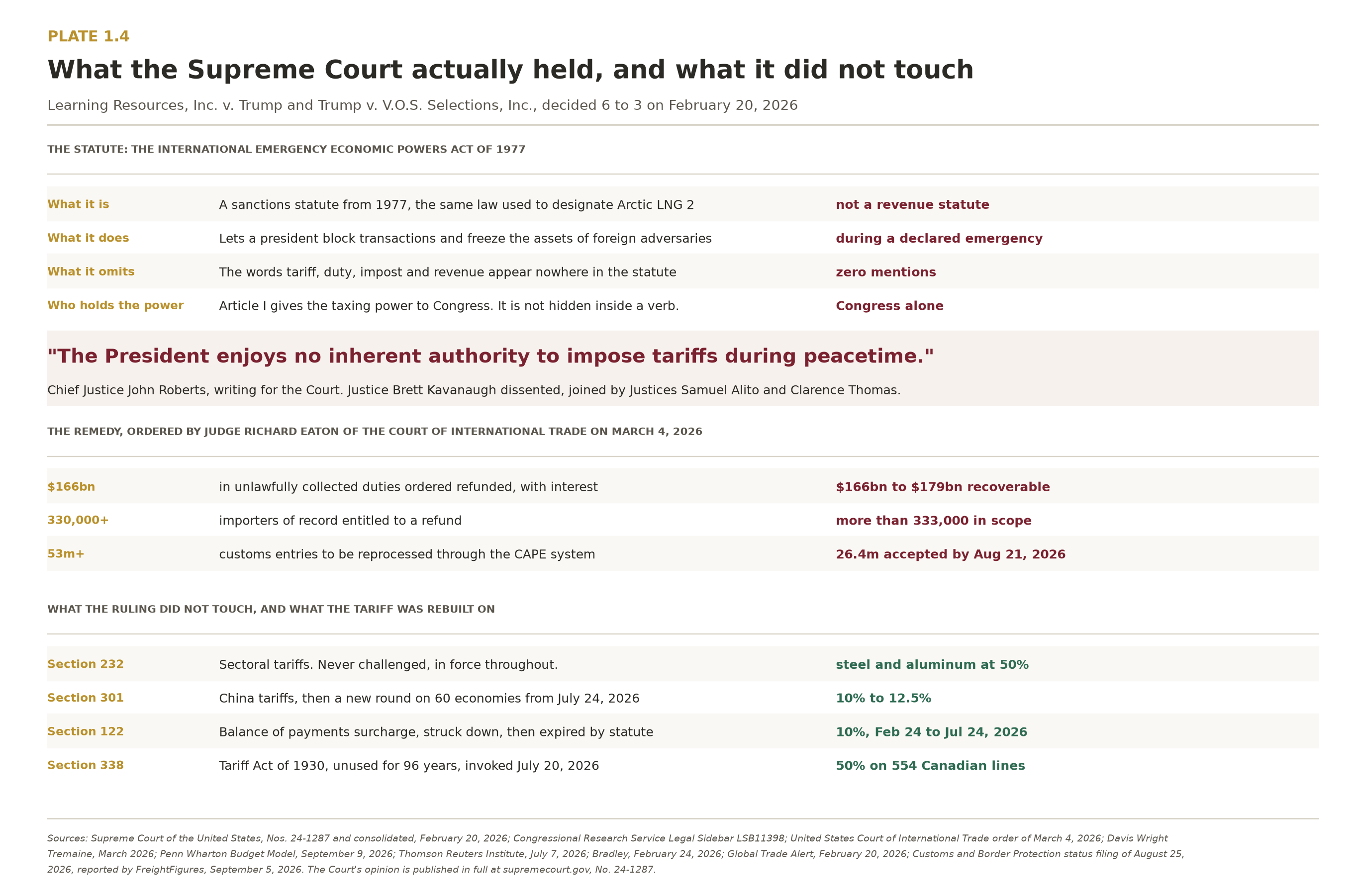
On February 20, 2026, the Supreme Court held 6 to 3, in an opinion by Chief Justice John Roberts, that the International Emergency Economic Powers Act of 1977 does not authorize tariffs at all. The controlling sentence: “the President enjoys no inherent authority to impose tariffs during peacetime.” Justice Brett Kavanaugh dissented, joined by Justices Samuel Alito and Clarence Thomas. The opinion is published by the Court and summarized by the Congressional Research Service in LSB11398.
The statute is worth explaining, because the abuse depended on nobody reading it.
Congress passed IEEPA in 1977 to let a president block transactions and freeze the assets of foreign adversaries during a declared national emergency. It is a sanctions statute. It is, in fact, the exact statute that produced the Arctic LNG 2 designation described above. It contains the word “regulate,” and Trump’s theory was that a power to regulate importation includes a power to tax it. Six justices found that a statute which never mentions tariffs, duties, imposts, or revenue does not silently contain the taxing power that Article I of the Constitution gives to Congress alone.
The same law did both jobs. The sanction use is what Congress wrote the law for, and it is lawful, and it has cost a Korean shipyard about $1.9 billion in claims while failing to stop a single cargo. The tariff use was never lawful at all.
The remedy arrived two weeks later. On March 4, 2026, Judge Richard Eaton of the Court of International Trade ordered nationwide refunds: roughly $166 billion owed to more than 330,000 importers across more than 53 million customs entries, per Davis Wright Tremaine. The Penn Wharton Budget Model puts the recoverable range at $166 billion to $179 billion.
VII. The wall did not come down. It changed statutes.
The February headlines said the Supreme Court struck the tariffs down. The tariffs are still being collected.
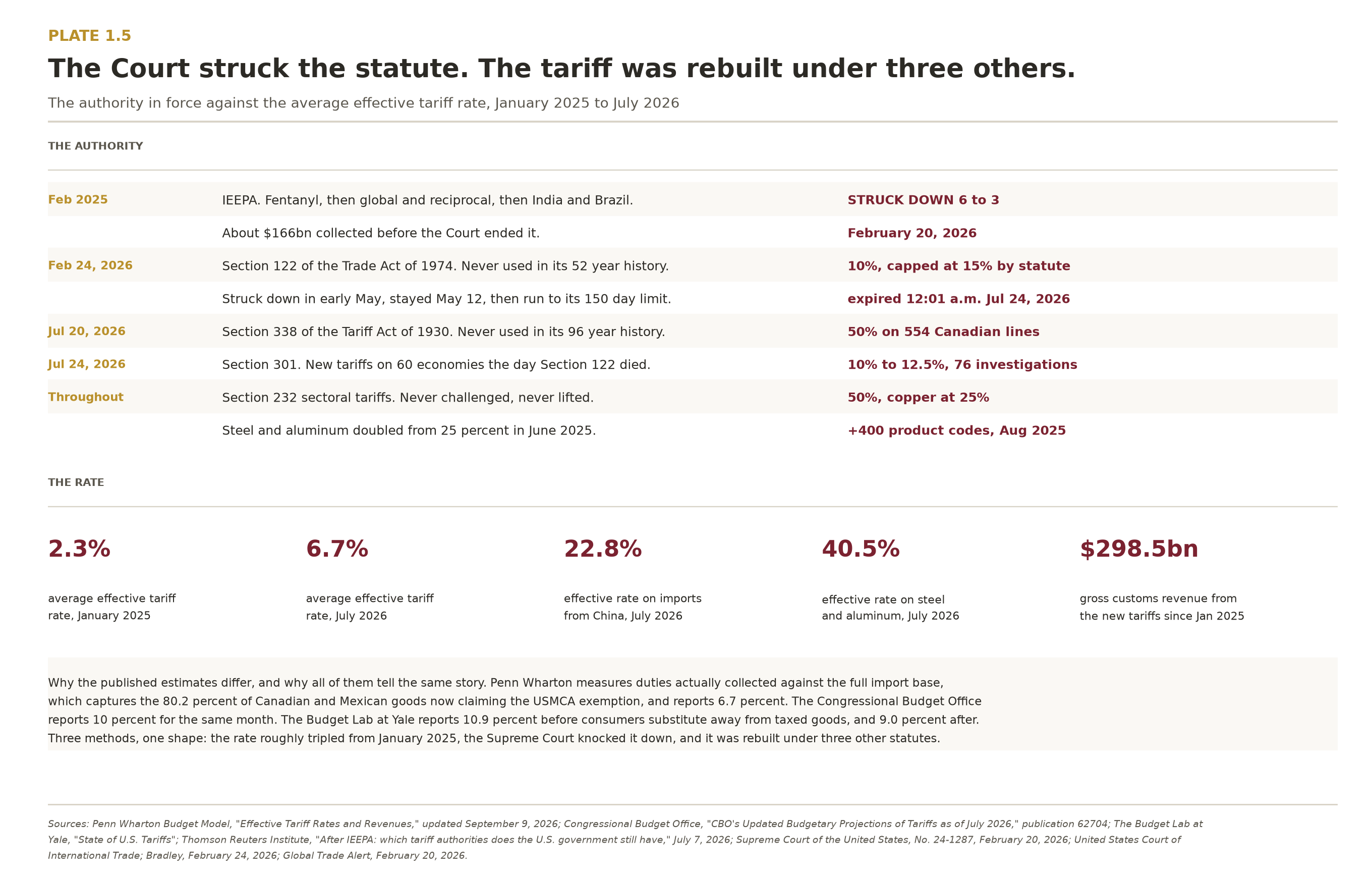
The Supreme Court invalidated the authority. It did not invalidate the idea. Trump signed Executive Order 14389 on February 20, 2026, the day of the ruling, rescinding the IEEPA tariffs, and within four days he invoked Section 122 of the Trade Act of 1974, a balance of payments provision never used in its 52 year history, to impose a flat 10 percent surcharge effective February 24, 2026, per White and Case. Section 122 caps out at 15 percent and expires after 150 days by statute, so it was a bridge and everyone involved knew it. The Court of International Trade struck it down in early May 2026, then stayed its own order on May 12, and the surcharge ran to its statutory expiry at 12:01 a.m. on July 24, 2026.
The day it expired, the substitute was ready. New Section 301 tariffs of 10 or 12.5 percent went onto imports from 60 economies, with roughly 76 countries under active Section 301 investigation, per Thomson Reuters. Section 232 sectoral tariffs were never in question at any point: steel and aluminum at 50 percent for most countries since June 2025, copper at 25 percent, with 400 new product codes added to the covered scope in August 2025. On July 20, 2026 Trump reached back to Section 338 of the Tariff Act of 1930, unused in its 96 year history, for 50 percent duties on Canadian alcohol, dairy, and vehicles across 554 tariff lines, worth roughly $20 billion a year in trade.
Now the arithmetic. The Penn Wharton Budget Model, updated September 9, 2026, puts the average effective tariff rate at 6.7 percent as of July 2026, against 2.3 percent in January 2025. China sits at 22.8 percent. Steel and aluminum at 40.5 percent. Automotive vehicles at 13 percent. Gross customs revenue from the new tariffs came to $298.5 billion between January 2025 and July 2026.
The estimates differ, and readers should know why rather than be handed one number. Penn Wharton measures duties actually collected against the full import base, which captures the fact that 80.2 percent of goods from Canada and Mexico now claim the USMCA exemption. The Congressional Budget Office puts the effective rate at 10 percent as of July 2026. The Yale Budget Lab publishes 10.9 percent measured before consumers substitute away from taxed goods and 9.0 percent after. All three are measuring slightly different things. All three show the same shape: the rate roughly tripled from January 2025, the Supreme Court knocked it down, and it was rebuilt under different statutes within five months.
China Daily described the sequence on February 26, 2026 as an attempt to “rummage through the legal attic for replacement weapons.” It is a hostile state newspaper. It is also an accurate description of Section 338.
VIII. The Justice Department is now in court trying to keep money the Supreme Court said it took unlawfully
The refund is not a check in the mail. It is a machine, and the machine is jammed.
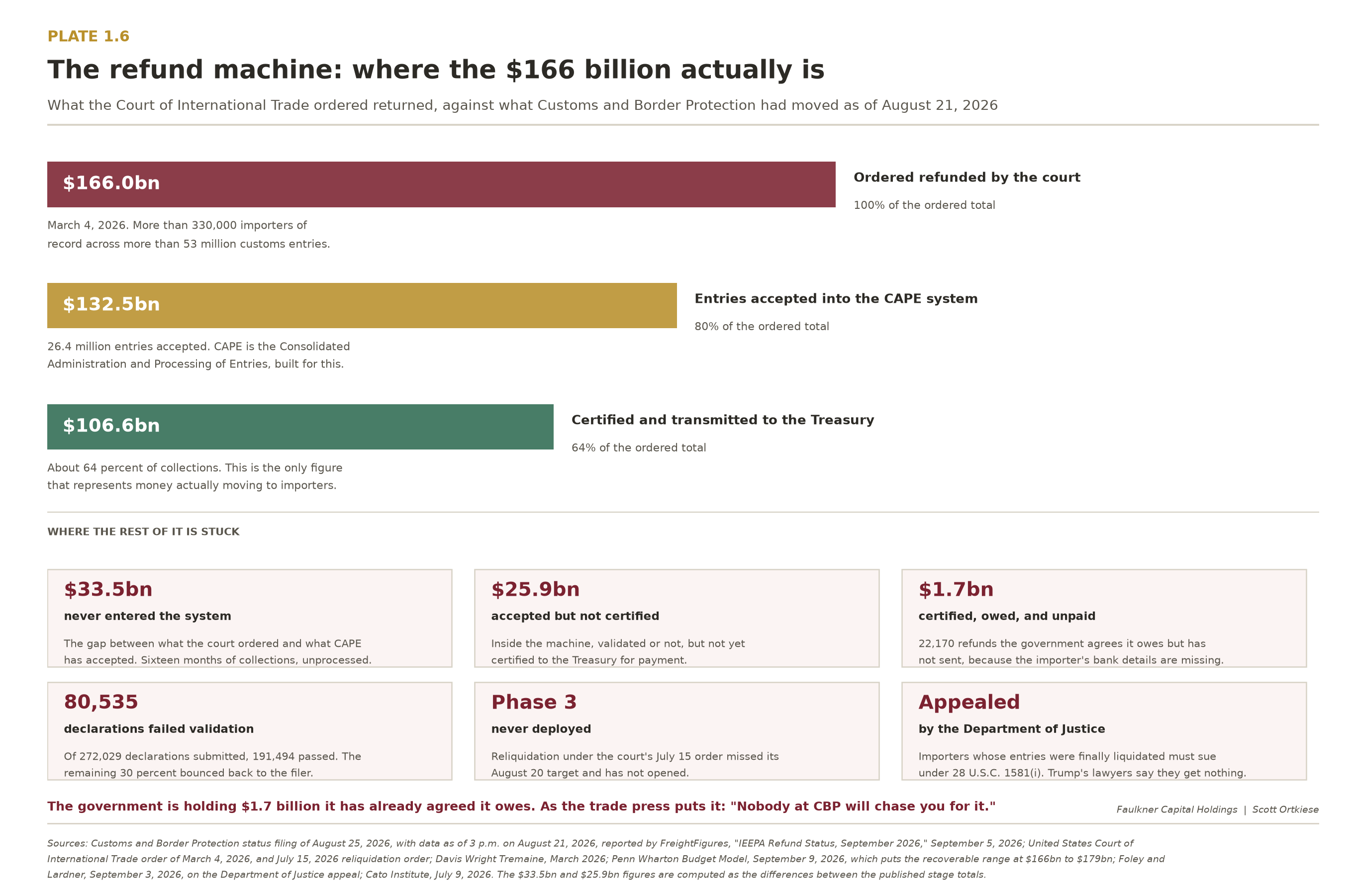
Customs and Border Protection built a system called CAPE, the Consolidated Administration and Processing of Entries, to handle it. As of 3 p.m. on August 21, 2026, per CBP’s own status filing reported by FreightFigures: 26.4 million entries accepted, representing about $132.5 billion; about $106.6 billion certified and transmitted to Treasury for disbursement; 272,029 declarations submitted, of which 191,494 passed validation. That is about two thirds of the money out the door six months after the ruling. The remaining third is stuck.
Some of it is stuck for reasons that are merely shabby. 22,170 certified refunds, worth about $1.7 billion, have not been transmitted because the importer’s bank account information is missing from the file. The government is holding $1.7 billion it has already agreed it owes, and, as the trade press puts it, “Nobody at CBP will chase you for it.” CAPE Phase 3, which covers reliquidation under the Court of International Trade’s July 15 order, missed its August 20 deployment target and has not opened.
And some of it is stuck because the government is fighting.
Under the Court of International Trade’s rulings, importers whose entries were finally liquidated, meaning more than 80 days past liquidation, fall outside the standard refund path and must bring an action under 28 U.S.C. section 1581(i), subject to a two year statute of limitations. The Court of International Trade ruled that those importers should get their money. The Department of Justice has appealed that question, arguing that importers who did not file protective lawsuits before the Supreme Court ruled are not entitled to refunds at all. The law firm Foley and Lardner advises clients that even if the non filers ultimately prevail, the process is likely to take a year or more.
Sit with the posture. The Supreme Court held that Trump had no lawful power to collect this money. Pam Bondi’s Justice Department is now in the Federal Circuit arguing that the American businesses he took it from should not get it back, on the ground that they failed to sue before they knew they had been wronged. Six justices said the taking was unauthorized. The answer from Trump’s lawyers is a filing deadline.
The fiscal result is the opposite of the pitch. The Congressional Budget Office projects that deficits will be $0.9 trillion larger over fiscal years 2027 through 2036 than they would otherwise have been. Lutnick said the tariffs would pay off the deficit. They added most of a trillion dollars to it, because a large share of the revenue was collected illegally, has to be returned with interest, and the drag reduced the tax base that funds the government. Part 4 follows the refunded money to where it actually landed, which was not the households that paid it.
IX. Novatek is negotiating to buy the ships
Return to Geoje, because the exhibit has one more turn in it.
In June 2026, the shipping outlet TradeWinds reported that Novatek was in talks to buy 10 ice capable LNG carriers from Mitsui O.S.K. Lines and Hanwha Ocean: the six stranded Arc7 vessels and the four Arc4 ships idling off Indonesia. Euromaidan Press summarized the reporting, noting the ships were said to be ready for delivery in 2026, which is months before the European Union’s full ban on Russian liquefied gas imports takes effect on January 1, 2027.
Follow the shape of it. The United States sanctioned a Russian project to deny it six ships. The ships were built anyway and never paid for. The Russian project sued the builder for a billion dollars for not delivering them. The Russian project is separately negotiating to buy them, presumably at a price reflecting the fact that the builder has been carrying six unsellable Arctic tankers and $50,000 a day in lay up costs on four more. The arbitration and the purchase talks are leverage on each other.
If that transaction closes, the complete result of three years of American sanctions policy on this file will be: a Korean shipyard stripped of roughly $780 million in payments and facing $1.9 billion in claims, a second Korean shipyard stripped of $3.54 billion in contracts, a French technology licensor out of its royalties, a Russian icebreaking shipbuilding industry created at Zvezda that did not exist before, a permanent 30 to 40 percent gas discount handed to China, 41 cargoes delivered to Beihai with a second Chinese terminal opening, and Novatek acquiring the same six vessels at a distressed price, on schedule, before the European ban.
The gas never stopped. It changed hulls, changed customers, and changed price. The only thing the policy reliably produced was a bill, and the bill went to Seoul.
X. What he wrote while it was happening
Everything above is reconstructed from filings, orders, customs data, and other people’s testimony. It does not have to be. Trump wrote most of the case against himself in public, at length, under his own name, on his own platform, and the archive of those posts is time stamped and searchable.
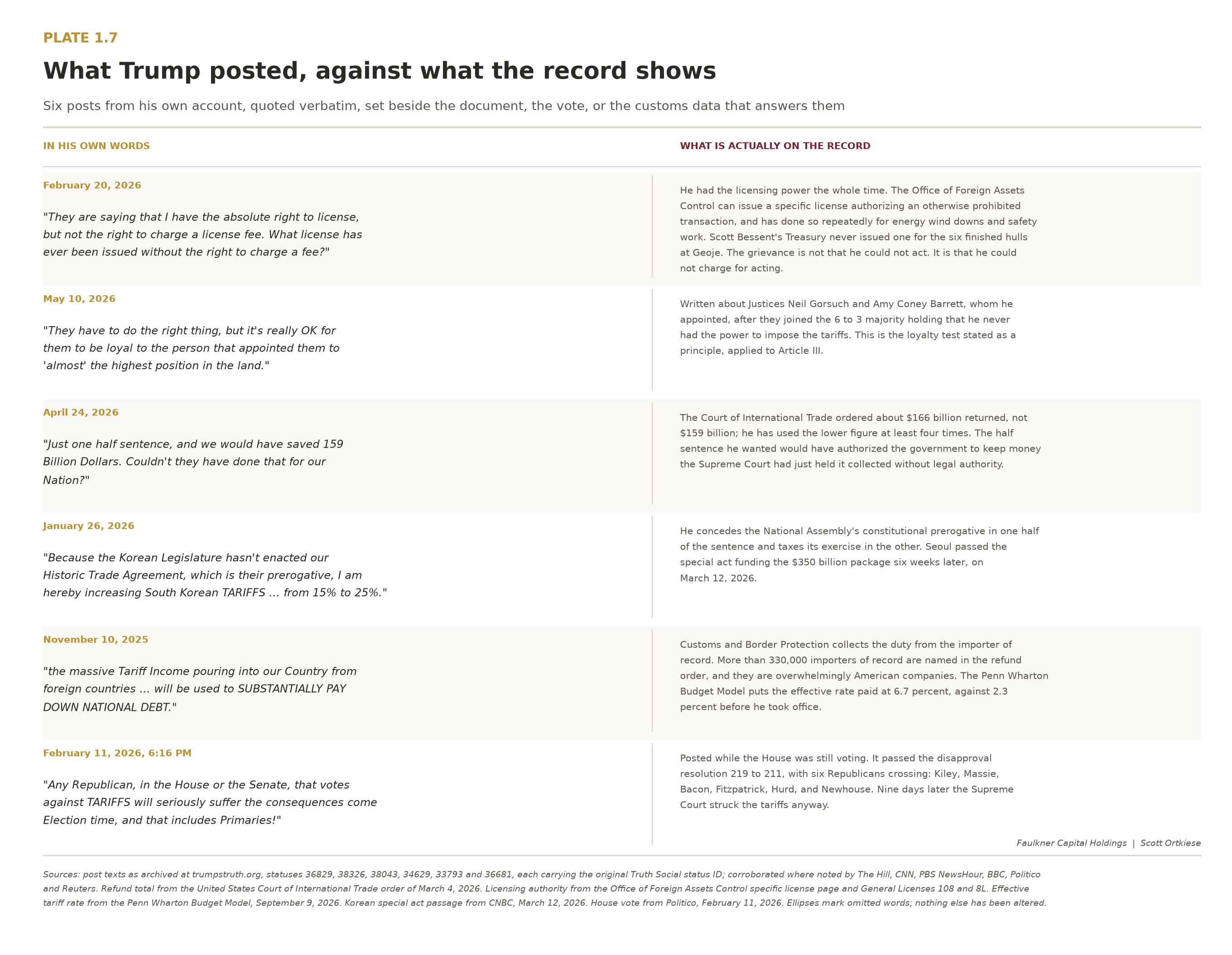
Start with the one that matters most, because it is the loyalty test stated as a principle. On May 10, 2026, angry that Neil Gorsuch and Amy Coney Barrett had voted to strike his tariffs, he wrote of the two justices he appointed: “They have to do the right thing, but it’s really OK for them to be loyal to the person that appointed them to ‘almost’ the highest position in the land, that is, a Justice of the United States Supreme Court.” He is not describing a legal theory. He is describing an obligation he believes attaches to anyone who has received something from him. That is the same instrument, applied to Article III, that Hanwha Ocean absorbed $780 million in unreceived payments to satisfy.
Now the licensing power, which is the hinge of this entire story. On the afternoon he lost, he complained: “They are saying that I have the absolute right to license, but not the right to charge a license fee. What license has ever been issued without the right to charge a fee?” Three days later he was still on it, in a post that opens “The supreme court (will be using lower case letters for a while based on a complete lack of respect!) of the United States accidentally and unwittingly gave me, as President of the United States, far more powers and strength than I had prior to their ridiculous, dumb, and very internationally divisive ruling,” and goes on: “I can use Licenses to do absolutely ‘terrible’ things to foreign countries.”
Hold that against Section I. The Office of Foreign Assets Control had a specific license sitting on the shelf the entire time, a piece of paper that would have let six finished hulls leave a Korean dry dock, and Scott Bessent’s Treasury never issued it. Trump spent February publicly aggrieved that the Court had left him only the power to license and not the power to charge for it. He had the licensing power. He used it on nobody. The complaint was never that he could not act. The complaint was that he could not bill.
He was equally clear about who he thought he answered to. “As President, I do not have to go back to Congress to get approval of Tariffs,” he posted on February 23, 2026. “It has already been gotten, in many forms, a long time ago!”
On the money, he cannot keep his own defeat straight. The Court of International Trade’s order and the government’s own filings put the refundable pool at about $166 billion. Trump has said $159 billion at least four times. “Handing over 159 Billion Dollars in Tariff refunds to people who have been Ripping Off our Country for years, is unexplainable,” he wrote on April 22, 2026. “One little sentence would have stoped [sic] this record setting payment from having to be made. It is a travesty!” Two days later he specified the sentence he wanted: “All they had to do was one little half sentence, ‘that the United States does not have to pay back monies that were already paid’.” Then: “Just one half sentence, and we would have saved 159 Billion Dollars. Couldn’t they have done that for our Nation?”
Read that plainly. The President of the United States is publicly disappointed that the Supreme Court declined to insert a line into its own opinion authorizing the federal government to keep money it had collected without legal authority. That is not a complaint about judicial reasoning. It is a request for absolution, submitted after the fact, in writing.
He saw it coming. On January 12, 2026, five weeks before the ruling, he posted that if the Court went against him the repayment would be “many Hundreds of Billions of Dollars,” that “it would be a complete mess, and almost impossible for our Country to pay,” and closed: “if the Supreme Court rules against the United States of America on this National Security bonanza, WE’RE SCREWED!” He had collected the money knowing it might not be his to collect, and he told everyone so.
On Korea he was blunter than any of his officials were willing to be. On January 26, 2026, he announced that because a sovereign parliament had not yet voted the way he wanted, he would tax its exports: “Because the Korean Legislature hasn’t enacted our Historic Trade Agreement, which is their prerogative, I am hereby increasing South Korean TARIFFS on Autos, Lumber, Pharma, and all other Reciprocal TARIFFS, from 15% to 25%.” The concessive clause is the tell. He acknowledges the National Assembly’s constitutional prerogative in one half of the sentence and punishes its exercise in the other.
He also understood exactly what he was doing to foreign investment in American shipbuilding, because 10 days after federal agents handcuffed Korean engineers at the Hyundai and LG battery plant in Georgia he wrote: “For example, Shipbuilding, where we used to build a Ship a day and now, we barely build a Ship a year.” And: “I don’t want to frighten off or disincentivize Investment into America by outside Countries or Companies.” Six weeks after that he was taking credit for the yard: “South Korea will be building its Nuclear Powered Submarine in the Philadelphia Shipyards, right here in the good ol’ U.S.A. Shipbuilding in our Country will soon be making a BIG COMEBACK.” He never once wrote the name Hanwha. The Philadelphia yard he was advertising is Hanwha Ocean’s, bought in December 2024, and it is the same corporate parent whose six Arctic hulls his Treasury would not license out of Geoje.
And on the central factual question of the entire tariff program, he has never moved. “All money left over from the $2000 payments made to low and middle income USA Citizens, from the massive Tariff Income pouring into our Country from foreign countries, which will be substantial, will be used to SUBSTANTIALLY PAY DOWN NATIONAL DEBT,” he posted on November 10, 2025. Two weeks later, the money was again “a direct result of Tariffs being charged to other countries.” His own Customs and Border Protection collects the duty from the importer of record, and more than 330,000 of those importers of record are American companies. The Penn Wharton Budget Model puts the effective rate paid on imports into the United States at 6.7 percent against 2.3 percent before he took office. Nobody in Seoul, Ottawa, or Beijing writes that check.
XI. The second loyalty test, and the people taking it in November
One more thing about a loyalty test. Once you have built one, you tend to use it on everybody.
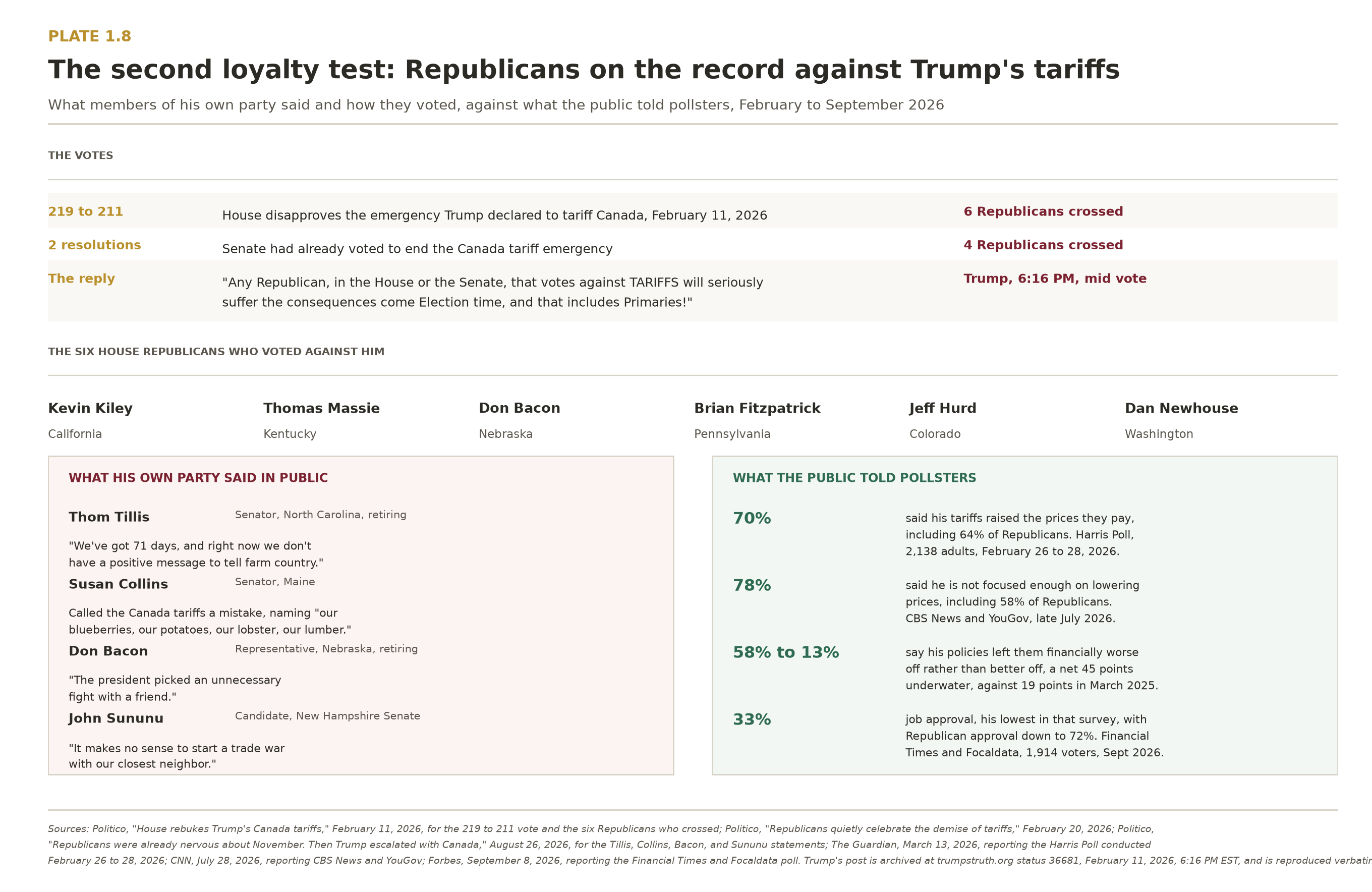
On February 11, 2026, the House of Representatives voted 219 to 211 to disapprove the national emergency Trump had declared to tariff Canada. Six Republicans crossed: Kevin Kiley of California, Thomas Massie of Kentucky, Don Bacon of Nebraska, Brian Fitzpatrick of Pennsylvania, Jeff Hurd of Colorado, and Dan Newhouse of Washington. Newhouse gave his reason in public: “Congress should not tie its own hands on our Constitutional authority to levy tariffs. While I understand the President’s approach to utilize tariffs as leverage to secure more trade deals, the fact of the matter remains the tariffs on Canada have harmed Washingtonians.” Politico counted the vote. The Senate had already passed two similar resolutions with four Republicans. Trump’s answer arrived at 6:16 that evening, while the vote was still being counted. He posted: “Any Republican, in the House or the Senate, that votes against TARIFFS will seriously suffer the consequences come Election time, and that includes Primaries!”
Nine days after that House vote, Trump lost at the Supreme Court, and Politico reported what Republicans in battleground states did when the tariffs went down: they quietly breathed a collective sigh of relief. Don Bacon posted that he felt “vindicated as I’ve been saying this for the last 12 months,” adding that “in the future, Congress should defend its own authorities and not rely on the Supreme Court.” Trump immediately pledged to bring the tariffs back, and did, within four days, under Section 122, and then again under Section 301, and then again under Section 338.
He did it against the numbers. The Harris Poll surveyed 2,138 adults from February 26 to 28, 2026 and found that 70 percent said his tariffs had raised the prices they pay, including 64 percent of Republicans, and that 67 percent said tariffs are not the right way to improve the economy, including 53 percent of Republicans, per the Guardian’s report of the survey. By late July, CBS News and YouGov found 78 percent of Americans saying his administration was not focused enough on lowering prices, including 58 percent of Republicans, and the share saying his policies had left them financially worse off had gone from 42 percent in March 2025 to 58 percent, against 13 percent saying better off, a net position 45 points underwater. Two months later his overall job approval hit 33 percent in the Financial Times and Focaldata poll of 1,914 registered voters, the lowest that survey has recorded, with his approval among Republican voters slipping to 72 percent, also a low, as Forbes reported on September 8, 2026.
And he kept going. In August 2026 he put 50 percent duties on $20 billion of Canadian goods under a 1930 statute, drawing retaliation, and the Republicans who have to stand for election said so out loud. Thom Tillis of North Carolina, retiring: “We’ve got 71 days, and right now we don’t have a positive message to tell farm country.” Tillis again, on whose problem it is: “the party that owns that tension is the party that will probably suffer the consequences in November.” Susan Collins of Maine called the Canada tariffs a mistake and itemized what crosses the border and comes back taxed: “our blueberries, our potatoes, our lobster, our lumber.” Don Bacon, retiring: “The president picked an unnecessary fight with a friend.” John Sununu, running to retake a New Hampshire Senate seat: “It makes no sense to start a trade war with our closest neighbor.” Politico assembled the complaints.
Read those five statements as a group. Not one of them is a Democratic talking point. They are Republicans, two of them leaving rather than run again, saying that the president of their own party has made their reelection harder for a policy that a court has already ruled he had no power to impose, that his own Treasury Secretary has conceded he was wrong about, and that seven in ten Americans say has raised their prices.
Which returns us to Geoje. Trump built an instrument whose only remaining function is to establish who will absorb a loss rather than cross him. He ran it on a Korean shipyard, which paid about $780 million in unreceived payments and $1.9 billion in claims to pass. He is now running the same instrument on his own party’s candidates, and the invoice on that one comes due in November.
Part 2 takes the bill to the American household.
Sources
The Hanwha Ocean arbitration and the Korean shipbuilding losses
- Reuters, “Russia’s Arctic LNG 2 seeks $1 billion in damages from South Korea’s Hanwha,” September 8, 2026. https://www.reuters.com/business/energy/russias-arctic-lng-2-seeks-1-billion-damages-south-koreas-hanwha-2026-09-08/
- The Maritime Executive, “Russia’s Arctic LNG 2 Files $1B Arbitration Claim for Canceled DSME Tankers,” September 8, 2026. https://maritime-executive.com/article/russia-s-arctic-lng-2-files-1b-arbitration-claim-for-canceled-dsme-tankers
- IAReporter, case record, LLC Arctic LNG 2 v. Hanwha Ocean Co., Ltd., filed 2026, arbitral phase pending. https://www.iareporter.com/arbitration-cases/llc-arctic-lng-2-v-hanwha-ocean-co-ltd/
- The Korea Times, “Hanwha Ocean faces mounting costs from blocked icebreaker delivery to Russia,” June 17, 2026. https://www.koreatimes.co.kr/business/companies/20260617/hanwha-ocean-faces-mounting-costs-from-blocked-icebreaker-delivery-to-russia
- Caliber.Az, “Russia’s Arctic LNG 2 escalates legal fight with South Korean shipbuilder,” September 8, 2026. https://caliber.az/en/post/russia-s-arctic-lng-2-escalates-legal-fight-with-south-korean-shipbuilder
- EADaily, “Around the gas carriers stuck in South Korea for Arctic LNG 2,” September 8, 2026. https://eadaily.com/en/news/2026/09/08/around-the-gas-carriers-stuck-in-south-korea-for-arctic-lng-2-the
- Xinde Marine News, “Putin Visits Zvezda as Russia Pushes Ahead with Arc7 LNG Carrier Localisation,” September 4, 2026, on the Samsung Heavy Industries contract terminations, the GTT suspension, and the status of the Zvezda hulls. https://xindemarinenews.com/news/2095684376424886274
- Euromaidan Press, “What does Russia do when sanctions strand ten ice-class LNG tankers,” June 18, 2026, summarizing TradeWinds reporting on the purchase talks. https://euromaidanpress.com/2026/06/18/novatek-ice-class-lng-tankers-sanctions/
How the sanction works
- Office of Foreign Assets Control, United States Department of the Treasury, consolidated frequently asked questions on secondary sanctions and foreign financial institutions. https://ofac.treasury.gov/faqs/all-faqs
- Office of Foreign Assets Control, specific licenses and interpretive guidance, on the authority to authorize otherwise prohibited transactions. https://ofac.treasury.gov/ofac-license-application-page
- Office of Foreign Assets Control, issuance of Russia related General License 108 authorizing limited safety and environmental transactions involving certain blocked persons, September 5, 2024. https://ofac.treasury.gov/recent-actions/20240905
- Office of Foreign Assets Control, issuance of Russia related General License 8L authorizing the wind down of transactions related to energy, January 10, 2025. https://ofac.treasury.gov/recent-actions/20250110
- Shin and Kim, “U.S. Financial Sanctions and the Structure of Dollar Settlement,” Trade, Industry, and Public Affairs Newsletter, July 8, 2026. https://www.shinkim.com/eng/media/newsletter/3371
- Reuters, “Chinese sanctions on Hanwha’s US shipbuilding units aim to coerce South Korea, state media says,” October 16, 2025. https://www.reuters.com/world/china/chinese-sanctions-hanwhas-us-shipbuilding-units-aim-coerce-south-korea-state-2025-10-16/
Where the gas went
- Bellona, “China keeps Arctic LNG 2 alive while Rosneft bets big on Vostok Oil,” August 7, 2026. https://bellona.org/news/arctic/2026-08-china-keeps-arctic-lng-2-alive-while-rosneft-bets-big-on-vostok-oil
- ArcticToday and The Independent Barents Observer, “Expanding Russian tanker fleet exports more Arctic LNG to China,” August 25, 2026. https://www.arctictoday.com/expanding-russian-tanker-fleet-exports-more-arctic-lng-to-china/
- NV, “Russia builds shadow fleet ahead of EU’s 2027 import ban, Ukrainian intelligence says,” August 14, 2026. https://english.nv.ua/business/russia-builds-lng-shadow-fleet-ahead-of-eu-import-ban-ukrainian-intelligence-says-50632513.html
- Reuters, “Russia’s second new LNG ice-class carrier is ready to enter into service, PM says,” June 18, 2026. https://www.reuters.com/business/energy/russias-second-new-lng-ice-class-carrier-is-ready-enter-into-service-pm-says-2026-06-18/
- Reuters, “Russia brings first cargo from Arctic LNG 2 to China this year, data shows,” January 26, 2026. https://www.reuters.com/business/energy/russia-brings-first-cargo-arctic-lng-2-china-this-year-data-shows-2026-01-26/
The escalation
- The White House, Executive Order 14326, “Further Modifying the Reciprocal Tariff Rates,” July 31, 2025. https://www.whitehouse.gov/presidential-actions/2025/07/further-modifying-the-reciprocal-tariff-rates/
- Reuters, “China tightens rare earth export controls,” October 9, 2025. https://www.reuters.com/world/china/china-tightens-rare-earth-export-controls-2025-10-09/
- Reuters, “What did Trump and Xi agree on tariffs, export controls and fentanyl,” November 1, 2025. https://www.reuters.com/world/us/what-did-trump-xi-agree-tariffs-export-controls-fentanyl-2025-11-01/
- Sandler, Travis and Rosenberg, Section 301 investigation into China’s shipbuilding and maritime logistics, port fee schedule. https://www.strtrade.com/trade-news-resources/tariff-actions-resources/301-investigation-china-shipbuilding-maritime-logistics
- Senators Elizabeth Warren and Mark Kelly, letter to United States Trade Representative Jamieson Greer on the suspension of the shipbuilding Section 301 port fees. https://www.warren.senate.gov/wp-content/uploads/media/doc/letter_from_senators_warren_kelly_to_us_trade_representative_greer_on_shipbuilding_301_port_fees.pdf
The ruling, the refunds, and what replaced the tariffs
- Supreme Court of the United States, Learning Resources, Inc. v. Trump and Trump v. V.O.S. Selections, Inc., No. 24-1287, decided February 20, 2026. https://www.supremecourt.gov/opinions/25pdf/24-1287_4gcj.pdf
- Congressional Research Service, Legal Sidebar LSB11398, on the IEEPA tariff decision. https://www.congress.gov/crs-product/LSB11398
- Davis Wright Tremaine, “Trade Court Orders Refunds of IEEPA Duties,” March 2026. https://www.dwt.com/insights/2026/03/trade-court-orders-refunds-of-ieepa-duties
- FreightFigures, “IEEPA Refund Status, September 2026,” September 5, 2026, reporting Customs and Border Protection’s status filing of August 25, 2026 with data as of August 21, 2026. https://www.freightfigures.com/articles/ieepa-refund-status-september-2026-phase-3-delayed-adcvd-hearing-september-15
- Foley and Lardner, “What Every Multinational Should Know About Securing Refunds for Finally Liquidated Entries,” September 3, 2026, on the Department of Justice appeal. https://www.foley.com/insights/publications/2026/09/what-every-multinational-should-know-about-securing-refunds-for-finally-liquidated-entries/
- Cato Institute, “IEEPA Refunds Update: Good Progress, but Still a Ways to Go,” July 9, 2026. https://www.cato.org/blog/ieepa-refunds-update-good-progress-still-ways-go
- Penn Wharton Budget Model, “Effective Tariff Rates and Revenues,” updated September 9, 2026. https://budgetmodel.wharton.upenn.edu/p/2026-09-09-effective-tariff-rates-and-revenues-updated-september-9-2026/
- Congressional Budget Office, “CBO’s Updated Budgetary Projections of Tariffs as of July 2026,” publication 62704, August 20, 2026. https://www.cbo.gov/publication/62704
- The Budget Lab at Yale, “State of U.S. Tariffs.” https://budgetlab.yale.edu/research/state-us-tariffs
- Thomson Reuters Institute, “After IEEPA: which tariff authorities does the U.S. government still have,” July 7, 2026. https://tax.thomsonreuters.com/blog/after-ieepa-which-tariff-authorities-does-the-u-s-government-still-have-and-what-global-manufacturers-need-to-know/
- Bradley, “Supreme Court Strikes Down IEEPA Tariffs: Key Takeaways,” February 24, 2026. https://www.bradley.com/insights/publications/2026/02/supreme-court-strikes-down-ieepa-tariffs-key-takeaways-and-next-steps-for-businesses
- Global Trade Alert, “What the SCOTUS ruling on IEEPA means for US tariffs,” February 20, 2026. https://globaltradealert.org/reports/SCOTUS-IEEPA-Tariff-Impact
- White and Case, “Trump Administration Imposes 10% Section 122 Tariff in Plan to Replace IEEPA Tariffs,” on the February 24, 2026 surcharge. https://www.whitecase.com/insight-alert/trump-administration-imposes-10-section-122-tariff-plan-replace-ieepa-tariffs
- The White House, Executive Order 14389, “Ending Certain Tariff Actions,” February 20, 2026. https://www.whitehouse.gov/wp-content/uploads/2026/02/eo-14389.pdf
Who directed it, and the second loyalty test
- Korea Economic Institute of America, “Understanding the $350 Billion MOU Putting Seoul Under Pressure,” on Trump’s personal selection of the investments Korea funds. https://keia.org/analysis/understanding-the-350-billion-mou-putting-seoul-under-pressure/
- Politico, “House rebukes Trump’s Canada tariffs,” February 11, 2026, on the 219 to 211 vote and the six Republicans who crossed. https://www.politico.com/news/2026/02/11/house-rebukes-trumps-canada-tariffs-00776898
- Politico, “Republicans quietly celebrate the demise of tariffs. That relief might not last,” February 20, 2026. https://www.politico.com/news/2026/02/20/tariffs-trump-gop-midterms-00791591
- Politico, “Republicans were already nervous about November. Then Trump escalated with Canada,” August 26, 2026, for the Tillis, Collins, Bacon, and Sununu statements. https://www.politico.com/news/2026/08/26/trumps-trade-moves-add-to-gops-midterm-anxieties-01050201
- The Guardian, “Seven in 10 Americans say Trump tariffs have cost them money, poll finds,” March 13, 2026, reporting the Harris Poll of 2,138 adults conducted February 26 to 28, 2026. https://www.theguardian.com/us-news/2026/mar/13/trump-tariffs-poll
- CNN, “The GOP’s 2026 Trump problem, in 2 charts,” July 28, 2026, reporting CBS News and YouGov findings. https://www.cnn.com/2026/07/28/politics/republican-midterms-poll-trump-inflation
- Forbes, “Trump’s Approval Rating Reaches New Floors In 2 Polls As Support Among GOP Voters Slips,” September 8, 2026, reporting the Financial Times and Focaldata poll of 1,914 registered voters. https://www.forbes.com/sites/saradorn/2026/09/08/trumps-approval-rating-reaches-new-floors-in-2-polls-as-support-among-gop-voters-slips/
Trump’s own posts, quoted in Section X and Plate 1.7
Every post below is quoted from the archive at trumpstruth.org, which preserves each post’s original Truth Social status ID and original URL. Where a news outlet independently reproduces the same wording, that outlet is named in the text.
- February 11, 2026, 6:16 PM EST, the threat to Republicans voting against tariffs. https://trumpstruth.org/statuses/36681 . Reproduced verbatim by The Hill at https://thehill.com/homenews/administration/5734521-trump-tariffs-primary-threat/ , by CNN at https://www.cnn.com/2026/02/11/politics/house-republicans-trump-canada-tariff-vote , by PBS NewsHour at https://www.pbs.org/newshour/politics/watch-live-house-expected-to-vote-on-trump-tariffs-save-act , and by the BBC at https://www.bbc.com/news/articles/clyz2142e77o
- February 20, 2026, 1:37 PM EST, the license fee post announcing the Section 122 replacement. https://trumpstruth.org/statuses/36829 . Spoken version of the closing paragraph reported by Politico at https://www.politico.com/news/2026/02/20/donald-trump-10-percent-global-tariff-00791317
- February 23, 2026, 7:06 AM EST, the lower case letters post. https://trumpstruth.org/statuses/36868
- February 23, 2026, 9:49 AM EST, on not needing Congress. https://trumpstruth.org/statuses/36879
- April 22, 2026, 9:41 AM EDT, on the refunds and the justices. https://www.trumpstruth.org/statuses/37985 . Reproduced by The Hill at https://thehill.com/homenews/administration/5843013-trump-supreme-court-conservative-justices/
- April 24, 2026, 3:07 PM EDT, the one little half sentence post. https://trumpstruth.org/statuses/38043
- May 10, 2026, 6:34 PM EDT, on Gorsuch, Barrett, and loyalty to the person who appointed them. https://trumpstruth.org/statuses/38326 . Reproduced by The Hill at https://thehill.com/homenews/administration/5872012-trump-scolds-justices-barrett-gorsuch/
- January 12, 2026, 1:11 PM EST, the WE’RE SCREWED post. https://trumpstruth.org/statuses/34540 . Context reported by the BBC at https://www.bbc.com/news/articles/cr578pvlp8qo
- January 26, 2026, 4:57 PM ET, raising Korean tariffs to 25 percent. https://trumpstruth.org/statuses/34629 . Reproduced in part by Reuters at https://www.reuters.com/world/asia-pacific/trump-says-he-is-raising-tariffs-certain-south-korean-imports-25-2026-01-26/
- September 14, 2025, 2:24 PM EDT, on frightening off investment, 10 days after the Georgia raid. https://trumpstruth.org/statuses/32976 . Coverage at https://fortune.com/2025/09/14/ice-raid-georgia-hyundai-lg-south-korean-workers-foreign-investment/ and https://www.axios.com/2025/09/14/trump-hyundai-south-korea-georgia-ice
- October 29, 2025, 6:03 PM EDT, the Philadelphia shipyard. https://trumpstruth.org/statuses/33503 . Coverage at https://breakingdefense.com/2025/10/trump-south-korea-nuclear-submarine-philadelphia/ and https://www.inquirer.com/politics/nation/nuclear-powered-submarine-philadelphia-south-korea-shipyard-20251030.html
- November 10, 2025, 10:43 AM EST, tariff income from foreign countries paying down the debt. https://www.trumpstruth.org/statuses/33793
- November 24, 2025, 5:38 AM EST, tariffs being charged to other countries. https://trumpstruth.org/statuses/33990
- South Korea’s National Assembly passed the special act funding the $350 billion package on March 12, 2026. https://www.cnbc.com/2026/03/12/south-korea-350-billion-investment-special-bill-us-trump.html
A note on the quotations. Trump’s posts use the em dash heavily and this publication does not. Rather than alter his words, every quotation printed here was selected so that no dash falls inside it. Ellipses mark omitted words. Capitalization, spelling, and punctuation are otherwise reproduced exactly as archived, including the misspelling flagged with [sic]. Two of his posts about the Supreme Court exist in more than one version, because he deleted and reposted them; the surviving version is the one quoted.