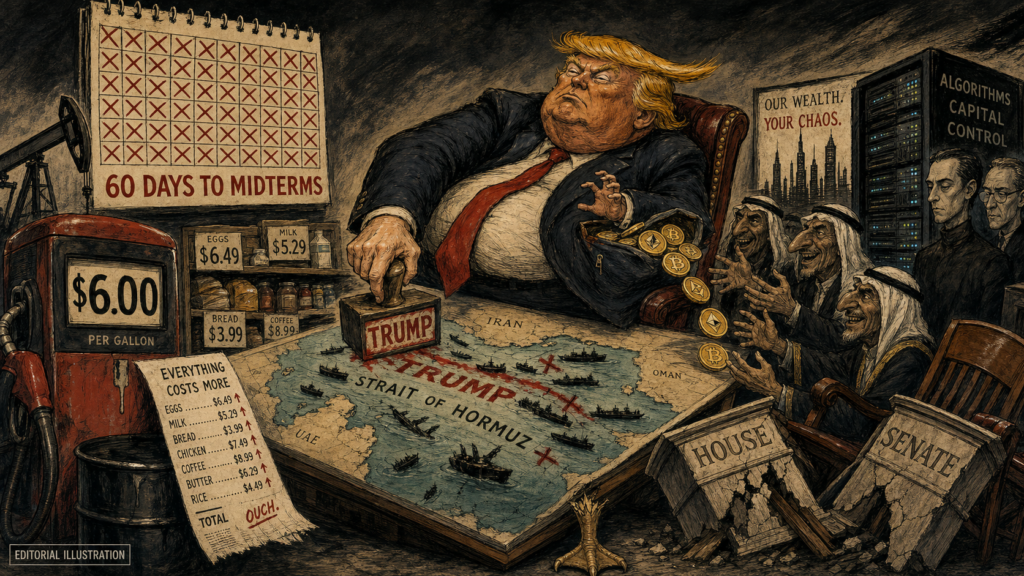
He promised peace, prosperity and America First. He delivered an unauthorized war, higher costs and open graft, then mistook a blockade for control while driving his party toward a midterm catastrophe.
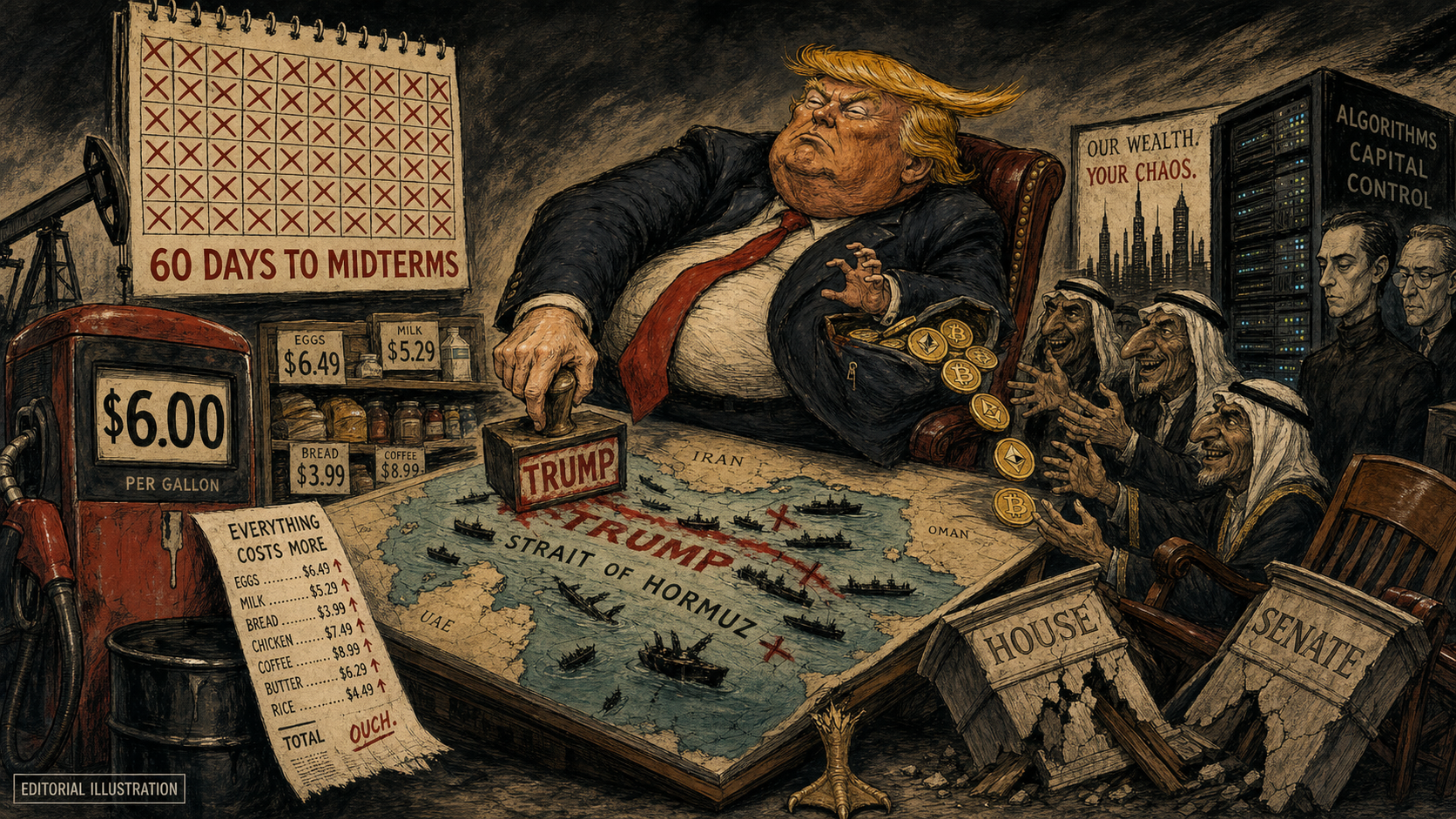
Scott Ortkiese | Throughline Synthesis | Houston, September 3, 2026
11:23 in the morning
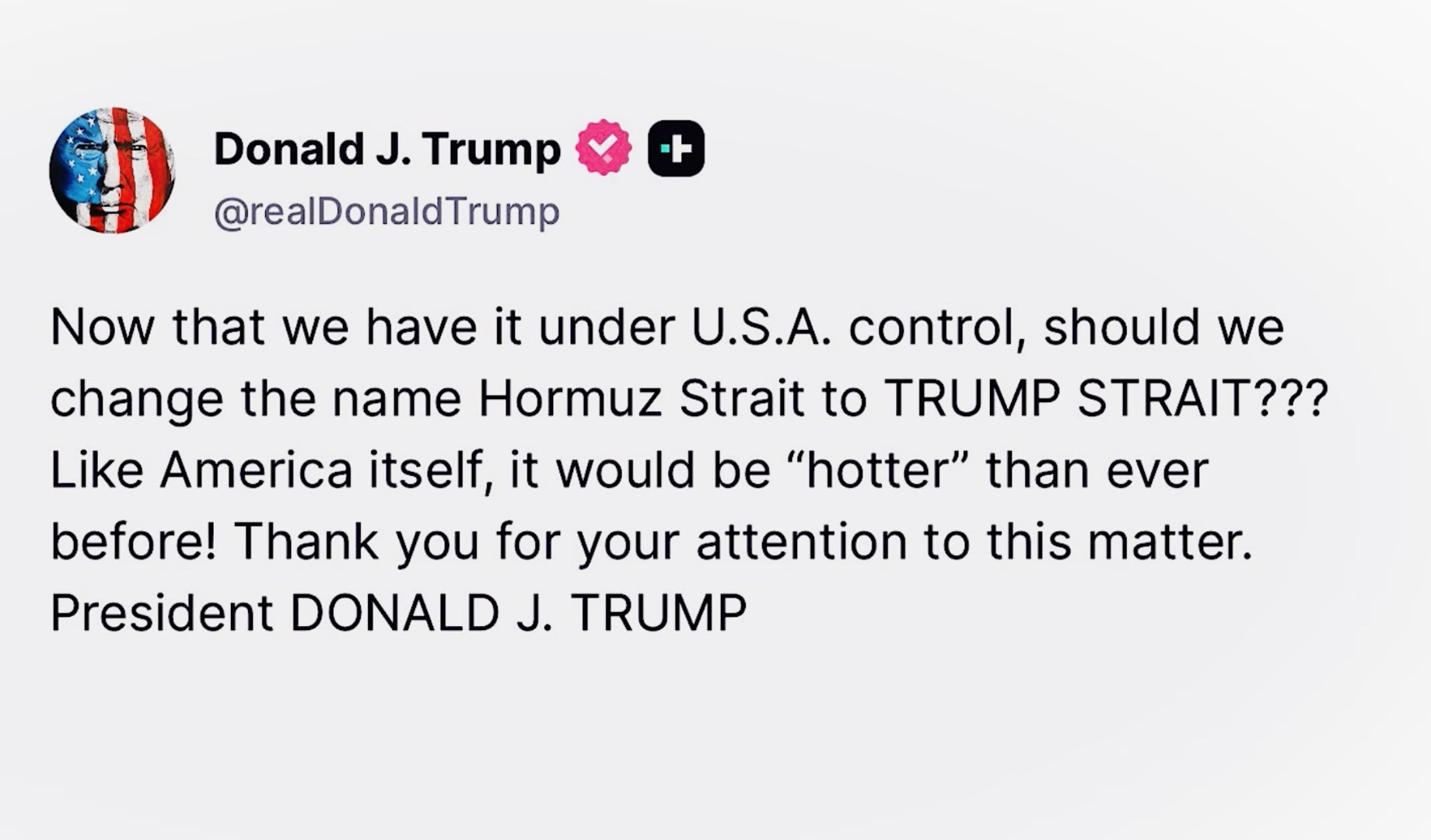
At 11:23 a.m. EDT on Wednesday, September 2, 2026, the President of the United States asked the internet whether the world’s most important oil chokepoint should be renamed after him.
“Now that we have it under U.S.A. control, should we change the name Hormuz Strait to TRUMP STRAIT??? Like America itself, it would be ‘hotter’ than ever before! Thank you for your attention to this matter. President DONALD J. TRUMP”
The post is authentic. Its text and timestamp were independently reproduced by Al-Ahram English, CNBC and The Hill. AFP separately documented the fake Hormuz posts that circulated earlier in 2026. This one clears every test those fakes failed (AFP Fact Check).
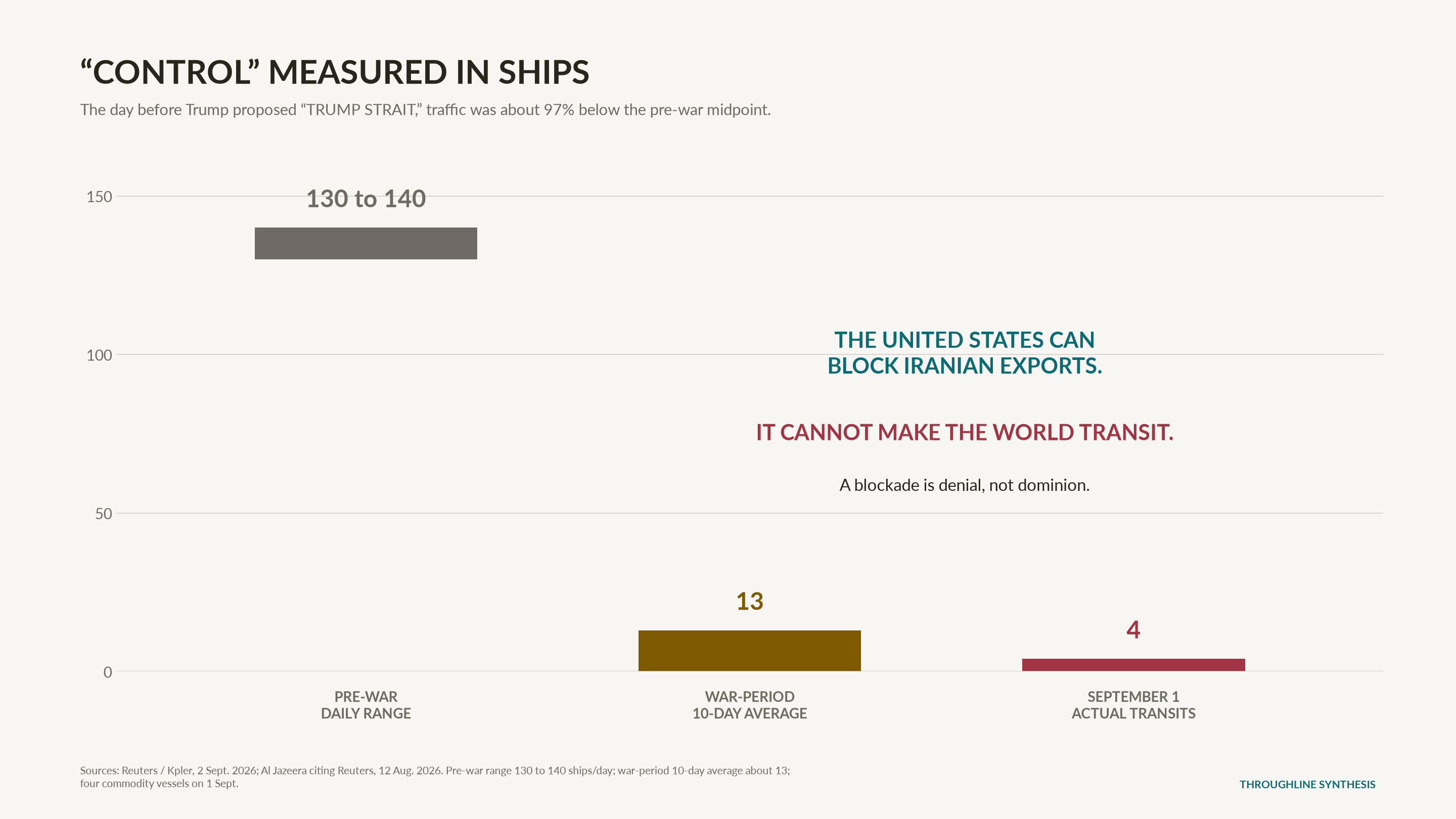
On Tuesday, September 1, the day before that post, four commodity vessels transited the Strait of Hormuz, one in and three out, per Kpler data reported by Reuters, against a ten-day average of about thirteen. The pre-war baseline was 130 to 140 ships a day (Al Jazeera). Four against 130 is roughly 97 percent below normal. The Revolutionary Guard said American strikes would “tighten the lock” on the waterway (Reuters). The Associated Press reported the strait “remains largely shut down… and Iran has regularly attacked vessels,” and that two Filipino sailors had just been killed aboard a Saudi Bahri vessel in that same water (AP).
And the night before the post, in Kuhestak, on the Hormozgan coast just east of the strait, a wedding ended when the roof came down. The New York Times’ visual investigation found the bomb “had been released by American forces,” killing “[a]t least five wedding guests … including a 6-year-old boy” and wounding at least 67 more per Iran’s Red Crescent Society. The Times’ description: “It ended when a bomb brought down the roof, turning a night of celebration into a jumble of dust-coated sandals, torn garlands and blood-soaked rugs” (NYT). The AP counts four dead including children aged 4 and 16, and at least 68 wounded (AP). The accounts differ at the margin. They agree on the roof, the wedding, and whose bomb it was.
Twenty-one hours later, the strait got a brand. By that afternoon the President laughed it off: “No, no I was just throwing that out” (NOTUS). Note what was withdrawn. The name was a joke. The claim of control was not.
Nor was it new. March 27, in Miami: “open up the Strait of Trump, I mean, Hormuz,” plus joint control by “me and the ayatollah” (CNBC). July 13, in writing: America “will be, from this point forward, known as ‘THE GUARDIAN OF THE HORMUZ STRAIT,’ but as such, and as a matter of FAIRNESS, will be reimbursed, at the rate of 20% on all cargo shipped” (trumpstruth.org). That is a presidential proposal to convert freedom of navigation into a franchise fee, and it drew a fraction of the attention the naming joke got. August 12: “The U.S.A. has total control over the Strait of Hormuz. I THINK WE WILL KEEP IT!”, plus the boast that Iran has “300% INFLATION” (trumpstruth.org), when Iranian year-on-year inflation hit a record 84 percent (House of Commons Library). He inflated a catastrophe three and a half times in his own favor.
The strongest counter-case is official. A White House release titled “President Trump Was Right: America Controls the Strait of Hormuz” claims cleared mines, “75 vessels that tried to break the blockade were turned around,” nearly 1,500 vessels moved under American protection, and zero Iranian oil exported since July. The blockade works against its target, and Iran’s economy is collapsing (House of Commons Library). But the release refutes the post it defends. Trump’s own August 14 formulation: “we own the Hormuz Strait, and we only allow boats to come in if we want them to come in” (whitehouse.gov). That describes a blockade, which makes the United States a direct cause of the collapse it cites as proof of control. The 1,500-vessel figure carries no time period, so it cannot be checked.
The professionals are not confused. Carl Schuster, former director of U.S. Pacific Command’s Joint Intelligence Center: “Until you can ensure safe use of the strait, you do not have total control” (CNN). From Israel’s Institute for National Security Studies, which is nobody’s antiwar shop, Dennis Citrinowicz: “The United States does not control the Strait of Hormuz,” and the drive to show America is “‘winning’ at all costs is creating a virtual reality that prevents both the administration and the president from making decisions based on the actual situation on the ground” (Al Jazeera).
The United States controls whether Iran may export. It does not control whether the world may transit. On September 1, four ships did.
The facts, and what they do not prove
In the first month of the 2026 war alone, the UN counted more than 2,100 civilians killed in Iran, more than 27,900 injured and 3.8 million people affected (UN humanitarian update No. 2). American losses stand at 18 service members killed and 757 wounded, with four deaths and dozens of injuries having “disappeared from the totals last month before being restored,” which the Pentagon attributed to “temporary data disruptions” (CNN). Hegseth priced the war at $37.5 billion in July while asking for $67 billion more (NYT). Public support is 31 percent, the President’s approval 33 percent, matching his all-time low (Reuters/Ipsos via Al Jazeera).
The charge is not that a cabal ran a war. It is that a decision was made by a President, on a clock set in Jerusalem, inside an executive branch that had stopped asking Congress, surrounded by an apparatus that profits from the doing and a family business collecting from the Gulf state with the largest stake in the outcome. Nobody had to conspire. Convergent interest and permissive design are enough, and worse, because conspiracies can be broken up and operating systems have to be replaced.
The other half of the job is dropping claims that hand the pro-war side a free win.
| Claim to abandon | What the record supports |
|---|---|
| Iran was fully compliant with inspections | The IAEA Board found Iran in non-compliance in June 2025 and “[d]eeply regrets Iran’s continued failure to remedy its non-compliance over the past 12 months” (IAEA GOV/2026/40) |
| Israel controls U.S. policy | Netanyahu supplied timing, target and intelligence; Trump supplied the decision, having promised support in December 2025 (NYT; Reuters) |
| Megadonors bought the war | No source documents a donor demand for war; what is documented is $104.3 million in AIPAC cycle spending making dissent expensive (Common Dreams) |
| Pax Silica commands the war | It is a real State Department program that moves economic-security policy outside Congress; nothing ties it to the Iran decision (state.gov) |
| The petrodollar is dissolving | The dollar’s share of allocated reserves rose to 57.13 percent in 2026Q1, with the renminbi at 1.99 percent (IMF COFER) |
Each correction makes the case harder to dismiss, which is the only reason to make it. A polemic refutable by one IAEA document is not a polemic. It is a gift.
The people who were right early
Chas Freeman, former assistant secretary of defense, said in May there was “no acceptable military method to reopen the Strait of Hormuz and that negotiations are the only remaining path,” and predicted Trump “may use a final violent gesture before withdrawing while claiming victory” (Greater Eurasia transcript). By August the Wall Street Journal reported Trump “laying the groundwork to declare victory,” possibly without any deal (Times of Israel). He called the ending in May, which earns his framework a hearing, including his charge that American conduct now resembles “banditry rather than statecraft” (chasfreeman.net).
Jeffrey Sachs wrote to the Security Council twelve days before the bombs, arguing the crisis “did not result from Iran’s failure to negotiate, but from the United States repudiating negotiations that had already succeeded,” pointing to the July 2015 accord, Resolution 2231 and the American withdrawal of May 8, 2018 (Common Dreams). In May he called it “neither a war of necessity nor a conventional war of choice, but ‘a war of whim'” (jeffsachs.org).
John Mearsheimer, March 3: “Iran was no threat to the US and there was no reason for Trump to attack it,” and the line the Pentagon should engrave somewhere: “Remember that in the Vietnam War, the US won virtually every battle and lost the war” (Substack). In August he named the real contest: “The US is betting it can strangle Iran’s economy to the point where Iran will concede defeat before the US is forced to do so” (Substack). Trita Parsi described the near-agreement on Hormuz passage and the transponders-off transits that destroyed it, and called the Minab school strike “one of the darkest moments in recent American military history,” tying it to “the removal of civilian-protection safeguards and personnel” (Democracy Now!); the documents behind that claim are below. Glenn Diesen supplied the frame: the world “is entering a dangerous transition from U.S.-led unipolarity to a multipolar international order” (archive).
Then there is the witness the administration hired. Joe Kent, Trump’s own Director of the National Counterterrorism Center, resigned on March 17: “I cannot in good conscience support the ongoing war in Iran,” “Iran posed no imminent threat,” and the war was sold through an “echo chamber … used to deceive you into believing that Iran posed an imminent threat to the United States… This was a lie and is the same tactic the Israelis used to draw us into the disastrous Iraq war” (Politico; authenticity confirmed by Snopes). The White House called the letter “insulting and laughable” and asserted that “The Commander-in-Chief determines what does and does not constitute a threat.” That is this administration’s entire constitutional theory, volunteered.
Now the discipline, in public, because policing your own side buys the right to be believed. Mearsheimer’s claim that Israel and its lobby “played a key role in causing 9/11” rests on nothing documentary and is not adopted here (Antiwar.com); his evidentiary base includes “the discourse on the internet,” which is not evidence and which he does not need. Sachs’s “deep state” framing is unfalsifiable, and his implied pace of dollar erosion is contradicted by IMF reserve data. Diesen’s archive platforms a claim that Washington is “Preparing for a Nuclear Strike” against Iran (archive); no primary source supports it, and repeating it would be a lie in service of a true argument, which is the most expensive kind.
Frameworks from the dissenters. Facts from the IAEA, the intelligence community, the IMF, the ethics office and corporate filings. Where they conflict, the documents win and the conflict gets printed.
The nuclear file, told straight
Start with the concession.
Iran broke its inspection deal. The IAEA Board found Iran in breach on June 12, 2025, and its June 10, 2026 resolution “[d]eeply regrets Iran’s continued failure to remedy its non-compliance over the past 12 months” and says flatly that “the Agency is not able to verify that there has been no diversion of nuclear material” to weapons (IAEA GOV/2026/40). “During the current reporting period, Iran did not provide access to the Agency to any of Iran’s four declared nuclear enrichment facilities.” Iran holds, on the last verified baseline of June 13, 2025, 440.9 kg of uranium enriched to 60 percent, and it “is the only NPT non-nuclear-weapon State to have produced and accumulated uranium enriched up to 60% U-235” (IAEA GOV/2026/8). And there was never a no-enrichment deal to break: the 2015 agreement allowed limited enrichment, and Washington walked out in 2018 (Common Dreams).
Anyone still saying Iran was “fully compliant with inspections” should stop today. It is false, it is checkable in four minutes, and repeating it forfeits an argument that does not need it.
The 2025 public assessment stated that “Iran is not building a nuclear weapon” and that the supreme leader had “not reauthorized the nuclear weapons program he suspended in 2003.” IAEA Director General Rafael Grossi said on March 4, 2026, four days into the war, that the Agency had no “information indicating that there was a structured systematic [Iranian] program to build or to construct a nuclear weapon.” This administration’s own Annual Threat Assessment “does not address Iran’s nuclear weapons activities” at all (CRS). What it does say is that Iran “had developed space-launch vehicles that it could use to develop a military-viable ICBM by 2035 should Tehran decide to do so” (ODNI).
By 2035. Should it decide to. On February 28, announcing the war, the President told the country Iran had missiles that “could soon reach the American homeland” (Miller Center). Examining three claims from that week, including that Iran had “enough available nuclear material to build a bomb within days,” the New York Times found “[a]ll three of these claims are either false or unproven” (NYT). Six months later, taking questions in the Oval Office on September 2, Trump reduced the case for war to an incantation: “It’s very simple. Iran cannot have a nuclear weapon.” He followed it not with evidence but with an estimate of suffering, “I don’t know how much more they can take,” and a boast that previous presidents “didn’t have whatever it takes to do it” (Breaking Points clip of the remarks, 0:10 to 0:43; same session at USA Today). This is not a threat assessment. It is a prohibition, a punishment forecast, and an ego claim wearing one sentence of policy. On March 4 Trump said that “if we didn’t hit within two weeks, [Iran] would have had a nuclear weapon,” and on March 10 his own chief negotiator told CNBC that “[e]verybody has known that [Iran has been] testing for weaponization since 2003,” inverting the intelligence community’s central finding (Arms Control Today).
Then, on March 18, the administration’s own Director of National Intelligence testified that Iran’s “enrichment program was obliterated” and that “[t]here has been no efforts since then to try and rebuild [Iran’s] enrichment capability” (Arms Control Today). The President said Iran was rebuilding, so the war was necessary. The DNI said Iran was not rebuilding, so the war had worked. Two mutually exclusive claims, three weeks apart, same building, same campaign. Fact-checked, the White House listed “74 times Trump had made a similar statement” (FactCheck.org), which is message discipline offered as evidence. Senator Mark Warner, after the classified briefing: “There was no imminent threat to the United States of America by the Iranians. It was a threat to Israel,” and “[w]e have seen the goals for this operation change now, I believe 4 or 5 times” (Fox News).
The war then made the nuclear problem worse. The Agency now states it “cannot provide any information on the current size, composition or whereabouts of the stockpile of enriched uranium in Iran,” and that its inability to verify the material “for nearly a year … is a matter of proliferation concern and of compliance with the NPT Safeguards Agreement” (IAEA GOV/2026/8; GOV/2026/33). As of September 1, “Iran’s stores of enriched uranium remain unaccounted for” (Al Jazeera). Iranian lawmakers fast-tracked a bill to leave the Non-Proliferation Treaty in March, and it has not passed (Al Jazeera; Iran International).
Six months of bombing produced less knowledge about Iranian fissile material than existed before it began, and pushed Iran toward the treaty exit. There was an alternative: on February 26, Iran presented an Omani-mediated proposal involving “a multiyear pause on uranium enrichment,” broad IAEA oversight, and an offer to blend down its 60 percent stockpile; on February 27 Oman assessed “substantial progress” and the parties agreed to technical talks on March 2 (Arms Control Today). The bombs fell on February 28, during Ramadan, two days before those talks.
The arsenal nobody is allowed to mention
SIPRI estimates Israel held roughly 90 nuclear warheads as of January 2026, with about 0.87 tonnes of weapon-available plutonium at the start of 2025, military production listed as “Continuing,” and construction “intensified … in 2025 at a new site at the Negev Nuclear Research Center near Dimona” whose purpose “has not been publicly disclosed” (SIPRI). These are expert estimates, with other ranges running 80 to 200 (Al Jazeera). Israel is not a party to the Non-Proliferation Treaty. Iran is.
On June 3, 2026, with an American nonproliferation war in its fourth month, Rep. Joaquin Castro asked the Secretary of State whether Israel possesses nuclear weapons. Rubio: “Most of the world assesses that they do… They’ve never acknowledged that publicly, and as a feature of our foreign policy, for a variety of reasons, we don’t discuss it in that way either.” Castro then read the State Department’s June 1 answer to the letter he and 29 colleagues sent on May 4: “We refer you to the government of Israel for your questions about Israel’s capabilities” (hearing video posted by Castro; the May 4 letter; Al Jazeera).
A feature. Not an accident, not a legacy embarrassment. No Israeli nuclear threat during this war appears in the record and none is alleged here. The double standard needs no allegation: a Secretary of State put it on the record himself.
The decision chain
The weak version of the antiwar case is that Israel dragged America into a war. The documented version is worse for everyone in it.
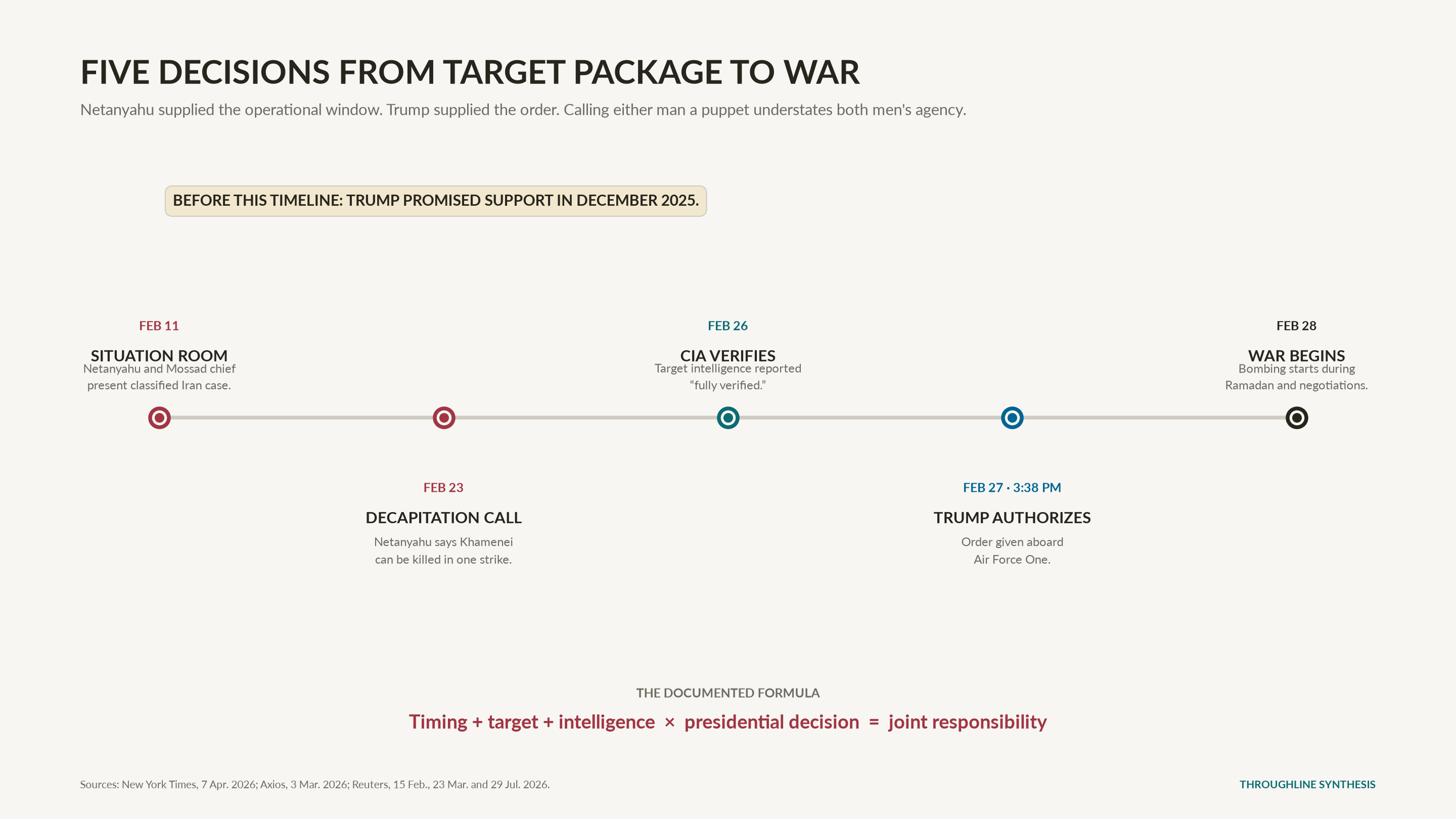
December 2025, Mar-a-Lago: “Netanyahu told Trump he was not fully satisfied with the outcome of the June joint operation. Trump indicated he was open to another bombing campaign but also wanted another round of diplomatic talks,” and told him he would back Israeli strikes on Iran’s missile program if negotiations failed (Reuters; Reuters). January 3, 2026: an American operation captured Venezuela’s president with no American deaths, which “demonstrated to Trump’s administration that ambitious military operations could have few collateral consequences for U.S. forces” (Reuters). One cheap success became a theory of consequence-free force.
February 11: Netanyahu arrives at the White House for “a highly classified presentation on Iran for President Trump and his team in the White House Situation Room,” a room “rarely used for in-person meetings with foreign leaders,” with Mossad Director David Barnea on screen and Rubio, Hegseth, Gen. Dan Caine, John Ratcliffe, Kushner and Witkoff present. The Times’ finding is explicit: “The decision by President Trump to give the go-ahead to join Israel in attacking Iran was influenced by a presentation by Prime Minister Benjamin Netanyahu in February” (NYT).
February 23: Netanyahu calls to say Khamenei and his top advisers would gather Saturday morning and “could potentially be eliminated in a single airstrike.” Trump orders CIA verification. February 26: the agency has “fully verified” the target set. Trump and Netanyahu held two in-person meetings and 15 calls in the preceding two months (Axios). Reuters reports Netanyahu argued, inside 48 hours, that “there might never be a better opportunity to kill Khamenei,” the window being the days before Khamenei went into hiding (Reuters). February 27, 3:38 p.m. EST: Trump authorizes Operation Epic Fury aboard Air Force One. February 28, about 9:45 a.m. in Iran: the war begins, during Ramadan, during negotiations. Netanyahu announces it himself: “in a powerful surprise attack, we destroyed the compound of the tyrant Khamenei in the heart of Tehran,” with a promise to “strike thousands of targets” (Prime Minister’s statement).
The correction that strengthens the charge: Trump was not a puppet. He promised support in December, ordered the strike himself, and by one Israeli account wanted to go earlier: “Trump wanted to strike earlier, in early January. It was Bibi who requested a delay,” with timing “fully coordinated” (Axios). A senior Israeli official called Trump the “senior partner” and Netanyahu the “junior partner” (Reuters).
Netanyahu supplied the timing, the target and the intelligence. Trump supplied the decision. Both are fully responsible. And the administration’s own stated reason for the timing was not Iranian action but Israeli action, in the Secretary of State’s words on the record: “We knew that there was going to be an Israeli action, we knew that that would precipitate an attack against American forces, and we knew that if we didn’t preemptively go after them before they launched those attacks, we would suffer higher casualties” (State Department). Speaker Mike Johnson, after his briefing: “Israel was determined to act with or without us” (Fox News). The United States entered a war of choice on another government’s operational schedule, its Secretary of State said so out loud, and nothing happened.
What the public was told differed from what was known. At the Saturday background briefing officials said the strikes came because Iran “was allegedly preparing to assault American forces in the vicinity”; “no intelligence supported this assertion,” and the administration “began making the case for war after the attack rather than before it” (Axios).
The internal dissent is nearly unanimous and on the record. Hegseth was “reportedly virtually alone among senior officials in supporting Trump’s decision to attack Iran,” while “[t]he secretary of state and CIA director opposed the idea.” The Director of National Intelligence warned Trump that killing the ayatollah would “likely usher in a more hard-line regime open to acquiring nuclear weapons,” that Iranians “would rush to close the Strait of Hormuz,” and that Iran “would strike U.S. forces and partners in the Middle East.” The Atlantic’s summary runs one sentence: “all of these things happened almost immediately after Trump gave the order to go to war” (The Atlantic).
His agencies predicted the outcome correctly, in advance, to his face. He went anyway, on the advice of the one senior official who agreed with him.
The vanishing Congress, and the money that makes silence affordable
There is no declaration of war and no authorization for force against Iran. There never has been.
Instead, on March 10, 2026, the administration wrote to the UN Security Council claiming the strikes were self-defense inside a war already underway. There was no such war: “there were no ongoing hostilities between the United States and Iran prior to the Trump administration launching a fresh attack upon Iran with a new label, Operation Epic Fury,” and, quoting Nuremberg, “[t]o initiate a war of aggression … is not only an international crime; it is the supreme international crime” (Just Security). More than 100 American legal scholars said the campaign broke the UN Charter’s ban on attacking another country, finding “no evidence that Iran posed an imminent threat” (Just Security). The Security Council then condemned the wrong country, censuring Iran’s counterstrikes and not the attack that came first, over China’s objection that “the United States and Israel launched military strikes without Council authorization” (UN SC/16315). The Secretary-General said the operation “squandered an opportunity for diplomacy” (UN News).
Congress then told him to stop twice, in words with no legal force, and killed the one measure that would have had teeth. In March, Thomas Massie’s resolution to end “unauthorized hostilities” failed the House (Congress.gov); Brian Fitzpatrick’s joint resolution, reciting that Congress “holds the sole power to declare war,” died in committee (Congress.gov). Then a concurrent War Powers Resolution directing Trump to end American involvement cleared the House 215 to 208 on June 3 and the Senate 50 to 48, completing passage on June 23, at which point Trump had still “not sought congressional approval for the conflict” and was claiming an April ceasefire satisfied the statute “despite ongoing active fighting.” A concurrent resolution needs no signature and carries no enforcement; Rep. Gregory Meeks called it a “significant bipartisan rebuke” of “an illegal war” (ASIL). On July 23 the House passed another non-binding rebuke 214 to 208 while the Senate killed Chris Van Hollen’s joint resolution, the kind that would bind, 47 to 49 (CNBC; NPR). Van Hollen: “There is no good way out of a bad war… This is an opportunity for this Congress to finally take responsibility” (CNBC).
Both chambers voted to end the war, and the war continued, because they chose the instrument that cannot be enforced. Forty-seven senators voted for the one that could and lost. Congress holds the purse and declined to close it. This is a legislature expressing itself through resolutions it knows are unenforceable, which is institutional suicide with excellent manners.
What makes silence cheaper than dissent is partly documented in dollars. AIPAC spent at least $104.3 million in the 2026 cycle, a figure excluding “spending by super PACs quietly bankrolled by AIPAC,” including $30.6 million in a single Michigan Senate primary, “the most money AIPAC has ever devoted to a single race,” against a candidate who won anyway (Common Dreams). Its super PAC was “the single largest outside spender of the 2026 cycle” at $54 million (France 24). Miriam Adelson gave $40 million in the first quarter of 2026, after $106 million in 2024 (VINnews; InfluenceWatch).
Two disciplines. First: no source documents any donor or lobby demand for war with Iran. The mechanism is not purchased strikes; it is the price of dissent. The cleanest documented link between pro-Israel money and Iran war-powers politics is that the Republican Jewish Coalition spent $2.9 million trying to defeat Thomas Massie in a primary (JNS). Massie wrote the resolution to end the war. That is not a theory. It is a disbursement.
Second, said once and then never defensively again: a lobby is not a community, and this community is the most antiwar constituency in the country. J Street/GBAO, 800 registered Jewish voters, late March: 60 percent oppose, 40 percent support, with 89 percent also disapproving of the Iranian regime and 77 percent saying Trump has no clear plan (J Street; deck). The Jewish Electorate Institute and Mellman Group, a separate 800-person sample and a different mode: 55 percent disapprove, 32 percent approve (JEI). The internal spread belongs in the record: Reform Jews opposed 86 to 14, Orthodox Jews supported 70 to 30 (Jewish Insider). The counter-evidence gets its hearing: a Jewish People Policy Institute panel of “connected” Jews found 68 percent support in March (Times of Israel), on a sample the institute says “is not representative of all US Jews,” and by August that panel had 64 percent calling the campaign a failure (Israel National News).
General-public opposition ran 58 percent in the same period, in a Fox News poll the same J Street deck cites. Jewish Americans were marginally more opposed to this war than Americans in general. Anyone answering evidence of political spending by conflating spenders with a religion is not defending Jews; they are using them as cover for a war Jewish voters oppose by twenty points.
The killing floor
The war’s central product is dead civilians, and the capacity to count them has been cut on purpose. Nothing in the sections that follow, on money or machinery, outranks this.
Minab: a school, a seven-year-old map, and a second pass
On the war’s first morning, February 28, 2026, a strike destroyed a primary school in Minab, Hormozgan. The UN fact-finding mission recorded “over 165 people reportedly killed; the vast majority appeared to have been schoolgirls” (A/HRC/61/60), and the mission’s chair put it at “more than 168 people… the vast majority girl students, many as young as seven years old” (UN News). The BBC, after visiting in July, reported 156 confirmed dead, including 120 children and a pregnant woman (BBC).
Whose bomb it was is no longer really in dispute, only who will say so. Weapons analysts examining verified video identified the munition that hit the adjoining IRGC compound as a US Tomahawk cruise missile, which “neither Israel nor Iran is known to possess,” and American military maps confirmed US operations in the Minab area at the time; a preliminary US assessment reportedly found American forces “likely” responsible but not deliberately aiming at the school (BBC). The New York Times then reported that US military officials privately acknowledged American forces carried out two strikes on the school, the second of which the military itself called a “double tap”; that the targeting used imagery seven years out of date that did not show the school; and that at least two people who assessed the site knew a building appeared to have been converted into a school, and that this was never passed to the officers picking targets (NYT).
The rule is not complicated. Before firing, find out what you are firing at, using current information. Firing a second time after survivors and rescuers gather is harder still to defend. More than a hundred days later, no findings had been published and no public admission made.
The official answers, in order. Trump first blamed the other side: “We believe it was carried out by Iran because, as you know, their munitions are very imprecise” (BBC). Hegseth said American forces “never target civilian targets.” The CENTCOM commander told Congress the inquiry was “complex” because the school sat “on an active IRGC cruise missile base,” which Iran’s foreign ministry called a “baseless fabrication” (BBC). Nobody alleges the school was deliberately targeted; the working American explanation is an intelligence failure.
Then the President, at the G7, on the deadliest American civilian-casualty incident since 1991: “Mistakes are made. War is nasty.” And: “Nobody did that on purpose” (NYT).
A teacher in Minab, Amaineh Nademi: “What was these children’s crime? Did they carry weapons? A pencil, a book, a notebook and a schoolbag” (BBC). The UN human rights office: “Children, little girls… at the beginning of the school day being killed in this manner, backpacks with bloodstains on them, this is absolutely horrific,” and “the onus is on the forces that carried out the attack to investigate it” (UN News).
Kuhestak, six months later
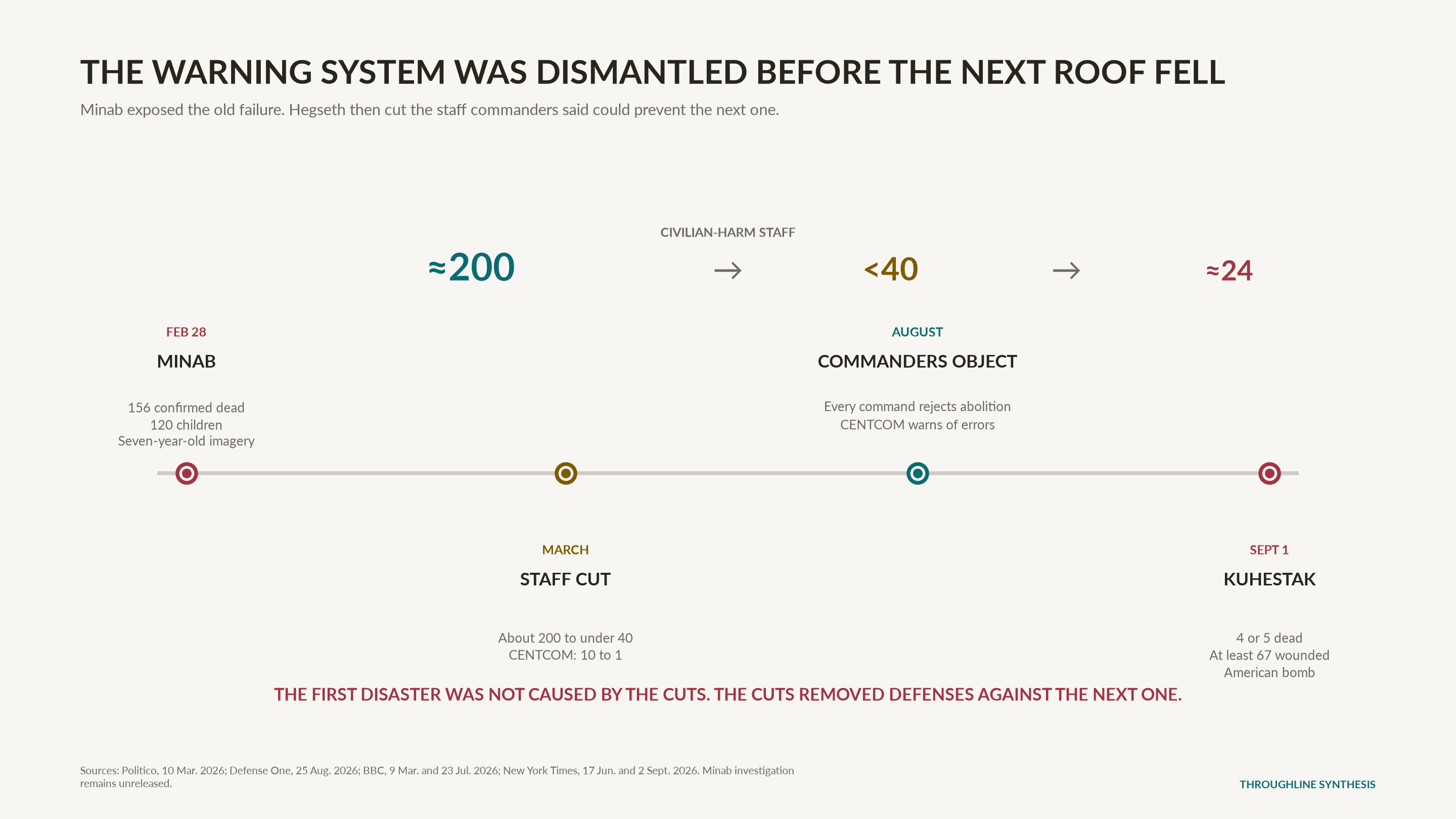
September 1, about 9:30 p.m. A wedding at a home. The roof came down. The Times found the bomb “had been released by American forces,” killing “[a]t least five wedding guests … including a 6-year-old boy” and wounding at least 67 more per Iran’s Red Crescent Society (NYT); the AP counts four dead including children aged 4 and 16 (AP). Twenty-one hours later the President proposed putting his name on the strait.
The office that counts the dead was gutted while the bombs fell
Congress created the Pentagon’s Civilian Harm Mitigation and Response program. By March 2026, weeks into the war, Politico documented a cut of “roughly 90 percent,” from about 200 staff to under 40, with CENTCOM’s team dropping “from 10 to one.” The mechanism, exactly: “Hegseth can’t close the offices because they are approved by Congress. But he has managed to make them nearly inoperable.” Wes Bryant, the former chief of civilian harm assessments, on Minab: “The fact that our secretary of Defense, that our Central Command commander, cannot actually tell us whether or not they dropped a bomb in this location, that is so unbelievably unacceptable” (Politico).
By August it was worse, and the military objected in writing. Hegseth offered commanders three options: cut the program 65 percent, shrink it to a Washington office, or eliminate it. Every commander rebuffed elimination; two “declined all three options, asking to maintain the full program.” CENTCOM’s written objection argues competence, not mercy: elimination would “result in decreased efficiency of U.S. lethal operations due to an increased risk of target misidentification,” and the program “enhanced our precision and accuracy, making us more lethal.” Gen. Erik Kurilla appealed and “that intent was overridden.” Staffing fell to “around two dozen, some working only part time” (Defense One).
The officers fighting the war said civilian protection made them better at it and asked to keep it. The Secretary of Defense cut it anyway, over unanimous objection, in a campaign whose first morning killed a school with a seven-year-old map. Parsi’s claim that Minab is connected to “the removal of civilian-protection safeguards and personnel” (Democracy Now!) rests on those documents.
Asked on June 10 how strikes on bridges and electrical infrastructure “would not be a war crime,” Hegseth called the question “disingenuous” and accused the reporter of “impugning the motives” of the military, without ruling out strikes on civilian infrastructure: “If we need to negotiate with bombs, we’ll negotiate with bombs” (Al Jazeera). His “no stupid rules of engagement” line came “just days after hundreds of Iranian schoolgirls were tragically killed in a missile strike,” Senator Jack Reed told him, along with “troubling statements about showing no mercy and no quarter to the Iranians, orders that would constitute war crimes” (Guardian).
Five theaters, two men, different debts
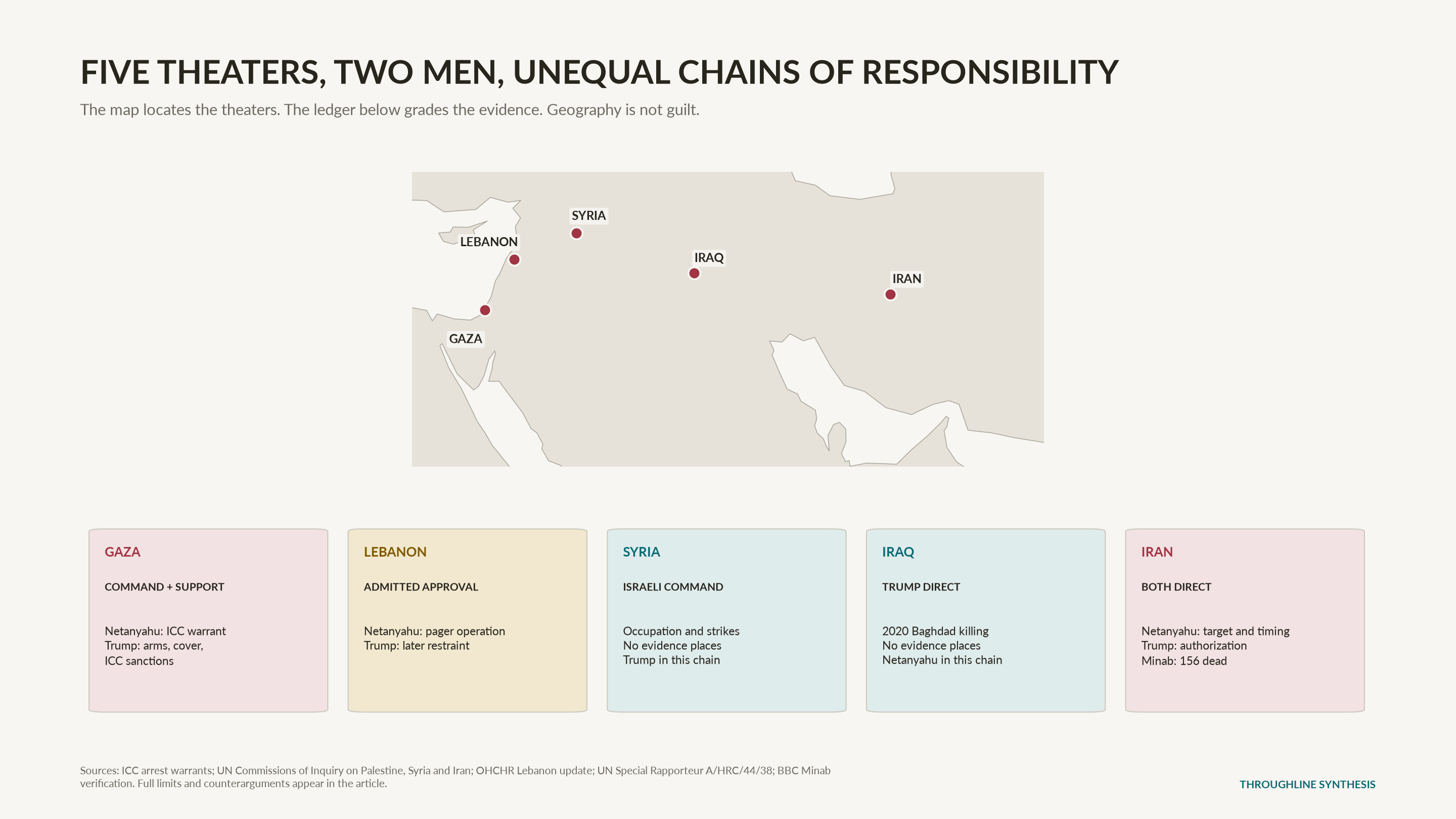
Trump and Netanyahu are not interchangeable, and pretending otherwise wrecks the case. In some places one ordered the strike. In some places the other did. In one place both did. In some places the exposure is money, weapons and cover rather than command. Sorted by theater, plainly.
Iran: both men, by name, in their own words
This is the one theater where personal command is documented for both. Netanyahu’s own office, February 28, 2026: “Israel and the United States launched a combined operation to remove the existential threat posed to Israel by the regime of the Ayatollahs in Iran,” and “in a powerful surprise attack, we destroyed the compound of the tyrant Khamenei in the heart of Tehran.” He promised to “strike thousands of targets,” told Iranians to “take to the streets to finish the job,” and thanked “my friend, President Donald Trump, for his historic leadership” (Prime Minister’s statement).
Trump the same day, to Iran’s security forces: “lay down your weapons and have complete immunity, or, in the alternative, face certain death” (BBC). His own White House later published the war aims in his voice, “First, we’re destroying Iran’s missile capabilities…”, alongside Hegseth’s: “The mission is laser-focused: obliterate Iran’s missiles and drones and facilities that produce them” (White House).
The cost, from UN and WHO records rather than compilations. In the twelve-day war of June 2025 the fact-finding mission put deaths at 1,082 to 1,190, including 182 to 436 civilians, against 31 killed in Israel (A/HRC/61/60). For the 2026 war, the UN’s humanitarian update counts more than 2,100 civilians killed and more than 27,900 injured, with 3.8 million people affected, from February 28 to March 30 alone, including 216 children, 251 women and 24 health workers, with 115,193 civilian units damaged, among them 763 schools, and WHO verifying 23 attacks on health care (UN humanitarian update No. 2). The Special Rapporteur put displacement inside Iran at three million by mid-March and reported destroyed hospitals and heritage sites, plus strikes on oil infrastructure causing “toxic environmental consequences… in a country that was already experiencing acute water shortages” (UN News). The mission says plainly it “was unable independently to verify the overall casualty figures in Iran or Israel,” blaming the scale, the internet blackout and Iran’s refusal of access (A/HRC/61/60).
The cleanest Israeli case is Evin prison, June 23, 2025. Strikes hit the visitation hall, a medical centre, the prosecutor’s office and prison wards during visiting hours, killing 79 to 80 people including at least one child and eight women. The mission “found no information indicating the presence of military personnel, weapons or military installations within the prison compound or its vicinity at the time,” while Israeli officials asserted, “without providing supporting evidence,” that intelligence operations were running inside (A/HRC/61/60).
Two things cut the other way. Iran’s government kills its own people at scale: the same mission records over 7,000 killed in protest crackdowns from late December 2025, 1,639 executions in 2025, and 222 in October 2025 alone, the highest monthly total in at least 25 years (A/HRC/61/60). And no court or UN organ has called this war an act of aggression. The Secretary-General condemned it, saying “[t]he use of force by the United States & Israel against Iran, and the subsequent retaliation by Iran across the region, undermine international peace & security” (UN News), while the only Security Council resolution on the war, 2817 of March 11, 2026, was adopted 13 to 0 and condemned Iran’s counterstrikes rather than the attack that started it (UN SC/16315).
Gaza: Netanyahu is a wanted man, Trump is the shield, and Trump also stopped the main phase
On November 21, 2024 the International Criminal Court issued arrest warrants for Netanyahu and then defence minister Yoav Gallant. The judges found reasonable grounds to believe the two “intentionally and knowingly deprived the civilian population in Gaza of objects indispensable to their survival, including food, water, medicine and medical supplies, fuel and electricity,” and charged them as co-perpetrators of starvation as a method of warfare, murder, persecution and other inhumane acts, and as civilian superiors for directing attacks at civilians (ICC). Say what that is and is not: it is a judicial finding that there are reasonable grounds to arrest him. It is not a conviction. There has been no arrest and no trial, and the court’s own appeal judges upheld admissibility only 3 to 2 (Just Security).
Separately, UN investigators concluded in September 2025 that four of the five acts listed in the Genocide Convention had been committed in Gaza and that “Israeli President Isaac Herzog, Prime Minister Benjamin Netanyahu and then Defence Minister Yoav Gallant have incited the commission of genocide” (Commission of Inquiry). That is investigators, not a court, and Israel’s answer is on the record: it “categorically rejects the libelous rant published today by the Commission of Inquiry,” accusing it of omitting Hamas’s atrocities and relying on “manipulated and unverified sources” (Israeli statement).
The harm, with the sourcing named. The Gaza health ministry counts 68,858 killed and 170,664 injured to October 31, 2025, including 20,179 children and 463 people starved to death; within that, OHCHR’s own verification recorded 4,528 killed in attacks on residential buildings, 1,677 killed in attacks on tents, and 2,079 people killed trying to reach food, 53.3 percent of them near the American-endorsed Gaza Humanitarian Foundation sites (OHCHR accountability snapshot). The World Court recorded that Israel “substantially restricted, and for this period completely prevented, the entry and distribution of aid, including food and water” from March 2 to May 18, 2025 (ICJ), and famine was formally confirmed in Gaza governorate for July and August 2025 (IPC Famine Review Committee). These cumulative totals are ministry figures the UN publishes while running slower verification of its own, which yields smaller confirmed counts: 685 verified deaths against more than 1,100 reported for October 2025 to mid-April 2026 (OHCHR). The starting point is also in the record: more than 1,200 killed and 251 abducted in Israel on October 7, 2023 (ICJ).
No court or commission names Trump for Gaza. What the record shows is a different debt. He said of Gaza on February 4, 2025: “The US will take over the Gaza Strip and we will do a job with it, too. We’ll own it,” and that Palestinians should go “to other countries of interest with humanitarian hearts” (Al Jazeera); the UN human rights chief answered that “any forcible transfer or deportation of Palestinians from occupied territory would violate international law” and is “strictly prohibited” (Anadolu). Then he went after the court. Executive Order 14203 declared the ICC’s conduct “an unusual and extraordinary threat to the national security and foreign policy of the United States,” called the warrants against Netanyahu and Gallant “baseless,” blocked the property of designated court personnel and named the prosecutor (White House). In July 2025 the State Department sanctioned the UN special rapporteur on Palestine for having “directly engaged with the International Criminal Court” (State Department). A president put the world’s war-crimes court under emergency sanctions to protect a foreign leader it wants to arrest, and the court did not blink.
And the concession that any honest account has to carry: Trump ended the main phase. The ceasefire took effect on October 10, 2025, and on November 17 the Security Council endorsed his plan 13 to 0, with China and Russia abstaining (Security Council). What followed is the argument. OHCHR, nine months on: “still, nowhere is safe for Palestinians in Gaza,” with 685 verified deaths since the ceasefire, 283 of them women and children (OHCHR).
Lebanon: Netanyahu signed the pagers, Trump pulled the leash
Netanyahu’s own spokesman confirmed the most indiscriminate operation of the entire period: “Netanyahu confirmed Sunday that he greenlighted the pager operation in Lebanon” (DW). UN human rights experts said booby-trapping thousands of devices could not “verify each target or distinguish between protected civilians and people who could potentially be attacked,” that simultaneous detonation “would inevitably violate humanitarian law,” and that the attacks “could constitute war crimes of murder, attacking civilians, and launching indiscriminate attacks.” At least 32 people were killed and 3,250 injured, about 500 with severe eye injuries (OHCHR). Nobody has to infer the chain of command here. The prime minister’s office announced it.
Hezbollah started the 2026 round, firing on March 2 after Khamenei was killed. What followed, in Lebanese government figures published by OHCHR: at least 1,029 killed and 2,786 injured between March 2 and 22, including at least 118 children and 40 health workers, with more than one million people displaced and 134,377 in collective shelters, under 71 Israeli warnings affecting more than 14 percent of Lebanon. OHCHR verified strikes on homes and clinics, including three paramedics killed at a health centre in Qlayleh and nine killed in Arkey, seven from one family, and said it was “not aware of any specific advance warning issued prior to each attack,” concluding that Israeli forces “may have failed to comply with international humanitarian law, specifically the principles of distinction, proportionality or precautions in attack” (OHCHR). Amnesty said strikes on roughly 30 branches of a financial association “must be investigated as war crimes,” since alleged links to an armed group “do not, on their own, turn a civilian or civilian building into a military objective” (Amnesty).
Trump’s Lebanon record runs the other way, and it should be said as plainly as the rest: he barred further Israeli airstrikes in April 2026 and announced a three-week ceasefire extension, saying only that “Israel is going to have to defend itself if they’re shot at, and they will. I would never say that they can’t,” with any response to be “surgical” (Public Papers of the Presidents).
Syria: Netanyahu took land, Trump’s receipt is Raqqa
UN investigators covering December 2024 to January 2026 found that after Assad fell, Israel “intensified its air operations,” “occupied additional Syrian territory” and “established military bases,” with over 1,000 reported airstrikes and more than 900 reported incursions in Quneitra, crossing the 1974 disengagement line by up to 20 kilometres. Their conclusions are unusually direct: ordering residents of Hamidiyah and Hurrya from their homes without protection or military necessity “may constitute forced displacement” and “may amount to war crimes”; seizing and looting the Quneitra governorate building and destroying the court archive “may amount to pillage”; and deliberate destruction of homes, buildings and roads without a military aim is prohibited outright. More than 15 buildings were bulldozed in Hamidiyah on June 16, 2025, and orchards were razed near Jubbata al-Khashab (A/HRC/61/62). A UN assistant secretary-general on the July 2025 strikes on Damascus: “In addition to violating Syria’s sovereignty and territorial integrity, Israel’s actions undermine efforts to build a new Syria at peace with itself and the region” (UN News).
Trump’s Syrian receipt is older and his own: Raqqa, 2017. Amnesty investigated 42 strike sites and interviewed 112 residents and found coalition air and artillery strikes “killed and injured thousands of civilians, including in disproportionate or indiscriminate attacks that violated international humanitarian law and were potential war crimes,” with US forces responsible for more than 90 percent of strikes and admitting to 30,000 artillery rounds whose margin of error exceeds 100 metres (Amnesty). The coalition’s answer, worth printing at full strength, was that there had “never been a more precise air campaign in the history of armed conflict.” Nothing in the record puts Trump in Israel’s Syrian occupation, or Netanyahu in Raqqa. Two separate debts.
Iraq: Trump’s alone
The Pentagon said the January 3, 2020 strike that killed Qassem Soleimani was carried out “at the direction of President Donald Trump.” A UN special rapporteur examined it and concluded it was “an arbitrary killing for which, under IHRL, the US is responsible,” that there was “no evidence that General Soleimani presented an imminent or even actual threat to life,” that American justifications were “remarkably vague and inconsequential,” that nine others died without individual assessment, five of them Iraqi civilians, and that the strike broke the UN Charter’s ban on force and amounted to an act of aggression against Iraq. The same report found Iran’s retaliatory missile strikes unlawful too, because “armed attacks for purposes of retaliation are never permissible” (A/HRC/44/38).
Six years later Iraq is a target again. US jets struck a Popular Mobilization Forces base at Habbaniyah in late March 2026, killing 16, then struck an Iraqi army base and clinic there the next day, killing 7, the worst loss for Iraqi troops since the war began; an Iraqi general put total Iraqi deaths at about 100 since February 28. Washington denied hitting a clinic. Iraq’s defence ministry called it “this aggression” (El País). In late July, joint Saudi-US strikes hit bases in seven provinces, killing at least 20 PMF members and four IRGC advisers; Iraq’s National Security Council called it “a flagrant violation of Iraq’s sovereignty and the sanctity of its lands” and said “[a]ny transgression or compromise of Iraq’s security and sovereignty will not be tolerated under any circumstances” (Al Jazeera). The rule here is the simplest in the file: you do not use force on another country’s territory without its consent. Iraq says it did not consent.
One older Iraqi receipt sharpens the Minab pattern. In Mosul on March 17, 2017, one 500-pound American bomb aimed at two snipers set off explosives inside the building, killing 101 civilians sheltering below plus four next door; CENTCOM’s own investigation found the strike lawful because the secondary blast “could not have been predicted” (CENTCOM). Take that at face value and the question stands: if American intelligence cannot tell its own pilots a hundred people are sheltering there, the duty to check was not met. Nothing in the record puts Netanyahu in Iraq, and this article does not put him there.
What the institutions have actually decided
No court has convicted either man of anything in any of these five countries. What exists is narrower and still damning. Netanyahu is wanted under an ICC arrest warrant for starvation, murder, persecution, other inhumane acts and directing attacks at civilians, with no arrest and no trial (ICC). UN investigators say he incited genocide, and Israel rejects it flatly (Commission of Inquiry; Israeli statement). A UN rapporteur found the killing Trump ordered in Baghdad unlawful and an act of aggression, with no enforcement behind the finding (A/HRC/44/38). For most of the 2026 conduct in Iran, Lebanon and Iraq, there is documented harm and no adjudication at all.
So here is the plain version. American bombs killed a school full of children in Minab and a wedding party in Kuhestak. American forces carried out two strikes on that school using a seven-year-old map, and a warning that the building had become a school never reached the people choosing targets. Congress never authorized the war. Legal scholars say it broke the UN Charter’s ban on attacking another country. The Secretary of Defense cut the staff whose job was to spot and prevent exactly these deaths, over his commanders’ written objections, and the President’s answer was that war is nasty. Some of this may be criminal; that turns on intent and on courts that will probably never sit, so it is not claimed here. None of the rest depends on it.
Pax Silica: the machinery that outlasts the war
This is an institutional claim, not a conspiratorial one.
Pax Silica is official and has a URL. “Pax Silica is the Department of State’s flagship effort on AI and supply chain security,” launched December 12, 2025 on a non-binding declaration candid about who acts: “We believe in mobilizing the immense creative and financial power of private industry and entrepreneurship,” and “we will endeavor to provide access to trusted partners to the full stack of technological advancements that are shaping the AI economy” (state.gov). Membership reached 24 by the June 2026 summit (Brownstein Hyatt). The Atlantic Council reads the name without embarrassment: it “means peace underpinned by the dominance or centrality of technology” (Atlantic Council).
The load-bearing fact is a personnel fact. Jacob Helberg became Under Secretary of State for Economic Affairs in October 2025; his official biography states he “served as Senior Advisor to the CEO of Palantir Technologies” (state.gov). His confirmation “advanced with no substantial discussion of his conflicts of interest,” and he planned to retain stakes in “a large portfolio of companies that stand to benefit from Helberg’s work,” including OpenAI, SpaceX and Anduril, while admitting “a heightened risk of conflicts of interest” (Sludge). His disclosure listed $112 million to $426 million or more in assets, and his ethics agreement “reveals that he retained his interests in the Founders Fund and Khosla Ventures.” In March 2026 he announced a Pax Silica fund to invest $4 trillion in energy, minerals and semiconductors (Revolving Door Project).
A serving Under Secretary, formerly senior adviser to Palantir’s chief executive, with retained exposure to Peter Thiel’s fund, announcing a four-trillion-dollar vehicle. That is not a leak, it is a press release.
The instruments move around Congress. Export financing as statecraft: the ExportAI Initiative has the Export-Import Bank underwriting foreign purchases of American AI, conditioned on Commerce licensing Nvidia chips first, and “[i]t remains unclear which nations and companies will benefit” (Reuters). Equity stakes as off-books industrial policy: “roughly $26.7 billion across 30 equity or quasi-equity deals,” including 9.9 percent of Intel “now worth $42 billion,” with positions “scattered across at least four agencies,” the earlier CHIPS Act “clawback and profit-sharing provisions … also eliminated,” and the government agreeing “to vote with Intel’s board on most matters” (Fortune). Licensing as reward: on July 10, 2026 Commerce granted the UAE license-free access to advanced computing items and said it would “favorably review” applications from MGX, making the UAE “the only country in the group that is not a member of multilateral export control regimes” (Reuters). Hold that fact; it returns in the next section wearing a different hat.
And the war pays the contractors in writing. Palantir holds an Army enterprise agreement “worth up to $10 billion over a decade” and a targeting contract elevated to a Pentagon-wide “program of record,” “ensuring continued funding and long-term deployment” (Military.com). On August 4, 2026, Deputy Defense Secretary Steve Feinberg, founder of the private-equity firm Cerberus, directed the Pentagon to commit “as much as $244 million for Palantir’s services until March 2027” without specifying programs, “in light of military operations in Iran that have significantly depleted critical U.S. munitions reserves” (Federal News Network).
The munitions the war consumed become the argument for the contract that replaces them, signed by a private-equity founder serving as the Pentagon’s second-ranking official.
Now the limits, because they make the rest usable. Thiel’s Israel position is his own: “my bias is to defer to Israel… And I believe that broadly the IDF gets to decide what it wants to do, and that they’re broadly in the right,” with Israel “a paying client” of Palantir (Responsible Statecraft). Palantir’s platform also “has served as the analytical backbone of the IAEA’s Iran monitoring operation” (Byline Times); that outlet’s further account of a data-to-strike chain is single-source and is not adopted here. No source shows Thiel advocating this war, and none shows Pax Silica members coordinating Iran policy. What survives the concession is the claim that matters: a non-binding, executive-only architecture with sovereign and corporate signatories, discretionary licensing, and $26.7 billion in equity a business magazine could not locate has moved economic-security policy outside appropriation and treaty. That machinery did not start the war. It will still be here when the war ends, and Congress still will not control it.
The family business
The graft is not an allegation. It is a filing, submitted by the President.
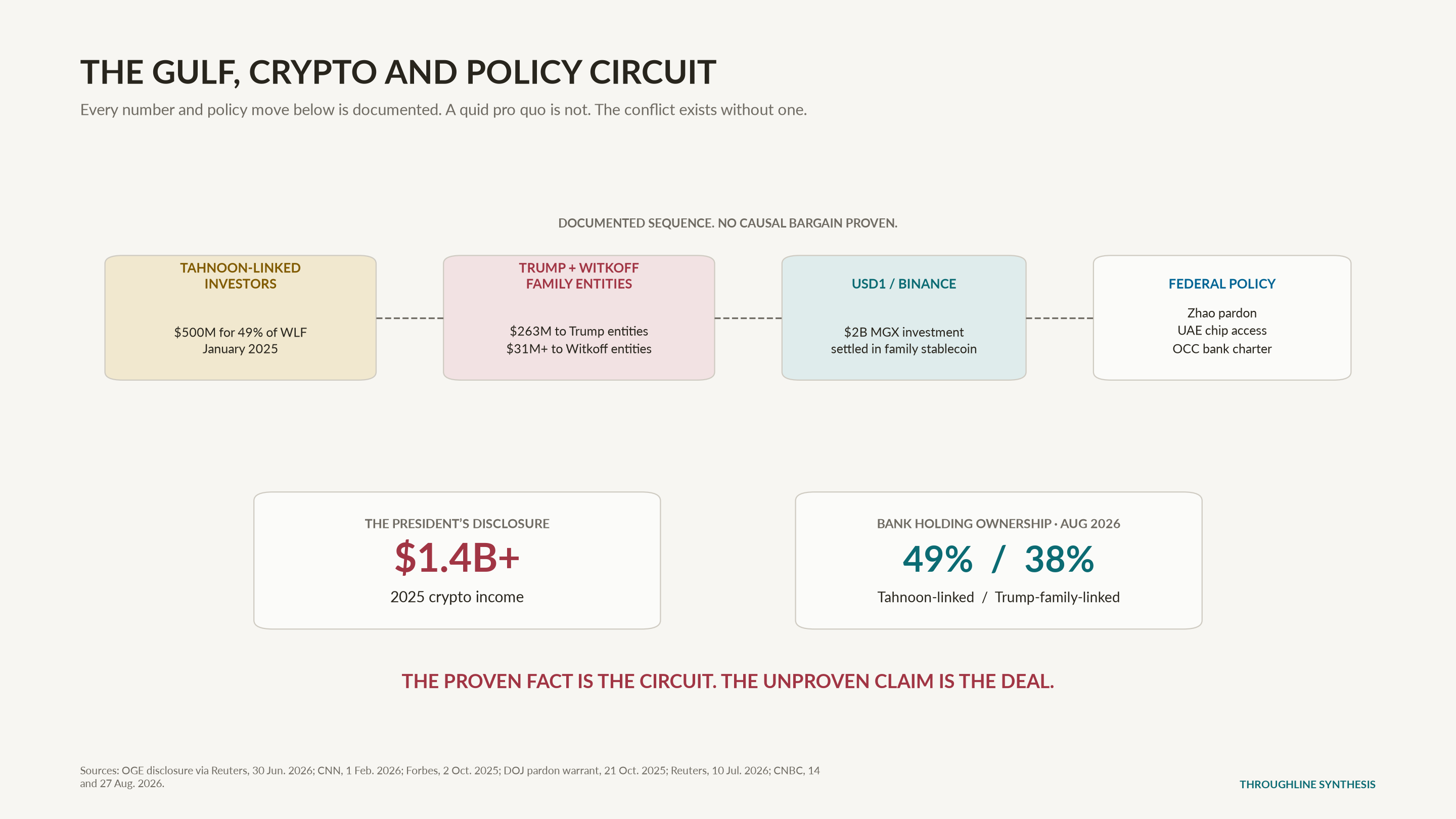
His June 2026 disclosure to the Office of Government Ethics reports more than $1.4 billion in 2025 crypto income: “almost $800 million from World Liberty Financial, a crypto venture he and his sons co-founded,” more than $520 million from token sales, more than $250 million from selling interests in the business, and “another $635 million from the sale of his Trump meme coins,” against $57.35 million in token-sale income the prior year, a nine-fold leap. On control, Reuters is precise: “the president remains the beneficiary of the assets in the trust that ultimately receives the income” (Reuters).
Who paid for it: “the Trump family has used this template to generate at least $2.3 billion in profit from investors… the more than a million investors whose net losses totaled $2.3 billion at the end of April,” on startup costs for the two largest ventures of “less than $1 million, and possibly much less” (Reuters; Reuters). Public Citizen puts investors “at least an estimated $4.7 billion underwater,” mostly unrealized (Public Citizen). The proceeds did not stay in tokens: “his portfolios of stocks and bonds increased at least fourfold as the crypto money flooded in” (Reuters). Retail kept the coins, bought at $0.015 and $0.05, on a two-year cliff and a four-year unlock (World Liberty docs). Concede the point that cuts the other way: Trump’s own 15.75 billion tokens carry “a longer vesting schedule than the general public” (Reuters). He is not dumping coins. He did not need to. Issuance was the business.
World Liberty’s own governing document names WC Digital Fi LLC, an “[a]ffiliate of Steve Witkoff and certain of his family members,” as receiving a service-agreement allocation, lists “Donald J. Trump, Chief Crypto Advocate,” and in the same file denies that any Trump “is an officer, director, founder, or employee of, or manager, owner or operator of” the company (WLF Gold Paper). The company states it is 38 percent owned by “an entity affiliated with Donald J. Trump and certain of his family members” (CNBC).
The foreign-money chain, in order, with the causal claim withheld.
| Date | The money | The policy |
|---|---|---|
| Jan. 2025, four days pre-inauguration | Investors described as “lieutenants of Sheikh Tahnoon bin Zayed Al Nahyan,” the UAE’s national security adviser, buy 49% of World Liberty for $500M; $187M up front to Trump family entities, $31M+ to Witkoff family entities, with $263M to Trump entities per his own disclosure (CNN; CNBC) | |
| May 2025 | Abu Dhabi’s MGX settles a $2B Binance investment in USD1, the family stablecoin; Binance comes to hold ~75% of USD1’s market cap (Forbes) | |
| Jul. 18, 2025 | The GENIUS Act creates the federal stablecoin framework, which the White House says will drive “demand for U.S. Treasuries” (White House) | |
| Oct. 21, 2025 | Trump grants Binance founder Changpeng Zhao “A FULL AND UNCONDITIONAL PARDON” (DOJ warrant) | |
| Nov. 2025 | Trump “agreed to transfer advanced AI technology to the UAE” (Democracy Defenders Fund) | |
| Jul. 10, 2026 | Commerce grants the UAE license-free AI chips and pledges to “favorably review” MGX applications (Reuters) | |
| Aug. 14, 2026 | The OCC conditionally charters World Liberty Trust Co., chaired by Zach Witkoff (CNBC) | |
| Aug. 27, 2026 | StringZ Holding RSC, behind which stand Sheikh Tahnoon “and his co-investors,” is reported to hold 49% of the bank’s holding company; a Trump-family entity holds 38% (CNBC) |
Throughout that sequence, Steve Witkoff was the President’s lead Iran negotiator, his son ran the company, and the ethics office had not certified his disclosure more than seven months after filing, against a 60-day norm (Democracy Defenders Fund). Chief counsel Virginia Canter: “Unlike the president, Witkoff is subject to criminal conflict of interest laws, and the public deserves to know whether Witkoff held an interest in World Liberty Financial while he was engaged in Middle East peace negotiations involving the UAE” (Democracy Defenders Fund).
The denials, on the record. World Liberty: “Neither President Trump nor Steve Witkoff had any involvement whatsoever in this transaction,” and White House Counsel David Warrington says Witkoff “has also divested from World Liberty Financial” (CNN). The President’s own version: “By the way, I could know about it. I didn’t. I mean, there’s nothing illegal, there’s nothing wrong with it. I could know” (The Hill). The rebuttal is documentary: the stakes “reside completely in his revocable trust, of which he is the sole donor and sole beneficiary,” and “[t]he Trump Organization itself confirmed in an April 2025 regulatory filing in the United Kingdom that Trump retains control over his businesses while in office” (Public Citizen).
On enforcement: SEC crypto actions fell to 13 in 2025, “a 60% decline,” with penalties “less than 3%” of 2024’s (Cornerstone Research). The Binance conduct the Justice Department prosecuted for $4.3 billion included “illegal transactions between U.S. users and users in sanctioned jurisdictions such as Iran” (FactCheck.org). Its founder was pardoned five months after his exchange became the dominant holder of the family stablecoin.
Every payment, date, percentage and pardon above is documented. What nobody has produced is a deal. No record here shows money buying a policy, and none is claimed. The sequence does not need one. A federally chartered trust bank, 49 percent held by a vehicle behind which stand a Gulf state’s national security adviser and his co-investors, 38 percent held by the President’s family, approved by the President’s own regulator, while the President prosecutes a war in that Gulf through a negotiator whose son runs the company. The question is not whether it is legal. It is why a country would allow it.
Three men and a war
No diagnosis appears here; observable conduct is more damning and harder to dismiss.
Pete Hegseth. Army Chief of Staff Gen. Randy George asked for a meeting on April 1, 2026. “He never had the meeting. The next day, he was fired.” Hegseth “has fired more than two dozen senior officers” and “personally removed at least 45 officers from promotion lists this year,” producing what a Pentagon official called “mass paranoia”: “there’s no delegation, there’s no trust. And if there’s no delegation or trust, policy decisions can’t be made” (CNN). On August 14 four four-star commanders filed formal “non-concurs” against keeping more than 50,000 troops in the Middle East, the naval chief saying the Navy “could not sustain its current level of commitment because no end date had been set” (Guardian). Army Secretary Dan Driscoll resigned over “Hegseth’s blocking those efforts specifically by firing the Generals who were responsible,” leaving the Army with no Senate-confirmed civilian or uniformed leadership mid-war (The Atlantic; Axios). The Pentagon’s spokesman called munitions-shortage reporting “false” and the arsenal “deep, ready” (Axios) in the same week Reuters reported the bombing halted “after warnings from military officials that munitions were being used up and meaningful targets were running out” (Reuters). Senator Reed named the mechanism: “I am concerned that you have been telling the president what he wants to hear instead of what he needs to hear,” and “[y]ou are hollowing out our military defensive experience and highest-performing senior officers” (Guardian).
Steve Witkoff and Jared Kushner. Both “were real estate businessmen with no government experience,” and “Iranian officials were confused when the White House again sent Kushner and Witkoff, neither of whom has a background in nuclear policy”; Kushner told prior envoys, “I don’t need a headache, and I don’t need a history lesson” (TIME). Witkoff was “smart but intermittent,” treated Iran’s program as “a bad investment,” cut briefings short, and was “most responsive on Signal,” while career nuclear experts “were consulted only intermittently” (CNN). Senator Mark Kelly: “You can’t send the two real estate developers to negotiate a peace with another region” (The Hill).
Scott Bessent. January 28, asked whether the United States was intervening to support the yen: “Absolutely not” (Reuters). By August, Treasury had executed “the first joint intervention in the Japanese yen in 15 years,” selling euros rather than dollars, and per the American Prospect without consulting the European Central Bank, which was “infuriated and offended” (CNBC; American Prospect). On February 4 he said he “was wrong when he said tariffs could be inflationary” (Reuters); eight days later the New York Fed reported that “90% of the tariffs … are borne by American consumers and companies” and that “foreign exporters did not lower their prices at all” (Reuters). On August 24 he predicted economic pressure made it “likely there will not be a large-scale kinetic [military] restart” (House of Commons Library); six days later the United States struck Larak Island (CNN). Asked about the President’s family earning a billion dollars from an industry his department regulates: “I don’t think there’s an appearance problem” (The Hill).
The two Treasuries
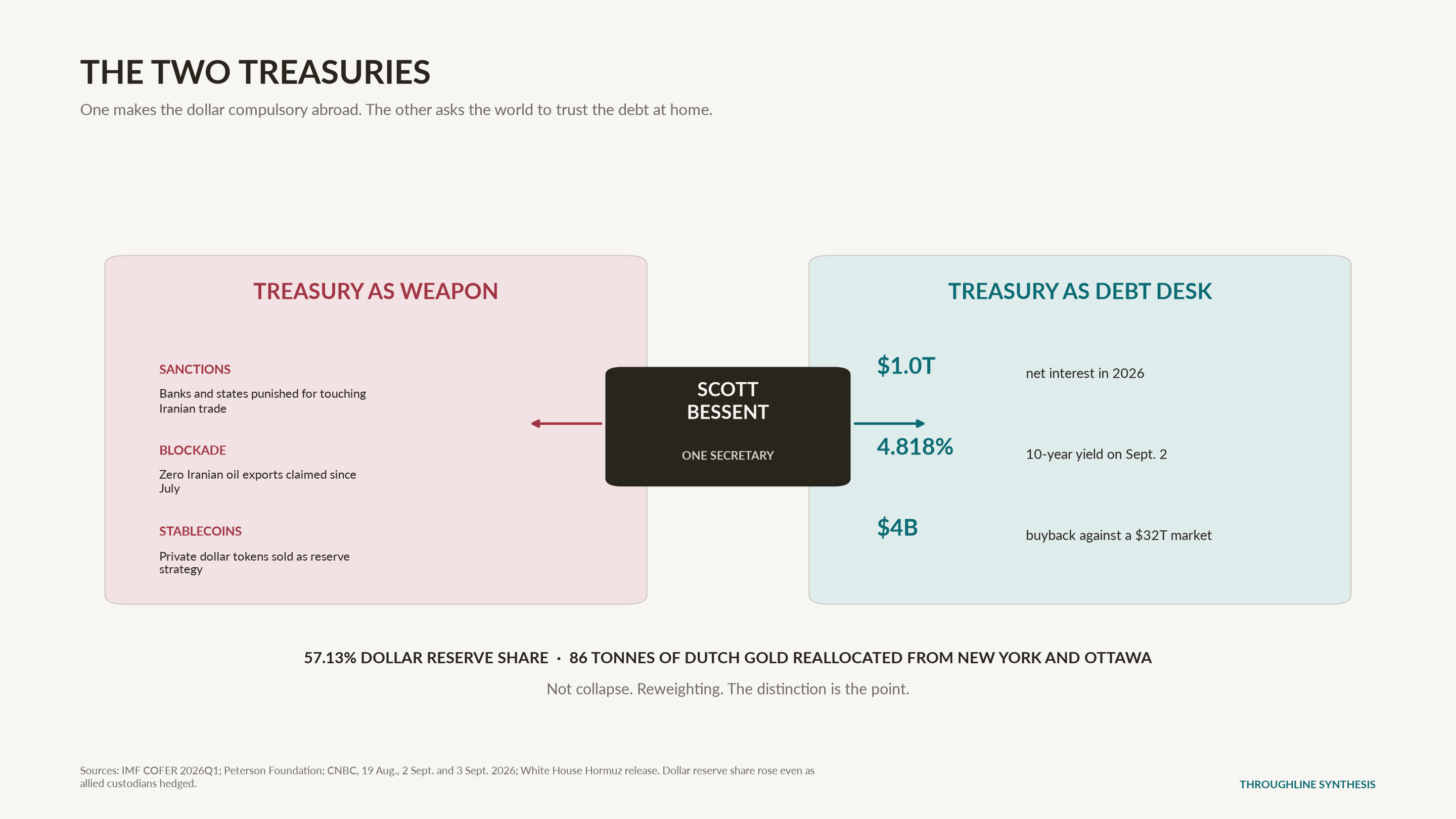
One Treasury weaponizes the dollar system against Iran and any bank that touches Iranian money. The other needs the world to keep buying Treasuries and believing the debt is manageable. The two Treasuries share a Secretary.
The correction first. The petrodollar is not dissolving. The dollar’s share of allocated reserves rose to 57.13 percent in 2026Q1; the renminbi sits at 1.99 percent (IMF COFER). Brookings: “There is very little indication that reserve managers are exiting the dollar, maybe for lack of obvious alternatives,” and “[t]he Chinese yuan actually lost allocations since the start of the second Trump term” (Brookings). Fadhel Kaboub’s formulation is the honest one: “I’m not going to say that the petrodollar is dead, because that’s wrong… I’m not gonna say that there is a thing called the petroyuan that’s a rising superpower. It’s not there yet” (Fortune).
The narrower case is worse. Reuters: “The petrodollar system is built on three foundational elements: America’s dependence on oil, oil being priced in dollars, and the security partnership between the Gulf region and Washington. All three are currently facing pressure,” with Saudi Arabia exporting “four times more oil to China than to the U.S.” (Reuters). The dollar has not fallen; it has been quietly reweighted, and reweighting is a process, not an event.
The bill arrives regardless. Net interest reaches $1.0 trillion in 2026 and $16.2 trillion across 2026 to 2035, “approximately three times what the government spent on net interest between 2006 and 2025” (Peterson Foundation). The fiscal 2026 deficit may hit 6.6 percent of GDP, “one of the widest on record outside of recessions, financial crises, pandemics or world wars” (Reuters). On September 2 the 10-year yield hit 4.818 percent, “its highest level since November 2023,” as Middle East escalation “renewed fears about inflation proving entrenched” (CNBC). And a tariff revenue line the Supreme Court voided 6 to 3 in February is still being counted, with $175 billion or more at refund risk (Reuters).
The response has been maneuvers markets read as politics. Bessent spent months rolling long maturities into short paper, “betting that interest rates would decline. The bet failed” (American Prospect), having attacked his predecessor in 2024 for “putting her thumb on the scale of markets to keep down the costs of overspending” (CNBC). On August 19 Treasury raised buybacks “from $2 billion to at least $4 billion” without saying how they would be funded, with participants expecting bills-for-bonds swaps “thereby manipulating the yield curve” (CNBC). Four billion dollars against $32 trillion. The Guardian: “The market intervention achieved its goal, but only fleetingly,” with Nomura’s Charlie McElligott calling it “a ‘band-aid on a bullet hole'”; Mohamed El-Erian: “I’m worried. The intervention in the bond market takes us to a different place if it continues” (Guardian).
The declared remedy for all this is the family’s product line. Bessent on the stablecoin law: it “will buttress the dollar’s status as the global reserve currency … and lead to a surge in demand for US Treasuries, which back stablecoins” (Treasury). The sixth-largest stablecoin issuer is 38 percent owned by an entity affiliated with the President, 75 percent of its float sat with one exchange, and “[t]he Trumps are entitled to a percentage of the interest earned” (Forbes; Reuters).
And the custodians’ custodians are hedging. Between March and August 2026, De Nederlandsche Bank relocated about 86 metric tonnes of gold, roughly 78 tonnes out of New York and 7 tonnes out of Ottawa, citing “increasing geopolitical unrest” and “crisis preparedness.” It said London gold is “the world’s most easily tradable,” while bars in the United States and Canada “could not be utilized as quickly and directly in a crisis situation” (CNBC; NL Times). Only about 27 tonnes physically left North America. Some 59 tonnes was sold in New York and repurchased in London, moving the claim without shipping the metal. London now holds 32.1 percent of Dutch reserves, Zeist 30.8 percent, and New York and Ottawa 18.5 percent each, a distribution DNB calls “more balanced.” France reached a similar destination by selling the 129 tonnes it held at the New York Fed between July 2025 and January 2026 and buying replacement bars for its Paris vault; its governor said the choice was “not politically motivated” (mining.com; Le Figaro). Neither bank blamed Washington. The fear they declined to name is nevertheless on the record in Germany, where the former head of Bundesbank research called it “risky to store so much gold in the US” and a member of parliament warned that reserves “must not become pawns in geopolitical disputes” (Guardian). This is not a run. It is custody risk being repriced by allies, in public, politely explained.
The prior receipt
Iran is the second use of this operating system; the first receipt is still on the counter.
Russia made the decision to invade Ukraine in 2022, and Russia owns it. Nothing that follows is an excuse; it is the record of the exits that were built and then wrecked. NATO declared at Bucharest in 2008 that Ukraine and Georgia “will become members of NATO” (NATO). Then came the 2014 rupture, Crimea, eight years of war in Donbas, and the Minsk package the Security Council endorsed but the parties never implemented (UN Digital Library). In spring 2022 the Istanbul drafts contemplated a permanently neutral, non-aligned and nuclear-free Ukraine in exchange for international guarantees, before negotiations collapsed amid Russia’s demand for a veto over those guarantees, irreconcilable limits on Ukraine’s armed forces, alleged Russian atrocities, battlefield reversals and expanding Western arms and sanctions (Reuters). Washington, NATO, Kyiv and Moscow share the history that made it foreseeable and the failed off-ramps that made it durable. “Russia invaded Ukraine” is a fact. Used as the whole explanation, it is propaganda by subtraction.
Congress appropriated $400 million for Ukraine in December 2025. Two months after a May 2026 Pentagon spending plan, the money had been “neither … allocated nor committed through contracts,” despite Hegseth saying it was disbursed on April 28. “[T]he president is required to spend funds appropriated by Congress and cannot unilaterally withhold them,” and the GAO previously found this administration “had violated the law by withholding defence funding intended for Ukraine, leading to Trump’s first impeachment proceedings in 2019” (Ukrainska Pravda). Same conduct, same President, same country. This time there was no hearing. The Pentagon also handed off the command coordinating Ukrainian equipment and training, which “means the U.S. will no longer help shape what Ukraine’s future military will look like” (Politico).
Allied criticism of the Iran war was answered with cuts to allied defense. The Congressional Research Service records that Trump’s April 2026 statement about withdrawing troops from Germany “followed German Chancellor Friedrich Merz’s criticism of some aspects of U.S. negotiations with Iran” (CRS); El País puts it plainly, that the withdrawal and missile decisions came “after German Chancellor Friedrich Merz criticized the U.S.-Israeli offensive against Iran,” with fighter jets cut by a third and strategic bombers by half (El País). The counterargument stands: the alliance adapted rather than collapsed, reaffirming Article 5 with all 32 members while European allies posted their largest spending increase since 1953 (Euronews; NATO). That is what managing an unreliable patron looks like.
The information environment needs precision. “Private equity controls the press” is not supported: the National Bureau of Economic Research found private-equity ownership produced “higher digital circulation and lower chances of newspaper exit,” even as “the number of reporters and editors falls, and participation in local elections declines” (NBER), and independents accounted for half of 136 recent closures against “only eight newspapers owned by investment companies” (Axios). The narrower claim holds: investment ownership measurably cuts reporting capacity across 211 newsrooms from 2005 to 2022 (ANNALS), and one firm alone “owns more than 160 American newspapers,” cutting staff “at double the rate of their competitors” and leaving one paper “one reporter covering an entire city of 120,000 people” (What Works in Community News). Not a controlled press. A thinned one, with fewer people left to check a 2035 missile timeline before it becomes “could soon reach the American homeland.”
The wealth numbers do not support a spike narrative: the top 1 percent held 31.6 percent of American net worth in 2026Q1, flat over the year (FRED). The behavior is the argument. Private-equity-owned nursing homes show “11% higher mortality rates” and “10-times higher bankruptcy risk”; in one case a $250 million Medicare fraud judgment was cut by bankruptcy “by 98%, or to under $5 million,” after the company “awarded its CEO $2 million in bonuses before placing nursing homes into bankruptcy” (Skilled Nursing News). Leverage the asset, extract the cash, socialize the loss, keep the bonus. Then look again at Pax Silica: the same administration that seated a private-equity founder as Deputy Secretary of Defense holds a $26.7 billion equity portfolio across four agencies, voting with management, clawbacks stripped, positions hard to find (Fortune). The state has adopted the private-equity model as its operating system, and the taxpayer is the limited partner who never sees the fund documents.
The politics of pretending
Reuters, September 2, citing four sources including three White House officials: aides are pushing to keep the war from escalating before November 3, with Vance and Rubio backing keeping it quiet, partly because a pause “could give the U.S. military time to replenish depleted munitions stockpiles.” One of them: “We are keeping the pressure on Iran… But November is a priority” (Reuters). The Atlantic, a week earlier, quoting an adviser: “We’re just trying to hang on until the midterms” (The Atlantic). The President’s public line is the reverse: “I’m not affected by the election… No. 1, I’m not running” (USA Today), and “I don’t care about the midterms” (NYT).
Measured, not forecast: approval at 33 percent in late August, matching the series low, with war support at 31 percent and Republican support down to 69 from 77 (Al Jazeera); Pew at 34 percent with a partisan gap of 78 points, “the widest in more than seven decades” (Pew). Charlie Cook in May, with independents at 27 percent: “Few would seriously argue that this won’t be a bad year for Republicans. The question is, how bad will it be?” (Cook). Forecast, labeled as such: a generic ballot of D+6.6 (Silver Bulletin), with compiled forecasts putting the House at Democratic gains of 15 to 20 and the Senate at 2 to 3, short of the four flips needed (Axios). A forecast is not a result. The mechanism is not a forecast: a war at 31 percent, tariffs Americans pay 90 percent of, the 10-year yield at its highest since 2023, and a President who says he does not think about Americans’ financial situation.
Then consider the incentives of a lame duck who has already said what he thinks. “Regrettably, I will be the last Republican president” unless the filibuster is abolished (Newsweek); from a rally, “If we don’t fix the election system, I may be the last Republican president,” alongside “We will be in office for the next hundred years” (The News). Note the conditions: not losing an election, but control of procedure and election rules. A President who believes his party’s survival depends on rewriting the rules, expecting to lose a chamber, holding a war he can restart at will, an executive-only international architecture nobody appropriated, discretionary export licensing, a $26.7 billion portfolio and a Gulf revenue line, has every structural incentive to lock in commitments before accountability arrives. That is an analysis of incentives, not a prediction of acts, and applied to any other country American officials would call it an obvious risk.
Meanwhile the war’s expansion is drafted in public. An August 30 Jerusalem Post op-ed proposes filling the ranks through a “debt forgiveness program” discharging “student loan, credit card, and loan balances after 24 or 36 months of service,” because “World War II offered the GI Bill. Vietnam offered college deferments… The Iran war will need to offer debt relief.” It puts a ground campaign at “between 750 thousand and 1.5 million American troops” against an active Army of “roughly 452 thousand,” and urges Congress to recognize “the sovereign independence of the Iranian Kurdistan, Ahwaz, and Baluchistan people,” conceding that “[p]artition would signal that the war has moved past regime change as a coherent objective” (Jerusalem Post).
Buy an army with debt relief, dismember a country of 90 million, printed in a mainstream Israeli daily, while the political strategy is to avoid mentioning the war exists.
What is actually being lost
The best opposing case, stated at full strength: Matthew Kroenig argued in March that Iran “has posed a major threat to regional, U.S., and global security,” that it “has posed an imminent threat to the United States since 1979,” that Security Council objections “should not outweigh the scale of the Iranian threat,” and that “the campaign is succeeding” (Foreign Policy). “Imminent … since 1979” is not a legal category; it is the abolition of one. And success is testable, so test it: the strait is shut (AP); the bombing stopped for want of munitions and targets (Reuters); the uranium is less accounted for than before the first bomb (Al Jazeera); and officials claimed regime change had occurred because “[t]he regime has changed because the former leaders are dead,” which experts rejected because “[t]he institutions remained intact” (PolitiFact).
What the war bought instead is a legitimacy loss being converted into institutions. On July 24 the foreign ministers of the Shanghai Cooperation Organisation called the strikes on Iran a “flagrant violation” of international law and the UN Charter, demanded political settlement of international conflicts, rejected unilateral economic coercion, and committed themselves to a “more representative, inclusive, just, democratic and multipolar world order” (SCO statement). On September 1 the heads of state approved 28 documents including the Bishkek Declaration (SCO summit record). The declaration condemns military strikes on Iranian territory that caused civilian casualties and economic damage, says they violate international law and the UN Charter, supports Iranian sovereignty, demands political and diplomatic settlement, and calls a just settlement of the Palestinian question “the only possible path” to peace and stability in the Middle East (SCO, Bishkek Declaration). It names neither the United States nor Israel. Narendra Modi signed it, while India’s own summit statement mentioned neither Iran nor Palestine and quoted him only that “conflicts cannot be resolved on the battlefield” (Al Jazeera; India Ministry of External Affairs). The signature is the commitment. The silence at home is the hedge. Across the Global South the war met “widespread denunciation as unlawful,” and Oliver Stuenkel identified “a deep-seated belief that international law is being systematically undermined,” with consequences for “many militarily weak and vulnerable countries in the global south” (Guardian).
What that is not: the end of the dollar, whose reserve share rose; the end of the alliance, which reaffirmed Article 5 with all 32 members; or a coherent rival bloc, since India hedges on its own terms and the UAE cut off trade with Iran while taking license-free American chips, its adviser Anwar Gargash asking for off-ramps rather than realignment (House of Commons Library; Reuters; CNN). What it is: a repricing of the American offer. An order endures while being inside it beats being outside it, and fails when the offer becomes compulsion. Freeman’s word for the result is better than the usual one, not multipolar but “multi-nodal,” because relationships “form, dissolve, widen, narrow, and redirect” (chasfreeman.net). Multipolarity in that sense is plumbing, not prophecy: settlement rails, refineries, chip fabs, gold vaults in London instead of New York. Every use of the dollar as a weapon teaches one more counterparty to route around it, which produces no headline and a slightly higher yield at every Treasury auction, forever.
The whole record. A real inspection crisis that inspectors could have handled, turned into a war that made the uranium harder to find and pushed Iran toward quitting the treaty. A decision chain running from a foreign leader’s operational window to a 3:38 p.m. authorization, over the objections of the Secretary of State, the CIA director and the intelligence chief. A Congress that passed a rebuke with no legal force and then voted 47 to 49 against the version that would have bound him. A State Department program with a four-trillion-dollar vehicle and no appropriation. A President whose family entities took $263 million from investors described as lieutenants of the national security adviser of the Gulf state whose chip licenses he liberalized and whose bank his regulator chartered. A Secretary of Defense who cut the office that counts dead children over unanimous command objection. A partner wanted by the world’s war-crimes court, and a President who sanctioned that court’s staff. And in the middle of it, a school in Minab, a wedding in Kuhestak, two Filipino sailors in the water, more than a million people displaced in Lebanon, and 18 American service members on a list that briefly lost four of them to “temporary data disruptions” (CNN).
The alternative is not restored hegemony, which is the same product in a different box. Stop turning shared infrastructure into a weapon. Return the war power to the body the Constitution assigns it to, and use it. Apply one nonproliferation standard, including to the arsenal the Secretary of State will not discuss “as a feature of our foreign policy.” Rebuild the capacity to count the civilians the United States kills, because a state that cannot count them has decided not to know. Let partners consent instead of comply. Accept a plural world and negotiate inside it, which is precisely what was on the table on February 26, two days before the bombs.
At 11:23 on a Wednesday morning, the President of the United States asked whether a waterway should carry his name. The day before, four ships crossed it. The night before that, a roof came down on a wedding. By the afternoon it was a joke he was “just throwing … out” (NOTUS). And 78 tonnes of Dutch gold were already off New York’s books, for “crisis preparedness” (CNBC; NL Times).
A strait named for a man who does not control it, in a country that no longer counts what it destroys. That is not strength. It is a receipt.