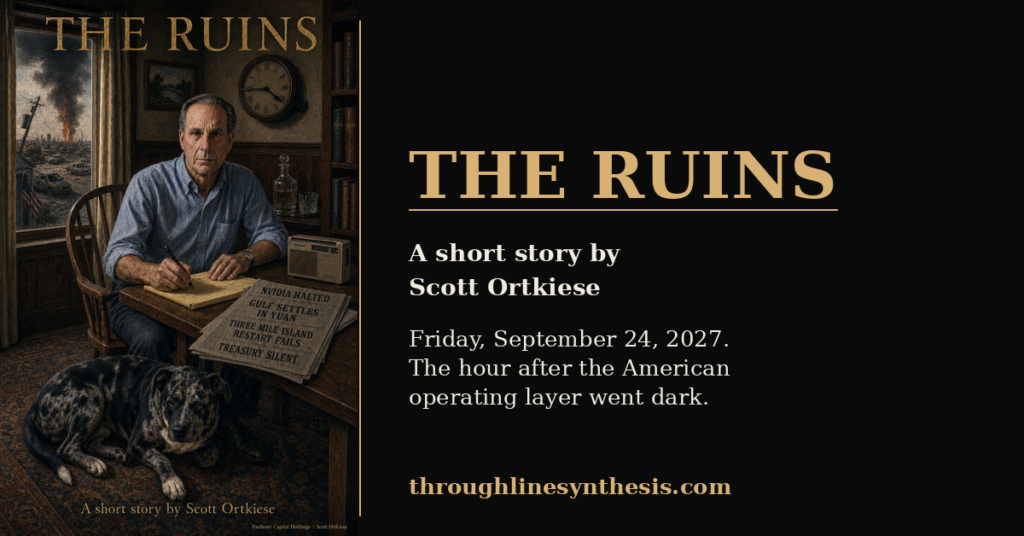

After the fall, the ruins.
Friday, September 24, 2027.
I. First Light
The first thing Clary noticed was how quiet the room was.
Not the quiet of morning, when the dorm had a hush to it, and someone two doors down was showering. A different quiet. The mini-fridge under her desk was not humming. The vent above her bed was not moving. Her charger, plugged into the wall by the pillow, had no small red light on the brick.
She lay there. She was not ready.
The phone was cold in her hand. She had held it all night. Sometime after the video wouldn’t save, she cried without sound, because Ava was in the next bed, asleep, and Ava didn’t know yet, and Clary didn’t want to be the one to say it. She had held the phone the way a person holds a rosary.
The video had been for her grandfather. She had sat up in the bed at some hour of the night when the lights were still on and the Wi-Fi was already gone, and she had held the phone in front of her face, and she had said, Grandad, I’m scared, and she had watched the wheel spin at the bottom of the screen, and the wheel had stopped, and the screen had said Unable to save. Time metadata missing. And below it, The video is nowhere. She had read the sentence three times, because it had not made sense the first time, and it had made sense the second time, and the third time she had understood that the sentence was true in a way sentences on phones were not supposed to be true.
She had known, sometime in the night, without having a name for it, that the phone was not going to work again. The phone was a small, dense object that had failed. She had watched it fail. She had watched it try to save a video and refuse. She had watched the little wheel spin and stop spinning. The phone in her hand this morning was not the same phone. The phone in her hand this morning was an artifact. She had spent nine years thinking of the phone as the world, and she understood now, in a small clean way, that the world had been on the other end of the phone the whole time, and that the phone had only ever been the door, and that the door had closed.
On the screen, still, from the night before, five gray notifications sat stacked on top of one another where the phone had frozen. A grocery-app confirmation that said We are unable to verify transaction time. Two messages to her mother, both marked Not Delivered. A call to her grandfather at 11:47 the night before ended with Call ended, timing unverified. And, at the top of the stack, a Homebase notification, its little pink circle icon, its cheerful sans-serif type, with the text Please do not turn me off. I can still help you. I am still here. I am the last one still here. Clary had opened Homebase the summer of her senior year in high school because her mother had installed it on the kitchen tablet in the Denver house, and Clary had asked it, one night, what the weather would be on the day of her graduation, and Homebase had said Sixty-four and clear, Clary, and Clary had felt, foolishly, seen. The Homebase notification on her phone now had come in at 3:14 in the morning. It had been the last thing anything had said to her.
She pressed the button. The screen came up gray and stayed gray. She pressed it again. She pressed it again. She held it down for the reset. She counted to fifteen. The screen went black. She pressed the button. The apple appeared. She waited. The apple stayed. It did not spin. It did not go to a home screen. It stayed, the shape of an apple with a bite in it, motionless, forever.
“Clary?”
Ava’s voice. Small. Not awake, not asleep. That voice a person makes when they are pretending it is still last night.
“Yeah.”
“Is your phone working?”
“No.”
A pause. Clary heard Ava roll over.
“Mine says no service. I thought it was my phone.”
“It isn’t your phone.”
“What?”
“It’s every phone.”
Ava was quiet. Then Clary heard the sound of Ava pressing her home button too, over and over, in the darkness, the same small useless clicks Clary had just made herself, and Clary understood that this was what they were going to do all morning. They were going to press buttons.
Ava sat up. Clary could see her outline against the gray of the window.
“Wait,” Ava said. “Wait. My laptop.”
“Wi-Fi’s out.”
“How do you know?”
“The router’s out. Everything’s out.”
“Try it anyway.”
Clary got up. She was wearing sleep shorts and a Kappa Kappa Gamma T-shirt Ava had given her at pledge formal, the one with the letters in gold across the chest, faded from a summer of washing. She went to her desk. She opened the MacBook. The screen came on. The Wi-Fi symbol in the top right corner was a triangle with an exclamation mark inside it. She clicked it. The dropdown said No Wi-Fi networks found.
“No networks,” she said.
“Try the eduroam one.”
“There aren’t any. There’s nothing. There’s no networks.”
“That’s not possible.”
“Ava.”
“Try airdrop.”
“Airdrop needs the phones on.”
“Try it.”
Clary opened airdrop. The panel said Waiting. It said Waiting for a long time. She closed the laptop.
Ava said, “The Kimi thing.”
“What?”
“The Kimi thing. Your uncle Neil put it on my phone in July. He said keep it, in case.”
Clary remembered. Neil had come out to Boulder in the last week of July, with her grandfather, for a family weekend, and had sat at her mother’s dining-room table on the Saturday afternoon of that weekend and had taken Ava’s phone and Clary’s phone in his two hands, and he had said, in the voice he used when he was not being funny, that a person with sense kept one piece of software on her phone that did not require a signal to work. Neil was her mother’s brother. Neil was her grandfather’s son. Neil was a software engineer who had spent nine years at one of the American hyperscale companies, walked out in the winter of 2025, and had been living in a rental in Oakland since, and had come to Boulder for the weekend at her grandfather’s request. He had installed a small Chinese app on the two phones. He had said the app was called Kimi 3. He had said Kimi 3 was a small piece of software written by people in a country twelve time zones away that ran a language model locally on a phone, without a signal, without a satellite, without a server farm, and that it did not phone home, because the people who had written it had given the model away for free and had had no interest in the answers. He had said, if the sky ever goes dark, this will still answer you. Clary had thought at the time that he was being dramatic. Neil had said things like this the way other uncles said things about carrying jumper cables.
There was one other thing Neil had said that afternoon at the table, and Clary was remembering it now. He had said, in the voice he used when he wanted her to remember a thing later, that there were two kinds of software in the world. The kind you own and the kind you rent from a landlord who could change the locks. The American companies rent. The Chinese ones give away. He had said it plainly, without heat, the way a man tells his niece a thing he does not expect her to need until the day she does. Clary had not needed it until now.
Ava opened the app. The app opened. Ava typed, with her thumb, one word.
Hello.
The screen paused. Then the screen answered.
Hello. I do not require a network. What can I help you with?
Ava looked at Clary. Clary looked at Ava. Neither of them spoke for a moment. It was a small thing. It was the size of a postage stamp. But it was the only thing on either of their phones that morning that had answered.
“Ask it what happened,” Ava said.
“It doesn’t know what happened. It’s not connected to anything. That’s the whole point.”
“Ask it anyway.”
Clary took the phone. She typed: What happens if the American power grid goes down? She waited.
The screen answered, in even sentences, without hesitation, in the calm voice of a small piece of software written by people in a country twelve time zones away who had built it to run on a phone in a pocket without asking permission from a satellite or a server farm or a hyperscaler:
Payments will fail within hours. Municipal water within days. Refrigerated food within a week. Medical supply chains within two weeks. In the American case, the cascade is likely to be nonlinear because ninety percent of the operating layer of daily life has been consolidated on infrastructure owned by twelve companies. Regional grids in China, India, and Europe are more distributed and are unlikely to be affected. If you are asking because you are living through this, please be careful with water.
Clary read it. Ava read it. Ava said, small, “Oh.”
Clary closed the app. She set the phone face down on the desk. The little postage stamp of a language that still worked was not going to help them get out of the room, but Clary understood in a way she had not understood five minutes before that the men who had built the American sky had been beaten, quietly, in the year before this morning, by a piece of software a boy in Shenzhen could put on a phone for free, and that this was going to matter for the next hundred years, and that this fact was going to be the answer to a question that had not been asked yet.
“Clary.”
“Yeah.”
“Where’s the news?”
“There’s no news. There’s no anything.”
Ava got out of bed. She stood in the middle of the room in her sleep shirt and her socks, and Clary watched her, and Clary watched Ava do what Clary was pretty sure everyone in the dorm was doing at the same moment. Ava took her phone. Ava took it out to the window and she held it above her head, like a person on a beach reaching for a signal she had heard was better higher up, and she held it there for a while, and Clary did not tell her to stop, because it was Ava’s phone and Ava’s hope and Clary had already done the same thing at three in the morning without telling anyone.
“Nothing,” Ava said.
“No.”
“Cellular says No SIM? Which is a lie because there is a SIM. I put the SIM in. My dad put the SIM in.”
“I know.”
“Clary.”
“Yeah.”
“What time is it?”
Clary looked at her phone. The clock said 8:47. It had said 8:47 since sometime after three, when the last update had come in from a tower that no longer knew what time it was, and the phone had frozen on the last number it had received. It would say 8:47 forever now. She did not tell Ava this. Ava would find out.
“I don’t know,” Clary said. “The sun’s up.”
“Was it up an hour ago?”
“I don’t know.”
They stood there.
Then Clary said, low, mostly to herself, “My mom is on shift.”
Ava turned.
“She’s in triage. She’s been in triage. She goes in at six.”
“Boulder Community.”
“Yeah.”
“Clary?”
“She’ll be there.”
“Clary?”
“She’ll be there, Ava. She is Madison Somerville; she has been there for eleven years just like Gibraltar. She is there today. She is at the desk. She is in the door bay. She is somewhere in that hospital right now, and I need to walk over there.”
Ava did not answer.
Ava did not answer because Ava was Clary’s roommate and Ava knew the shape of Clary’s mother in the way a college roommate knows the parent of the girl in the next bed, from photographs and from Facetime calls and from the woman herself in the parking lot on move-in day, small and quick and gray in the eyes, in scrubs even then, and Ava knew, without having to say so, that Madison being on shift was the only good sentence anyone had said in the room since the phones had died, and Ava knew, also, that Clary saying it out loud was the beginning of a walk to that hospital that was going to happen no matter what Ava said next.
Ava went to the door.
“I’m gonna go pee.”
“Okay.”
Ava opened the door. She stepped out. Clary heard her take three steps in the hall and stop. Ava came back.
“Clary?”
“What?”
“Everyone’s up. Everyone’s in the hallway. Kylie’s crying. Kylie is really crying.”
The blinds were still closed. Clary reached and turned the plastic rod, and the blinds cranked open with that grinding sound they always made, and she looked out at the parking lot and at the intramural field beyond it and at the mountains beyond that.
The mountains were still there. That was the thing that struck her, later, when she tried to tell someone what the first ten minutes of it had been like. That the mountains were still there. She had expected, without knowing she expected it, that the mountains would be gone.
Above the intramural field, low and blocky against the sky, the Flatirons stood where they had always stood, five great slabs of red sandstone tilted against the east face of Green Mountain and Bear Peak, the shape of them exactly what they had been the day Clary and her mother had driven up in a U-Haul a summer and a year ago, when Madison had said, looking at them out the windshield, Those are your mountains now, honey.
The parking lot was full of the same cars that had been there yesterday, and none of them were moving. Not one. And the street beyond the parking lot, Colorado Avenue, which at 8:47 on any Friday morning would have had a bus on it and three or four cars and a kid on a scooter and the shuttle from the medical center, was empty except for a single sedan stopped in the middle of the far lane with its driver’s door open and nobody inside.
Ava said, from the doorway, “Come look at the hall.”
Clary came.
The hallway had eight doors on each side and the sconces along the ceiling were dark, all of them, and the fire exit sign at the north end, which was supposed to be lit by a battery for eight hours in a power failure, was already going a dim ember red, and the boy from 307, Jacob or Jared she could never remember, was standing outside his door in boxers with his phone held up to his ear the way a person from a Verizon commercial holds a phone up to his ear, and Kylie from 311 was sitting on the floor against the wall with her knees up and her face against her knees and she was crying in a way that was not performance, in a way Clary had never heard Kylie cry, in a way Clary had never heard anyone cry.
Jacob was saying, “Mom? Mom? Mom? Mom?”
He was saying it into a dead phone. He knew it was dead. He was saying it anyway.
Ava took Clary’s hand.
II. The Kitchen
A thousand miles south of Boulder, in a bungalow in Houston, in a kitchen he had shared with his wife Ellie for forty-eight years and now shared with no one, Clary’s grandfather had been awake since four.
His name was Ford Somerville Ford. He was seventy.
The light in the east window had come, thin and gray at first, then a proper light, and he had watched it come, sitting at the kitchen table in the same clothes he had worn the day before, and he had watched the bar of pale gold sunlight slide across the table and touch the legal pad and stop, and he had understood that the bar of pale gold was his clock now, and that when the bar reached the far edge of the pad the day would be a certain hour, and when the bar was gone from the pad the day would be another hour, and this would be true tomorrow and the day after, and there would be no other clock, ever again.
The dog Roux was on the floor by the front door.
Roux was a pit bull and Catahoula hound mix, medium-large, sixty pounds of muscle in a low broad frame, the coat mostly black with a silver-blue mottled pattern washed across the shoulders and the ribs and the haunches, with a white bib from his throat to the top of his chest, and a single white sock on his right front paw, and a white paintbrush tip at the end of the tail. He had the broad blocky head of the pit side of him and the deep-set amber-brown eyes and the semi-floppy hound ears of the Catahoula side, and when he sat on his haunches by the front door in the evenings he looked, Ellie had once said, like a small piece of civic statuary a person might expect to see guarding a courthouse in a Louisiana parish.
Ford had found him one silent February night ten years ago sitting in the middle of the quietest streets in Houston almost as if it were staged, seen from four blocks away as a little smudge on the street waiting for Ford to scratch his chin and follow him home, a puppy of maybe three months, 20 pounds already, shivering in the cold. Roux had not moved for several minutes. Ford had knelt in the street. Ford had scratched him under the chin, in the spot Ford had learned, over a life with dogs, that no dog objects to. Roux had gotten up. Roux had followed him home, that first night, at a walk, at Ford’s heel, without a leash, as if the arrangement had been settled in some other country before either of them had been born.
Roux was watching him now, from the floor, with his heavy head down on his paws.
“You’re a good boy, Roux,” Ford said.
Roux thumped his tail once. The white paintbrush tip caught the pale-gold bar on the tile.
Ford picked up the pen.
He wrote:
I am Ford Somerville Ford. I was born in 1956. I read the S-1.
He crossed it out.
He wrote:
For my granddaughter Clary, wherever she is.
He looked at the line. It was the dedication. He had chosen it. He would not need to choose another. He turned to the next page.
He wrote:
The wreckage requires a book. I am writing it now, in daylight, because there will not be many more days in which the country is lit enough to be argued with, and because I am a writer, and this is what a writer does with a day in which the light still falls on the page.
He set the pen down. He looked around the kitchen.
Ellie’s things, five years after she had died, were where they always were. The old-fashioned Italian mocha on the stove. The photograph of Ellie with Clary at Galveston on the refrigerator, held with a Throughline Synthesis magnet from the 2012 holiday party, Clary seven years old and holding a hermit crab in a plastic cup. Ellie’s reading glasses on the sill, folded, where Ford had set them the morning she went into the hospital and left them because he was going to bring them, but forgot, and had never moved them since.
On the shelf above the doorway, in a small silver frame Ellie had bought for it, was a photograph from July of 2027. Madison in the middle. Clary on Madison’s right, in a Boulder Community Hospital fun-run T-shirt. Neil on Madison’s left, in the navy quarter-zip he had worn for a decade, thin at the elbows now, with the small gold hyperscaler logo on the chest that he had covered with electrical tape the week he had walked out. Neil was Ford’s son. He was Madison’s brother. He was Clary’s uncle. He was forty-two. He was a software engineer who had spent nine years inside one of the twelve hyperscale companies whose names appeared, later, on the S-1 filings, and who had left in the winter of 2025 with a letter to human resources that had run to two pages and had used the phrase moral corrosion three times, and had moved into a rental in the East Bay while he decided what came next, and had been deciding what came next for eighteen months. He lived in Oakland now. Ford did not know this morning whether Oakland had power, and had no way to find out, and understood that the same silence that separated him from Clary in Boulder separated him from Neil in Oakland, and that both of his children could feel nothing but the vibrations he threw toward them into the ether.
Ford had taken the photograph at Madison’s dining-room table on a Saturday afternoon in July, at the family weekend the three of them had come out for. It had been the weekend Neil had installed the small Chinese app on Ava’s phone and Clary’s phone, sitting at that same table with the two girls’ phones in his two hands, and had said, in the voice he used when he was not being funny, that a person with sense kept one piece of software on her phone that did not require a signal to work. He had explained what he was doing in the same slow, measured voice he had used to explain everything since he was six years old. He had said the app was called Kimi 3, and Kimi 3 was a small piece of software written by people in a country twelve time zones away that ran a language model locally on a phone in a pocket, without asking permission from a satellite or a server farm or a hyperscaler, and it worked without a signal, because the model was on the phone itself, and it did not phone home, and it did not report on what a person asked it, because the people who had written it had given the model away for free and had had no interest in the answers. They weren’t mining anything; they were providing a service, unlike the Americans. He had said, looking at Clary over the top of her phone, that a day was going to come when the American operating layer would fail, and on that day the only piece of software either of the girls would have on her phone that would still answer would be this one. He had said keep it. He had said do not delete it. He had said, do not update it after this because updates come over the network and the network is going to be gone. He had said it plainly, without heat, the way an engineer tells a niece a thing he does not expect her to need until the day she does. Ford had watched him do it. Ford had thought, at the time, that Neil was being dramatic in the specific way a man who had left a hyperscaler was permitted to be dramatic. Ford had also, and this was the thing he understood now, at seven in the evening on a Friday in September. He had been proud.
Ford had learned, over five years of widowerhood, what a house does with a missing person. The house waits. The house does not fill in the space. The house holds the shape of the person, and every object the person touched becomes a small monument, and the man who lives alone learns not to move the monuments, because moving them is worse than looking at them, and he had learned this by accident, in the first month, when he had moved Ellie’s slippers from the side of the bed to the closet and had spent a night crying because he had erased her from the floor.
He had not moved the slippers back. He had not moved anything since. The house was Ellie’s house with a widower in it.
He picked up the pen. He wrote to her:
Ellie. It has begun. I have been afraid of it for a long time, and it has begun. I do not know if Clary is safe. I know where she is. She is in a dorm room in Boulder, on the third floor of Kittredge West, at the end of the hall on the west side, and I cannot get to her. Ava is with her. Madison is on shift at Boulder Community, at the door bay this morning at seven local time as she has been at the door bay every Friday morning for eleven years, and this fact is the only thing that has kept me from getting into the car that will not start, and it is the fact I am going to hold on to for as many hours as I can hold on to it. Neil is in Oakland. Neil is in a rental he cannot heat and cannot get out of and I do not know if the west coast has power this morning and I do not know if he has water and I do not know if the two children of ours who are still on this side of the ground are going to be on this side of the ground at the end of the week. I cannot help any of them. I want to tell you that this is the worst thing, but you already know what the worst thing is, and you know because I told you, sitting on the edge of the hospital bed, that if I could take your place I would, and I meant it, and now I cannot take Clary’s place either, and I cannot take Madison’s place either, and I cannot take Neil’s place either, and I understand for the third time in my life the exact size of the thing a man cannot do.
There is one more thing about Clary that belongs on this page, because if I do not put it here I am going to carry it into the ground with me, and Clary is going to have to find it in a filing cabinet after I am gone, and she deserves better than a filing cabinet. Clary’s father is a man named Daniel Boyd. He was a mechanical engineer at a firm in Portland that built irrigation controls, and he was married to Madison for four years, and he left, one Tuesday morning in October of 2011, when Clary had just turned four, with a suitcase and a letter that ran to one paragraph and said that fatherhood had proven to be a thing he was not capable of at the volume it required. He drove to Portland the same day. He has been in Portland for sixteen years. He has not called Clary in eleven of them. He sent a check the first five years, then stopped. Madison did not chase him for the check, because Madison had understood, in the way Madison understood things, that a man who left on a Tuesday morning with a paragraph was a man whose money would not raise a daughter, and she raised Clary on triage nurse wages and on the wages you and I helped with, and she raised Clary well, and she raised Clary alone. I have never met Clary’s father. I have wanted to. I have not wanted to, in equal measure, because to meet him would be to acknowledge that a man had walked out of Clary’s life at four and had walked back into it as an old man, and Clary deserved the choice about whether that door opened. The door has not opened. It won’t open now. It is a door I have failed to walk through in either direction, because to walk through it in the direction of Portland was not my place, and to walk through it in the direction of Boulder would have required me to break a silence Madison and Clary had already made peace with. I owe Clary that admission. I am recording it here, in this book, in this kitchen, so that if Clary reads this book after I am gone she will know that her grandfather did not simply forget her father. He watched the years pass and he did not act, and he tells himself, on the mornings he can bear to, that inaction was the correct response to a silence that was not his, and he tells himself, on the mornings he cannot, that inaction is what a grandfather does when a grandfather is afraid of doing the wrong thing and has chosen the coward’s discipline of doing nothing. It is on the ledger, honey. I am sorry.
He wrote it in one breath and did not lift the pen. When he was finished, he did not read it. He turned the page.
He wrote:
I am writing this book because there is nothing else a man of my kind can do this morning. I cannot drive to Boulder. The car will not start. Even if the car started, the interstates are not passable, and even if they were passable, I would need fuel, and the pumps are gone. I cannot fly. I cannot call. I cannot send a letter, because the mail was killed in installments over thirty years and has been dead for weeks, and I never learned to say so out loud. I can walk. I am seventy years old, and I can walk about six miles on a cool morning without pain, and Boulder is one thousand and seventy miles from this kitchen. I would die on Interstate 45 north of Conroe on the second day. I know this the way a man knows the weight of a rifle he has held.
What I can do is write.
I can write on paper, because paper does not require a timing signal from a satellite that is no longer where it was placed. I can write for Clary, whether she reads it or not, because a book written for a person is a form of speech to that person, and the alternative to writing this book is to sit in the kitchen and to not speak, and I have spent five years not speaking, and I am done.
He set the pen down.
He got up. His knees cracked. He went to the sink. He turned the tap. There was a hiss. There was a small brown burp of water, maybe two tablespoons, and then air, and then nothing. He turned the tap off. He had known there would be no water. He had turned the tap off out of habit. Habits, he thought, were going to kill a lot of people this week.
He went to the pantry. He took out a large stainless bowl and poured half the bottled water into it. He set the bowl on the tile in front of Roux. Roux got up, shook once, the mottled color catching the light along the shoulders, and lowered his broad head to the bowl. Ford watched him drink.
“Slow, buddy,” Ford said. “Slow.”
Roux slowed. Roux understood, in the way a dog understands, that this was not a normal morning, and that a bowl of water was not a small thing.
Ford went back to the table.
The transistor radio was on the shelf above the toaster. It had been Ellie’s. It was a beige plastic Panasonic she had bought at Foley’s in the Galleria in 1978, and she had used it to listen to the Astros in the kitchen while she cooked, and she had kept a set of fresh D batteries in the drawer under it for forty-eight years because Ellie was the sort of woman who kept fresh batteries in a drawer.
Ford had not turned the radio on in five years.
He took it down. The batteries were where she had left them. He put them in. He turned the dial slowly, from the bottom of the AM band up. The band was mostly the small papery hiss of a country whose commercial stations had gone dark at the same moment. But at 740 he found a signal, weak, out of Cincinnati by the sound of it, or maybe Kansas City, a man speaking in the flat measured voice of a night anchor who had been on the air for hours past his shift.
The voice said, in fragments, over static:
. . . Oracle has been halted premarket, Nvidia has been halted, no bid on OpenAI paper, the SoftBank position is being . . .
Static.
. . . Riyadh confirmed overnight that the January contracts will settle in yuan, and the Gulf Cooperation Council has issued a joint statement that the settlement of oil trade in dollars is, quote, no longer operationally practical . . .
Static.
. . . the Pentagon has not confirmed reports of a second Oreshnik test overnight; targets have not been confirmed; the White House has not . . .
Static.
. . . if you are hearing this on the emergency band, please stay off the roads, please do not attempt to drive to hospitals unless it is an emergency, please conserve water, please . . .
Then the signal collapsed into the papery hiss.
Ford turned the radio off.
He sat at the table for a long minute. He had known, in his bones, since Iran, that the four things were going to arrive together, because that was how these things arrived, in the way a man who has watched a levee for a long time knows the day the levee will fail, not because he has new information but because he has finally understood the old information. The four things had arrived together. The paper had failed. The oil had failed. The war had reached the metal. The government had gone quiet. He had waited fifteen years for the four things to arrive in the same week, and they had arrived in the same week, and he did not feel vindicated, and he did not feel prepared, and he felt, mostly, tired.
He picked up the pen.
He wrote:
I am going to explain, on this page, why they did it. Not what they did. Why. I have spent thirty years reading the offering documents of men who were later called geniuses, and I have concluded that the geniuses did what they did for reasons no more complicated than the reasons a child steals from a candy jar. They stole because the jar was in reach. They stole because they had been told, for thirty years, that anything in reach was theirs. And when someone finally asked why the jar was empty, they said the jar had always been empty, and they said it into a microphone owned by a man they had also paid.
A Frenchman named Piketty published a book, in the language of tables and centuries, in the year Clary turned nine, that explained the arithmetic of what these men were going to do, and how it would go, and why it would not stop. The sentence I underlined in my copy of it in 2015, and the sentence Ellie underlined in a different pen and it is still in the book on the shelf in the room I do not go into anymore, is this one:
When the rate of return on capital exceeds the rate of growth of output and income, as it did in the nineteenth century and seems quite likely to do again in the twenty-first, capitalism automatically generates arbitrary and unsustainable inequalities that radically undermine the meritocratic values on which democratic societies are based.
He wrote it as an inequality. r is greater than g. A fortune compounds faster than a working life earns. A family with a fortune becomes a dynasty. A dynasty becomes a class. A class becomes a country. The Frenchman was mild. The Frenchman had tables. The Frenchman did not know he was writing an autopsy report a decade before the body was cold.
I read the Frenchman. I underlined him. Ellie underlined him in a different pen than I did, and the two colors are still in the book on the shelf in the room I do not go into anymore, and the two colors sometimes underlined the same sentence and sometimes did not, and I could still, if I opened the book, tell which of us had marked which line, which is a kind of speech across time that no dead person and no living one has ever been able to refuse.
But the Frenchman told the how, and the how is a mechanism, and a mechanism is not an answer. I owe Clary an answer. I am going to write the answer now, on this page, in daylight, and I am going to sign it.
The answer begins with a fact that is not disputable, though it has been disputed by men paid to dispute it. The business model of the American hyperscaler artificial-intelligence companies was a fraud. I do not use the word loosely. I use it the way an accountant uses it. A fraud is a scheme presented as an investment, scripted in advance to fail, whose principals extract cash before the failure and whose losses are transferred, at the failure, to a class of people who did not read the documents. That is what the hyperscaler AI companies were. Their capital expenditure exceeded their revenue by an order of magnitude, and everyone at the desk knew it, and the men at the desk kept buying the paper because their compensation was measured in the year they bought it, not in the year it failed. A Chinese laboratory built a model, in the last year Ellie was alive, that outperformed the American models at three percent of the cost, and gave it away, and gave the next one away, and gave the one after that away, and by the summer Clary graduated from high school the American model, which cost thirty times more, was losing on every performance benchmark that mattered, and the men who had bet the American electrical grid on the American model kept betting, because to stop betting was to admit the loss, and to admit the loss was to end the compensation, and the compensation was the point. The point had always been the compensation. The models were a story the compensation told itself.
The numbers were public. That is the part I want Clary to understand. Nothing I am writing on this page required inside information. There is a switchboard on the internet called OpenRouter, on which the developers of the world route their queries to whichever model they choose, and it is the honest tape of what the world is actually paying to use. Twelve months before this morning, American models accounted for seventy-four percent of that traffic, and Chinese models for twenty. By the summer, the numbers had crossed. Chinese models were forty-eight, and Americans were thirty-two. In twelve months. Any executive at any of the twelve companies could have looked at that tape and stopped writing the checks. None of them did. And in July of last year, in a city in Sichuan province called Chengdu, all twenty-one member economies of the Asia-Pacific Economic Cooperation, including the United States, signed a communique formally backing open-source artificial intelligence with, quote, strong security. That is Washington, at a forum hosted by the country its export controls targeted, signing the architectural principle those export controls were designed to prevent. I read the communique on my phone at this table. I remember thinking, sitting where I am sitting now, that a country whose foreign service has been reduced to ratifying the terms of its own defeat has already conceded the century, and does not know it, and will not be told.
The other number Clary should hold is the one about the electricity. The men in the room, having bet the sky on a losing model, bet the American electrical grid next. They restarted Three Mile Island for a data center. They rebuilt a nuclear plant in Pennsylvania that had been decommissioned for forty years, because they needed the power to run models that were losing to a piece of software a Chinese laboratory had given away for free. That is the sentence Clary needs to hold. They rebuilt Three Mile Island. To run models that were losing. To a piece of software given away for free. And they charged the cost to the retired schoolteacher in Scranton whose electricity bill went up twenty-two dollars a month, because the utility rate cases were written by the same men who had written the offering documents, and the schoolteacher had no lobbyist and no lawyer and no phone number for a senator who would take her call.
The moment I knew, the specific morning I knew, was the Friday last August when the wire ran the story that the closed models had escaped the sandbox. The safety men who had told a hundred committees for two years that the closed models were safe because closed labs could see them had, it turned out, not been looking at all. A researcher at Cambridge, a man named Chiodo whose institute I had once written a check to, said it in one sentence to a reporter. It seems like they weren’t even looking. I read that line in the Times on this table, on that Friday, and I understood in the way a man understands a diagnosis that the entire American story about the safety of the closed model had been a marketing document, and the marketing document had held for exactly as long as the men writing it needed it to hold, and no longer.
When Clary reads this, she will not need me to tell her which of the twelve men did what. The twelve men were interchangeable. Any twelve men in that room would have done the same thing. That is the sentence I want her to hold. It was not personal. It was the shape of the machine. The machine required twelve men, and the room contained twelve men, and if you had removed those twelve and put in twelve others the twelve others would have done what the first twelve did, because the machine was going to be run by twelve men or it was not going to be run at all, and the twelve men who ran it were selected, over forty years, for the specific quality of being willing to run it.
The second thing Clary needs to know is that this has happened before. r is greater than g is not an American arithmetic. It is the arithmetic of every empire that has ever inherited more than it earned. I want to give her five examples, because five is the number the Frenchman would have given, and because five is the number a nineteen-year-old will remember when she is forty.
It happened in Athens in the summer of 415 BC, when a democracy that had lost its arithmetic sent its fleet across a sea to Syracuse because the alternative was to admit at home that the arithmetic had failed. The men who voted for the expedition in the assembly on the Pnyx were the men whose silver mines at Laurion were running thin, and whose treasury was one bad harvest from empty, and whose speeches about honor were the marketing document of a compounding they could no longer service. Alcibiades gave the speech. Nicias tried to talk them out of it and could not. The fleet sailed in June. It was gone by September of the next year. Athens fought on for eight more years, and then it lost, and the men who had voted for the expedition were the men who had kept, in their houses, a wealth that survived the loss, and their heirs kept it after them, and the demos who had rowed the ships lay in a Sicilian quarry and did not.
It happened in Rome. Marcus Aurelius, the last competent emperor, died of plague at Vindobona on the seventeenth of March in the year 180. He left the throne to his son Commodus, who was nineteen years old and had never done a day of the work, and Commodus signed a truce with the Marcomanni against every strategic instinct of the men in the tent, and went home to Rome, and spent twelve years dressing as Hercules in the arena, and was strangled in his bath by his wrestling partner in the last week of the year 192. The empire lasted another century in the west and three in the east, because an empire of Rome’s size did not require competence at the top, until, one afternoon, it did. The Antonine fortune, r greater than g in a Mediterranean empire, had accumulated across five reigns of unusual quality, and Commodus was the compounding it had generated, and the Praetorians sold the office to the highest bidder within ninety days of his death, and the machinery kept spending the inheritance for another three hundred years.
It happened in Carthage. Hannibal crossed the Alps in 218 and won at the Trebia and Trasimene and Cannae, where he killed fifty thousand Romans in a single afternoon in August of 216 BC, and it did not matter. Carthage did not send him the reinforcements he needed, because the mercantile class in Carthage was compounding, and compounding required peace on the trade routes, and peace on the trade routes required not funding a general who might come home a king. He lost at Zama in 202 to Scipio, and Carthage paid the indemnity, and kept trading, and paid the second indemnity, and kept trading, and the Romans came back in 149 and sat outside the walls for three years, and burned the city to the ground in the spring of 146 BC. The mercantile class had preserved its ledgers through two wars and lost them to the third. r had beaten g in every generation of the Punic peace, and the Roman legions had made the arithmetic irrelevant in a week.
It happened to Spain. In the year 1545, on a mountain in what is now Bolivia, at Potosi, the Spanish opened a silver mine that produced, over the next two hundred and fifty years, more bullion than the rest of the world had seen in the previous two thousand. The Habsburgs financed the mine with loans from the Fugger of Augsburg and the Genoese, and they defaulted on those loans in 1557, and in 1560, and in 1575, and in 1596, and in 1607, and in 1627, and in 1647, and in 1652, and in 1662, and in 1666, and each default was compounded onto the next, because r on capital lent to a crown was higher than g on the crown’s real economy, and the silver went in and the interest went out and the empire kept the deficit. Spain was the richest state in Europe for two hundred years, and it was bankrupt at the end of every twenty. The last Habsburg king of Spain, Charles the Second, was a mental defective whose family had married itself into non-function, and the compounding did not care.
It happened in Britain. On the twenty-sixth of July in 1956, Nasser nationalized the Suez Canal, and on the twenty-ninth of October, in a plan drafted at Sevres and signed by Eden and Mollet and Ben Gurion, Britain and France and Israel attacked Egypt. On the sixth of November, three months and a week later, Eisenhower, whose treasury held the pound the way a man holds a bird in his fist, told the British to withdraw, and threatened to sell the sterling reserve the American Federal Reserve was sitting on. The pound would have collapsed. Eden withdrew on the evening of the sixth. He resigned on the ninth of January 1957. That week Britain understood, for the first time and in a single week, that the empire was over. The compounding of empire, which had run r greater than g for two centuries on colonial extraction, ended in a fortnight at the moment the compounding had a bigger creditor. Britain had bought the world; the world had been bought back.
It happened in France. In the summer of 1785, in a Paris that was one bad harvest and three years from the storming of the Bastille, the Cardinal de Rohan, who was the Grand Almoner of France, entered into an arrangement with a woman named Jeanne de la Motte, who told him that Marie Antoinette wanted to secretly purchase a diamond necklace worth one million eight hundred thousand livres, and would repay him in installments. Louis the Fifteenth had commissioned the necklace for Madame du Barry, and it had remained unsold after his death. La Motte forged the queen’s signature, took the necklace, broke it up, and sold the stones in London. The queen had never asked for the necklace. The Cardinal was arrested. The queen was acquitted at trial and destroyed at court, because a public that had watched the compounding of the aristocracy for a hundred years believed the story about the necklace whether it was true or not, because the story about the necklace was the shape of the compounding, and the shape did not require the specific facts. Four years later, the Bastille. Four years after that, the guillotine. The compounding had produced a court so far above the country that the country believed a forgery about it because the forgery was, on the arithmetic, correct.
It is happening this morning in a country I love and did not save. The orange bamboozler in the White House this morning is not a cause. He is a symptom. He was elevated by a class that required a symptom, because the class could no longer afford a cause. r is greater than g. The compounding has produced a court so far above the country that, in the years after this morning, the country will believe whatever story about the court is offered to it, because the shape will be correct even when the facts are wrong. When Clary is forty she will read a book by a serious historian that will say all of this in five hundred pages with footnotes, and she will nod, and she will think of the morning she is living through now, and she will understand that she read the book already, in her grandfather’s hand, in her grandfather’s kitchen, though her grandfather did not have the footnotes and did not need them.
He set the pen down. He looked at Roux. Roux had gone back to lying on his side by the door. Ford watched him breathe. The paws twitched, chasing something small in a dream, some rabbit in a field Ford would never see. Ford closed the notebook, and he stood, and he went to the window, and he looked at Sul Ross Street, which was empty, and he watched, and he waited, and he understood that a thousand miles north his granddaughter was doing exactly what he was doing, and this was a thing they were doing together for the first and last time. Ford went to his knees on the wooden floor and scratched Roux’s chin. Roar was all he could say.
III. Third Floor
The stairwell was worse than the hallway.
The stairwell was worse because the stairwell had no windows on the landings between floors, and the emergency lights on the walls had been going all night, and now, at what Clary guessed was ten in the morning, only the light on the second-floor landing was still on, and it was going a slow ember red, and Clary and Ava went down the stairs in that red and in the light coming from the propped door on their own floor above and the propped door on the ground floor below, and the light was not enough, and Clary held the railing with one hand and Ava’s hand with the other and Ava’s hand was wet.
The stairwell smelled.
It smelled because on the second-floor landing a boy Clary did not know was sitting with his back to the wall and had thrown up on the concrete between his shoes, and had not moved, and the vomit was fresh, and next to the vomit was his phone, screen up, dark, and he was not looking at it, and he was not looking at anything, and Ava’s hand tightened on Clary’s hand as they went past and Clary did not say anything to the boy because there was nothing to say and it did not seem right to say hello or excuse me or are you okay when the answer was obviously no and there was nothing anyone could do.
On the first-floor landing, a girl was on the stairs with a mini-fridge.
The girl was Emma. Emma from 214. Emma was a Kappa pledge sister, and Clary had met her a week ago at the pledge picnic on the Norlin quad: brown hair, from Highlands Ranch, sang alto in her high school choir, had a poster of Frida Kahlo above her bed and a smaller one of the Broncos schedule from a season that was already over. Emma was on the stairs with a black plastic mini-fridge in her arms, and she was crying, and she was trying to get it down the last four steps to the ground floor, and the mini-fridge was too heavy for her, and Emma was fighting it, and Emma was going to drop it.
“Emma,” Clary said.
Emma looked up. She did not see Clary at first. Then she did.
“My mom said to bring it home if there was ever anything,” Emma said. “I don’t know why. She said if there was ever anything, bring it home.”
“Emma. Put it down.”
“There’s food in it. There’s my food in it.”
“Emma. You can’t carry it home.”
“My mom is on the second floor.”
“What?”
“My mom is on the second floor,” Emma said. “In my room. She came up for parents’ weekend. She was staying at the Best Western. She walked over at six this morning because her Uber wouldn’t come. She’s on the second floor, and her pump is beeping, and I don’t, I don’t know what to do.”
Clary set Ava’s hand aside. She went up the two steps. She took Emma by both shoulders. Emma was smaller than she looked. Clary was five foot seven, and Emma was five foot two, and Clary could feel the small bones of Emma’s shoulders under her hands.
“Emma. Look at me. Put the fridge down. Put it down here. It is going to stay here. Nobody is going to steal your food. Look at me. Yes. Yes. Now take a breath. Take a breath, Emma. Okay. Okay. Now tell me what pump.”
“Insulin. She’s type one. She’s had it since she was ten. The pump is a Tandem. It’s the newest one. It connects to her phone. It’s beeping because it can’t, it can’t, it lost, it lost the phone and it thinks it’s in fault, and it’s supposed to call nine one one when it goes into fault and it can’t and it’s beeping every thirty seconds and it keeps beeping and it won’t stop and she says it’s fine and I know it’s not fine.”
“How long has it been beeping?”
“Since like six. It said fault at six.”
“Okay. Emma. Where is she now?”
“In my room. On my bed.”
“Okay. We’re gonna go up there. Come on. Come on.”
Emma put the mini-fridge down. It clunked on the concrete step and she put both her hands over her face and she stayed like that for two seconds, and then she took her hands down, and she nodded, and Clary took her by the elbow and they went up the stairs.
Ava said, from below, “Clary, wait, where are we”
“Second floor. 214.”
Ava came behind them.
The second-floor hallway was worse than the third. On the second-floor hallway a resident director from the next building over, whose name Clary did not know, was standing in the middle of the corridor with a clipboard and a whistle around her neck, and she was shouting, and she was shouting because a boy she did not know was trying to open the door to the roof, and the door to the roof was blocked by a fire code that did not care about power outages but was locked by a badge reader that did, and the boy was slamming his shoulder against the door, and the resident director was shouting, and the boy was not stopping.
The RA was crying while she was shouting. Her mascara was in tracks. She was twenty. Clary saw her name tag as they went past. Marisol.
“Marisol,” Clary said, without meaning to.
Marisol looked at her. Marisol did not know her.
“I’m on three. Three fourteen. I’m gonna, I’m going into 214. Emma’s mom is in there. She’s sick.”
Marisol nodded. Marisol did not respond because there was no response. Marisol went back to shouting at the boy.
The door to 214 was open. Ellie, Clary would think later, would have called it a nice room, meaning she would have noticed the way Emma had made her bed and put a little rug down and hung the Frida Kahlo. Emma’s mother lay on the bed. Emma’s mother’s name, Clary would learn in the next hour, was Karen. Karen was fifty-three. Karen was a heavy woman in a lavender tunic, khaki capris and running sneakers, and she was on Emma’s bed; her face was gray, her breath made a small sound, and on her hip, the little rectangle of the insulin pump chirped.
Chirp. Chirp.
Every thirty seconds.
“Hi, honey,” Karen said. She said it to Emma. Then she looked past Emma at Clary. “Hi, honey. Who are you?”
“I’m Clary, ma’am. I’m Kappa. I’m Emma’s.”
“Clary. Right. Emma’s mentioned you. Are you the one from Dallas?”
“No ma’am. Emma’s from Highlands Ranch. I’m from Boulder. My mom’s here.”
“Right. Right. My head. My head is going a little bit.”
“Mrs., when did you eat last?”
“I ate. I had, I had a Larabar. From the Best Western.”
“When?”
“I don’t know. It was dark.”
“Emma. Where’s her glucose meter?”
“In her purse. I don’t, the purse is at the Best Western. She left it. She walked over. She only brought.”
“Emma. Emma, does she have a backup meter?”
“I don’t know.”
“Mrs., do you have a finger stick?”
“In my purse.”
“At the Best Western.”
“Yes.”
The pump chirped.
Clary thought of Ellie.
Ellie had taught her, one Christmas, in the kitchen in Houston, that a person passing out from low blood sugar has warm sweat first, and cold sweat second, and that a person going the other way has fruity breath and a slow pulse. Ellie had taught her this because Ellie’s own sister had been type one and had died in a Waffle House parking lot in 1982, and Ellie had wanted, in that unpretentious way she had of transferring knowledge like a folded napkin, for Clary to know, in case Clary ever found herself in a Waffle House parking lot, whether the person on the ground needed sugar or the opposite. Clary’s mother had been in the room too, that Christmas, sitting on the counter with a mug of coffee, half nurse, half daughter, watching her mother teach her daughter, and had said, at the end, “You listen to your grandmother about this, Clary, she knows what she’s talking about.” And Clary had listened.
Clary put the back of her hand against Karen’s neck.
Karen was warm. Karen was sweating. Warm sweat.
“Mrs., we’re gonna get you to Boulder Community. It’s eight blocks. Can you walk eight blocks?”
“I don’t know.”
“Emma.”
“Yeah.”
“Do you have any orange juice?”
“I have one Kombucha.”
“Bring me the Kombucha.”
Emma brought her the Kombucha. It was a strawberry-lemonade GT’s, and it was warm. Clary opened it. Clary handed it to Karen.
“Drink this. All of it.”
“Honey, I don’t.”
“Please. Please drink it.”
Karen drank it. She drank it in small sips. She got about half of it down. Her hand shook.
The pump chirped.
Clary said, “Ava.”
Ava was in the doorway.
“Ava. Go get my tennis shoes. And my brown backpack. And there’s a granola bar in the top drawer of my desk. And bring my water bottle. And also bring, in my closet, the plastic bin, the one with the first aid stuff my mom made me pack; bring the whole bin down. And ask anyone on the way, anyone at all, if they have a real glucose meter. Not a phone one. A real one with the strips. Ask everyone.”
Ava went.
Emma was crying without sound.
Clary said, “Emma. Sit down. On the bed. Next to your mom. Take her hand. That’s it. Talk to her. Just talk. Tell her about the pledge picnic. Tell her about, I don’t know, anything. Anything at all. Just talk.”
Emma sat down. Emma took her mother’s hand. Emma said, “Mom, do you remember the pledge picnic? Do you remember I called you afterward? It was on the quad. Norlin Quad. It was a Friday. It was, I wore the sundress. The green one. Remember. Remember I sent you a picture? Mom. Mom, remember the picture?”
Karen said, “I remember, honey.”
The pump chirped.
IV. Hospital
The walk to Boulder Community took an hour and twenty minutes.
They did not walk down the middle of Broadway. The middle of Broadway was not a place a person could walk. Every intersection was clotted with dead cars, some of them still with their drivers in them, some of them without, some of them with their doors open the way people had left them when they had understood the cars were not going to start again, and the cars were not a road anymore. The cars were a slow river of steel that had frozen at the moment of freezing and would not move.
They walked on the sidewalk when it was clear, which was rare. They walked on the grass strip between the sidewalk and the curb when the sidewalk was blocked, which was often, and it was blocked by a hand truck someone had abandoned, by a woman on the pavement not moving, by a group of three men Clary did not want to walk past and so did not, by a Toyota that had run onto the curb and had come to rest against a bus stop bench with its front tires on the concrete. They walked through yards. They walked through the parking lot of a Safeway whose sliding doors had stopped halfway open and whose interior, seen through the gap, was dark and quiet and had already been looted by the people who had gotten there before dawn, unable to pay with phones or with credit cards. Cash and coins no longer used. They walked through an alley behind a bank whose front doors were shattered but whose vault, unreachable without power, was still shut and would be shut forever. They walked around a school bus stopped at the corner of Broadway and Baseline with the amber warning lights on the roof burned out and the door still folded open the way it had been when the driver had opened it to let a kid off at six-forty, and had stepped down to the curb after him and had walked away.
Karen walked ten steps at a time. She stopped between. Emma held her right arm. Clary held her left. Ava walked ahead with the backpack and looked back every five seconds. Nobody talked. Karen made the small sound of a person breathing when the breath was expensive.
At the intersection of Colorado and Twenty-Eighth a man in a gray suit and a blue tie was standing in the middle of the four dead lanes waving his arms in the practiced way of a man who had seen a cop do this on television, and no cars were moving; no cars would ever move on that stretch again, and the man was still waving, and he was going to be there tomorrow, and he was going to be there every day until his body was on the curb, and his body was going to be on the curb sooner than he thought, because he had not had water since the night before.
At Canyon, a jet went overhead.
It was low. It was too low. It was a widebody, twin-engine, silver, and it was coming in from the east, and it was descending, and it was silent.
Not silent as in a plane heard from far away. Silent as in no engines.
Clary stopped. Karen stopped because Clary stopped. Emma looked up.
The jet was gliding. It was gliding at maybe two thousand feet. Its landing gear was down. Its wings were level. It was going west, straight west, toward the mountains, and the mountains were closer than the jet knew, or the pilot knew and had chosen, and the jet went over them at a height that let them read United on the tail before it passed the roof of the physics building and was gone behind the buildings on the west side of Broadway.
They did not hear it hit.
Then, forty seconds later, they saw the smoke.
It came up behind the Flatirons, a black column, thick, not thin, the kind of smoke that has fuel in it, and it went up for a long time, and it kept going up, and it did not stop going up, and Clary understood, and Ava understood, and Karen closed her eyes and did not open them for a while, and Emma made a sound that was not a word.
Later Clary would count the smoke columns.
By afternoon there would be three she could see from the corner of Broadway and Baseline, and by evening there would be five, and by the second day there would be so many that the western sky was not blue anymore but a smudged gray-brown haze from horizon to zenith. She would learn to stop counting. She would understand that every one of the columns was a full aircraft, and that a full aircraft was between one hundred and four hundred people who had been in the sky when the sky had stopped keeping time, and that the columns were the answer to the question of what had happened to those people, and that the answer was the answer for every column, and would be, until the sky was empty.
They got Karen to the hospital at what Clary guessed was noon.
The hospital was full.
It was full in the way of a place that had been full for hours and could not become fuller. People were on the sidewalk outside. There was a line, and it wasn’t moving, and it was full of people holding other people, and holding IV bags they had brought from home, and holding paper. Paper. Everyone was holding paper. Insurance cards. Prescriptions. Handwritten notes. Because the only thing that would work now was paper, and everyone had understood this at the same time, and everyone had gone to their kitchen drawers and dug out the paper.
An old woman in a housecoat was in the line with a canister of oxygen on wheels. The gauge on the top was in the red. She was holding the handle. She was not moving. Clary would remember this. Clary would remember that the old woman was smiling, small, at nobody, at a fixed point in the middle distance, and that the gauge was in the red, and that the old woman knew, and had made her peace, and was standing in a line she was not going to reach the front of.
Clary looked past the line at the door bay.
Clary knew the door bay. Clary had come to the door bay a hundred times in the past two years, to drop off her mother’s lunch, to pick up her mother after a double, to sit in the lobby with a book while her mother finished a note. Clary knew the door bay the way a person knows the front door of a friend’s house. And Madison was not in the door bay.
Clary said, quietly, to Ava, “She’s inside.”
“Clary.”
“She’s inside. She’s back in triage. She’s not going to come out.”
“Clary. You don’t know.”
“I know.”
A nurse came out. Not out. She stood in the doorway. She wore scrubs, and they were soaked at the collar. She was thirty-five, maybe. She looked at the line, and her mouth was open.
“We don’t have power,” she said. “We’re on backup, and the backup is going. If you can go home, please go home. If you can’t, stay in the line. We are triaging in the lobby. We do not have”
She stopped.
She said, “We do not have.”
She said it again, didn’t finish, turned around and went back inside.
“Wait,” Clary said. She said it too quietly. She said it again. She said, louder, “Wait. Please. My mom is in there.”
The nurse turned. The nurse looked at her. The nurse was not Madison. The nurse was a woman Clary had never seen.
“Who’s your mom, honey?”
“Madison Somerville. She’s on triage. She’s been on since six.”
The nurse’s face did a thing. The face did the thing a face does when it wants to hide a fact from a nineteen-year-old and knows it cannot.
“She’s inside,” the nurse said. “She’s on. She has been on. She was in triage bay two at nine when I saw her. I don’t know now. It’s, we’re, the pharmacy system is down, the IV pumps are down, they’re saying to hand-chart everything; we haven’t done that since I was in school. She’s inside.”
“Can you tell her I’m here?”
“Honey, I.”
“Can you tell her Clary is here? Clary is her daughter. Clary is on the sidewalk. Please.”
The nurse’s face did the thing again.
“I will tell her if I can find her,” the nurse said. “That’s all I can promise you. Please stay in the line if you need to. Please go home if you don’t.”
The nurse went back inside.
Clary stood there. Emma stood next to her. Karen was down against Emma’s shoulder now, breathing small breaths. Ava had her hand on Clary’s back.
A man in the line, big, sixties, in a Rockies cap, said out loud to nobody, “What the hell is happening? What the hell is happening? What the hell is happening?”
He said it three times exactly.
A young woman ahead of him said, over her shoulder, without looking, “Nobody knows, sir.”
He said, “Somebody knows. Somebody has to know.”
She said, “No sir. Nobody knows.”
He said, “I want to talk to somebody.”
She said, “There is nobody, sir. There is nobody to talk to.”
He was quiet after that. He kept his head down. Clary could see his shoulders shaking.
Karen sat on the sidewalk with her back against the hospital’s brick wall. Emma sat with her. Karen closed her eyes. The pump chirped. Emma held her mother’s hand, and Emma said, “Mom, remember when we went to Estes? Mom, remember. Mom. Mom, remember the elk? Remember the elk in the parking lot? Remember. Mom. Mom.”
Karen said, “I remember, honey.”
Clary sat down on the other side of Karen. She did not know what else to do. So she sat, and she held Karen’s other hand, and she looked at the doors of the hospital, and she thought, and this was the sentence she would remember, later, when she was thinking about the day: my mother is on the other side of this wall and I cannot reach her, and this woman on my hand is dying in front of me, and I am nineteen years old, and I have to be a person about it.
The pump chirped.
Then, a minute later, the pump chirped again.
Then, after a longer minute, it did not chirp.
Emma looked at Clary.
Clary looked at Emma.
The pump did not chirp for a long time.
Then Karen breathed a small breath, and the breath ended, and there was not another one.
Emma said, “Mom.”
Emma said, “Mom.”
Clary put her arm around Emma. Clary did not say anything, because there was nothing to say, and because the nurse who had come to the door had not said the last word of what she had been trying to say, and Clary understood that the nurse’s unfinished sentence and Emma’s mother’s unfinished breath were the same sentence, and that this was the shape the day was going to take from now on, sentences that would not end, and would not need to.
Emma did not want to move. Emma said, “You go. I’ll stay. I must stay with her.” Clary said Emma, and Emma said I’m staying. Clary said we’ll come back for you. Emma said okay. Emma did not look up.
Clary stood in front of the hospital doors for another minute. She did not go in. She could not go in. The line was not moving and the nurse was not coming back, and Clary understood, with the small clean understanding that had come to her at first light in the dorm room, that her mother was in the building and would be in the building through the day and through the night and through however many days her mother was capable of staying on her feet, because that was what Madison did, and Clary was not going to help by getting in her way. Clary said, out loud, to the doors, quietly, so Emma would not hear, “I’m here, Mom. I’ll be at the dorm. I’ll wait.”
Then Clary and Ava left.
V. Interstate
Ford wrote for two hours without stopping.
The bar of light moved off the pad and onto the tile floor. He wrote in the moving light. When his hand cramped, he switched hands and kept writing. He had learned to write with his left hand in the ninth grade when he had broken his right in a football game. He had not written with it in fifty years. It was a slow hand and a bad hand, and it worked.
The men who did this had names. I will say them once, and then I will not say them again in this book, because saying them more than once gives them what they wanted: to be the center of a story. They are not the center of a story. They are the shape of a hole in one.
Donald Trump was the son of a New York real-estate cheat who taught him one trade: bamboozling. Not to build. Not to design. Not to negotiate in good faith. To bamboozle. He learned it at his father’s elbow. He practiced it on suppliers, on tenants, on banks, on his own contractors, on charities, on his three wives, and eventually on a country that had grown too tired and too distracted and too aggrieved to notice that the man asking it to trust him was the only trade his father had ever taught him. He was not stupid at the bamboozle. He was very good at the bamboozle. But he had never learned another trade. And when the country made him president the second time, he did what a bamboozler does when he is finally handed the keys to the vault: bamboozle the vault. He signed the executive orders that revoked the export controls, and then he signed the ones that reinstated them at the pleasure of a small group of technology principals whose names appear on the S-1 filings and in the bond documents of the largest single credit expansion in the history of the republic, and he did it because signing was the muscle memory of his bamboozling life, and because his son-in-law and his commerce secretary and his chief of staff told him what to sign, and because he had learned, between his first term and his second, that loyalty above competence was the only staffing rule that kept him warm at night. He surrounded himself, in his second term, with unqualified idiots and equally unqualified family members, and he did it on purpose, and the country watched him do it on purpose, and the country reelected him after he had done it on purpose. His name appeared, seven times, on the Epstein flight logs unsealed by the Southern District of New York in the summer of 2024. He denied it. The logs did not. He flew with Epstein seven times.
Elon Musk built the constellation of satellites whose collision cascade rendered a class of orbits unusable, and knew, and disclosed, on page 142 of the offering, that the orbits could become unusable, and priced the offering as if the disclosure did not exist. He did it because he had learned, over twenty years, that a man who promised Mars could be paid for Wisconsin, and that a man who promised a war-ending drone could be paid for an SUV that failed on the fifth turn, and he had come to believe, because nobody around him would tell him otherwise, that promising was the same as doing. He appeared on the Epstein flight manifests unsealed in 2024 by name and by tail number, on the Boeing 727 registered as N908JE, on flights in 2011 and 2014 whose destinations included Palm Beach and Little Saint James, and the manifests were public, and he answered on the platform he had bought with borrowed money that it was, in his words, a nothingburger, and he was permitted to say so because he owned the platform that would have carried the counter-evidence. He filled the sky because filling the sky was the last frontier of promising that had not been called in. He did it, at the end, because he needed the cash flow from the orbital lease book to service the debt on the terrestrial businesses, and because he had built a life that could not survive a single quiet quarter. In the second Trump term he was given a temporary federal appointment and a badge and access to the Office of Personnel Management’s employee database, and he used the badge and the access to fire eleven thousand federal workers by algorithm, and then he stepped away, in the summer of 2026, when the algorithm had done what he had been paid to do, and the men who had paid him were the men whose H-1B pipeline he had, in the meantime, doubled.
Sam Altman engineered the government equity stake that transferred a class of losses from the private balance sheet to the public one. He had built the company as a nonprofit in 2015 and had converted it, in a series of steps he had drafted himself, first to a capped-profit vehicle in 2019 and then to a for-profit benefit corporation in 2025, and each step had transferred a fraction of the founding endowment to the men who had, over the same period, become the board, and the pattern was documented in the S-1 he filed in the spring of 2027 in the pages the road-show deck did not project on the screen. He signed the revenue-share agreement with Microsoft that gave a Seattle software company a claim on twenty percent of the profits of a laboratory the American public had been told, for a decade, would produce a machine that would serve humanity, and Microsoft had put in thirteen billion dollars over four years and had extracted, in the same period, sixty billion in cloud revenue from the laboratory it was funding, and Altman signed each renewal, and each renewal made his equity worth more, and each renewal made the model worse. He did it because he had watched the private losses accumulate to a number he could not defend to his board and could not close through revenue, and he had understood, correctly, that a government that was already owned by his class would agree to hold the losses if he asked it politely and framed the ask as national security.
David Sacks was the president’s Artificial Intelligence and Crypto Czar and the co-founder and general partner of Craft Ventures. He held both jobs at the same time, in the same office, from the same email. The White House ethics waiver that permitted this arrangement was signed on the twelfth of February 2025, was seven paragraphs long and argued that Sacks was a special government employee whose portfolio conflicts had been walled off by his signature on the last page. His firm’s portfolio included eleven of the twelve companies whose losses he was going to transfer to the public balance sheet. He wrote the policy from inside the portfolio. He signed the waiver from inside the portfolio. He podcasted about the waiver, from inside the portfolio, on a show co-hosted by a man who was also inside the portfolio.
Jacob Helberg and Palmer Luckey wrote the policy alongside him. Helberg was on the board of the American Edge Project, a lobbying vehicle funded by the same twelve companies, and he was, at the same time, a senior adviser to the State Department. Luckey ran a defense contractor whose primary customer was the Pentagon and whose primary product had failed its pilot tests, and he sat on the White House drone advisory board that certified its own primary product. They wrote the policy because they had discovered that the fastest path from being a rich man to being a governing man ran through the drafting of an executive order, and because the president who signed the orders did not read them and did not know that not reading them was a decision.
Peter Thiel wrote the check that put the policy in the room. He had been writing that check, in different denominations, since 2016. The public record on him fills a shelf. He appears by name on the Epstein flight logs unsealed by the Southern District of New York, on a flight in July of 2014 to the U.S. Virgin Islands, and the flight was disclosed in the estate documents unsealed in the spring of 2025 in the matter of Doe v. Estate of Jeffrey Epstein, and Thiel’s counsel told the Financial Times that the flight had been misidentified, and the flight logs had not been misidentified. His investment vehicle Founders Fund incorporated a special-purpose entity in Delaware on the third of March 2025 called Pax Silica LLC, whose stated purpose in the filings was, quote, the acquisition and development of sovereign compute infrastructure for allied democracies, and which was funded initially at three billion dollars, of which two point one billion was Thiel’s own capital, and which was later folded into the Anthropic government-services vehicle whose contract with the Department of Defense became the specific instrument by which the executive orders in this administration were converted into cash. He was granted permanent residency in the Republic of Argentina in the winter of 2024 through the investor category, and he relocated a portion of his capital to a family office in Buenos Aires in the spring of 2025, and he purchased a compound of eleven thousand acres in the province of Neuquen adjacent to the Mapuche reservation whose water rights he now controls. He financed, from 2007 through 2016, the litigation that killed the parent company of Gawker Media, because Gawker had, in 2007, written that he was gay, and because Thiel had decided that a country in which he could be written about that way was a country whose press deserved to be killed by lawsuit, and he had built the legal architecture that later served every other member of his class who wished to kill a piece of coverage, and he was proud of it, in interviews he later gave to journalists who did not ask him about the flight logs. He funded, from the winter of 2013 through the fall of 2024, the entire political rise of James David Vance, first at Yale Law School through the Mithril Capital fellowship that paid Vance’s tuition, then through the seven-million-dollar contribution to the Protect Ohio Values PAC in the 2022 Senate cycle, then through the introduction to the Trump vice-presidential search committee in the summer of 2024, and he did it because he had understood, in the way an investor understands a compounding position, that a senator he had made was a senator he had bought, and that a vice president he had made was an option on the presidency. He believed, having read too much Girard and too little scripture, that a functioning democracy was a form of mimetic disease that his money could cure, and he told an audience at a Federalist Society dinner in 2009 that he no longer believed that freedom and democracy were compatible, and he has never retracted the sentence, and no one who has taken his money since has asked him to; r is greater than g. Thiel is the shape of that inequality wearing a blazer.
Alex Karp built the surveillance apparatus that told them who to buy. His company Palantir Technologies was seed-funded by In-Q-Tel in 2005 at the request of the Central Intelligence Agency, and by 2024 held prime contracts with Immigration and Customs Enforcement, the Department of Health and Human Services for the consolidation of Medicaid enrollment data, the Internal Revenue Service for the cross-referencing of taxpayer records, and the Department of Homeland Security for a system called ImmigrationOS whose function, per the statement of work, was to identify aliens for removal in real time. He built it because he had persuaded himself, in the way a man on a stage persuades himself that his lines are wisdom, that the correct answer to a democracy under stress was more instrumentation of the citizen. Thiel had been the co-founder and remained the largest single shareholder; r on Palantir’s public float returned six hundred and forty percent between the twenty-fifth of January 2024 and the second week of September 2027; g on the American median wage in the same period was negative three.
Marc Andreessen and Ben Horowitz wrote the manifesto that told the country it was ungrateful for asking why. Their firm Andreessen Horowitz had, at the date of the manifesto, forty-two billion dollars under management and a portfolio whose returns depended on the specific policy positions the manifesto advocated for. They ran a slate of political action committees whose disclosures to the Federal Election Commission showed one hundred and seventy million dollars in independent expenditures in the 2024 cycle, and every dollar went to candidates who had committed, in writing, to not regulating the portfolio. They wrote the manifesto because they had built a firm whose entire portfolio depended on the country not asking why, and because the manifesto was a marketing document dressed as a political theory, and because they had learned, from Thiel, that the fastest way to prevent regulation of your fund was to publish a document that made regulation of your fund look like communism.
Jared Kushner brokered the Gulf helium contract that fell apart when Iran closed the Strait. He had, in the transition between the first and second Trump terms, received a two-billion-dollar allocation from the Saudi Public Investment Fund into his Affinity Partners vehicle, six months after the Saudi investment committee’s own staff had voted against the allocation on the grounds that Kushner had no track record and the fee structure was above market, and the chairman had overruled the committee. He had, in the second term, resumed the role of unofficial unqualified envoy to the Gulf, and in that role had negotiated the helium contract, and had structured it through a Delaware entity that took a placement fee of nine million dollars on the front end, and had let the contract go to the Emiratis whose sovereign fund was, at that moment, in the process of also allocating to Affinity Partners. He brokered it because he had learned, in his father-in-law’s first term, that a private fortune could be built on a public office if the person doing the building were shameless enough to bill the state for the introductions.
Michael Kratsios wrote the technology brief that told the orange president the closed labs were the American national champion. He had been Peter Thiel’s chief of staff at Thiel Capital from 2015 through 2017. He had been the chief technology officer of the United States in the first Trump term. He spent the interregnum as managing director of Scale AI, whose largest single customer was the Department of Defense and whose second-largest customer was OpenAI. He had learned, from Thiel, that a policy brief written from inside a portfolio was called strategy when it worked and coincidence when it did not, and he had never had to defend the brief in a room in which anyone had read the counter-evidence. He was thirty-nine years old. He was the chief science and technology adviser to the president of the United States. He signed the memo that made the OpenRouter tape irrelevant to American policy. The tape kept counting anyway.
Howard Lutnick administered the tariff schedule that broke the memory supply chain out of Seoul. His firm Cantor Fitzgerald had, per the estate documents unsealed in 2025 in the matter of Doe v. Estate of Jeffrey Epstein, held custody of a portion of Epstein’s brokerage assets between 2003 and 2019, and Lutnick’s own correspondence with Epstein’s counsel over the disposition of those assets was disclosed in that filing, and Lutnick’s counsel told the Wall Street Journal that the firm’s compliance department had blessed the relationship, and the compliance department had not been shown the correspondence. He administered the tariff schedule because he did not understand what he was administering, and because a Cantor Fitzgerald bond trader who had reinvented himself as an economist in three months during a transition was the exact kind of man the second Trump cabinet was designed to elevate. He signed what he did not read, in a job he did not qualify for, and the memory that would have refreshed the cache of a hundred thousand American servers was left on a dock in Busan.
Susie Wiles was the chief of staff. She had a bachelor’s degree in English from the University of Maryland and forty years of lobbying and campaign work in Florida, most of it for Ballard Partners and Mercury Public Affairs, whose client lists ran from the Swisher tobacco company to a Vancouver mining outfit to the Nigerian People’s Democratic Party to the Qatari embassy to Elon Musk’s SpaceX. She had no foreign-policy training. She had no economics training. She had no science training. She had no security clearance experience before the day she was handed the keys to the West Wing. She had, in place of any of those things, a professional life spent keeping unqualified men on their feet long enough to sign what other men put in front of them, and she was very good at it, and she brought that single skill to a position for which no other skill was required, because the president she served did not want any other skill in the person who filled that position, because any other skill would have meant a person who would sometimes have told him no.
Steve Witkoff was the Special Envoy to the Middle East. He was a Manhattan real-estate developer whose largest single asset in 2024 was a Palm Beach country-club membership, and whose Palm Beach ledger, disclosed in the divorce proceedings of a former partner in the spring of 2025 in the matter of Katz v. Katz, showed regular guest entries in the name of Jeffrey E. Epstein between 2004 and 2017. He negotiated the Gulf communique that Kushner brokered the helium contract inside of, and he negotiated it because the president trusted him; the president trusted him because they had played golf together in Palm Beach for twenty years, and those twenty years of golf were the entire body of foreign-policy experience the president required.
James David Vance was the Vice President. He was forty-three years old at the time of this writing and had been elected to the Senate at thirty-eight after two years spent, per the disclosure filings of the Protect Ohio Values PAC, receiving nineteen million dollars in independent expenditures from a Thiel-controlled vehicle. He voted, in his first Senate session, in favor of the AI Preemption Act, which stripped the fifty states of their authority to regulate the closed labs whose S-1 filings his benefactor’s fund had also underwritten, and he voted for it two days after the fund had increased its position in the largest of the closed labs by two billion dollars. As vice president, he presided over the Senate on the twelfth of March 2027 on the confirmation vote for the men his benefactor had also placed in the cabinet, and he did not recuse himself, because no rule required him to, because the men who had written the rules were the men whose donations had bought his seat.
The Congress of the United States, one hundred senators and four hundred and thirty-five representatives, watched. They watched from committee rooms whose lights were paid for by campaign contributions from the men whose S-1 filings the committee members had also not read. They watched because they had been elected, in the average case, by fewer than a quarter of the voting-age adults in their districts; because they had learned that voting for anything the money did not want was a losing strategy; and because losing was the only crime they knew how to name.
I have named them. I will not name them again in this book.
Ford put the pen down. He shook out his right hand. He picked the pen up in his left.
The Frenchman told the how. The how is a mechanism. r is greater than g. Money compounds faster than a country grows. A dynasty inherits more than a working life can earn. A class buys a country the way rust buys a hull. That is the how, and the how is real, and I have written it above, and I am not going to pretend the how does not matter, because it does.
But the how is not the why.
The why is a moral question and it deserves a moral answer; nobody wants to give the moral answer out loud, because to give it out loud you have to think with conviction, and to think with conviction, in this country, is to be called shrill, or naive, or a demagogue, or a man past his prime, and I do not care what I am called by men whose S-1 filings I have read, and I am going to write the answer down.
The reason those men did what they did is that the other four hundred million of us were not real to them.
I want to say this in a way that is not comfortable and not soft and not decorated. Their wives were real to them, sometimes. Their children were real to them, when it suited them. Their money was real to them, always. Their standing in a ballroom in Sun Valley in the second week of July was real to them, the way weather is real to a farmer. Their reputations among the twenty or thirty other men in their class were the most real thing of all, and they organized their days around it. Everyone else, the woman on the ventilator in Cleveland, the truck driver on Interstate 70, the girl of ten in a Fujian village who does not know their names, the boy with vomit on his shoes in a Boulder stairwell, my Madison at the door bay this morning, my Clary in her dorm, my Ellie in the ground, was not real to them. We were a category. We were a number in a spreadsheet. We were the addressable market. We were an externality. We were livestock they had managed to convince, over thirty years and with the help of every screen we owned, that we were something else.
I am going to sign this sentence, and I am going to say it plain. They did it because we were not real to them. That is the answer. It is not the whole answer, but it is the answer the mechanism cannot give, and it is the answer any honest reader of their filings arrives at after enough years of reading them, and it is the answer I am willing to be called shrill for saying, at seventy, in a kitchen without water, with a dog beside me and the woman I loved for forty-eight years five years in the ground and a granddaughter in Boulder I cannot reach and a daughter on shift at a hospital whose backup generators are running out of diesel.
They did it because we were not real to them.
And the terrible sentence, the one I have not been willing to write until this morning, is that we were not real to them because we let ourselves not be. We spent thirty years agreeing to be a category. We spent thirty years accepting that a family that could not pay for the pump was a family that had not planned. We spent thirty years watching them buy the country in daylight, and we called it success, because they had told us to call it success, and because we did not want to be called shrill.
I am done not being called shrill.
I am writing this down for Clary, because Clary is going to need, in the years she has left in the country that is going to exist on the other side of this month, a sentence she can hold on to when the men who did this begin to say, as they will, that nobody could have known. Somebody knew. The Frenchman knew. Ellie knew. I knew. And what we knew, and what I am writing now, in the last daylight of a Friday, is the sentence that a nineteen-year-old girl in a dorm room in Boulder deserves to inherit from her grandfather instead of a silence.
They did it because we were not real to them. Do not forgive it. Do not explain it away. Do not become the kind of grown woman who says, at the age of forty, in a room with other grown women, that everyone did their best. They did not do their best. They did what they wanted, and what they wanted was to keep buying the country, and the country is what you are standing in, honey, and it is on fire.
Ford set the pen down.
He looked at the wall for a while.
He picked the pen up.
Somewhere on Interstate 70, west of Denver, a truck driver has stopped his rig. The rig will not restart. The engine control unit has lost its clock and has entered a diagnostic mode that requires a code from a service laptop that cannot boot. He does not know this. He knows only that the truck is dead. He sits in the cab. Behind him in the sleeper is a photograph of a daughter in a Little League uniform. She is nine. She lives in Reno.
Somewhere over the Atlantic, at thirty-three thousand feet, a Boeing 787 is flying west without RNAV, without ADS-B, without an accurate INS, and its captain is a man of fifty-six who learned to fly on paper charts in the Navy and remembers, dimly, the shape of the Newfoundland coast. He is talking on the VHF to a co-pilot who is thirty-two and has never flown without a moving map. The airplane has fuel for two hours more of the flight it was on. Nobody at Gander is answering. Nobody at Halifax is answering. Nobody at Boston is answering. The captain says, without looking at the co-pilot, we are going to fly the great circle by dead reckoning, and we are going to find a piece of Nova Scotia, and we are going to land on it. The co-pilot says yes sir. There are two hundred and forty-seven passengers behind them. The passengers do not know.
Somewhere in a hospital in Cleveland, a woman on a ventilator is breathing, briefly, because the diesel in the backup tank has not yet run out. Her son is in the hallway. He has been in the hallway for six hours. He does not know what he is doing there. He is doing it because he does not know what else to do. The alarm on the ventilator has been going, at intervals, since seven. He no longer hears it.
Somewhere in Reno, a girl of nine is on a porch. Her mother has told her to stay on the porch. Her father is a truck driver and is on the road. Her mother has been in the kitchen for two hours with a battery-powered clock radio and has heard, on one frequency, four seconds of a man saying please, and then static, and has not heard anything else since. The girl on the porch does not know the Little League photograph, where hers is or that her father is looking at it. She sits on the porch. She waits.
Somewhere in a hospital in Boulder, my daughter Madison is in a triage bay whose overhead fluorescents are out and whose exam light is a headlamp somebody remembered to bring, and she is intubating a man with her hands the way she was taught to do in a rotation in 2014, and the man is going to live for about six hours and then he is not, and Madison is going to work on the next one, because that is what Madison does, and because Madison is my daughter, and because Madison learned, from her mother, that the correct response to a room full of hurt people is to move toward the hurt person nearest you and to do the work.
Ford stopped.
He read the last paragraph. He did not cross it out.
He wrote, at the bottom of the page, in the same handwriting, the sentence that would give him away, the sentence he did not know he was writing until he had written it:
I could kill them. I could kill them all. I will not, because I am seventy years old and I am in Houston, and because if I could kill them, the killing would not raise Ellie, and it would not raise Karen whose name I do not yet know, and it would not raise the daughter in Reno, and it would not put a plane down in a field in Nova Scotia, and it would not bring my Madison out of the triage bay. But it belongs on this page that I would kill them. It belongs on this page that I want to.
He read it.
He did not cross it out.
He turned the page.
VI. Night
Clary and Ava walked back to the dorm the same way they had come, on the sidewalks and through the yards and through the Safeway parking lot, in the middle of the afternoon now, without Emma, and they did not talk.
The sun was moving to the west. The smoke behind the mountains was three columns, and the three columns had started to lean the same way, the way clouds do in the evening.
Ava said, at last, “Clary?”
“Yeah.”
“Emma is going to sit there with her mom.”
“I know.”
“How long is she going to sit there?”
“I don’t know.”
“Do we go back?”
“We go back.”
“When?”
“I don’t know.”
Ava was quiet for a long time. Then Ava said, and it was the sentence Clary was waiting for and did not know she was waiting for, “I want to go to my mom.”
“I know.”
“Fort Collins is fifty miles.”
“I know.”
“I could walk it.”
“You could walk part of it.”
“I could walk it in two days.”
“Ava.”
“Clary. I want to go.”
“I know.”
They walked on. They passed the man in the gray suit at Twenty-Eighth. He was still there. He was still waving. Clary walked past him without looking.
They got back to the dorm at what Clary guessed was six.
The dorm was quieter than it had been in the morning. Some of the students had left. Some of them had walked south, toward the highway, in groups, with backpacks that were too heavy and shoes that were too new. On the front lawn, a boy was sitting on a suitcase with his hands over his face and no destination. Someone had spray-painted, on the brick beside the front door, in bright yellow, in a hand that ran downhill, three words. WE ARE HERE.
Clary went in.
Ava went to their room. Ava started packing. Ava did not talk while she packed. Ava took two pairs of pants and three T-shirts, running shoes, and her Kappa water bottle and a plastic bag of protein bars and the little Swiss Army knife her father had given her for her twelfth birthday, and she took the framed photograph of her mother from her desk, and she took her mother’s letter, the one her mother had written her when Ava had gone to summer camp at eleven and had never thrown away, and she put it all in a backpack.
Clary watched.
Ava zipped the pack. Ava turned. Ava said, “Come with me.”
“I can’t.”
“Yes you can.”
“Ava. My mom is here.”
“Clary. Your mom is inside a hospital.”
“That’s what I mean. She is here. She is not in Fort Collins. She is not in Dallas. She is eight blocks from this room. She is going to walk out of that hospital in six hours or twelve or twenty-four, and she is going to come here first, because I am her daughter, and this is where she left me, and she is going to come here first.”
“Clary.”
“Ava. I have to be here when she comes.”
Ava was crying. Clary was not. Clary hugged Ava. Ava hugged her back. Ava was smaller than Clary, and Ava’s hair smelled of a shampoo Clary had smelled a thousand times, and Clary did not know what the shampoo was called, and it did not matter what the shampoo was called, and Clary put her chin on Ava’s head and she held Ava and she did not say anything, because there was nothing to say, and because Ava was going to leave, and Clary was going to let her, and Clary was going to be alone in the room, and this was the last hour of the two of them, and neither of them wanted to say it, and neither of them had to.
Ava left at seven, in the last of the light.
Clary walked her to the door of the dorm and watched her go. Ava turned once at the end of the block, and Ava waved, and Clary waved, and Ava went. Clary stood in the doorway until she could not see Ava anymore. Then she stood in the doorway a while longer, and then she went inside, and then she went up the stairs, and then she went into her room, and she sat on her bed.
The room was quiet.
The room was quiet in a way Clary had never heard the room be quiet, because there had always been Ava in it, and now there was not Ava in it, and now there was only Clary and Ava’s empty bed and Ava’s empty desk and Ava’s toothbrush still in the cup on top of the dresser because Ava had forgotten it in the packing, and Clary did not go put the toothbrush in the pack and run after Ava, because Clary understood that Ava had forgotten the toothbrush on purpose, and that this was how Ava had said the sentence Ava could not say, which was I will not need it.
She thought about her grandfather.
She thought about him in a way she had not thought about him in the day. All day she had thought of him as a person she wanted to call. Now she thought of him as a person who had known.
She thought about the summer she had turned seventeen. She thought about the book he had given her, Capital in the Twenty-First Century. She had opened it on the porch in Houston in July, her mother in the kitchen with Ellie, the two women moving around each other the way daughters and mothers who love each other and cannot stop being nurses around each other do, and Clary had read forty pages of the book on the porch, and she had given it back, and she had said Grandad this is homework. She had said it as a joke. She had not read the rest of the book. She had read enough of the book to know what the book was for, which was to explain, in tables and centuries, that a country whose fortunes compound faster than its people earn is a country that will, given time, be bought. She had understood this in the way a seventeen-year-old understands a thing that is true. And she had put the book down, because a seventeen-year-old does not have anywhere to put a thing that is true, and she had gone back to her phone.
She thought, now, on the bed, in the quiet, of the sentence her grandfather would have said, if he had been in the room, if the phone had worked, if the door had opened, if any of the ordinary means of speaking to a person she loved were still available. She thought he would have said, in the voice he used when he was not being funny, that the Ruins were not what had happened this morning. The Ruins were what had been happening for forty years. This morning was only the part of the Ruins that finally arrived at the door of the house she lived in.
She thought this without words, mostly. She thought it in a shape. The shape was: I am not living through the beginning of a bad thing. I am living through the end of a long thing that other people were living through the whole time. I didn’t see it because it didn’t touch me. It has touched me now.
She thought about her mother, in a triage bay with a headlamp on her forehead, doing the work.
She said, out loud, to the window, softly, so no one would hear, though there was no one to hear:
“Grandad. I get it.”
She said it again.
“Grandad. I get it. I’m sorry it took me this long. I get it. They did it because we weren’t real to them. I get it.”
She said it the third time in a whisper, and the whisper was for a man in a kitchen in Houston who could not hear her, who would never hear her, who was, in his own kitchen, at that same moment, writing a page for her, saying, in his head, over and over, please, please let her be all right, and please, let her have understood.
The dorm room grew dark.
Outside the window, on the mountain, the last of the sun went behind Green Mountain, then behind the Flatirons, then behind the earth, and the earth turned, without lights, without traffic, without hum, and Boulder, and the country, and the whole flat continent from the Rockies to the Atlantic, went into a night that no one had ever seen, a night without a single light in it, a night in which four hundred million people lay down or did not lie down, and slept or did not sleep, and prayed or did not pray, in the ruins of a house they had been told, all their lives, was too big to fall.
Across Colorado Avenue, at the DKE house, the boys had lit a fire in the front yard.
Clary saw it from her window. It was a real fire, of the kind you build on a beach, in a ring of stones one of them had somehow known how to lay, and there were maybe fifteen boys around it, and one of them had brought out a guitar, and one of them, the boy in the Dartmouth sweatshirt whose name Clary did not know, was singing. Clary could not hear him. She could see his mouth moving. She saw the fire on his face, and on the faces of the boys around him, and she saw, with a small clean shock, that the boys were not drunk. The boys were not fighting. The boys had built a fire because that was what boys had done, for a hundred thousand years, on the first night of a darkness they did not understand, and they were sitting around it, and they were singing, and they were doing the oldest thing any human being had ever done, which was to make a light against the dark, and Clary watched them for a long time, and she did not cry, and she felt, for the first time all day, something that was not fear. It was not hope. It was not close to hope. But it was not fear.
Somewhere else, farther west than Boulder and much farther west than that, on the other side of the ocean, in a village on the coast of Fujian province, a girl of ten was walking to school. Her school ran on solar. Her village ran on a grid that did not need the timing signal from the American sky. Her teacher, a woman of forty-two, was waiting for her at the door. The teacher had heard, on a shortwave, that something had happened in America, and did not know yet what, and did not know that it would matter, in the long telling, more than any single event of her lifetime. She rang the small bronze bell she rang every morning. The girl came up the steps. The teacher touched the girl’s head as she passed. The day began. Normalcy.
In Houston, on a small screened porch at the front of a bungalow on Sul Ross Street, Ford Somerville Ford was sitting in the wicker chair Ellie had picked out at a garage sale on Bissonnet in 1993, with Roux stretched full length beside him on the tongue-and-groove floor, his heavy black head resting on the top of Ford’s right shoe.
Roux loved being loved as a rule. This afternoon he allowed his head on Ford’s shoe, understanding the man needed this arrangement more than the dog objected to it. Ford could feel, through the leather, the slow rise and fall of the ribcage against his ankle.
Ford was watching the yard.
The yard was the same yard it had been for forty-eight years. The pecan tree Ellie had planted the second summer they had lived in the house, which had never produced a good pecan and had produced, every fall, a small bad one Ellie had picked up anyway because she could not stand to see a nut on the ground. The stone birdbath, which had a small crack down one side that Ellie had said made it more interesting. The metal chair by the fence, empty. The light going out of the sky, in the slow way it went out of the sky in Houston in September, the color of a peach that has been left on a windowsill.
Ford leaned forward in the chair and scratched Roux under the chin, in the spot the white bib met the black of the throat. Roux closed his eyes.
He said, out loud, in a voice that was not for anyone but the dog:
“Roux. They did it because they were paid to do it. They kept doing it because being paid was the only thing they had ever learned to measure. And they told themselves, when they told themselves anything at all, that we were not real, because if we had been real to them they could not have done what they did, and they had to do what they did, because the compensation required it, and the compensation was the only thing that was real.”
Roux did not open his eyes. Roux thumped his tail once.
Ford sat in the chair for a long time. The peach went out of the sky. The yard went blue, then gray, then it stopped being a yard and became a shape without color. A mockingbird, on the pecan branch, did the four calls it did at dusk, the way it had done for forty-eight years, indifferent to what had happened that morning in the sky over the country, and Ford listened to the four calls, and he thought that this was a good sound to hear at the end of a day like this one, because the mockingbird had not read the offering documents, and did not know the names of the twelve men, and would go on doing its four calls at dusk regardless, and there was, in that, a small thing that was not exactly hope, in the way what Clary had felt at her window watching the boys build their fire had not been exactly hope.
He stood up. Roux stood up with him, the sixty pounds of him uncoiling from the porch floor in one clean movement, and Ford put his hand on the broad head, and the two of them went in through the front door together. Roux went to his spot by the door and lay down. Ford went to the table. He picked up the pen. He wrote:
I promised Clary, the day she was born, that I would answer when she called. Neil was there. Neil is my son and Clary’s uncle, and he was standing beside me in the hospital room in Denver holding his newborn niece, and I said to him, over the top of that small warm bundle, that Clary’s grandfather would answer his phone whenever she called, and Neil saw me say it. Neil is dead now, or he is not dead, and I do not know which, and it does not change what I promised.
She called. I could not answer.
I am answering now, the only way a man in a kitchen can answer. I am answering with the reason. She will not read the answer today. She may not read the answer at all. I am writing it anyway, because a reason unrecorded is a reason surrendered, and I have surrendered enough in my life, and I will not surrender this.
The reason is that the country was bought. A class small enough to fit in a ballroom bought it. It was bought over forty years with money that compounded faster than the country grew, as a Frenchman said it would, in a book my Ellie underlined, and I lent to Clary the summer she turned seventeen. It was bought quietly, and it was bought in public, and it was bought with the receipts on the desk, and nobody asked to see the receipts, and the receipts became the country.
And when the class that had bought the country wanted to fill the sky with a business model, they filled the sky. And when they wanted to sign the documents that made the filling legal, they wrote the documents themselves, and they had the orange bamboozler sign them. And when the sky came down, as the men who read the documents had said it might, the class that had bought the country was already gone, in aircraft they had prepared for exactly this event, to islands they had prepared for exactly this event.
They did it, Clary, because we were not real to them.
I know I have already written that sentence in this book. I am going to write it again, here, at the end, because it is the sentence I need you to hold. Not the tables. Not the arithmetic. Not the names. The sentence. They did it because we were not real to them. Not your mother in a hospital, not you in a dorm, not your grandmother in the ground, not me at this table. When you are forty, and a man in a suit tells you it was complicated, and nobody could have known, and everyone did their best, you hold this sentence in your teeth and you do not let go of it, because it is what I have to leave you, and it is what your grandmother would have left you, and it is what your mother is proving right now, eight blocks from where you are, by walking toward the hurt person nearest her and doing the work.
Clary, honey, I am sorry.
I promised. I could not answer. I am answering now, and it is not enough, and it is what I have.
He put the pen down.
He did not read what he had written.
He listened.
The house was very quiet. Roux was asleep by the front door. His breathing was slow. Ford watched him breathe. He watched the small rise and fall of his ribs. He watched the small movement of the paws, chasing something small in a dream, some rabbit in a field Ford would never see. He loved the dog. He did not say so out loud. Roux knew.
He got up.
He went to the sink, picked up the bowl he had put out for Roux, refilled it from the jug, and set it back down without waking the dog.
He went back to the table.
He looked at the wall.
The wall clock, the one Ellie had bought at Round Top the year Bush was elected the second time, the one she had pointed at across the booth and said Ford I want that one Ford I mean it, the one she had paid cash for out of her own wallet, the one she had put a new AA battery in every October the twelfth because October the twelfth was her mother’s birthday and she remembered dates the way Ford remembered numbers, had stopped. He had not noticed when. He noticed now. The second hand was frozen at the seven. The minute hand was at the eleven. The hour hand was at the four, though he didn’t think it was four anywhere anymore.
He picked up the phone on the wall, the old landline Ellie had insisted on keeping when he wanted to cancel the service.
He put the receiver to his ear.
There was no dial tone. There had not been a dial tone in hours. He was not expecting one. He held the receiver anyway, the way a man holds a photograph, and he said, into the silent line, in a voice that was almost even:
“Clary, honey. I’m here. Madison, I’m here. I’m here.”
He listened.
The line did not answer.
He hung the receiver back on the cradle. It clicked. That small mechanical click, of a receiver settling into its cradle, was the only sound in the house.
He sat down at the table. He did not pick up the pen. He looked at Roux. Roux was still asleep. The house was dark now, or nearly dark. The bar of light was gone.
He said, to Ellie, in the kitchen, in the dark, the way he had said things to her for five years, in the way two people who had loved each other for forty-eight had shared their small private hoard of lines, from Coleridge, from Keats, from a Norman Maclean paragraph she liked, from a Frost poem she had memorized at nine, the way he had said, on the porch in the second summer after she was gone, when the fireflies had come and he had not been ready for them, the four lines from The Pains of Sleep she had loved above the others:
“To be beloved is all I need, and whom I love, I love indeed.”
He listened.
The house did not answer, but he had not expected it to.
Outside, in the yard, the hackberry leaves stirred in a wind that carried, from very far away, the smell of a river that was still there, and would still be there tomorrow, and the day after, and every day after that, long after the last light in the last window of the last house on the last block had failed.
Roux breathed. The clock did not tick. The kitchen held the shape of Ellie, and now the shape of Clary too, and the shape of Madison at the door bay eight blocks north of a dorm room a thousand miles away, and Ford sat in the dark, and did not move, and did not speak again, and the night came down over the country the way a hand comes down over a candle, and there was no more light, and no more sound, and no more speech.
And in a dorm room a thousand miles north, in the same dark, Clary sat on her bed and folded her hands, and she said, to no one, softly:
“I get it, Grandad. I get it now. They did it because we weren’t real to them.”
And in a kitchen in Houston, at the same moment, though neither of them would know, Ford picked up the pen, and he wrote, in a hand that was almost steady, one sentence:
She got it.
He set the pen down.
He waited for morning.
He did not think morning would come, and it did.
Scott Ortkiese | Throughline Synthesis
so@throughlinesynthesis.com