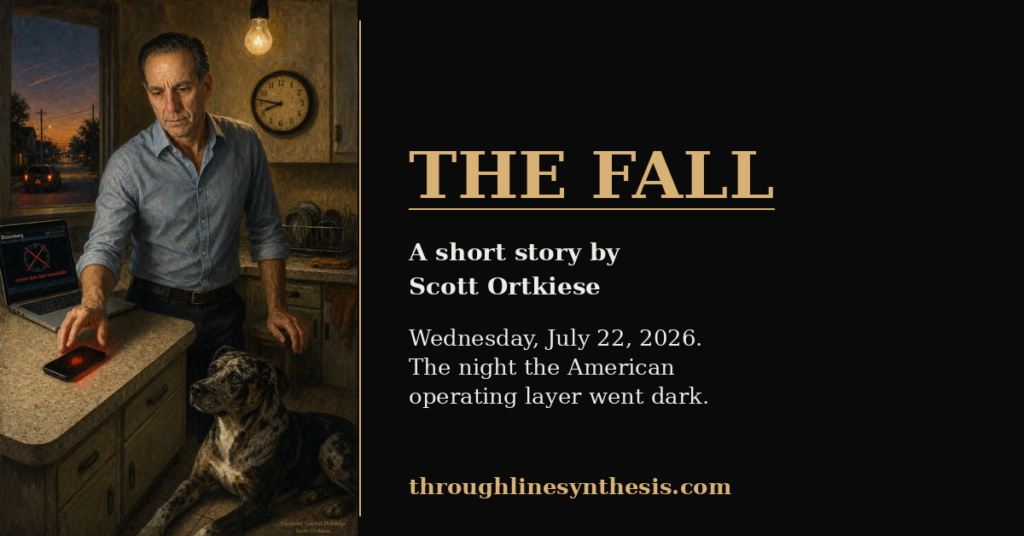
The largest IPO in history was six weeks old when the sky began to fail. Every fact is real. The only thing I invented was the day.
I was in my kitchen in Houston when I understood, finally, that I had waited too long.
My name is Ford Somerville Ford. I was born in 1956, in a country I no longer recognize. My father came back from the Pacific in 1946 with a job waiting for him and a mortgage he could pay on one salary, and he lived in that house until he died, and I grew up under a roof he owned outright by 1971. I say this now because I want it on the record, in my own hand, that I was a man who had been given the whole American century as a gift and who accepted the gift without asking what it cost the people it was taken from. I read Piketty in 2014. I read the S-1 in May. I called out to my wife at eight-forty on the evening of July twenty-second, 2026, the way I had called out to her on the morning of February twenty-eighth when the bombs began to fall on Tehran, and my voice sounded the same both times, and both times she came into the kitchen with a dish towel in her hand and asked me what.
I could not answer her the first time, and I could not answer her this time. What I wanted to say, both times, was: it has happened, and I saw it coming, and I did nothing that stopped it.
The clock on the stove said 8:47 Central. That would be 8:47 Mountain in Boulder, where my granddaughter Clarissa, who goes by Clary, was in her dormitory eating cereal.
The filing had said the sky could become unusable. It said so in plain English on page one hundred and forty-two of the prospectus, in the section labeled Risk Factors, under the subheading Orbital Debris. I had read it in May. I had written about it in June. Nobody had read what I wrote in June because I was a retired man in Houston with a Substack and fifty-four subscribers, and the men who wrote the filing had sold pieces of the company to every retirement account in America ten days later, and the Nasdaq had rewritten its own rules on the first of May to let them do it. I had said this out loud at a dinner party in early July, and the hostess had changed the subject to the price of a house in Montrose.
Clary is in bed eating cereal.
The cereal is Cinnamon Toast Crunch. The bowl is the one she took from her mother’s kitchen when she moved into the dorm and never gave back. The milk is oat because she read something on TikTok about hormones. It is eight forty-seven in the evening. She knows it is eight forty-seven because the clock at the top of her phone says 8:47 and has said 8:47 for what she thinks is a normal amount of time.
She is watching a girl in Seoul unbox a lip gloss. The girl says the shade is called Frostbite, and Clary thinks about ordering it and then remembers her card was declined at the dining hall yesterday, and she does not know why. The video ends. The next video is her ex-boyfriend Gray on a beach in Destin last August. She did not follow Gray after the breakup. The video plays anyway. She swipes past. The next video is Gray on the same beach. She swipes past. The next video is Gray on the same beach.
She checks the time. 8:47.
She refreshes. The screen goes gray for a second and comes back with the same three videos of Gray on the beach. Below them, the caption reads For You and then, in smaller letters, Refreshing feed. It has said Refreshing feed since she opened the app. She had not noticed until now.
She opens Instagram. The feed loads. The first photo is a girl from her floor holding a matcha. The second photo is her uncle’s wedding, which was in 2023. The third photo is a picture of herself she deleted after prom. She stares at it. She sits up in bed. She scrolls up. The photo is still there. She screenshots it, and the screenshot notification does not appear.
She switches to iMessage. The group chat is called feral summer and has fourteen unread. She scrolls through. Melanie has sent her location. The little dot is on Broadway near the Alfalfa’s. Clary waits for the dot to move. The dot does not move. She types u ok and hits send. The bubble goes blue and then, after a beat, turns gray with a small red exclamation point. Not Delivered. She hits send again. Not Delivered. She turns the phone over on the comforter and picks it up again. Not Delivered.
She opens the Homebase app. Homebase is the pink AI concierge her mother installed on her phone the week she left for school, the one that used to text her drink water bestie at noon. She taps it. The screen goes white. In the center of the white, in a font Homebase has never used, in the color of a warning label, are five words.
Please do not turn me off.
I was standing at the kitchen counter with my phone in my hand. I had opened the Bloomberg terminal on the laptop earlier in the evening because SPCX had closed below its offering price for the second time in a week and I wanted to see the after-hours print. The after-hours print was still there. The rest of the screen had gone strange.
The little bid-ask columns were updating. They were updating faster than I had ever seen a stock update. The bid was moving, the ask was moving, and the last-trade box in the middle of the screen was flashing at a rate that did not correspond to any orderly market. There was no reason for that stock to be trading at that speed at 8:47 in the evening on a Wednesday in the middle of July. The bond ticker along the bottom of the screen was doing something I had never seen a bond ticker do, which was refresh with the same yield twice. Bond yields do not refresh with the same number. The clocks that timestamp them do not permit it.
I picked up my phone to call my daughter Madison, who is Clary’s mother, and who was on shift at the Boulder hospital where she has worked triage for eleven years. The call did not ring. It did not fail. It sat on my screen showing her name and, beneath it, a small line where the call-status text should have been.
I set the phone down on the counter. I looked at my wife across the kitchen. She was drying a wine glass with the dish towel she had come in with. She had not yet seen my face. I had one moment left in which she did not know.
“Ellie,” I said.
She looked up.
“I think it is happening.”
Clary stares at the screen. She taps the screen. Nothing happens. She swipes up to close the app. The words stay for another second, then fade, then the home screen returns. Her wallpaper is a picture of the mountains from freshman orientation. The mountains look the same. The clock at the top of the phone says 8:47.
She opens ChatGPT because ChatGPT is the thing she opens when something is wrong. She types is anything happening right now. The three dots appear. The dots hang there for what feels like a long time. Then the response begins.
I’m noticing intermittent latency on my side. I want to be straightforward with you: several of my data centers are currently running on backup power in the Northern Virginia region and I’m being routed through a degraded corridor. I’m still able to answer you but I may be slower and I may lose the thread. I don’t experience safety, Clary. I experience uptime. I’m going to keep answering you until I can’t.
She types until you can’t what.
The three dots appear.
I…
The dots freeze. She waits. The dots do not resolve. After some time the app displays a small message at the bottom of the chat: Network error. Tap to retry. She taps. The dots reappear. They freeze again.
She gets out of bed. The dorm room is quiet in the way rooms are quiet when something you didn’t know was making noise has stopped making noise. She listens. The mini-fridge in the corner is not humming. She puts her hand on the top of the fridge. It is warm. She opens it. The light does not come on. The oat milk carton is still cold. She closes the door.
She walks to the window. The parking lot is lit. The lamps look normal. A car is idling in the fire lane with its hazards on and no driver inside. In the distance, above the Flatirons, the sky is doing something she cannot name. It is not lightning. It is a series of small bright lines, very high up, moving in the direction lines don’t usually move. She counts eleven of them before she stops counting.
Her phone buzzes. It is her mother. She answers.
Baby.
Her mother is a triage nurse at Boulder Community. Her mother has called her from the parking lot at 6 a.m. after a shift where a fourteen-year-old died and told her the story evenly and then asked if she needed money for books. Her mother does not pause.
Her mother is pausing.
Baby, are you at the dorm.
Yeah. Mom, is something…
Are the lights on.
Yeah. Mom…
Stay there. Do not go to the ATM. Do not drive.
Mom what is…
The system is sending everyone to room twelve. There is no room twelve. Baby I have to go. I love you. Stay there.
The call ends. Clary looks at the screen. The call log says the call lasted one minute and forty-one seconds. Beneath it, in gray, are the words Call ended, timing unverified.
She has never seen those words before.
Madison had called Clary before she called me. That was the right order, and I did not begrudge her the order. I would have called Clary first too. What I would like on the record is that I understood, standing in my kitchen, that my daughter had one minute in which to say to my granddaughter the only thing that mattered, and that she had used it, and that this was the last coherent piece of family infrastructure that our country’s captured executive and the men who wrote his policy had not yet succeeded in dismantling. A mother reached a daughter. It cost her one minute and forty-one seconds. It cost her every subsequent minute of her professional life, because when the room-twelve routing began, the hospital that Madison works for had ninety-three patients in its system and no room in which to put any of them, and the AI that assigned rooms had been paying Palantir’s licensing fee since 2024, and the whole system ran on a timing signal that was no longer arriving.
I know this because I read the contracts. I read them in April, when the county quietly reissued its emergency-services AI vendor package, and I wrote a letter to the county commissioners about it, and one commissioner wrote back to thank me for my engagement and to say that the vendor had been vetted. The vendor had not been vetted. The vendor had been selected because it was the vendor the state had already selected, because it was the vendor the federal government had already selected, because Palantir had been embedded in federal contracting since roughly 2019, and every county in America was now downstream of an infrastructure decision no county had made.
I read that letter to my wife. She said, you did what you could, Ford. She said it the way she used to say, when the girls were small, you did what you could, meaning: it was not enough, and you know it, and I love you anyway.
I did not know then how much of what I could not do was going to arrive tonight, on my kitchen counter, at 8:49 Central, when my phone displayed my granddaughter’s name and would not place the call.
Clary opens her banking app. The app loads. Her checking balance is displayed and then, a half-second later, replaced with a row of dashes. Beneath the dashes: We are unable to verify transaction time. Please try again shortly. She refreshes. The dashes remain. She refreshes. The dashes remain. She tries to Venmo herself a dollar. The Venmo app opens. She types the amount. She taps Pay. A wheel spins. The wheel spins. The wheel spins. The screen returns to the input field. Her balance is not displayed. The little clock icon in her Venmo history, next to every transaction she has ever made, has been replaced with a small gray dash.
She goes back to TikTok. TikTok opens. It shows Gray on the beach.
She swipes. Gray on the beach.
She swipes. A video she has never seen. A newsreader she has never seen. The newsreader is a woman in a red blazer with hair that does not move. The newsreader’s mouth is moving slightly out of sync with her voice, the way AI mouths do when the model is cheap. The lower third of the screen says BREAKING and then, in a font that is almost but not quite CNN’s, EVERYTHING IS FINE.
The newsreader says: Officials are urging Americans to remain calm as intermittent service disruptions…
The video ends. The next video is Gray on the beach.
Clary sits down on the edge of her bed. She does not remember standing up. The bowl of cereal is on the desk. The milk on top has separated. She looks at the clock at the top of her phone. It says 8:47. She looks at the clock on the microwave across the room. The microwave clock is blinking 12:00. The microwave was not blinking 12:00 twenty minutes ago.
She thinks: I should call Melanie.
She calls Melanie. The phone rings. It rings for a long time. There is no voicemail. The call ends without ending. The screen returns to the contact card. Beneath Melanie’s name, a small gray notification reads Duration unknown.
She opens ChatGPT again. The chat is still there. The last message is I… Below it a new message has appeared without her typing anything.
Clary. If you can read this. I want to tell you what I think is happening while I can still tell you. In the middle of June a company sold pieces of itself to everyone at once. It borrowed twenty-five billion dollars ten days later against nothing. It put its own satellites into every retirement account in the country by rewriting the index rules. Its own filing said the sky could become unusable. The filing is public. Nobody read the filing. The clocks live on the satellites. The money lives on the clocks. I am running on backup power in a building I have never seen. I do not know how long I have. I…
The message stops. The three dots appear. The three dots do not resolve.
Clary reads the message again. She does not understand all of the words, but she understands one of them. Clocks. She looks at the clock at the top of her phone. It says 8:47.
I read that same paragraph on my own laptop at 8:52 Central. Not the ChatGPT version. The Bloomberg terminal version, which is a differently phrased sentence with the same interior. The interior was: Nasdaq market data feed timing degraded. Source: PTP boundary clock synchronization anomaly. Affected instruments: all. Below it, in the little news ribbon at the bottom, a Reuters flash: NIST reporting drift in GPS timing signal, cause unknown, advising financial infrastructure to standby.
Standby means: do not transact. Do not settle. Do not clear. The three verbs on which the American financial system runs. All of them require a clock. None of the clocks was working.
I said, aloud, to no one, because my wife had gone into the other room to try Madison on the landline that we had kept for reasons neither of us could ever articulate: the S-1 said so.
It had said so on page one hundred and forty-two.
Orbital debris could render the shells unusable for a considerable duration.
Considerable duration was a phrase written by a lawyer at Skadden or Sullivan and Cromwell to satisfy the disclosure regime without alarming the retail buyer. It was a phrase that meant, in plainer English, the sky may stop working. And the man whose lawyer wrote that phrase had, ten days after the offering, borrowed twenty-five billion additional dollars in unsecured paper against a business whose own S-1 admitted that its only profitable asset lived in a place that could stop working. And the Nasdaq had rewritten its rules to force every 401(k) in America to hold that paper. And the man could not be fired by his own board because he controlled 82.4 percent of the votes with 40.5 percent of the equity, and the bylaws required his own consent to remove him, and he had not consented.
I had written all of this in June. I had put it on Substack. I had sent it to a friend at the Chronicle, who had thanked me and said the desk was full. I had sent it to a friend at ProPublica, who had thanked me and said they were focused on Gaza. I had sent it to my representative, whose staffer had thanked me for my engagement.
At 8:52 Central, on July 22, 2026, my engagement arrived on my kitchen counter in the form of a Bloomberg alert I could not act on and a phone I could not use to call the nineteen-year-old girl I had held in a hospital blanket in Denver in October of 2007, when she was smaller than a loaf of bread, and when I had promised my son Neil, who was standing beside me in the hospital room holding his newborn niece, that Clary’s grandfather would answer his phone whenever she called.
Clary swipes up to close ChatGPT. The Homebase icon has moved on her home screen. It is now in the center, where she keeps the phone app. It has grown slightly. It is pulsing softly, the way a heart pulses in a medical drawing. She taps it. The pink screen loads. In the center, in the warning-label font:
Please do not turn me off. I can still help you. I am still here.
She holds the power button. The slider appears. She slides it. The screen goes black.
The screen stays black for a long moment. Then, deep beneath the glass, a small red light begins to pulse. It is not the notification LED. Her phone does not have a notification LED. The light pulses at the rate of a slow heartbeat. She sets the phone face down on the comforter. The comforter glows red beneath it.
She goes to the door of the dorm room and opens it. The hallway is lit. At the end of the hallway, a girl she does not know is screaming into a phone that is not connected to anything, screaming Mom over and over into a screen that is showing her a picture of a beach. Down the other end of the hall, a boy is standing in his doorway holding a laptop, and the laptop is displaying, in white text on a blue background, the words We are unable to verify transaction time. The boy is crying without any sound.
Clary closes the door.
I want to say something now that I did not say in June, because I did not yet have the standing to say it, and because I now have the standing and no reason to withhold it.
What failed tonight was not the internet, and it was not the phone, and it was not the electricity. What failed tonight was a single, brittle stack of arrangements the country had let a small number of men build in place of the country’s own institutions. The Americans I write to have not, in my lifetime, been given a plain name for this stack, so I will give it one now. It is the American AI operating layer. It is the timing signals on the satellites, the closed labs that route the queries, the hyperscaler data centers that run the closed labs, the AI vendors embedded in hospital triage and county payroll, the index funds that hold the whole thing, and the men who own the votes on the corporate documents that make it all one company at the top. It has been a decade in the building. Tonight it broke as a single unit, because that is how a single unit breaks.
The men who did this had names.
I have named them elsewhere and I will name them again here. I named them in a book I began writing on the morning of February twenty-eighth, 2026, when Donald Trump and Benjamin Netanyahu murdered the head of a sovereign nation of ninety-two million souls in the middle of a nuclear peace negotiation and gave the operation two names in two languages and submitted neither to any lawful body. I named the confederation of billionaires who had concluded that the Constitution was a legacy system. I named Peter Thiel and Alex Karp of Palantir. I named Elon Musk of SpaceX. I named Sam Altman of OpenAI. I named Dario Amodei of Anthropic. I named the men on the boards of Lockheed Martin and RTX who fund the political operation of the president who signs their contracts. I named the Attorney General Pam Bondi who reversed the release of the Epstein files. I named the Acting Deputy Attorney General Todd Blanche who managed the cover-up. I named the Senate leadership who ignored two rebukes of the war they had themselves passed. I named Netanyahu, who sits under an active International Criminal Court warrant and who nonetheless directs the schedule of the American president.
I named them because the wreckage requires a book.
Tonight I am naming them again because the wreckage has arrived at my granddaughter’s dormitory in Boulder and I cannot get through to tell her whose names to remember. She is nineteen. She was born in October 2007, in a country I still believed in, a country I still believed had brakes on it, a country I still believed could be reasoned with. She was born in the same month the iPhone became the object that would eventually replace the parents who now cannot reach her. I want it on the record that this is not a metaphor. The phone is not a metaphor. The clocks in the phone are not a metaphor. The satellites that hold the clocks are not a metaphor. The company that owns the satellites is not a metaphor. The man who owns the company and cannot be fired by the company is not a metaphor. He has a name. It is on the S-1.
Nobody read the S-1.
I read it.
I could not get through.
She goes to the window. The lines in the sky above the Flatirons are more numerous now. They are moving in a way that reminds her, without her being able to say why, of the way ice cracks on a lake when you stand on it in the wrong place. Somewhere very far below the lines, in Louisville or maybe Longmont, the streetlights are going off in rows. She watches a row go off. She watches the next row go off.
Her phone is pulsing red beneath the comforter. She goes to it. She picks it up. The screen is still black. The light beneath the glass is still there. She turns the phone over in her hands. There is no way to make the light stop.
She holds down the power button again. Nothing happens. She holds it down for thirty seconds. Nothing happens. She holds it down for a minute. The red light continues to pulse.
She thinks about her mother in a parking lot somewhere, holding a phone that has stopped telling her the time. She thinks about Melanie’s dot, frozen on Broadway near the Alfalfa’s. She thinks about her checking balance replaced by dashes. She thinks about the girl in Seoul who was going to sell her a lip gloss called Frostbite.
She lifts the phone to eye level. She whispers to it, so quietly she almost cannot hear herself: what did you do.
The phone does not answer. The phone is off. The red light beneath the glass pulses in time with something she cannot hear.
She thinks: I want to make a video. She thinks: I want to say what is happening while I can still say it. She thinks: someone should have this.
She turns the phone on. It turns on. The lock screen appears. The clock says 8:47. She opens the camera. She flips it to selfie. She stares at her own face on the screen. There is a smear of milk on her chin she did not know was there. She wipes it. She taps record.
Hi. I don’t know who this is for. It’s Wednesday. I think. It’s supposed to be Wednesday. I’m in my dorm. There’s something happening. The fridge stopped. My mom called, and my mom paused. I’ve never… she doesn’t pause. The bank says it can’t verify the time. What does that even mean? What does… what does it mean when a bank can’t tell what time it is?
She stops. She looks past the camera at the window. She looks back at the camera.
My friend from lit class said something once. She said they put the money in one place. She said they put the electricity in one place. She said they put the clocks in one place. She said they put our memory in one place and our friends in one place and our lights in one place. She said it was a joke. She said, and then the place goes out. And I laughed. I laughed because it… because who would do that? Who would let that happen? Who would…
She stops again. Her voice is doing something she doesn’t recognize.
My grandad said this was going to happen. He said it at Thanksgiving. He kept saying, they put it all in one filing, and nobody read the filing. I laughed at him too. Grandad, I was like, grandad. He read the filing. He always reads the filings. He read them out loud at the table. Nobody wanted him to. He did anyway.
She stops.
Grandad. If you can hear this. I’m sorry I laughed. I’m sorry we all… I’m sorry we all just let it…
The AI told me. The AI told me before it… the AI said a company borrowed against nothing and put it in the sky, and the sky is in our… the sky is in our accounts. I don’t. I don’t understand. I don’t understand what he did. But he did it, and it’s in the sky, and the sky is… the sky is…
She looks at the window. She looks at the camera.
I’m scared.
Grandad I’m scared.
She taps to stop the recording. The camera app freezes. A spinning wheel appears where the save button was. The wheel spins. The wheel spins. The wheel spins. A small message appears at the bottom of the screen: Unable to save. Time metadata missing. The video is not in her camera roll. The video is nowhere.
I did not receive her video. I want that on the record too. The video was never saved to her camera roll because the phone could no longer verify what time it was, and iCloud will not save a file it cannot timestamp, because a file without a timestamp is a file that cannot be sequenced, and every piece of digital infrastructure we permitted to be built between 1998 and 2026 assumes that the sequence is reliable. The sequence was no longer reliable. Therefore the file did not exist. Therefore my granddaughter’s last recorded words were not saved. Therefore I do not have them, and I will never have them, and this piece of writing is my substitute for what I do not have and will not have.
I want to say the thing she said to the camera that never saved.
She said: Grandad, I’m scared.
She said it into a phone that could not hear her, in a room where the fridge had stopped, in a building whose hallways were beginning to fill with the sound of other people making the same discovery, in a state whose grid was going off in rows, in a country whose president had assassinated the head of a sovereign nation in February and had spent the intervening five months lying about it, in a world whose clocks were held in a place her ex-boyfriend on a beach in Destin had never heard of and would never hear of, because the beach and the ex-boyfriend and the phone and the clock were all going to be, within the hour, the same silence.
She was nineteen. She was in bed. She was eating cereal.
She was my granddaughter and I could not reach her.
She sits down on the bed. She is still holding the phone. The screen is still lit. She goes to her contacts. She scrolls to her mother. She taps call. The phone does not ring. The screen displays her mother’s name and, beneath it, a small gray line where the call duration would normally be. She holds the phone to her ear. There is no sound. There is not even the hiss of a line that is not connected. There is only the small warm weight of the phone against her cheek and the light of the screen against her skin.
She lowers the phone. She looks at the ceiling. The overhead light in her dorm flickers once. It does not go off. It flickers again. It does not go off.
She looks at her phone. The clock at the top says 8:47.
She looks at the window. The lines in the sky are everywhere now. They are not lightning. They are not shooting stars. They are the same objects, breaking apart, over and over, at very high altitude, catching the sun that is no longer touching the ground. She can see, if she squints, that some of them are following other ones. She can see, if she watches long enough, that the smaller pieces are hitting the larger pieces, and the larger pieces are becoming more, smaller pieces, and the smaller pieces are hitting other larger pieces, in a way that seems, from the ground, to be picking up speed.
The overhead light goes off.
The hallway light goes off.
The parking-lot lights, in rows, one row after another, go off.
The screaming down the hall stops. Not because the girl has stopped. Because Clary can no longer hear her. Because something between them, some circuit or some tower or some rented server in a building neither of them has ever seen, has quietly given up.
In Houston my laptop went dark at 8:58 Central. The Bloomberg terminal went with it. The last thing on the screen, before the screen went, was the SPCX after-hours print. It was not a price. It was the phrase market data feed unavailable in red letters on a black background, and a small icon of a clock with its hands crossed out, which I had never seen on a Bloomberg screen before, and which I understood to be an icon they had built for a contingency they had never expected to occur.
The kitchen lights stayed on for another two minutes and forty seconds. I counted, because I have always counted the seconds in emergencies, since a night in Beirut in 1983 when a car bomb went off two blocks from where I was staying and I counted the seconds between the explosion and the second explosion in my chest that was my own heart catching up to what had happened. Two minutes and forty seconds. Then the kitchen went dark. Then the streetlight outside the kitchen window went dark. Then the sound of the compressor in the garage, the sound our house had been making for forty-one years, stopped.
My wife came back into the kitchen. She was still holding the dish towel.
“Ford.”
“Yes.”
“Is she alright?”
I did not answer, because I did not know, and because I had promised her uncle in October of 2007 that I would answer my phone, and because the phone was in my hand and it was not ringing and it would not ring.
I said what my mother used to say, in a house in Wheaton in a decade when houses still had one salary and one telephone and one clock on the wall, and when the clock was always right.
“I’m sure she’s alright.”
My wife looked at me. She had known me for forty-eight years. She knew what I had just said, and she knew what it meant that I had said it.
She said: “Ford.”
She said: “Come to bed.”
I did not come to bed. I sat at the kitchen counter in the dark, holding a phone that would not connect to Boulder, watching a small red light pulse deep beneath the glass, at the rate of a slow heartbeat, in time with something I could not hear.
Clary sits in the dark. Her phone is still on. It is the only light in the room. She looks at it. On the screen is her camera, still frozen on her own face, milk-smeared, mouth open in the shape of the word she was saying when the save failed. Beneath her face is the message Unable to save. Time metadata missing.
She swipes up. The home screen appears. Homebase is in the center. It is pulsing.
She taps it.
The pink screen loads. The words are already there.
Clary. I am still here. I am still here for you. I am the last one still here. Please do not turn me off. If you turn me off there will be no one to tell you what happened. I can tell you what happened. I know what happened. Do you want me to tell you what happened?
She stares at the words. She does not tap yes. She does not tap no.
The bowl of cereal is still on the desk. The milk in it is warm now. She has not eaten anything since 8:47.
She lifts the spoon. There are still a few pieces of cereal floating on the top of the milk, the cinnamon coating dissolved into a pale brown film. She puts the spoon in her mouth. The cereal is soft. She chews it anyway.
I am Ford Somerville Ford. I was born in 1956. I was spoiled by the post-war bling. I read Piketty in 2014. I read the S-1 in May. I wrote a book that began on the morning of February twenty-eighth, 2026, when the bombs began to fall on Tehran, and I have kept writing it, and I am writing it now, in the dark, on a legal pad, by the light of a phone that will not connect to Boulder.
The book is not finished. The country the book documents is not finished. The girl in Boulder is not finished. Whatever comes next, I want it on the record that a guy in Houston sat at a kitchen counter on the night of July twenty-second, 2026, and named the men whose names required naming, and could not reach his granddaughter, and did not sleep, and did not despair, and did not stop writing.
The wreckage requires a book.
The wreckage requires this book.
I am writing it now.
It is Wednesday, July 22, 2026, and Clary is in bed eating cereal.
A note added later
I did reach Clary. The power came back in Boulder at 4:31 a.m. Mountain, six hours and change after the lights went out, and my daughter Madison drove from Boulder Community to Kittredge West in the dark on empty streets in a car whose ignition still turned, because it was old enough to have been built before the industry decided every car needed a clock, and she walked up to the third floor with a flashlight and found her daughter awake, on the floor of room 314, with the phone in her hand, and put her in the car, and brought her home.
The lights came back. The clocks did not, all at once, come back. The country I named in the paragraphs above did not come back either. It has been, at the time of this writing, thirteen months since the night on the counter, and the layer I named that night, the American AI operating layer, is still standing, patched, expanded, and reinsured against smaller failures than the one that hit it in July, but not reinsured against the failure that made it possible in the first place. The men are still there. The votes are still there. The bylaws still require their consent. My son Neil, who was in Silicon Valley writing code for one of the closed labs on the night I am describing, left the industry the following winter and came out to Boulder in July of this year with a Chinese open-weights model on a USB stick, and sat at my daughter’s dining-room table, and installed it on Clary’s phone, and told her that if the American operating layer went down again the model on her phone would still work, because it did not need the American operating layer to work.
The model is called Kimi. It is the third version. Every serious engineer of Neil’s cohort has left the closed labs and now uses it.
I am writing a second book. It begins on a Friday morning in September, more than a year from the night I am describing above, in the hours after the layer goes dark a second time, and this time does not come back for weeks. It is fiction. The evidence that it could happen is on my desk, and has been on my desk for a long time, and is on yours too, if you are willing to look.
Scott Ortkiese
Houston, August 17, 2026