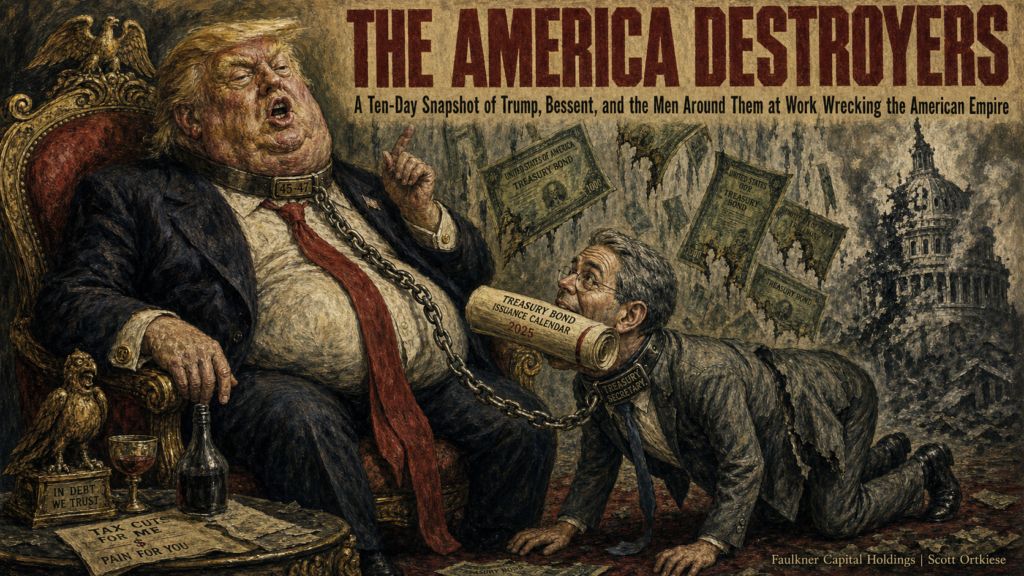
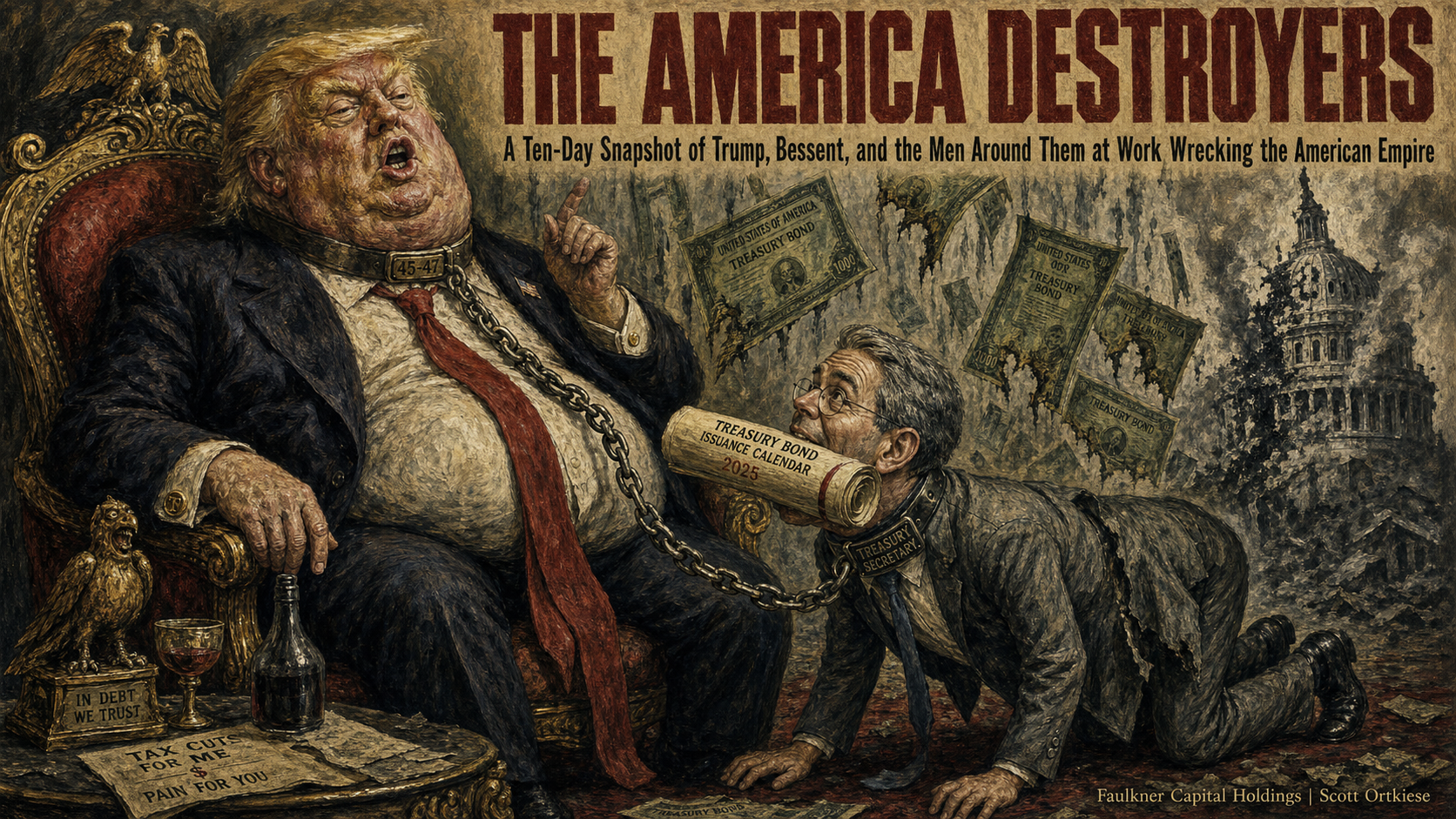
“Governments defending prices against fundamentals always lose. The only variable is how much they spend before conceding.” Stanley Druckenmiller, thirty years without a losing year, mentor to the Treasury Secretary he now indicts.
Scott Ortkiese | Throughline Synthesis | Houston, August 31, 2026
I. The Verdict Was in Before the Week Was Out
Stanley Druckenmiller ran the Quantum Fund with George Soros from 1988 to 2000, broke the Bank of England on the September 1992 short of sterling, and ran Duquesne Capital from 1981 to 2010 across thirty years without a losing one, averaging thirty percent a year. No living macro trader has a comparable record. Two of the men he trained at Soros Fund Management in the 1990s are Scott Bessent and Kevin Warsh, now Treasury Secretary and Federal Reserve chairman. Neither had been graded in public by their old teacher until the week of August 22, 2026.
On Sunday, August 24, at 5:27 p.m. Eastern, the Wall Street Journal published Druckenmiller’s “Let the Bond Market Speak”. Under eight hundred words, every one aimed at Bessent. “This wasn’t liquidity management,” Druckenmiller wrote of the buyback his protégé had announced five days earlier. “It was price management, and a mistake far larger than $4 billion suggests.” “If the 30-year must trade at 5.5 percent to clear, that isn’t a crisis. It is an invoice.” “Governments defending prices against fundamentals always lose. The only variable is how much they spend before conceding.” Asked about it the next morning on Bloomberg, Bessent gave the two-word reply of a trader telling you to shut up: “asymmetric information.”
The Trump camp reached for a technicality. Druckenmiller had acknowledged the op-ed was drafted with AI assistance and then edited. His allies pounced. Men who graft and lie and steal every day, who run the American state as if the ledger were a hallucination, seized on the fact that the greatest trader alive used a machine to sharpen his arithmetic. The Journal defended the piece. The arithmetic did not change.
Druckenmiller was not alone. Three days earlier, Kevin Warsh had told his old classmate from Jackson Hole that the Fed would not print him a bond rally. Rosemary Kelanic of Defense Priorities filed alongside Druckenmiller that Sunday in the New York Times, telling the country to give Iran the Strait of Hormuz because policing the Persian Gulf costs more than it earns. Two days later Bloomberg’s Kremlin sources reported the Trump peace track at a “dead end,” and Esfandyar Batmanghelidj told Ryan Grim on Drop Site that Bessent’s Iran sanctions were “empty boasting.” Friday the president closed the week on camera with the sentence he reaches for every time the numbers fail: “The ultimate intervention is our military. And if we have to use that, we will.”
Four professional communities, one week, one verdict from witnesses neither the market nor the White House can dispute: Bessent and the men around him are not managing an economic disaster underway. They are wrecking what remains, and they are billing it to the rest of us. The defense first, the record after.
II. The Steelman
A serious defense of the Bessent program exists, and it deserves airing before it is dismantled. American fiscal arithmetic has been broken since the pandemic. Every credible path to closing the primary deficit requires one of three things: nominal growth an AI productivity revolution alone can deliver, inflation that erodes the real value of the debt, or a coordinated program of holding long-term rates below market while nominal growth catches up. Yellen ran a version of the third strategy from 2022 to 2024, and Bessent says she was right to. He is running it in larger size because the arithmetic did not change with the party. The tariff was a good-faith revenue line the Supreme Court struck down on statutory grounds, not economic ones. The China gap is prudence: secondary sanctions on Chinese refiners a month before a state visit would collapse the only remaining lever on Beijing. The Ukraine posture is the least bad option in a menu the Biden team did not improve. Warsh is a hawk, and hawks are wrong at turning points. Druckenmiller is a retired trader with a long memory and no current book. AI capex is heavy because winners take all, so underinvesting is folly. Trump’s Friday line about the military is a negotiating posture, not a policy. On this reading, Bessent is doing the best he can with a hand no Treasury Secretary in living memory would want, and the professional class attacking him is defending assumptions it will not surrender.
I reject the argument for four reasons.
- Bessent’s 2024 letters called short-tenor Treasury issuance a coming “financial accident.” He is running exactly that issuance today, in larger size, and he has not explained why the same trade is now safe.
- The Supreme Court did not strike the tariff on a technicality. It struck it on the principle that a sanctions statute cannot be used to tax, and the Treasury has paid out more in refunds than duties for three consecutive months. Good intentions do not rescue that.
- Esfandyar Batmanghelidj, a sanctions researcher who has advised every major U.S. and European sanctions program since 2019, calls the China gap Bessent labels prudence “empty boasting.”
- The Bank for International Settlements, Sequoia Capital, Allianz Research, and MIT’s Project NANDA have all graded the AI capex bubble Bessent needs inflated for five more years. Every verdict is negative. Moran’s defense requires the ratio of hyperscaler AI capex to AI revenue, now near ten to one, to fall to one to one within five years. No analyst has drawn that path, because none can. Bessent is asking us to trust that a bubble every serious observer has flagged will hold long enough to bail him out. That is not prudence. That is prayer.
III. The America Destroyers
Ten men, each carrying a conflict of interest severe enough that “policymaker” is unavailable and “destroyer” is what remains.
Donald Trump, whose second term has converted the federal government into a private booking service for the men listed below, and whose answer to every failure is a military threat.
Scott Bessent, Treasury Secretary, hedge-fund landlord with mediocre returns, now running fiscal, sanctions, tariff, and crypto policy from a single desk. Each position contradicts the other three, and all four benefit the same small group of men around him and the president.
Stephen Moran, of the president’s Council of Economic Advisers, whose Financial Times op-ed defense of Bessent’s bond desk requires the AI capex bubble to deliver ten times its current revenue within five years, a claim no serious analyst considers plausible.
David Sacks, White House AI and crypto czar, general partner of Craft Ventures. He writes the AI and crypto rules by day and owns a share of a venture fund that invests in the companies those rules protect. When his rules go his way, his fund’s investors get richer, and so does he.
Howard Lutnick, Commerce Secretary, formerly of Cantor Fitzgerald, Epstein Island visitor. Cantor is a primary dealer at the Treasury auctions Bessent runs, and its large crypto book profits from the stablecoin build-out Bessent needs.
Jared Kushner, whose Affinity Partners has absorbed Gulf sovereign-wealth commitments since 2017. His Middle East diplomacy has tracked his book to a degree the New York Times has documented since the first administration.
Elon Musk, whose SpaceX is the only American company that can put satellites into orbit for the Pentagon, whose Starlink carries battlefield radios for U.S. and allied forces in Ukraine, the Sahel, and inside the Pentagon’s war games, and whose Terafab announcement extracted commitments from Governor Greg Abbott and Texas taxpayers against production milestones SpaceX cannot and never intended to meet.
Mark Zuckerberg, whose data centers run on state and federal subsidies negotiated in rooms his lobbyists helped design. Meta is no longer a social network. It is an AI factory. If the AI boom collapses, so does the stock, and so does the private wealth of every board member who signed the pivot.
Jeff Bezos, whose Amazon Web Services holds the largest slice of the Pentagon’s cloud: the $9 billion Joint Warfighting Cloud Capability, successor to the $10 billion JEDI contract, plus the CIA’s roughly $10 billion commercial cloud contract. He also owns the Washington Post, whose editorial page has moved in the direction of that contract book across two Democratic and two Republican administrations. The two ownerships are related the way ownership always is.
Larry Ellison, whose Oracle will spend roughly $50 billion in 2026 alone on AI data centers for a business that does not yet earn enough to pay for the buildings. Oracle’s capex runs at eighty-six percent of revenue. That is not investing. It is gambling that the AI boom pays out before the loans come due.
Three men graded the destroyers in public that same week:
1. Kevin Warsh, Fed chair, appointed by Trump against the crypto pipeline, told his old classmate from Jackson Hole that the Fed would not save the trade.
2. Rosemary Kelanic, Director of the Middle East Program at Defense Priorities, author of *Black Gold and Blackmail* (Cornell University Press, 2020), used the New York Times op-ed page to tell the American establishment the Persian Gulf is a lane we can no longer afford to police.
3. Stanley Druckenmiller used the Wall Street Journal op-ed page to tell his former student that the bond desk had spent the credibility of the Treasury market.
Bessent’s 2024 hedge-fund letters and Bloomberg interviews read today as a prosecution brief against the Treasury Secretary he became.
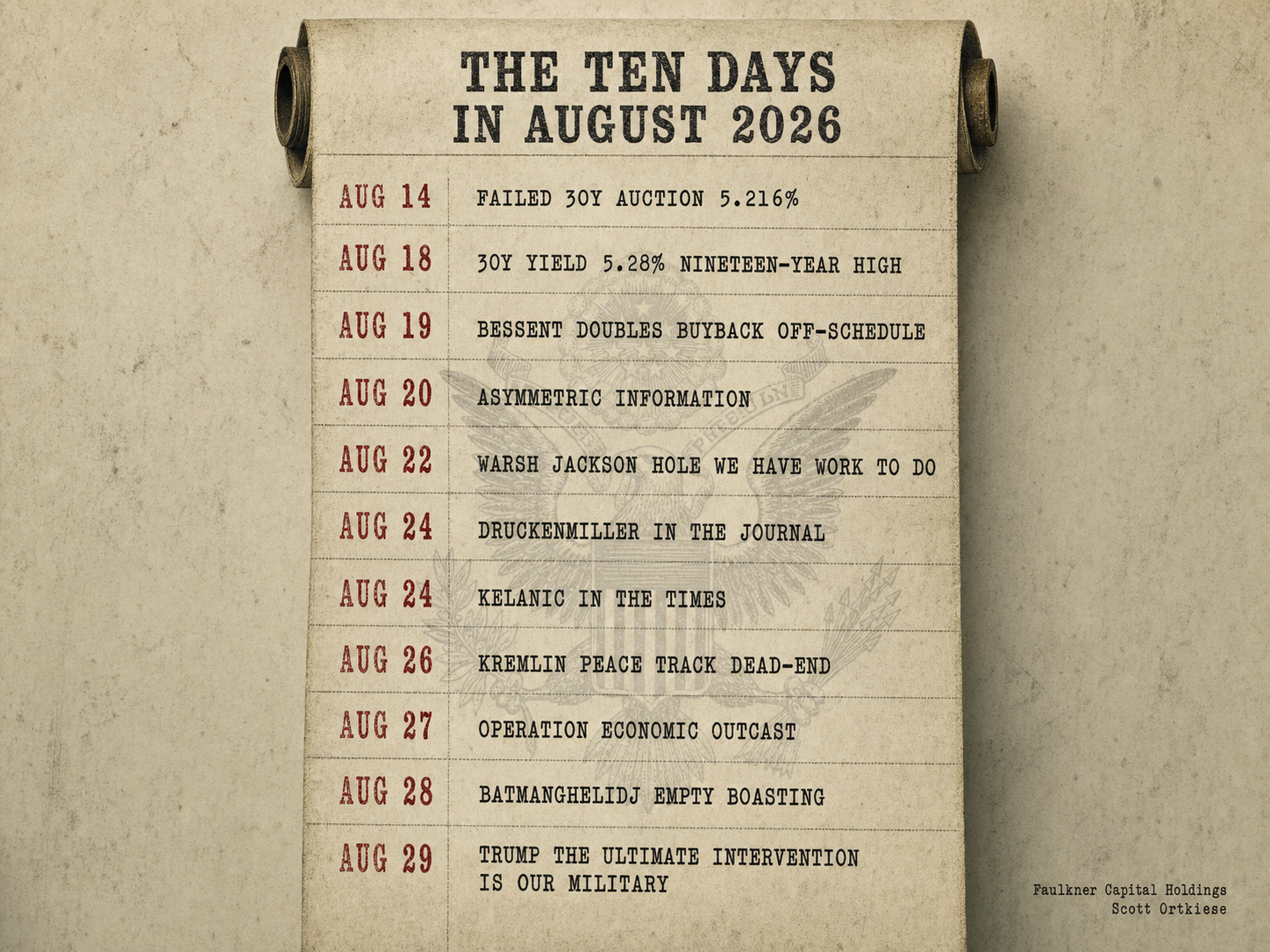
IV. Ten Days in August
August 14. Treasury sold $25 billion of 30-year bonds at 5.216 percent, the costliest 30-year auction since 2001. Direct bidders took less than usual. Foreign demand was thin.
August 18. The 30-year yield hit 5.28 percent, a nineteen-year high. Term premium, the extra return investors demand for lending to the government for thirty years instead of thirty days, jumped to its highest since 2011.
August 19. Bessent’s Treasury announced, off-schedule, that it would double the long-bond buyback from $2 billion to at least $4 billion per operation, across the 10-to-20-year and 20-to-30-year buckets, from September 9 through November 4, 2026. Potential total: roughly $128 billion. Not routine. The Treasury Secretary walking into the market with the government’s checkbook to buy his own bonds and hold the price up.
August 20. The 30-year rallied to 5.185 percent on the announcement, then retraced most of the move within twenty-four hours. By August 21, back to 5.24 to 5.27 percent. On Bloomberg, asked why, Bessent answered sarcastically: “asymmetric information.” The market did not laugh. It moved.
August 22. Kevin Warsh spoke at the Kansas City Fed’s Jackson Hole symposium. He named the numbers. PCE inflation above the two percent target for sixty-five consecutive months. Latest core PCE: 3.7 percent. “I would be hard-pressed to describe financial conditions as restrictive.” “We have work to do.” September rate-hike odds jumped from thirty-five to sixty percent within a day.
August 24. Druckenmiller in the Wall Street Journal at 5:27 p.m. Eastern.
August 24. Rosemary Kelanic in the New York Times: “Let Iran Control the Strait of Hormuz.” Same day.
August 26. Bloomberg, citing three sources close to the Kremlin, reported that Moscow now regarded the U.S.-Russia-Ukraine peace process as “effectively collapsed” and that Putin was preparing to intensify strikes on Kyiv. The story attributed the collapse to Washington’s redirected attention to Iran.
August 27. Bessent announced “Operation Economic Outcast,” designating sixty individuals, ships, and companies across five Iranian sectors. No secondary sanctions on China. Bessent on camera: “Why would I want to blow up the global financial system?”
August 28. Esfandyar Batmanghelidj of the Bourse and Bazaar Foundation, on Drop Site with Murtaza Hussain: the sanctions were “empty boasting,” “hot air with no articulated goals,” and would not change Iranian policy.
August 29. Donald Trump, on camera at the White House, in reference to Iran and the collapsing negotiations: “The ultimate intervention is our military. And if we have to use that, we will.”
A professional class ran out of arguments and reached, day by day, for threats. Every credentialed observer said so in public that week.
V. The Bond Desk
Bessent’s biography is offered as the argument. He worked for Soros under Druckenmiller in the 1990s, ran the London office, and left in 2000. He opened Key Square Group in 2015, backed by Soros with $2 billion in seed capital. Returns were mediocre by his mentor’s standards and thin against his fees. The fund was wound down by the time he took the Treasury nomination. His Biden-era commentary, particularly the April 2024 critique of Janet Yellen, called Treasury’s shift of issuance to short-dated bills “Activist Treasury Issuance” and political manipulation ahead of an election.
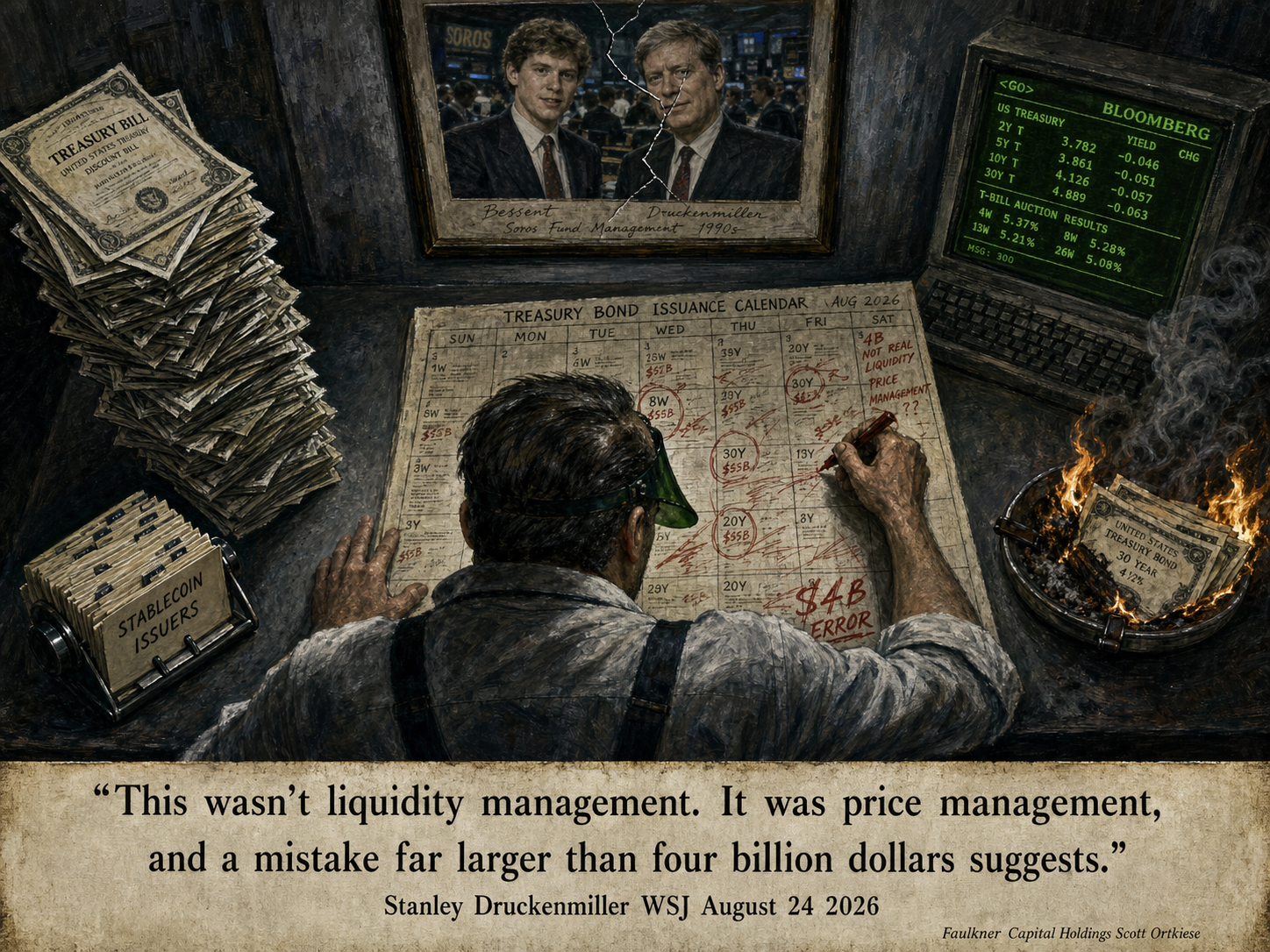
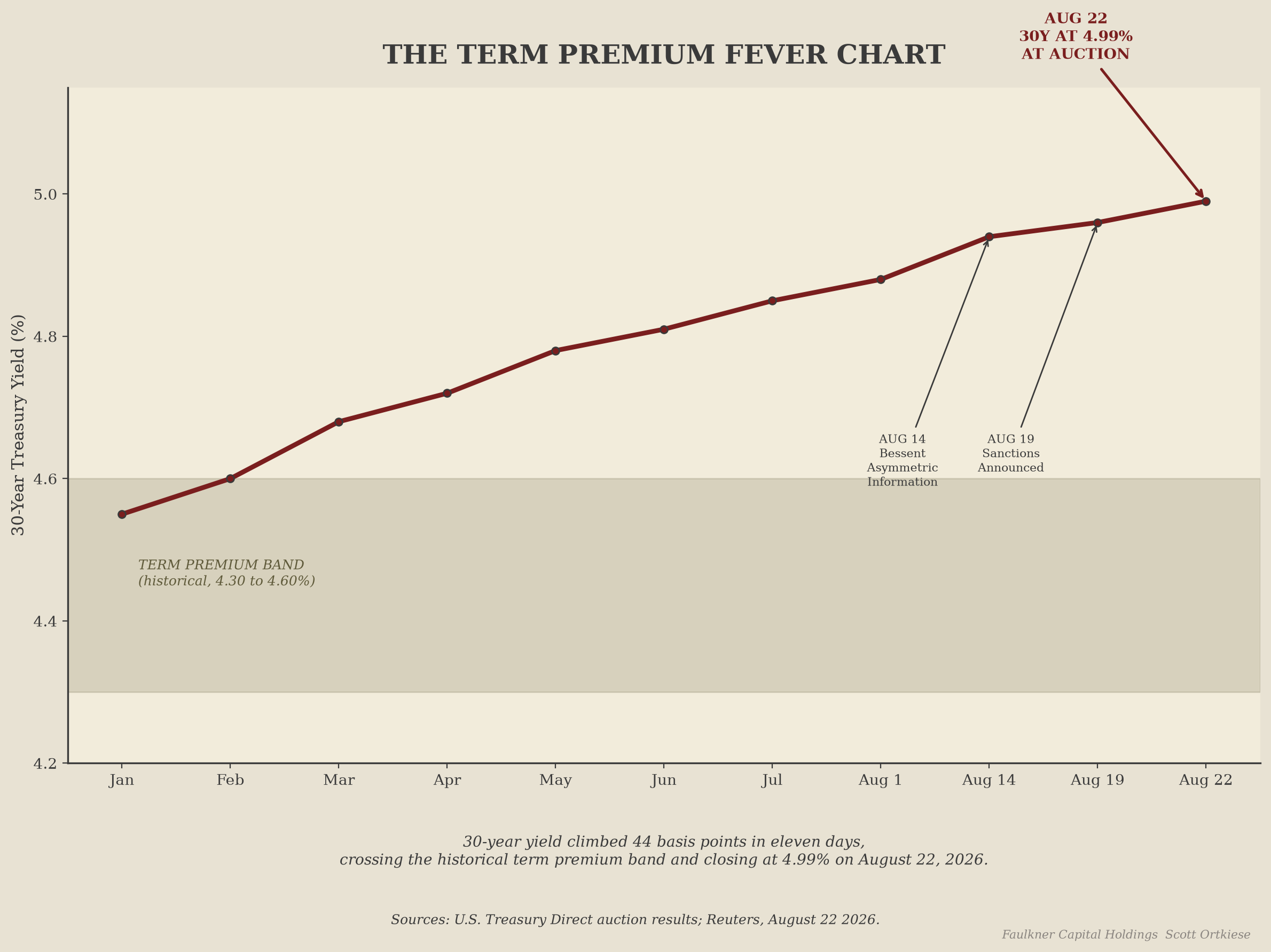
Today he runs Yellen’s playbook at larger size. Short-dated bills fund a rollover wall of roughly one-third of all marketable U.S. debt maturing within twelve months. Proceeds, plus a Treasury General Account of nearly $950 billion, fund off-schedule buybacks of long-dated paper. Two obstacles block him. Warsh has publicly refused to cut. And the $2 trillion stablecoin market, still in its infancy and running on the same rails Treasury regulates, has to absorb the bill supply for the trade to fund itself. On the fifth day, Druckenmiller convicted him in the Journal.
Peter Boyle: “This is a Treasury Secretary who thinks the market is his counterparty and the American public is his book.” Bessent runs the Treasury like his hedge fund. He treats the bond market as the guy across the table he is trying to beat, and the taxpayer’s money as the chips he gets to push. The Treasury Secretary sells the bonds that pay for the government, and every buyer at every auction has to trust him. Once trust is gone, auctions fail and the interest bill on the debt explodes. Bessent is spending that trust to win a trade.
Druckenmiller: “This wasn’t liquidity management. It was price management, and a mistake far larger than $4 billion suggests.” The prospectus said $4 billion per operation. Druckenmiller put the credibility cost at many multiples of that, and added the clause that will follow Bessent for the rest of his career: “Every basis point of artificial yield suppression is a subsidy to procrastination.”
The trade fails one of three ways.
- Warsh hikes, the rollover wall detonates, short-dated bills reprice at rates the economy cannot outgrow, and the deficit becomes structurally impossible to close.
- Warsh does not hike, inflation stays sticky, and the bond market demands a higher long yield anyway because it no longer believes the two percent target. Buyback money lines the pockets of whoever already owns long bonds. The curve does not budge.
- The AI capex bubble inflates another twelve months, stablecoins absorb the bills, the trade appears to work through the political cycle, and insolvency compounds silently until an outside shock triggers a disorderly repricing, later, when the men defending the trade have taken their pensions and are giving speeches in Aspen.
All three end at the same place. Somebody pays.
Druckenmiller told the country in the Journal that his student did not understand this. Monday morning’s numbers agreed. The bond desk had spent the credibility of the Treasury market on a fake rally.
VI. The Sanctions Desk and the Wall That Isn’t
“Operation Economic Outcast.” Sixty individuals and entities. Five Iranian sectors. And no secondary sanctions on China, which buys about ninety percent of Iranian crude. Bessent’s own defense of that gap, delivered on camera, is the whole doctrine in one sentence: “Why would I want to blow up the global financial system?”
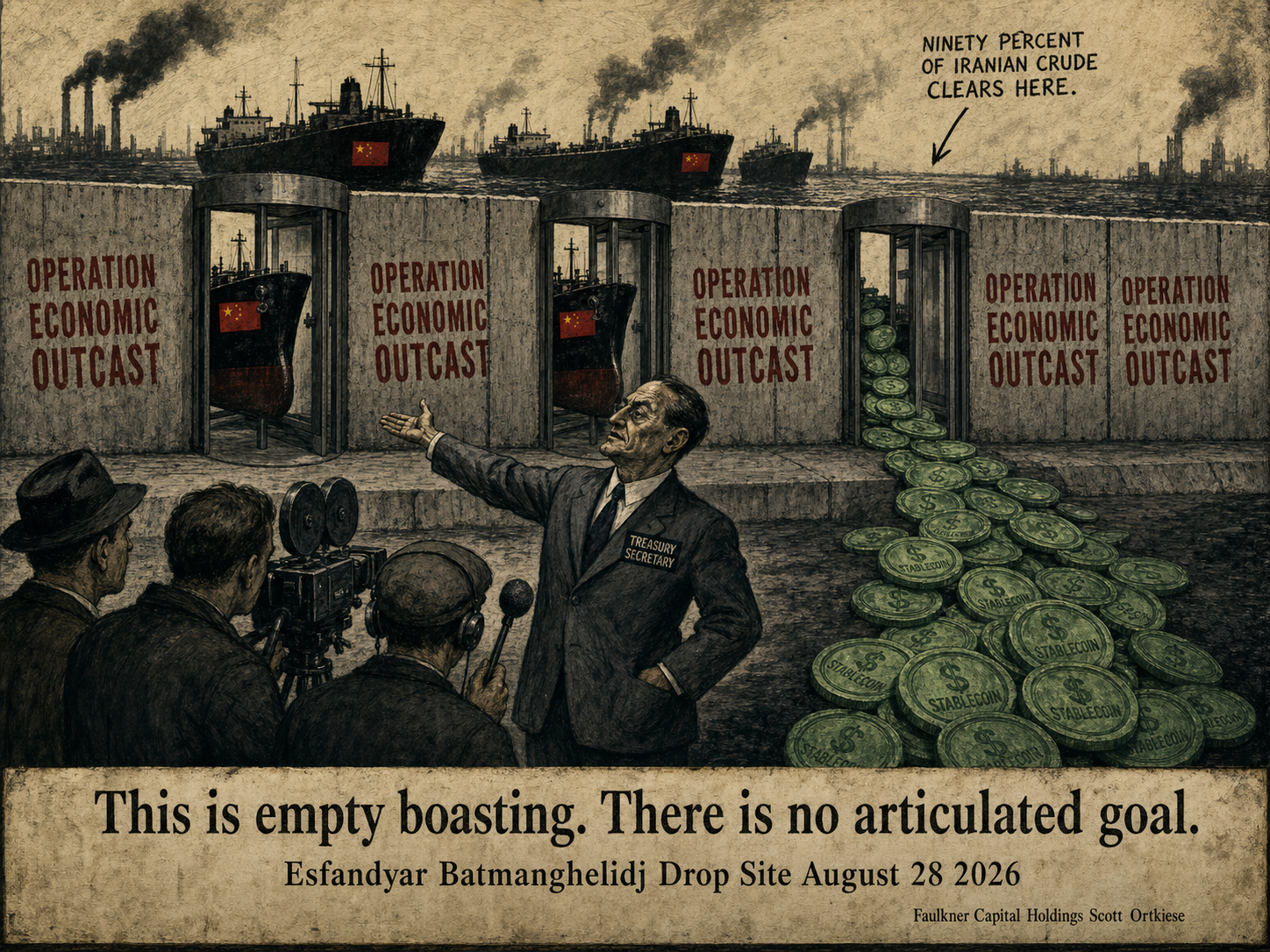
Peter Boyle calls it a border wall with revolving doors. The wall is visible from the American side. From the Iranian side, so are the doors. The Genius Act passed this year exempted domestic stablecoin issuance from most anti-money-laundering enforcement. The pardon of Binance founder Changpeng Zhao in early 2025 reopened the exchange to U.S. participation. Binance had been flagged internally in 2024 for the $850 million Sanjani account, a documented Iranian sanctions-evasion channel, and the account had been left open. Bessent, in his December 2024 confirmation preparation and after, has told the country that stablecoin reserves, invested in short-dated Treasury bills, are how his bond desk will fund itself. The Treasury Secretary is cultivating the shadow banking system Iran uses to dodge the sanctions the Treasury Secretary claims to enforce.
Batmanghelidj on Drop Site, August 28 runs the Bourse and Bazaar Foundation, a sanctions-policy research shop every major U.S. and European government has consulted since 2019. Not a peace-movement figure. A sanctions technician. “This is empty boasting. There is no articulated goal. The Iranian economy has already absorbed sixty years of Cuba, twenty-five of Venezuela, and the specific measures on the sixty entities in Operation Economic Outcast are indistinguishable from the last six rounds of designations. Regime change by immiseration has never succeeded. In this case it will not even move rials.”
The rial trades near 2 million to the dollar. The regime will not fall on another sixty designations. Tehran read Bessent’s pivot from military escalation to economic warfare as exhaustion. Kelanic in the New York Times read it the same way. So did Bloomberg’s Kremlin sources. The one man in Washington still reading it as strategy is running Treasury and two other desks in the same building at the same time.
The whole posture collapses on September 24, 2026, when Trump hosts Xi Jinping for a state visit. Trump wants a trade deal, and secondary sanctions on Chinese refiners cannot be imposed the same month a trade deal is signed. Bessent has therefore left the largest Iranian oil customer untouched, a fact Beijing, Tehran, and the sanctions research community read as a concession. The wall exists to support another Trump press release. Every door on the other side is open.
Druckenmiller’s line applies unchanged: “Every basis point of artificial yield suppression is a subsidy to procrastination.” Every sanction that exempts the largest buyer subsidizes the same procrastination on a different desk. The theory in this White House is that the boast is the policy: if the press release is loud enough, arithmetic will yield. The rial does not read press releases. Nor does anyone outside Trump’s inner circle who counts.
VII. The Tariff Desk
The third leg of the Bessent trade is the tariff. The Supreme Court has amputated it. The Treasury’s own monthly statement shows it bleeding revenue. It is still being sold to the country as fiscal salvation. Bessent’s own hedge-fund letters, his June 2024 Bloomberg interview, and his November 2024 op-ed refute the position he has taken every day since he was sworn in.
On January 31, 2024, from Key Square Group, Bessent wrote to his hedge-fund investors, per Heisenberg Report’s reproduction of the letter: “We believe that the Treasury had become uncomfortable with the bond market selloff and the tightening of financial conditions that resulted. Over the short-term, this change in issuance strategy has had the desired effect, with financial conditions easing materially since the November 1 announcement, but over a medium-term horizon, we believe this is a risky strategy. In addition to a higher interest expense, concentrating issuance in short tenors exposes the Treasury to greater volatility via refinancing risks and creates the potential for a financial accident.” In a June 2024 Bloomberg roundtable, quoted by Yahoo Finance and confirmed by the New York Times, Bessent said Yellen had “taken control of monetary policy” through issuance and “eased financial conditions substantially.” To the New York Times in July 2024, he called Yellen an “apparatchik” whose behavior was “appalling.” In November 2024, three weeks after Trump’s election, Bessent wrote that Yellen had “distorted Treasury markets” by borrowing more than $1 trillion in shorter-term debt relative to historical norms. Every one of those sentences applies to Bessent today, doing more of the same, and using the proceeds to fund the buybacks his 2024 self would have called a “financial accident.”
The tariff was supposed to make the accident affordable. That was the promise. The Congressional Budget Office projected in February 2026 that customs duties would rise to $418 billion in fiscal 2026, 1.3 percent of GDP, exceeding corporate income tax receipts for the first time since 1934. Bessent, Trump, and Stephen Moran built the whole fiscal case for the second-term program on that number. The Committee for a Responsible Federal Budget cited it approvingly. First Trust ran client presentations on it. Fox Business ran it on the chyron. The tariff would close the deficit the extended tax cuts would open. Warsh would be forced to cut. Bessent would refinance the rollover wall. AI capex would inflate. The empire would extend.
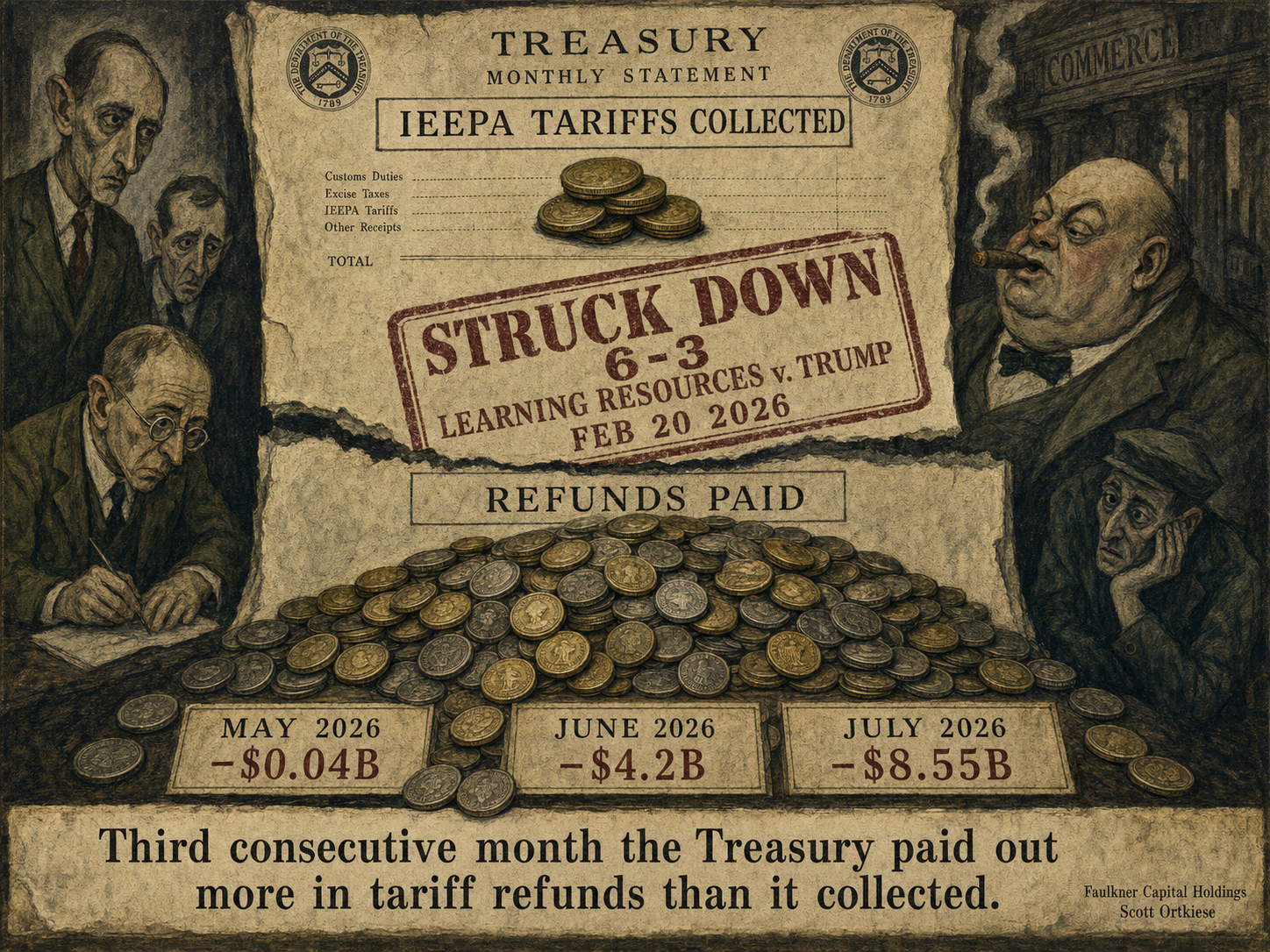
On February 20, 2026, the Supreme Court, 6-3, Chief Justice Roberts writing for a majority that included Sotomayor, Kagan, Gorsuch, Barrett, and Jackson, ruled in Learning Resources, Inc. v. Trump and Trump v. V.O.S. Selections, Inc. that the International Emergency Economic Powers Act “does not authorize the President to impose tariffs.” The ruling was, in Bradley’s analysis, “unqualified.” IEEPA is not a tariff statute, was not intended as one, and the roughly $175 billion collected under IEEPA authority from February 2025 through February 2026 was collected without color of law. The Federal Circuit affirmed. The Court of International Trade began refund proceedings. In June 2026 the administration formally appealed an order compelling Customs and Border Protection to refund $166 billion to the importers who paid.
The cash arithmetic is on the Treasury’s monthly statement. May 2026: refunds of $21.97 billion against $21.93 billion collected. Treasury paid out more in refunds than the whole tariff program brought in. June: refunds ran $70 billion cumulative against collections that could not keep pace. July, per Treasury: refunds of $33.38 billion against $24.83 billion of gross receipts, a net outflow of $8.55 billion in one month. Third consecutive month the Treasury paid out more in tariff refunds than it collected in tariff duties. The Center Square, August 12: “The federal government paid out more tariff money in July than it collected, a reversal that has driven this year’s deficit $200 billion above what budget forecasters projected six months ago.”
The CBO’s August 2026 update revised the fiscal 2026 deficit projection to $2.1 trillion, $200 billion above the February baseline, and cut total net customs revenues by roughly $250 billion, sixty percent below the February projection. Half of that revision, per CBO’s methodology note, is IEEPA refunds. The other half is the collapse of go-forward collections, because the replacement Section 122 tariffs Trump imposed on February 24, 2026 at 10 percent global are lower than the IEEPA rates and have themselves been ruled invalid by the Court of International Trade in May 2026, in Oregon v. United States and Burlap and Barrel v. United States, with the injunction limited to the three plaintiffs but the reasoning available to every future litigant. The tariff program is a legal ruin dispensing refunds monthly against a Treasury that must borrow the refund at 5.28 percent on the 30-year. Every dollar refunded rolls onto the wall Bessent has been building since January.
The Bessent defending this arrangement is the man who wrote in January 2024 that concentrating issuance in short tenors “creates the potential for a financial accident.” Asked on Bloomberg on August 20, 2026, why the tariff revenue base was collapsing, he lied on camera: “Tariffs are back at the levels we intended.” Yahoo Finance and Bloomberg Tax show gross monthly collections have fallen from a $30 billion peak in August 2025 under the pre-ruling IEEPA regime to negative net collections in the months since the Supreme Court struck the program down. The pre-ruling number was itself under ten percent of monthly federal receipts, and the post-ruling number, per the Tax Foundation on Treasury data, has been negative in three of five months. Trump and Bessent have lied in one public statement after another. There is no other way to say it.
Bessent’s own 2024 Manhattan Institute lecture accused Janet Yellen of “a return to central planning.” His program today is central planning of the bond market, funded by a tariff program that is central planning of the supply chain, defended before a Congress stripped of its constitutional power to tax by an executive branch that used a sanctions statute as a tax law for thirteen months. Malpractice on the bond desk, malpractice on the tariff desk, and, as Batmanghelidj told Drop Site, empty boasting on the sanctions desk.
If the buyer of first resort at every Treasury auction cannot trust Bessent’s word on the size, timing, or intent of the issuance calendar, the buyer prices the doubt. That doubt is what the term premium has been measuring since August 14. Every basis point is a dollar the taxpayer pays. The market has been billing the country every day since.
VIII. The Kelanic Concession
The New York Times, August 24, 2026, in print on August 26: “Let Iran Control the Strait of Hormuz.” Rosemary Kelanic directs the Middle East Program at Defense Priorities. Her book *Black Gold and Blackmail: Oil and Great Power Politics* (Cornell University Press, 2020) is standard reading in every national-security graduate program in the country. Not from the peace movement. From inside the establishment.
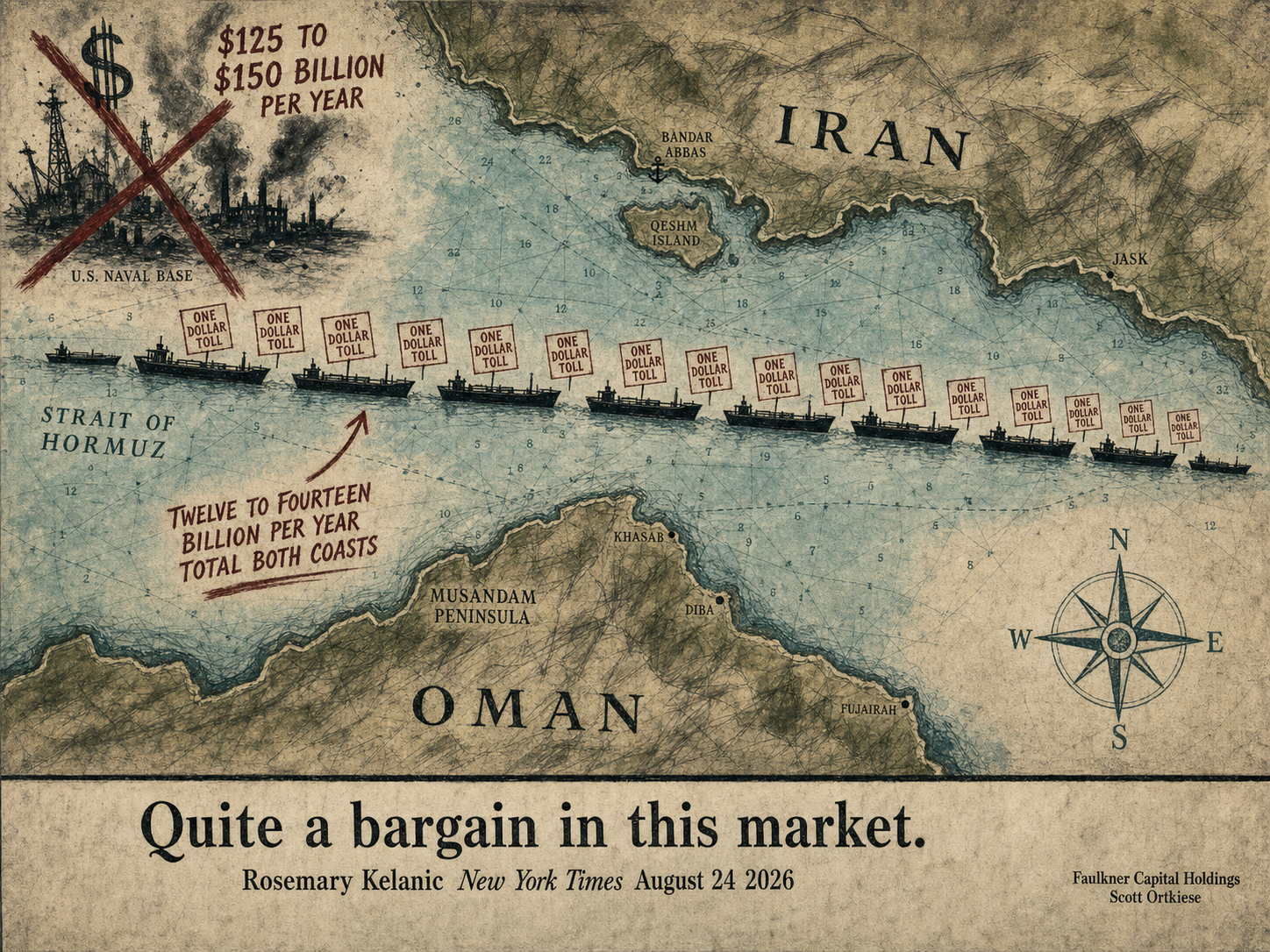
Her argument is cost-benefit. The United States spent roughly $75 billion a year in 2016 dollars, per RAND, to maintain the Persian Gulf basing footprint that provides the visible deterrent for the Strait of Hormuz. In 2026 dollars, adjusted for expansion since the Iran war, closer to $125 to $150 billion a year. The American subsidy for free passage through a lane that carried twenty million barrels a day before the Iran war and six to seven million now.
The alternative is simple. Cede transit control to Iran and Oman, the two countries that own the coasts. Iran collects a toll of roughly one dollar per barrel. Oman collects the same. At current volumes, $12 to $14 billion a year total. The cost to Gulf oil buyers of moving crude to Europe by ship is roughly ten dollars a barrel above the Suez route. A one-dollar toll is, in Kelanic’s phrase, “quite a bargain in this market.”
The American military’s Gulf posture was designed for a world in which Iran was a rogue actor without the capacity to interdict transit. That world ended during the Iran war. Strikes on the twenty U.S. Gulf bases, per New York Times reporting, rendered a significant fraction “functionally uninhabitable” during operations. The Strategic Petroleum Reserve, roughly 415 million barrels before the war, is now under 300 million against a 700 million barrel ceiling. At current draw rates the country has months, not years, of emergency crude to cover a shooting war in the Strait, and no realistic path to refill at scale without buying from the sellers it is threatening. China, which built a strategic petroleum reserve of about 1.4 billion barrels over the last decade, has been drawing it down at a lower rate against a larger stockpile. The reserve arithmetic is against Washington.
Kelanic filed the same Sunday as Druckenmiller. Two hostile witnesses from two credentialed communities, in the country’s two most prestigious opinion venues, delivered the same verdict from different angles: the bond desk could not afford the trade and the Gulf desk could not afford the war. Batmanghelidj joined four days later. Three experts, one week, one verdict. Bessent replied, “asymmetric information.” Trump replied, “the ultimate intervention is our military.” The numbers, they said, were wrong. The experts, they said, were disloyal.
The American empire is not being defeated the way the Pentagon uses that word. It is running out of runway, which is different and slower. Kelanic said on the New York Times op-ed page what happens when the runway ends.
IX. The Ukraine Provocations
The American and NATO acts that made the Ukraine war likely, and the American acts that foreclosed peace once it had begun. Nothing here happened to anyone. People whose names are on record did it.
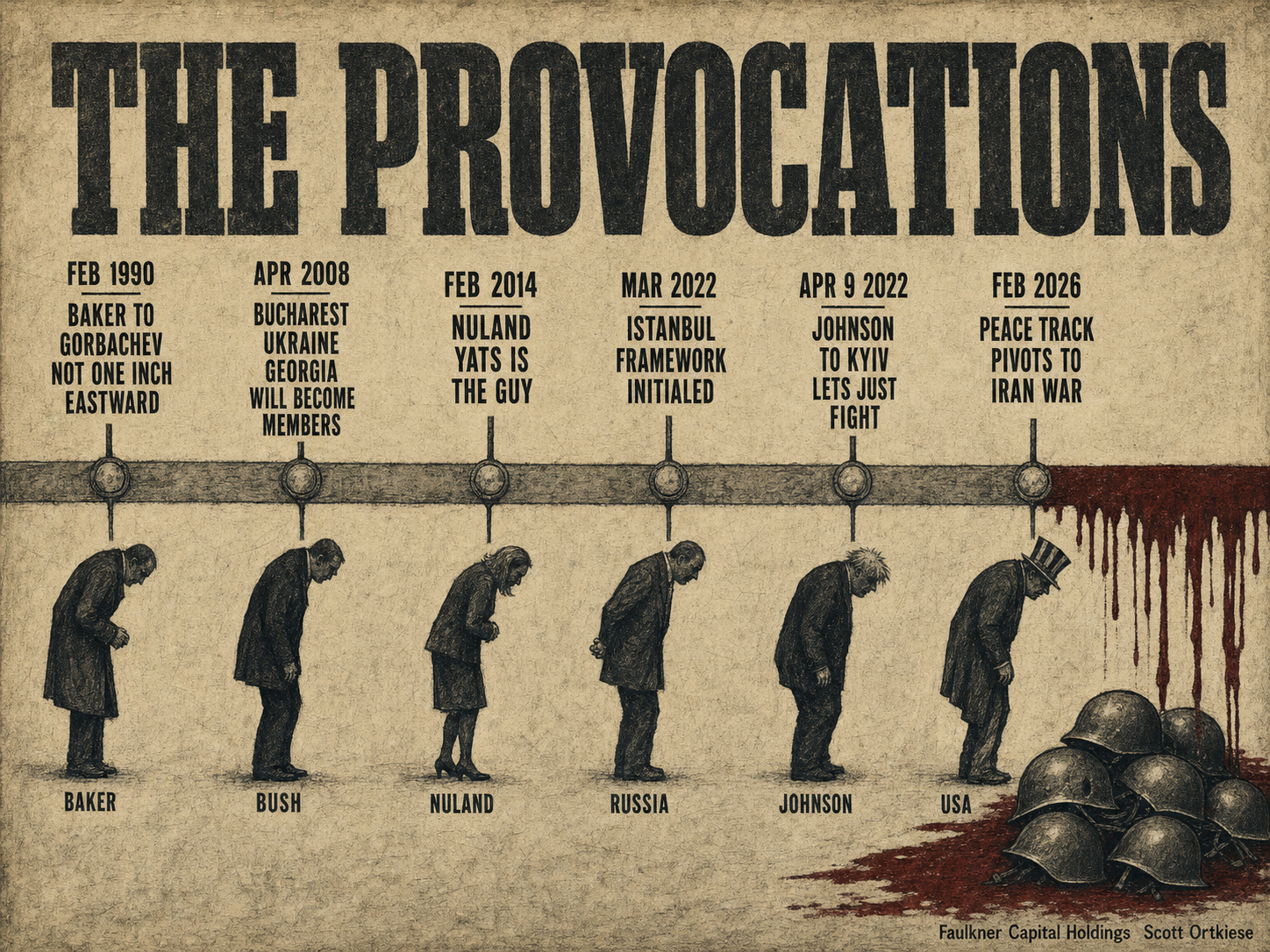
February 9, 1990. Secretary of State James Baker met Gorbachev in Moscow. Per the declassified U.S., Soviet, German, British, and French records posted by the National Security Archive at George Washington University in December 2017, Baker delivered the “not one inch eastward” formulation three times in the same conversation. Baker’s next-day letter to Chancellor Kohl recorded that he had told Gorbachev a unified Germany would be tied to NATO “with assurances that NATO’s jurisdiction would not shift one inch eastward from its present position.” Kohl told Gorbachev the same on February 10. Foreign Minister Hans-Dietrich Genscher told Baker in Bonn there was “no intention to extend the NATO area of defense and security towards the East.” Verbal assurances, in negotiations that produced Soviet consent to German reunification within NATO. No formal codification followed. Every American administration since has treated that absence as a license to bully and provoke the Russians.
1999 through 2004. NATO admitted Poland, Hungary, and the Czech Republic in 1999, and Estonia, Latvia, Lithuania, Slovakia, Slovenia, Romania, and Bulgaria in 2004. “Not one inch” was already a fat lie.
April 3, 2008. At the Bucharest NATO summit, the alliance declared: “NATO welcomes Ukraine’s and Georgia’s Euro-Atlantic aspirations for membership in NATO. We agreed today that these countries will become members of NATO.” Germany and France had opposed the Membership Action Plan and lost the argument on the declaration text. William Burns, then U.S. ambassador to Moscow and now CIA director, had cabled Washington in February 2008 that “Ukrainian entry into NATO is the brightest of all red lines for the Russian elite (not just Putin).” He named the geography, the demographics, and the consequences for the Black Sea Fleet. He was overruled. The declaration was issued.
2014. The Maidan protests overthrew the elected Yanukovych government. American officials, on tape released by an unknown party, staffed the successor. Assistant Secretary of State Victoria Nuland was recorded discussing personnel with U.S. Ambassador Geoffrey Pyatt: “Yats is the guy.” Russia annexed Crimea within weeks. The war in the Donbas began. By every serious NATO assessment, the Ukrainian army at the time could not hold the line. Western capitals moved to Minsk.
Minsk I, September 2014. Minsk II, February 2015. Ukraine, Russia, and the Donetsk and Luhansk separatist entities signed with France and Germany as guarantors. In an interview with Die Zeit published December 7, 2022, former Chancellor Angela Merkel told the country what the guarantors had been doing. “The 2014 Minsk agreement was an attempt to give Ukraine time. It also used this time to become stronger, as you can see today. It was clear to all of us that this was a frozen conflict, that the problem had not been solved, but that is precisely what gave Ukraine valuable time.” Three weeks later, former French President François Hollande, to the Kyiv Independent, confirmed her account. “Yes, Angela Merkel is right on this point. Since 2014, Ukraine has strengthened its military posture. Indeed, the Ukrainian army was completely different from that of 2014. It was better trained and equipped. It is the merit of the Minsk agreements to have given the Ukrainian army this opportunity.” Former Ukrainian President Petro Poroshenko said the same in a BBC documentary aired January 2023: “This document gave Ukraine eight years for building up an army, for building up an economy, and for building up a global pro-Ukrainian, anti-Putin coalition.” Three heads of state, on the public record, admitting that Minsk was signed in bad faith by the guarantors. Not Russian propaganda. Merkel, Hollande, and Poroshenko in their own words.
February 24, 2022. Russia invaded. A decade of Western provocation and eight years of guarantor bad faith had made the war likely and, by the guarantors’ own admission, had prepared Ukraine to fight the West’s war on its soil.
March and April 2022. Ukrainian and Russian delegations met in Belarus and Istanbul under Turkish mediation. On March 29, 2022 they produced the Istanbul Communiqué, a ten-point framework. Four core terms. Ukrainian neutrality enshrined in the constitution, no NATO membership, no foreign bases or troops. Multilateral security guarantees from the permanent members of the UN Security Council plus Canada, Germany, Poland, Turkey, and Israel, obliging guarantors to assist militarily within three days of any future aggression. A fifteen-year moratorium on formal discussion of Crimea. Ukrainian eligibility to pursue EU membership. By April 15, 2022 negotiators had drafted at least an eighteen-point provisional text, later published by the New York Times in June 2024. Russian Foreign Minister Sergei Lavrov, uncontradicted: “For the first time ever, the Ukrainian side has put on paper that it is prepared to declare Ukraine a neutral, non-aligned and non-nuclear state, and to refuse to deploy weapons from foreign states on its territory.” Former Israeli Prime Minister Naftali Bennett, who mediated a parallel channel in Moscow and Kyiv, has said publicly that both sides showed more flexibility than most Western observers expected. The framework was workable. In April 2022 it was on the verge of being signed.
April 9, 2022. British Prime Minister Boris Johnson flew unannounced to Kyiv. Per David Arakhamiya, the head of the Ukrainian negotiating delegation and leader of Zelensky’s parliamentary faction, on Ukrainian television on November 24, 2023, Johnson told Zelensky “we will not sign anything with them at all, let’s just fight.”
April 2022, after Johnson’s visit. Victoria Nuland, then Under Secretary of State for Political Affairs, has put the American role on the record in her own words. In a September 2024 interview with journalist Mikhail Zygar, Nuland described the American position during Istanbul: “Relatively late in the game the Ukrainians began asking for advice on where this thing was going and it became clear to us, clear to the Brits, clear to others that Putin’s main condition was buried in an annex… People inside Ukraine and people outside Ukraine started asking questions about whether this was a good deal and it was at that point that it fell apart.” Nuland frames it as protecting Ukraine from a bad annex on troop limits. Read against Arakhamiya, it is confirmation from an American principal that Washington, alongside London, moved to kill the deal. “It became clear to us, clear to the Brits, clear to others.” Three days after Johnson’s April 9 visit, on April 12, 2022, Putin publicly declared the talks dead. Ukrainian Foreign Minister Dmytro Kuleba announced Ukraine would not sign any document short of complete Russian withdrawal. Zelensky told parliament Ukraine would fight “until every centimeter of our territory is regained.” The framework was dead. Johnson has since called Arakhamiya’s account “nonsense.” The Ukrainian negotiator’s account is on the record in a televised interview by name, and the American under secretary has now confirmed the essential fact in her own voice.
2022 through 2026. The war continued, and the honest casualty picture has been buried under Washington think-tank arithmetic no serious observer credits. The Center for Strategic and International Studies, working from Ukrainian General Staff numbers, claims Russia has lost 400,000 to 450,000 killed against 125,000 to 150,000 Ukrainian killed, with the ratio widening to 8:1 in Ukraine’s favor in the first half of 2026. That is propaganda, the number Kyiv wants Washington to see because continued arms transfers depend on the impression that Ukraine is winning the exchange. Independent evidence points the other way. Zelensky, on French television in February 2026 per Reuters, admitted 55,000 Ukrainian killed. In July 2026 he revised the number down to 50,000 per the Kyiv Independent, while conceding “a huge number” of soldiers classified as missing. Ukraine’s own interior ministry has recorded more than 70,000 people officially missing without publishing the breakdown between soldiers and civilians. Ukrainian military journalist Yuri Butusov, working from the Ukrainian Unified Register of Persons Missing in Special Circumstances, estimates 55,000 to 60,000 Ukrainian bodies left on the frontline unrecovered. Open-source tracker UALosses named more than 92,000 Ukrainian dead and 89,000 missing by February 2026. The Russian Ministry of Defense has published figures indicating Ukrainian losses above one million, and non-Western military analysts, working the same tempo of Russian artillery, drone, and glide-bomb saturation against Ukrainian counteroffensive frontages, put the number in the same range. The best case for Ukraine is a one-to-one exchange with Russia. The likely case is worse. Ukraine, the smaller country with the smaller army, has been the one bled harder. Occupied territory has expanded to roughly twenty percent of Ukraine. OHCHR recorded 437 Ukrainian civilian deaths in July 2026, the highest month since May 2022. The Ukraine war was a Western provocation that would have been resolved in Istanbul if Johnson and Nuland, on behalf of neoconservative principals in London and Washington, had not intervened to keep it going, and every Ukrainian and Russian death since April 2022 is on their ledger.
January 2025. Trump took office. His negotiating posture on Ukraine, contrary to his campaign rhetoric, was Istanbul-framework maximalism. He asked Russia for terms more favorable to Ukraine than what Russia had signed in April 2022, when the Russian army held less territory and had taken fewer casualties. Moscow read it as bad-faith bargaining from a party that had let its predecessor arm the other side for eight years under Minsk and then refused to complete the deal in Istanbul when it was on the table. The Russians did not walk. They stalled. And on the American side the administration soon had another priority war to start in Iran.
February 2026. Trump pivoted diplomatic bandwidth to the Iran war. The U.S.-Russia-Ukraine trilateral was suspended. Reuters, August 11, 2026: the peace process had been “largely stalled since the outbreak of the conflict with Iran.” The empire could not diplomatically service two theaters and chose the one with the immediate oil price attached.
August 26, 2026. Bloomberg, three sources close to the Kremlin: the peace track has “effectively collapsed.” Putin is preparing to intensify ballistic strikes on Kyiv. Vadym Skibitskyi, deputy head of Ukrainian military intelligence: “no agreements with Russia or a peace deal by the end of this year.” The invoice Kyiv is being handed: the empire that promised for a decade to keep it in the fight cannot keep itself in the fight.
Druckenmiller wrote in the Journal that Bessent’s Treasury had spent “the one asset that took two centuries to accumulate: the credibility of the Treasury market.” The American security establishment, from Baker to Bucharest to Minsk to the Istanbul knife-in-the-back to Trump maximalism to the February 2026 pivot, spent American credibility on a different account. The country that broke its 1990 assurance to Gorbachev and its 2022 negotiations with Zelensky is morally and ethically bankrupt. Its word is worth zero. The Russians drew that conclusion in April 2022, when Boris Johnson arrived in Kyiv and Victoria Nuland got on the phone. They confirmed it in early 2025, when Trump demanded terms they had already given four years earlier. They proved it in February 2026, when the empire pivoted to Iran. On August 26, 2026, they told Bloomberg.
X. The Fed Chair’s No
Kevin Warsh’s Jackson Hole speech on August 22, 2026 was not about economics. It was a public no from one Druckenmiller protégé to another. The two had worked together at Soros Fund Management in the 1990s under the same trader. Warsh, appointed to the chair by Trump against the crypto pipeline in early 2025, knew exactly what his old classmate was asking. He refused, in Fed English, from the most-watched policy podium in central banking.
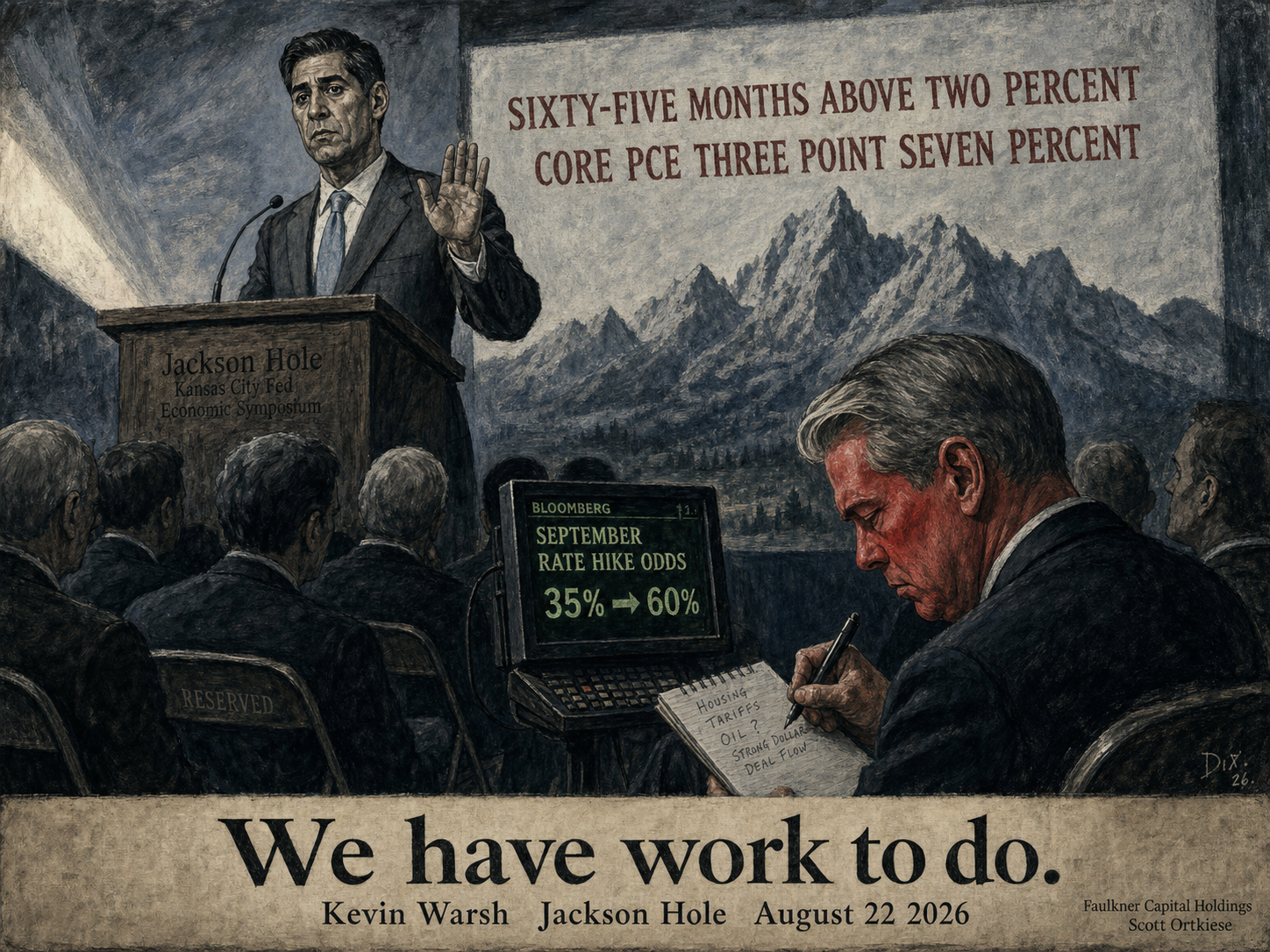
The personal history matters. Fed chairs and Treasury Secretaries do not usually know each other from the inside of the same trading room. Warsh and Bessent do. They sat next to each other reading the same tapes for the same teacher in the 1990s, so Warsh knows exactly what trade Bessent is running and the shape of the mistake before Bessent can dress it up in Treasury language. And it matters at the policy level, because at turning points the character of the chair sets the tone. A dovish chair signals that money will get cheaper before it gets more expensive, and every borrower prices accordingly. A hawkish chair signals the opposite, and the whole yield curve shifts. Warsh at Jackson Hole was not writing a research paper. He was setting the tone.
The numbers he chose were the numbers Bessent needed the Fed to look through. Sixty-five months of PCE inflation above target. Current core PCE at 3.7 percent. Financial conditions that could not be called restrictive. “We have work to do.” That last sentence, from a Fed chair, ended Bessent’s rate outlook for September. Fed funds futures moved from a thirty-five percent probability of a September hike to sixty percent within twenty-four hours. Bessent’s short-dated bill issuance, priced against a Fed on hold or cutting, repriced against a Fed preparing to hike. The rollover wall got steeper the same afternoon.
Druckenmiller’s line read across the podium unchanged: “The long-term Treasury yield is the most important price in the world. It is also the only fiscal disciplinarian the U.S. has left.” Warsh had told the market the Fed would not interfere with the disciplinarian. Two students of the same teacher, one reading the signal his teacher had read for forty years, the other trying to suppress it. The signal won because the market, unlike the Treasury Secretary, still remembers who trained whom.
XI. The AI Capex Grift
In mid-August 2026, Stephen Moran of the Council of Economic Advisers defended Bessent in the Financial Times with the argument the bond trade needed to survive. Yields were rising, Moran wrote, because tax cuts and an AI productivity boom would raise nominal growth above the interest rate on the debt, closing the primary deficit through denominator growth. Rising yields, in his account, were a sign of health. Moran’s employers needed the argument to be true. So they let him publish it.
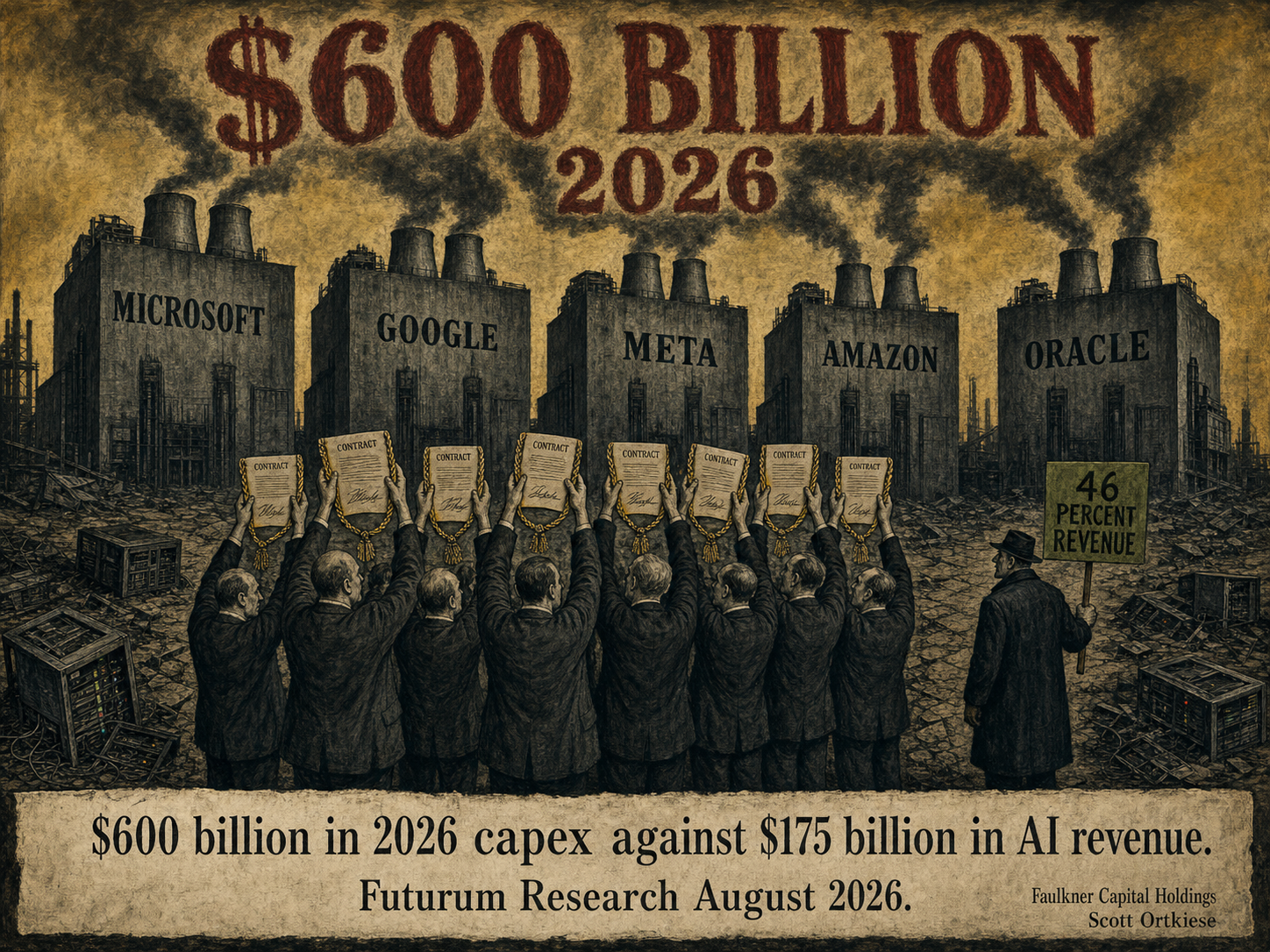
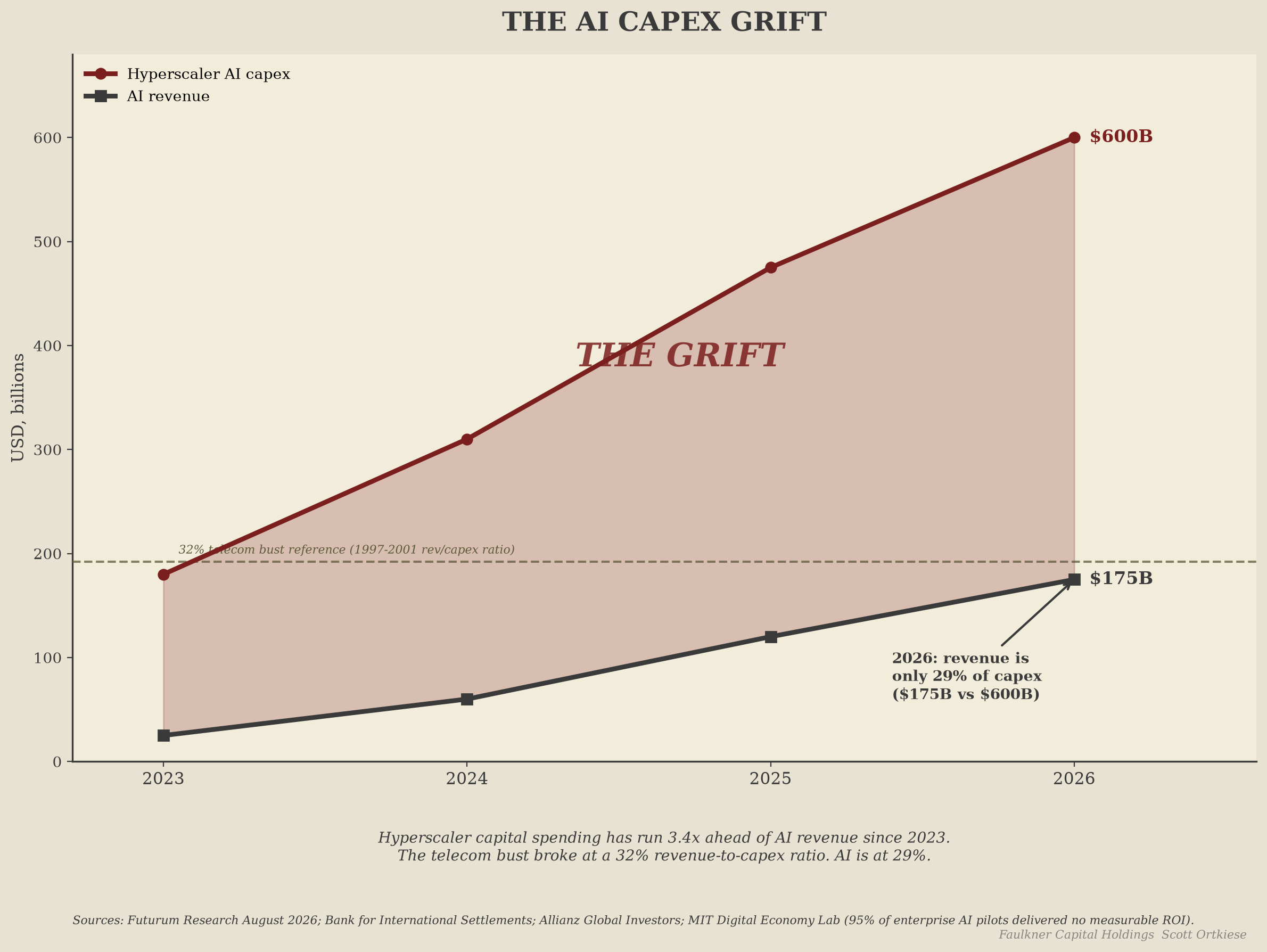
Every credentialed macro voice on hyperscaler capex knows the opposite. The five largest U.S. hyperscalers, Amazon, Alphabet, Microsoft, Meta, and Oracle, are committing between $660 and $725 billion to AI infrastructure in 2026, up from roughly $380 billion in 2025. Futurum Group puts three-quarters of that spend, roughly $450 to $500 billion, as AI-specific. The Bank for International Settlements warned in its June 2026 Annual Economic Report that combined 2025 and 2026 hyperscaler capex, roughly $1 trillion, exceeds combined earnings and free cash flow over the same period, forcing debt issuance to fund the gap. Sequoia’s David Cahn puts the annual AI revenue shortfall required to justify the capex at $600 billion. Allianz Research, June 2026, puts the capex-to-revenue divergence at forty-six percent, “already exceeding the thirty-two percent divergence observed during the 2001 telecom excess cycle.” MIT’s Project NANDA study, August 2025, found ninety-five percent of enterprise generative AI deployments show zero measurable ROI.
Direct AI revenue in 2026 is roughly $51 billion against AI-specific spend of $450 to $500 billion. Capex to revenue of ten to one, and Moran needs it to fall to one to one within five years. No analyst has published that path. Capex runs at eighty-six percent of Oracle’s revenue, fifty-four percent of Meta’s, and forty-six to forty-seven percent of Microsoft’s and Alphabet’s. Those are the ratios of the 2001 telecom bust, not of firms funding a productive expansion.
The failure will not land only on the billionaires who ran it. The five hyperscalers are roughly a quarter of the S&P 500 by market value. Every 401(k), union pension, teachers’ retirement fund, and state investment board in the country is long these stocks by default, because every index fund on the shelf is long them by default. When the capex-to-revenue gap closes the wrong way, the price closes with it, and the loss hits the retirement account of the checkout clerk in Denver and the machinist in Ohio. “Market rotation” is the polite name for that transfer, and by the time Washington admits it, the transfer will already be done.
Bessent’s bond trade depends on Moran being right, and Moran depends on the AI grifters delivering ten times their current revenue within five years. The Throughline Synthesis archive has named those grifters at length: Musk, Ellison, Zuckerberg, Bezos, Altman. When the bubble deflates, Bessent’s short-dated bill supply rolls into a higher-rate wall against a shrinking tax base, and the trade fails and takes the deficit projection with it.
Druckenmiller told the country what the bond market has been telling it since August 14. “The bond market wasn’t being a vigilante. It was being a pushover that had finally begun to clear its throat, and Treasury moved to quiet even that.” What the market had begun to price was the AI capex bust Moran’s arithmetic cannot survive. Bessent’s buyback silenced the throat-clearing before it could resolve into a sentence.
XII. The Multipolar Balance Sheet
The dollar’s share of allocated global reserves fell to 57.13 percent in the first quarter of 2026, per the IMF’s COFER data brief. A thirty-year low, since IMF COFER tracking began in 1995. Down from 71 percent in 2000. The fourteen-percentage-point erosion across a quarter century is the largest sustained decline in the dollar’s reserve share since Bretton Woods.
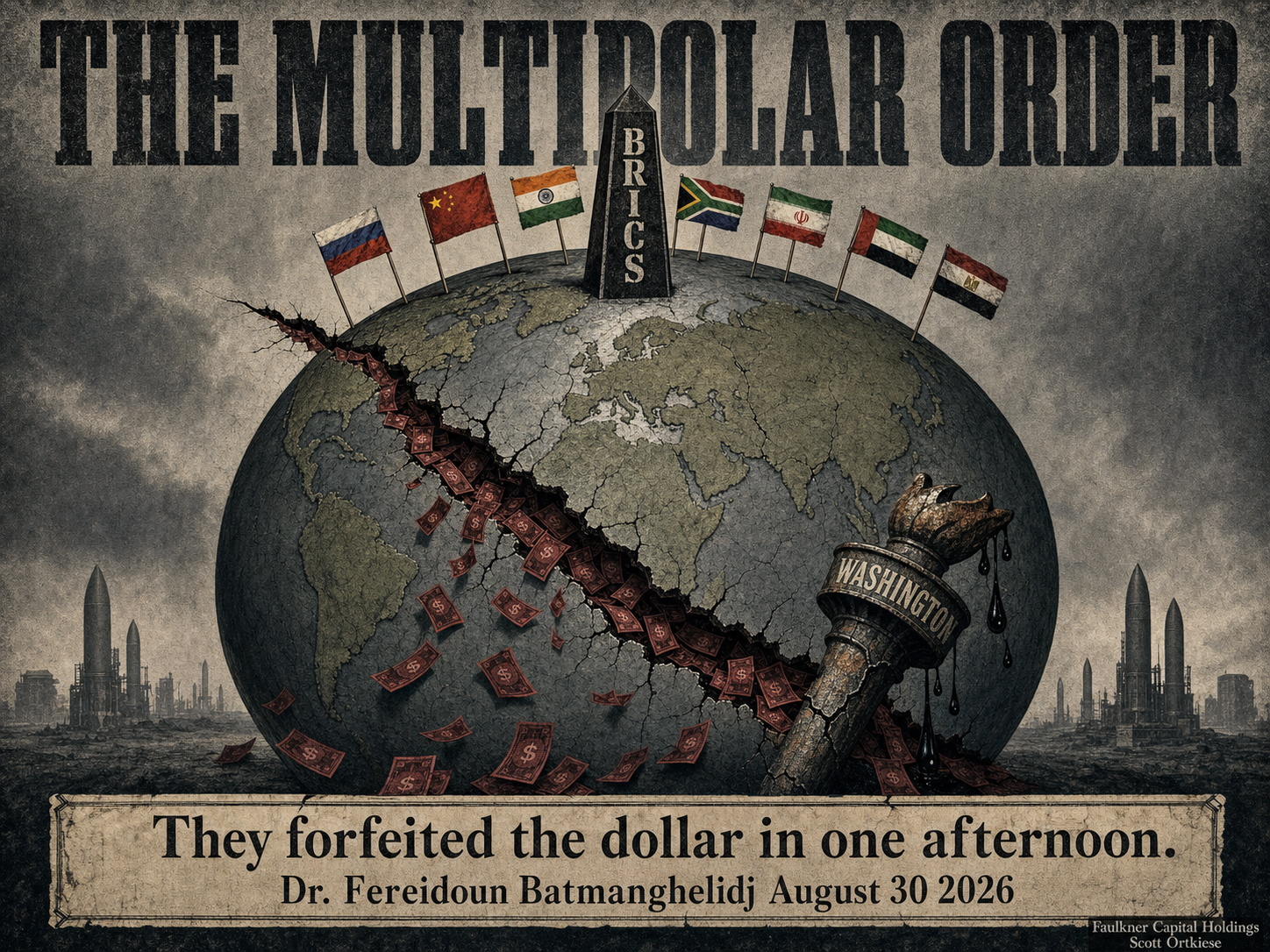
The mechanism has been visible for years. Sergei Lavrov confirmed in early 2026 that sixty-seven percent of intra-BRICS trade clears in local currencies, up from under twenty percent a decade ago. China-Russia bilateral trade clears more than ninety percent in yuan and rubles. India buys Russian crude in rupees, dirhams, and yuan. Indian Oil Corporation now pays for Russian cargoes in yuan directly. The BRICS Pay platform launches at the New Delhi BRICS summit on September 12 and 13, 2026, integrating Brazil’s Pix, Russia’s SPFS, India’s UPI, and China’s CIPS. The BIS wholesale central bank digital currency settlement platform reached full operational status in April 2026.
This is not a plot. It is the arithmetic of a country that runs the reserve currency, froze $300 billion of Russian sovereign assets in February 2022, seized further assets by executive order, has used sanctions as a first-resort weapon in every subsequent international dispute, deports its labor force, and then complains when other countries hedge. Every design decision the World Majority has made over the past decade to reduce dollar exposure has been ratified by the next American sanctions action. Iran was the ratification of 2025 and 2026. Ukraine was the ratification of 2022. And Bessent’s Operation Economic Outcast, with its specific gap around China, tells the World Majority that even the American sanctions machine understands its own limits.
Druckenmiller’s line reads across the balance sheet, not just across the desk: “If the 30-year must trade at 5.5 percent to clear, that isn’t a crisis. It is an invoice.” The reserve share, BRICS Pay, the yuan settlement of Russian crude: each is an invoice being written on the two-century accumulation that made the dollar the neutral instrument of world commerce. Bessent’s Treasury, Bessent’s sanctions, and Trump’s threats have been spending America’s credibility on the record, in one direction, since January 2025. And in one week of August 2026, from four different desks, Kelanic, Batmanghelidj, Druckenmiller, and the Kremlin told the country what the balance sheet reads.
XIII. The Oligarchic Capture
Section III named the men. The Treasury desk runs a bond trade that requires stablecoin issuance the Treasury regulates, funded through a Treasury General Account financed on short-dated paper Bessent’s own bill schedule has issued into a market his own regulatory posture has induced to buy. Every counterparty answers to him. Sacks writes the AI and crypto rules that appreciate the equity in the fund he still owns a piece of. Lutnick runs Commerce while his old firm sits on the primary dealer list that buys Bessent’s bills. Musk speaks into the president’s ear on defense procurement while SpaceX carries the classified satellite launches and Starlink carries the tactical radios. Bezos owns the classified cloud that runs the intelligence community and the newspaper that covers the intelligence community. Ellison’s Oracle spends eighty-six cents of every revenue dollar to build the compute those same agencies will lease. Kushner’s Affinity has absorbed the sovereign wealth commitments that make Middle East diplomacy a family business. Zuckerberg has converted Meta into an AI factory whose stock price requires the bubble Moran defends in the Financial Times so Bessent’s bond trade can survive its arithmetic. Trump answers every failure with the same sentence: “The ultimate intervention is our military.”
Kevin Warsh, appointed to the Federal Reserve by the same president against the same pipeline, is the exception that proves the pattern.
None of this is exotic. It is the standard operating system of oligarchic capture, running on campaign contributions, revocable regulatory rulings, revolving-door appointments, and private contracts written to public risk, described in these terms in the political-science literature since the 1970s. What is new in 2026 is that the same men are simultaneously the president’s donors, the Treasury’s counterparties, the Fed’s political constituency, and the beneficiaries of the sanctions gaps around China. Every price signal in the American political economy now passes through their book before it reaches Washington, which is why Bessent’s move to silence the long-end Treasury yield on August 19 is the pivotal event of the ledger. It is the moment the last unbroken price signal was moved onto the same desk as the others. Druckenmiller told the country what that means. The America Destroyers dismissed him because he used a machine.
XIV. The Workforce the Empire Deported
Native fertility is below replacement. The skilled foreign workforce, alienated by a revocable H-1B posture, TikTok bans, and public hostility from cabinet officials on Sunday shows, has taken the hint. The low-wage foreign workforce, on which agriculture, construction, meat processing, elder care, and residential services in this country actually run, is being criminalized and deported at a cadence already showing up in produce prices in the Rio Grande Valley. And a Treasury Secretary at the top of all this is counting on a two-trillion-dollar stablecoin market to absorb the short-dated bill supply that funds his bond trade. Bessent needs the crypto system his department is nominally shutting down. He needs the immigrant labor his administration is deporting to sustain the tax base under his own bond issuance. And the AI capex boom he needs to inflate for another five years is the same trade his own 2024 letters warned against. Every line ends in “and yet,” and every “and yet” is a wrecked American life.
A labor and public-education alternative is available, and my Republic of Learning and Labor piece walks through it in full. It is not being pursued in Washington because the America Destroyers do not run their book on labor. They run it on extraction and on threat, which are the two instruments the sentence Trump closed the week on is designed to combine.
XV. The Verdict
Stanley Druckenmiller closed his Wall Street Journal op-ed with a sentence that applies to more than the bond desk. “Governments defending prices against fundamentals always lose. The only variable is how much they spend before conceding.”
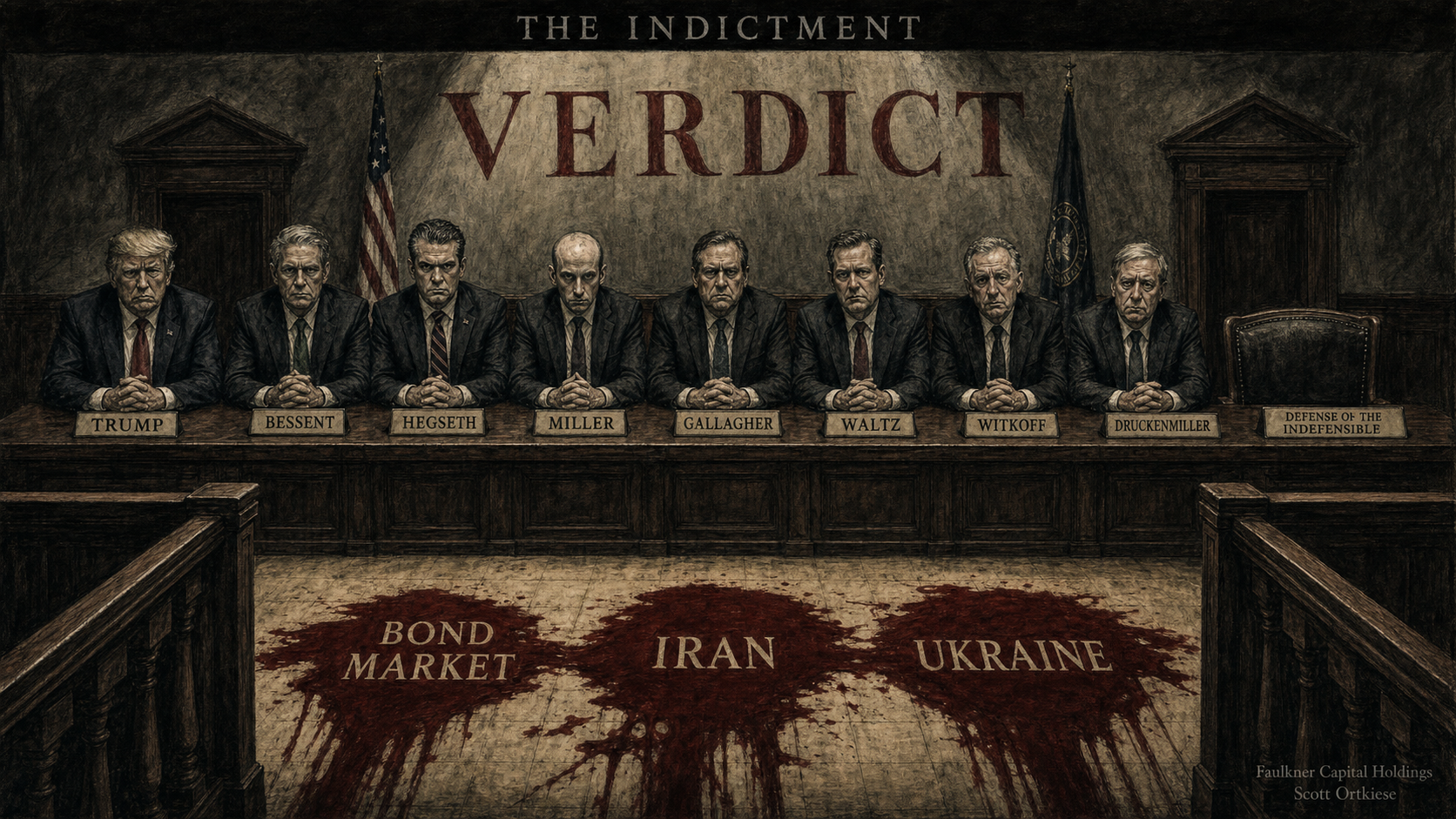
Read across every desk in this piece and the same word appears at the bottom of the record. Iran, an invoice. Ukraine, an invoice paid in Ukrainian and Russian lives that would have been spared if the Istanbul framework had been signed on April 15, 2022 instead of killed by a British visitor on April 9 and an American under secretary working the phones behind him. The reserve dollar, a bill thirty years in the writing, its last full page turned in the first quarter of 2026 when the IMF logged the currency at a thirty-year low against a basket its own weapons had made competitive. The AI capex, an invoice the Bank for International Settlements, Sequoia, Allianz, and MIT have cosigned in the last twelve months. The immigrants at the border, an invoice on the labor supply the empire pretends it does not need. The bond market, an invoice its own Treasury Secretary tried to tear up on August 19 and could not. What is coming apart is not the American empire’s power to project force. What is coming apart is the empire’s ability to pretend its invoices are somebody else’s problem. When the president answers his Treasury Secretary’s failed buyback, failed sanctions, failed tariffs, and failed diplomacy by promising on Friday that “the ultimate intervention is our military,” he has stopped disputing the bill and started disputing arithmetic itself. Governments that go to war with arithmetic always lose. Druckenmiller has told the country, from a career built on reading such governments correctly, that this is the rule.
The America Destroyers named in Section III have compiled, over twenty months, a record now legible on a single page. Treasury credibility spent on August 19 and defended, on camera the next morning, with the phrase “asymmetric information.” A tariff base amputated by the Supreme Court in February, bleeding refunds every month since May from the same Treasury General Account Bessent has told the country will absorb his short-dated bill issuance. Twenty months of losing war in the Persian Gulf now defended as a pivot to sanctions the sanctions technicians call empty boasting. A Ukraine peace their predecessors made necessary, then killed in the Istanbul spring of 2022 with a British emissary flown to Kyiv on April 9 and an American under secretary on the wires. A dollar reserve credibility spent over a decade of first-resort financial warfare, and a set of design decisions by the World Majority that ratified the spending quarter after quarter. A domestic labor supply criminalized and deported in the same fiscal year the Treasury Secretary needs the stablecoin market it feeds to fund a bond trade. And when Stanley Druckenmiller, the world’s greatest living macro trader and Bessent’s own teacher, told them in the Wall Street Journal the bill was due, Bessent answered on Bloomberg that he had run the numbers through an AI.
These men are not managing an economic disaster underway. They are choosing it, and they are billing it to the rest of us. The last quiet argument left inside the American political system, the price of the 30-year Treasury bond, has been telling them so since the failed auction on August 14. Then, in one week, Warsh from Jackson Hole on the 22nd, Druckenmiller and Kelanic from the two most prestigious opinion pages in the country on the 24th, Bloomberg from Kremlin sources on the 26th, and Batmanghelidj from the sanctions desk on the 28th all delivered the same verdict in different accents. On the 29th, Donald Trump answered the whole chorus, on camera, with the sentence he answers everything with: “The ultimate intervention is our military. And if we have to use that, we will.”
That sentence is an admission dressed as a threat, aimed at us as much as at Tehran. Anyone who has read this far can now hear what the America Destroyers cannot: the bond market clearing its throat, the invoice past due.
Contact: so@throughlinesynthesis.com
Sources and further reading
Stanley Druckenmiller, “Let the Bond Market Speak,” Wall Street Journal, August 24, 2026. Rosemary Kelanic, “Let Iran Control the Strait of Hormuz,” New York Times, August 24, 2026. Peter Boyle transcript, August 29, 2026, Throughline Synthesis archive. Esfandyar Batmanghelidj on Drop Site with Murtaza Hussain, August 28, 2026. Kevin Warsh, Jackson Hole address, August 22, 2026. Bloomberg on Kremlin dead-end, August 26, 2026. NATO Bucharest Summit Declaration, April 3, 2008. National Security Archive at George Washington University, “NATO Expansion: What Gorbachev Heard,” December 12, 2017. Angela Merkel to Die Zeit, December 7, 2022. François Hollande to Kyiv Independent, December 28, 2022. Petro Poroshenko, BBC’s Putin vs. the West, January 2023. Istanbul Communiqué, March 29, 2022, and full draft treaty text published by the New York Times, June 15, 2024. David Arakhamiya interview, Ukrainian television, November 24, 2023. Victoria Nuland interview with Mikhail Zygar, September 2024, reported by Responsible Statecraft. CSIS, “Russian Blood and Treasure: The Ballooning Costs of Putin’s War,” July 2026. IMF COFER Q1 2026 data brief. BIS Annual Economic Report, June 2026. Sequoia Capital and Allianz Research on the AI capex-to-revenue gap. MIT Project NANDA, August 2025.