How an American retreat toward Israel could turn Saudi wealth into dependence
Scott Ortkiese | Throughline Synthesis | Houston, September 18, 2026
Research and scenario analysis through September 18, 2026. Geographic facts, dated economic baselines, and conditional scenarios are distinguished throughout.
Saudi Arabia does not have to disappear from the map to lose the freedom to determine its own future. Its monarchy could remain in place, its flag could continue to fly, and its ministries could continue to function while the essential terms of its security, trade, and foreign policy were increasingly set by others. That is the Saudi collapse scenario worth examining first: not immediate national disintegration, but a progressive loss of strategic autonomy.
The foundations of that scenario are no longer entirely hypothetical. Yemen specialists report that Houthi forces captured Mocha, Dhubab, and Mayyun in September, extending their control along Yemen’s Red Sea coast and strengthening their position at Bab al-Mandeb.67 Saudi Arabia’s Ministry of Energy confirmed on September 11 that the East-West Pipeline had been shut down as a precaution following multiple attacks.68 Meanwhile, an American organization advocating closer U.S.-Israeli military integration has published a concrete proposal to transfer additional American military functions from other regional bases to Israel.24
These developments do not establish that every American base outside Israel is being abandoned, that all Saudi oil infrastructure has been destroyed, or that the Saudi state is about to dissolve. They establish something different: the premises of Saudi security deserve to be tested against a world in which American protection becomes less dependable, infrastructure is repeatedly interrupted, and regional adversaries acquire greater bargaining power.
The argument here is conditional. If Washington loses the ability or willingness to maintain its old regional security system, Saudi Arabia’s most immediate danger is not necessarily conquest. It is the discovery that possessing valuable resources is not the same as controlling the conditions under which those resources can be produced, transported, sold, and converted into political authority.
There is a missing half to the familiar story of oil exchanged for protection. Gulf governments supplied territory, command facilities, access, and political cooperation to the power that protected them, while some also intervened directly in neighboring states. The Congressional Research Service documents Saudi command-center access during the 2003 Iraq invasion, the UAE’s extensive military partnership with Washington, and Bahrain’s naval hosting arrangements.2 69 4 Their vulnerability must therefore be examined not only as the possible abandonment of clients, but also as the strategic consequences of choices those clients made.
That is not an argument that a population deserves suffering or that past wrongdoing erases a country’s borders. It is an argument that protection can encourage policies whose costs outlast the protector’s commitment. When that commitment weakens, the adversaries, dependencies, and grievances remain.
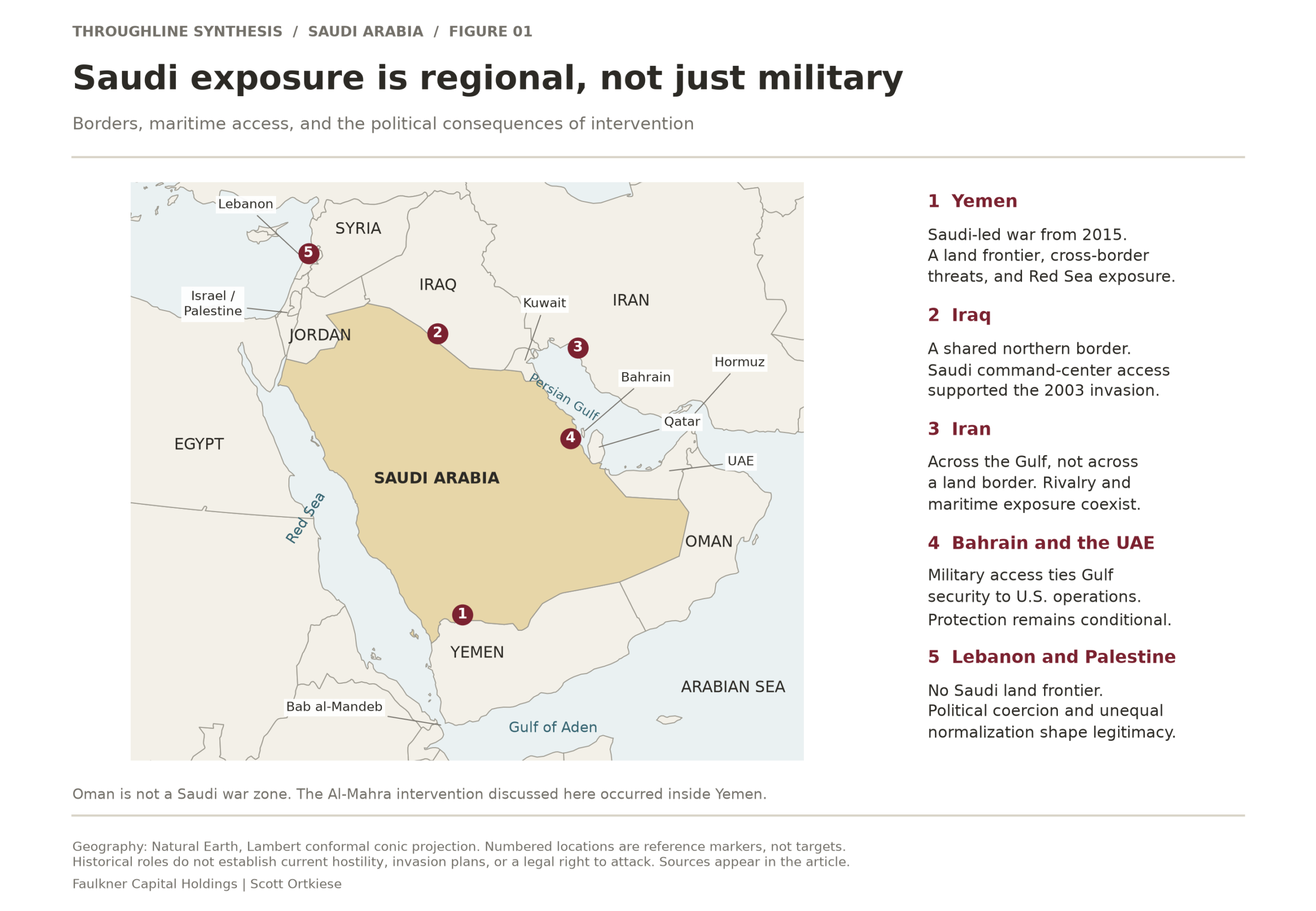
The map distinguishes shared borders, maritime exposure, and the regional reach of Saudi policy. The numbered markers refer to relationships explained in the article, not targets or predicted invasion routes. Historical responsibility does not cancel sovereignty.1 2 3 4
Article contents
- Read the geography before predicting the collapse
- How borders, oil concessions, and foreign protection made the region
- An American stronghold in Israel is not a replacement for a regional security system
- What would count as an American defeat?
- Oil underground is not revenue in the treasury
- Bab al-Mandeb: coercive leverage without complete command of the sea
- The Saudi military problem is institutional, not racial or cultural destiny
- Education, labor, and the limits of purchased capacity
- MBS, nationalism, and the danger of making the ruler the state
- Strategic consequences are not collective punishment
- A Saudi collapse model already exists, but it needs rebuilding
- The bargaining game after the protector retreats
- Saudi Arabia is already seeking alternatives
- Could China broker a Saudi settlement?
- The other Gulf states would face different crises
- The American domestic connection
- How the process could unfold
- The most plausible loss is freedom of action
Read the geography before predicting the collapse
The Arabian Peninsula is not synonymous with the Middle East, the Gulf, or Saudi Arabia. Saudi Arabia occupies most of the peninsula, with the Red Sea on its west and the Persian Gulf on its east; Yemen lies to the south, Oman to the southeast, and the smaller Gulf states along its eastern flank. Iran is across the Gulf, Iraq lies to the north, and Israel sits on the eastern Mediterranean, separated from Saudi Arabia by Jordan except for their respective coastlines on the Gulf of Aqaba. The accompanying maps use geographic outlines rather than imagined future partitions.1
The 3 maritime passages that matter most here are not interchangeable. Hormuz connects the Persian Gulf to the Gulf of Oman and the Arabian Sea. Bab al-Mandeb connects the Red Sea to the Gulf of Aden. Suez connects the northern Red Sea to the Mediterranean. Saudi Arabia’s access to 2 coasts creates alternatives, but an alternative port is useful only if production, pipelines, loading, shipping, and commercial arrangements still function.26
This geography complicates the idea that American facilities in Israel could simply replace those elsewhere. An air force operating from the eastern Mediterranean and a security system distributed around Gulf ports, airfields, and sea lanes solve different problems. That is a strategic distinction, not an assertion that distance makes American action impossible.
The atlas places population and economic scale beside the maps because territorial size can mislead. A large landmass is not a measure of deployable manpower, and a large economy is not the same as cash available to the government. Resident population also includes foreign workers, not just citizens. Those distinctions are essential when evaluating recruitment, technical capacity, labor retention, and the political obligations a government must finance.
The 2024 baseline gives Saudi Arabia 35.30 million43 residents, compared with Yemen’s 40.58 million44, Iraq’s 46.04 million45, and Iran’s 86.00 million46. Saudi Arabia is not demographically insignificant, but neither its territory nor its wealth makes it the region’s population giant. These counts cannot establish how many people a state can recruit, train, supply, or persuade to fight.
The economic imbalance is much sharper. Saudi nominal gross domestic product, the value of annual output measured in current dollars, was $1,237.53 billion47, against Yemen’s $19.10 billion48, Iraq’s $279.64 billion49, and Iran’s $436.91 billion50. That asymmetry helps frame the strategic puzzle: a much poorer opponent need not match Saudi output to impose costs on exposed infrastructure or commercial access. Wealth and the ability to deny someone else the use of wealth are different forms of power.
These are dated baseline observations, not a wartime census or a measure of resources immediately available to governments. National population series differ in residency definitions, estimation methods, and reference dates; dollar GDP comparisons are sensitive to exchange rates and wartime estimation. Lebanon’s missing GDP observation in the selected series is not zero output. The graphics establish scale, not a precise ranking of military endurance.
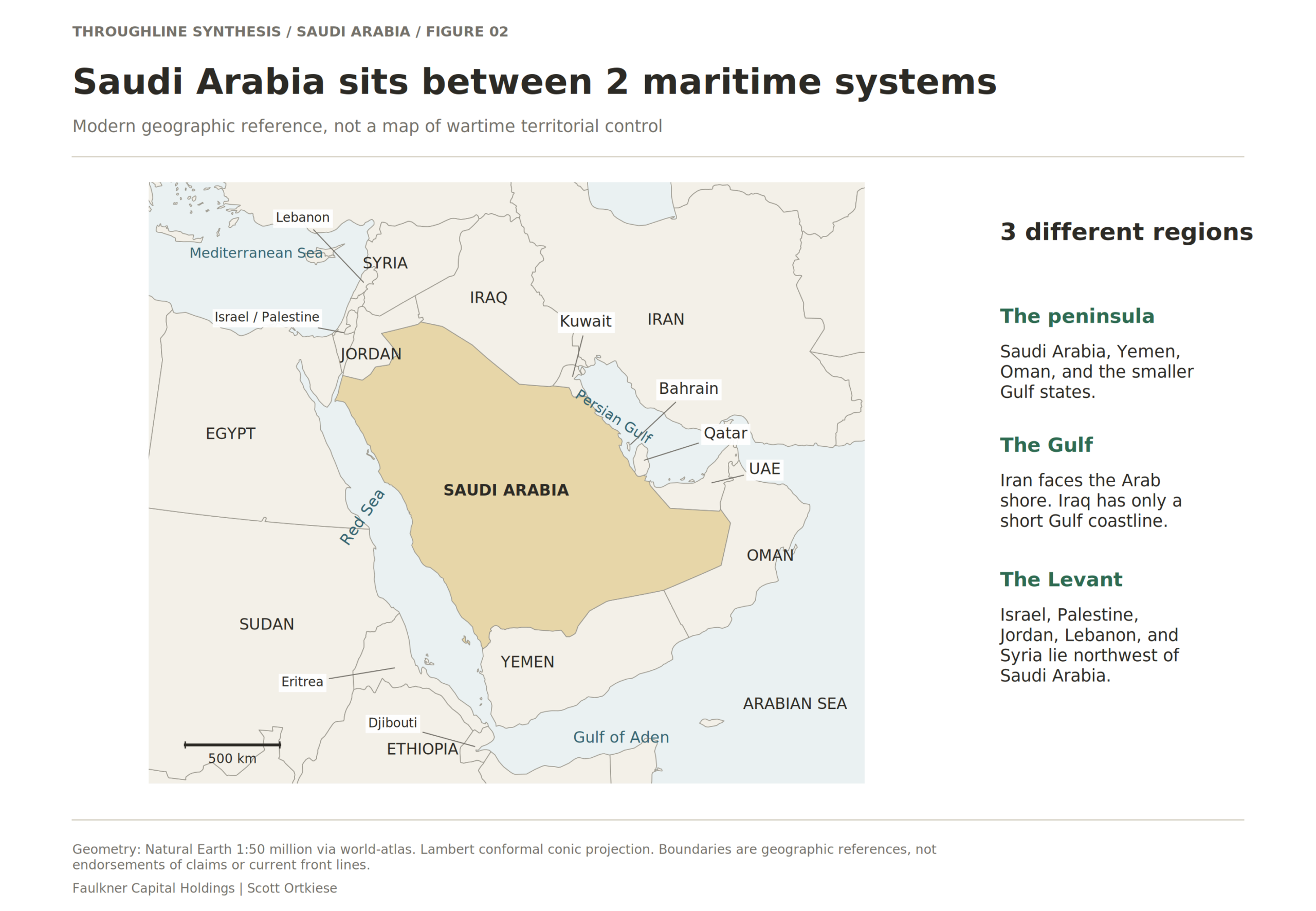
Saudi Arabia has access to the Red Sea and the Persian Gulf. Israel is on the Mediterranean side of the region, not a substitute location for every Gulf security function.1
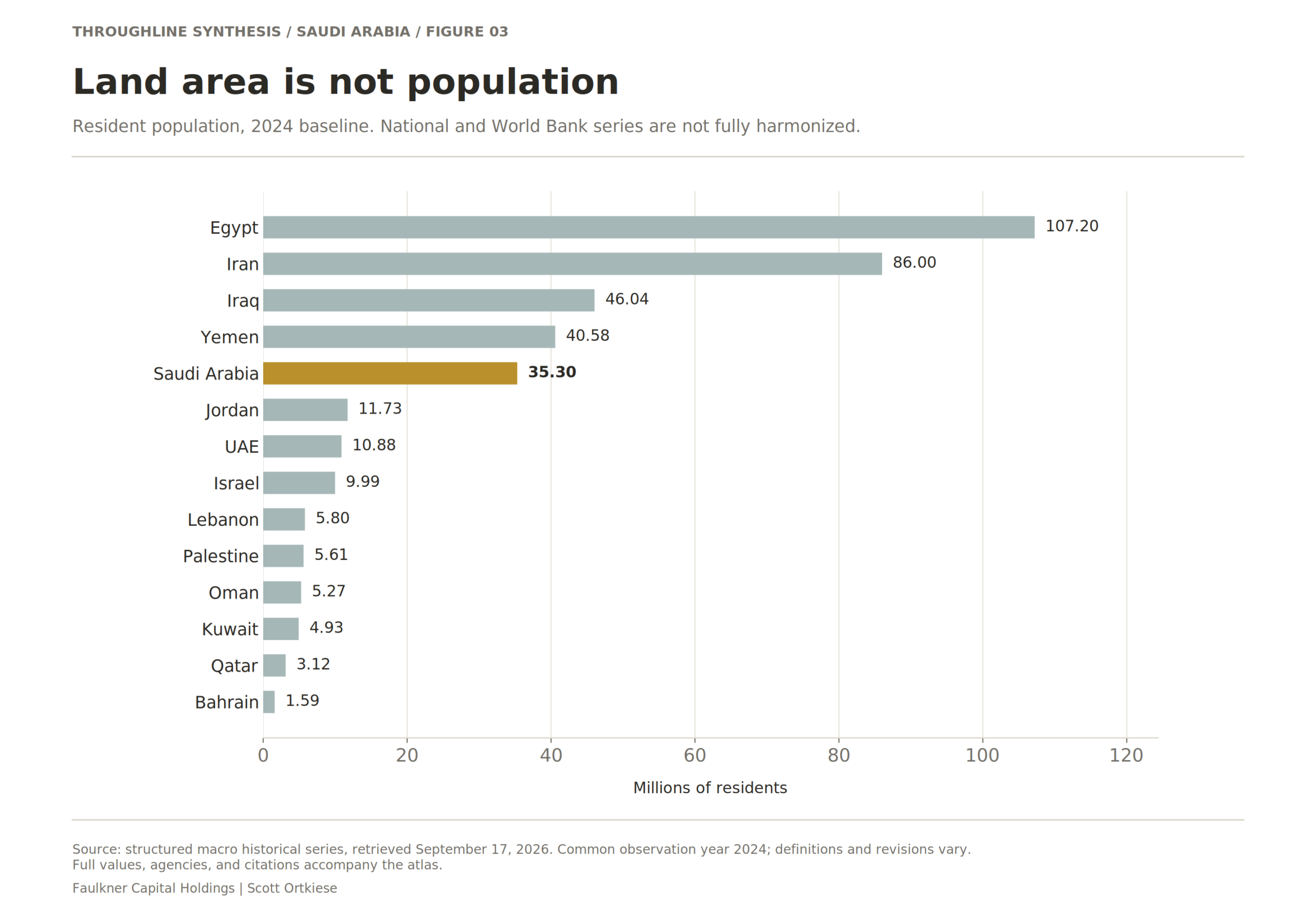
Residents include foreign workers. Counts are not citizen populations, combat manpower, or a measure of allegiance.5 6 7 8 9 10 11 12 13 14 15 16
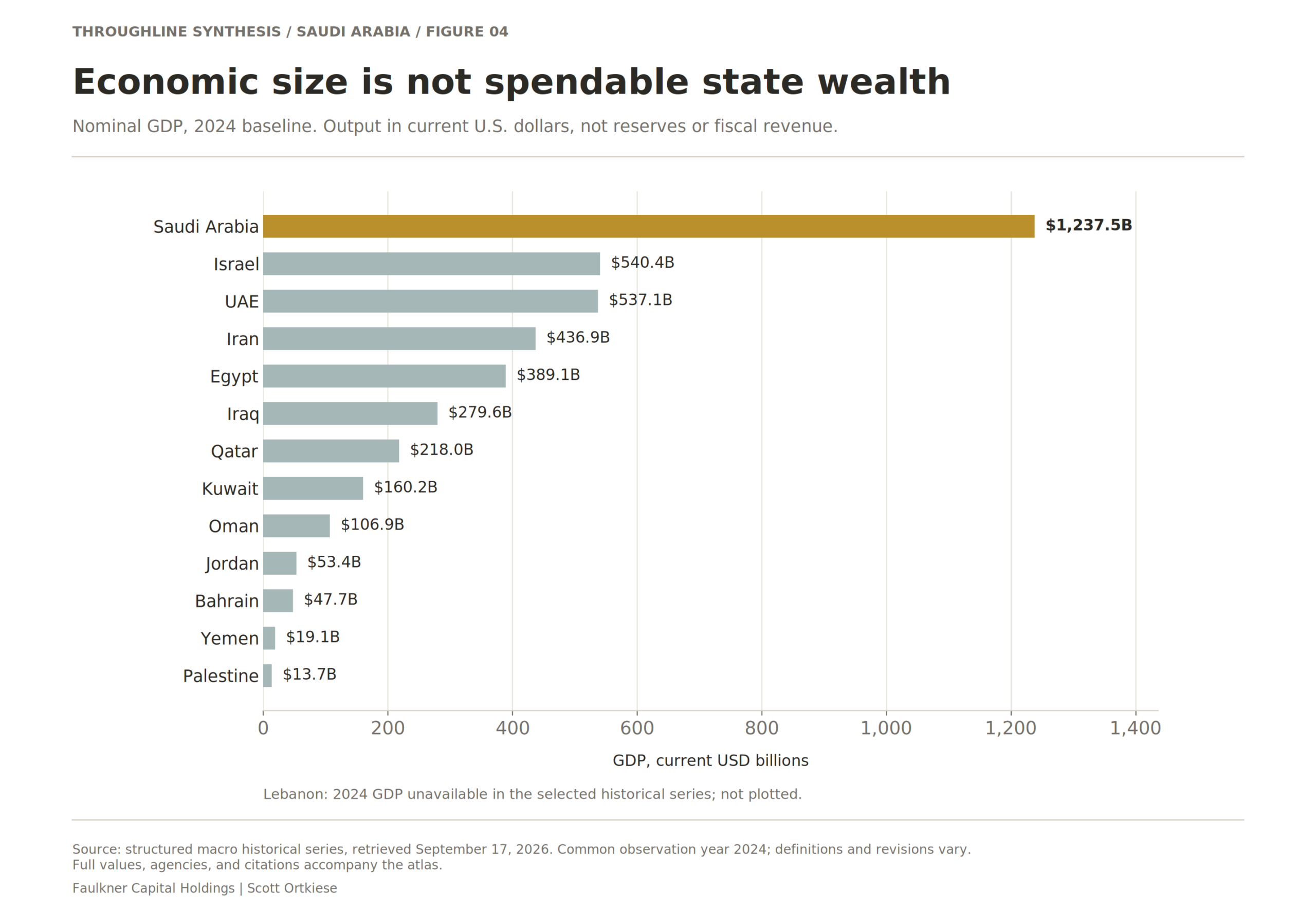
GDP measures annual production. It cannot be substituted for government cash, sovereign assets, or military capability.10 17
How borders, oil concessions, and foreign protection made the region
Daniel Yergin’s The Prize provides a useful historical frame: oil became a source of power through concessions, companies, finance, transportation, and state protection, not simply because it existed underground. But the book does not support the claim that every regional border was drawn in a single colonial settlement. Its account of Saudi consolidation distinguishes territorial conquest, boundary negotiations, and the later struggle over oil rights.18
The distinction starts with 2 very different uses of a line on a map. At Uqair in 1922, British intervention helped determine boundaries involving Ibn Saud’s territories, Kuwait, and Iraq, with neutral zones accommodating shared interests and movement. The United Nations treaty record dates the Nejd-Kuwait boundary agreement to December 2, 1922.18 20
The Red Line Agreement of 1928 was something else. It restricted the participating oil companies from pursuing independent oil operations inside a defined area without their partners; it was not a treaty creating the national borders shown on today’s map. Confusing the concession system with political boundaries would obscure how corporate coordination operated across territories governed by different rulers.18
Saudi Arabia itself emerged through Ibn Saud’s consolidation of territory and authority, including the conquest of the Hejaz, the region containing Mecca and Medina. The name Saudi Arabia was adopted in 1932, before commercial oil production began. Oil subsequently transformed the resources available to an existing ruling project; it did not create that project from nothing.18
The Depression had reduced pilgrimage income and strained Ibn Saud’s finances when Standard Oil of California obtained its Saudi concession in 1933. Commercial discovery at Dammam No. 7 followed in 1938. That sequence matters: the concession joined a ruler’s need for revenue to a foreign company’s capital, technical knowledge, and access to markets.18 22
The smaller Gulf monarchies followed different paths. James Onley’s history distinguishes British-protected states from outright colonies and separates those arrangements from Britain’s less formal relationship with Oman. Kuwait became independent in 1961; Bahrain, Qatar, and the United Arab Emirates emerged from the end of Britain’s protected-state system in 1971. Oman should not be folded into that same legal history.19
Local rulers were not merely passive recipients of British lines. Naosuke Mukoyama’s Fueling Sovereignty examines how oil strengthened the ability of rulers in Bahrain and Qatar, among other cases, to resist proposed amalgamation and pursue separate statehood. Oil could therefore reinforce political separation as well as attract external domination.70
Nor were all Saudi boundaries settled before the oil era. The Saudi-Yemeni border treaty signed in Jeddah on June 12, 2000, affirmed the earlier Treaty of Taif and completed arrangements for a permanent land and maritime boundary. Today’s frontier is the product of successive settlements, not an untouched line inherited from 1 colonial conference.21
Foreign protection changed in stages too. Roosevelt’s meeting with Ibn Saud aboard the USS Quincy in 1945 became a landmark in American-Saudi relations, but Yergin notes the limited official record of their specific discussion of oil. The meeting should not be presented as a signed, perpetual oil-for-protection contract.18
Britain announced its planned withdrawal from the Gulf in 1968 and ended the old regional protection system in 1971. That withdrawal changed the security order without erasing the Gulf monarchies from the map, an important historical counterexample to any claim that the loss of a patron automatically dissolves its clients.18 19
Saudi control over oil also expanded rather than remaining frozen in the concession era. Aramco records government ownership rising to 25% in 1973, 60% in 1974, and 100% in 1980. The deeper question today is not whether Saudi Arabia owns its resources. It is whether ownership can be converted into dependable income and independent policy when the surrounding security and commercial systems are under pressure.22
This history supplies the article’s central test. Political borders can endure while the arrangements that make sovereignty effective change around them. The next transition could therefore preserve the Saudi state while changing who finances it, who protects it, and what concessions those partners demand.
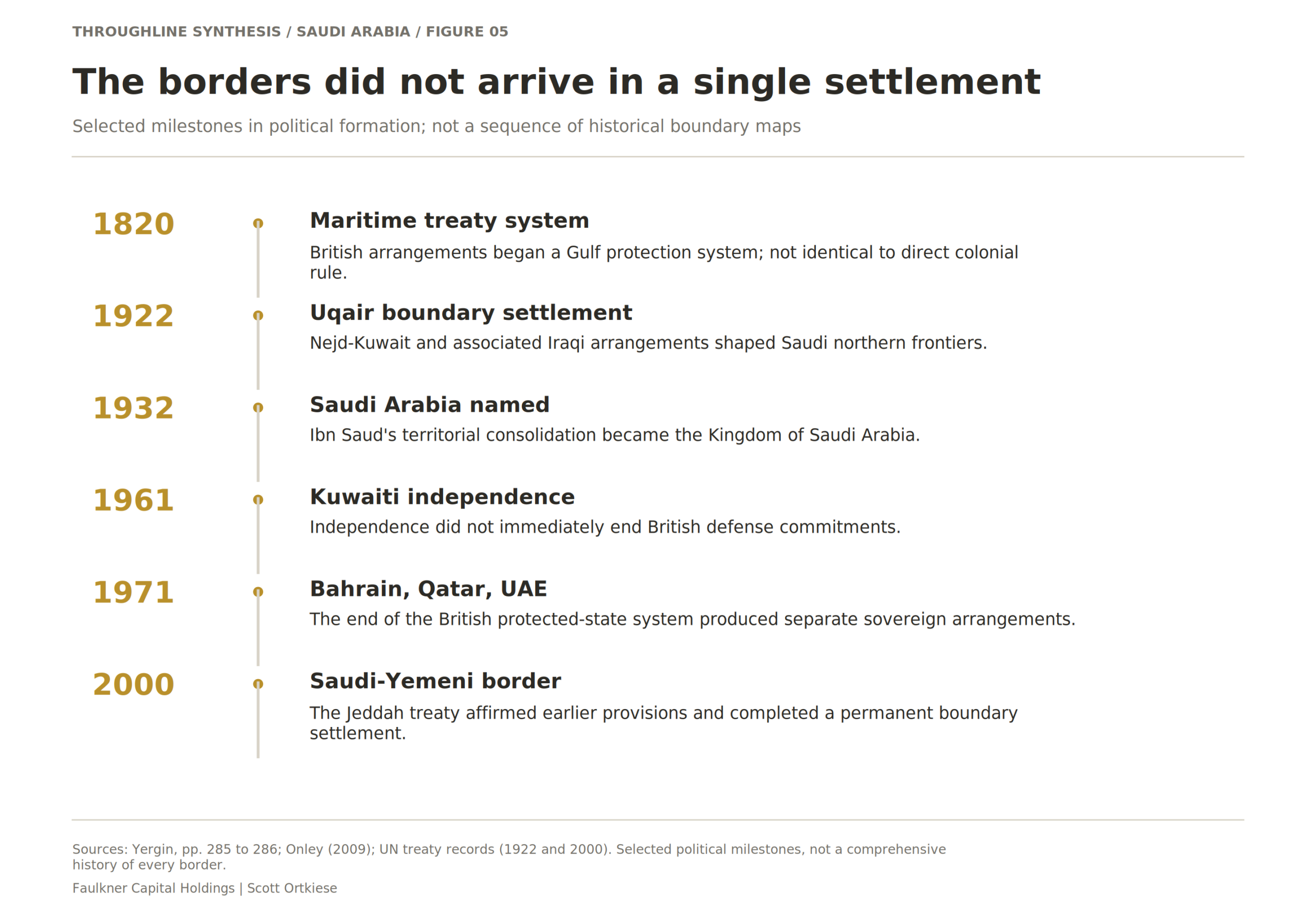
The peninsula’s states emerged through conquest, negotiation, treaties, and decolonization at different times. Oman had a distinct history and was not simply another British-protected Gulf state.18 19 20 21
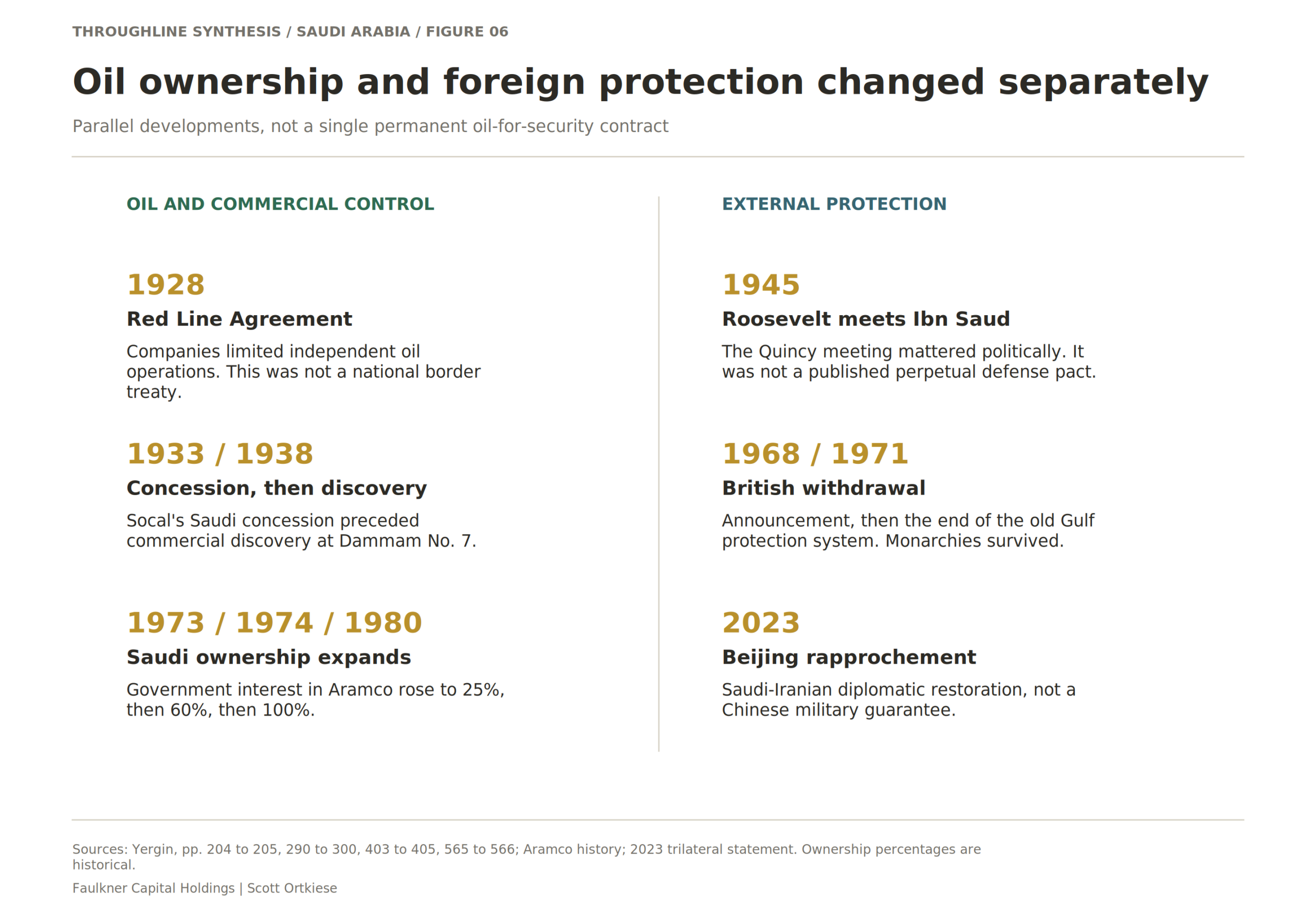
Yergin’s oil history is a history of changing bargaining power. Ownership, operating expertise, market access, and military protection remained distinct relationships.18 22 23
An American stronghold in Israel is not a replacement for a regional security system
The political history behind the bases matters as much as their location. Before examining where American forces might go, we need to examine what the host governments helped them do.
The umbrella also made its clients participants
Military participation does not begin and end with the aircraft that releases a weapon. Command centers coordinate operations; tankers extend their reach; ports move equipment; intelligence supports decisions; maintenance sustains the force. A government that supplies those functions contributes to a military system even when its own troops do not enter the country under attack.
Saudi Arabia’s role in the 2003 Iraq invasion illustrates both the contribution and its limits. According to the Congressional Research Service, Riyadh ultimately allowed the American air-operations command center at Prince Sultan Air Base to support the war. It restricted most strike-aircraft operations, the entry of invading ground forces, and the use of Saudi ports for invasion-related sealift.2 Those restrictions matter, but they do not turn command support into neutrality. Nor should the 2003 invasion be conflated with the coalition response to Iraq’s earlier occupation of Kuwait: different wars require separate judgments.
The UAE became another important operating platform. Congressional researchers describe Al Dhafra’s role in American and coalition air operations, including intelligence and aerial refueling, and Jebel Ali’s naval logistics function; they also document Emirati combat participation and the UAE’s intervention alongside Saudi Arabia in Yemen.69 This was an active military partnership, not simply a country purchasing an insurance policy.
Bahrain hosts the headquarters of the U.S. 5th Fleet and Naval Forces Central Command under a defense relationship that includes access, basing, and overflight rights.4 Its participation is also visible in specific operations: U.S. Central Command identified Bahrain among the countries supporting the January 22, 2024, U.S.-British strikes in Yemen.71 That statement does not identify the form of Bahraini support or establish that the attacking aircraft departed from Bahrain. It establishes that Bahrain was publicly counted among the operation’s supporting states.
Historical access is not proof of unrestricted permission for every subsequent war. On January 26, 2026, the UAE’s Foreign Ministry stated that it would not allow its airspace, territory, or waters to be used for hostile action against Iran and would not provide associated logistical support.72 That declared policy is not independent verification of every military movement. It is a necessary distinction between a long-standing military relationship and permission for a particular attack.
The strategic contradiction remains. A host may seek enough integration to keep American protection credible, while seeking enough distance to avoid becoming a party to American wars. The more central its territory becomes to the patron’s operations, the harder that distinction may be to sustain politically. An adversary’s perception of complicity can increase danger without establishing that an attack on the host would be lawful.
Yemen exposes the moral and strategic cost
Yemen was not an incidental casualty of Saudi security policy. The Saudi-led intervention made the kingdom a belligerent, with the UAE a major coalition partner; United Nations investigators subsequently documented coalition airstrikes that failed to respect distinction, proportionality, or precautions, alongside serious abuses by other parties.3 The investigators identified conduct that could amount to war crimes. That finding deserves to be stated plainly, without pretending it is a completed criminal trial.
Washington’s enabling role is not a matter of inference alone. In his April 16, 2019, veto message, Trump acknowledged American information sharing and logistical support for the coalition, including aerial refueling until shortly before the message, while arguing that this assistance did not constitute American participation in the relevant hostilities.73 The distinction protected the administration’s legal position. It did not erase the practical value of the assistance.
This was a policy with continuity across administrations, but not unanimity across the American government. Congressional researchers trace support under Obama, the end of aerial refueling in 2018, the congressional effort to end involvement in 2019, Trump’s veto, and Biden’s later declaration that offensive support would end.74 Congress’s resistance did not prevail, but it existed. Describing every president and legislator as executing 1 undifferentiated plan would obscure the institutions and decisions through which support actually continued.
The central strategic failure is easier to identify. A campaign intended to reduce a perceived threat can instead deepen hostility, give an armed movement a durable mobilizing grievance, and make the intervening state more dependent on outside support. The present bargaining problem cannot be understood if Yemen appears only as a source of threats to Saudi infrastructure and never as a country subjected to Saudi and Emirati force.
The Houthis are not synonymous with Yemen, and acknowledging coalition abuses does not absolve them of their own. The same UN investigation documented abuses by Houthi authorities and other parties.3 A settlement must therefore address Yemeni civilians and competing Yemeni political actors, not merely exchange Saudi payments for an armed organization’s promise.
Security agreements do not guarantee immunity
Calling every agreement worthless goes too far. Calling them dependable promises that the United States will fight whenever a partner is endangered goes further than the public texts support.
The Comprehensive Security Integration and Prosperity Agreement with Bahrain provides for immediate senior-level consultation after external aggression or its threat. The parties are to determine additional defense needs and develop and implement responses they decide upon, potentially including economic, military, and political measures, consistent with their constitutional processes and laws.75 That is a substantive framework for cooperation. It is not a specified, automatic obligation to enter a war.
The White House’s November 2025 account of the U.S.-Saudi Strategic Defense Agreement emphasizes defense integration, American firms’ operations, and Saudi burden sharing, alongside technology and other partnerships.76 A public summary is not the complete agreement, and it cannot establish obligations its text does not disclose.
The asymmetry is the point. Access and integration can produce continuing benefits for the patron, while the precise response to a client’s emergency remains a political decision. A base can help prosecute a regional war without guaranteeing that its host’s refinery, port, or government will receive effective protection from the consequences.
Normalization without Palestinian sovereignty
The UAE and Bahrain took a different public course toward Israel from Saudi Arabia. The UAE’s 2020 normalization treaty established diplomatic relations and a framework for extensive cooperation while referring to a negotiated Palestinian settlement; it did not condition the establishment of those relations on Palestinian statehood.77 Bahrain also normalized relations in 2020 and maintained diplomatic ties through the subsequent Gaza war.4
The political criticism is direct: recognition and integration were concrete; Palestinian sovereignty remained an aspiration. Those governments could condemn particular Israeli actions while preserving the relationships that normalization had created. Whether this offered useful leverage should be judged by what that leverage secured, not by the existence of diplomatic language.
Saudi Arabia cannot accurately be described as having made the same public bargain. Its February 7, 2024, statement said there would be no diplomatic relations with Israel without an independent Palestinian state on the 1967 borders with East Jerusalem as its capital, an end to the Gaza war, and Israeli withdrawal from Gaza.78 The stronger criticism asks whether Riyadh used its material and diplomatic influence effectively to secure those objectives. It does not require erasing its stated position.
Nor should the character of the violence be softened into a generic dispute. In September 2025, the UN Independent International Commission of Inquiry concluded that Israeli authorities and security forces had committed genocide in Gaza.79 This is an attributed finding by a UN investigative body, not a final judgment of the International Court of Justice or a finding that every state maintaining relations with Israel is legally complicit.
Lebanon belongs in the analysis as well. Human Rights Watch documented Israeli attacks on medical workers and facilities in October 2024 that it characterized as apparent war crimes, finding no evidence of military use for the facilities it examined.80 Lebanese sovereignty had also been subjected to pressure from Riyadh: Carnegie’s analysis describes the 2017 detention and forced resignation of Prime Minister Saad Hariri as part of Saudi policy’s failures in the region.81
These are different forms of conduct, not interchangeable crimes. Together they expose a hierarchy of priorities in which the autonomy and security of weaker populations can be subordinated to the preferred regional alignment. Gulf governments risk discovering that this hierarchy offers no permanent exemption for wealthy clients.
Consolidation would change whom American power protects
The Israeli basing idea is real, but its status matters. Jonathan Ruhe’s March 2026 JINSA paper describes American combat-aircraft deployments to Ovda and tanker deployments to Ben Gurion, then recommends expanded prepositioning, logistics, training, and operational activity in Israel. It is an advocacy document describing some actual deployments and proposing further changes, not an American directive closing the rest of the regional base network.24
That distinction sharpens the strategic question. A concentration of American airpower in Israel could preserve substantial destructive capability while reducing Washington’s capacity to provide geographically distributed protection. The ability to launch a strike is not the same as the ability to keep an ally’s ports operating, protect civilian shipping continuously, sustain repairs, or reassure investors that the next attack will not interrupt business.
An Israel-centered posture could offer Washington political reliability and military interoperability, the advantages emphasized by JINSA.24 It could also make American power more visibly inseparable from Israeli policy, narrowing Washington’s room to present itself as a security provider whose commitments serve a wider set of regional interests. That second proposition is an inference about the political consequences of consolidation, not evidence that consolidation is already complete.
The geographic problem would remain. An airfield in Israel cannot simply assume every function of dispersed Gulf air bases, naval facilities, logistics networks, and access agreements. Longer operating distances, permissions to cross other states’ airspace, maintenance demands, and the protection of transport routes would still have to be managed. Moving forces can reduce some vulnerabilities while creating others.
Nor does the available evidence describe an empty sea after an American departure. Maged Al-Madhaji’s September analysis identifies a Saudi-led maritime coalition operating separately from the U.S. Navy, the 5th Fleet, and Task Force 153, which continued their own regional operations.25 The emerging pattern is therefore better described as overlapping security arrangements than as a completed American evacuation.
A plausible retreat would be uneven: reduced use of exposed facilities, relocation of selected functions, retention of intelligence and access arrangements, offshore operations, and a stronger military concentration in Israel. Only under a more extreme branch of the scenario would Washington relinquish all its other regional bases and access rights. That branch deserves examination, but it must not be mistaken for the verified starting point.
Protection also has layers. A patron can continue providing intelligence, maintenance, equipment, and diplomatic backing while refusing a new combat operation. For Riyadh, the decisive failure would not require every American adviser to leave. It could occur when the assistance still available no longer secures the result Saudi policy depends on.
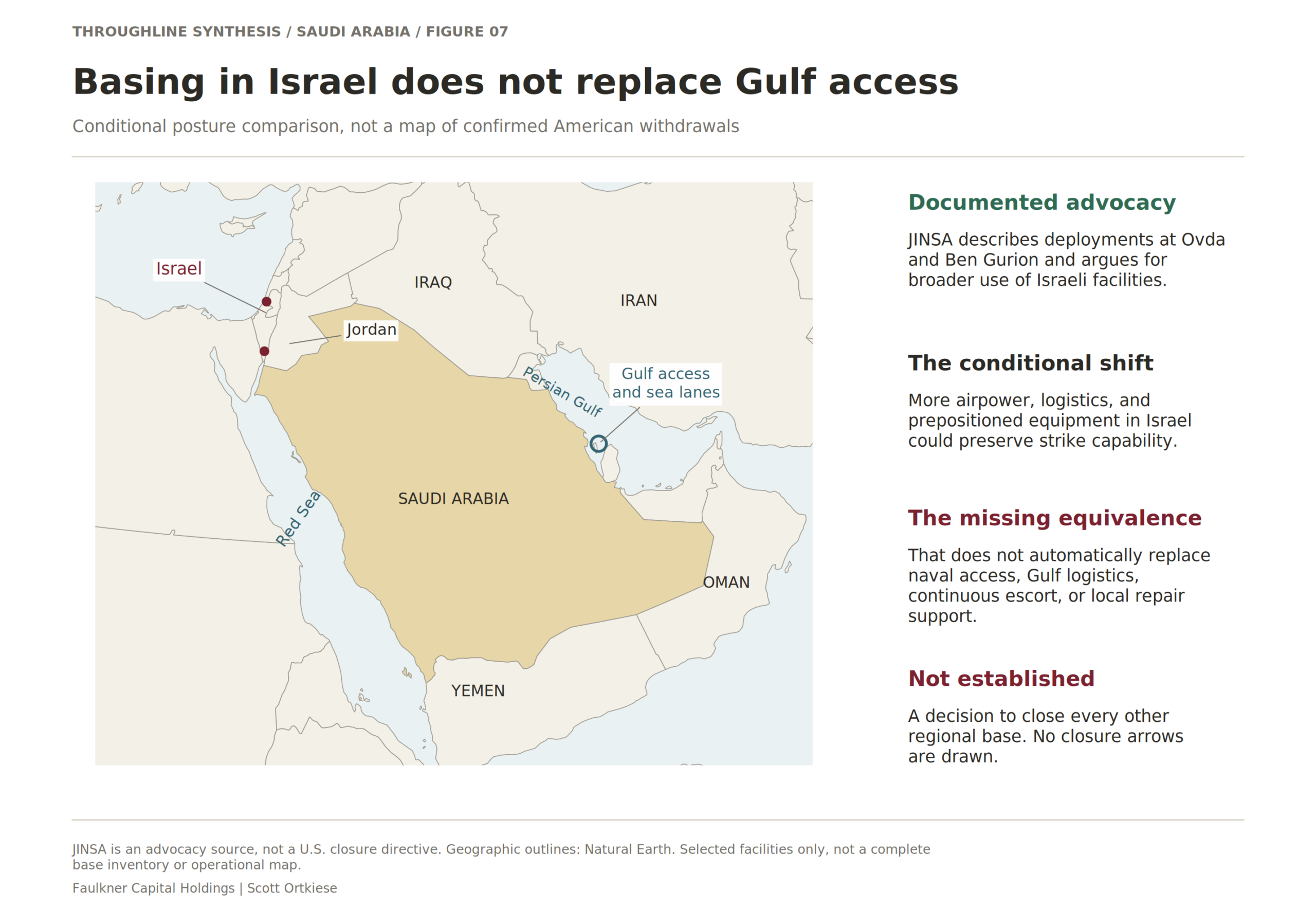
The 2 red points mark approximate locations of Ben Gurion and Ovda, discussed in JINSA’s March 2026 paper. The Gulf marker is a regional access concept, not a specific base. A shift in functions is modeled without inventing withdrawal orders.24 25 1
What would count as an American defeat?
A war can fail strategically even when the stronger military continues to destroy targets. For this analysis, defeat means that Washington cannot secure a durable political outcome proportionate to the war’s costs: dependable navigation, acceptable regional stability, credible protection for partners, and a settlement that does not require indefinite escalation. This definition avoids confusing tactical damage inflicted with a sustainable postwar order.
The legality of the war is a separate question from its strategic outcome. In her examination of Operation Epic Fury, international-law scholar Federica D’Alessandra argues that the U.S.-Israeli initiation of force against Iran lacked an adequate legal justification, including a demonstrated imminent threat sufficient to support the claimed self-defense rationale.82 That is a reasoned legal assessment, not a judgment issued by an international court.
The imperial question is also narrower than whether the United States remains powerful. An empire can lose the ability to organize a region around its preferences while retaining aircraft carriers, financial influence, advanced technology, and the capacity to wage destructive war. The scenario explored here is the erosion of American regional primacy, not the disappearance of American power.
Indeed, an Israeli stronghold could be the institutional expression of that distinction: a durable concentration of force inside a shrinking political system of alliances. Washington might retain the power to punish without retaining the authority or practical capacity to stabilize.
Oil underground is not revenue in the treasury
Saudi vulnerability becomes clearer when the analysis begins with infrastructure rather than reserves. A hydrocarbon deposit is a resource stock. State revenue requires functioning production, processing, transport, commercial access, payment, and a government able to capture part of the proceeds. A serious interruption anywhere along that chain can weaken the state without eliminating the resource itself.
There is evidence of both damage and resilience. In April, the Saudi Ministry of Energy reported that attacks had reduced pipeline pumping and production capacity but subsequently announced restoration of the East-West Pipeline’s full pumping capacity and recovery of affected Manifa production, while work at Khurais continued.83 The September pipeline announcement confirms another interruption but does not establish permanent destruction or provide a restoration date.68
These facts rule out an easy narrative in either direction. It is wrong to assume that expensive infrastructure is invulnerable; it is equally wrong to assume that every successful attack removes that infrastructure from service indefinitely. A collapse model must distinguish damage, precautionary shutdown, partial operation, repair, and repeated disruption.
The relevant variable is sustained usable throughput. If repairs consistently restore output and transport before the fiscal and political effects accumulate, the state absorbs the shock. If renewed interruptions arrive faster than recovery, the losses compound through revenue, insurance, contracting, employment, and confidence.
A simple hypothetical illustrates why an oil-price increase may not rescue an impaired exporter. If export volume falls to 50% of its previous level while the realized price rises to 150%, gross export receipts become 75% of their previous level, before additional repair, transport, insurance, and security costs. This is arithmetic under assumed conditions, not a forecast of Saudi production or prices.
Refineries complicate the picture further. Their disruption can reduce domestic fuel availability or export earnings, but a refinery outage does not automatically mean crude production has stopped. Likewise, a pipeline interruption may constrain transport without destroying the field that supplies it. Treating every part of the system as interchangeable exaggerates immediate damage and obscures the genuine risk of cascading failures.
The more dangerous scenario is cumulative: impaired production or processing, unreliable transport, restricted maritime access, rising costs, and an extended demand on public funds. Under those conditions, money buys time, but the rate at which it buys time deteriorates.
The fiscal test is usable cash
A transparent stress test starts with export volume, the net price actually received, and the government’s effective share of the proceeds. It then adds non-oil receipts and financing and subtracts essential spending, debt service, and extraordinary repair and security costs. Opening liquidity plus that balance determines how much usable cash remains. This is an accounting framework, not a fitted forecast.
The boundaries matter. A central bank reserve asset, a sovereign wealth fund investment, an oil deposit, and cash available to pay a contractor are not interchangeable. Transfers between public entities cannot be counted as new national income, and the same asset cannot serve simultaneously as a financing receipt and an untouched reserve. An asset sale may provide cash while sacrificing future income or accepting an unfavorable price.
The research baseline places Saudi government debt at 31.7% of GDP51 in 2025. That ratio alone cannot tell us how long the state could withstand disrupted exports. A defensible estimate would require usable liquidity, payment obligations, actual throughput, borrowing access, spending flexibility, and repair costs. Without those inputs, a countdown to insolvency would be invented precision.
The political question is who absorbs the adjustment. Deferring a prestige project is different from delaying military pay, maintenance, contractor wages, or essential services. A state can remain wealthy on paper while choices about immediate payments weaken the institutions that protect its future revenue.
There is a documented precedent for modeling the commercial chain. A declassified report on a January 2007 petroleum simulation in Beijing describes an insurer suspending coverage during a combined supply and transport crisis, then restoring it after hazards were addressed and security assurances were provided.84 It is not a forecast for the present war, and it does not substantiate numerical insurance thresholds recalled in a recent interview.
The lesson cuts in both directions. Physical access can remain possible while commercial participation collapses. But credible coordination can also restore activity, which means the model must allow recovery rather than treat every interruption as irreversible decline.
Bab al-Mandeb: coercive leverage without complete command of the sea
The September Houthi advance changes the bargaining environment, but geography must remain precise. The reported gains concern Yemen’s Red Sea coast and strategically important positions around Bab al-Mandeb, not the entire coastline of the Red Sea or ownership of both sides of the strait.67 85
Nor does coastal possession automatically confer unrestricted sea control. Al Jazeera Centre for Studies emphasizes the paradox of expanded Houthi leverage accompanied by a longer, more exposed coastline and limited naval capacity.85 The Houthis could become more influential and more vulnerable at the same time.
Their strongest position may not require permanently closing the waterway. Al-Madhaji describes the emergence of a Houthi system seeking to make safe passage conditional on dealing with a Houthi-controlled authority, even as the group describes its coordination service as voluntary and free.25 The strategic prize is the ability to affect expectations: which ships can travel, under what assurances, and at what perceived risk.
That is a form of coercive leverage, not internationally recognized sovereignty. It becomes valuable when commercial actors must account for the threat even when no attack occurs.
Bab al-Mandeb is also not a universal switch controlling every Saudi export route. Saudi Red Sea ports north of the strait can connect northward through Suez or Egypt’s SUMED crude pipeline without passing through Bab al-Mandeb; southbound voyages face a different geometry.26 The severity of the constraint therefore depends on destination, available northern access, the reach of threats beyond the strait, and the condition of the infrastructure feeding the ports.
These alternatives are meaningful, but not frictionless: pipeline capacity, suitable tankers, refinery requirements, and contractual arrangements constrain how much trade can be redirected, while refined products cannot use SUMED as crude can.26 In the sovereignty scenario, adaptation could therefore preserve revenue while increasing dependence on additional transport and commercial counterparties.
This distinction does not diminish the danger. It prevents an exaggerated claim from obscuring a more defensible one: a regional actor does not need to occupy Saudi territory or halt every shipment to impose persistent costs on Saudi strategic choices.
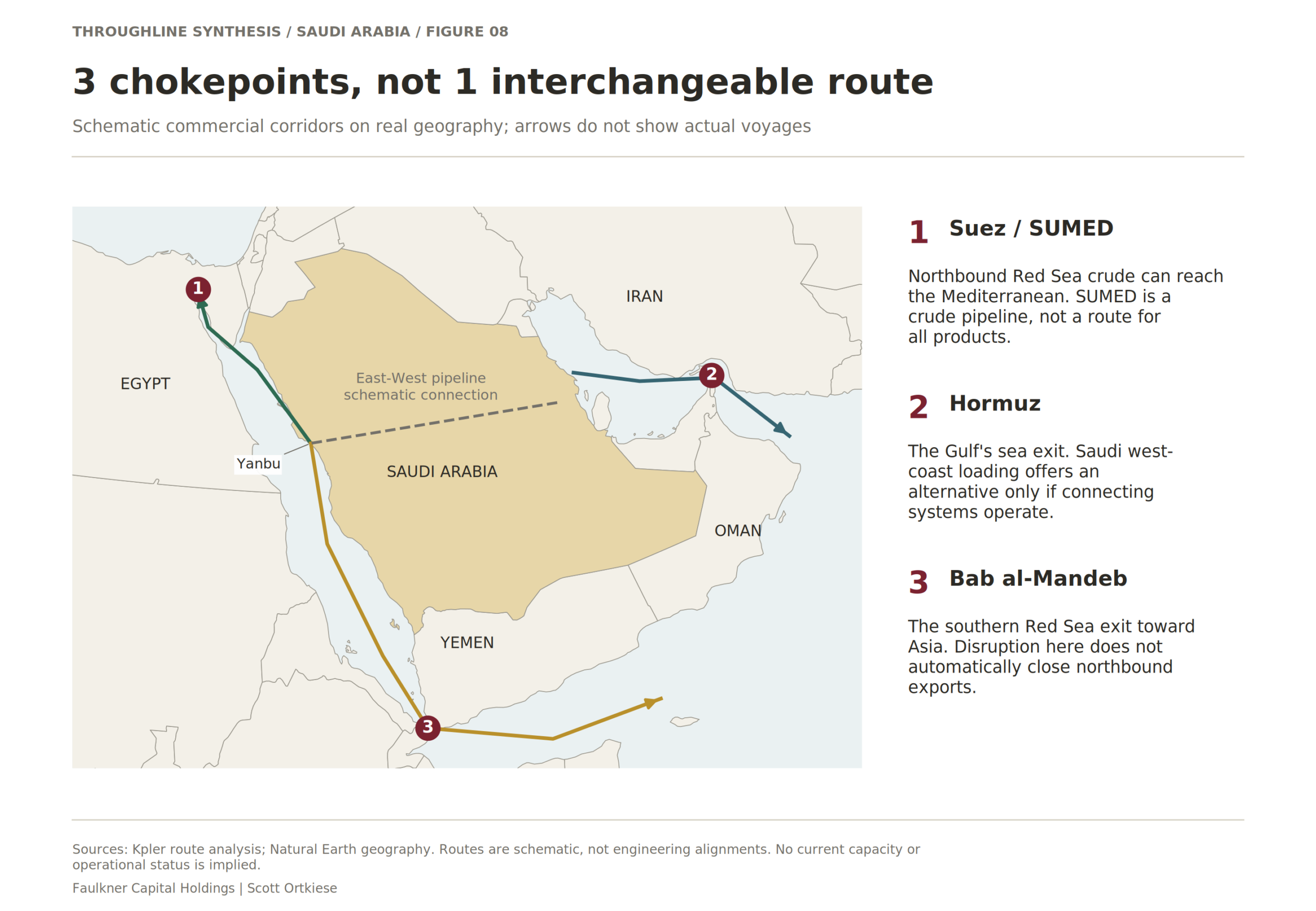
A route is a chain of functioning systems. These indicative corridors explain alternatives without claiming that pipelines, ports, or passages are currently open.26 1
The Saudi military problem is institutional, not racial or cultural destiny
Saudi military weakness deserves direct examination. It does not become more rigorous when described as an immutable defect in the Saudi people.
David B. Roberts’s recent study of Gulf military effectiveness locates major problems in institutional choices: coup-proofing, patronage, procurement incentives, divided military structures, and restrictions that protect rulers while weakening battlefield performance.86 His argument is particularly important because it explains why expensive equipment can coexist with disappointing results without treating all Arab forces as identical.
An army designed partly to prevent independent centers of power from emerging may be less able to reward initiative, circulate bad news, or coordinate complex operations. A procurement system that also distributes patronage may buy political loyalty more effectively than military capability. These are intelligible political choices, even when they produce strategically damaging results.
May Darwich’s study of the Saudi intervention in Yemen identifies another mechanism: a leadership seeking recognition as a regional power can undertake a war to demonstrate status, only to expose the limits of its capabilities.87 The distinction between obtaining prestigious military assets and producing effective military organizations is central to that failure.
There is also a protection problem. Roberts describes how reliance on external security partnerships can weaken incentives to develop independent capabilities, while stressing that Gulf governments retain agency in choosing those arrangements.86 If the external guarantee then deteriorates faster than the domestic institution improves, the client state confronts a dangerous transition.
Saudi Arabia’s size matters through demands on deployment, logistics, infrastructure protection, and internal coordination. But territorial size divided by population is not a collapse formula. A state need not defend every square mile equally; the more relevant tests are whether it can protect essential civilian systems, sustain functioning command structures, and keep its forces cohesive under prolonged pressure.
The strongest military indictment is therefore not that Saudis are incapable of fighting. It is that a system optimized for regime security, external dependence, and prestige procurement may be poorly prepared for a war that demands sustained organizational competence.
Education, labor, and the limits of purchased capacity
There is measurable evidence for serious educational weaknesses. In the OECD’s 2022 assessment, 30% of Saudi students reached at least baseline proficiency in mathematics, compared with 69% across the OECD; the corresponding figures were 37% versus 74% in reading and 38% versus 76% in science.27
These results support concern about the depth of the future skills base, but they are an assessment of sampled 15-year-olds, not a measurement of the competence or work ethic of every Saudi worker. The same assessment records improvement in mathematics since 2018, deterioration in reading, and broadly unchanged science performance.27
The distinction matters for resilience. A country can operate advanced systems with a combination of domestic expertise, foreign specialists, imported components, and contracted services while still having weaknesses in the breadth of its domestic technical workforce. The crisis question is whether those complementary inputs remain available simultaneously.
Labor incentives are a better analytical category than national character. If public employment, protected positions, cheap migrant labor, or patronage offer greater returns than technical mastery and productivity, the model should examine those incentives. It should not substitute a claim that an entire population is unwilling to work.
Migrant labor is also part of the security system, not merely a cost in a commercial budget. The International Labour Organization’s 2026 assessment identifies migrant workers as especially exposed to job loss, reduced hours, delayed wages, and the vulnerabilities created by their legal status during the regional crisis.28
In a severe Saudi stress scenario, the departure of technical and service workers could amplify disruption even if the government still possessed money. At the same time, less mobile workers could become stranded, unpaid, or unable to leave. Neither outcome should be romanticized as evidence of strategic success by an adversary.
The effect would extend beyond the Gulf through reduced remittances, interrupted recruitment, and the costs borne by workers’ families and countries of origin. That is why a military model that counts weapons and oil but leaves out labor is incomplete.
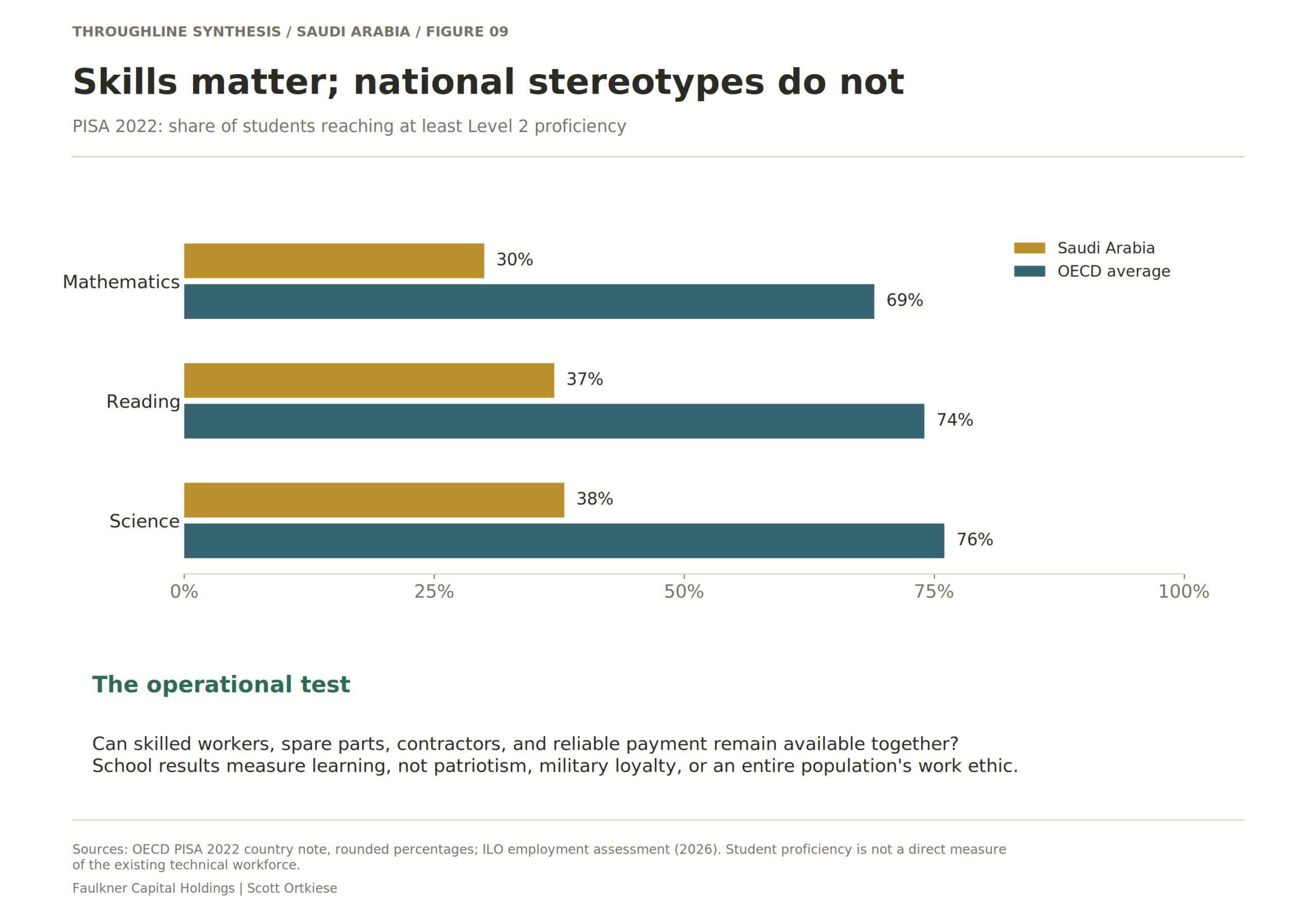
OECD student assessments identify an educational challenge, not an immutable cultural trait. The ILO’s crisis analysis highlights risks to wages, employment, and migrant workers that belong in a resilience model.27 28
MBS, nationalism, and the danger of making the ruler the state
The claim that Saudi Arabia has little nationalism is not a sound starting assumption. Madawi Al-Rasheed’s work describes the interaction of repression, social fragmentation, ideological competition, and nationalist mobilization in sustaining Saudi rule, while later scholarship examines the deliberate construction of a more territorial, Saudi-centered nationalism under MBS.41 88
The unresolved issue is what that nationalism can sustain when prosperity, security, and the ruler’s promises diverge. Public enthusiasm, loyalty to the country, loyalty to a dynasty, and willingness to endure a prolonged war are different things. No reliable measure reviewed for this article establishes how those commitments would interact under a severe national crisis.
MBS can be effective at concentrating power and still make poor strategic decisions. Consolidating authority measures success at controlling rivals; it does not establish competence in war, economic allocation, or the management of external threats.
The comparison with Donald Trump is most useful at the level of decision-making mechanisms rather than personality labels. Personalized rule can make dissent resemble disloyalty, turn optimistic claims into tests of allegiance, and raise the reputational cost of reversing a failed policy. Under those conditions, subordinates may have incentives to protect the leader’s preferred interpretation rather than correct it.
The systems are not identical. The relevant question is whether institutions can impose corrections before a misjudgment becomes a national emergency. A state in which the ruler claims personal credit for every achievement may eventually make him personally responsible for a widening set of failures.
Yet the reverse outcome is possible. War can strengthen authoritarian control by making opposition appear dangerous and national unity appear inseparable from obedience. Al-Rasheed’s account of Saudi resilience explicitly warns against assuming that hardship or regional turmoil automatically creates a unified movement for political change.41
Strategic consequences are not collective punishment
Saudi intervention has produced grievances that belong in any serious assessment of its present vulnerability. United Nations experts documented coalition airstrikes affecting civilians and civilian facilities in Yemen, severe restrictions on access, and conduct that raised grounds for findings of violations of international humanitarian law, while also documenting abuses by other parties.89
But responsibility must be specified rather than accumulated into a generalized indictment. The Bahrain Independent Commission of Inquiry recorded the Saudi-led Gulf deployment in 2011 while finding no evidence that the deployed Gulf units themselves committed the human-rights violations it examined; it also found that the Bahraini government’s submitted evidence did not establish a discernible Iranian link to specific events in the uprising.90 Supporting the political order that carried out repression is a different claim from proving that Saudi soldiers directly committed particular abuses.
The Oman claim also needs geographic precision. The documented Saudi intervention examined here concerns Al-Mahra in eastern Yemen, alongside Oman, where Saudi control of facilities and interference in local affairs generated resistance and concern about sovereignty.91 It is not evidence of a Saudi military atrocity committed inside Oman.
Iran’s grievances have a concrete interstate history. Fatma Aslı Kelkitli’s study of Saudi-Iranian relations documents Saudi political, financial, and logistical support for Iraq during the Iran-Iraq War, explaining that Saudi rulers regarded Saddam Hussein as a lesser threat than revolutionary Iran.92 Riyadh was therefore not simply a spectator to a war fought against Iran. That history helps explain distrust without requiring the claim that Iranians are uniformly hostile to Saudis or that accommodation is impossible.
Iraq requires comparable care. F. Gregory Gause’s analysis distinguishes Saudi state strategy, sectarian rhetoric, and private Saudi support for Iraqi insurgents rather than treating them as one undifferentiated policy.93 More recent research describes a turn toward pragmatic Saudi and Emirati engagement with Iraq, illustrating why past antagonisms should not be treated as permanent alignments.94
The strongest argument about consequences is causal, not theological. Intervention can create organized adversaries, strengthen hostile political identities, consume resources, and leave a state dependent on a protector whose priorities may change. None of that establishes that Saudi civilians deserve injury or that retaliation against civilians becomes legitimate because another government previously committed abuses.
A Saudi collapse model already exists, but it needs rebuilding
The possibility of Saudi collapse is not an unexplored idea. Peter Turchin published a formal model in 2006 linking oil income, population, expanding elite claims, and state finances to the risk of Saudi fiscal crisis.39
Its historical importance should not be confused with forecasting validation. Under one set of assumptions, Turchin projected fiscal insolvency around 2020; the paper’s outcomes depended heavily on oil prices, elite costs, and demographic assumptions, and fiscal breakdown was not itself a fully specified model of territorial disintegration.39 Reprinting that forecast as though it were a new warning would conceal the problem rather than solve it.
Other work approaches the issue through political contingencies. Amos Yadlin and Yoel Guzansky examined destabilization scenarios including ruling-family conflict, unrest, and more severe fragmentation, while a Canadian Forces College service paper considered the regional implications of a Saudi regime collapse.95 96 These are useful scenario studies, not calibrated probability estimates.
There is also an important counter-literature. Gause explains monarchical resilience through domestic coalitions, material resources, and external support, while Al-Rasheed gives greater weight to fragmentation, repression, and the difficulty of building a common opposition.40 41
An updated model must therefore put functioning export capacity, liquid financing, imported expertise, security-force cohesion, elite coordination, and external rescue into the same framework. It must allow repression and nationalism to stabilize the government as well as allowing fiscal stress to weaken it. It must also allow a leadership change that preserves the state, because a palace settlement and national dissolution are not the same event.
The model must distinguish 5 outcomes often collapsed into 1 word. Loss of autonomy means outsiders increasingly set the terms of policy. A fiscal emergency means the state cannot meet obligations on existing terms. A regime crisis threatens the governing arrangement. Leadership replacement changes who rules without necessarily changing that arrangement. Fragmentation means the loss of effective territorial control. These are not inevitable stages: fiscal adjustment can preserve a regime, and replacing a leader can prevent a wider breakdown.
Each source of vulnerability also has a possible stabilizer. Repeated outages must be weighed against repair and redundancy; payment stress against reliable support for essential institutions; elite discontent against coordinated burden sharing; labor departures against worker protection and recruitment; and broken promises against continued services and domestic solidarity. The relevant test is whether these stabilizers work together under pressure, not whether any single institution has defects.
This produces a conditional framework, not a calibrated probability of collapse. The scholarship supplies mechanisms and competing explanations. It does not provide a validated percentage that can be attached to Saudi fragmentation today.
The bargaining game after the protector retreats
James Fearon’s analysis of war offers a more useful starting point than a simple division between rational and irrational leaders. Even where a negotiated settlement would be preferable to fighting, private information, incentives to misrepresent, and an inability to make credible commitments can prevent agreement.29
Applied to this scenario, Riyadh’s problem is not just whether it can reach an agreement with an adversary. It is whether concessions today will produce security tomorrow or invite larger demands after its bargaining position has weakened.
Its adversaries face a related problem. A Saudi promise to restrict hostile military activity might be withdrawn if American protection returns. An agreement with Tehran might not bind the Houthis or every armed group operating in Iraq. Conversely, a bargain with the Houthis would not automatically settle Saudi-Iranian relations.
That distinction is supported by research on the Iran-Houthi relationship. Thomas Juneau describes an expanding partnership in which Iran gained influence but also benefited from Houthi successes it did not simply create or command.32 A negotiator dealing with Tehran therefore cannot assume that every other party has already been brought to the table.
Alliance theory identifies another tension. Glenn Snyder’s account of abandonment and entrapment explains why a client seeks dependable protection while its partners resist being drawn into decisions they did not control.31 Replacing one patron with several partners can redistribute that problem without eliminating it.
For the Gulf hosts, abandonment and entrapment can occur together. They could bear the political and security costs of facilitating a patron’s operations, yet fail to obtain the protection they expected when those costs arrive. This is the article’s application of Snyder’s framework, not a claim that every host faces the same treaty or threat. The escape from that trap would require verifiable limits on hostile military access, reciprocal nonintervention, and credible protection for commercial activity, not merely a different flag over a security agreement.
This produces several interacting games rather than a single confrontation:
- External protection: Saudi Arabia seeks credible assistance without surrendering excessive control to a replacement patron.
- Regional bargaining: Iran, the Houthis, Saudi Arabia, and other actors test the relationship between coercion and concessions.
- Domestic survival: The leadership must maintain cooperation among security institutions, political elites, workers, and citizens while deciding who bears the costs.
- Commercial continuity: Shipping firms, contractors, lenders, and skilled workers decide whether Saudi promises are sufficient to justify continued exposure.
The dangerous outcome is a reinforcing cycle. Infrastructure interruptions reduce available resources; fiscal choices weaken domestic support or operational capacity; outsiders demand better terms; and expectations of decline make financing, insurance, and labor retention harder.
The stabilizing alternative is a staged bargain with reciprocal, observable obligations: reduced attacks and intervention, restored commercial access, an agreed regional role for Saudi Arabia, and security arrangements that do not depend entirely on one outside power. Whether the parties could credibly sustain such a bargain is an empirical question, not a moral assumption.
Why a profitable peace can still fail
Robert Powell sharpens the problem: even informed actors can fight when shifts in power make future promises unreliable. A concession that changes tomorrow’s bargaining position may be unacceptable today, although both parties would benefit from avoiding destruction.30
Applied here, Riyadh could fear that withdrawing forces or paying compensation would reduce its leverage without buying durable restraint. The Houthis could fear that accepting a settlement would give Saudi Arabia time to rebuild and resume pressure. Tehran could distrust a regional bargain that left its adversaries free to restore the old military arrangement later. These are model assumptions about incentives, not claims to know private negotiating positions.
China faces a separate choice. It could earn diplomatic and commercial benefits by helping all sides reach a workable accommodation, but a military guarantee would impose obligations that mediation does not. A Chinese preference for continued oil deliveries does not by itself establish a willingness to fight for Saudi policy. Scholarship on Saudi hedging likewise distinguishes strategic partnerships from alliances rather than treating closer commercial relations as an automatic transfer of protection.42
The practical model is a repeated bargain. Each party compares the immediate gain from violating the agreement with the future benefits it would lose and the penalties it could credibly face. Monitoring matters because an undetected breach is difficult to punish. Attribution matters because punishing the wrong party can destroy cooperation. Patience matters because a government or armed organization expecting imminent defeat may value immediate advantage more than future income.
In plain terms, cooperation holds when the immediate gain from cheating is no greater than the value of continued cooperation plus the expected cost of an enforceable penalty. This simplified rule assumes that future benefits remain available and that a breach puts them at risk. It is not an estimated equilibrium: renegotiation, changing power, unauthorized attacks, and doubts about political survival can change the calculation.
The rule suggests observable tests. Are promised benefits arriving, and do they reach actors capable of sustaining the bargain? Can investigators attribute a breach credibly? Would the guarantor actually impose the threatened penalty? A spectacular punishment that nobody will carry out offers less security than a limited, credible response. China’s participation must pass its own test: the commercial and diplomatic benefits must justify the costs and risks it accepts.
The same discipline applies to a replacement alliance. What action is promised, what triggers it, who verifies the trigger, what resources are committed, and what happens if the partner refuses? A weapons purchase, diplomatic statement, or mediation role answers only part of that contract. Calling several relationships a security architecture does not fill the gaps.
That reasoning points toward a sequence rather than a grand declaration. An initial agreement could establish communication, independent incident review, limited reciprocal restraint, and civilian access. Later stages could connect verified compliance to commercial normalization and audited reconstruction funds. More demanding security limits would follow demonstrated performance, not precede every assurance.
Commercial continuity presents a related coordination problem. A contractor may withdraw if it expects insurers, suppliers, or skilled workers to leave, even when continued participation by all would remain viable. Reassurance must therefore address connected decisions rather than issue a general declaration of confidence. Insurance availability, shipping activity, critical staffing, payment performance, and repair schedules would show whether that cycle was beginning or being reversed. This is a mechanism to test, not a claim that a general exodus has occurred.
Civilian relief should not become a hostage to that bargaining process. Humanitarian access and essential support require protections distinct from discretionary economic rewards. Nor should every local breach automatically collapse the entire settlement; a dispute process would need to distinguish unauthorized acts, contested attribution, and deliberate policy reversal.
The most dangerous failure would be a bargain that pays today for promises whose value cannot be tested until tomorrow. The most durable arrangement would make compliance beneficial to each participant even when relations remain hostile. Neither conclusion requires pretending that hostility has disappeared.
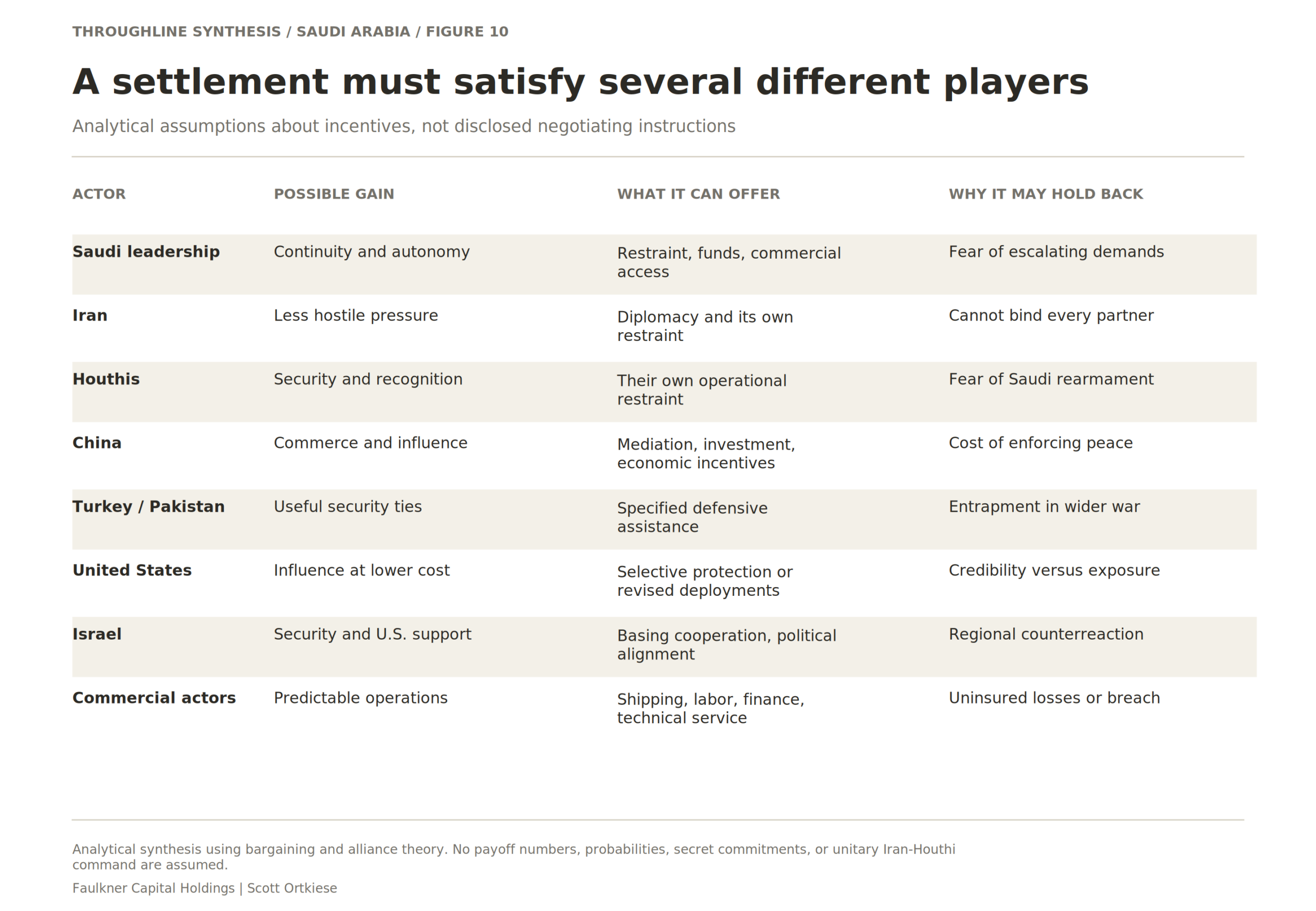
A Saudi-Chinese bargain cannot automatically bind Iran, the Houthis, other Yemeni parties, or private commercial actors. This is an analytical actor map; objectives can conflict within each actor.29 30 31 32
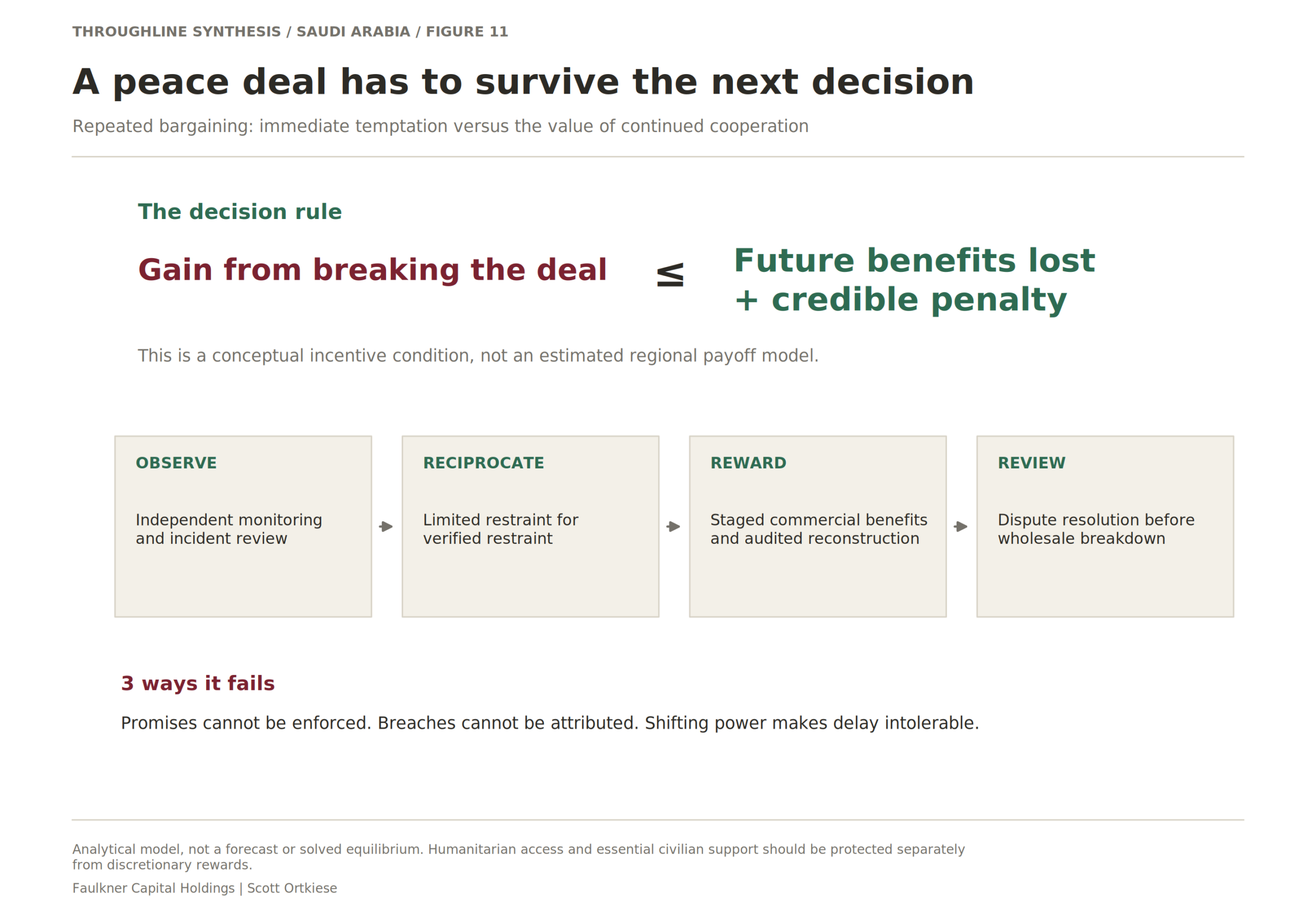
Fearon’s information and commitment problems and Powell’s shifting-power mechanism explain why a mutually beneficial bargain can still fail. The staged process shown here is a proposed application, not an agreement already in place.29 30
Saudi Arabia is already seeking alternatives
The most important corrective to a narrative of helplessness is an official document. On August 7, 2026, Saudi Arabia, Turkey, and Pakistan signed the Makkah joint defense agreement, declaring that an armed attack against any of them would be regarded as an attack against all.97
That changes the starting point of the scenario. Riyadh is not waiting passively for an American withdrawal before looking for other security relationships.
But a collective-defense declaration is not the same as an integrated war-fighting system. The published communiqué does not disclose a common command structure, automatic force deployments, or an explicit nuclear guarantee.97 Pakistan subsequently described the agreement as defensive and not directed against a particular country or sectarian bloc.98
The likely test is whether Turkey and Pakistan can and will provide the particular forms of support Saudi Arabia needs without being drawn into an open-ended war. Training, maintenance, intelligence, reassurance, and limited defensive assistance could be easier to sustain than a commitment to reconquer territory in Yemen.
Turkish Foreign Minister Hakan Fidan made the implementation problem explicit in an August 8 interview: assistance could take several forms, and the agreement still required work on interoperability, training, and logistics.99 A declaration can change expectations immediately, but the capacity to act together must still be built.
China offers a different relationship. The 2023 agreement restoring Saudi-Iranian diplomatic relations, brokered in Beijing, established a basis for dialogue and noninterference but did not create a Chinese military guarantee for Saudi Arabia.23 In a retreat scenario, China’s greatest contribution might be to support a bargain that keeps energy and commerce moving, rather than reproduce the American basing system.
India would have strong reasons to resist an exclusive anti-Iranian or anti-Saudi alignment. Indian strategic research describes relationships spanning Iran, the Gulf monarchies, Israel, and Western partners, together with an interest in maritime access and avoiding regional entrapment.100
Russia could pursue diplomatic influence, commercial relationships, and security cooperation, but the scenario should not assume that Moscow would automatically underwrite Saudi survival or subordinate all its other interests to Riyadh. Likewise, Iran might prefer a constrained, predictable Saudi state to a disintegrating neighbor whose instability could spread. These are possible interests to test, not promises already made.
Multipolarity, in this sense, is not a succession ceremony at which China replaces the United States. It is a more fragmented bargaining environment in which different states provide different services, demand different concessions, and resist becoming responsible for the entire system.
Could China broker a Saudi settlement?
A Chinese role is more plausible as part of a negotiated regional settlement than as a simple purchase of a replacement security umbrella. The 2023 Saudi-Iranian agreement supplies a diplomatic precedent, but its text does not create a Chinese obligation to defend either state.23 Mediation, economic participation, monitoring, and military enforcement are different commitments.
There is already an economic basis for a larger Chinese role. Saudi Arabia’s official trade report identifies China as its largest merchandise export destination and import supplier in 2023, accounting for 16.6% of exports and 20.9% of imports. Japan and India were the next-largest export destinations, an important reminder that Asian demand is not exclusively Chinese. These are dated trade shares, not evidence of a 2026 security commitment.33
Beijing’s public position also resists a simple choice between Saudi Arabia and the Houthis. In June, China credited Saudi Arabia and other mediators for a detainee-release agreement, supported Yemeni sovereignty, and called for respect for commercial navigation.101 That is evidence of an interest in an inclusive settlement, not a promise to deliver Riyadh to its adversaries or protect it from every consequence of its policies.
An imaginable bargain would link reduced attacks and intervention to reconstruction funding, compensation arrangements, commercial access, and reciprocal security limits. Funding would need rules governing recipients, auditing, civilian access, and disputes. Payments alone would not establish who can bind armed organizations or what happens when an agreement is violated.
Calling those payments reparations would raise additional questions about responsibility, eligible losses, consent, and enforceability. Yemen, Oman, Iran, and Iraq cannot simply be placed on one compensation list without specifying the injury and the responsible actor in each case. In particular, documented Saudi intervention in Al-Mahra concerns territory inside Yemen next to Oman, not proof of the same conduct inside Oman.91
Financial realignment could accompany a political bargain, but it must be modeled separately. Moving gold custody, selling Treasury securities, changing reserve currencies, and investing in Chinese assets are distinct transactions with different purposes. No evidence established for this article demonstrates that Saudi gold is now being transferred from U.S. custody to China or that an agreed Treasury liquidation is financing a peace settlement.
Nor should the argument depend on claims that Saudi Arabia has simply ignored Palestine. Its published position has conditioned diplomatic relations with Israel on Palestinian statehood, and later Israeli research describes a harder Saudi stance toward normalization.102 103 Whether Saudi conduct has matched its declarations is a legitimate question, but it is different from saying that no acknowledgment exists.
The defensible scenario is therefore a negotiated reduction in Saudi freedom of action, potentially accompanied by reconstruction commitments and more diversified financial relationships. It is not an established secret agreement in which China guarantees peace, Saudi Arabia pays every neighbor, and Israel receives precisely the regional order it planned.
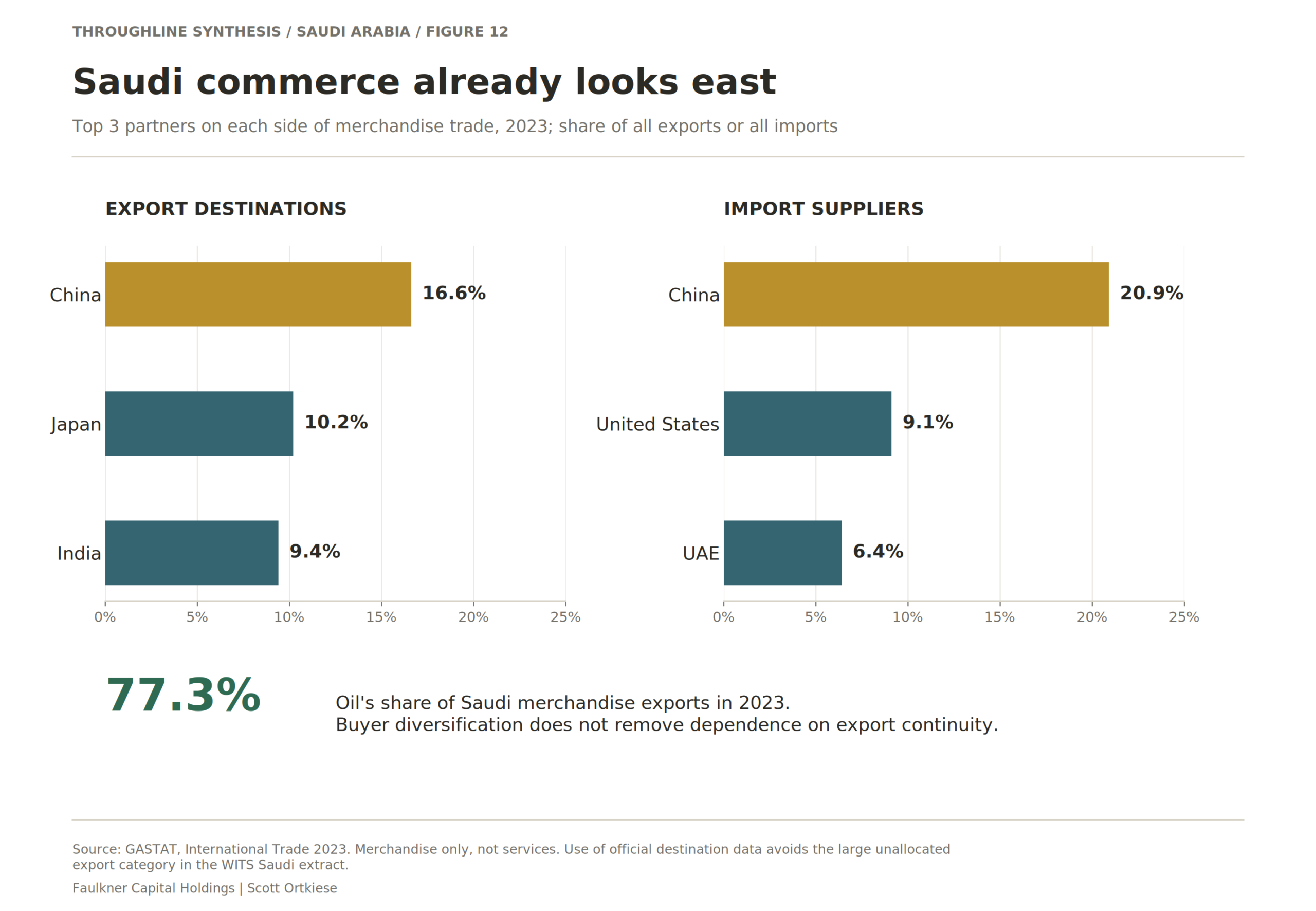
China is important on both sides of Saudi trade, while Japan and India matter as export buyers. These relationships create incentives for stability, not automatic defense guarantees.33
The other Gulf states would face different crises
A Saudi crisis would not produce identical outcomes across the Gulf. Geographic exposure, political structure, resource revenues, commercial dependence, and the ability to obtain outside support would determine how the shock travels.
The fiscal starting points also differ. The 2025 government-debt observations are 32.8% of GDP52 for the UAE, 41.4%53 for Qatar, 14.6%54 for Kuwait, 35.8%55 for Oman, and 147.6%56 for Bahrain. These gross-debt measures are not net public wealth or a fully harmonized assessment of obligations. They identify questions about financing room, not automatic default thresholds; the UAE aggregate also cannot substitute for an examination of individual emirates and public entities.
The UAE: commercial confidence and Saudi rivalry
The UAE’s 2024 baseline combines 10.88 million57 residents with $537.08 billion58 in nominal GDP. It is a smaller population supporting a substantial economic system, not a miniature version of Saudi Arabia. Its resilience must be evaluated through the continuity of that system as well as through public financial resources.
For the UAE, a Saudi setback could initially appear to create opportunities to attract business or improve its relative position. But that calculation becomes dangerous if Saudi weakness is part of a broader collapse in confidence in Gulf security. A commercial hub can benefit from a neighbor’s policy mistakes; it cannot assume it will benefit from a region-wide loss of safe transport and predictable business conditions.
Saudi-Emirati rivalry is already an established factor in Yemen. Farea Almuslimi describes distinct Emirati objectives, durable local networks, and the persistence of influence even after the UAE announced its withdrawal following the late-2025 confrontation with Saudi Arabia.104
The scenario implication is that Abu Dhabi might seek an accommodation with Riyadh, strengthen separate partnerships, or preserve local influence without rebuilding a common Saudi-Emirati strategy. Financial reserves could help absorb losses, but they would not by themselves restore the commercial confidence on which internationally connected sectors depend.
Bahrain: political exposure to Saudi weakness
With 1.59 million59 residents and $47.74 billion60 in 2024 nominal GDP, Bahrain has a much smaller domestic economic base. Its high gross-debt starting point makes the terms and reliability of external support especially important to the scenario, without proving that a financing crisis is inevitable.
Bahrain’s vulnerability would be especially political. Its experience in 2011 demonstrates the importance of Gulf intervention to the ruling order, although that history must not be used to erase domestic political agency or portray every opposition movement as Iranian-directed.90
A Saudi government forced to concentrate resources at home could become a less reliable supporter. Bahrain might then seek more assistance from other Gulf partners or outside powers, intensify domestic control, or face pressure to negotiate internally. None of those outcomes automatically implies Iranian takeover.
Qatar and Kuwait: financial capacity is not geographic immunity
The baseline records Qatar at 3.12 million61 residents and $217.98 billion62 in nominal GDP, and Kuwait at 4.93 million63 residents and $160.23 billion64. These figures show economic scale relative to resident populations, not the size of citizen populations, liquid government portfolios, or available military manpower.
For Qatar, the stress test is whether export earnings, external partnerships, and domestic continuity remain dependable during prolonged maritime disruption. For Kuwait, it is whether financial capacity can be converted into credible protection and practical access under pressure.
In both cases, accumulated wealth could support endurance, but the relevant question would be how much is liquid, politically available, and usable without impairing future income. Neither state should be treated as destined to collapse simply because Saudi Arabia weakens; nor should financial wealth be treated as proof that regional security no longer matters.
Oman: room for mediation, but no automatic sanctuary
Oman’s baseline is 5.27 million65 residents and $106.94 billion66 in nominal GDP. Its importance in this scenario comes less from economic scale than from the choices its geography and diplomatic relationships could make possible.
Oman could gain diplomatic importance as the value of nonexclusive relationships and negotiated access increased. Its role in the talks preceding the Saudi-Iranian rapprochement is acknowledged in the 2023 joint statement, and Indian strategic research identifies Oman within an existing network of maritime access relationships.23 100
That potential advantage would come with burdens. Oman could face stronger demands to mediate, accommodate displaced commercial activity, and manage instability near its borders. The experience of Al-Mahra illustrates why the security of the Arabian Peninsula cannot be reduced to arrangements among capitals alone.91
Oman has also articulated an alternative to permanent bloc confrontation. Foreign Minister Badr Albusaidi’s March essay criticized the U.S.-Israeli attack on Iran while condemning Iranian retaliation against neighboring states and proposed linked negotiations, confidence building, nuclear transparency, and potentially a nonaggression framework.105 This is a regional diplomatic proposal, not evidence that a new security order has already been agreed.
Across these states, civilian water, power, food distribution, and labor continuity would be central to resilience. Research on Gulf water security emphasizes both dependence on desalination and important differences in redundancy, distributed capacity, and emergency preparation.106 It does not support a universal claim that a single infrastructure failure would make every Gulf state uninhabitable.
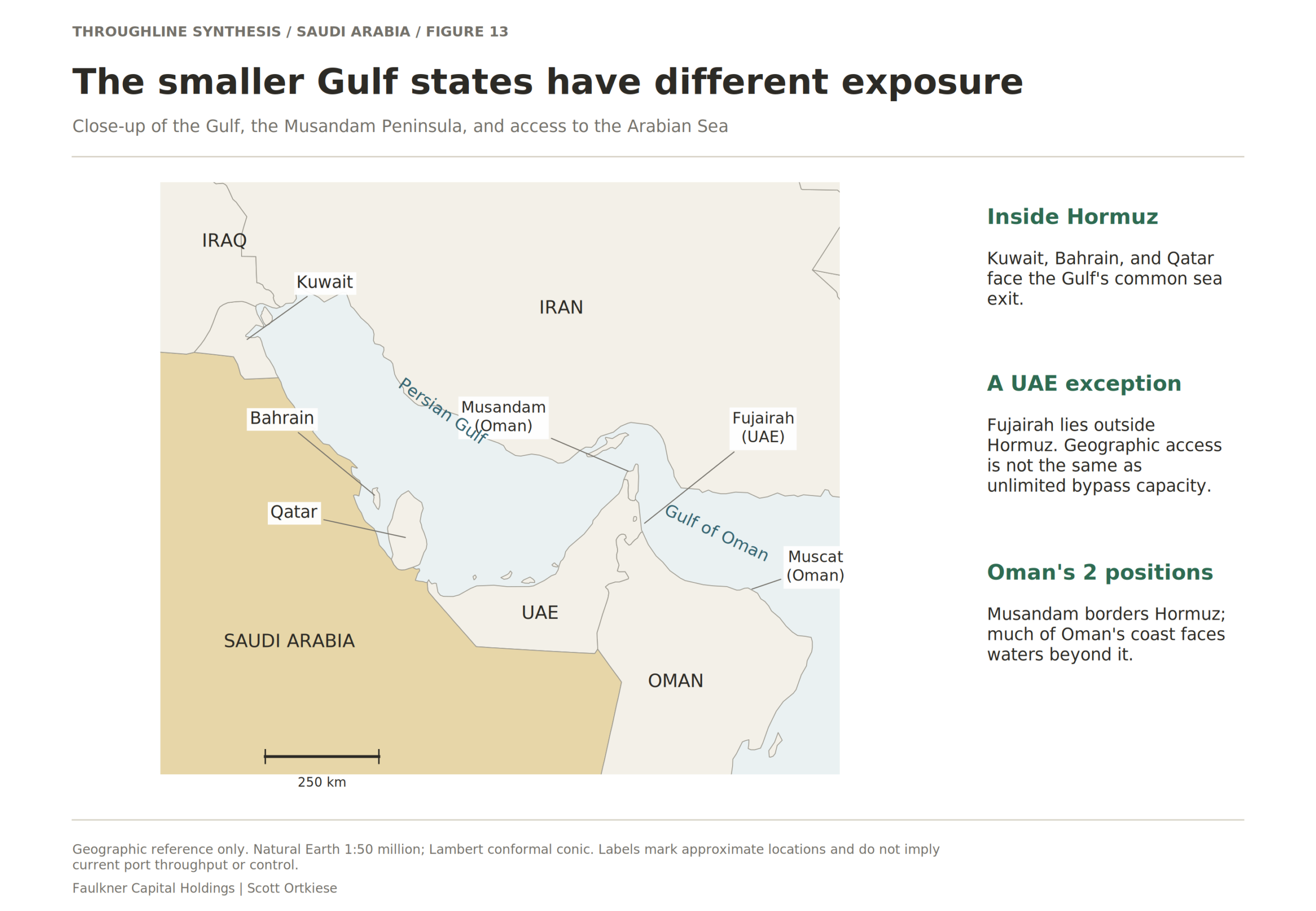
Country size, coastline, and port location create different options. Oman’s Musandam exclave and the UAE’s Fujairah coast are particularly important geographic distinctions.1 26
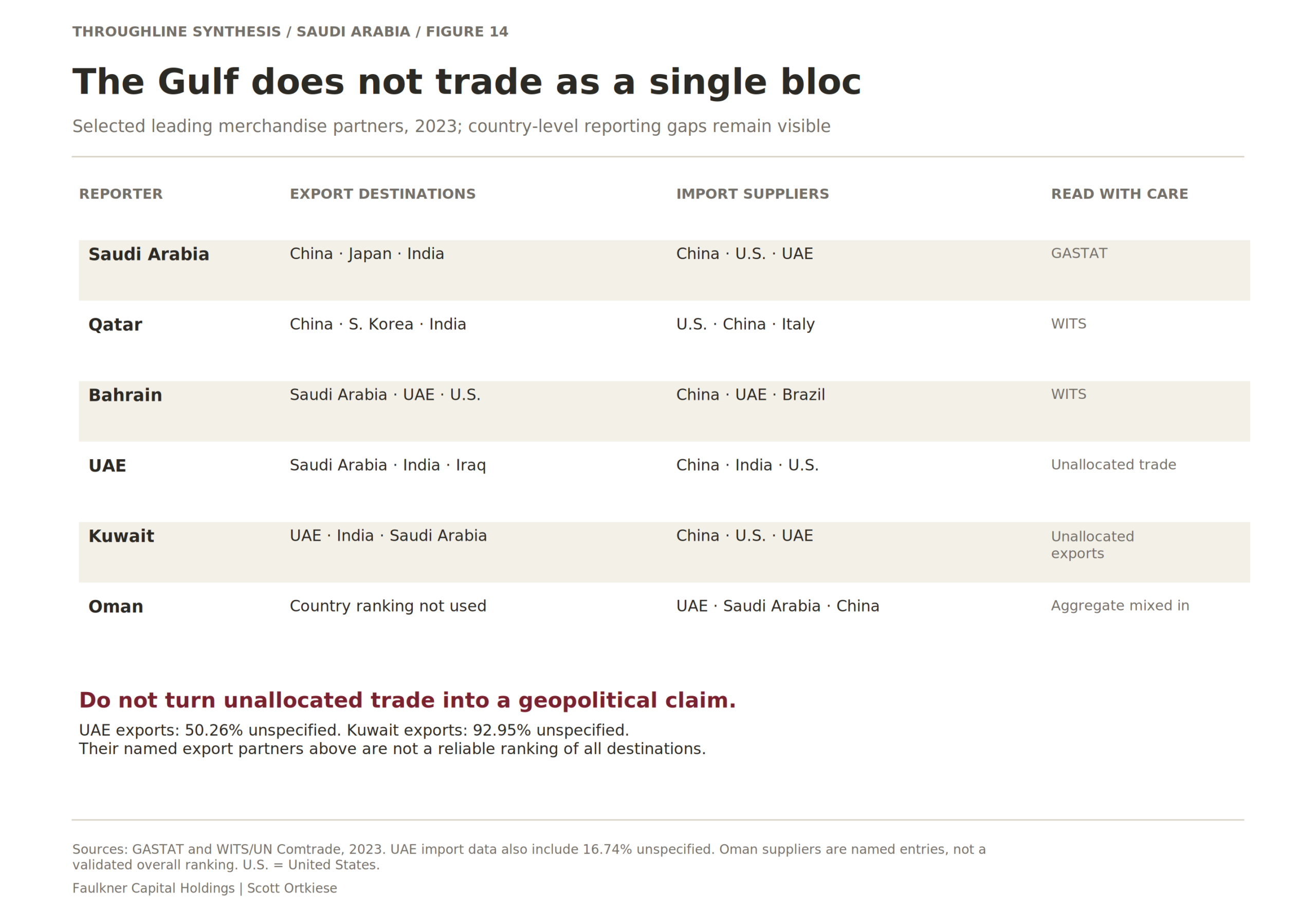
Saudi, Qatari, and Bahraini rows show the leading named partners in the cited source. UAE and Kuwait export rows show the first named countries after the unspecified category, not a complete destination ranking. Oman’s WITS output mixes a regional aggregate with countries, so its export ranking is withheld. Services, re-export effects, and reporting gaps limit comparisons.33 34 35 36 37 38
The American domestic connection
The problem begins with the kind of sovereignty Washington is prepared to recognize. Article 2(4) of the UN Charter prohibits the threat or use of force against a state’s territorial integrity or political independence, subject to the Charter’s legal framework.107 The modern legal question is therefore more precise than an appeal to a supposedly unbroken Westphalian tradition: do powerful states accept enforceable constraints on their own conduct?
Trump’s proposal to take over Gaza supplied a revealing test. In February 2025, UN experts warned that his proposed American takeover and displacement of Palestinians would shatter fundamental rules of the international order.108 A proposal is not a completed annexation. It nevertheless reveals the danger of treating a people’s territory as an asset to be allocated by outside powers.
For Saudi rulers, the warning is not that this proposal proves a secret plan to partition their kingdom. It is that an order willing to subordinate weaker peoples’ rights to strategic or commercial preference cannot supply unconditional reassurance to its clients. Legal protection loses credibility when its beneficiaries defend it only for themselves.
Israeli strategy, American agency, and the technology bargain
Jeffrey Sachs interprets the 1996 Clean Break strategy associated with Netanyahu’s American advisers and the subsequent sequence of regional wars as a project to reshape the Middle East in Israel’s favor.109 That interpretation belongs in this debate. It should be identified as an argument about strategy and influence, not treated as proof that every American decision was dictated from Israel or that American leaders lacked agency.
The claim that Israeli leaders want no regional stability at all is less precise than the evidence allows. In his September 2024 UN address, Netanyahu promoted Saudi normalization and a new regional alignment while presenting Iran and its partners as the opposing threat.110 His declared objective was not universal disorder. The more consequential question is what kind of stability his government would accept, under whose terms, and with what room for Palestinian sovereignty and independent neighboring states.
A region can be stable for trade, investment, and aligned governments while remaining coercive toward populations and states that resist the prevailing arrangement. In that model, selective normalization and destructive military action are not necessarily contradictory. The analytical test is whether policy seeks a reciprocal order of sovereign equals or an order in which some actors retain broad freedom to use force while others are expected to accommodate it.
American technology capital adds another layer of dependence, but the mechanism should be documented rather than imagined. The White House’s May 2025 account of its UAE agreement connected access to American artificial-intelligence technology with national-security alignment, protection of American-origin technology, and commitments to finance and build American data-center capacity.111 Its November Saudi announcement likewise linked defense relations with an artificial-intelligence memorandum and technology safeguards.76
These agreements do not prove that a technology executive ordered a war. They show that military alignment, sovereign investment, computing infrastructure, and access to technology are becoming parts of the same bargaining relationship. The relevant questions concern who controls the terms, who receives the commercial benefits, and how much freedom the Gulf partner retains to change course.
The old dependence on weapons, spare parts, and military support could therefore acquire a technological counterpart. A government may own the facility and finance the project while remaining dependent on foreign authorization, equipment, and continuing cooperation. Wealth can purchase a place inside that system without purchasing control over it.
Wealth concentration and the failure to correct policy
The durability of an external guarantee depends partly on the institutions that authorize it, fund it, scrutinize it, and revise it. A promise can become less credible when policy is personalized, commitments shift abruptly, and the domestic costs of foreign policy are poorly represented in the decisions that produce them.
Martin Gilens and Benjamin Page found substantial independent influence for affluent citizens and organized interests in their study of American policy outcomes, while average citizens had little independent influence after other preferences were accounted for.112 Their evidence covers policy issues from 1981 to 2002 and uses affluent respondents as a proxy for economic elites; it is not a direct study of today’s billionaires or proof that a particular war was purchased.
More recent institutional evidence comes from V-Dem. Its 2026 report, covering developments through 2025, records a decline in the U.S. Liberal Democracy Index from 0.79 in 2023 to 0.57 in 2025, alongside weakening legislative and judicial constraints on the executive.113 These are research-based indices with methodological uncertainty, not a declaration that every democratic institution has ceased to function.
The causal argument is therefore a mechanism to investigate, not a proven equation. Concentrated wealth can increase unequal access to policy; weak oversight can reduce the political cost of strategic error; and war can distribute gains and losses very unevenly. If those making consequential decisions are insulated from the costs borne by workers, households, service members, and future taxpayers, failure may persist longer before the political system forces correction.
Congress matters through authorization, appropriations, investigation, and public accountability. Courts matter through enforceable limits on executive action, even though they do not ordinarily design military strategy. The executive matters through the quality and independence of its professional institutions, its treatment of dissent, and its willingness to revise policy.
The danger is not merely an expensive foreign policy. It is a feedback system that protects decisions from correction until their accumulated costs force abrupt reversal. An ally accustomed to long-term American commitments would then confront both declining protection and unpredictable withdrawal.
Nevertheless, domestic decay does not mechanically guarantee imperial retreat. Political leaders could respond to failure with renewed escalation, and threatened elites could support greater coercion rather than retrenchment. Any serious forecast must preserve that possibility.
How the process could unfold
The following sequence is a scenario, not a dated prediction. Its stages could overlap, reverse, or stop.
In an initial phase, roughly the first 6 months after a decisive reduction in dependable American protection, Saudi policy would likely prioritize infrastructure repair, continuity of essential payments, emergency security cooperation, and reassurance of workers, investors, and commercial partners. Prestige projects would compete with more immediate requirements. Evidence of quick repairs, functioning services, and effective replacement support would weaken the collapse thesis.
Over a subsequent 6 to 24 months, a sustained shock could change the political bargain. The government might demand more restraint from citizens, greater concessions from contractors, and more tangible assistance from allies. Adversaries could seek commitments on military access, regional intervention, or Yemen. At this stage, constrained sovereignty could deepen without a change of ruler or borders.
Beyond that, several paths remain open. A negotiated regional settlement could stabilize Saudi Arabia. A more centralized and coercive government could endure by reallocating costs. A palace-level change could preserve the state while replacing leadership. Only a more severe conjunction of prolonged revenue loss, service failures, fractured security institutions, elite defection, and inadequate external rescue would make territorial disintegration a leading concern.
That last scenario is possible enough to study, but too demanding to infer from one defeat, one damaged pipeline, or one episode of unrest. It requires evidence that the institutions holding the state together are failing together.
The decisive indicators would not be dramatic speeches about a new world order. They would be repeated infrastructure outages that cannot be repaired durably, impaired access to usable financing, arrears in essential payments, departures from critical occupations, visible breakdowns in security-force coordination, and concessions that progressively narrow independent policy.
Those indicators must be read together and against counterevidence. Durable repairs, reliable essential payments, retained technical staff, cohesive security commands, and financing on manageable terms would favor recovery or adaptation. A harder authoritarian settlement would require enough resources and institutional loyalty to sustain enforcement. Leadership replacement would require evidence of elite coordination against the ruler, not simply public criticism of him.
Fragmentation demands a higher evidentiary threshold. Fiscal stress and local grievances do not draw future borders. A serious partition scenario would need identifiable armed organizations, sustained failures of central authority, local governing capacity, and outside actors willing and able to support separation. A map that simply converts tribal or sectarian identities into new states would conceal those missing mechanisms.
The evidence also has different weights. An official restoration announcement needs operational confirmation; a basing proposal is not a deployment order; and a military college scenario paper is not an official forecast. The strategic hedging study cited here was available through its abstract, which limits the conclusions drawn from it. The research does not establish current unit-level readiness, a consolidated usable-liquidity balance, or the contents of private security commitments. These limits prevent a defensible collapse probability, but not a disciplined comparison of conditional paths.
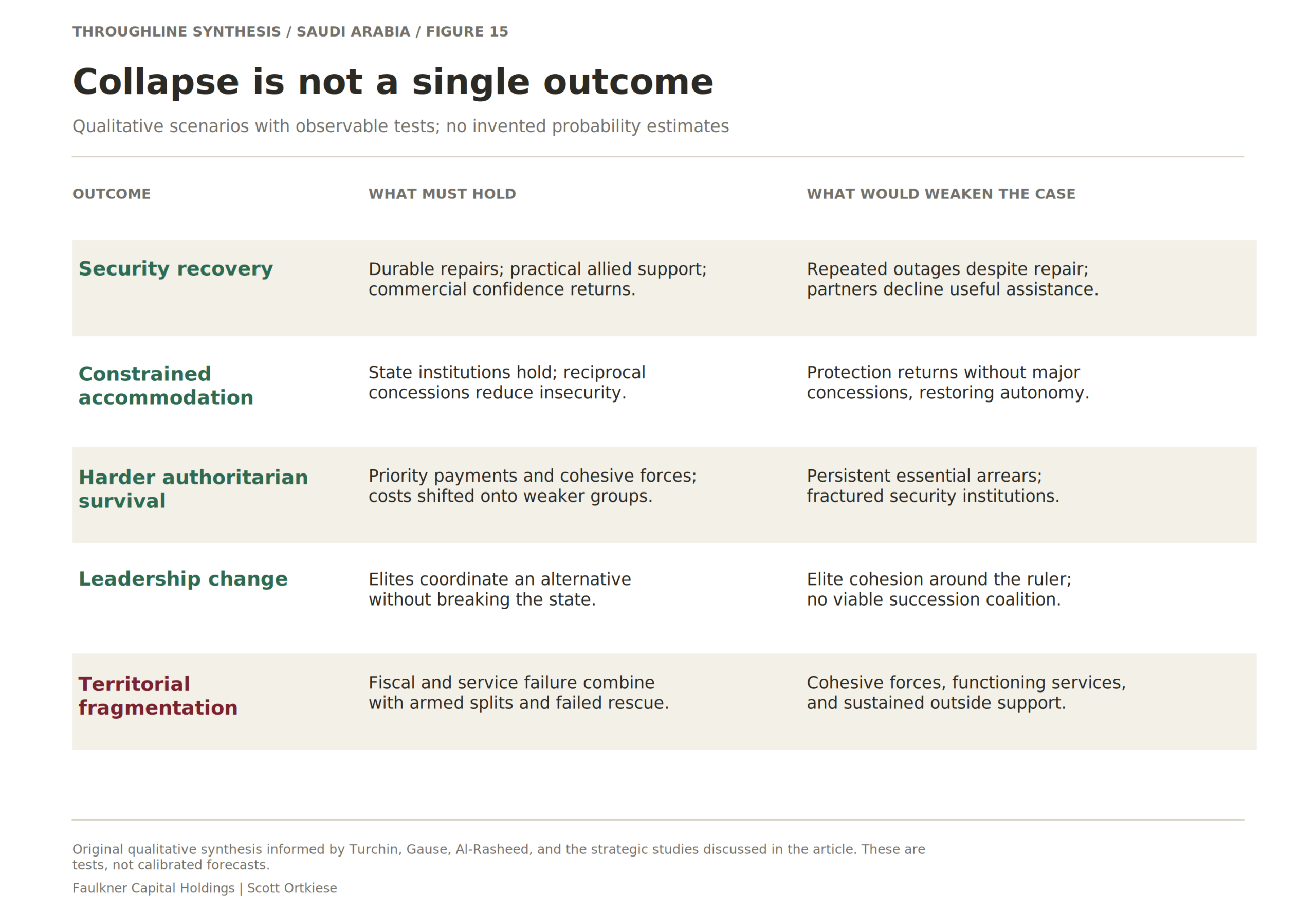
Fragmentation requires more simultaneous institutional failures than loss of autonomy. The scenarios can overlap or reverse; their order is not a forecast of an inevitable progression.39 40 41
The most plausible loss is freedom of action
Saudi Arabia’s strategic consequences could be severe without producing the spectacle of immediate collapse. A state that once intervened to shape its neighbors’ political order could find itself negotiating limits on its own. A leadership that treated foreign protection as a durable asset could discover that it had been a contingent service.
The strongest version of this argument does not claim that Saudi Arabia possesses nothing except money and oil. It asks how much of its military, economic, and administrative capacity remains effective when the systems connecting money and oil to actual power are disrupted. That question is more demanding, and more revealing, than an indictment of national character.
An American retreat toward Israel could preserve an armed position while signaling the contraction of a wider regional order. A multipolar replacement could give Gulf states more choices, but also more counterparties to satisfy, more fragmented guarantees, and fewer assumptions they could safely leave untested.
The central forecast is therefore conditional and limited: if infrastructure insecurity persists, external protection weakens, and Saudi institutions fail to adapt, the kingdom is more likely to lose strategic freedom before it loses territorial integrity. Whether that becomes a durable accommodation, a harsher authoritarian settlement, a leadership crisis, or national fragmentation will depend on choices still being made.
Financial realignment could be the quieter expression of that transition. In this scenario, Riyadh would not announce that it had exchanged 1 empire for another. It would gradually change where it holds assets, how it pays counterparties, whose projects it finances, and which political relationships those decisions reinforce.
The economic baseline and fiscal model impose an important constraint on that choice. Diversification must preserve the liquidity needed to finance imports, essential payments, repairs, and credible commitments to a settlement. Moving assets toward a new partner could strengthen a political relationship while making funds harder to mobilize when needed. A change of destination is therefore not, by itself, a gain in financial independence.
The first step could be less dramatic than dumping Treasuries: directing some new investment elsewhere, reducing reinvestment as securities mature, or retaining more liquidity for domestic needs. Selling a Treasury transfers a claim to another holder; it does not cancel America’s debt. Large, hurried sales could also impose costs on the seller, so a state trying to preserve usable wealth would have reasons to avoid turning diversification into a public financial assault.
A second step could expand settlement in renminbi, China’s currency, for selected transactions. But the currency used to invoice oil, the currency used to settle payment, the asset in which proceeds are invested, and the location of custody are separate decisions. Paying a Chinese supplier in renminbi does not prove that oil has stopped being priced in dollars, that the riyal’s exchange-rate policy has changed, or that all Saudi reserves have moved to China.
Gold would require the same discipline. A purchase, a change of custodian, a physical shipment, and a pledge of collateral are different events. The evidence reviewed here does not establish the premise that Saudi gold is being removed from U.S. vaults and sent to China. That claim remains a proposition requiring custody records or an authoritative disclosure, not a fact that can be inferred from deteriorating relations.
A third step could tie selected Saudi investments, energy arrangements, or reconstruction commitments to a regional settlement supported by China and other partners. Such a package might compensate documented losses in Yemen while reducing incentives for renewed attacks and intervention. It would still require agreement on responsibility, recipients, oversight, and enforcement. The name “reparations” cannot substitute for those terms, and a settlement with 1 government cannot bind every armed actor.
The strongest version of the theory therefore ends with a conditional bargain, not a triumphant transfer of treasure. Saudi Arabia preserves its territory and ruling institutions but accepts narrower military freedom, larger reconstruction obligations, and deeper Asian commercial relationships. China gains influence without necessarily accepting an American-style defense burden. Iran and Yemeni parties gain specified concessions but must decide whether predictable benefits are worth more than continued coercion.
There is a harsher alternative. If financial diversification merely replaces dependence on Washington with concentrated exposure to another patron, Saudi Arabia could exchange 1 set of constraints for another. If it preserves several buyers, financing channels, and security relationships while rebuilding domestic capability, it could recover room to maneuver. The outcome depends on the terms of the settlement, not on the label “multipolar.”
The old security order need not end with every base closed and every monarchy overthrown. It could end when its clients can no longer assume that their wealth will buy protection on terms they control and begin reallocating that wealth accordingly.
The moral history is part of the strategic calculation, not an ornament attached to it. Governments that helped sustain interventions cannot assume that changing patrons will erase the consequences. Saudi security would be more durable if it rested on reciprocal restraint, reconstruction, and respect for neighboring peoples than on another promise that money can purchase immunity. None of this licenses attacks on Saudi civilians or the destruction of Saudi sovereignty. It explains why preserving that sovereignty may require abandoning policies once pursued under the protection of a more powerful state.
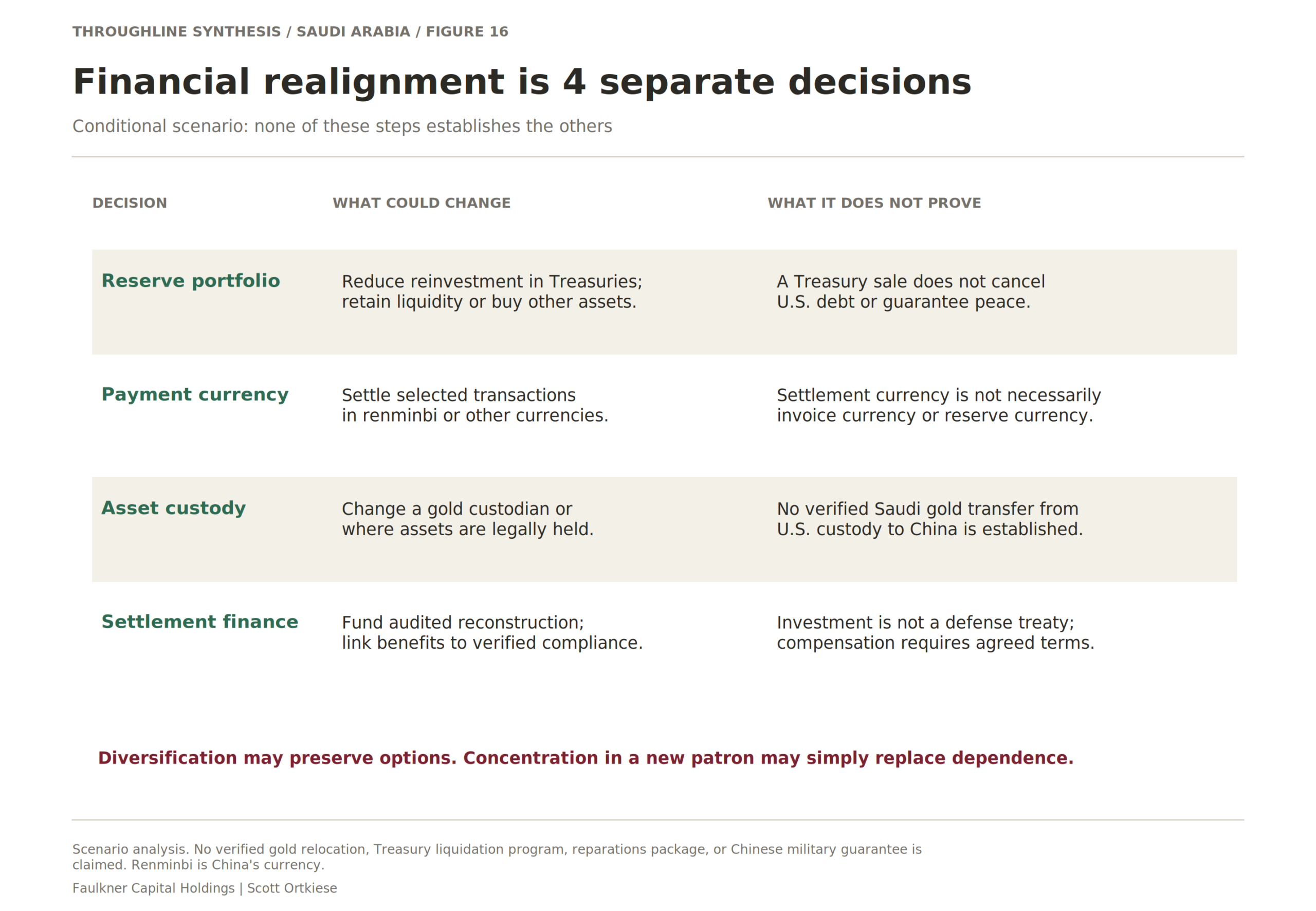
The article’s conclusion models gradual changes in investment, settlement, custody, and reconstruction finance. These are conditional mechanisms, not reports of Saudi transactions already completed.23 42
Sources and data notes
Figures and scenarios distinguish dated observations from modeled outcomes. Agency links identify the source of the retained economic baseline; they are not a substitute for the dated series specified in each data note.
- Natural Earth geography https://github.com/topojson/world-atlas/blob/master/README.md Return to text
- CRS on Saudi access https://www.congress.gov/crs_external_products/RL/PDF/RL31946/RL31946.3.pdf Return to text
- UN Yemen investigation https://www.ohchr.org/en/press-releases/2020/09/un-group-eminent-international-and-regional-experts-yemen-releases-their Return to text
- CRS on Bahrain https://www.congress.gov/crs_external_products/RS/HTML/95-1013.html Return to text
- CAPMAS, Egypt http://www.capmas.gov.eg/ Return to text
- Central Bank Of Iran https://www.cbi.ir/default_en.aspx Return to text
- World Bank https://www.worldbank.org/en/home Return to text
- General Authority for Statistics, Saudi Arabia https://www.stats.gov.sa Return to text
- Department of Statistics, Jordan http://www.dos.gov.jo Return to text
- World Bank https://www.worldbank.org/ Return to text
- Central Bureau of Statistics, Israel http://www.cbs.gov.il Return to text
- Palestinian Central Bureau of Statistics https://www.pcbs.gov.ps/default.aspx Return to text
- National Centre for Statistics and Information (Oman) https://www.ncsi.gov.om/ Return to text
- Central Statistical Bureau (Kuwait) http://www.csb.gov.kw Return to text
- National Planning Council, State of Qatar https://www.npc.qa/en/pages/default.aspx Return to text
- World Bank https://data.worldbank.org Return to text
- Palestine Monetary Authority (PMA) https://www.pma.ps/en/ Return to text
- Yergin, The Prize https://www.iwp.edu/wp-content/uploads/2020/06/The-Prize-The-Epic-Quest-for-Oil-Money-and-Power-by-Daniel-Yergin.pdf Return to text
- Onley, Britain and the Gulf Shaikhdoms https://www.files.ethz.ch/isn/110431/cirsoccasionalpaper4jamesonley2009.pdf Return to text
- UN Uqair treaty record https://treaties.un.org/pages/showDetails.aspx?objid=08000002800b3b06 Return to text
- UN Saudi-Yemeni treaty https://www.un.org/depts/los/LEGISLATIONANDTREATIES/PDFFILES/TREATIES/YEM-SAU2000IBT.PDF Return to text
- Aramco corporate history https://www.aramco.com/en/about-us/our-history Return to text
- 2023 trilateral statement https://peacemaker.un.org/sites/default/files/document/files/2024/05/joint20trilateral20statement20by20the20peoples20republic20of20china20the20kingdom20of20saudi20arabia.pdf Return to text
- JINSA basing paper https://jinsa.org/wp-content/uploads/2026/03/Basing-Insight-3.31-1.pdf Return to text
- September maritime analysis https://sanaacenter.org/publications/perspectives-and-analyses/28289 Return to text
- Kpler route analysis https://www.kpler.com/blog/explainer-can-saudi-arabia-keep-its-red-sea-oil-exports-flowing-without-bab-el-mandeb Return to text
- OECD PISA 2022 Saudi country note https://www.oecd.org/en/publications/pisa-2022-results-volume-i-and-ii-country-notes_ed6fbcc5-en/saudi-arabia_f69c2e4b-en.html Return to text
- ILO May 2026 crisis update https://www.ilo.org/sites/default/files/2026-06/Brief_Employment%20and%20Social%20Trends.pdf Return to text
- Fearon (1995) http://slantchev.ucsd.edu/courses/pdf/fearon-io1995v49n3.pdf Return to text
- Powell (2006) http://slantchev.ucsd.edu/courses/pdf/powell-io2006.pdf Return to text
- Snyder (1984) https://www.cambridge.org/core/journals/world-politics/article/security-dilemma-in-alliance-politics/681B1AF11D96E61995028026205CE783 Return to text
- Juneau on Iran and the Houthis https://econpapers.repec.org/article/tafuterxx/v_3a47_3ay_3a2024_3ai_3a3_3ap_3a278-300.htm Return to text
- GASTAT International Trade 2023 https://www.stats.gov.sa/documents/20117/2435279/ITR+2023E.pdf/338b0598-4aa7-1a51-5983-37c1f4b023ad Return to text
- WITS QAT 2023 https://wits.worldbank.org/CountryProfile/en/Country/QAT/Year/2023/tradeFlow/EXPIMP Return to text
- WITS OMN 2023 https://wits.worldbank.org/CountryProfile/en/Country/OMN/Year/2023/tradeFlow/EXPIMP Return to text
- WITS BHR 2023 https://wits.worldbank.org/CountryProfile/en/Country/BHR/Year/2023/Summarytext Return to text
- WITS KWT 2023 https://wits.worldbank.org/CountryProfile/en/Country/KWT/Year/2023/Summarytext Return to text
- WITS UAE 2023 https://wits.worldbank.org/CountryProfile/en/Country/ARE/Year/LTST/Summarytext Return to text
- Turchin fiscal model https://peterturchin.com/wp-content/uploads/2023/07/Turchin_AlSaud2006.pdf Return to text
- Gause on monarchical resilience https://www.brookings.edu/wp-content/uploads/2016/06/Resilience-Arab-Monarchies_English.pdf Return to text
- Al-Rasheed on Saudi resilience https://eprints.lse.ac.uk/64749/1/Al_Rassheed%20Is%20It%20always%20to%20be%20a%20king%20SaudiResilience.pdf Return to text
- Saudi strategic hedging study https://www.tandfonline.com/doi/abs/10.1080/25765949.2024.2411105 Return to text
- Saudi Arabia, 2024 population, million residents: 35.3003. General Authority for Statistics, Saudi Arabia; series 2024-12-31. Historical baseline retrieved September 17, 2026. https://www.stats.gov.sa Return to text
- Yemen, 2024 population, million residents: 40.58. World Bank; series 2024-12-31. Historical baseline retrieved September 17, 2026. https://www.worldbank.org/en/home Return to text
- Iraq, 2024 population, million residents: 46.04. World Bank; series 2024-12-31. Historical baseline retrieved September 17, 2026. https://www.worldbank.org/en/home Return to text
- Iran, 2024 population, million residents: 86.0. Central Bank Of Iran; series 2024-12-31. Historical baseline retrieved September 17, 2026. https://www.cbi.ir/default_en.aspx Return to text
- Saudi Arabia, 2024 nominal GDP, current USD billion: 1237.53. World Bank; series 2024-12-31. Historical baseline retrieved September 17, 2026. https://www.worldbank.org/ Return to text
- Yemen, 2024 nominal GDP, current USD billion: 19.1. World Bank; series 2024-12-31. Historical baseline retrieved September 17, 2026. https://www.worldbank.org/ Return to text
- Iraq, 2024 nominal GDP, current USD billion: 279.64. World Bank; series 2024-12-31. Historical baseline retrieved September 17, 2026. https://www.worldbank.org/ Return to text
- Iran, 2024 nominal GDP, current USD billion: 436.91. World Bank; series 2024-12-31. Historical baseline retrieved September 17, 2026. https://www.worldbank.org/ Return to text
- Saudi Arabia government debt as percent of GDP, 2025: 31.7%. National Debt Management Center, Saudi Ministry of Finance; series SAUDebt2GDP. Observation dated December 31, 2025; retrieved September 17, 2026. https://www.ndmc.gov.sa/en/Pages/default.aspx Return to text
- UAE government debt as percent of GDP, 2025: 32.8%. Central Bank of the UAE; series AREDebt2GDP. Observation dated December 31, 2025; retrieved September 17, 2026. http://www.centralbank.ae Return to text
- Qatar government debt as percent of GDP, 2025: 41.4%. Qatar Central Bank; series QATDebt2GDP. Observation dated December 31, 2025; retrieved September 17, 2026. Provider supplied no source URL. Return to text
- Kuwait government debt as percent of GDP, 2025: 14.6%. International Monetary Fund; series KuwwaitGovGDP. Observation dated December 31, 2025; retrieved September 17, 2026. https://www.imf.org/en/Home Return to text
- Oman government debt as percent of GDP, 2025: 35.8%. Central Bank of Oman; series OMAOMANGOVGDP. Observation dated December 31, 2025; retrieved September 17, 2026. https://cbo.gov.om/ Return to text
- Bahrain government debt as percent of GDP, 2025: 147.6%. International Monetary Fund; series BAHRAINGOVGDP. Observation dated December 31, 2025; retrieved September 17, 2026. https://www.imf.org/en/Home Return to text
- United Arab Emirates, 2024 population, million residents: 10.88. World Bank; series 2024-12-31. Historical baseline retrieved September 17, 2026. https://www.worldbank.org/ Return to text
- United Arab Emirates, 2024 nominal GDP, current USD billion: 537.08. World Bank; series 2024-12-31. Historical baseline retrieved September 17, 2026. https://www.worldbank.org/ Return to text
- Bahrain, 2024 population, million residents: 1.59. World Bank; series 2024-12-31. Historical baseline retrieved September 17, 2026. https://data.worldbank.org Return to text
- Bahrain, 2024 nominal GDP, current USD billion: 47.74. World Bank; series 2024-12-31. Historical baseline retrieved September 17, 2026. https://www.worldbank.org/ Return to text
- Qatar, 2024 population, million residents: 3.12. National Planning Council, State of Qatar; series 2024-12-31. Historical baseline retrieved September 17, 2026. https://www.npc.qa/en/pages/default.aspx Return to text
- Qatar, 2024 nominal GDP, current USD billion: 217.98. World Bank; series 2024-12-31. Historical baseline retrieved September 17, 2026. https://www.worldbank.org/ Return to text
- Kuwait, 2024 population, million residents: 4.93. Central Statistical Bureau (Kuwait); series 2024-12-31. Historical baseline retrieved September 17, 2026. http://www.csb.gov.kw Return to text
- Kuwait, 2024 nominal GDP, current USD billion: 160.23. World Bank; series 2024-12-31. Historical baseline retrieved September 17, 2026. https://www.worldbank.org/ Return to text
- Oman, 2024 population, million residents: 5.27. National Centre for Statistics and Information (Oman); series 2024-12-31. Historical baseline retrieved September 17, 2026. https://www.ncsi.gov.om/ Return to text
- Oman, 2024 nominal GDP, current USD billion: 106.94. World Bank; series 2024-12-31. Historical baseline retrieved September 17, 2026. https://www.worldbank.org/ Return to text
- Sana’a Center, September 15, 2026 https://sanaacenter.org/publications/perspectives-and-analyses/28317 Return to text
- Saudi Ministry of Energy https://x.com/MoEnergy_Saudi/status/2098478368081502260?ref_src=twsrc%5Etfw Return to text
- CRS on the UAE https://www.congress.gov/crs_external_products/RS/PDF/RS21852/RS21852.147.pdf Return to text
- Cambridge University Press's account of Mukoyama's research https://www.cambridge.org/core/books/fueling-sovereignty/084C268D6F4DF2B717E3B8278CB6D74C Return to text
- CENTCOM https://www.centcom.mil/MEDIA/PUBLIC-RELEASES/Article/3652569/us-forces-allies-conduct-joint-strikes-in-yemen/ Return to text
- UAE Foreign Ministry https://www.mofa.gov.ae/en/MediaHub/News/2026/1/26/UAE-Iran Return to text
- Trump's veto message https://trumpwhitehouse.archives.gov/presidential-actions/presidential-veto-message-senate-accompany-s-j-res-7/ Return to text
- CRS, Yemen and U.S. Policy https://www.congress.gov/crs_external_products/R/PDF/R45046/R45046.31.pdf Return to text
- C-SIPA text https://assets.publishing.service.gov.uk/media/6a8ec795f5b35599aec18ddd/TS_38.2026_Comprehensive_Security_Integration_and_Prosperity_Agreement.pdf Return to text
- White House fact sheet https://www.whitehouse.gov/fact-sheets/2025/11/fact-sheet-president-donald-j-trump-solidifies-economic-and-defense-partnership-with-the-kingdom-of-saudi-arabia/ Return to text
- UAE-Israel treaty https://trumpwhitehouse.archives.gov/briefings-statements/abraham-accords-peace-agreement-treaty-of-peace-diplomatic-relations-and-full-normalization-between-the-united-arab-emirates-and-the-state-of-israel/ Return to text
- Saudi Foreign Ministry https://www.mofa.gov.sa/en/ministry/statements/Pages/The-Ministry-of-Foreign-Affairs-stated-that-regarding-the-discussions-between-Saudi-Arabia-and-the-US.aspx Return to text
- Commission report https://www.ohchr.org/sites/default/files/documents/hrbodies/hrcouncil/sessions-regular/session60/advance-version/a-hrc-60-crp-3.pdf Return to text
- Human Rights Watch https://www.hrw.org/news/2024/10/30/lebanon-israeli-attacks-medics-apparent-war-crimes Return to text
- Carnegie's Sada analysis https://carnegieendowment.org/sada/2023/04/saudi-failures-in-the-mashreq-and-the-beijing-agreement?lang=en Return to text
- D’Alessandra, Carnegie Endowment https://carnegieendowment.org/research/2026/03/operation-epic-fury-and-the-international-law-on-the-use-of-force Return to text
- Saudi Ministry of Energy, April 12, 2026 https://www.spa.gov.sa/en/w2557744 Return to text
- Executive Level Simulation on Petroleum Issues https://www.esd.whs.mil/Portals/54/Documents/FOID/Reading%20Room/Other/15-F-0945_DOC_02_Executive_Level_Simulation_on_Petroleum_Issues.pdf Return to text
- Al Jazeera Centre for Studies https://studies.aljazeera.net/en/policy-briefs/expansion-and-exposure-paradox-houthi-control-bab-al-mandeb Return to text
- Roberts, Journal of Strategic Studies https://www.tandfonline.com/doi/full/10.1080/01402390.2025.2598762 Return to text
- Darwich, “The Saudi Intervention in Yemen: Struggling for Status” https://pure-oai.bham.ac.uk/ws/portalfiles/portal/90966016/Darwich.pdf Return to text
- Hilmi Özev, “Nation Building in Saudi Arabia” https://www.insanvetoplum.org/content/5-online-first/m0735/muharrem-hilmi-ozev-1.pdf Return to text
- UN report A/HRC/39/43 https://www.ohchr.org/sites/default/files/Documents/Countries/YE/A_HRC_39_43_EN.docx Return to text
- Bahrain Independent Commission of Inquiry, Chapter IX http://www.biciactions.bh/wps/themes/html/BICI/en/pdfs/C9.pdf Return to text
- Sana’a Center, Al-Mahra study https://sanaacenter.org/publications/policy-research/7606 Return to text
- Kelkitli, 2016, p. 30 https://dergipark.org.tr/en/download/article-file/844870 Return to text
- Gause, 2007 https://ciaotest.cc.columbia.edu/olj/si/si_6_02/si_6_02_c_gause.pdf Return to text
- Clingendael, 2025 https://www.clingendael.org/publication/saudi-and-emirati-engagement-iraq Return to text
- INSS, 2018 https://www.inss.org.il/wp-content/uploads/2018/01/adkan21-1ENG_3-33-45.pdf Return to text
- Amunategui, 2022 https://www.cfc.forces.gc.ca/259/290/24/192/Amunategui.pdf Return to text
- Pakistan Ministry of Foreign Affairs, summit communiqué https://mofa.gov.pk/press-releases/makkah-al-mukarramah-summit-for-joint-defence Return to text
- Pakistan Foreign Ministry briefing, August 12, 2026 https://mofa.gov.pk/press-releases/transcript-of-the-press-briefing-by-the-spokesperson-on-wednesday-12th-august-2026 Return to text
- Fidan interview, Anadolu https://www.aa.com.tr/en/turkiye/mecca-joint-defense-agreement-does-not-target-any-country-turkish-foreign-minister/4022116 Return to text
- Talha Latief Tantray, Journal of Defence Studies https://idsa.in/wp-content/uploads/2026/05/05-jds-20-1-2026-Talha-Latief-Tantray.pdf Return to text
- China’s UN mission, June 16, 2026 https://un.china-mission.gov.cn/eng/hyyfy/202606/t20260619_11948899.htm Return to text
- Saudi Foreign Ministry, February 7, 2024 https://www.spa.gov.sa/en/w2042969 Return to text
- INSS, February 2026 https://www.inss.org.il/publication/saudi-israel-2026/ Return to text
- Arab Reform Initiative https://www.arab-reform.net/publication/how-saudi-uae-rivalry-is-reshaping-the-yemen-war/ Return to text
- Oman Foreign Ministry https://www.fm.gov.om/en/39771/ Return to text
- Middle East Council on Global Affairs https://mecouncil.org/blog_posts/water-must-not-become-a-target-in-the-regions-wars/ Return to text
- UN repertory of Article 2(4) https://legal.un.org/repertory/art2/english/rep_supp7_vol1_art2_4.pdf Return to text
- UN experts https://www.ohchr.org/en/press-releases/2025/02/us-proposal-take-over-gaza-would-shatter-fundamental-rules-international Return to text
- Sachs's argument https://www.jeffsachs.org/newspaper-articles/sjt7dthh74wec92hepptkw96j6bmnw Return to text
- Netanyahu's UN address https://www.un.org/unispal/document/israel-pm-remarks-un-ga-79-27sep24/ Return to text
- White House fact sheet https://www.whitehouse.gov/fact-sheets/2025/05/fact-sheet-president-donald-j-trump-secures-200-billion-in-new-u-s-uae-deals-and-accelerates-previously-committed-1-4-trillion-uae-investment/ Return to text
- Gilens and Page, 2014 http://piketty.pse.ens.fr/files/GilensPage2014.pdf Return to text
- V-Dem Democracy Report 2026 https://www.v-dem.net/documents/75/V-Dem_Institute_Democracy_Report_2026_lowres.pdf Return to text