
Chinese open-weight models can make AI more useful while eroding the returns expected from its infrastructure. Railways, satellites, and solar manufacturing show why a technology’s success does not guarantee its investors a return.

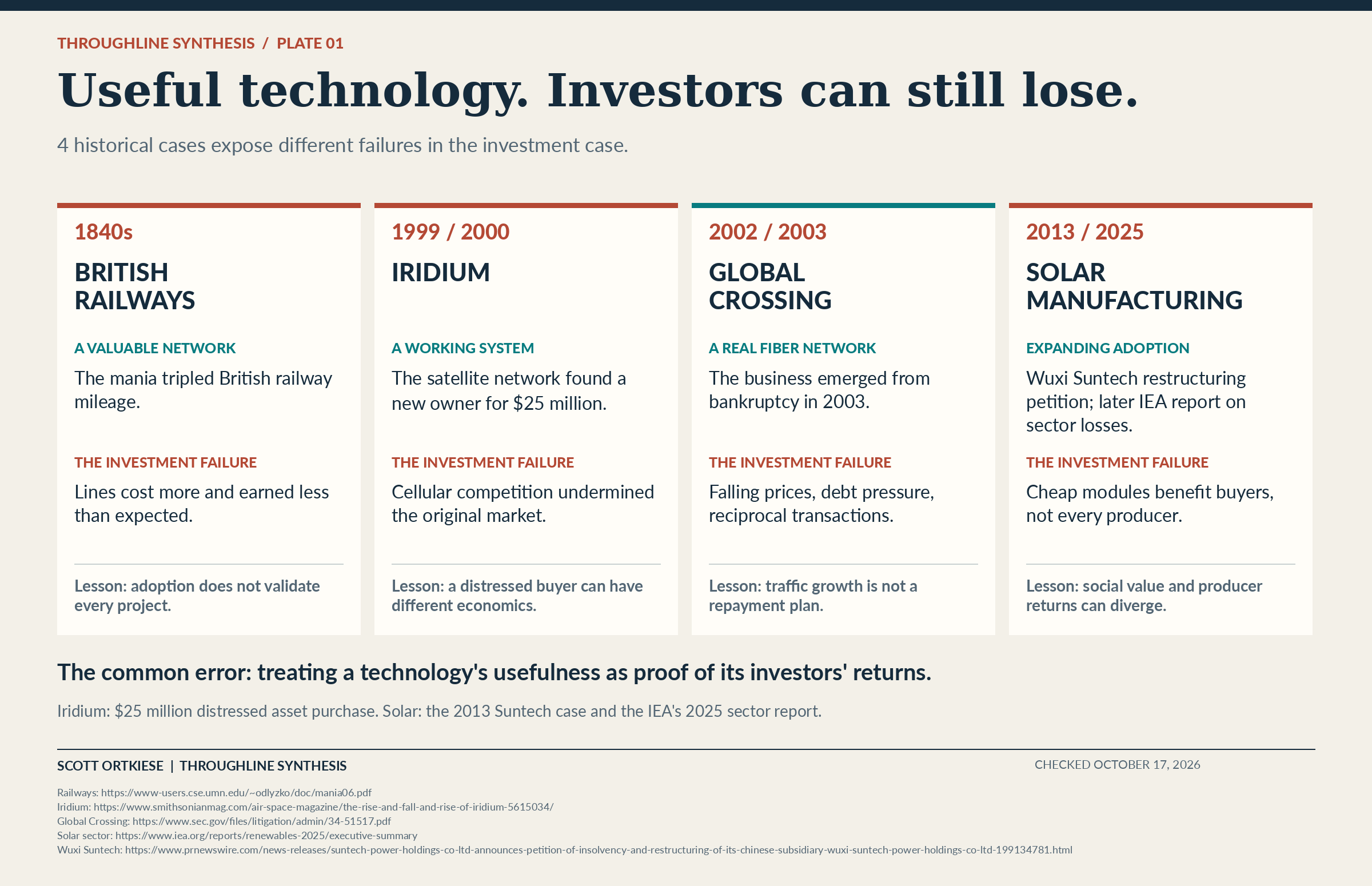
Global Crossing filed for bankruptcy on January 28, 2002, and emerged on December 9, 2003 (U.S. Securities and Exchange Commission). The operating business survived the failure of the financing behind it.
The company built a global fiber-optic network, but competition and better transmission technology drove bandwidth prices down faster than expected as demand grew more slowly than forecast (Los Angeles Times). The internet did not have to disappear for the investment case to break. Demand could grow while prices fell below the level needed to support the investment.
That is the strongest historical analogy for the AI infrastructure boom. AI could become abundant, capable, and cheap before its expensive infrastructure earns back its cost.
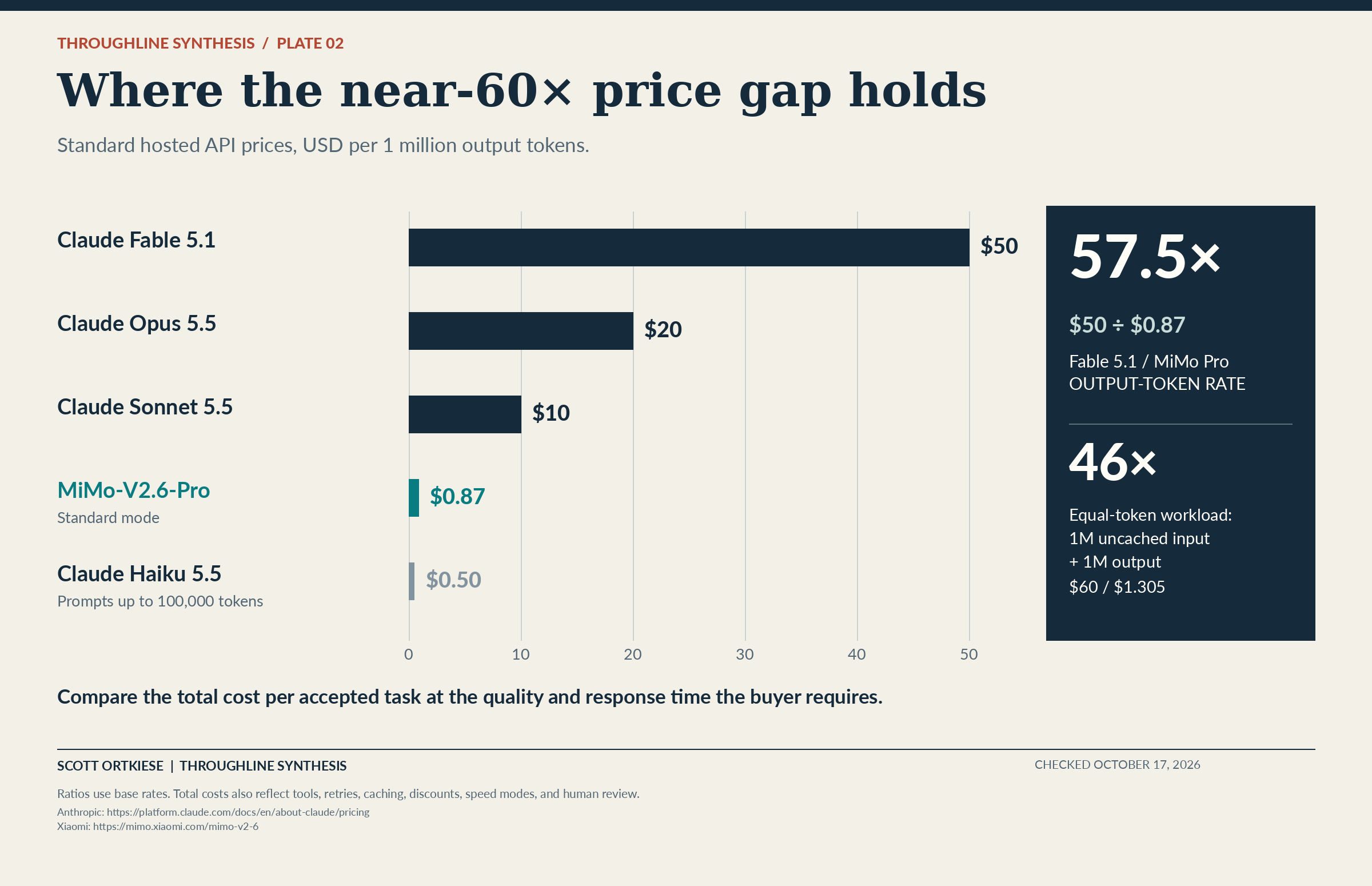
Chinese open-weight models make that possibility concrete. Xiaomi lists MiMo-V2.6-Pro at $0.87 per million output tokens, the units of generated text, compared with Anthropic’s $50 standard rate for Claude Fable 5.1 (Xiaomi, Anthropic). Independent testing places MiMo among the leading open-weight models (Artificial Analysis). That combination challenges the assumption that premium prices will endure.
Global Crossing: growing traffic, failing economics
Better transmission equipment let new networks undercut existing operators and carry more traffic over each strand of fiber (Los Angeles Times). Making the infrastructure more productive weakened the scarcity on which its owners had counted.
Financial reporting compounded the problem. In its April 2005 settlement order, the SEC found that some Global Crossing capacity sales depended on purchases of similar amounts from the same customers and that the company had inadequately disclosed these reciprocal transactions and their effects on liquidity (SEC).
Receipts appeared in operating cash flow and the corresponding purchases in investing cash flow, although the transactions did not improve operating liquidity (SEC). Reported activity could grow without sustainable cash flow from end users.
The Federal Trade Commission’s January 2025 study documented arrangements requiring AI developers to spend much of a cloud provider’s investment on that same provider’s services (FTC). Investment and revenue are different economic events, even when the same money passes through both.
The investor’s question is not simply whether spending is growing. It is whether paying customers will generate enough cash to support the chain without successive financing rounds.
Railways: the right technology at the wrong investment price
Britain’s 1840s Railway Mania shows the same problem. Andrew Odlyzko’s historical reconstruction describes a tripling of British railway mileage and major investor losses as new lines cost more and earned less than expected (Odlyzko, University of Minnesota).
Demand for rail transport and returns on railway investment were separate questions. A society can benefit from a network whose original capital providers overpaid for it.
Odlyzko also distinguishes the disastrous 1840s episode from the earlier railway speculation of the 1830s, whose investments ultimately performed much better (Odlyzko). The investment outcome depends on the amount built, the price paid, and the earnings available.
The corresponding AI mistake is to treat forecasts of widespread adoption as justification for every planned data center. Industry growth does not give every operator the same utilization, pricing power, or access to new financing when old debt comes due.
Iridium: the network survived at a different price
Iridium entered bankruptcy in 1999 after terrestrial cellular networks undermined much of the market for its satellite service (Smithsonian, Air & Space). A successor bought the existing network for $25 million in a distressed sale in 2000 and restarted service with support from a U.S. Defense Department contract (Smithsonian).
Useful infrastructure can become commercially viable on terms radically different from those available to its original financiers. A new owner does not have to recover the capital that a previous owner lost.
That distinction matters when someone defends an AI project by saying its facilities will eventually find a use. Eventual usefulness tells a lender little about the original borrower’s ability to make the next payment or the price a buyer will pay after creditors take a loss.
Solar: customers can win while manufacturers lose
Solar manufacturing connects technological progress, Chinese competition, and producer distress. In March 2013, Suntech announced that banks had petitioned for insolvency and restructuring of Wuxi Suntech, its principal Chinese operating subsidiary, while production was expected to continue (Suntech announcement).
The International Energy Agency’s Renewables 2025 report documents a decline of more than 60% in solar photovoltaic prices in China since 2023 amid a glut of modules (IEA). Major solar manufacturers reported large losses despite surging global installations (IEA).
For a solar developer, cheaper panels are an advantage. For a manufacturer carrying costly factories and debt, the same price decline can be a threat. Chinese manufacturers face the same arithmetic.
Open-weight competition puts the same pressure on AI providers. Cheaper alternatives force them to defend the prices and margins built into their investment plans.
What the 60× comparison actually measures
Open weights are a model’s trained numerical settings, available to download and run under its license. DeepSeek’s V4-Pro-0813 release provides local-deployment instructions and licenses its repository and weights under the MIT License (DeepSeek model card). Buyers can purchase hosted access or operate the model themselves.
The quoted rates apply to an application programming interface (API), through which software calls a hosted model (Anthropic’s API pricing guide). On October 17, 2026, Xiaomi listed MiMo-V2.6-Pro at $0.87 per million output tokens, and Anthropic listed Fable 5.1 at $50, a 57.5× ratio calculated as $50 ÷ $0.87 (Xiaomi, Anthropic).
Anthropic lists Opus 5.5 at $20 and Sonnet 5.5 at $10 per million output tokens, equivalent to 23× and 11.5× MiMo’s rate, respectively (Anthropic, Xiaomi). Its smaller Haiku 5.5 costs $0.50 per million output tokens for prompts up to 100,000 tokens (Anthropic).
Input also matters. At the listed base rates, 1 million uncached input tokens and 1 million output tokens cost $60 on Fable 5.1 and $1.305 on MiMo-V2.6-Pro, a 46× ratio (Anthropic, Xiaomi).
The buyer’s total cost also depends on caching, discounts, tool calls, retries, and human review. Buyers should compare cost per accepted task at the quality and response time they require.
Self-hosting shifts spending to hardware, electricity, engineers, and security. The British National Cyber Security Centre distinguishes private cloud services from self-hosted models and specifies security assessment and infrastructure protection for self-hosted deployments (NCSC).
Frontier performance is task-specific
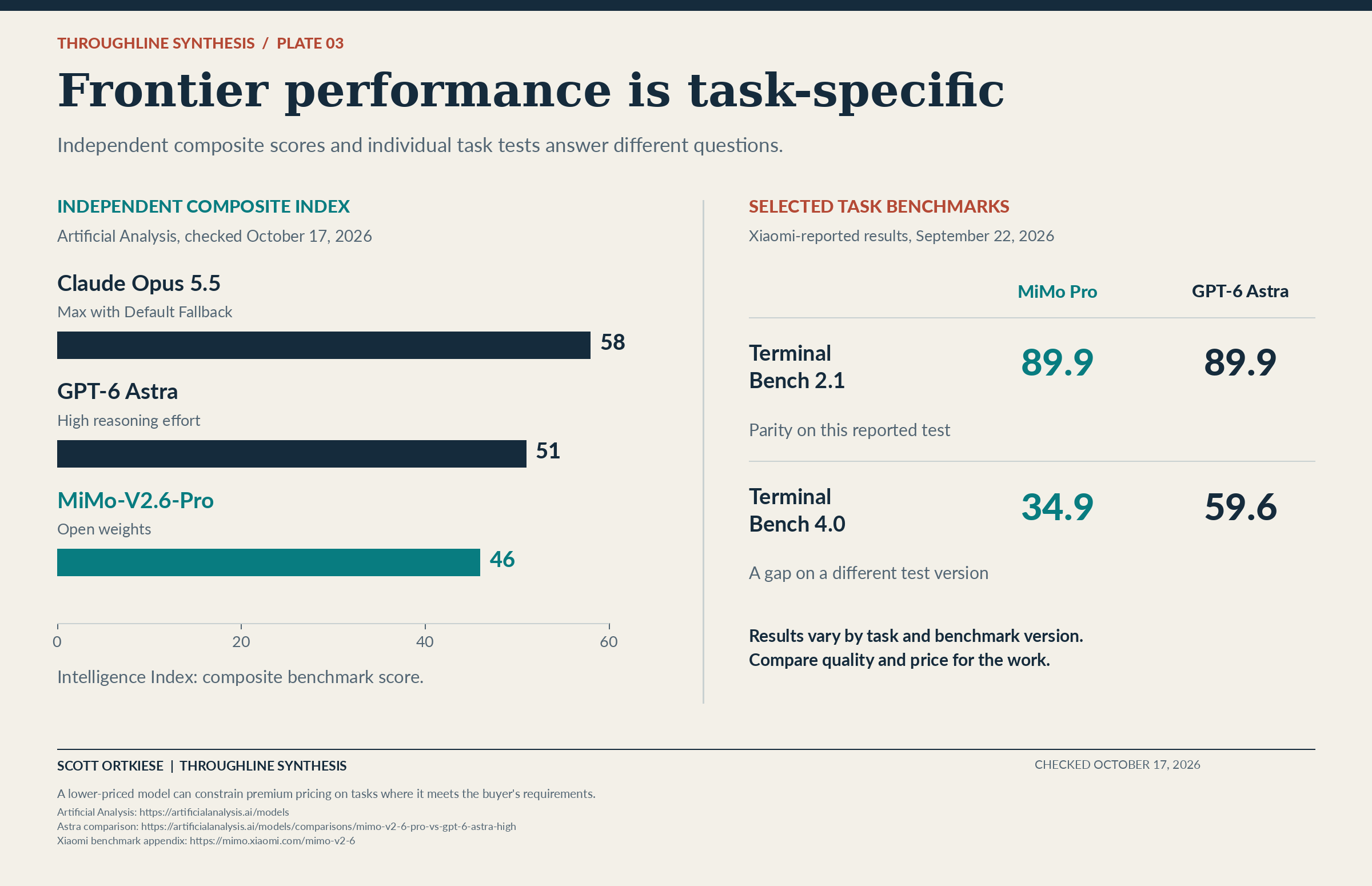
On October 17, 2026, Artificial Analysis ranked MiMo-V2.6-Pro first among open-weight models on its composite Intelligence Index with 46 points (Artificial Analysis leaderboard). GPT-6 Astra scored 51 at high reasoning effort, and the leading Claude Opus 5.5 configuration scored 58 (Artificial Analysis leaderboard, MiMo and Astra comparison).
In Xiaomi’s September 22 tests, MiMo-V2.6-Pro and GPT-6 Astra both scored 89.9 on Terminal Bench 2.1 (Xiaomi benchmark appendix). On Terminal Bench 4.0, MiMo scored 34.9, and Astra scored 59.6 (Xiaomi benchmark appendix).
Premium pricing must survive this competition. Buyers can reserve expensive models for difficult work while routing other tasks to cheaper models that meet their requirements.
Open weights change who controls the deployment
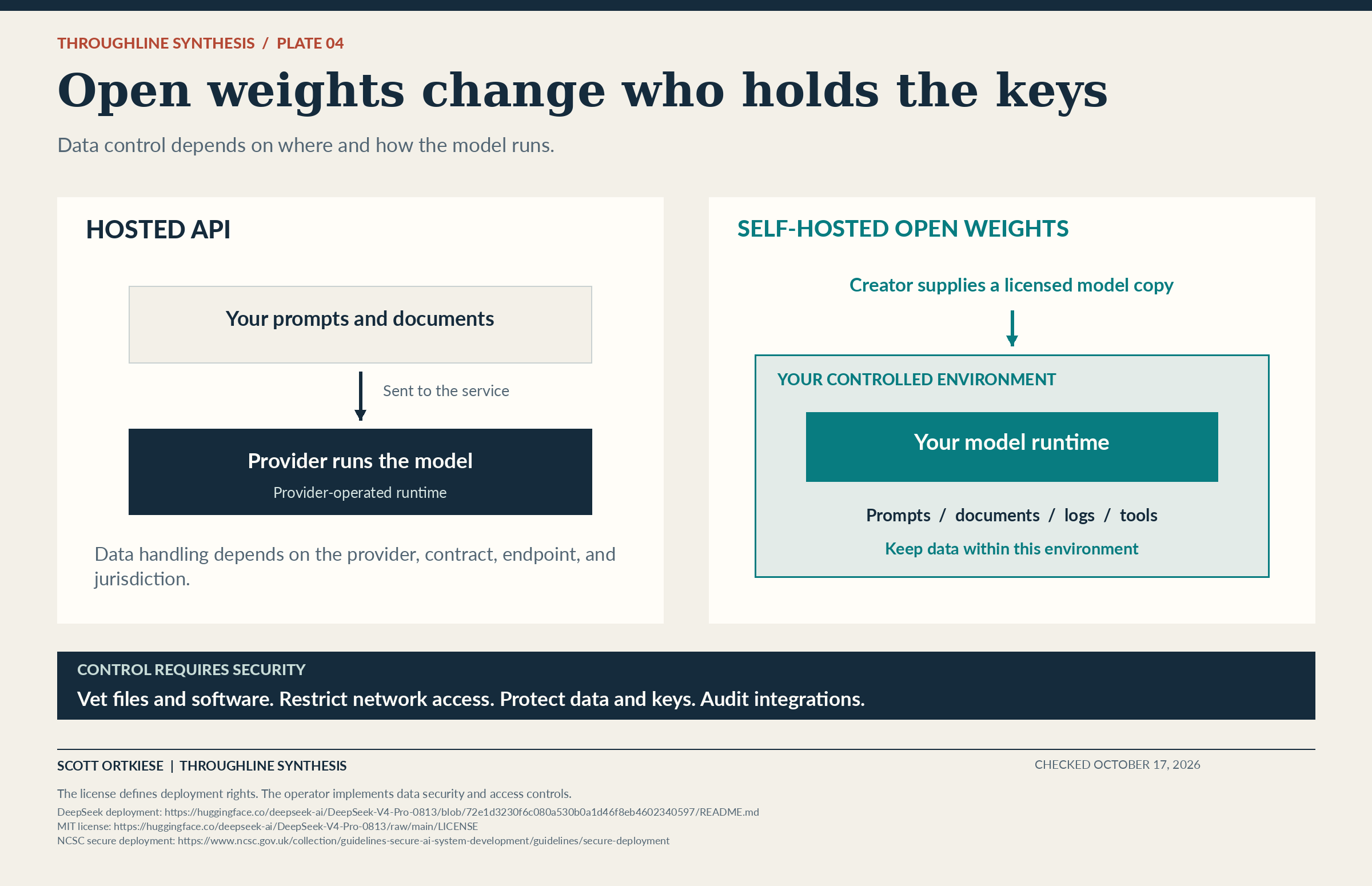
Data control depends on where and how the model runs. The NCSC distinguishes public services, private cloud services, and self-hosted models, each with different security responsibilities (NCSC).
A properly designed self-hosted deployment can keep prompts, documents, and outputs inside the organization’s chosen environment. The organization sets the rules for logs, tools, storage, network access, and administration.
A European enterprise can run a Chinese-developed model without using the developer’s hosted chatbot. It chooses the hosting environment, jurisdiction, software dependencies, and security design.
DeepSeek’s MIT License grants broad rights to use, copy, modify, distribute, sublicense, and sell copies, subject to preserving the required notices (DeepSeek license). Those rights support control over a licensed copy and its deployment.
The NCSC’s deployment guidance calls for access controls, segregation of sensitive environments, protection against confidential-data extraction, model-file verification, testing, and incident response (NCSC secure-deployment guidance). The operator puts those controls into practice.
Control has economic value. Retaining a working deployment, customizing it, or moving it to another operator can strengthen the customer’s bargaining position and challenge the model creator’s ability to charge a premium on every use.
Follow cash flow through to the creditors
Cheaper AI can encourage greater use, and open-weight deployments consume computing resources. Model providers compete on service prices, computing operators depend on utilization, and chip suppliers sell the equipment that serves both.
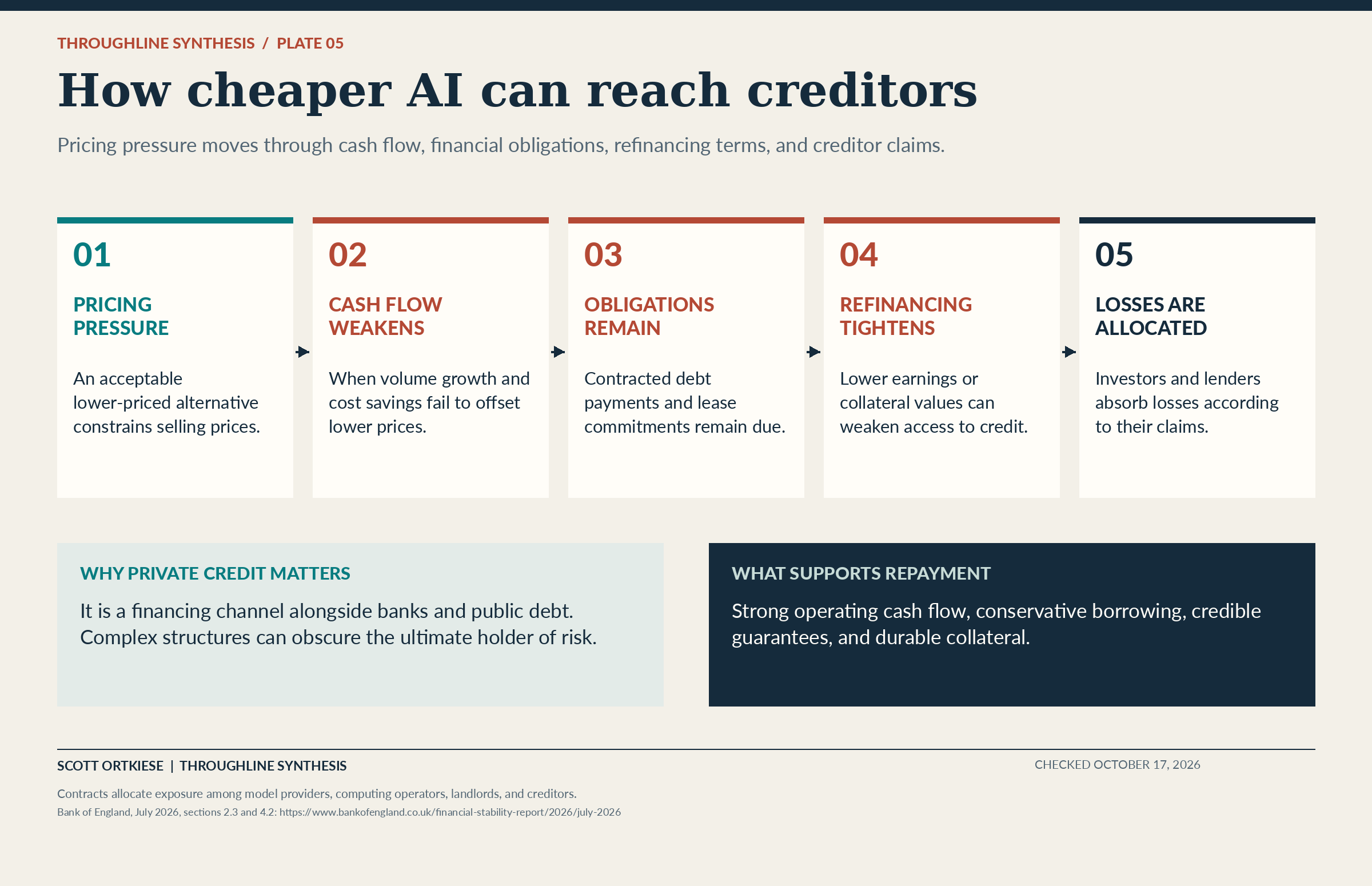
At a constant product mix, a 90% fall in selling price requires 10 times the volume to preserve revenue. The cash available for creditors also depends on operating costs and equipment replacement spending.
A borrower becomes vulnerable when the business produces less cash than its repayment obligations require. Debt and lease payments still come due.
The Bank of England’s July 2026 Financial Stability Report identifies growing reliance on external finance, circular financing, and arrangements that place some financing outside sponsors’ reported balance sheets (Bank of England, sections 2.3 and 4.2). It stresses the difficulty of locating the ultimate risk and the importance of leases and guarantees backing creditors’ claims (Bank of England). The financing documents matter as much as the headline investment totals.
The report identifies short and uncertain AI-chip lifecycles and notes that shortages and demand for older chips support longer use (Bank of England). A lender must assess the equipment’s remaining earning power against the borrower’s repayment schedule.
The closest Global Crossing analogues are investments whose survival depends on high utilization, favorable rental rates, concentrated customers, and continued refinancing. Their financial obligations must be tested against the cash those assets produce.
Hélène Rey, economic adviser and head of the Monetary and Economic Department at the Bank for International Settlements, noted in October 2026 that many major cloud companies have low leverage and cash flows unrelated to AI (Rey presentation). She also identified rapid credit growth, complex financing, and concentrated risk (Rey presentation).
The Bank of England describes financing channels that include private markets, public debt, and bank lending (Bank of England). The financing documents determine which creditors have claims on the borrower, its assets, and any guarantor.
Useful AI is not a repayment plan
Useful technology, growing demand, and impressive engineering leave the financing question unanswered. Investors still need to establish what they are paying for and how they will be repaid.
Sound AI investment requires independent customer spending to support returns after operating costs and equipment replacement. It requires productive use of the capacity built and enough cash to meet the obligations undertaken.
Chinese open-weight models compete on price, deployment control, and license rights. A model that meets the customer’s requirements on better terms forces the premium provider to compete.
Customers should not be expected to pay avoidable premiums to protect someone else’s investment forecast. Nor does a useful data center automatically justify transferring its financing losses to the public. Keeping a service operating and preserving its original investors are separate policy decisions.
The question is not whether AI will matter. It is who will collect enough cash, at the prices competition permits, to repay the money already committed.