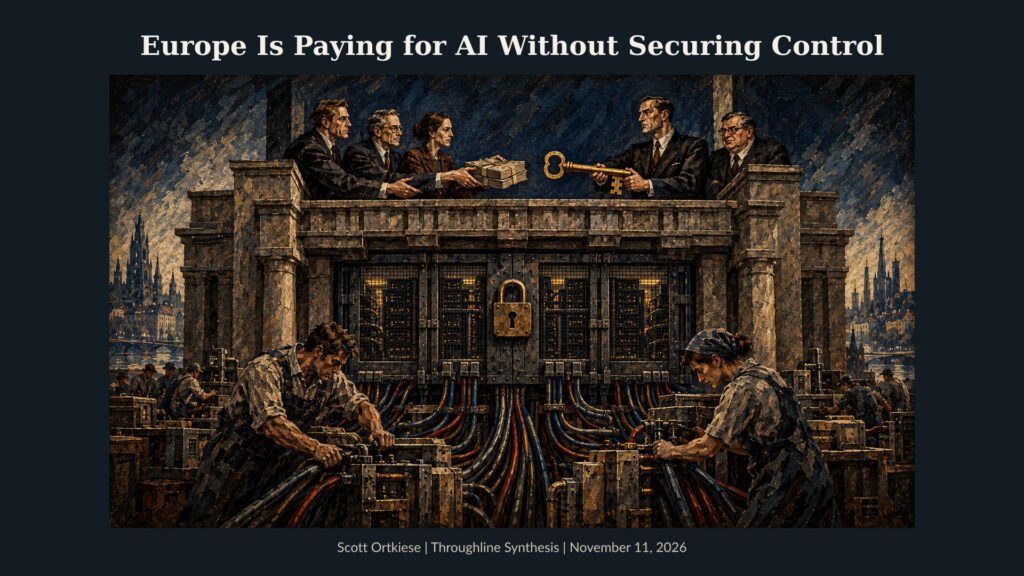

Europe needs funded AI deployment, not indefinite experimentation. Public money must buy operating capability, competitive choice, and control.
Scott Ortkiese | Throughline Synthesis | Houston, November 11, 2026
Europe cannot build an AI economy by commissioning experiments and postponing operating decisions. Institutions need a defined task, a responsible manager, a budget, a security test, and a deadline. Without those, caution becomes paralysis.
Anxiety about existential risk does not answer an operating question. What work should the system perform? What error rate is acceptable? What does a completed, verified task cost? Who can stop the system, repair it, or replace its supplier? A committee that cannot answer those questions has not made AI safe. It has left the institution unprepared.
The alternative is not reckless adoption. It is controlled implementation with financial and operational milestones. Europe must develop that capacity itself rather than wait for American and Chinese suppliers to determine its choices.
The immediate problem is visible in the calendar. On November 5, the European High Performance Computing Joint Undertaking, EuroHPC, extended the first AI Gigafactory tender deadline to February 4, 2027, so participating countries could complete national budget procedures and financial commitments (EuroHPC tender notice). Meanwhile, Siemens and NVIDIA had already announced their expanded industrial AI partnership on October 22 (Siemens announcement). Public commitments are still being assembled while commercial dependencies are taking shape.
I have already argued that Europe should operate downloadable AI models, cooperate selectively with China, and build systems it can replace (America’s AI Blunder Is Europe’s Lesson). The harder question is why European institutions keep accepting arrangements that stop short of those objectives. The answer requires looking inside Europe, at the conflict between suppliers seeking durable customers and societies seeking durable independence.
This is the European AI rent trap. Public money expands adoption; incumbent suppliers retain permission over essential connections; customers finance the integration that makes leaving expensive. Europe needs investment that breaks this arrangement, not investment that puts a European intermediary inside it.
Separate 3 decisions. Buying a service purchases useful work. Securing control purchases the ability to operate, maintain, and replace it. Financing the underlying assets assumes investment risk. Europe must not pay for all 3 while receiving only the first.
A European server is not European control.
In April, the European Commission awarded 4 cloud arrangements under a procurement framework allowing purchases of up to €180 million over 6 years (Commission procurement announcement). That is a ceiling, not €180 million already spent (Commission procurement announcement). More importantly, the awards do not provide the same level of independence.
The Post Telecom partnership with OVHcloud and CleverCloud, STACKIT, and Scaleway reached SEAL-3, the Commission’s digital-resilience level; the Proximus-led partnership using S3NS, Clarence, and Mistral reached SEAL-2, the data-sovereignty level (Commission assessment). S3NS is a Thales-Google Cloud joint venture, and the Proximus arrangement uses Google technology within an EU-operated environment (Commission assessment).
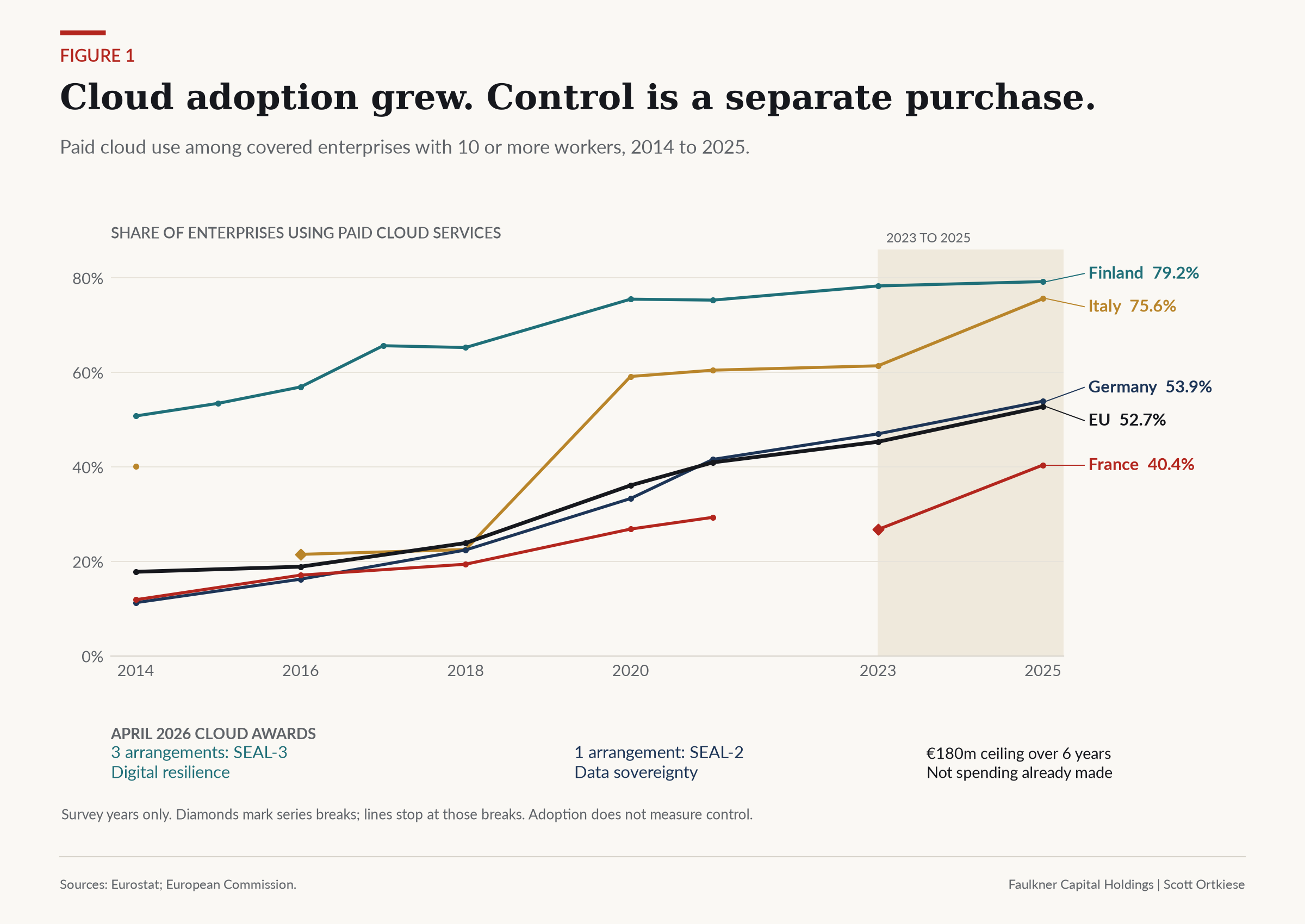
These distinctions matter because protecting data and surviving a foreign supply interruption are different accomplishments. A public buyer can legitimately purchase the first. It must not describe that purchase as automatically delivering the second.
The proposed Cloud and AI Development Act also separates assurance levels, allows qualifying foreign-controlled suppliers at lower levels, and excludes hardware from the relevant assurance annex (Commission legislative proposal). It remains a proposal, separate from the existing SEAL procurement assessment (Commission legislative proposal). A sovereignty label therefore needs a plain-language answer to a practical question: what can the customer continue doing without the original supplier?
Publish that answer in every public contract. Identify who controls operation, maintenance, modifications, updates, and replacement. The public should not have to decode a certification system to discover which dependencies its money is preserving.
European champions can be gatekeepers too.
SAP, the German business-software company, supplies a concrete example of contractual control. Its application programming interfaces, or APIs, connect software to data and instructions. Its policy prohibits covered API use by autonomous or generative AI systems that plan, select, or execute sequences of calls, except through specified SAP-endorsed architectures, services, or pathways (SAP API Policy).
A manufacturer can choose an open model and still lack permission to connect it to the business systems required to perform useful work. The model and the doorway belong to different markets. Freedom in the first does not dissolve control in the second.
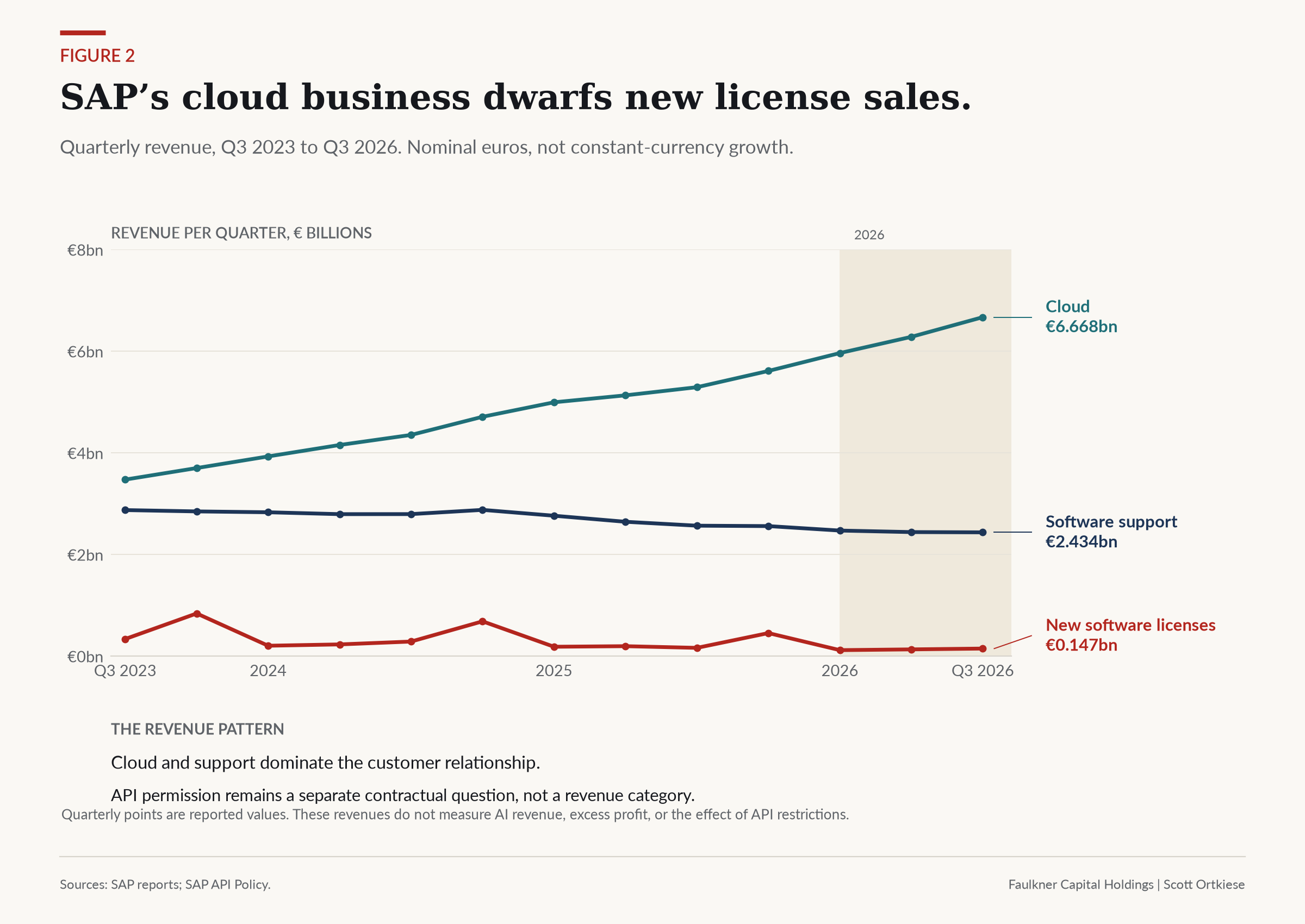
This is where a policy of supporting European champions can turn on European customers. If public support enlarges a supplier’s market without securing usable access and replacement rights, it strengthens the supplier’s bargaining position. Nationality does not resolve that conflict.
Nor does keeping factory data onsite. Siemens and NVIDIA’s October announcement combines Siemens industrial software with NVIDIA computing and CUDA-X libraries, the software components used to accelerate supported calculations (Siemens announcement). The specific Simcenter simulation package can run without an internet connection, keeping sensitive data onsite (Siemens announcement).
The partnership can deliver useful industrial capabilities. Its public announcement does not establish abusive terms, and undisclosed terms should not be invented. The procurement question remains unanswered: what happens when the customer wants to change the technology beneath its production process?
An independent economy needs the engineering capacity and contractual rights to make that change. A successful European reseller or integrator is not a substitute for either.
Industrial strength does not spread by itself.
Europe’s industrial data is not a ready-made competitive advantage. A joint Fraunhofer and Inria investigation identifies firms withholding data for competitive reasons, fragmented systems, scarce skills, integration costs, uncertain returns, and limited practical results from interoperability initiatives (French-German industrial AI report). Data becomes useful only when someone can access it, interpret it, connect it to operations, and maintain the resulting system.
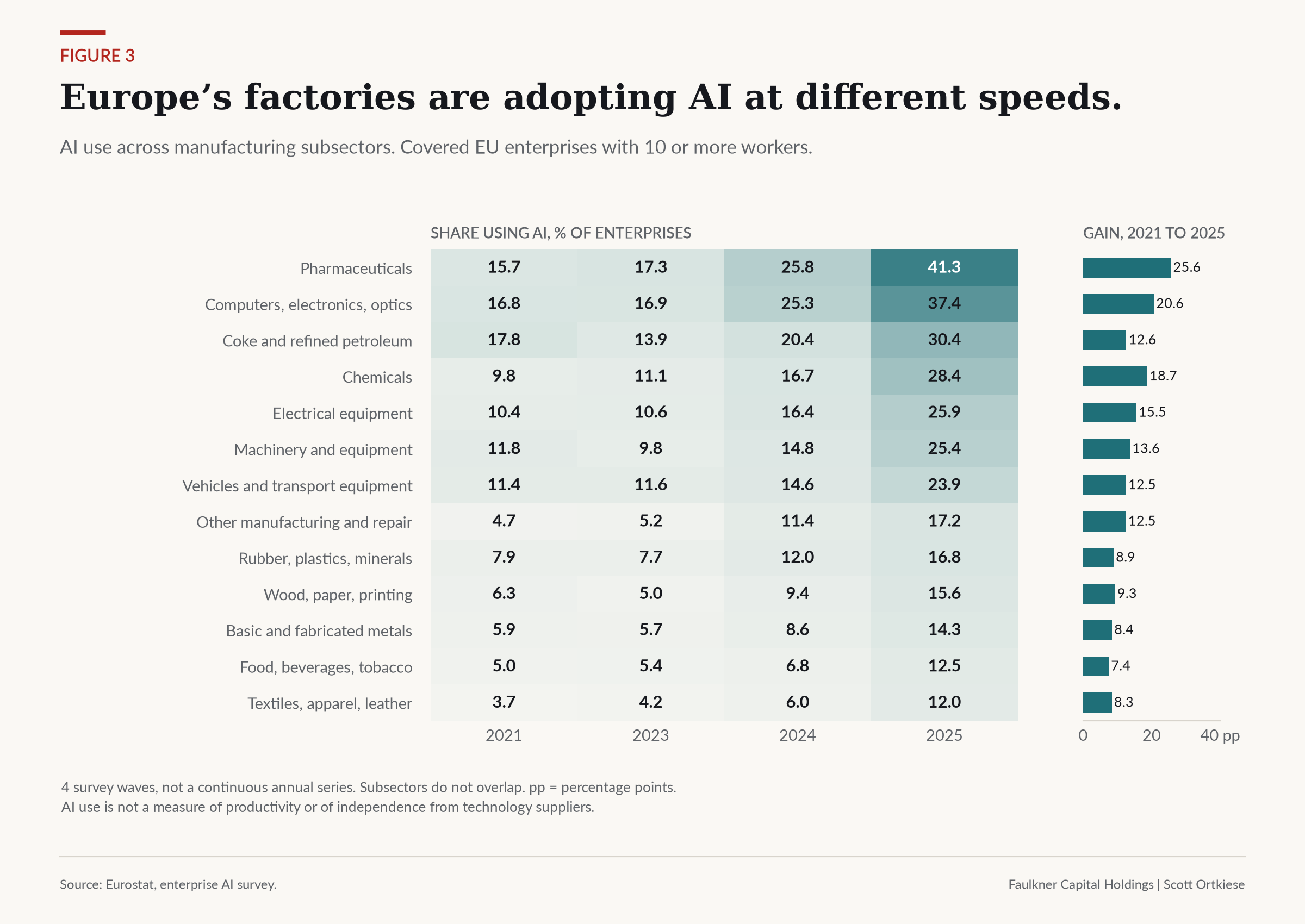
Eurostat’s 2025 survey shows the distance between Europe’s largest firms and its smaller businesses: 55.03% of large enterprises used AI, compared with 30.36% of medium enterprises and 17% of small enterprises (Eurostat enterprise AI statistics). Large-firm adoption was 38.03 percentage points higher than small-firm adoption, or 3.24 times the rate, calculated from those figures (Eurostat enterprise AI statistics).
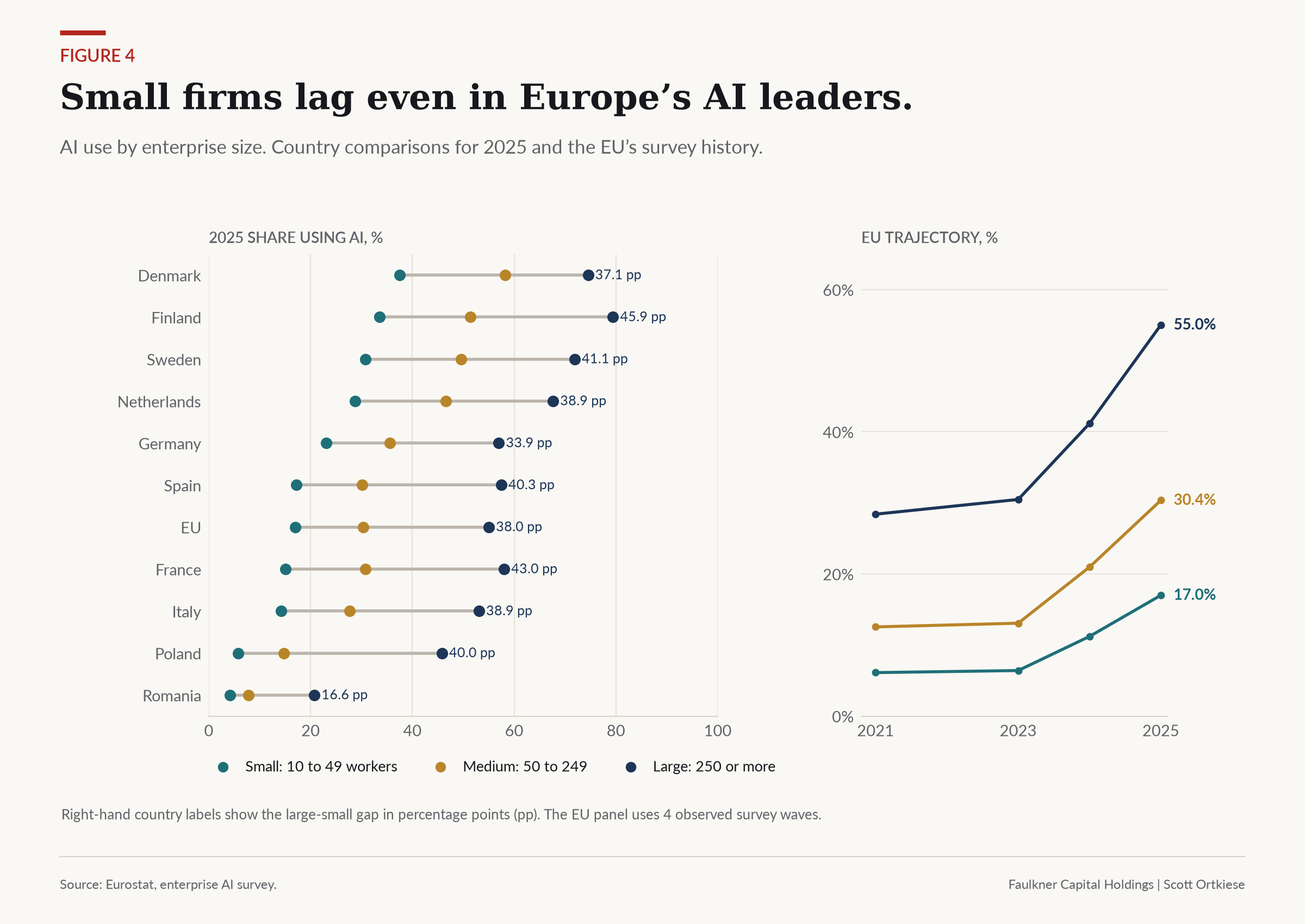
The policy consequence is straightforward. Subsidizing computing capacity does not, by itself, put an engineer inside a small manufacturer, reorganize its maintenance records, or make equipment from different suppliers work together. Europe needs shared engineering services, applied research partnerships, technical training, and affordable testing facilities alongside computing.
The same survey identifies the missing capability. Among AI nonusers, 14.21% had considered using AI; within that subgroup, 70.89% cited insufficient expertise, 52.52% legal uncertainty, and 48.83% privacy concerns, with multiple answers permitted (Eurostat enterprise AI statistics). Those percentages describe that subgroup, not all European businesses.
Legal uncertainty is a real obstacle. It is not the entire problem, and eliminating an obligation does not create a skilled workforce. An industrial policy built around regulatory relief alone leaves the largest firms best positioned to exploit it.
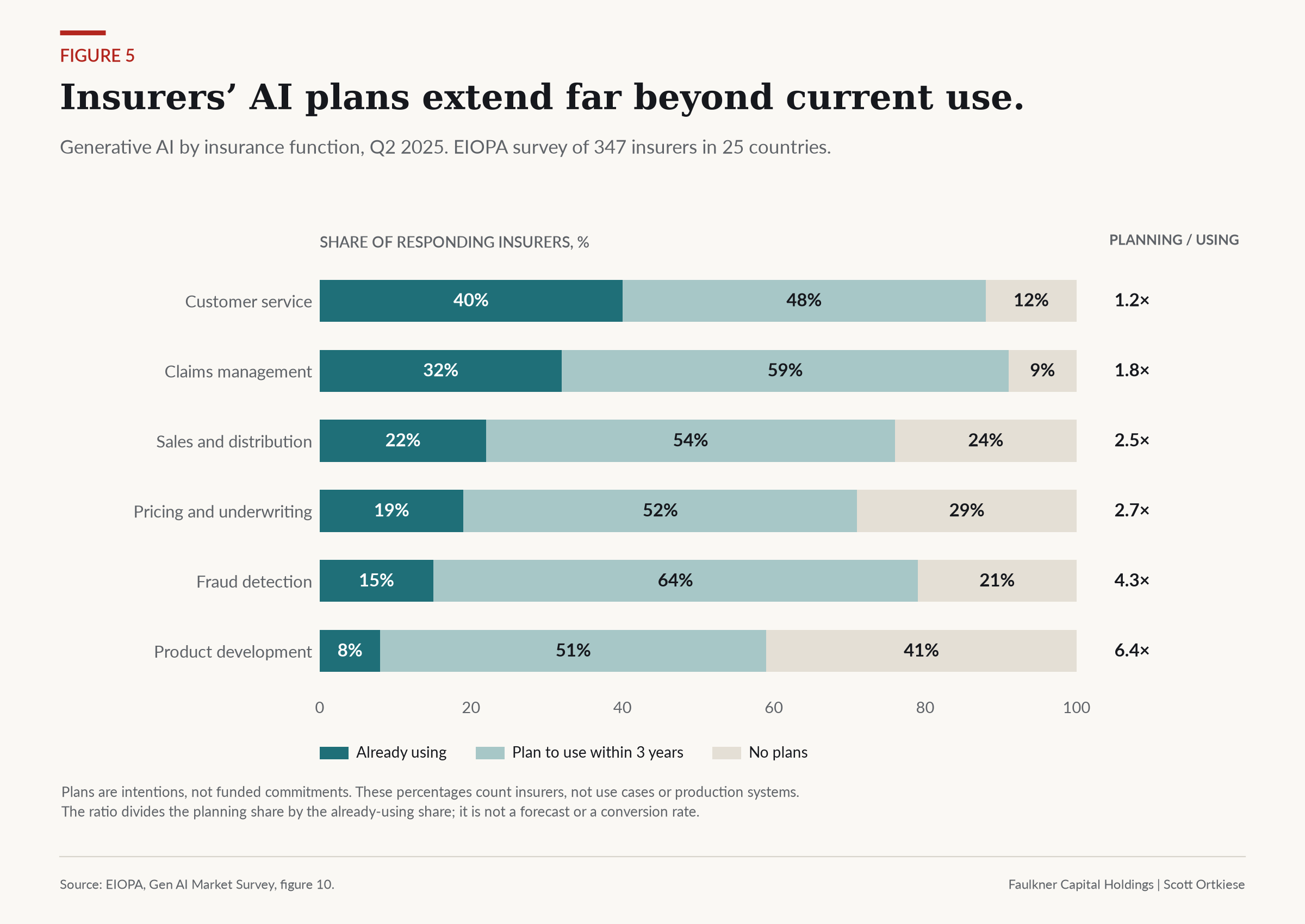
Insurance shows why adoption statistics are not enough. The European Insurance and Occupational Pensions Authority, EIOPA, surveyed 347 insurers across 25 EU and European Economic Area countries about their position in the second quarter of 2025: 65% reported using generative AI, but 64% of reported use cases remained experiments or proofs of concept, compared with 32% in production (EIOPA market survey). The first percentage counts insurers; the second counts use cases.
EIOPA also documents dedicated roadmaps and policies alongside phased deployment (EIOPA market survey). The practical failure to confront is the distance between permission to experiment and a funded, tested operating system. A pilot deserves continued financing only when it produces evidence about useful work, full costs, reliability, and the next deployment decision.
The survey identifies privacy and security, regulatory compliance, and scarce skills as leading barriers, not existential risk (EIOPA market survey). Treat those problems as engineering and management responsibilities. Assign owners, budgets, tests, and deadlines instead of letting an undifferentiated fear of AI suspend investment indefinitely.
France’s AI Booster program exposes the missing commitment. In its 2025 national AI strategy audit, the Cour des comptes, France’s public audit institution, found that the program offered awareness, diagnostics, and implementation planning but never introduced its planned fourth service, testing solutions and starting operational deployment, because resources were lacking (national AI strategy audit, page 53). Its budget was cut from €25 million to €10 million in 2023 and was never replenished (national AI strategy audit, page 53). France funded preparation and left the bridge into operation unfunded. That is a specific policy failure, not an unavoidable technological limitation.
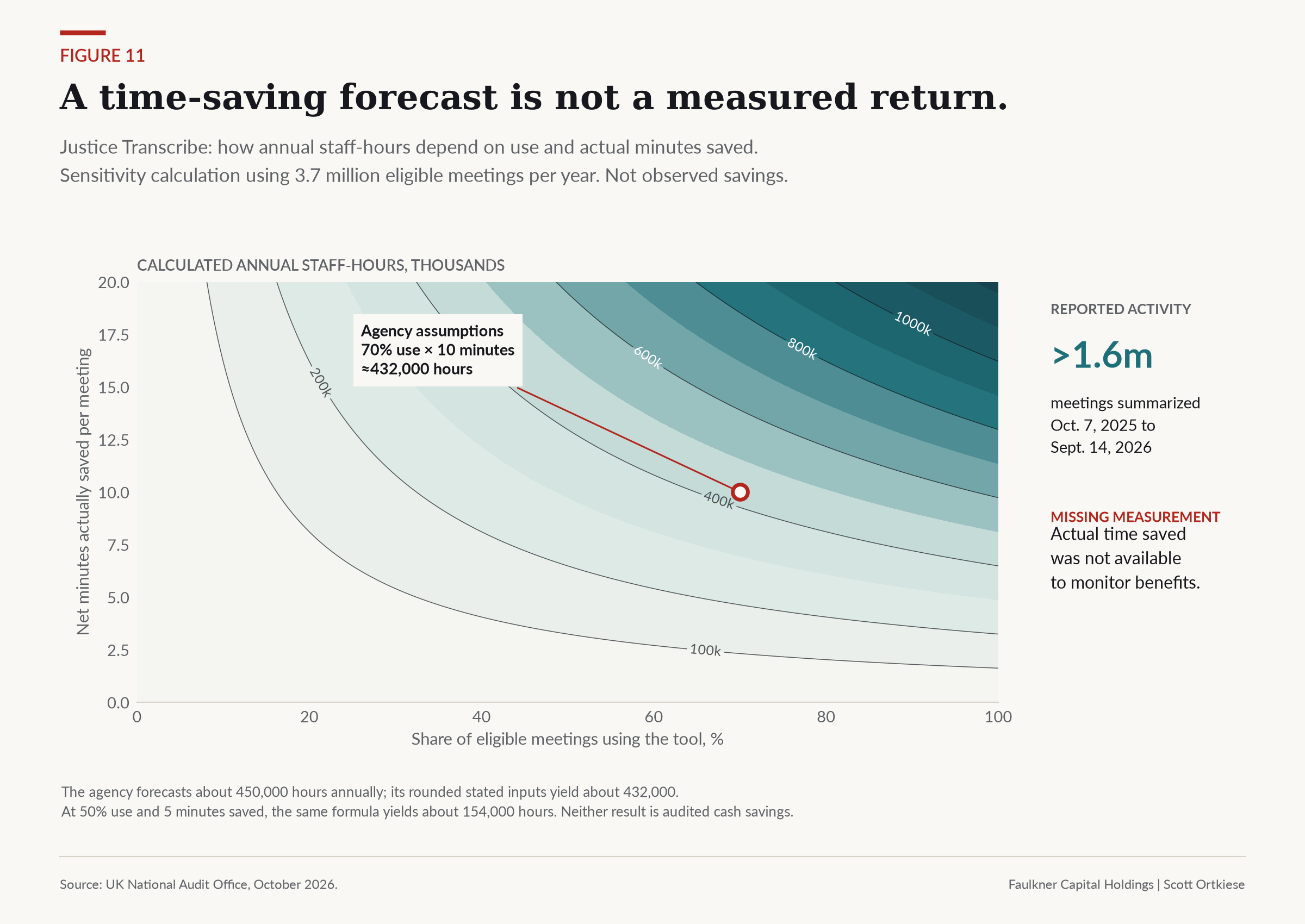
Britain supplies a practical counterexample. Its Justice Transcribe tool, developed for probation officers, moved from 2025 testing and pilots to rollout across the service in February and March 2026; the National Audit Office’s case study emphasizes frontline involvement, feedback, and managed implementation (NAO case study). The justice agencies estimate 450,000 staff hours saved annually, not audited cash savings (NAO case study). The lesson is the operating method, not an inflated return claim. Define useful work, test it with the people doing it, fund deployment, and measure the result.
The robotics comparison makes inherited industrial strength an especially poor excuse for complacency. In 2025, China installed 354,000 industrial robots, up 20%; the US installed almost 38,500, up 12%, while Germany, Italy, and France recorded declines (International Federation of Robotics).
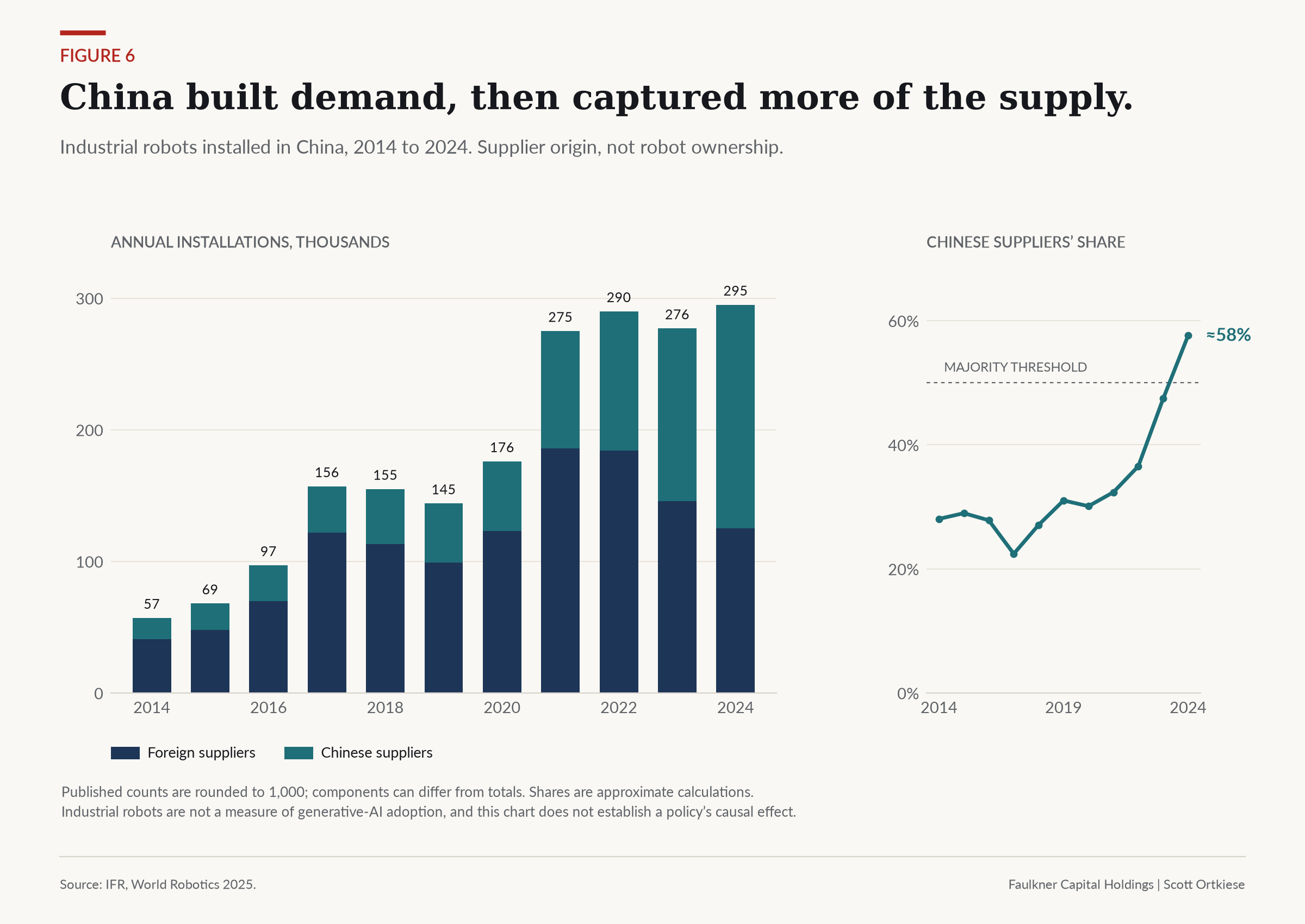
Those figures do not identify the cause of Europe’s investment weakness. They do demolish the assumption that possessing factories guarantees leadership in modernizing them. Industrial AI must reach ordinary production, not remain a showcase for the largest companies.
Governments choose which investments deserve protection.
Europe’s fiscal rules are political choices, not natural laws. The Council’s national escape clause permits qualifying defense-spending deviations of up to 1.5% of gross domestic product, the value of annual economic output, per year from 2025 through 2028 (Council explanation). Energy-resilience measures have a smaller allowance of up to 0.3% annually, subject to a cumulative 0.6% limit from 2026 through 2028 (Council explanation).
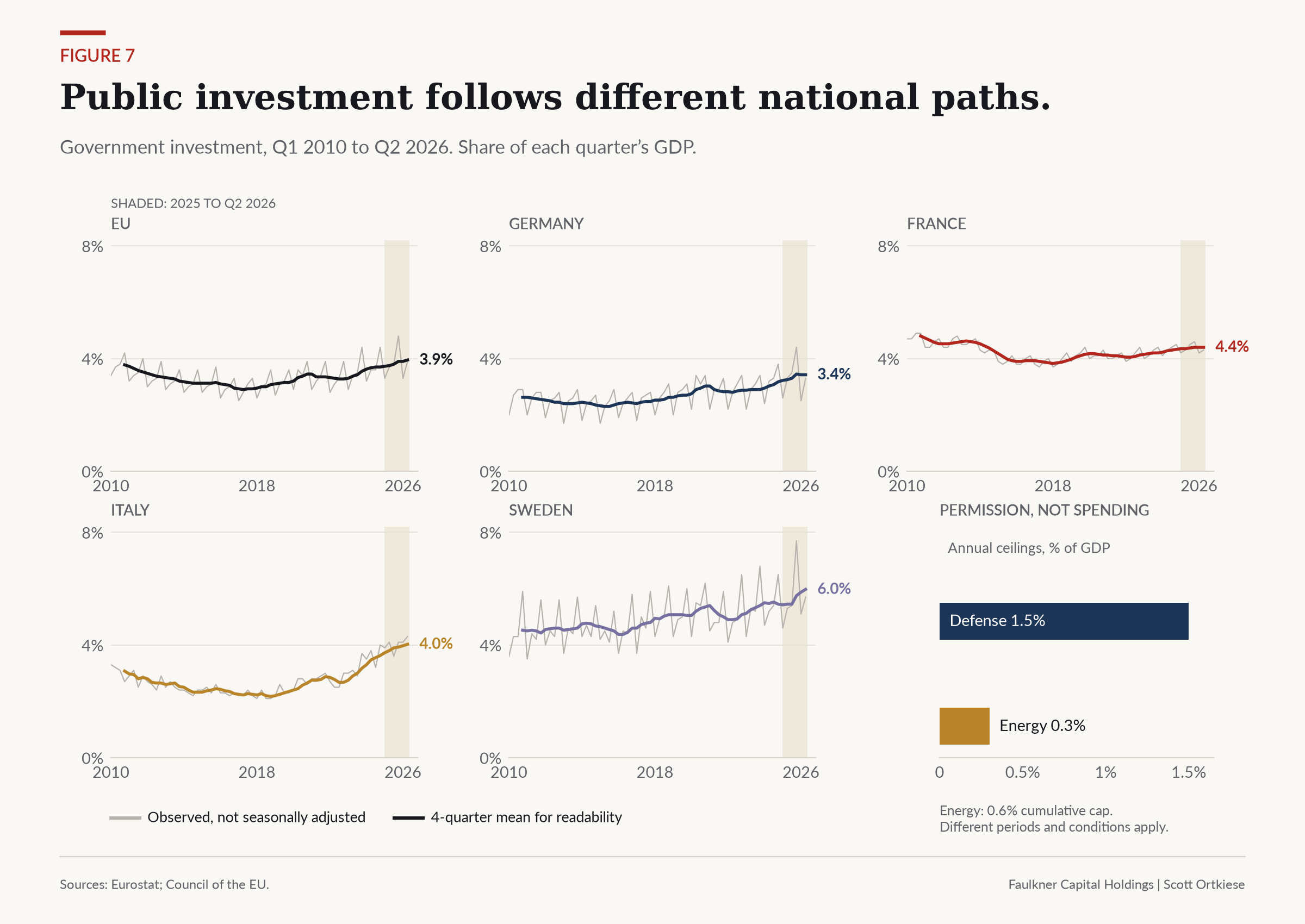
These exceptions answer the claim that civilian investment must accept whatever room the rules happen to leave. Governments can change how they treat spending when they consider its purpose important. Research, technical education, power systems, and civilian infrastructure deserve the same seriousness.
This is not a claim that every military euro was removed from an AI laboratory. It is an objection to the hierarchy of commitments. A continent cannot treat military expansion as urgent, productive capacity as discretionary, and technological dependence as a surprise.
The machinery debate also needs to catch up with enacted policy. The AI Omnibus moved AI-enabled machinery from the AI Act’s directly applicable high-risk requirements to the separate machinery-safety framework; the Council adopted the act on June 29, and it was published on July 24 (European Parliament legislative record). Europe has already changed the rules, not merely talked about changing them.
Funding is on a different schedule. EuroHPC’s November 5 notice moved the first Gigafactory tender deadline to February 4, 2027, to allow national budgets and financial commitments to be completed; the second deadline remained December 3, 2026 (EuroHPC tender notice).
The research base beneath those ambitions is uneven. Eurostat’s long-run comparison separates research performed by businesses, universities, government, and nonprofits; it identifies who does the work, not who supplied the money (Eurostat R&D expenditure series). Financing a computing center does not replace the institutions needed to use it.
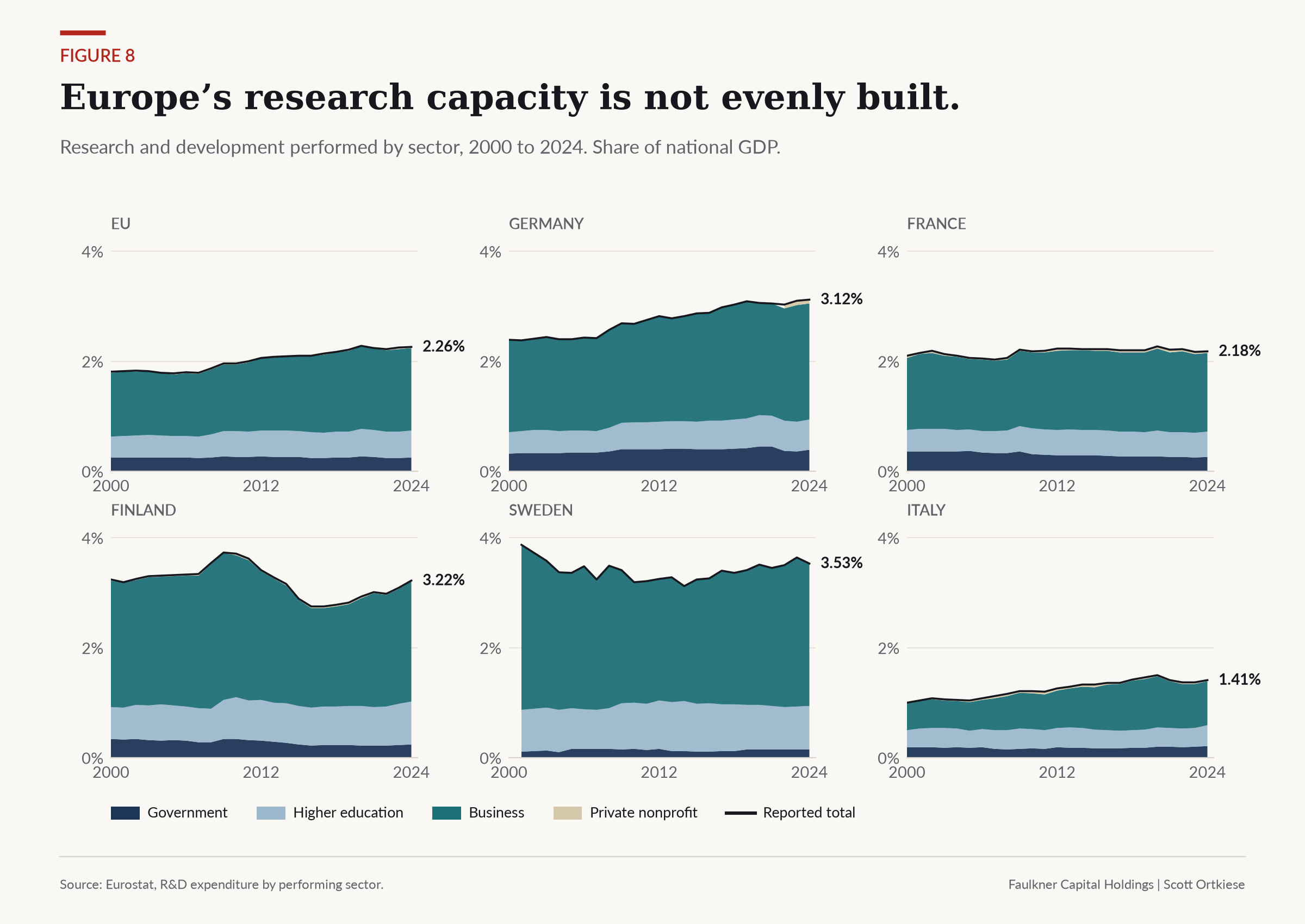
Stop measuring commitment by announced ambitions. Publish binding contributions, procurement milestones, available power, operating capacity, and usable access. A relaxed rule and a promised computing center are inputs; functioning industrial capability is the result.
The separate data-policy debate exposes another conflict. Business associations have sought broader conditions for AI use of data, while European data-protection authorities have argued that existing legitimate-interest rules already permit some AI development and have questioned the need for a new general provision (joint industry statement; joint regulatory opinion). These are contested policy positions, not proof that all simplification is harmful or that privacy must disappear.
Simplify requirements that obstruct useful work. Do not confuse permission to extract more data with investment in the institutions that can use it. A small manufacturer needs practical capability, not merely a larger supplier with fewer obligations.
Cutting research makes dependence harder to escape.
On May 4, the French Academy of Sciences reported that France’s government demanded another €20 million in savings from CNRS, the national research organization, including withdrawal of €13.5 million already allocated to laboratories (Academy statement). That is 67.5% of the additional savings request coming from allocated laboratory funding, calculated from the Academy’s figures (Academy statement).
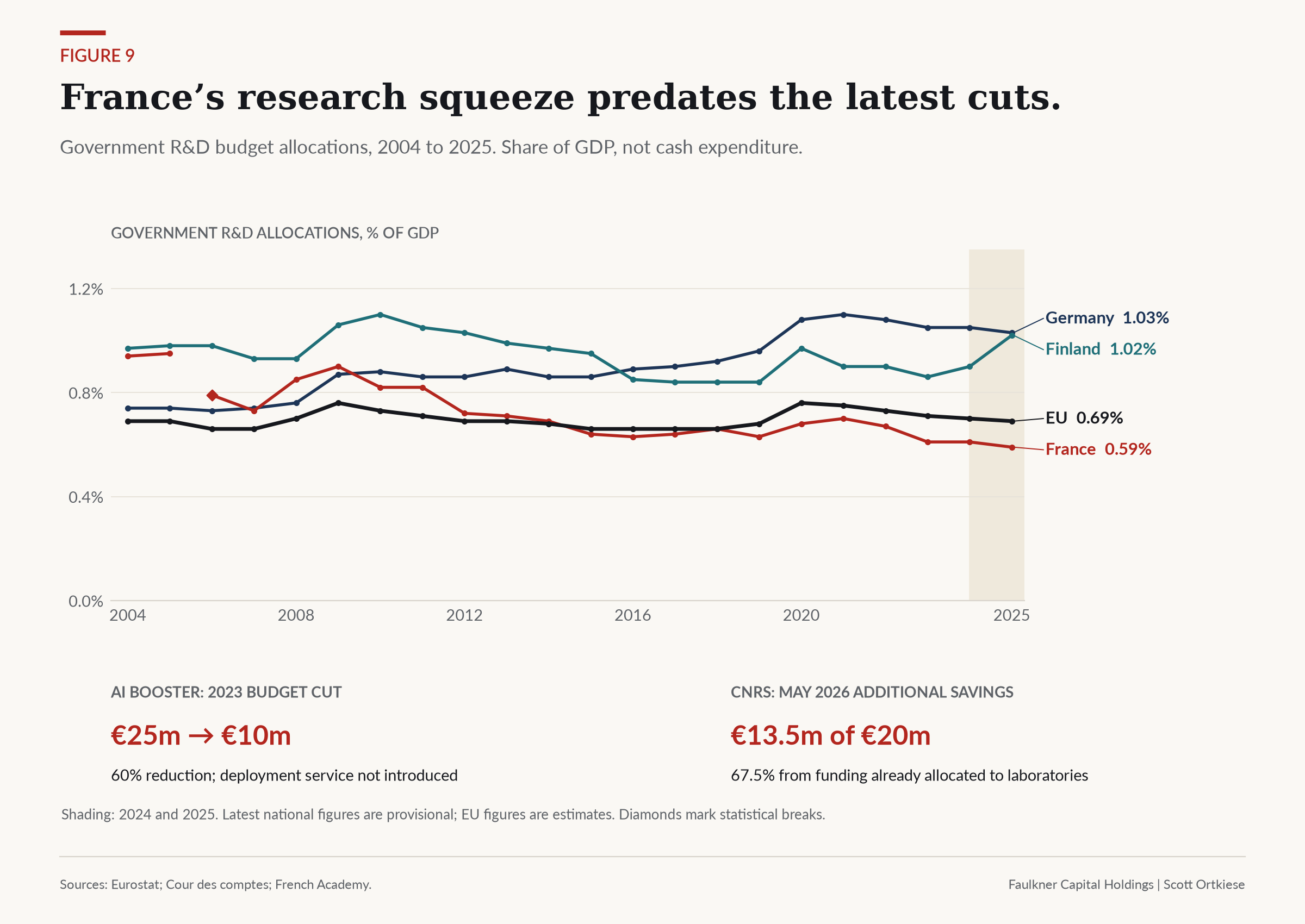
The contradiction is concrete. Firms report a lack of expertise, while the government withdraws money already assigned to research institutions (Eurostat; French Academy of Sciences). The 2026 cuts did not cause the 2025 survey result. They show why buying equipment cannot replace maintaining the institutions that develop and retain technical knowledge.
Europe needs education policy that builds competence rather than treats labor as a cost to remove. Fund apprenticeships, technical colleges, research careers, and time for experienced workers to train others. A manufacturer that automates a task without preserving the knowledge needed to diagnose failure has exchanged a wage bill for another dependency.
Measure deployment by usable knowledge, not just output. Workers need authority to challenge unreliable systems, access to the information needed to inspect them, and a share in the gains their expertise makes possible. Publicly financed automation should strengthen the workforce’s bargaining power, not merely the owner’s ability to replace it.
Energy policy is industrial policy.
In the first half of 2026, Eurostat’s non-household electricity prices ranged from €0.2666 per kilowatt-hour in Ireland to €0.0928 in Finland within the same consumption band, a 2.87-fold difference (Eurostat electricity statistics). The band covers annual consumption from 500 to under 2,000 megawatt-hours; each megawatt-hour equals 1,000 kilowatt-hours, and the quoted prices exclude value-added tax and other recoverable charges (Eurostat electricity statistics).
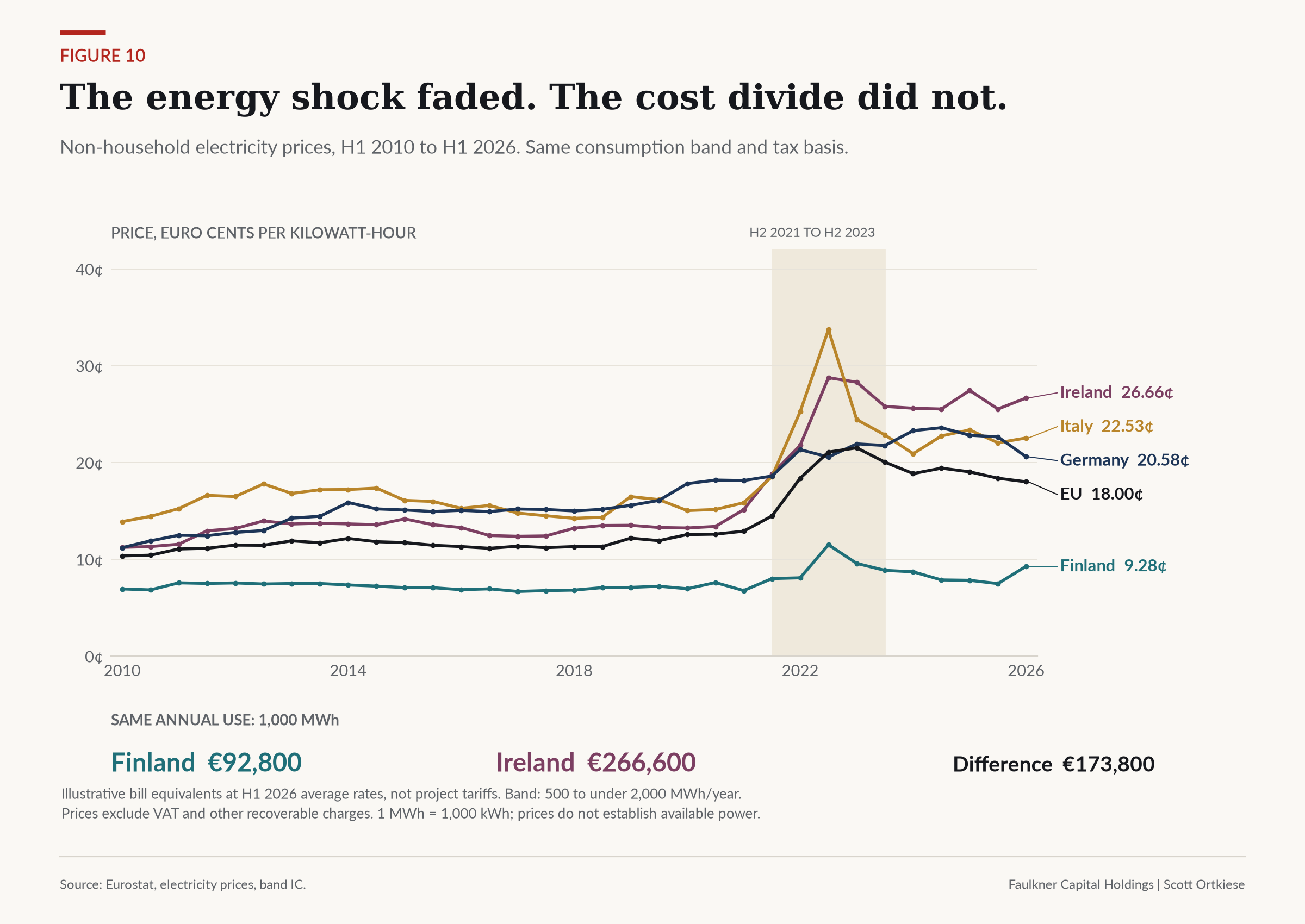
The differences rule out treating Europe as a single energy-cost problem. The Commission’s competitiveness assessment identifies gas pricing, electricity taxes, permitting, and grid expansion among the constraints on European industry (2026 competitiveness report). Energy reform must address supply, networks, financing, and the prices industrial users actually pay.
Subsidizing a computing center while neglecting its power supply shifts the bill from construction to operation. An AI program needs a credible connection schedule, reliable generation, and an affordable long-term operating plan. Otherwise, public support buys an asset whose usefulness remains hostage to another bottleneck.
China is explicitly connecting those decisions. Carnegie’s analysis of its 2026 to 2030 energy plan identifies computing demand and direct connections to renewable generation as parts of electricity-system planning (Carnegie’s energy-plan analysis). That policy does not establish that every project is economical. It identifies what Europe must plan together: where power is available, what work computing will perform, who will buy it, and who will pay for unused capacity.
Peace belongs in this industrial strategy. Europe should pursue a negotiated settlement of the war in Ukraine and assess future economic relations with Russia by their contribution to peace, security, and productive capacity, not by requiring permanent hostility. That does not make Russian supply an automatic solution to every electricity problem; it makes diplomacy part of the effort to expand Europe’s options.
Cooperation should widen Europe’s choices.
The August 2025 EU-US trade framework states an EU intention to buy at least $40 billion in American AI chips and develop technology-security requirements aligned with the United States (joint framework statement). Those are stated intentions, not verified completed purchases (joint framework statement). They nevertheless turn industrial choices into a bargain over geopolitical alignment.
Europe should not let Washington decide which technological relationships are acceptable merely because the supplier competes with an American company. Security requirements should address identifiable risks and be applied consistently. An American supplier’s commercial interest is not a European security interest.
Cooperation with China belongs inside that approach. China’s October 16 notice proposes export-catalog changes covering 23 AI technology categories. It establishes interim registration, while excluding technologies already in the public domain through open release or publication (Chinese Commerce Ministry notice). Access to an existing released model and access to every future generation are therefore separate questions (Bruegel analysis).
Buy and adapt useful technology without pretending that any country guarantees permanent access. Require documentation, maintenance skills, usable licenses, independent testing, and credible alternatives. The objective is to make cooperation replaceable, not to replace dependence on Washington with dependence on Beijing.
Nor should Europe wait for an American AI crash to rescue it. Cheaper technology does not automatically produce a trained workforce, an accessible business interface, or a power connection. A supplier’s financial failure can destroy continuity just as surely as its commercial success can strengthen its bargaining power.
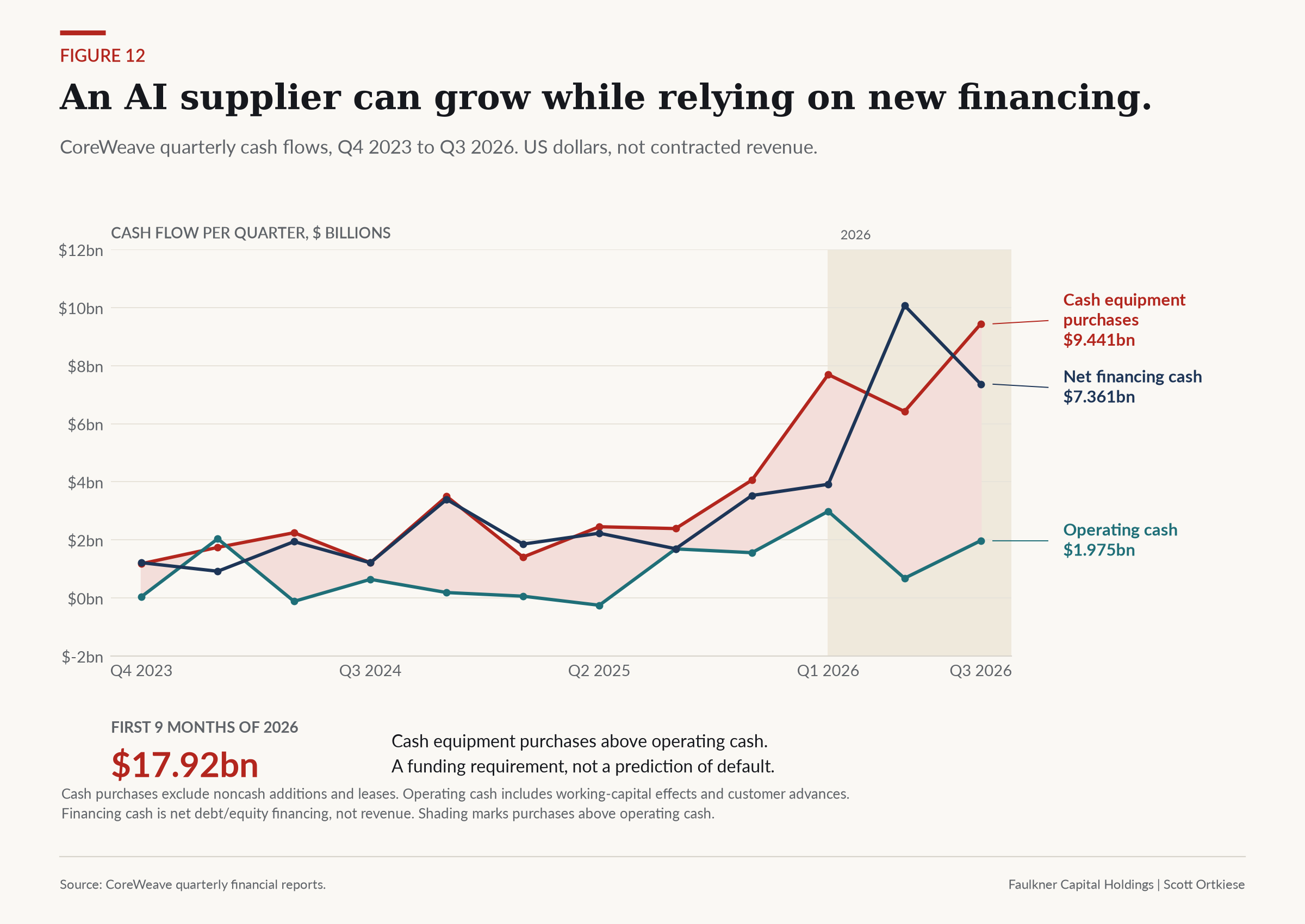
The contracts expose that risk before bankruptcy. CoreWeave’s $2.6 billion DDTL 5.5 facility finances about 5-year debt, while customer contracts average about 3 years, leaving renewal risk after the original customers’ commitments expire (CoreWeave financing disclosure). Europe should test what happens when its operator loses financing, changes owners, or cannot renew a critical lease. A right to export data is inadequate if replacement software, licenses, power, or maintenance are unavailable.
China challenges the business model, not every benchmark
The American technology oligarchs do not have to lose every technical contest to lose their commercial advantage. A model can lead a benchmark while its supplier loses customers who need lower costs, local operation, and freedom to modify the system. Europe should exploit that competition, not protect a premium business model from it.
Frontier performance, meaning the best measured capability, must be tested separately from price. On the Artificial Analysis leaderboard checked November 11, Claude Fable 5.2 at maximum reasoning scored 65 on its Intelligence Index; Kimi K3.1 Pro, the highest-ranked open-weight model identified there, scored 46 (Artificial Analysis leaderboard). That evidence does not support declaring American frontier research defeated. It supports choosing the capability the job requires rather than paying automatically for the highest score.
Prices already span a much wider range than a simple national rivalry suggests. DeepSeek lists its Flash model at peak rates of $0.30 per million uncached input tokens and $1.20 per million output tokens; OpenAI lists GPT-6 Astra at $10 and $50, but GPT-6 Luna at $0.10 and $0.50 for standard processing below 272,000 context tokens (DeepSeek pricing; OpenAI pricing). Tokens are the pieces of text a model processes or produces, not completed business tasks.
Those are different models, not equal-quality substitutes, and the quoted rates exclude the rest of an implementation. Measure the full cost of accepted work: inference, repeated attempts, integration, data preparation, human review, security, hosting, and eventual migration. Reject both the claim that a low token price proves a cheap implementation and the claim that a closed American model deserves a premium merely because it is American.
Security also contains separate questions. Keeping data under local custody reduces dependence on a remote service; it does not make a model resistant to malicious instructions. In a competition analyzed by the US National Institute of Standards and Technology, attackers found at least 1 successful hijacking attack against each of 13 frontier models across more than 250,000 attempts (NIST agent-security analysis). That establishes a shared exposure, not identical failure rates.
Nor does Chinese origin establish superior defenses. NIST’s July assessment of GLM-5.2 reported mixed safeguards and security performance, with results depending on the test and deployment configuration (NIST GLM-5.2 assessment). Procurement must therefore test the actual deployed system: its permissions, external connections, response to malicious documents, ability to leak information, and recovery after failure.
The indictment is commercial and political. Restricting competing models, withholding usable interfaces, and making replacement expensive protects a supplier’s income at the customer’s expense. Europe should require suppliers to win on verified performance, full operating cost, and tested security. Buying downloadable Chinese models can widen its choices; surrendering judgment to any national supplier bloc cannot.
An exit is something institutions build
Schleswig-Holstein offers a concrete example of institutional commitment. In December 2025, the German state government reported that nearly 80% of relevant workplaces, excluding tax administration, were using LibreOffice and that nearly 44,000 mailboxes had migrated from Microsoft’s email system (state government report).
The government also reported more than €15 million in licensing savings and €9 million in one-time investment for migration and open-source development in 2026 (state government report). The statement does not specify the savings period, so subtracting the figures would manufacture a net return.
Office software is not industrial AI. The relevant lesson is institutional: replacing a supplier requires a budget, people, migration work, and a willingness to endure transition. Independence is not a free feature attached to procurement.
Britain’s transcription rollout also shows why deployment and return need separate tests. The National Audit Office reports the number of meetings summarized by the tool but says time-saved data were unavailable to monitor the estimated benefits (NAO, Justice Transcribe, paragraphs 15 and 16). The sensitivity calculation below exposes what must be measured before an activity count becomes a credible benefit claim.
The EU Data Act moves some rights in that direction. It creates access and sharing rights for covered connected-product data, excludes derived or inferred information from the relevant provisions, and excludes designated digital gatekeepers from the relevant third-party recipient route (Commission Data Act explanation). Cloud switching charges are scheduled to disappear on January 12, 2027 (Commission Data Act explanation).
Those rights matter, but a free data transfer is not a functioning replacement. The customer still needs compatible software, documented processes, trained staff, and the legal ability to keep operating. Public contracts should require a tested migration, not accept an export button as proof of freedom.
Public money must buy public rights.
Europe needs public investment institutions capable of financing long-lived productive assets and shared technical capabilities. It also needs to stop treating the volume of private capital attracted as the measure of success. Public money that makes a private monopoly safer has not necessarily made society stronger.
The conditions should be explicit. Public financing should purchase enforceable access, continuity after termination, rights to publicly financed modifications, independent maintenance, and the power to change operators. Where taxpayers absorb substantial commercial risk, they should receive ownership and governance rights commensurate with that risk.
Put continuity rights in place before distress. Require transferable operating licenses where legally available, current copies of essential configurations and documentation, access to equipment, and agreements with the parties controlling the premises, power, and maintenance. Identify which rights require lender or landlord consent. Test an operator replacement before releasing the final public payment. These are proposed contract conditions, not rights created by a sovereignty label.
CoreWeave’s cash flows make the financing question visible: equipment purchases and outside financing can grow far beyond the cash generated by operations (CoreWeave quarterly financial reports). A buyer needs protection against a financing interruption even when the supplier’s service works. Paying for useful work and underwriting the supplier’s expansion are different decisions.
A public shareholding alone is insufficient. Board representation, worker participation, access conditions, dividend rights, and limits on transferring control answer different questions. The contract must say which decisions the public can influence and what happens when the original business plan fails.
Follow the money through the whole arrangement. Disclose the owners, founders’ voting rights, deal arrangers’ fees, fund managers’ compensation, lenders’ guarantees, and who pays for any credit rating used to justify public support. State who loses money first and who retains control afterward. Taxpayers must not underwrite a structure that pays intermediaries upfront, protects founders’ control, and leaves the public with losses but no operating rights.
Do not confuse an insurer’s use of AI with its AI financing. For investment exposure, identify the borrowing entity, instrument, maturity, collateral, guarantees, and ultimate holder. A relationship with a fund manager does not identify ownership of a particular loan. Public investment institutions need that look-through before committing money, not after a manager announces a loss.
Direct domestic savings toward productive investment through transparent public institutions. Do not subsidize an investment merely because the recipient is European. A protected domestic rent collector can divert income from productive users as effectively as a foreign supplier.
Financing also needs honest repayment assumptions. A computing center selling services, a public laboratory producing knowledge, and a grid expanding industrial capacity generate different combinations of cash income and social benefit. State which revenues repay investors, which benefits justify taxation, and who absorbs a shortfall.
Test the computing investment against lower selling prices, weaker utilization, delayed power, and customer contracts ending before its debt. Do not assume a larger volume of cheaper work restores the original return. If public intervention becomes necessary, value the assets and rights Europe needs at their current usefulness, not at the price required to make previous investors whole. Keep the service running where it serves a public purpose; restructure the claims that its revenues cannot support.
Reforming interest paid on bank reserves, restructuring bonds held inside the public sector, and distributing public investment dividends deserve examination as distinct proposals. Changing publicly held bonds is not the same as repudiating privately held debt. None of these measures should be sold as unlimited finance without legal, monetary, or distributional consequences.
Release financing against verified construction, staffing, power, and access milestones. For the applications themselves, require 4 operating decisions before authorizing expansion. These are proposed funding conditions, not claims about an existing European program.
First, define the job and its baseline. An insurer testing document extraction should measure current processing time, correction costs, and error rates before inserting a model. Name the person responsible for the result and the errors that make deployment unacceptable.
Second, compare suppliers on the same held-out work, meaning documents and cases not used to tune the system. Include a locally operated model where feasible, count human review and failed attempts, and calculate cost per accepted result. Keep sensitive records inside the approved environment.
Third, test failures before widening authority. Insert malicious instructions, withdraw a connection, simulate a supplier outage, and verify that the system stops safely or returns work to a person. A model that reads a document should not automatically gain permission to move money or alter a claim.
Fourth, release the next financing installment only after useful production performance and a working replacement have been demonstrated. Set those thresholds and deadlines before the trial begins. Stop projects that cannot meet them; expand those that can.
This is how caution becomes competence, not paralysis. Staged financing makes implementation visible and permits correction before more money is committed. Productive capacity, not the announcement of a fund or the number of pilots, is the test.
The choice is not between doing nothing and handing incumbent suppliers another protected market. Europe can finance research, educate its workforce, expand reliable energy, cooperate internationally, and require public returns from public risk. It must make those commitments part of the AI investment itself.
Europe should pay for systems it can operate, understand, modify, and replace. If public money buys only permission to remain a customer, the supplier gains a market, and Europe finances another dependency.