Part 2 of 5. The Federal Reserve Bank of New York had published the number four months before he denied it. That is the rare case where the lie can be measured to the decimal, which is why it is the one worth building a record around.
I. The two answers
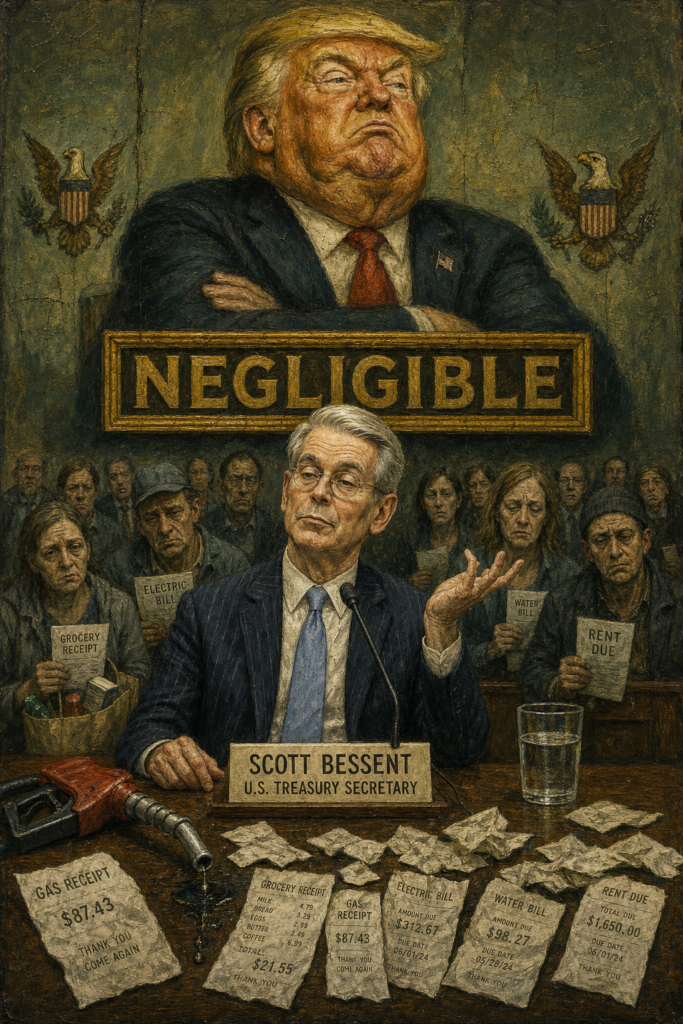
The hearing had been running more than four hours by the time Representative Thomas Suozzi of New York got his five minutes, which is the part of the day when a witness stops performing and starts answering, and it is therefore the only part worth reading. Earlier that Thursday, June 4, 2026, Representative Mike Kelly of Pennsylvania had opened with Dickens, and Suozzi picked the book back up. “A tale of two cities,” he said. “We might say Manhattan and Dallas.” Treasury Secretary Scott Bessent, who runs a hedge fund manager’s career in reverse and now answers for the fiscal condition of the United States, declined the frame. “I wouldn’t say that, but okay.”
“I would,” Suozzi said.
Then he did the useful thing: he established the witness’s own position before testing it.
“You said earlier today, and I’m sure you stick by this, the economy is very strong.”
“It is.”
“Over 70% of Americans think the economy is bad and getting worse. Are you familiar with that polling?”
“Uh, I am.”
“So, have you heard the expression, uh, the, uh, the K economy or the K recovery?”
“Yes, sir. But I think we’re probably moving to a C economy where the top…”
Suozzi did not let him finish the letter. He put the distribution on the record instead: 93% of the stock holdings in America are held by the top 10% of households, and 50% of Americans hold 1% of them. Then he asked the two questions that led to this article.
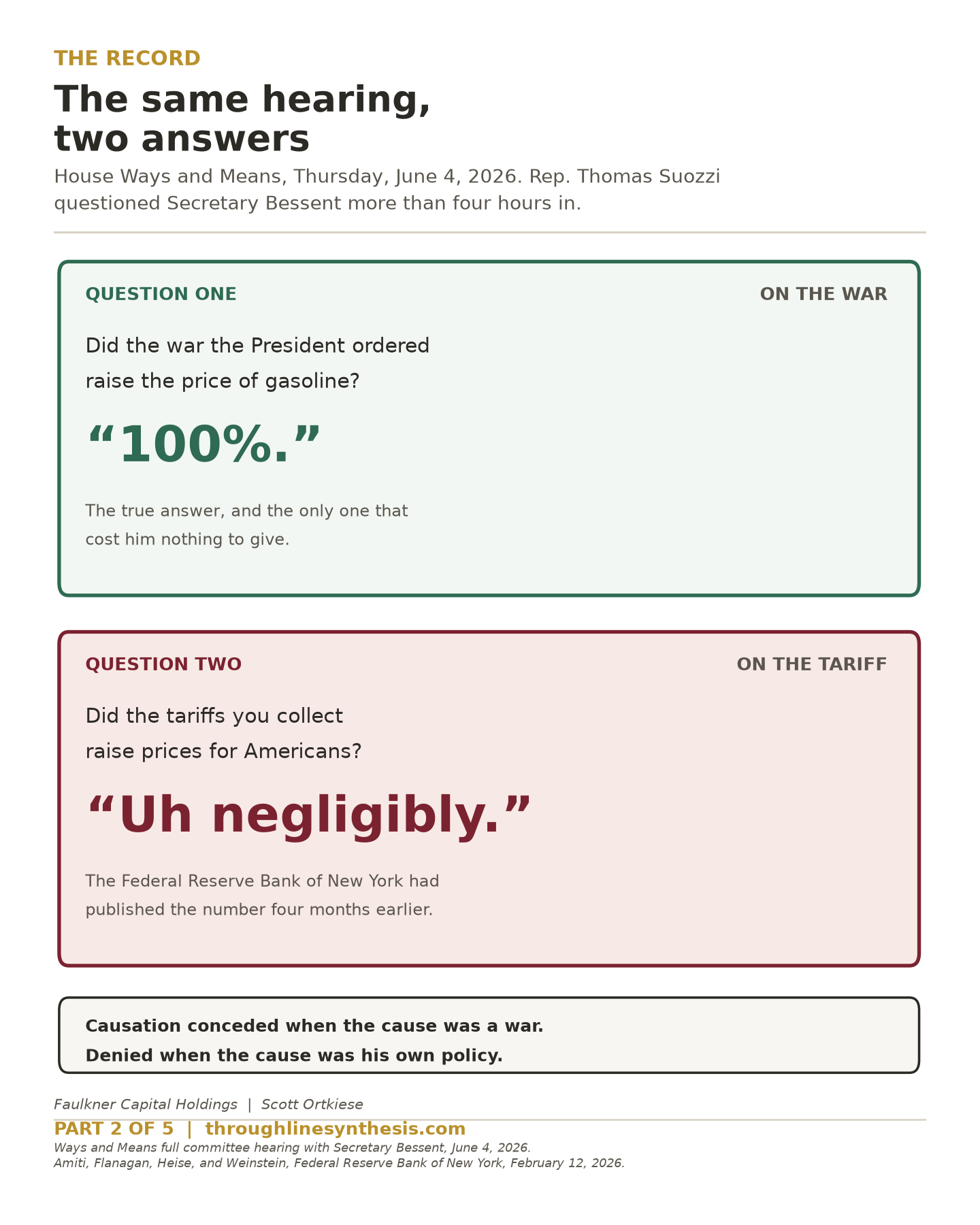
He asked about the war. “So, you do admit though that the war has caused prices to go up for gasoline, for example.”
“100%.”
He asked about the tariffs. “So the second thing is that the uh tariffs do you think tariffs have caused prices to go up?”
“Uh, negligibly.”
Two causal questions, one witness, the same posture, the same five minutes. When the cause was a war that Donald Trump ordered, and Bessent does not administer, the pass-through was total and immediate and conceded without qualification. When the cause was a tariff program that Bessent collects, defends, refunds, and testifies about, the pass-through was negligible. The difference between “100%” and “negligibly” is not a difference in the economics. It is a difference in who owns the policy.
And the number he was denying had been published four months earlier by the Federal Reserve Bank of New York.
II. The record it belongs to
“Negligibly” would be a small thing if it were one bad answer by a tired witness at the end of a long Thursday. It is not. It is an entry in a pattern that can be counted, and the counting is the point of this section, because a reader who is told that an administration lies has been given an opinion, and a reader who is handed the entries has been given a record.
A word about the word. This article uses “lie,” not “false statement,” not “misleading claim,” not “inaccuracy,” and the choice is deliberate rather than rhetorical. A lie requires two things: the statement is false, and the speaker knew it or had the answer in his own hands. Both conditions are met in every entry below, and the speaker or his own government produced the documents. Bessent wrote that tariffs are inflationary to the investors paying him to be right, then told Congress the pass-through was negligible. He said he had not bought anything while his own Treasury published the purchase results. Hegseth called the inspector general’s report his exoneration, even though the report said he transmitted strike times for manned aircraft over hostile territory. Trump said the Strait of Hormuz was completely open and, six days later, that it was sealed up tight. These are not errors of recollection. The correct answer was on the speaker’s own desk.
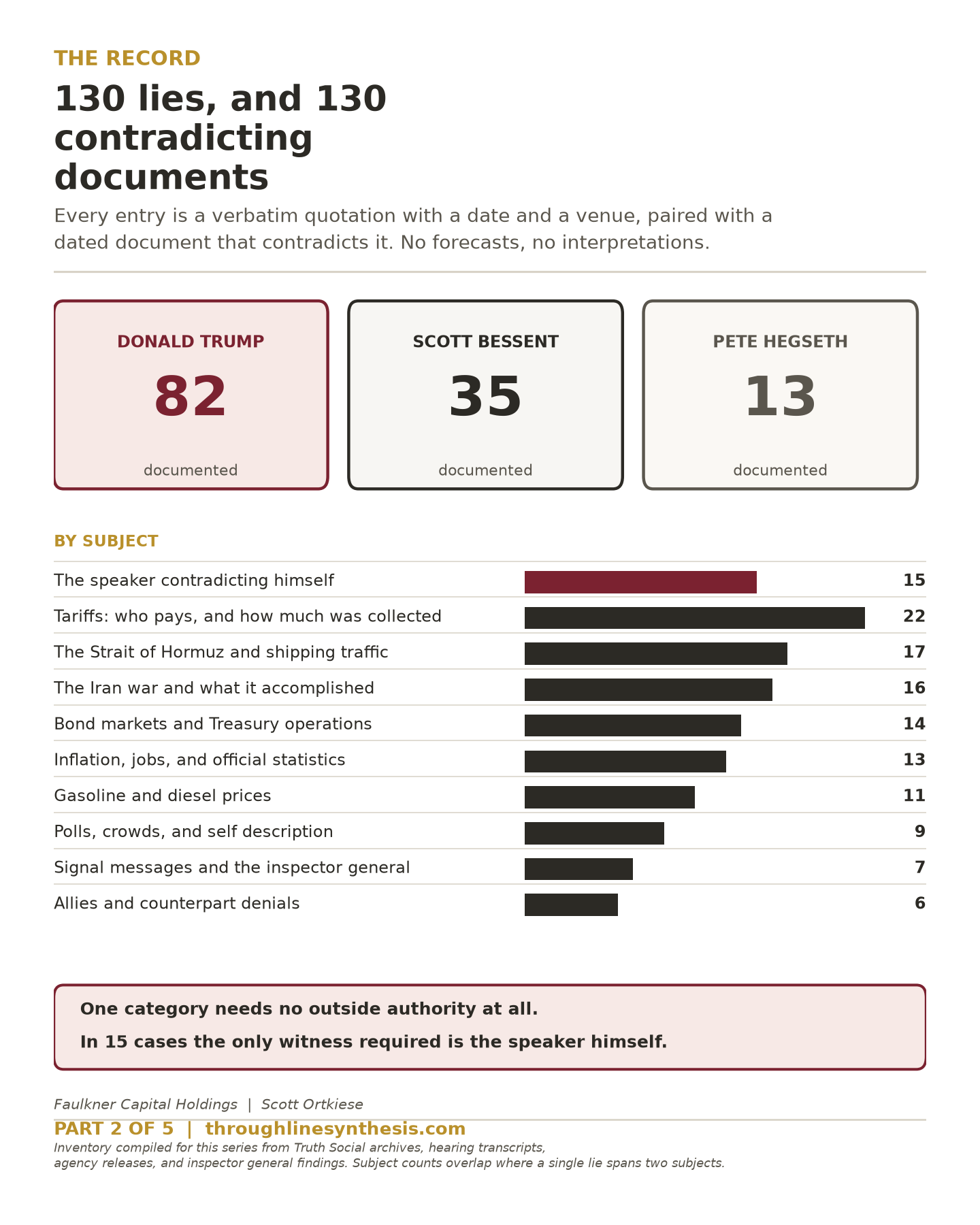
The inventory assembled for this series now holds 130 lies by three men, each one a verbatim quotation with a date, a venue, a link to the statement, and a separate link to the document that contradicts it. Donald Trump accounts for 82. Scott Bessent accounts for 35. Pete Hegseth accounts for 13. They are grouped by subject, and the subjects are not exotic: who pays a tariff, whether the Strait of Hormuz is open, what the bond market is doing, what the Iran war accomplished, what gasoline costs, what the inspector general found, what the polls say.
One category inside that inventory is worth more than the rest, because it needs no outside authority at all. In 15 cases, the same man said two incompatible things, and the only witness required is himself.
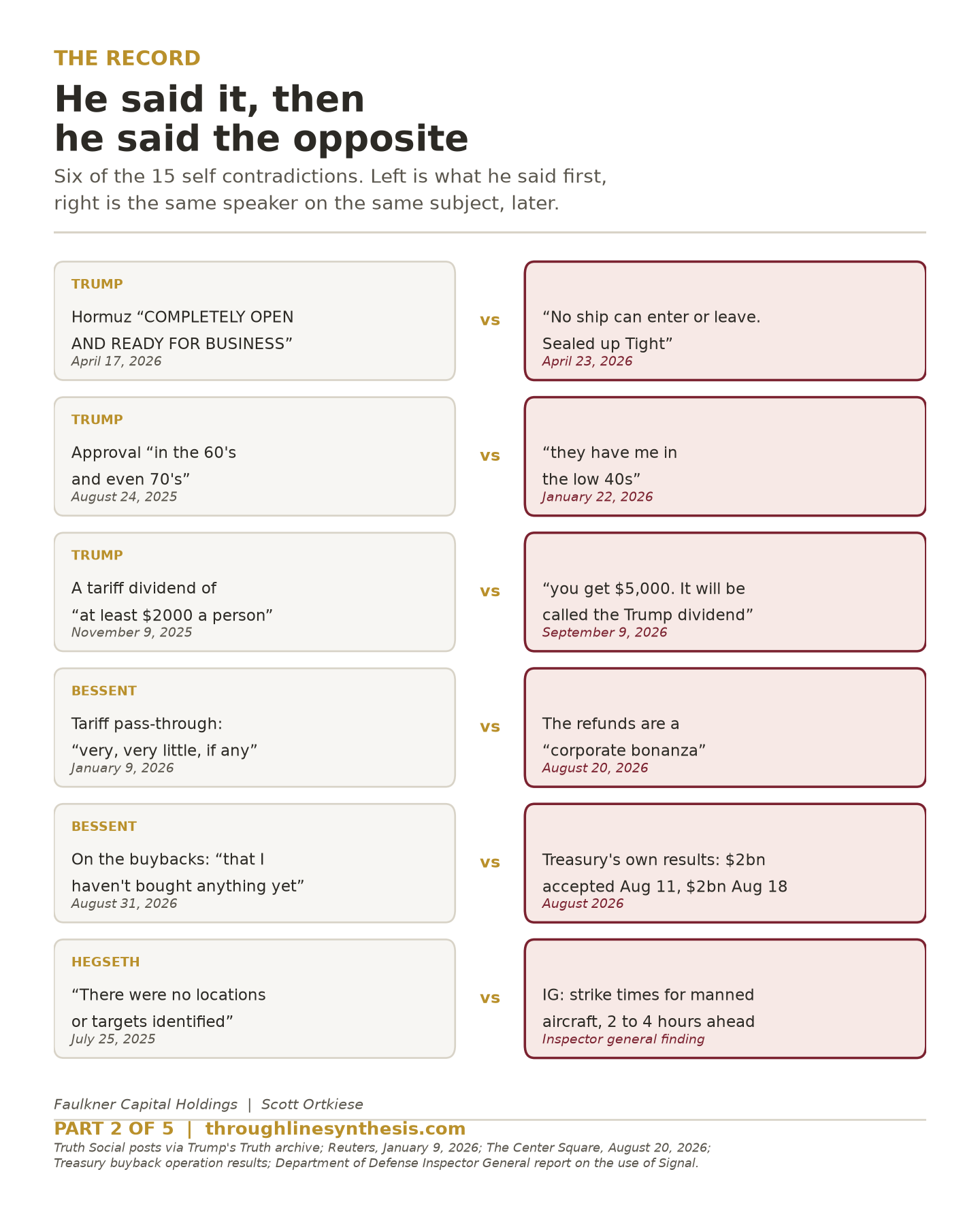
Trump wrote that the Strait of Hormuz was “COMPLETELY OPEN AND READY FOR BUSINESS AND FULL PASSAGE” on April 17, 2026, and six days later that no ship could pass without the approval of the United States Navy because it was “Sealed up Tight”. He wrote that “Consumers aren’t even paying these Tariffs” on August 12, 2025. He put his own approval “in the 60’s and even 70’s” on August 24, 2025, and conceded on January 22, 2026, that published polls “have me in the low 40s,” then went back to 65% in June and 59% in July. He promised a tariff dividend of “at least $2000 a person” on November 9, 2025. He told the Republican midterm convention in Dallas on September 9, 2026, that “you get $5,000. It will be called the Trump dividend,”, a promise estimated at $1.2 trillion that Speaker Mike Johnson declined to commit to four days later. He put Iranian inflation at 250% on June 21, 2026 and at 300% on August 12, which is an internal contradiction about a single quantity rather than a dispute with Tehran’s statistics.
Bessent wrote to his own investors in January 2024 that concentrating issuance in short tenors “creates the potential for a financial accident,” and in August 2026 he upsized exactly that program. He said there had been “very, very little, if any” tariff pass-through in January 2026 and called the refunds a “corporate bonanza” in August. He said “nothing is as fleeting as a supply shock” in May and “traditionally, you don’t raise rates into a supply shock” in August. On August 31, 2026, he said of the buyback program, “that I haven’t bought anything yet,” when Treasury’s own results show $2 billion accepted on August 11 and $2 billion more on August 18.
Hegseth told the public in July 2025 that “there were no locations or targets identified” in his Signal messages, and in December 2025 that the matter was “total exoneration, case closed.” The Department of Defense Inspector General found that he transmitted the quantity and strike times of manned American aircraft over hostile territory roughly 2 to 4 hours before execution, that this “created a risk to operational security,” and that it “did not comply with DoD Instruction 8170.01.” The refuting document is the investigation he cited as his exoneration.
That is the character of the thing. Now the scale, which requires more care than it usually gets.
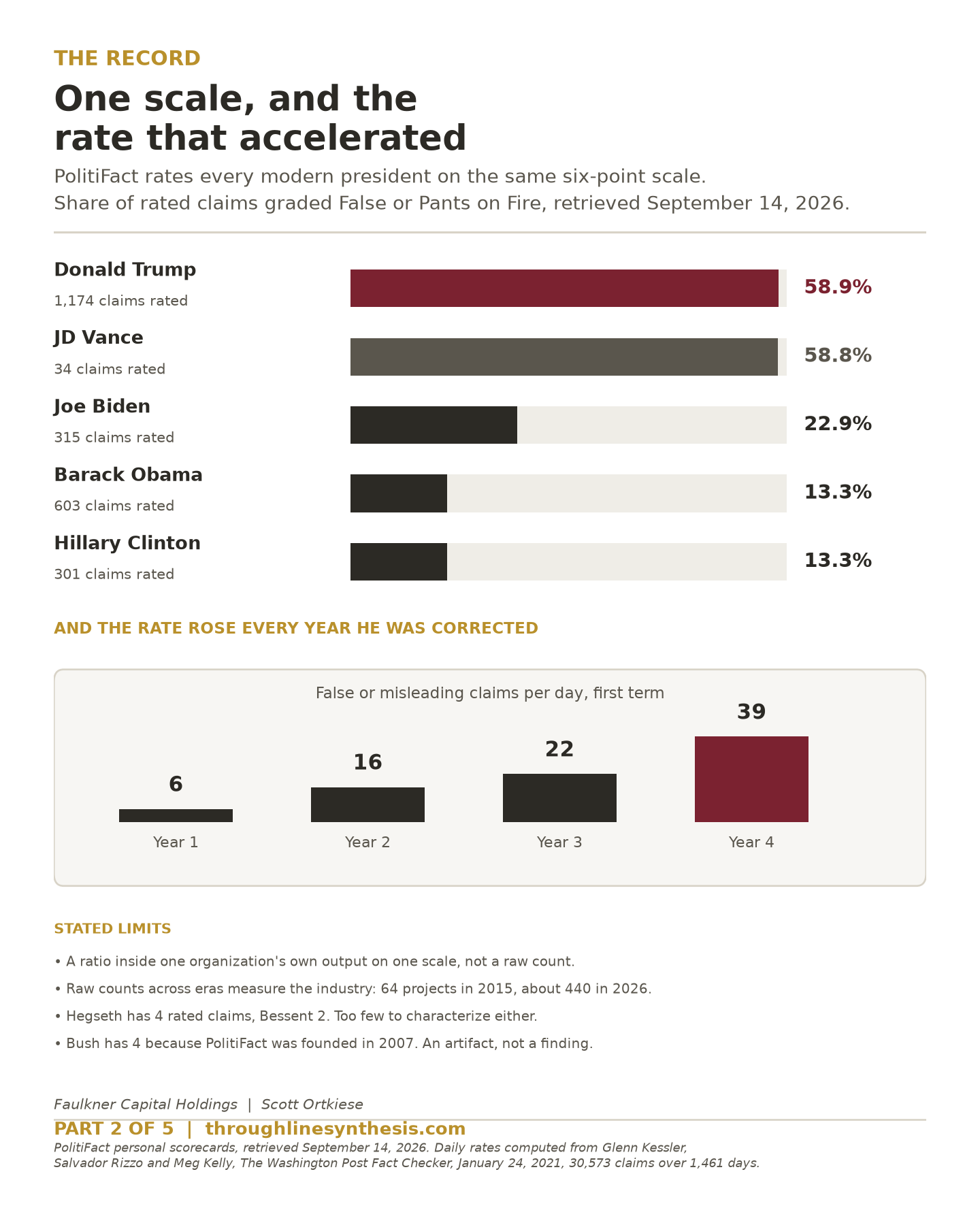
The number in circulation is 30,573, which is the Washington Post Fact Checker’s final count of false or misleading claims across Trump’s first term, published January 24, 2021, over 1,461 days, that is about 21 a day. The shape matters more than the total: the daily rate ran about 6 in the first year, 16 in the second, 22 in the third, and 39 in the fourth, and the single worst day, November 2, 2020, carried 503. It took 27 months to reach 10,000, 14 more months to reach 20,000, and fewer than 5 more to reach 30,000. A man who was being corrected daily for four years accelerated.
That database does not cover the current term, and it is not because the lying stopped. Glenn Kessler took a buyout on July 31, 2025, and the Post abandoned the Fact Checker column, as the Duke Reporters’ Lab recorded in its 2026 census. No organization has attempted a comparable running count since. The instrument was retired; the subject was not.
So the honest cross-president comparison has to come from somewhere else, and only one series rates every president on the same six-point scale: PolitiFact’s personal scorecards. Retrieved on September 14, 2026, they read as follows. Of 1,174 claims rated for Trump, 462 are False and 229 are Pants on Fire, which is 58.9% in the two worst categories and 78.0% across the three false categories combined. His True count is 36. Of 603 claims rated for Barack Obama, 13.3% are False or Pants on Fire. For Joe Biden, 315 rated, the figure is 22.9%. For Hillary Clinton, 301 rated; 13.3% are False or Pants on Fire. For JD Vance, 34 rated, 58.8%.
Now the objections, stated at full strength, because a charge of this size has to survive them.
PolitiFact chooses which claims to check and does not sample at random, so the denominator is editorial rather than statistical. A comparison of the Post and PolitiFact databases published in PLOS ONE found the two organizations disagreed 22.6% of the time about which claims were worth checking. However, they conflicted on the verdict in only 1 of 64 shared cases, which is the more useful finding: fact-checkers differ on what to examine and agree on what they find. Research in PNAS Nexus indicates that prominence, not party, predicts who gets checked. And the industry’s capacity exploded, from 64 fact-checking projects in 2015 to about 440 in 2026 by the Reporters’ Lab count, which means raw counts across eras measure the instrument as much as the man.
Take all of that as true, and the comparison still holds, for a reason the objections do not reach. Trump’s 58.9% is not a count, it is a ratio inside one organization’s own output, scored on one scale, and it is 4.4 times Obama’s rate on a sample twice the size. Selection bias would have to run in opposite directions for different presidents to explain that, and nobody has shown that it does. Two further honesties: George W. Bush has only 4 rated claims because PolitiFact was founded in 2007, so his low false rate is an artifact, not a finding, and Hegseth at 4 rated claims and Bessent at 2 are sample sizes too small to characterize anyone. Their entries in this inventory rest on documents, not on scorecards.
The defensible sentence, then, is not that Trump has told more lies than any president in history, which no instrument in existence can establish. It is narrower and worse. Measured by the only organization that has rated every modern president the same way, he is false at several times the rate of his predecessors; measured over his first term by the one outlet that counted daily, he accelerated under correction for four consecutive years; and measured by his own words against his own words, he and the two officials in this file have contradicted themselves 15 times on the specific subjects covered here.
Which is what makes the tariff worth the rest of this article. Most political lies cannot be settled, because they are claims about intention or about the future. This one can. There is a number; it was produced by the Federal Reserve Bank of New York; it was published on February 12, 2026; and the Secretary of the Treasury denied it in a hearing room on June 4.
III. Who actually pays a tariff
A country does not pay a tariff. The importer of record pays it at a port, in dollars, to U.S. Customs and Border Protection before the container moves. When Trump says China, Japan or Mexico is paying, he is not describing the transaction, because the transaction has an American name on it. He is asserting a second-order effect: that the foreign exporter will cut its price by enough to absorb the duty, so the American buyer ends up no worse off. That is testable, it has been tested, and it is false.
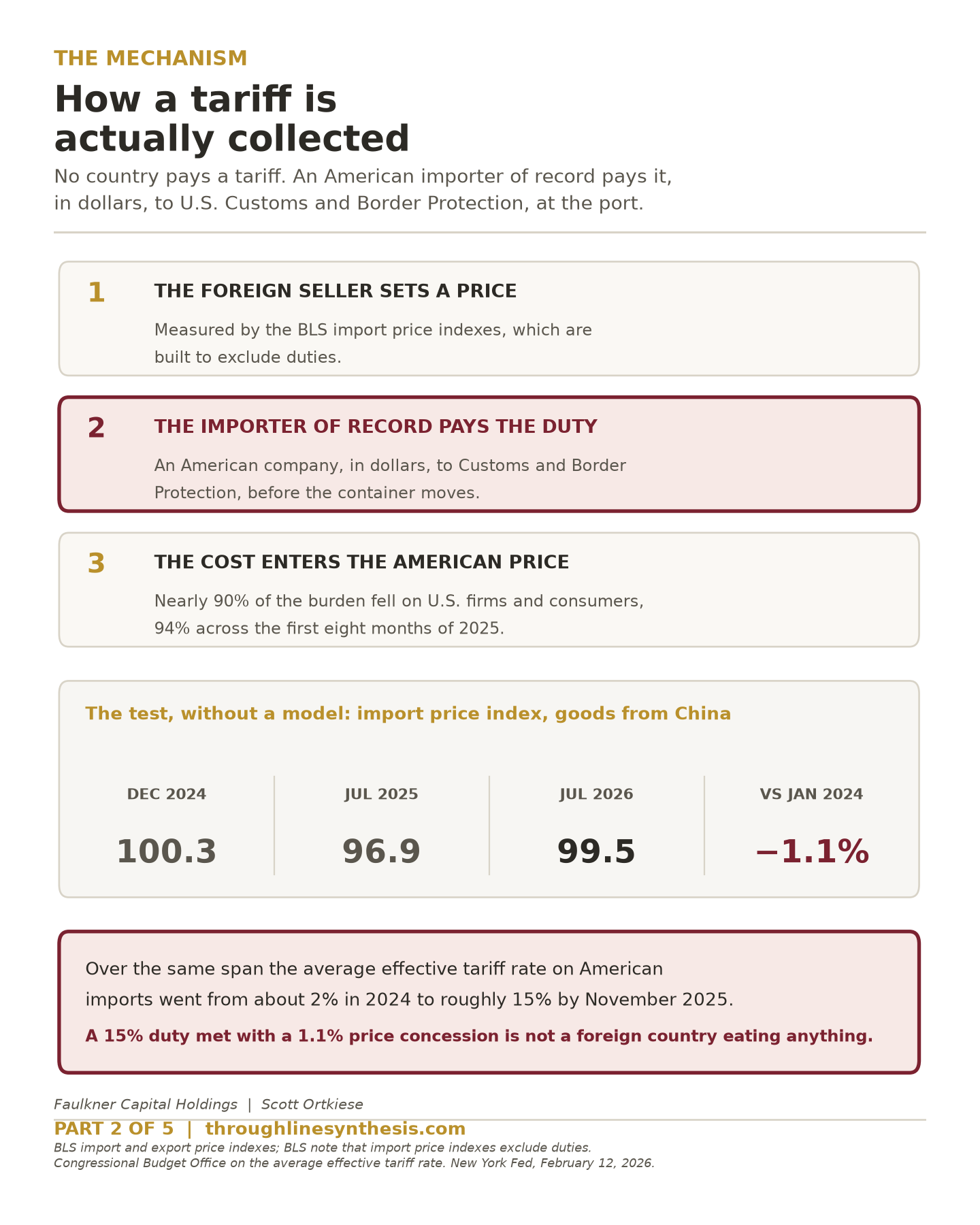
Mary Amiti, Chris Flanagan, Sebastian Heise, and David E. Weinstein published the test at the New York Fed on February 12, 2026. Their finding, in their words: “nearly 90 percent of the tariffs’ economic burden fell on U.S. firms and consumers”. The share was 94% across the first eight months of 2025, and pass-through was still running at 86% in November 2025. The same authors’ institution restated the finding on July 8, 2026, and added that more of it was still in the pipeline. The Peterson Institute for International Economics, surveying three independent studies, put about 90% of the burden in 2025 on American buyers.
There is a cleaner way to see it, and it does not require a model. The Bureau of Labor Statistics import price indexes exclude duties. They measure what the foreign seller charges at the border, before Customs touches it. If exporters were eating the tariff, that index would fall by roughly the amount of the tariff. The index for goods from China went from 100.3 in December 2024 to 96.9 in July 2025, a trough of just 3.4% below where it started, and by July 2026 it was back to 99.5, which is 1.1% below January 2024. Over the same span the average effective tariff rate on American imports went from about 2% in 2024 to roughly 15% by November 2025.
A 15% duty met with a 1.1% price concession is not a foreign country eating anything.
The most recent BLS release points in the other direction. Prices for nonfuel imports were up 4.5% year over year, the largest such advance since June 2022, and prices for imports from China rose 0.8% in a single month, the largest monthly increase since July 2008. Foreign sellers are not absorbing the tariff. They are raising prices into it.
IV. He knew, and he wrote it down
The most damaging document in this file is not a Federal Reserve study. It is a letter Bessent wrote to his own investors, for money, when he had no political interest in the answer.
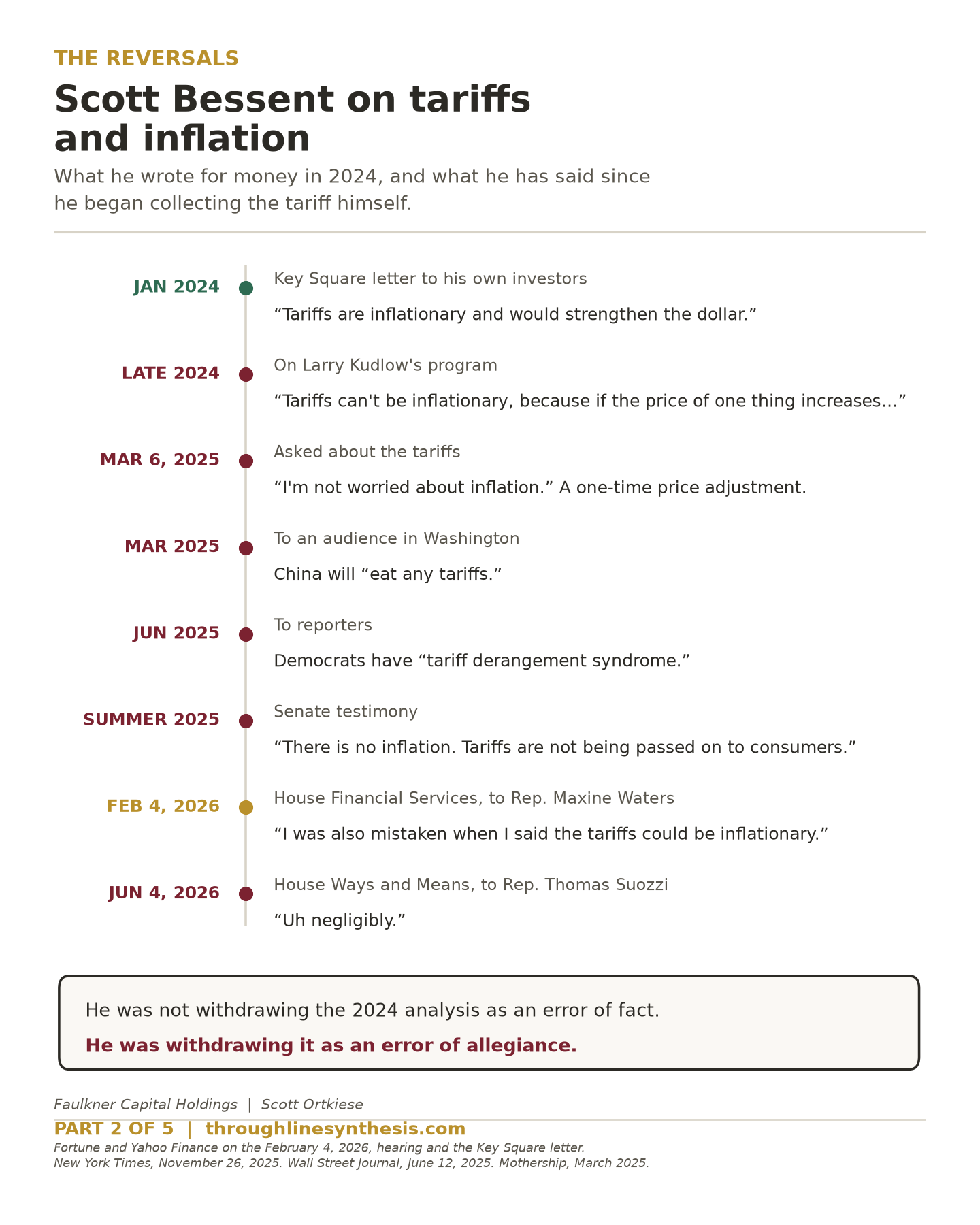
In the January and February 2024 letter to investors in his fund, Key Square, Bessent wrote that “Tariffs are inflationary and would strengthen the dollar,” and that “The tariff gun will always be loaded and on the table but rarely discharged.” That is the analysis of a man paid to be right rather than loyal.
By late 2024 he had reversed the sign. On Larry Kudlow’s program, he argued that “Tariffs can’t be inflationary, because if the price of one thing increases…”, which is the substitution argument, and which is a statement about relative prices masquerading as a statement about the price level. On March 6, 2025, he said, “I’m not worried about inflation” from the tariffs, describing them as a one-time price adjustment, and he repeated the “one-time price adjustment” formula at the Economic Club of New York. He told an audience in March 2025 that China would “eat any tariffs”. In Senate testimony in the summer of 2025 he said, in a line Representative Maxine Waters later read back to him word for word, “There is no inflation. Tariffs are not being passed on to consumers.” In June 2025 he told reporters that Democrats had “tariff derangement syndrome”.
On February 4, 2026, in front of the House Financial Services Committee, Waters put the Key Square letter in front of him. He first denied having written that tariffs are inflationary. Then he conceded it, and then he conceded something larger: “If I was mistaken, I want to correct it. And I was also mistaken when I said the tariffs could be inflationary.” He was not withdrawing the 2024 analysis as an error of fact. He was withdrawing it as an error of allegiance. Then he gave the line he wanted on the wires: “So tariff inflation was the dog that didn’t bark.”
He also promised the money. Tariff revenue, he told Treasury’s own press operation on April 7, 2025, would run $300 billion to $600 billion a year and start paying down the debt. Net customs revenue for fiscal 2025 came in at about $195 billion. After the Supreme Court struck down the statute he had been collecting under, the Congressional Budget Office put 2026 tariff and customs collections about $250 billion, or 60%, below its earlier projection.
He was closer to the truth when he was charging a management fee for it.
V. What it cost, per household
The distributional work is not contested in any serious way, and Bessent did not contest it either.
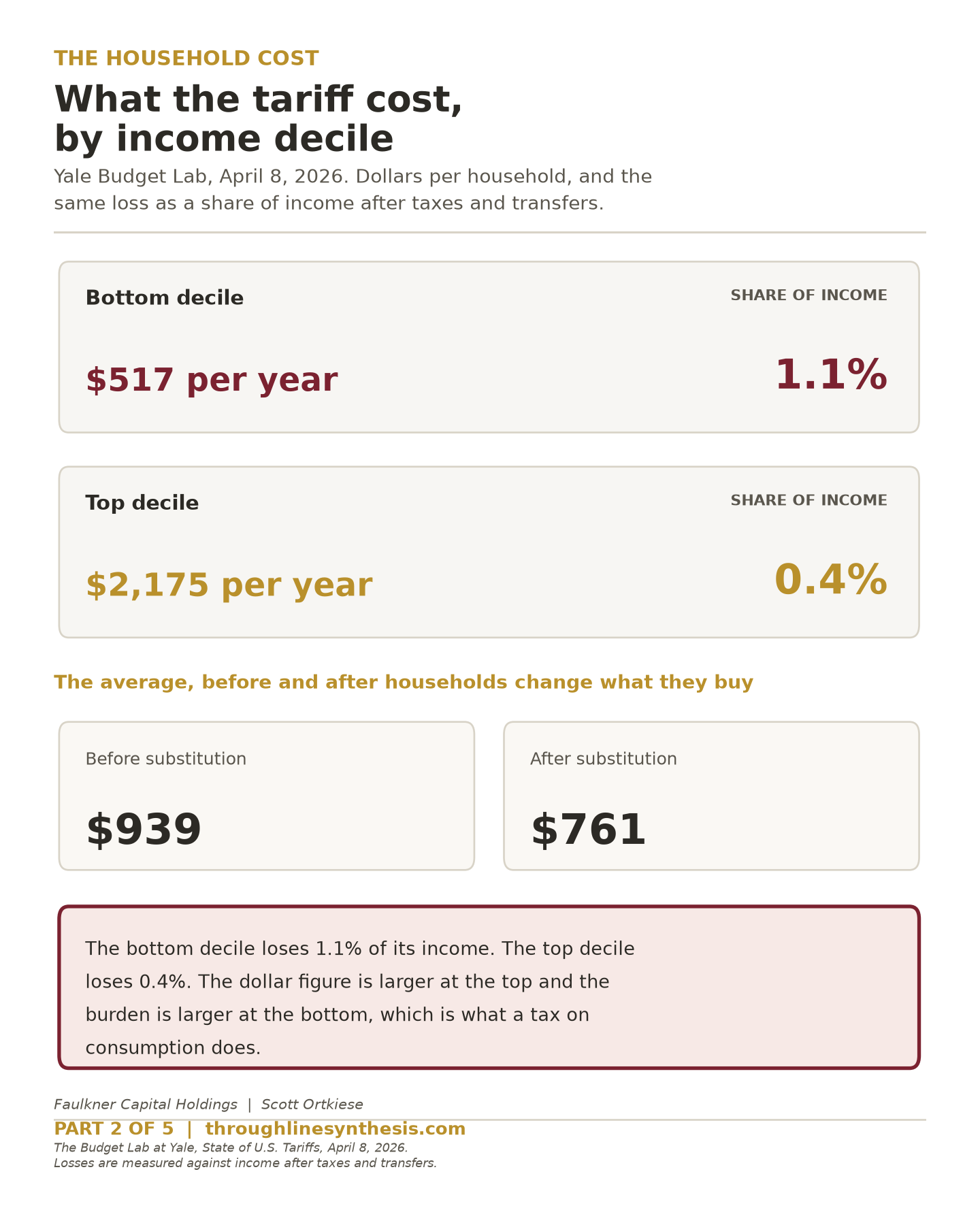
In its April 8, 2026 analysis, the Yale Budget Lab put the cost of the tariffs at $939 per household before consumers change what they buy, and $761 after. The averages are the least interesting numbers in the document. The bottom decile of American households paid about $517, which is 1.1% of income after taxes and transfers. The top decile paid about $2,175, which is 0.4% of income after taxes and transfers. As a share of what a family actually has, the burden on the poorest tenth is about three times the burden on the richest tenth.
The other estimates cluster in the same place. The Tax Foundation put the cost at about $1,000 per U.S. household in 2025 and $820 in 2026. The Tax Policy Center, in June 2026, put it at $1,250 overall, running $230 for the lowest quintile, $530 for the second, $940 for the middle, and $4,430 for the top. The Democratic staff of the Joint Economic Committee added up actual collections and got more than $231 billion in tariff costs between February 2025 and January 2026, “an average of roughly $1,745 per family”.
Suozzi cited the Yale Budget Lab. Bessent said the Yale Budget Lab is “a bunch of Biden era second stringers.”
Suozzi then read back the three courses Bessent taught at Yale: “The 20th Century Financial Booms and Bust, hedge funds, and a seminar on financial panic of 2000 to 2009.”
This piece leads with the New York Fed rather than Yale for a reason. Bessent has called the Budget Lab a nest of second stringers. He has not yet said that about the Federal Reserve Bank of New York, and when a witness discredits the researcher instead of the research, the correct response is to hand him a researcher he cannot afford to discredit.
VI. Where it showed up in the register
Here the honest version of the case is narrower than the loud version, and the narrow version is harder to answer.
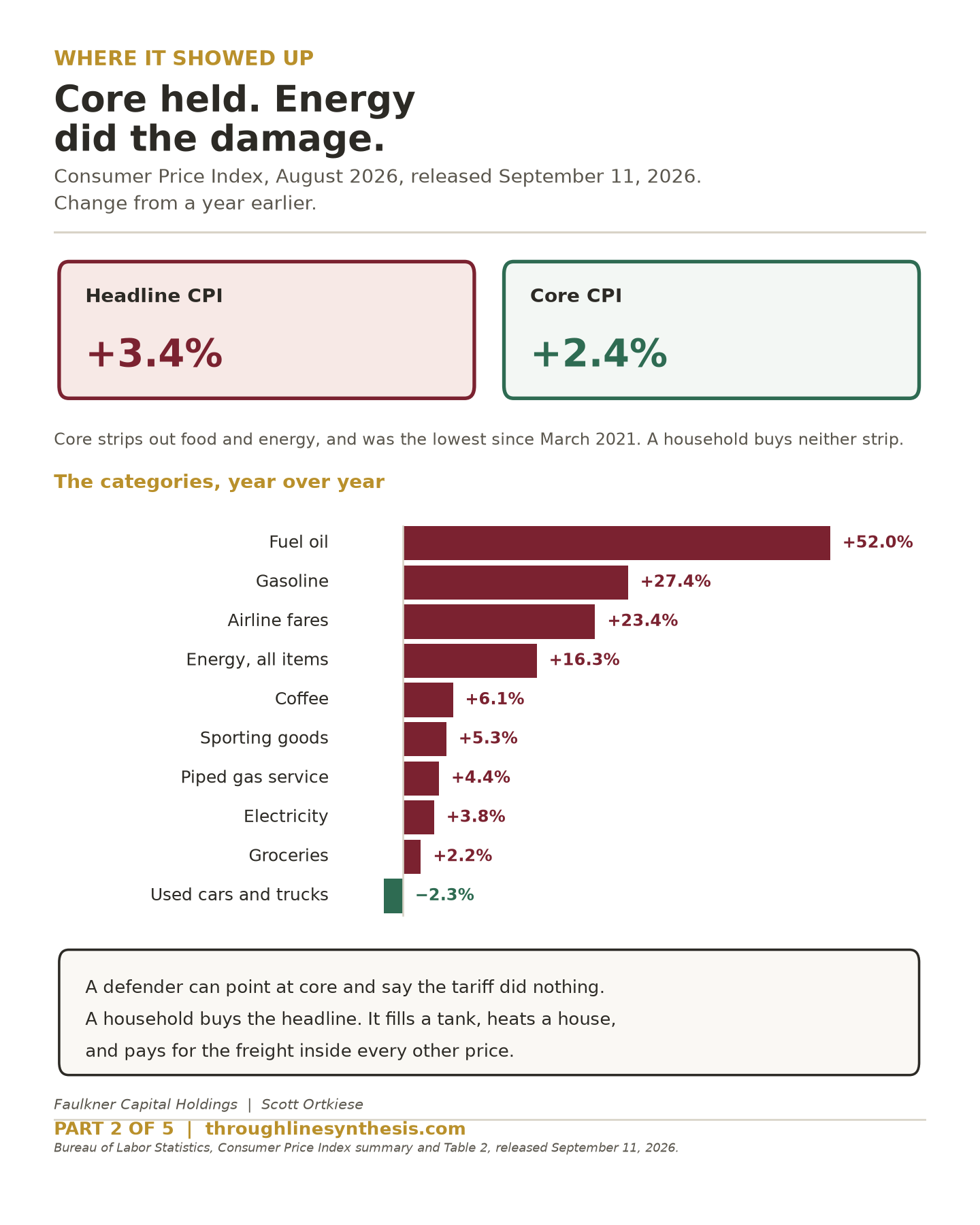
The August 2026 Consumer Price Index, released September 11, put all items up 3.4% over the year and 0.4% on the month, with core, which strips out food and energy, up 2.4%, the lowest since March 2021. Headline spiked from 2.4% in February to 4.3% in May, then settled back. Anyone claiming a general inflationary spiral from these numbers isn’t reading them.
Read the components instead. Energy as a whole was up 16.3% over the year. Gasoline was up 27.4%. Fuel oil was up 52.0%. Airline fares, which are a jet fuel bill with seats attached, were up 23.4%. Coffee was up 6.1%, sporting goods 5.3%, piped gas service 4.4%, and electricity 3.8%. Grocery inflation decelerated to 2.2%, and used cars fell 2.3%. American natural gas at the wellhead was cheaper than a year earlier, at $2.78 per million British thermal units at Henry Hub versus $2.97, but that didn’t stop the household bill from rising, because what a household buys is delivery.
So the price level is not running away, and the parts of it that are running are energy and imported goods. Bessent has a phrase for this. On June 3, 2026, before the Senate Finance Committee, he called it a “short-term blip” and added, “I think we have the makings of one of the strongest economies in history.”
The blip is 16.3% on energy, 27.4% on gasoline, 52.0% on fuel oil, and 23.4% on an airline ticket, in the year his government went to war over a strait.
VII. Then the war did what the tariff could not
On March 2, 2026, Trump sent Congress the letter the War Powers Resolution requires. The operative phrase is his own: “at my direction, on February 28, 2026, United States forces conducted” the strikes. Ayatollah Ali Khamenei, 86 years old, was killed in the joint American and Israeli attack that Saturday. Trump announced the death before Iran confirmed it and called on Iranians to take control of their government. There were nearly 900 strikes in the first 12 hours. Iran declared 40 days of national mourning, and closed the Strait of Hormuz.
What followed is the largest disruption of seaborne energy trade since the tanker war of the 1980s, and it is measurable in barrels.
Total oil moving through Hormuz ran 20.7 million barrels a day in the fourth quarter of 2025. It fell to 14.6 million in the first quarter of 2026, to 4.9 million in the second, and to roughly 1.5 million by the first half of September. Liquefied natural gas fell from 10.5 billion cubic feet a day in the fourth quarter of 2025 to 0.8 billion in the second quarter of 2026, a 92% drop. War risk insurance, which cost 0.15% to 0.25% of a vessel’s value before the war, reached 7.5% to 10% of hull value per seven-day period. By late March, Iran was selling passage outright, with tolls reported as high as $2 million per ship and exemptions for China, Russia, India, Iraq, Pakistan, the Philippines, Malaysia, and Thailand. The first Qatar-linked LNG cargo since late July left Ras Laffan for Pakistan on September 10, 2026.
The congestion moved west. SK Gas paid $5.3 million for a single auctioned transit slot at the Panama Canal, a record, against a median auction price of about $55,000 between October 2025 and February 2026. That is the premium for jumping the line, not the toll, which runs $300,000 to $400,000. Average winning bids reached about $1.1 million in August 2026, 16 times the level of a year earlier, and the canal cut daily transits from 40 to 32 on low water.
Then it reached the pump, and it reached the wrong pump for anyone hoping the political damage would be contained. On-highway diesel averaged $3.459 a gallon on January 12, 2026. It hit $5.967 in the week ending September 7, and on Thursday, September 10, the national average crossed $6 a gallon for the first time in American history, at $6.06. Diesel did not stop there. By Monday, September 14, AAA had the national diesel average at $6.2301, which is not a high for the year or for the decade. It is the highest diesel price AAA has ever recorded, and it was recorded that Monday. Gasoline set no all-time record, which is the most that can be said for it: the AAA national average was $4.3163 on September 14, 2026, up 16.6 cents in a week and $1.14 on the year, against the record of $5.0165 set on June 14, 2022.
There is a third fuel, and it is the one that prices a vacation. Jet fuel on the Gulf Coast spot market reached $4.341 a gallon on September 8, 2026, against $2.070 a year earlier, a rise of 110%. That is why airline fares in the August index are up 23.4%, why American Airlines cut its full-year guidance, and why Southwest cut planned capacity growth to 1.5%. Refiners are not the bottleneck or the villain here: American refineries ran at 97.8% capacity in the week ending September 4, close to the physical limit, with distillate inventories 13% below the five-year average. They are running flat out, and the distillate crack spread, the margin between a barrel of crude and the diesel made from it, is above $100 a barrel. No idle capacity is left to call on. That is what a supply shock looks like when it is real.
What he wrote while this was happening is a matter of record, under his own name, with a timestamp. On September 7, 2026, with the national average at $4.157 on his own Energy Information Administration’s series that same day, Trump posted that gasoline was at “Three Dollars a gallon, but ultimately, below Two Dollars a gallon.” He had made the claim before, at $1.98 a gallon on May 2, 2025, when the actual figure was $3.147, and at $1.99 on January 11, 2026, when it was $2.779. The number was never checked because the number was never the point.
The reserve that exists for this was already spent. On March 11, 2026, Energy Secretary Chris Wright announced the release of 172 million barrels from the Strategic Petroleum Reserve, the American share of a coordinated International Energy Agency action. The reserve stood at 285.4 million barrels in the week ending September 4, 2026, down 31% since January and the lowest level since November 1982. That is about 14 days of American consumption. It was drawn down to hold the price, and the price is where it is.
Nor is it one strait any more. On September 11, drones launched from Iraqi territory struck the Saudi East-West pipeline, and the Saudi Ministry of Energy shut it down, taking 4 to 5 million barrels a day of capacity offline with no restart date. That pipeline moves crude to the Red Sea and bypasses Hormuz, so the workaround was destroyed when the main route closed. On September 10 and 11, Houthi forces took the Yemeni port of Mokha and Perim Island, giving them the Bab al-Mandab approaches, the other end of the same shipping lane. Brent last settled at $104.61 on Friday, September 11, and traded between $105.23 and $109.74 on Monday, September 14. A government that opened this file in February now faces three chokepoints it does not control and one pipeline it cannot protect.
Diesel is the fuel that moves everything else. Gasoline is the fuel that moves voters. The first one is at an all-time high, and the second one is up more than 40% since January, and the honest version of that sentence is more damaging than the exaggerated one, because it cannot be waved away.
When Suozzi asked Bessent whether the war had raised the price of gasoline, Bessent said “100%,” and he was telling the truth. It is the only question that day where the true answer cost him nothing.
VIII. What he said about the strait, and what the sensors show
The advantage of the Hormuz lies over most of the rest of the inventory is that satellites do not have a press office.
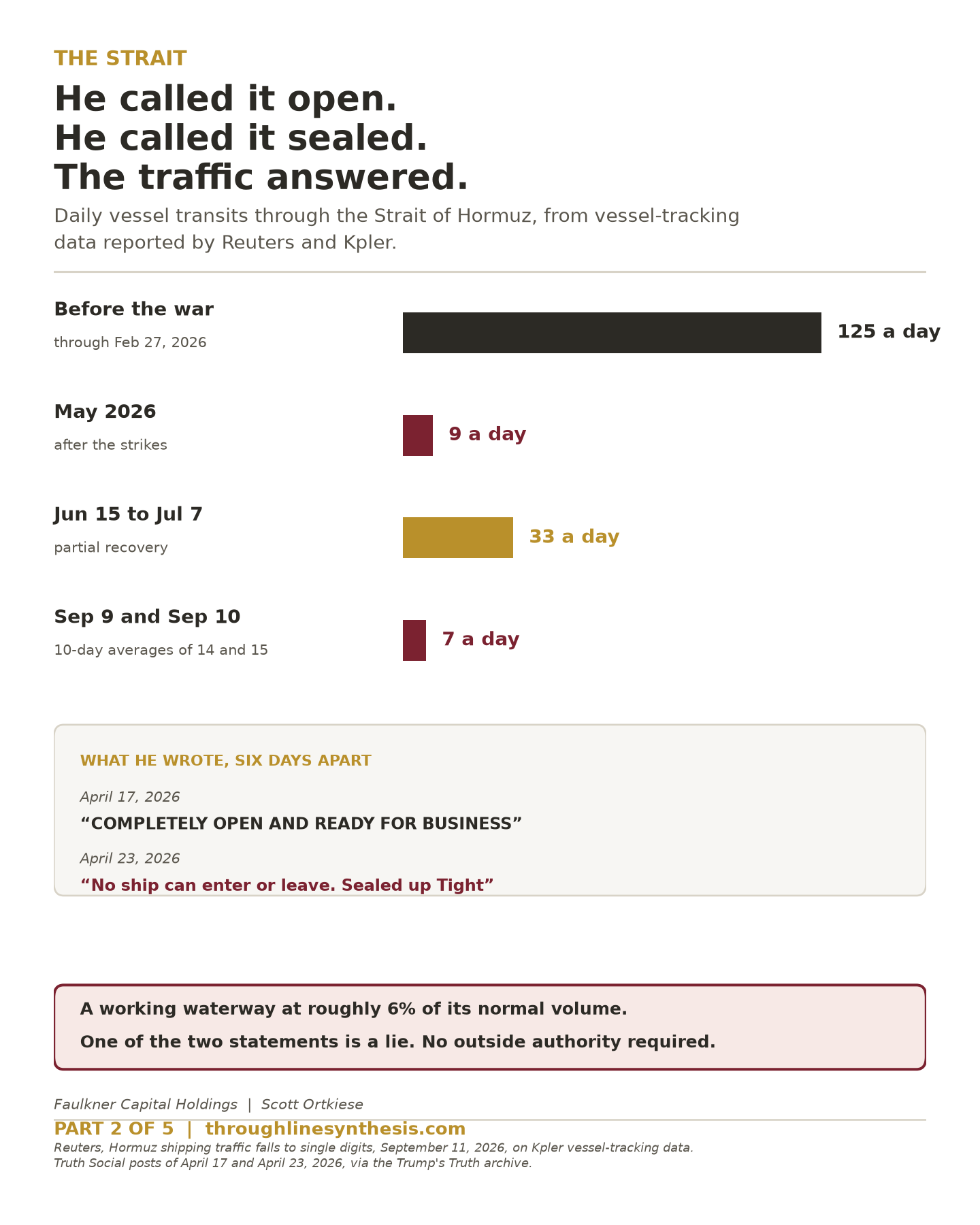
On April 17, 2026, Trump wrote that the strait was “COMPLETELY OPEN AND READY FOR BUSINESS AND FULL PASSAGE.” On April 23, he wrote that no ship could enter or leave without the approval of the United States Navy and that it was “Sealed up Tight.” Six days. One strait. The same man issued both as fact. Whatever else is arguable, one of them is a lie, and no outside authority is needed to establish it.
The traffic itself is not arguable either. Before the war, about 125 vessels a day moved through Hormuz. In May the figure was 9 a day. Between June 15 and July 7 it recovered to about 33. On September 9 and September 10, Reuters counted 7 transits on each day against 10-day rolling averages of 14 and 15, drawing on vessel-tracking data from Kpler. That is a working waterway reduced to roughly 6% of its normal volume.
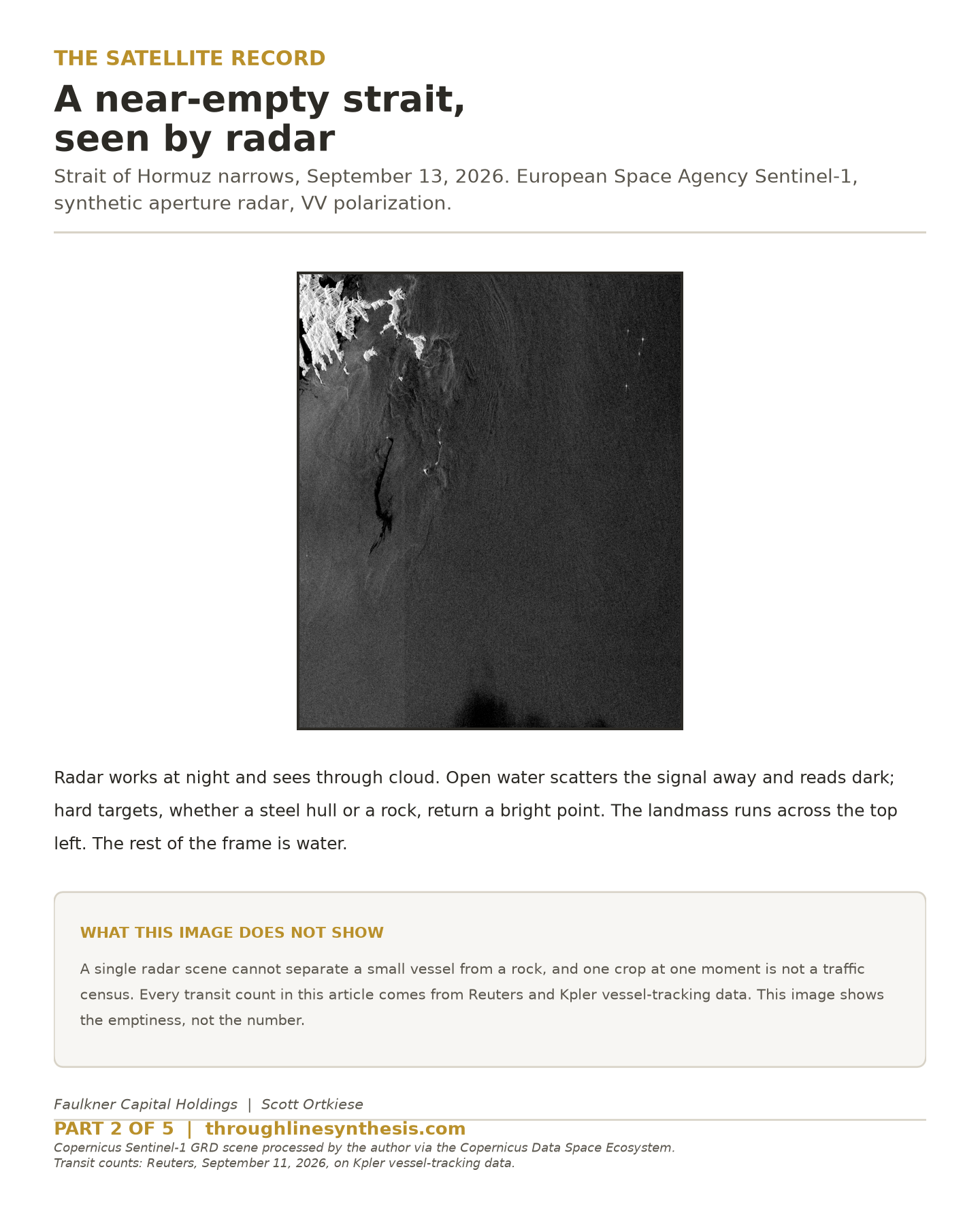
A European Space Agency radar satellite passed over the narrows on September 13, 2026, and the scene is reproduced here. Synthetic aperture radar works at night and through clouds: open water scatters the signal away from the sensor and reads almost black, while a hard target returns a bright point. Land runs across the top left of the frame; the rest is water, and the water is nearly empty. Two honest limits on that image. A single radar scene cannot tell a small vessel from a rock, and one crop at one moment is not a traffic census. Every transit count above comes from Reuters and Kpler. The picture shows the emptiness, not the number.
The same instruments settle a second question. On September 10 and 11, projectiles struck two pumping stations on the Saudi East-West pipeline, a line built so Saudi crude could reach the Red Sea without passing through Hormuz. CNN published commercial imagery from Planet Labs showing fires at both. The two sites were identified as al Mesba’ah and al Dhekra, also called Pump Station 9, and geolocated by NPR’s Geoff Brumfiel at 23.9565 N, 40.0538 E and 24.2521 N, 42.1311 E.
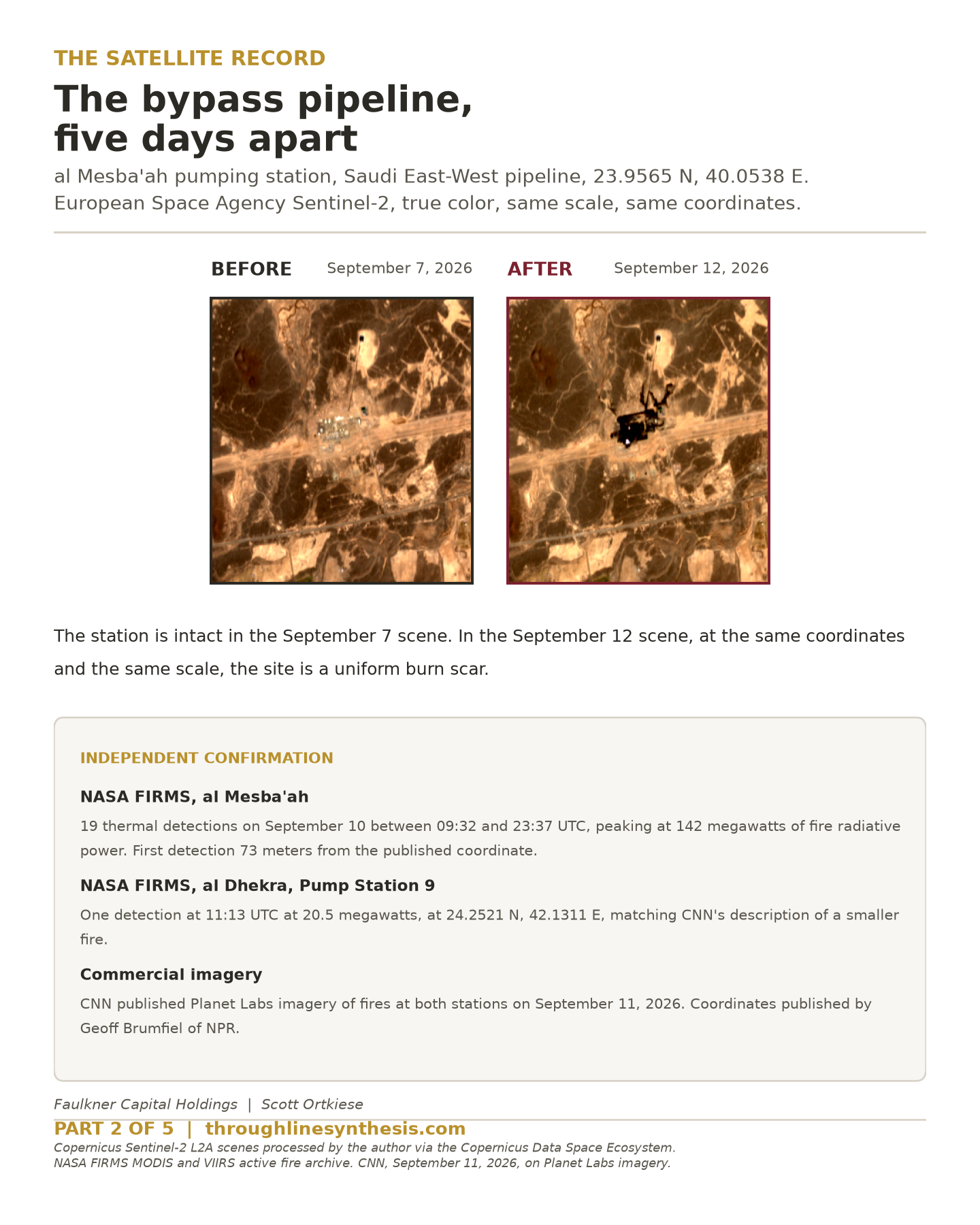
Both are independently confirmed in NASA’s Fire Information for Resource Management System, which logs thermal anomalies from the MODIS and VIIRS instruments without reference to anybody’s account of events. At al Mesba’ah, 19 separate detections on September 10 between 09:32 and 23:37 UTC, peaking at 142 megawatts of fire radiative power, the first of them 73 meters from the published coordinate. At al Dhekra, one detection at 11:13 UTC at 20.5 megawatts, which matches CNN’s description of a smaller fire. The free European Sentinel-2 imagery reproduced here shows the al Mesba’ah station intact on September 7 and, at the same scale and the same coordinates, a uniform burn scar across the site on September 12.
The bypass was disabled after the main route was closed. That is not an inference from a press statement; it is a before-and-after picture of the same square kilometer of desert, taken by a public satellite, five days apart.
IX. From an order on a Friday to a WARN notice in Louisiana
The chain from a decision made in Washington to a layoff notice filed in Convent, Louisiana, has four links, and none of them is rhetorical.
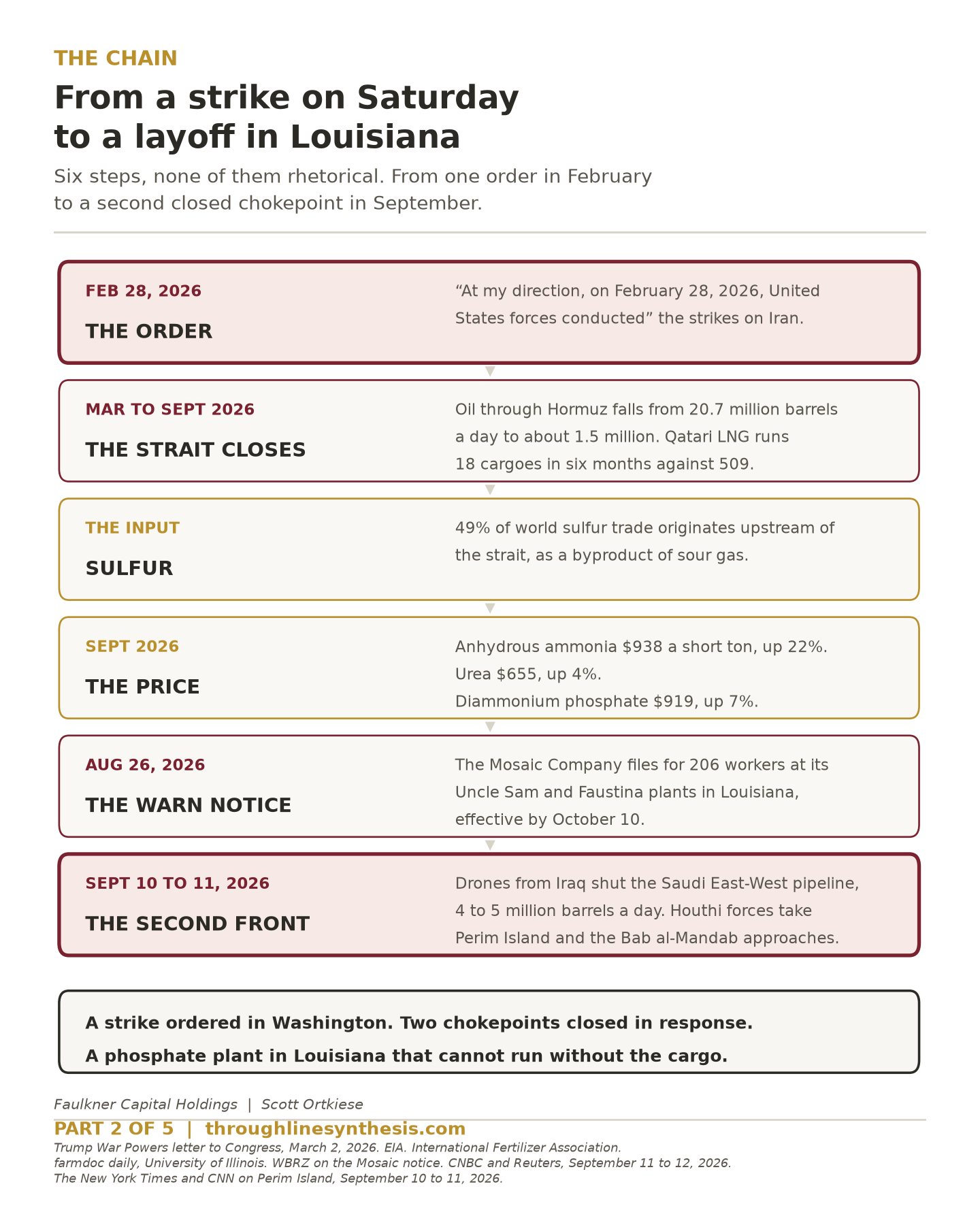
The first link is sulfur. Nearly half of the world’s sulfur trade (49%) originates upstream of the Strait of Hormuz because sulfur is a byproduct of sour gas processing, and the sour gas is in the Gulf. The second link is fertilizer. The International Fertilizer Association puts the Gulf at close to 30% of global major fertilizer exports, with Iran, Qatar, Saudi Arabia, the United Arab Emirates, and Bahrain together accounting for 34% of world urea trade and 23% of world ammonia trade.
The third link is price. Anhydrous ammonia ran at $938 per short ton in early September 2026, up 22% from a year earlier, after peaking at $1,126 in the week of May 11. Urea was $655, up 4%, after a May peak of $864. Diammonium phosphate was $919, up 7%. Those are the input costs of the 2027 American corn crop, being set now.
The fourth link is a document. The Mosaic Company filed a WARN notice on August 26, 2026, covering 206 workers at its Uncle Sam plant in Donaldsonville and its Faustina plant in Convent, Louisiana, effective by October 10, as phosphate operations idled for want of sulfur. Seven months and eight days separate Trump’s War Powers letter from the date those people stop being paid.
They are not alone, and the rest of the list is not all attributable to the strait. Tyson Foods cut about 3,200 jobs across closures in Illinois and Utah. Phillips 66 cut 277 at its Los Angeles refinery as the plant shut down. Alton Steel in Illinois closed and laid off 253. BAE Systems cut nearly 200 in Jacksonville.
The Mosaic notice is the one that matters for this argument, because the mechanism is legible end to end: a strike ordered on February 28, a strait closed in response, a sulfur cargo that never sailed, and a phosphate plant on the Mississippi River that cannot run without it.
X. What it costs a household that has to borrow
On March 10, 2025, Bessent said the housing market was stuck but “will unfreeze in weeks”.
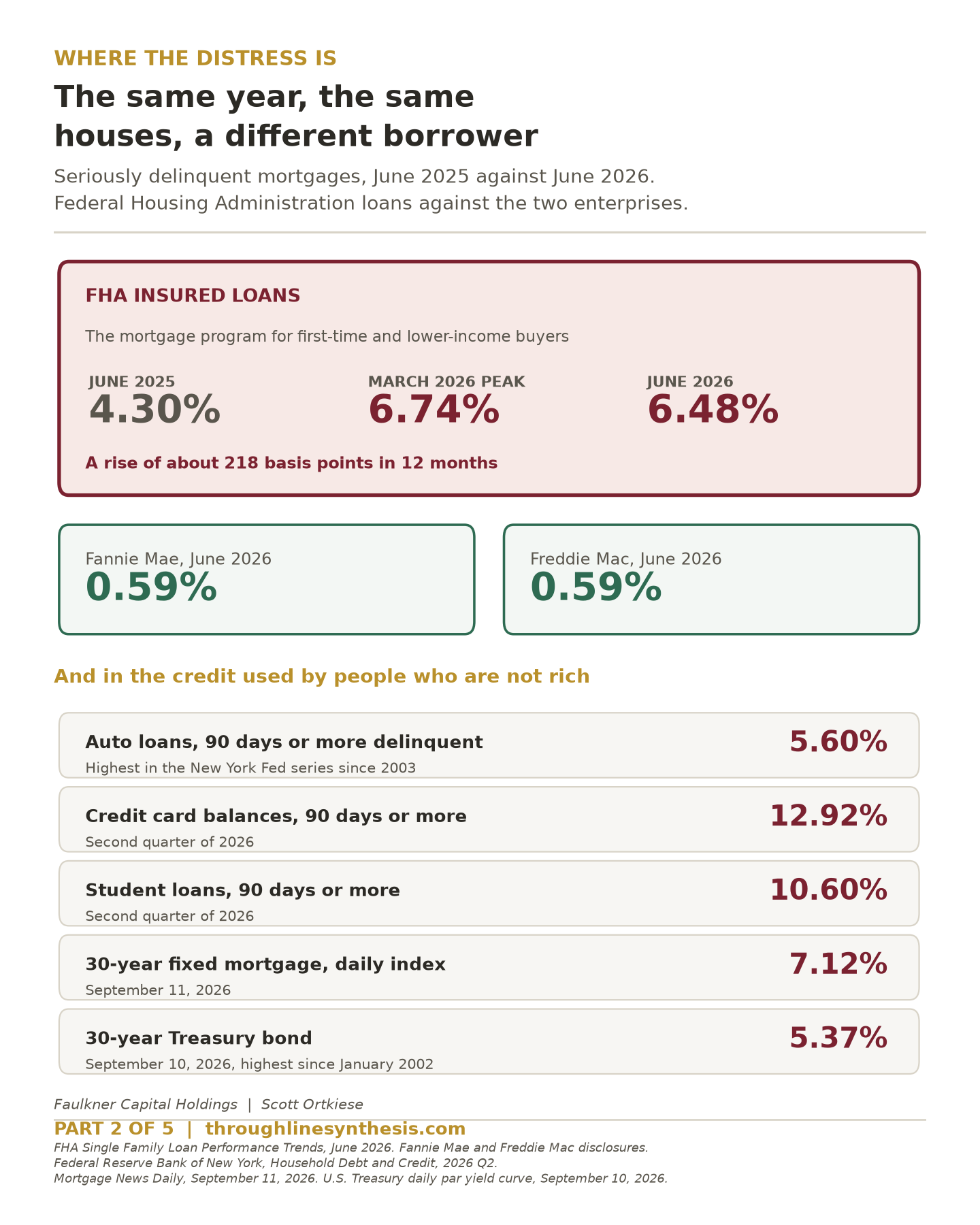
Eighteen months later, the 30-year fixed mortgage stood at 6.76% on September 10, 2026, up from 6.71% the week before and 6.35% a year earlier. On February 6, 2025, he had told CNBC that Trump was focused on the 10-year Treasury yield, which is the number the mortgage is priced off, and that he would not push the Federal Reserve to cut rates. The 10-year closed at 4.96% on September 11, 2026, the highest since 4.98% on October 19, 2023, and it has not closed at or above 5% since July 19, 2007. The 30-year closed at 5.37% on September 10, 2026, the highest since 5.57% on January 4, 2002, which was 24 years ago. On the Friday before this was written, the curve stood at 4.63% at 2 years, 4.96% at 10, and 5.35% at 30.
One note on the mortgage number: the two series in circulation are different instruments, and the difference is about a third of a percentage point. Freddie Mac’s survey is weekly and reported 6.76%. The Mortgage Bankers Association put the 30-year conforming contract rate at 6.85% for the week ending September 4. Mortgage News Daily, which publishes a daily index rather than a weekly survey, had 7.12% on September 11 and 7.17% on September 14. A borrower locking a rate this week is quoted the daily number.
Below the yield curve, in the accounts of people who have no yield curve, the distress is already recorded.
Seriously delinquent loans insured by the Federal Housing Administration, which is the mortgage program for first-time and lower-income buyers, went from 4.30% in June 2025 to 6.48% in June 2026, a rise of about 218 basis points, with a peak of 6.74% in March. Over the same period, the comparable rate was 0.59% at Fannie Mae and 0.59% at Freddie Mac. The same houses, the same job market, the same year. The difference is the borrower.
Auto loans 90 or more days delinquent reached 5.60% of balances in the first quarter of 2026, the highest in the New York Fed’s series since it began in the first quarter of 2003, and 5.49% in the second. Credit card balances 90 or more days delinquent stood at 12.92%, and student loans at 10.60%. Foreclosure starts were up 10% year over year in July, with 4,764 completed foreclosures, up 23%. Total household debt reached $21.4 trillion and was growing at a 5.0% annual rate. However, the New York Fed’s own quarterly count showed the total falling $13 billion in the second quarter, which is the kind of number a defender should cite and which does not touch the delinquency series at all.
A household in the top decile treats a 6.76% mortgage as a reason not to move. A household in the FHA book meets it as the reason the refinance that would have saved the house is not available. That is the whole distance between “negligibly” and 6.48%.
XI. Who the policy was for
Set the two tax changes of this presidency side by side, and the direction of each is unmistakable.
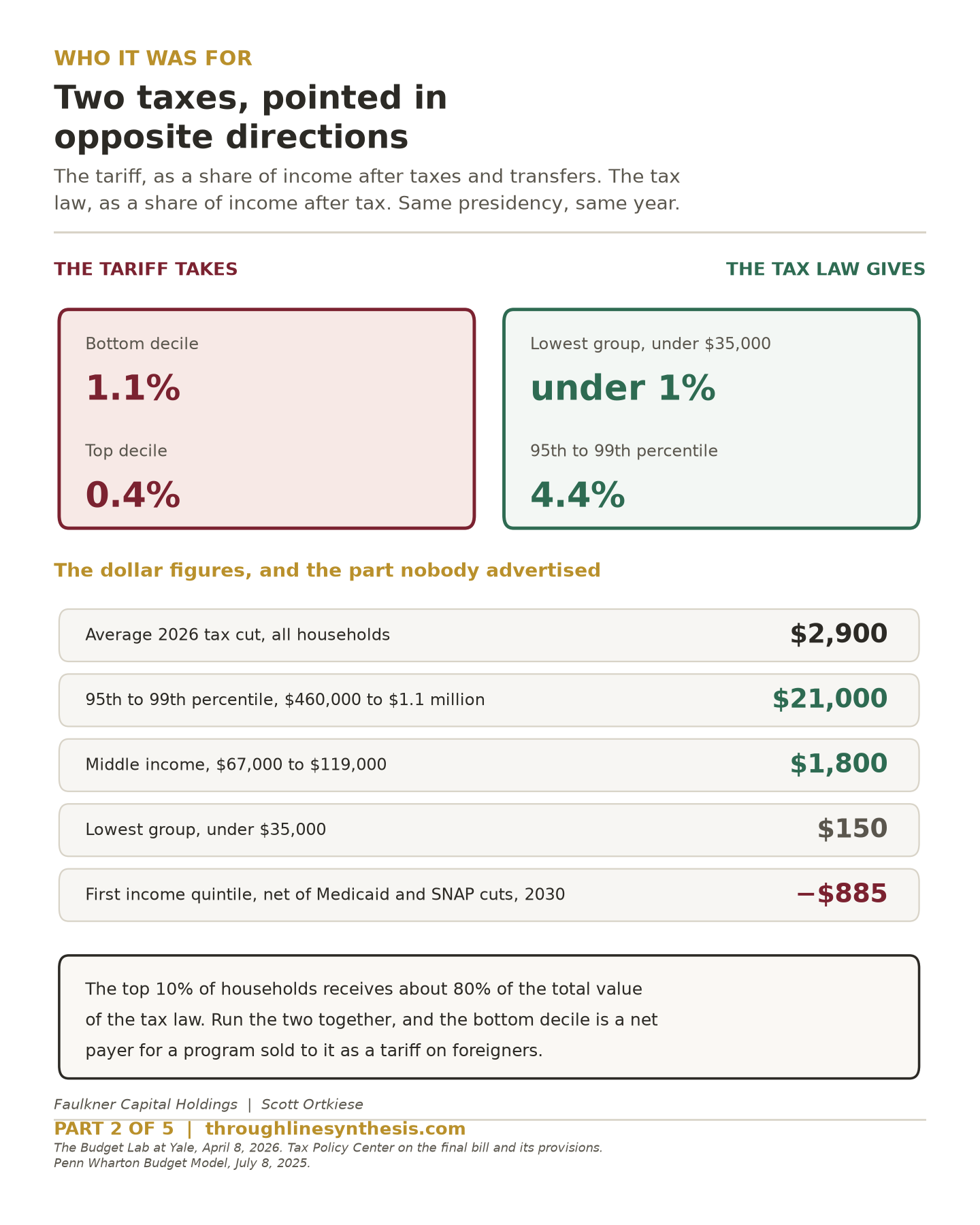
The tariff, as measured by the Yale Budget Lab, took about $517 from the bottom decile (1.1% of income after taxes and transfers) and about $2,175 from the top decile (0.4%).
The tax law ran the other way. The Tax Policy Center put the average 2026 tax cut at about $2,900, with households between the 95th and 99th percentiles, roughly $460,000 to $1.1 million of income, gaining about $21,000, or 4.4% of after-tax income; middle-income households, between roughly $67,000 and $119,000, gaining about $1,800, or 2.3%; and the lowest group, under about $35,000, gaining about $150, which is under 1%. The Penn Wharton Budget Model, which counted the cuts to Medicaid and the Supplemental Nutrition Assistance Program alongside the tax provisions, found that households in the first income quintile lose about $885 in 2030, while the top 10% receives about 80% of the total value of the legislation.
One tax took 1.1% from the bottom tenth. The other gave under 1% to the bottom fifth and 4.4% to the households just below the very top. Together, the bottom decile is a net payer for a program sold to it as a tariff on foreigners.
The money’s destination shows up in the price of financial assets. Robert Shiller’s cyclically adjusted price-to-earnings ratio for the S&P 500 stood at 40.58 in September 2026, which is 2.28 times its 1881 to 2026 average of 17.79, above the 1929 peak of 32.56, and about 8% below the December 1999 record of 44.20. Margin debt in customer accounts reached $1.417 trillion in July 2026, up 38.6% year over year, roughly 4.4% of gross domestic product.
Which returns the argument to Suozzi’s two numbers. If 93% of the stock is held by the top 10% of households and 50% of Americans hold 1% of it, then a policy mix that transfers 1.1% of income from the bottom decile and delivers 4.4% to households near the top, in a market trading at 2.28 times its long-run valuation on record margin debt, is not a K and it is not a C. It is a transfer, and it is working as designed.
XII. When the price of credit would not cooperate, they went after the people who set it
The one price this government could not talk down was the long Treasury yield, because it is set by people who are under no obligation to believe anybody. So the pressure moved to the institution that sets the short rate.
On July 21, 2025, Bessent told CNBC: “What we need to do is examine the entire Federal Reserve institution and whether they have been successful. Has the organization succeeded in its mission? If this were the [Federal Aviation Administration] and we were having this many mistakes, we would go back and look at why has this happened.” In January 2026, he called Chair Jerome Powell’s attendance at the Supreme Court argument on Federal Reserve independence a “mistake” and said Powell was “politicizing the Fed”. On February 5, 2026, he declined to rule out a lawsuit against Powell’s successor, Kevin Warsh.
The Justice Department opened a criminal investigation of Powell over the renovation of the Federal Reserve’s headquarters. In March 2026, Chief Judge James Boasberg quashed the subpoenas, holding that “the government has offered no evidence whatsoever that Powell committed any crime other than displeasing the president”. The Department dropped the matter in April.
Trump had already tried to remove Governor Lisa Cook outright in a letter dated August 25, 2025. The Supreme Court decided the case on June 29, 2026, by 5 votes to 4, on the narrow ground that the President had failed to give Cook the procedural protections the statute requires. The reasoning is worth the space it takes, because it is the majority telling this administration what it was doing. In the words of the slip opinion, the question is whether the cause assigned truly implies “an unfitness for the place” or merely reflects an effort to secure a “more congenial” replacement, since otherwise “any perceived or alleged misstep (past or present) could provide a ready pretext for a Governor’s removal. Nothing could be more corrosive of the independence that Congress sought to preserve.”
And then the same Secretary who spent a year attacking the Federal Reserve’s independence went to the Federal Reserve to protect an American interest rate from an American war.
When the yen hit 40-year lows, Treasury conducted its first yen-buying intervention alongside Tokyo in more than a decade, beginning in late July 2026. Bessent told Senator Elizabeth Warren, in writing: “Treasury exchanged existing Exchange Stabilization Fund foreign-currency assets for yen. No new congressional appropriation was involved, and no credit was extended to Japan. Japan owes Treasury nothing.” Separately, he pressed Warsh’s Federal Reserve to expand the FIMA Repo Facility, the standing arrangement that lets foreign central banks borrow dollars against their Treasury holdings instead of selling them, which carries a $60 billion per-counterparty limit, so that Japan could raise dollars without selling Treasuries, because selling them “could push yields higher, adding pressure to U.S. borrowing costs.” He said he would do “whatever it takes” to support Japan. Japan spent a record 15.4 trillion yen ($96.5 billion) in a single month.
Read that in the order it happened. He spent a year arguing that the Federal Reserve should be audited like a failing air traffic control system. Then he asked it to widen a dollar facility so an ally would not have to dump the bonds that price the American mortgage. He understood the transmission mechanism perfectly the whole time. He denied it existed when the question was tariffs.
XIII. The bill
Total public debt reached $40.05 trillion on September 10, 2026, up $3.83 trillion since inauguration week. On August 20, 2026, on CNBC, Bessent said there is nothing magic about the $40 trillion number.
The magic is in the carry. Net interest for fiscal 2025 ran about $970 billion, 3.2% of gross domestic product, a record share. In the first 10 months of fiscal 2026, net interest was $963 billion, up $117 billion, or 14%, year over year; against receipts of $4,485 billion in the same period, that is 21.5% of every dollar the government collected. In the first three months of fiscal 2026, net interest of $270.3 billion exceeded the $266.9 billion spent on national defense. The country now pays more to rent its past than to arm its present.
The deficit ran $2.0 trillion in the first 11 months of fiscal 2026, $82 billion worse than the same period a year earlier after adjusting for payment-timing shifts, against the Congressional Budget Office’s full-year estimate of $2.1 trillion. On June 3, 2026, Bessent told Senate Finance he would like to see “something with a three in terms of deficit to GDP by the time the president leaves.”
The tariff was supposed to pay for this. It delivered $195 billion in fiscal 2025 against a promise of $300 billion to $600 billion a year, and after the Supreme Court struck the authority, collections came in about $250 billion below projection.
It also did not fix the trade account. The 2025 goods trade deficit set a record at $1.24 trillion, with the bilateral deficit with China cut roughly in half while the deficit with Mexico nearly tripled, which is what happens when you tax a route rather than a behavior. China’s 2025 trade surplus set its own record at $1.189 trillion. The July 2026 American deficit came in at $88.6 billion, up $17.4 billion in a single month, the largest since March 2025.
Higher prices, lower revenue than promised, a larger trade deficit, a bigger debt, and an interest bill that outgrew the Pentagon. That is the return on the instrument.
XIV. The verdict, and the limits of it
Say the things that cut against the case, because a case that cannot survive them is not worth making.
The labor market is not cracking in the aggregate. Initial claims were 206,000 in the week ending September 5, 2026. The layoff and discharge rate in the Job Openings and Labor Turnover Survey has been range-bound at 1.0% to 1.2% all year. Challenger, Gray and Christmas counted 529,914 announced cuts from January through August 2026, down 41% from the 892,362 of the same period in 2025, though August alone was 58% above July. Core inflation at 2.4% is the lowest since March 2021. American natural gas is cheaper than a year ago. Grocery inflation slowed to 2.2%. Household debt fell $13 billion in the second quarter.
So this is not a general collapse, and nobody should sell it as one.
It is something more specific and harder to argue with. The damage is concentrated, and it is concentrated precisely where the two named men made their decisions: in distillate fuel, which crossed $6 a gallon for the first time; in ocean freight, where war risk cover went from 0.25% to 10%; in farm inputs, where anhydrous ammonia is up 22%; in long-term interest rates, where the 30-year Treasury closed at its highest level in 24 years; and in the credit used by people who are not rich, where FHA serious delinquency went from 4.30% to 6.48% and auto delinquency set a record in a 23-year series.
Which brings it back to the hearing room, four hours in, on Thursday, June 4, 2026.
Asked whether a war ordered by the President of the United States raised the price of gasoline, the Secretary of the Treasury said “100%,” and he was right.
Asked whether a tariff collected by the Secretary of the Treasury raised prices, he said “negligibly,” and the Federal Reserve Bank of New York had already published the number, at nearly 90%, four months before he said it.
He is not confused about incidence. He wrote the correct answer to his own investors in 2024, when being wrong would have cost him money. He is confused about nothing. He simply now works for the man whose name is on the tariff, and the letter he wrote for money has been replaced by the answer he gives for free.
A standard objection applies to everything above, and it deserves a straight answer. Every politician lies, and a reader who has heard it about this president has heard it about every president since the invention of the telegraph. The objection is fair as far as it goes. It does not go far enough.
This article does not charge that these men exaggerate. It is narrower, harsher, and checkable. A statement is in the inventory only when a dated document contradicts it: a Federal Reserve Bank research paper, a Treasury auction result, an Energy Information Administration price series, a Bureau of Labor Statistics release, an inspector general’s findings, a foreign government’s own denial, a Supreme Court order, or the speaker’s own earlier words. Not a disputed interpretation. Not a forecast that failed. A number against a number, with both links printed.
On that standard, the count is 130; the category that requires no outside authority runs to 15 entries in which the speaker contradicts himself, and the most damaging entries are those where the contradicting document was produced by the government he runs. The Treasury Secretary said he had not bought anything while his own Department published the purchases. The Secretary of War said the investigation exonerated him while the investigation said he transmitted strike times for manned aircraft over hostile territory. The President said the strait was completely open and, six days later, sealed up tight.
And there is the matter of what happens after the correction. A man who makes honest mistakes makes fewer of them once he is shown the evidence. The Washington Post counted this one daily for four years, and the rate rose every year it was measured, from about 6 a day to about 39. Correction did not slow him down. It taught him that nothing follows from being caught.
Which returns the argument to the question Suozzi actually asked, and to the reason it was worth an article. Most of what a government says cannot be settled, because most of it is about the future or about intent. This could be settled. The Federal Reserve Bank of New York measured it, published it on February 12, and put the figure at nearly 90%. Four months later, the Secretary of the Treasury sat in a hearing room and said “negligibly.”
He was not guessing. The number was on his own system’s website.
Sources
The record of lies. PolitiFact scorecard, Donald Trump, retrieved September 14, 2026: https://www.politifact.com/personalities/donald-trump/ | Barack Obama: https://www.politifact.com/personalities/barack-obama/ | Joe Biden: https://www.politifact.com/personalities/joe-biden/ | Hillary Clinton: https://www.politifact.com/personalities/hillary-clinton/ | JD Vance: https://www.politifact.com/personalities/jd-vance/ | Glenn Kessler, Salvador Rizzo and Meg Kelly, “Trump’s false or misleading claims total 30,573 over four years,” Washington Post, January 24, 2021: https://www.washingtonpost.com/politics/2021/01/24/trumps-false-or-misleading-claims-total-30573-over-four-years/ | Washington Post Fact Checker database: https://www.washingtonpost.com/graphics/politics/trump-claims-database/ | Duke Reporters’ Lab, 2026 fact-checking census, June 12, 2026, recording the closure of the Post’s Fact Checker column and the growth of the field from 64 projects in 2015 to about 440: https://reporterslab.org/2026/06/12/2026-census-fact-checking-losses-continue-amid-funding-pressure-but-most-projects-persist/ | David Folkenflik, NPR, on Kessler’s departure, July 31, 2025: https://www.npr.org/2025/07/31/1256500282/fact-checker-washington-post-truth-trump-pinocchios | On the limits of comparing fact-check databases, PLOS ONE, 2023, finding 22.6% disagreement on claim selection and conflict on only 1 of 64 shared verdicts: https://journals.plos.org/plosone/article?id=10.1371/journal.pone.0289004 | On prominence rather than party predicting who is fact-checked, PNAS Nexus: https://pmc.ncbi.nlm.nih.gov/articles/PMC11732390/ | Department of Defense Inspector General report on the Secretary’s use of Signal, full text: https://www.pbs.org/newshour/world/read-the-full-report-on-hegseths-use-of-signal-from-the-pentagon-inspector-general
The satellite evidence. Strike imagery from Planet Labs published by CNN, September 11, 2026: https://www.cnn.com/2026/09/11/politics/saudi-arabian-oil-pipeline-hit-by-projectiles-triggering-fires | Geolocation of the two struck pumping stations by Geoff Brumfiel of NPR: https://x.com/gbrumfiel/status/2098469299643875700 | NASA Fire Information for Resource Management System, MODIS and VIIRS active fire detections, archive download: https://firms.modaps.eosdis.nasa.gov/download/ | Copernicus Sentinel-1 and Sentinel-2 scenes via the Copernicus Data Space Ecosystem, processed by the author: https://dataspace.copernicus.eu/ | Hormuz transit counts, Reuters, September 11, 2026: https://www.reuters.com/world/middle-east/hormuz-shipping-traffic-falls-single-digits-data-shows-2026-09-11/ | Kpler on the strait’s traffic recovery and relapse: https://www.kpler.com/blog/what-the-strait-of-hormuzs-fragile-recovery-signal-means-for-oil-flows-and-prices
The hearing. House Committee on Ways and Means, full committee hearing with Treasury Secretary Scott Bessent, Thursday, June 4, 2026: https://waysandmeans.house.gov/event/full-committee-hearing-with-treasury-secretary-scott-bessent-2/ | Bessent written testimony, June 4, 2026: https://waysandmeans.house.gov/wp-content/uploads/2026/06/Ways-and-Means-Testimony-Sec.-Bessent-06042026.pdf | Senate Finance Committee, the President’s fiscal year 2027 budget for the Department of the Treasury, June 3, 2026, full transcript: https://www.rev.com/transcripts/senate-finance-committee-hearing-ftmy9 | Bessent written statement to House Financial Services, February 4, 2026: https://docs.house.gov/meetings/BA/BA00/20260204/118925/HHRG-119-BA00-Wstate-BessentS-20260204.pdf
Who pays a tariff. Amiti, Flanagan, Heise, and Weinstein, “Who Is Paying for the 2025 U.S. Tariffs?”, Federal Reserve Bank of New York, February 12, 2026: https://libertystreeteconomics.newyorkfed.org/2026/02/who-is-paying-for-the-2025-u-s-tariffs/ | “More Tariff Pass-Through Is in the Pipeline,” Federal Reserve Bank of New York, July 8, 2026: https://libertystreeteconomics.newyorkfed.org/2026/07/more-tariff-pass-through-is-in-the-pipeline/ | Peterson Institute for International Economics, who pays tariffs: https://www.piie.com/blogs/realtime-economics/2026/who-pays-tariffs-insights-recent-research | Bureau of Labor Statistics, import price indexes exclude duties: https://www.bls.gov/mxp/questions-and-answers.htm | BLS import and export price indexes news release: https://www.bls.gov/news.release/ximpim.htm and Table 7: https://www.bls.gov/news.release/ximpim.t07.htm | Congressional Budget Office on the average effective tariff rate: https://www.cbo.gov/publication/62704
Household cost. Yale Budget Lab, April 8, 2026: https://budgetlab.yale.edu/sites/default/files/page_to_pdf/1466/publication_1466.pdf | Tax Foundation, Trump tariffs and the trade war: https://taxfoundation.org/research/federal-tax/trump-tariffs-trade-war/ | Tax Policy Center, June 2026: https://taxpolicycenter.org/sites/default/files/2026-06/tariff%20credit_June%2026.pdf | Joint Economic Committee Democratic staff, cost of tariffs for families: https://www.jec.senate.gov/public/_cache/files/7cc03e65-d40a-465f-9e88-09dd53d3502f/jec-fact-sheet-on-cost-of-tariffs-for-families-update.pdf
Prices. BLS Consumer Price Index summary, released September 11, 2026: https://www.bls.gov/news.release/cpi.nr0.htm and Table 2: https://www.bls.gov/news.release/cpi.t02.htm | EIA weekly on-highway diesel: https://www.eia.gov/dnav/pet/hist/LeafHandler.ashx?n=pet&s=emd_epd2d_pte_nus_dpg&f=W | EIA weekly regular gasoline: https://www.eia.gov/dnav/pet/hist/LeafHandler.ashx?n=pet&s=emm_epmr_pte_nus_dpg&f=W | Reuters on diesel crossing $6, September 10, 2026: https://www.reuters.com/business/energy/us-average-diesel-prices-cross-6-gallon-first-time-gasbuddy-says-2026-09-10/ | AAA daily national averages for regular gasoline and diesel: https://gasprices.aaa.com/ | EIA Henry Hub spot: https://www.eia.gov/dnav/ng/hist/rngwhhdm.htm
The war and the strait. Trump War Powers letter to Congress, March 2, 2026: https://assets.ctfassets.net/6hn51hpulw83/5edNAbR7EeCaJ0clRleAyA/5950549daa05588a0bd2790c7b37f9b3/20260302_Trump.pdf | NPR, February 28, 2026: https://www.npr.org/2026/02/28/nx-s1-5730158/israel-iran-strikes-trump-us | Associated Press, February 28, 2026: https://apnews.com/article/iran-us-explosion-tehran-c2f11247d8a66e36929266f2c557a54c | Britannica, 2026 Iran war: https://www.britannica.com/event/2026-Iran-war | International Energy Agency, Strait of Hormuz: https://www.iea.org/about/oil-security-and-emergency-response/strait-of-hormuz | IEA, the Middle East and global energy markets, August 12, 2026: https://www.iea.org/topics/the-middle-east-and-global-energy-markets | Institute for Energy Research on the EIA disruption data: https://www.instituteforenergyresearch.org/fossil-fuels/gas-and-oil/new-eia-report-shows-extent-of-hormuz-oil-disruptions/ | S&P Global Commodity Insights on war risk insurance, March 30, 2026: https://www.spglobal.com/energy/en/news-research/latest-news/shipping/033026-war-risk-insurance-cost-off-highs-but-still-elevated-in-persian-gulf | Insurance Business, September 2, 2026: https://www.insurancebusinessmag.com/us/news/marine/hormuz-warrisk-rates-face-fresh-pressure-as-iranus-clashes-resume-588288.aspx | Deutsche Welle on Iran’s passage charges: https://www.dw.com/en/iran-us-war-strait-of-hormuz-shipping-oil/a-76503935 | Bloomberg, March 24, 2026: https://www.bloomberg.com/news/articles/2026-03-24/iran-charges-some-ships-hormuz-transit-fees-for-safe-passage | Reuters, Hormuz shipping traffic, September 11, 2026: https://www.reuters.com/world/middle-east/hormuz-shipping-traffic-falls-single-digits-data-shows-2026-09-11/ | FreightWaves on the $5.3 million Panama slot: https://www.freightwaves.com/news/5-3-million-a-new-record-for-panama-canal-transit | Seoul Economic Daily, August 13, 2026: https://en.sedaily.com/international/2026/08/13/panama-canal-toll-auctions-hit-record-11-million | Al Jazeera, September 3, 2026: https://www.aljazeera.com/news/2026/9/3/panama-canal-restricts-traffic-amid-hormuz-crisis-why-this-matters
Fertilizer and layoffs. International Fertilizer Association, March 16, 2026: https://www.fertilizer.org/news/protect-fertilizer-supply-chains-to-safeguard-global-food-security/ | farmdoc daily, University of Illinois, fertilizer and fuel prices heading into fall 2026: https://farmdocdaily.illinois.edu/2026/08/fertilizer-and-fuel-prices-higher-heading-into-fall-2026.html | WBRZ on the Mosaic layoffs: https://www.wbrz.com/news/over-200-mosaic-employees-laid-off-at-two-facilities-amid-sulfur-supply-shortage/ | NewsNation on Tyson: https://www.newsnationnow.com/business/tyson-laying-off-3k-employee-closures-illinois-utah/ | Reuters on Phillips 66: https://www.reuters.com/business/energy/phillips-66-cut-jobs-los-angeles-refinery-shuts-bloomberg-news-reports-2026-02-05/ | Peoria Journal Star on Alton Steel: https://www.pjstar.com/story/news/state/2026/02/08/illinois-company-under-investigation-after-closure-and-mass-layoffs/88546889007/ | News4Jax on BAE Systems: https://www.news4jax.com/news/local/2026/06/11/bae-systems-lays-off-nearly-200-jacksonville-workers/
Household credit. Freddie Mac Primary Mortgage Market Survey, September 10, 2026: https://freddiemac.gcs-web.com/news-releases/news-release-details/mortgage-rates-average-676 | FHA single family loan performance trends, June 2026: https://www.hud.gov/sites/default/files/Housing/documents/FHALPT_JUN2026.pdf | Fannie Mae monthly summary: https://www.fanniemae.com/media/58046/display | Freddie Mac investor disclosures: https://www.freddiemac.com/investors | Federal Reserve Bank of New York, Household Debt and Credit, 2026 Q2 data: https://www.newyorkfed.org/medialibrary/interactives/householdcredit/data/xls/HHD_C_Report_2026Q2.xlsx | HousingWire on ATTOM July foreclosure filings: https://www.housingwire.com/articles/foreclosure-filings-july-attom/ | Federal Reserve Z.1 recent developments: https://www.federalreserve.gov/releases/z1/current/recent_developments.htm | CNBC on the 30-year Treasury, August 18, 2026: https://www.cnbc.com/2026/08/18/treasury-yields-.html | CNBC on the 10-year, September 2026: https://www.cnbc.com/2026/09/02/bond-yields-treasurys-inflation.html
Distribution and valuation. Tax Policy Center on the final bill: https://taxpolicycenter.org/taxvox/tpc-finds-final-house-budget-bill-cuts-average-taxes-2900-mostly-high-income-households | Tax Policy Center, what the tax provisions will really do: https://taxpolicycenter.org/taxvox/what-will-tax-provisions-big-budget-bill-really-do | Penn Wharton Budget Model, July 8, 2025: https://budgetmodel.wharton.upenn.edu/p/2025-07-08-president-trump-signed-reconciliation-bill/ | Robert Shiller, online data, cyclically adjusted price-to-earnings ratio: https://img1.wsimg.com/blobby/go/e5e77e0b-59d1-44d9-ab25-4763ac982e53/downloads/70fec4f5-727f-4e53-b5f1-179af109c5fa/ie_data.xls?ver=1788371540009 | FINRA margin statistics: https://www.finra.org/rules-guidance/key-topics/margin-accounts/margin-statistics
Bessent on tariffs, and on the Federal Reserve. Fortune on the February 4, 2026, hearing and the Key Square letter: https://fortune.com/2026/02/04/scott-bessent-trump-tariffs-inflation-maxine-waters-hearing/ | New York Times, November 26, 2025: https://www.nytimes.com/2025/11/26/business/scott-bessent-inflation.html | Yahoo Finance, March 6, 2025: https://finance.yahoo.com/news/bessent-i-am-not-worried-about-inflation-from-trumps-tariffs-191734298.html | Mothership on “eat any tariffs”: https://mothership.sg/2025/03/us-china-tariffs-eat/ | Wall Street Journal live coverage, June 12, 2025: https://www.wsj.com/livecoverage/stock-market-today-trump-tariffs-trade-war-06-12-2025/card/bessent-democrats-have-tariff-derangement-syndrome–lJWZqnTyfdtFFIxlIKl2 | Reuters text via Yahoo Finance, February 4, 2026: https://finance.yahoo.com/news/treasurys-bessent-says-wrong-said-175515951.html | Treasury press release, April 7, 2025: https://home.treasury.gov/news/press-releases/sb0073 | CNBC, February 6, 2025: https://www.cnbc.com/2025/02/06/bessent-says-trump-is-focused-on-the-10-year-yield-wont-push-fed-to-cut-rates.html | Manausa on the housing remark, March 10, 2025: https://www.manausa.com/blog/housing-market-will-unfreeze-in-weeks/ | Banking Dive, July 21, 2025: https://www.bankingdive.com/news/fed-review-treasury-bessent-powell-trump/753581/ | New York Times, January 20, 2026: https://www.nytimes.com/2026/01/20/us/politics/bessent-powell-supreme-court-fed.html | Bloomberg video, January 21, 2026: https://www.bloomberg.com/news/videos/2026-01-21/powell-is-politicizing-the-fed-bessent-says | Politico, February 5, 2026: https://www.politico.com/live-updates/2026/02/05/congress/bessent-fed-chair-lawsuit-00767130 | Jurist on the Powell investigation: https://www.jurist.org/news/2026/04/doj-drops-criminal-investigation-of-fed-chair-jerome-powell-refers-matter-to-inspector-general/ | Letter to Governor Lisa Cook, August 25, 2025: https://www.presidency.ucsb.edu/documents/letter-federal-reserve-governor-lisa-cook-notifying-her-her-dismissal-from-office | Supreme Court of the United States, Trump v. Cook, slip opinion: https://www.supremecourt.gov/opinions/25pdf/25a312_5468.pdf
The yen intervention. CNBC, August 1, 2026: https://www.cnbc.com/2026/08/01/us-treasury-intervenes-to-support-yen-after-japan-steps-in-ft.html | CNBC on Bessent’s written answer to Senator Warren, August 28, 2026: https://www.cnbc.com/2026/08/28/bessent-warren-yen-intervention-treasury-japan.html | CNBC on the FIMA repo facility, August 3, 2026: https://www.cnbc.com/2026/08/03/bessent-fed-japan-yen-fima-repo-facility.html | Reuters, August 4, 2026: https://www.reuters.com/business/us-treasurys-bessent-reasonable-fed-consider-upsizing-fima-2026-08-04/ | Reuters, “whatever it takes,” August 4, 2026: https://www.reuters.com/world/asia-pacific/us-treasury-secretary-bessent-will-do-whatever-it-takes-support-japan-2026-08-04/ | Reuters on Japan’s record intervention, August 28, 2026: https://www.reuters.com/world/asia-pacific/japan-spent-record-965-billion-support-yen-over-past-month-ministry-data-shows-2026-08-28/
Debt, deficits, and trade. Treasury Fiscal Data, Debt to the Penny: https://fiscaldata.treasury.gov/datasets/debt-to-the-penny/ | CNBC, August 20, 2026: https://www.cnbc.com/2026/08/20/bessent-budget-deficit-trump.html | Committee for a Responsible Federal Budget on the CBO February 2026 outlook: https://www.crfb.org/papers/cbos-february-2026-budget-and-economic-outlook | CBO Monthly Budget Review, July 2026: https://www.cbo.gov/system/files/2026-08/61983-2026-07-MBR.pdf | CBO Monthly Budget Review, August 2026: https://www.cbo.gov/publication/61984 | Anadolu Agency on interest exceeding defense: https://www.aa.com.tr/en/economy/us-interest-payments-exceed-defense-spending/3812997 | The Center Square on fiscal 2025 customs revenue: https://www.thecentersquare.com/national/article_ccfe605f-43ee-460b-b6d7-061c6da14985.html | Forbes on the record 2025 trade deficit: https://www.forbes.com/sites/kenroberts/2026/02/19/new-data-2025-us-trade-set-record-at-559-trillion-despite-tariffs/ | Reuters on China’s record 2025 surplus: https://www.reuters.com/world/china/chinas-trade-ends-2025-with-record-trillion-dollar-surplus-despite-trump-tariffs-2026-01-14/ | Census Bureau FT900, July 2026: https://www.census.gov/foreign-trade/Press-Release/current_press_release/ft900.pdf
Counter-evidence. Department of Labor unemployment insurance claims: https://www.dol.gov/ui/data.pdf | JOLTS layoffs and discharges rate: https://fred.stlouisfed.org/series/JTSLDR | Challenger, Gray and Christmas, August 2026 report: https://www.challengergray.com/wp-content/uploads/2026/09/Challenger-Report-August-2026.pdf
Contact: so@throughlinesynthesis.com