

Scott Ortkiese | Throughline Synthesis | Houston, October 23, 2026
Updated October 23, 2026. Market observations and management statements retain their individual dates. Offering plans and scenarios below are not completed events.
Anthropic’s planned initial public offering could turn November’s political uncertainty into a concrete test of AI financing. Reuters reports that the company intends to market its shares during the week of November 9 and go public in mid-November, with a public prospectus possible in late October; the schedule remains provisional, and Anthropic declined to comment1.
A recent conversation with 2 colleagues sharpened the question behind this article: could the midterms, arriving immediately before that offering, change the market’s willingness to finance the AI buildout? My answer is yes, as a testable possibility, not a prediction that an election result automatically stops government borrowing or collapses an IPO.
The real question is not whether investors applaud another extraordinary valuation. It is whether new investors supply enough usable cash, on sustainable terms, to support commitments already made, and whether that money reaches companies beyond the strongest issuer.
That offers something more useful than another declaration that AI is a bubble. This article follows the sequence from political expectations to financing terms, from financing to contractual payments, and from missed expectations to the institutions and households carrying the risk.
But following the money cannot stop at the borrower. The larger question is how capital owners, asset managers, specialist funds, financial markets, and distributors turn an investment story into claims on future income, and how political support helps sustain that process. The standard is not simply whether AI produces useful services. It is whether the private returns being promoted justify the resources committed, the alternatives displaced, and the risks transferred to people farther down the chain. The inquiry includes the industry’s supporters, investors, political allies, and increasingly organized opponents, as well as businesses competing with the buildout for capital and essential resources.
The election changes expectations before it changes Congress
Even if Democrats win both chambers, the new congressional terms do not begin until January 3, 20272. The federal debt limit concerns borrowing to meet existing legal obligations, not authorization of new spending3. An election result is therefore not, by itself, a debt-limit deadline or an immediate legal prohibition on borrowing.
The more credible near-term mechanism is repricing. Investors could revise expectations about spending, regulation, permitting, public guarantees, or future fiscal confrontation before any law changes. Those are separate channels, not interchangeable versions of a government debt halt.
The direction is not predetermined. An outcome already anticipated may move markets little; an unexpected outcome may matter more. Credit spreads, the extra compensation lenders demand for risk, can widen even if benchmark Treasury yields fall. A falling Treasury yield would not, on its own, show that AI financing has become easier.
The risk window also extends beyond election night. The New York Times reports planning for renewed US and Israeli strikes on Iran after the election, while explicitly noting that Trump has not necessarily approved them; it also reports Iranian threats against regional data centers and underwater cables4.
That is a scenario to investigate, not a forecast of war. For each relevant project, the questions are practical: where is it, what powers it, what interrupts delivery, and who pays under force majeure, outage, cancellation, and insurance clauses? A geopolitical shock could affect energy costs, construction schedules, and financing independently of congressional control.
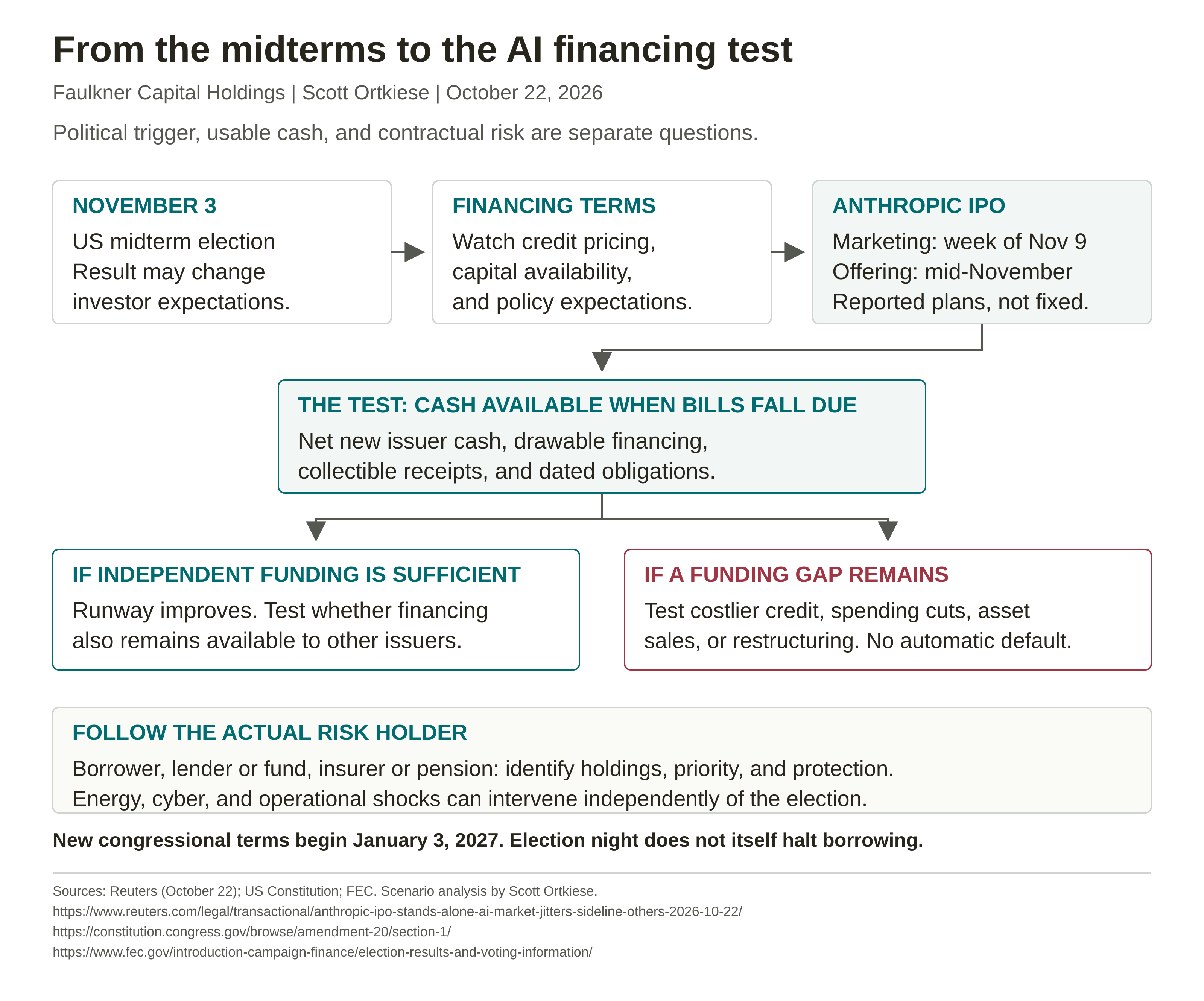
The companion to the neocloud map separates the political event, the funding test, and possible loss transmission. Arrows describe hypotheses to test, not an inevitable sequence; the IPO dates are reported plans5; 6.
A valuation does not pay the bills
The offering’s financing value depends on the cash it puts into the business, not the value assigned to all its shares. Money paid for newly issued shares can finance the issuer; money paid for existing shares goes to the selling holders7. The cash available to the company must also reflect fees and expenses rather than treat gross proceeds as fully available.
The necessary comparison is a dated cash schedule: opening unrestricted cash, net primary proceeds, collectible operating receipts, and financing that is contractually available to draw. The corresponding uses are operating payments, equipment purchases, leases, interest, principal, and other enforceable commitments. A total commitment is not necessarily due immediately, and a projected revenue figure is not cash already collected.
The offering documents must answer 4 questions:
- New money: How much reaches Anthropic, rather than selling shareholders, and when?
- Independent demand: How much investment and customer spending comes from parties outside the same supplier, investor, and customer network?
- Cash runway: Which obligations become payable before the next financing round or refinancing, and under what conditions?
- Economic return: What remains after serving customers and replacing equipment, rather than before those costs?
A strong offering could strengthen Anthropic without reopening financing for weaker operators. Reuters reports that some other issuers are reluctant to compete with Anthropic for investors’ attention and capital, and that Nscale’s delay was partly attributable to SEC comments8. Neither a successful Anthropic IPO nor a delayed rival offering supplies a verdict on the entire sector.
The thesis must also be capable of failing. Substantial independent equity, manageable dated obligations, improving cash generation, and continued financing access elsewhere would weaken the argument that this event exposes a system-wide funding break. A disappointing offering would strengthen scrutiny, but it would not itself constitute a default.
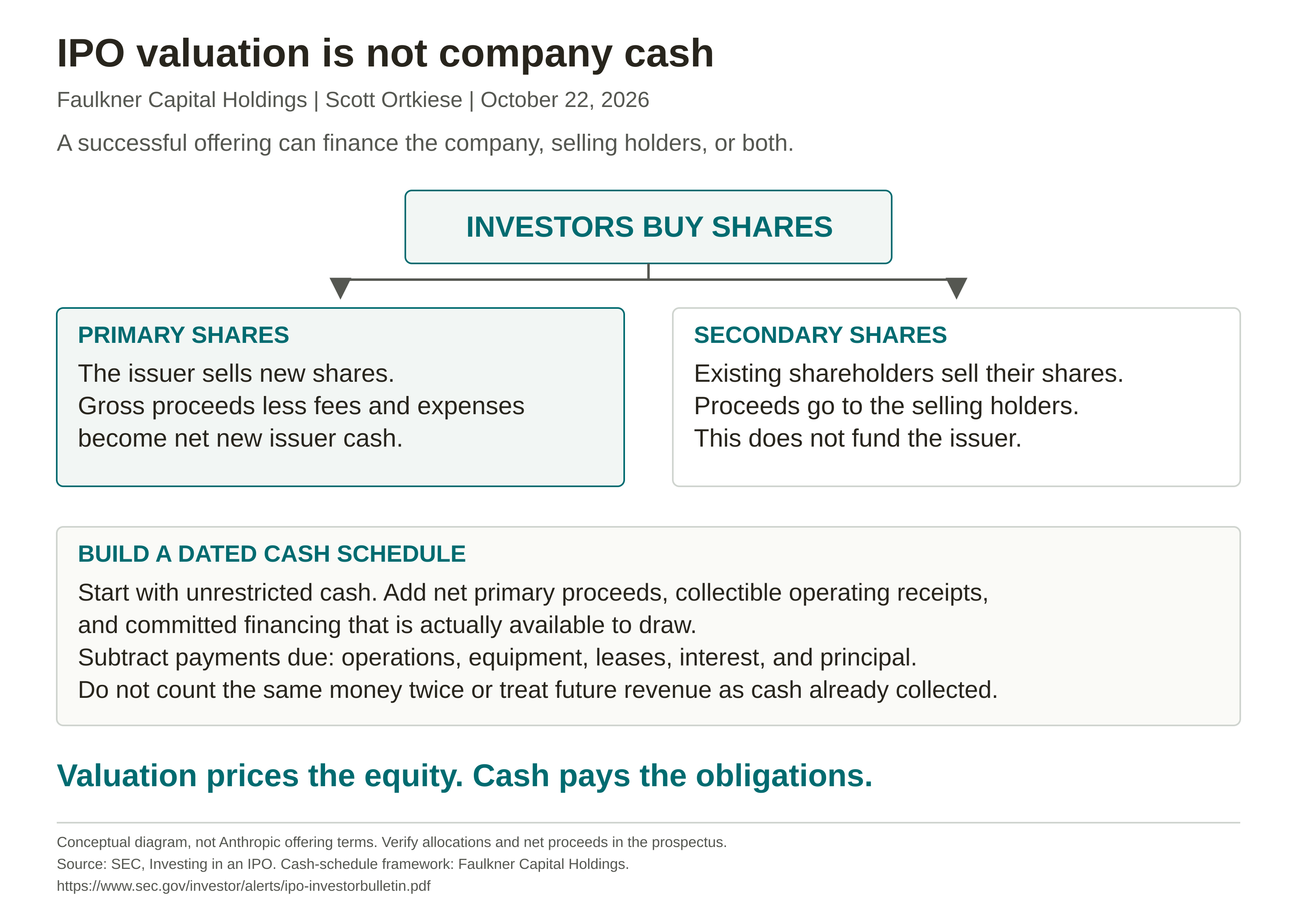
A conceptual cash-flow diagram, not an estimate of Anthropic’s offering proceeds. The primary/secondary allocation and final terms must be established from the offering documents.
Gray is a participant, not a referee
Blackstone President and Chief Operating Officer Jon Gray’s October 22 interview with Bloomberg belongs inside this investigation, not above it as an independent verdict. He describes a strong AI business with demand outstripping the ability to deliver capacity, while acknowledging the difficulty of assembling capital, power, chips, and data centers9. My reading is that this is a participant’s justification of the buildout and its financing, which should be tested using the terms on which that participant supplies capital.
The commercial connection is explicit. Blackstone, Anthropic, Hellman & Friedman, and Goldman Sachs announced an enterprise AI-services venture intended to serve investment-firm portfolio companies and independent customers10. The relevant inquiry follows the customer’s money, the service contract, the financing, and the return to each participant. An affiliated customer can buy something useful without its spending becoming independent evidence that the entire investment chain is sound.
Gray cites portfolio-company spending on models rising 20-fold year over year and deliverable compute commanding prices 50% above a year earlier11. Those claims need their cohorts, baselines, costs, and cash consequences. A shortage can support current prices without validating every acquisition price, debt maturity, collateral assumption, or promised investment return. Demand is not a waiver of financial discipline.
His discussion of Anthropic’s proposed IPO is especially revealing. He connects public-market standing and credit ratings with easier financing and reduced reliance on hyperscalers12. That identifies a second financing channel beyond net primary proceeds: the ability to support borrowing and contracts on the issuer’s own credit. It is not automatic; S&P’s corporate framework examines business risk, cash flow, leverage, liquidity, and other factors, not public status alone13.
The investigation must therefore follow both the sale of the story and the allocation of the risk. Compare promotional claims with underwriting documents, fees, asset sales, distributions, and the exposure retained after a transaction. Who receives cash now? Who must wait for the promised operating return? Who can exit, and who remains exposed? These are the records needed to test suspicions of promotion followed by risk transfer; confidence on television does not establish market manipulation.
The banks supplied access and credibility
JPMorgan and Goldman Sachs belong in this investigation alongside the asset managers, not outside it as supposedly neutral observers. CoreWeave’s March 27, 2025, pricing announcement named Morgan Stanley, J.P. Morgan, and Goldman Sachs & Co. LLC as joint lead bookrunners for its IPO14. Their participation is documented; the next question is how their institutional reputations helped turn the investment story into securities investors were willing to buy.
That is a specific inquiry, not guilt by association. Compare the prospectus, marketing claims, underwriting arrangements, fees, conflicts disclosed, and exposure retained after distribution. Examine what the bank put at risk versus what it placed with clients. A recognizable name on an offering does not independently establish that the issuer’s cash generation supports the valuation or debt.
“Too big to fail” also needs discipline. JPMorgan Chase, Goldman Sachs, and Morgan Stanley appear on the Financial Stability Board’s list of global systemically important banks, a designation carrying additional capital, loss-absorption, resolution, and supervisory requirements, not an unconditional government guarantee15. Large asset managers and their funds must be examined on their own legal terms rather than presumed to have the same status.
The business question is how financing power, distribution, and institutional credibility reinforce one another. The accountability question is who collects fees and gains, who retains enforceable risk, and whether anticipated political protection encourages commitments that the underlying cash cannot support.
CoreWeave remains useful because the tension between management’s language and market pricing is explicit. CNBC reported that the AI computing provider’s 5-year credit default swap spread stood near 1,038 basis points on October 15 after trading higher that day16. That is a dated market observation, not a current quote or a measured probability of bankruptcy.
A credit default swap transfers specified credit risk between counterparties17. Its price reflects market concerns and contract terms; trading volume is not premiums paid, net exposure, or realized losses18. The useful question is what deteriorating credit prices reveal about the debt underneath, not whether a dramatic number proves collapse.
CNBC quoted CoreWeave CEO Mike Intrator: “We are confident in our backlog which more than supports all of our debt obligations”19. That statement supplies a concrete test for Forensic Statement and Linguistic Analysis (FSLA), combined with financial analysis.
Backlog is not a bank balance. Its ability to support debt depends on delivery conditions, billing dates, customer creditworthiness, termination rights, operating costs, and the debt-service schedule. The relevant comparison is cash available when obligations fall due, not the headline value of multiyear business versus a debt total.
Circular financing makes that distinction more important. The International Monetary Fund (IMF) describes arrangements connecting equity investment, debt, and future revenue commitments among AI firms, while also stating that current financial-stability risks appear manageable and could grow as leverage and interconnectedness increase20. Both parts of that finding matter.
Supplier-funded purchasing can represent genuine business. It can also make demand dependent on continuing financing from the same network that benefits from the sale. External customer cash, strategic investment, credit support, and internal recycling are different sources of funding; a connection between the parties does not by itself establish fraud.
Ordinary supply-chain payments are not the same as circular demand. The test is whether a payment depends on a supplier’s funding or guarantee, and what happens when that support ends. The key distinction is independent demand versus demand sustained by the financing being investigated.
Anthropic is the prospective financing event; CoreWeave is a credit comparison. This does not assume a direct customer relationship between them or a contractual route by which trouble at either automatically defaults the other.
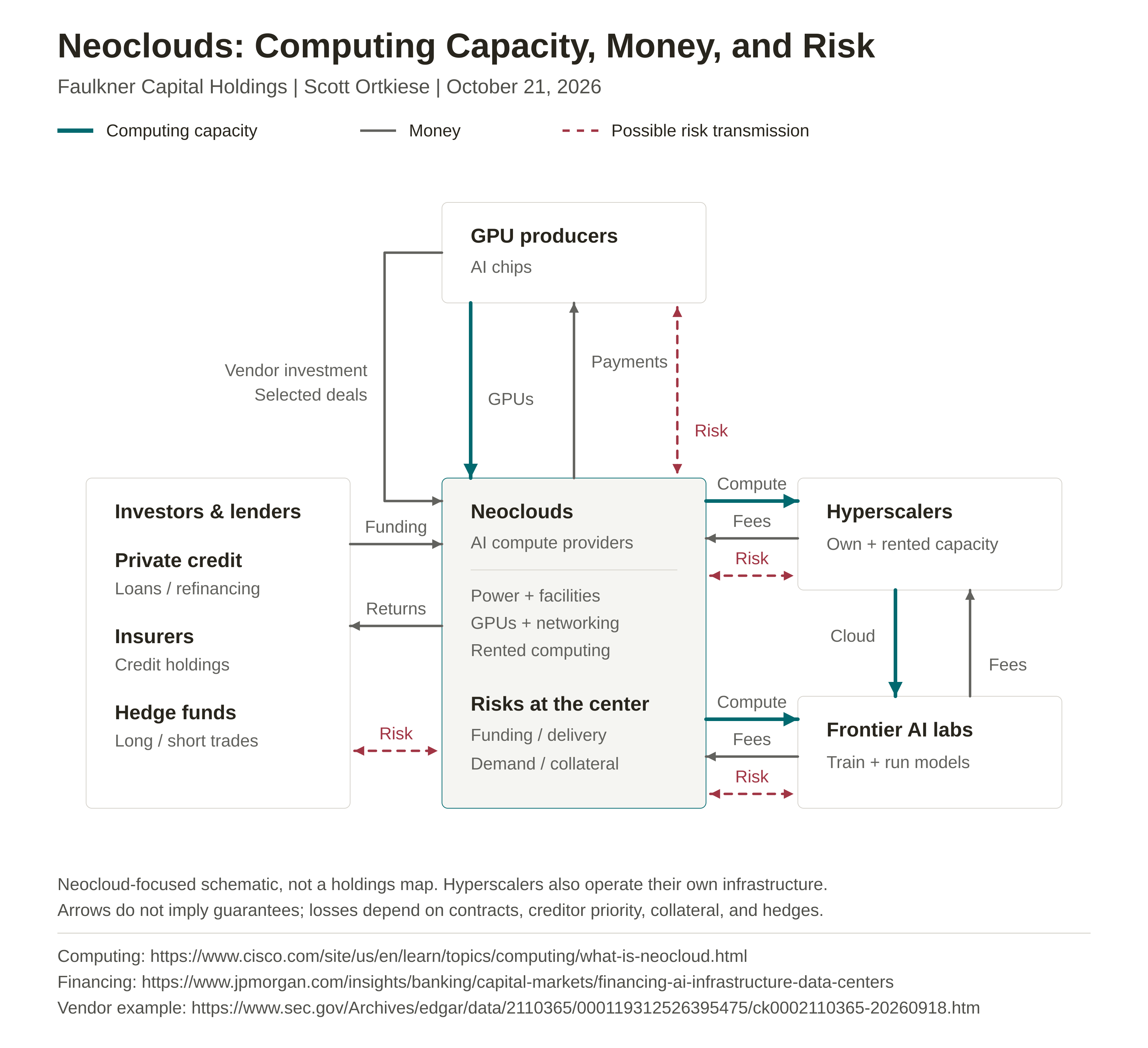
The original October 21 map remains the structural overview. It separates computing capacity, money, and possible risk transmission; the arrows do not establish actual holdings or unconditional guarantees.
Permission to build is a financing assumption
The buildout also depends on public consent, not just capital. An ABC News/Washington Post/Ipsos survey conducted October 9 through 13 found 66% of US adults opposed new data centers nationally and 72% opposed a new data center in their own community21.
Those responses are not permit denials. They identify a reason to examine whether a financing model assumes approvals, interconnection, and local agreements that have not actually been secured.
The financial sequence is straightforward: a delay can defer billable capacity while interest, land, staffing, or other contractual costs continue. Whether a customer must still pay, and whether a lender must still advance funds, depends on the documents.
There are household consequences before a financing crisis. Urban Institute researchers identify local competition for land, skilled labor, and financing, but explicitly say evidence of a nationwide causal effect on housing remains limited22. Those local trade-offs deserve scrutiny without making AI the explanation for every increase in housing or electricity costs.
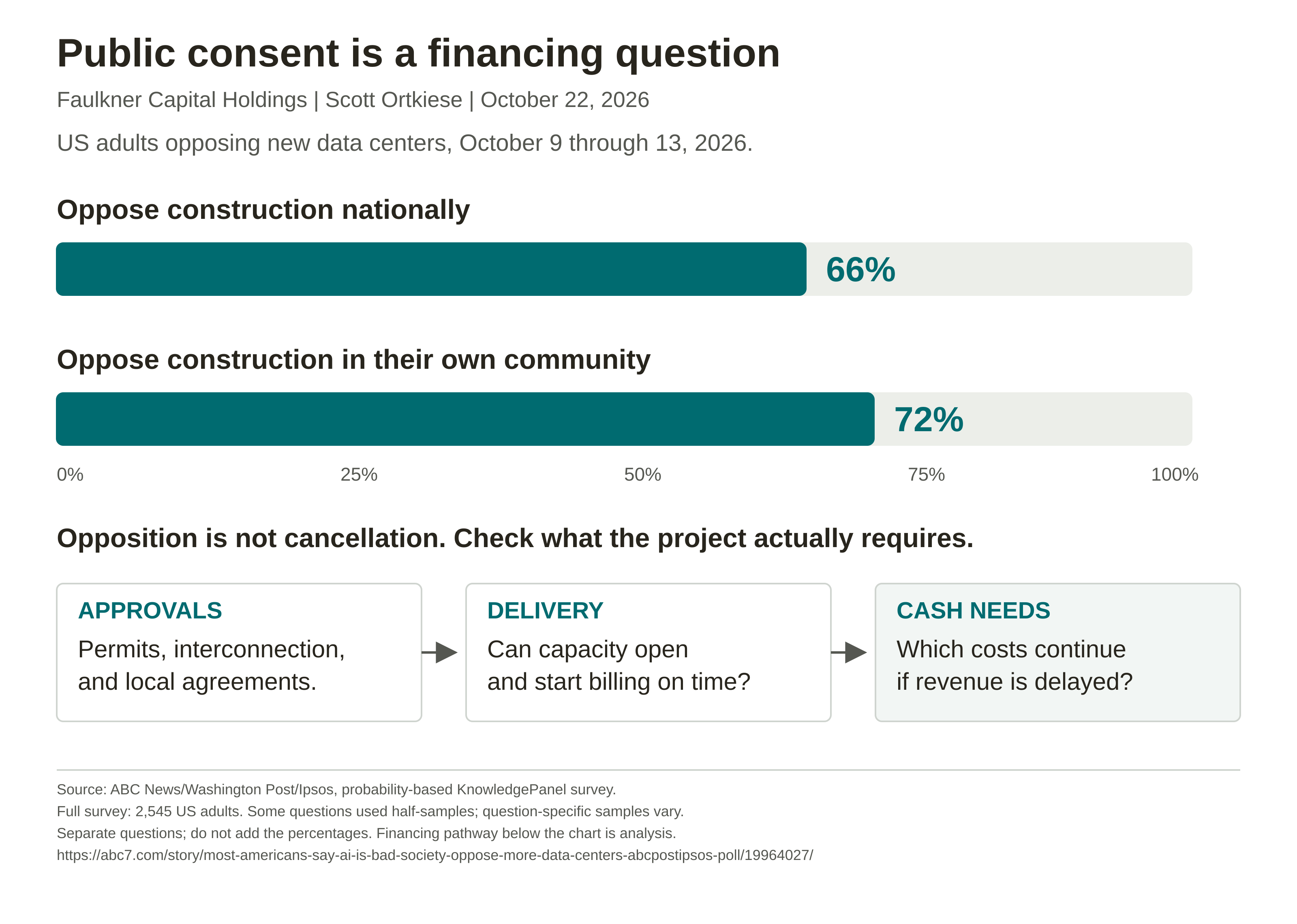
National and local opposition are separate questions, not categories to add together. The survey covered 2,545 adults overall, with some questions asked of half-samples; the accompanying financing pathway is analysis, not a measured effect of the poll23.
What else could that capital build?
An AI investment is not judged only relative to another AI investment. The opportunity cost includes housing, automobile production, industrial expansion, transport, and the infrastructure that supports ordinary goods and services. AI facilities are themselves physical assets, and AI can provide useful services. The question is why particular claims on future returns receive financing, scarce power, skilled workers, land, and political priority ahead of competing uses.
The competition is concrete where the same lenders face exposure limits or projects need the same land and trades. Urban Institute researchers identify these channels but find that national displacement of housing investment has not yet been quantified24. That is a reason to test lending allocations, prices, project delays, and resource commitments, not to exclude the costs from the investment story or invent a dollar-for-dollar national estimate.
The cost is not confined to a rejected loan. It can appear as a higher borrowing spread, a smaller credit line, a shorter maturity, or a delayed factory, housing development, or equipment purchase. Test those terms at lenders exposed to both sectors and compare them with broader credit conditions. An increase in rates across the economy is not automatically evidence that AI crowded out a particular borrower.
Nor should forecast demand, signed commitments, recognized revenue, and collected cash be treated as the same thing. The issue is not whether any AI use exists today. It is whether projected demand can become independent, paying demand on terms that justify the capital committed. Money and physical resources are committed now; much of the economic return being promised remains to be demonstrated.
Thomas Piketty’s distinction between the return on capital, r, and economic growth, g, belongs here. His argument is that a larger gap between them can amplify the concentration and persistence of wealth; he also makes clear that r > g is not, by itself, a problem in every economic model or a sufficient explanation of inequality25. It is a framework for examining accumulation and power, not a clock that dates the end of a boom.
The question for AI is whether returns to owners are being supported by durable increases in productive capacity and broadly shared income, or by rising asset prices, privileged access, and the transfer of costs to others. Claimed private returns are not a complete account of economic value. A sound analysis has to examine what the investment produces and what its financing and resource demands prevent others from producing.
AI can create risks for the institutions financing it
The cybersecurity story adds a different dimension. On October 21, the PHP Foundation reported fixes for 2 critical vulnerabilities in PHP, software used to run web services, and described using AI tools in security research and validation alongside human engineering26. This is evidence of AI’s usefulness in finding problems, not proof that AI caused the vulnerabilities or that every PHP website was compromised.
More revealing is the foundation’s description of the delay in fixing a vulnerability as “a structural failure,” caused by its decision process and lack of resources27. Faster discovery does not automatically produce faster repair. The capacity constraint can be experienced engineers, funding, and authority to make difficult decisions, not insufficient computing power.
The financial question is whether defenses, patching processes, and contractual protections can keep pace with discovery and exploitation. The exposure lies in outage costs, service commitments, cyber coverage, exclusions, and dependence on common software or cloud providers. Capability gains can create real value while imposing new costs and concentrated operational risks.
Banks face another possible channel: faster deposit movement. US Federal Deposit Insurance Corp. Chair Travis Hill said on October 20 that AI agents moving deposits are a major issue under consideration, while emphasizing uncertainty about adoption and noting that depositors value services beyond interest rates28.
That creates a testable combination, not evidence of a bank run. A bank financing AI directly or through investment funds could face credit losses on its assets while competition for deposits raises its funding costs. Cyber disruption could add another pressure, but actual exposure and timing must be demonstrated institution by institution.
Private-credit portfolios can also face losses from opposing directions. Researchers at the Bank for International Settlements (BIS) document substantial software lending alongside AI exposure and investor concern that AI could disrupt existing software businesses29. AI infrastructure can disappoint its investors while successful AI products undermine other borrowers. There is no contradiction.
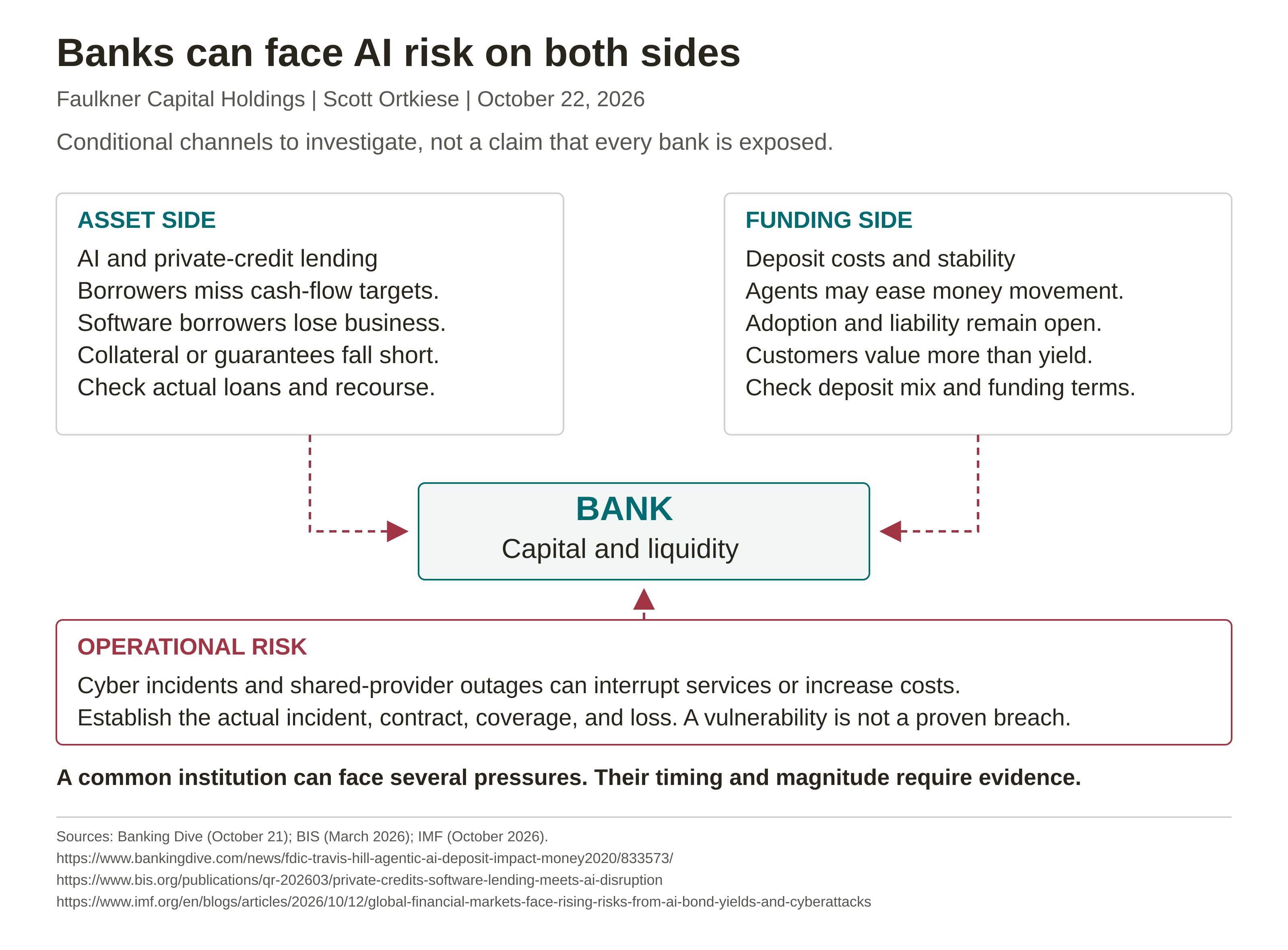
The diagram combines possible asset, funding, and operational pressures, not a claim that every bank has all these exposures. Agent-enabled deposit movement remains an adoption and liability question30; software-credit and cyber channels are also documented31; 32.
Moving the debt does not eliminate the risk
The BIS describes a shift from internally generated cash toward debt and private credit to finance AI infrastructure33. The IMF also identifies growing bank/nonbank connections and liquidity vulnerabilities involving insurers, pensions, and private-credit providers34.
Legal obligations, rather than reassuring labels, determine where the risk resides:
- Separate entities: A special purpose vehicle can isolate specified assets and obligations. Consolidation treatment, guarantees, and recourse determine what remains with the sponsor; the debt has not simply disappeared.
- Collateral: For graphics processing units (GPUs), accounting life, book value, productive life, and liquidation value answer different questions. Recovery estimates need to withstand falling rental rates and simultaneous equipment sales.
- Customer support: A utilization commitment, lease guarantee, and debt guarantee are not interchangeable. The beneficiary, trigger, cap, expiration, and exclusions determine the protection each provides.
- Reported earnings: Adjusted measures require reconciliation to cash. Capitalized costs, depreciation changes, and payment-in-kind interest, which adds interest to debt rather than paying cash, deserve scrutiny without treating every permitted accounting choice as deception.
- Investor liquidity: Withdrawal rights have to be assessed alongside asset liquidity and funding commitments. Limited repurchase windows are not a promise that all investors can leave at the stated value.
The household channels remain central: investment funds, pension portfolios, insurers, employment, and borrowing conditions. But an insurer’s investment loss does not automatically reduce a policyholder’s benefits by the same amount; applicable guaranty protection depends on the product, state law, and limits35.
Tracing the borrower is not the end of the investigation. A cancellation can leave contractors without work, investors with impaired assets, or utility customers responsible for unrecovered infrastructure costs. The contract or regulatory decision allocating that cost determines who pays. Fees collected early and losses arriving later deserve scrutiny, but they do not establish that every intermediary escapes the loss.
Europe belongs in the analysis, not in a misleading size comparison. Its AI Gigafactories initiative targets more than €30 billion of investment, supported by up to €10 billion of public funding and at least €20 billion of private investment; the call closes November 1236. This is a specific program, not total European AI investment. Its reliance on private capital makes financing conditions relevant even where public support is explicit.
The capital chain also seeks political protection
The financial chain extends from capital sources through lead asset managers, specialist or second-tier managers, funds and project vehicles, institutional placement, and products sold to end investors. It is not a single mandatory route: pensions, insurers, banks, and individuals can supply capital at several points. At each transfer, the investigation should identify the mandate, fee, valuation, liquidity promise, contractual claim, and party retaining the downside.
The political branch is not an incidental publicity exercise. Leading the Future describes its purpose as identifying and supporting pro-AI candidates to advance an innovation-policy agenda and build enduring political support37. Cronkite News reports that its network spent $34.7 million in congressional races through September via American Mission and Think Big, with backing from Greg and Anna Brockman, Marc Andreessen, and Ben Horowitz38.
That is organized spending to influence who governs and which policies advance. The channels matter: super PAC funds finance independent political activity, not direct or coordinated contributions to candidates39. Establishing a purchased vote, unlawful coordination, or a corrupt bargain requires transaction-specific evidence; the documented effort to shape political power does not depend on proving any of those offenses.
The next step is to connect the political objective with the investment economics. Which permitting decisions, public purchases, tax provisions, energy allocations, or proposed guarantees would improve a project’s return? Which costs would remain private, and which would move to taxpayers or ratepayers? A claim that an industry is indispensable can also become an argument for protecting its financing when private returns disappoint. An asserted need for rescue must not be confused with an existing public guarantee.
The feedback can run in the opposite direction. Voters who experience higher costs, disrupted communities, or unequal gains may challenge the political support on which an investment story depends. A midterm reversal would not automatically invalidate private contracts or stop borrowing, but it could change oversight, policy expectations, and the credibility of assurances made to investors. Whether it does so is an event to observe, not an election result to assume.
AI’s opponents are organizing and raising money too
The other side now has financing and organization of its own. Axios reports $48 million in election-cycle spending by AI-safety groups and individual donors, and $11.7 million raised by Guardrails Alliance across its super PAC and affiliated advocacy nonprofit40. Those are different populations and accounting categories. They must not be added together or treated as matched opposing budgets alongside Leading the Future’s spending.
Opposition is not a single anti-technology bloc. Guardrails Alliance says it supports beneficial AI while seeking stronger rules and accountability; its coalition includes workers, organizers, policy experts, parents, and AI-safety researchers41. Axios also identifies political giving by AI researchers, demonstrating that the policy divide can run through the industry itself rather than simply separating technology companies from outsiders42.
That widens the investigation and its audience. Home builders, automobile producers, manufacturers, transport businesses, utilities, unions, and community organizations have reasons to examine the allocation of financing, power, land, and labor. Their exposure does not establish that they have joined an anti-AI coalition. Some may adopt AI while contesting subsidies, infrastructure priorities, or financing terms that favor its suppliers.
PACs and parties are not merely audiences for persuasive words. They allocate money around policy claims with economic consequences. Their funders and advisers need financial judgment about the assumptions, interests, costs, and risks behind those claims, including the effect on businesses and investments outside the AI network. Political spending is not an investment fund, and a campaign’s success is not proof of a sound economic proposition.
The same scrutiny must apply to supporters and antagonists. Trace funding, identify financial interests, distinguish proposals from enacted policy, and test claimed benefits or harms. A donor’s financial exposure does not establish a corrupt motive, and opposition to a project does not establish that its economic claims are correct. Independent validation must be capable of contradicting the party commissioning it.
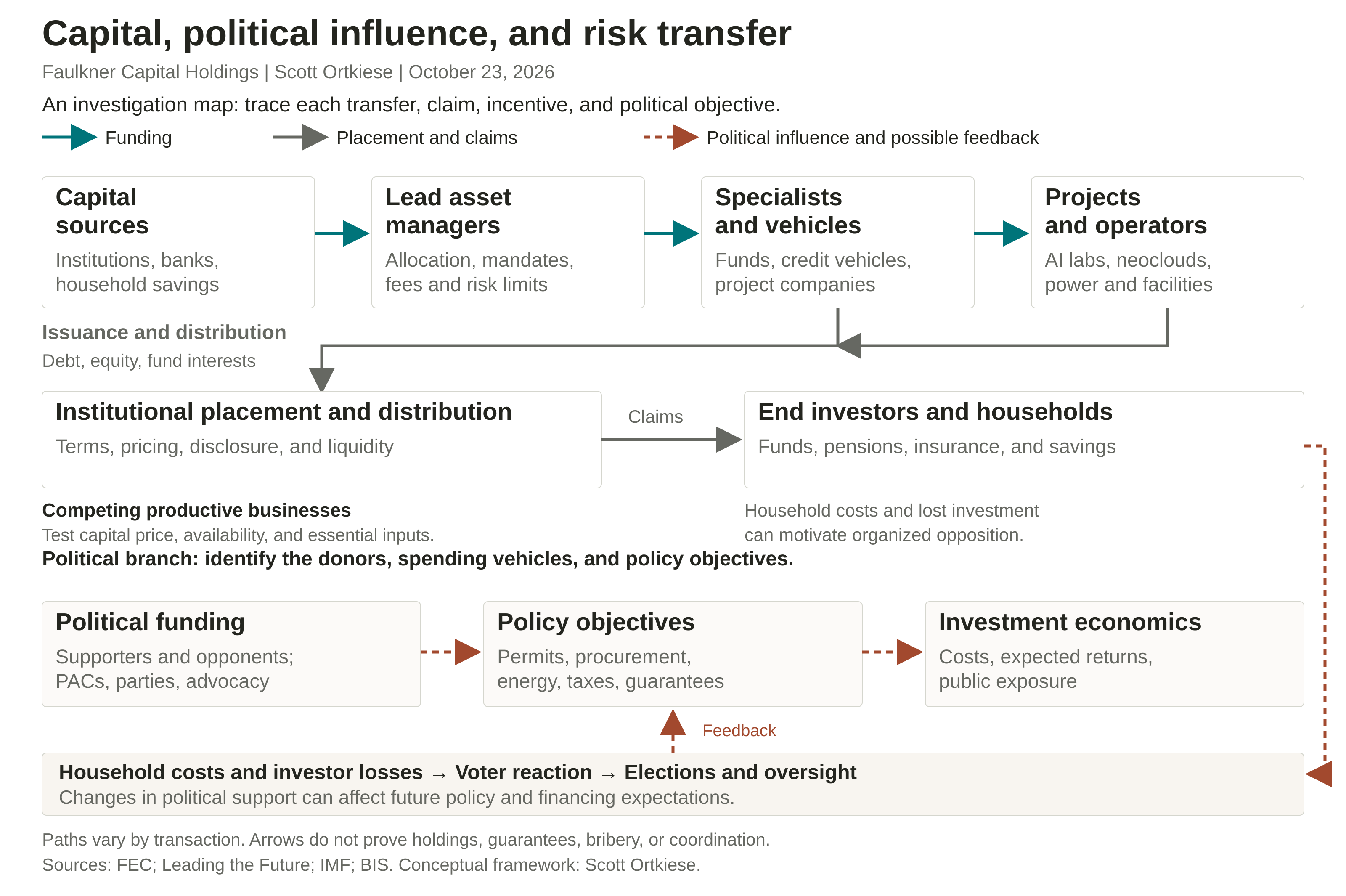
An investigation map covering financing, distribution, political supporters and opponents, competing businesses, and possible voter response. Paths vary by transaction; arrows do not establish holdings, guarantees, unlawful coordination, a purchased policy outcome, or measured capital displacement.
FSLA must lead to a document and a cash consequence
Forensic Statement and Linguistic Analysis connects management’s language to the financial and contractual evidence. It is not a separate commentary on whether executives sound nervous. Words such as “confident,” “secured,” “funded,” and “guaranteed” are starting points for checking scope, not findings of dishonesty.
Each material statement needs its exact quotation, date, audience, surrounding qualifications, and earlier comparable statements. The next questions concern the legal entity making the promise, the obligation it describes, the document supporting it, and the financial consequence if the statement is incomplete or wrong.
Apply that test throughout the chain, not just to a technology CEO. Compare a capital allocator’s mandate with a manager’s pitch, a specialist fund’s valuation with its placement material, and an investor product’s liquidity promise with its underlying assets. Apply it to political claims about jobs, national necessity, and public benefit as well. A claim can change meaning as qualifications disappear between the original analysis, the sales presentation, the campaign message, and the product reaching an individual investor.
Demand for credible analysis may increase when an investment or political narrative loses authority. Credibility is not something to manufacture for whoever pays. The value of independent scrutiny is its capacity to validate a supported claim, reject an unsupported one, expose a contradiction, or identify the evidence still missing.
OpenAI illustrates why precision matters. Its September 2025 infrastructure blueprint explicitly supported expanding US loan guarantees for purchases of US-made chips43. In November 2025, Sam Altman distinguished discussions about chip-factory guarantees from guarantees for OpenAI’s data centers and said the company had not formally applied for financing44.
Those statements concern different scopes and must not be collapsed into an invented contradiction. The proper investigation asks which assets would be supported, who would receive the benefit, what was requested, and what was actually approved. Advocacy for a guarantee is not an enacted bailout.
But the distinction is not the end of the inquiry. OpenAI’s blueprint explicitly identifies reduced financing costs for AI companies as a benefit of the proposed guarantees45. A guarantee need not be issued directly to an AI lab to support its business. The economic beneficiary matters as much as the legal borrower, as does the party carrying the public exposure.
The same discipline applies to the argument in this article. Rising credit-protection costs are not proof of fraud; circular transactions are not necessarily fictitious revenue; a postponed offering is not necessarily insolvency. A contradiction requires evidence, not an inference about intentions drawn from tone.
What November’s financing test will reveal
Anthropic’s proposed offering supplies the dated event to watch, CoreWeave the credit comparison, and Nscale a check on financing access for another issuer. They illuminate different parts of the system without necessarily sharing the same financial condition.
The evidence that matters is specific: management’s exact claims, available filing disclosures, financing conditions, dated payment obligations, and identified risk holders. Private, unavailable, or unfiled information remains a gap, not an invitation to substitute an estimate that looks like a fact.
During and after the offering window, the decisive measures will be net issuer proceeds, primary versus secondary sales, changes in financing terms, comparable issuers’ access to capital, and any documented operational or policy shock. AI issuers’ performance needs comparison with broader credit markets so that a general market move is not automatically attributed to the election or Anthropic.
Language analysis and financial analysis are strongest when each challenges the other. Every conclusion must survive scrutiny of the words, the contracts, and the cash.
The investigation is therefore wider than an IPO verdict. It must follow how financial claims acquire credibility, how political support protects their assumptions, and how costs and losses reach people who did not write the original investment story.
The technology can work while its financing fails. The decisive questions are where a promise stops being supported by collectible cash, who still has an enforceable claim, and who is left carrying the loss.
Source notes
- Reuters, October 22 ↩
- US Constitution, Twentieth Amendment ↩
- US Treasury ↩
- New York Times ↩
- Reuters ↩
- US Constitution ↩
- SEC, Investing in an IPO ↩
- Reuters ↩
- Bloomberg interview ↩
- Blackstone announcement ↩
- Bloomberg ↩
- Bloomberg ↩
- S&P Global Ratings ↩
- CoreWeave’s pricing announcement ↩
- Financial Stability Board ↩
- CNBC, October 15 ↩
- BIS, CDS mechanics ↩
- BIS ↩
- CNBC ↩
- IMF, AI ecosystem study ↩
- ABC News/Washington Post/Ipsos ↩
- Urban Institute, October 19 ↩
- ABC News/Washington Post/Ipsos ↩
- Urban Institute ↩
- Piketty, “Property, Inequality, and Taxation,” pages 632 through 638 ↩
- PHP Foundation ↩
- PHP Foundation ↩
- Banking Dive, reporting from the event ↩
- BIS, March 2026 ↩
- Banking Dive ↩
- BIS ↩
- IMF ↩
- BIS, Financing the AI Boom ↩
- IMF, October financial-stability discussion ↩
- NOLHGA ↩
- European Commission ↩
- Leading the Future ↩
- Cronkite News, October 21 ↩
- Federal Election Commission ↩
- Axios ↩
- Guardrails Alliance ↩
- Axios ↩
- OpenAI infrastructure blueprint ↩
- Reuters ↩
- OpenAI ↩