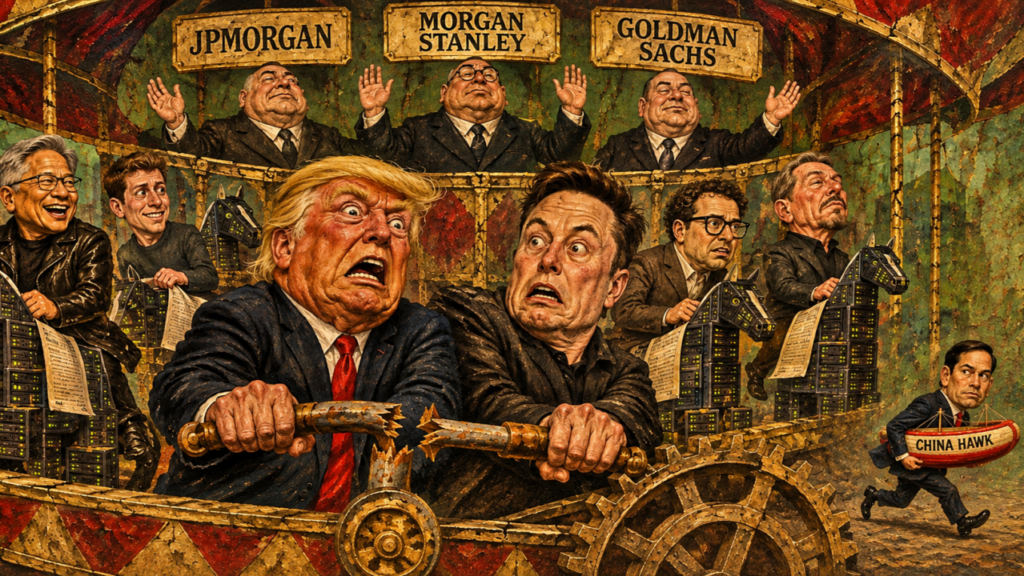
Trump and the tech bros built this mess. Wall Street sold it. Meanwhile, China is cutting the price, voters want out, and Rubio is running with his hat, ass and bicycle for his anti-China raft.
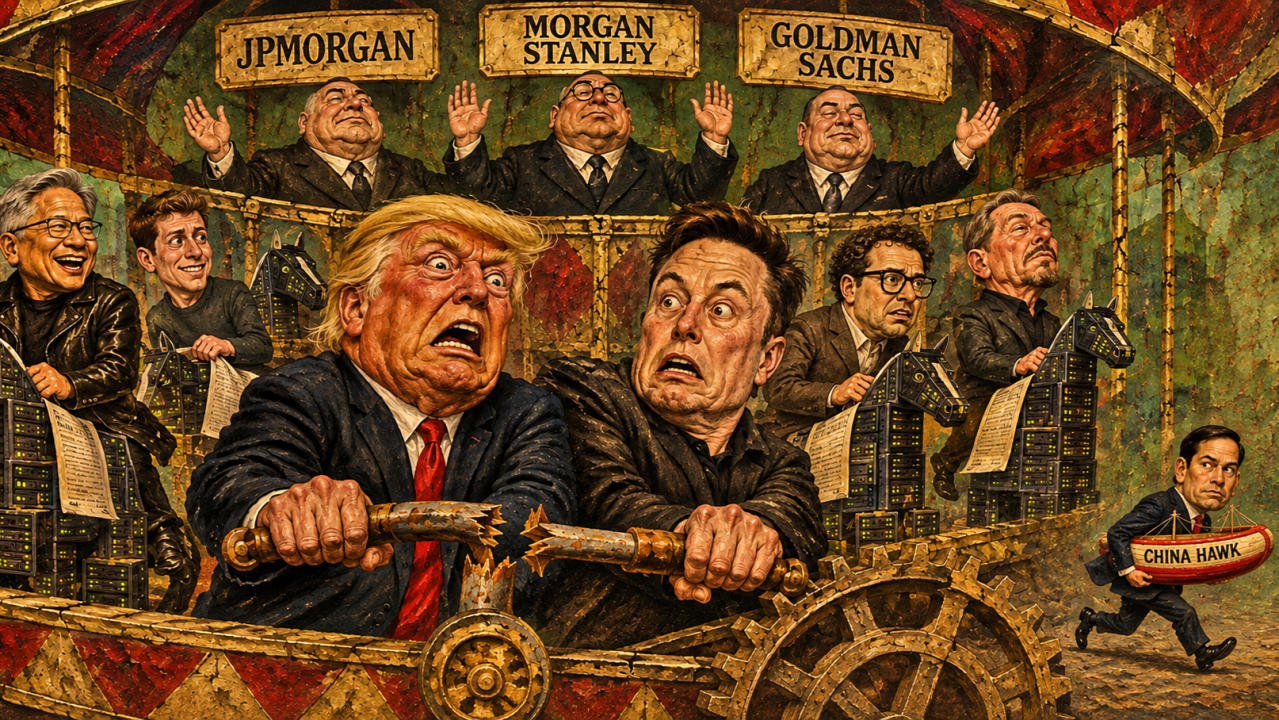

Energy and Geopolitics | Structured Finance
Scott Ortkiese | Throughline Synthesis | November 16, 2026
Introduction
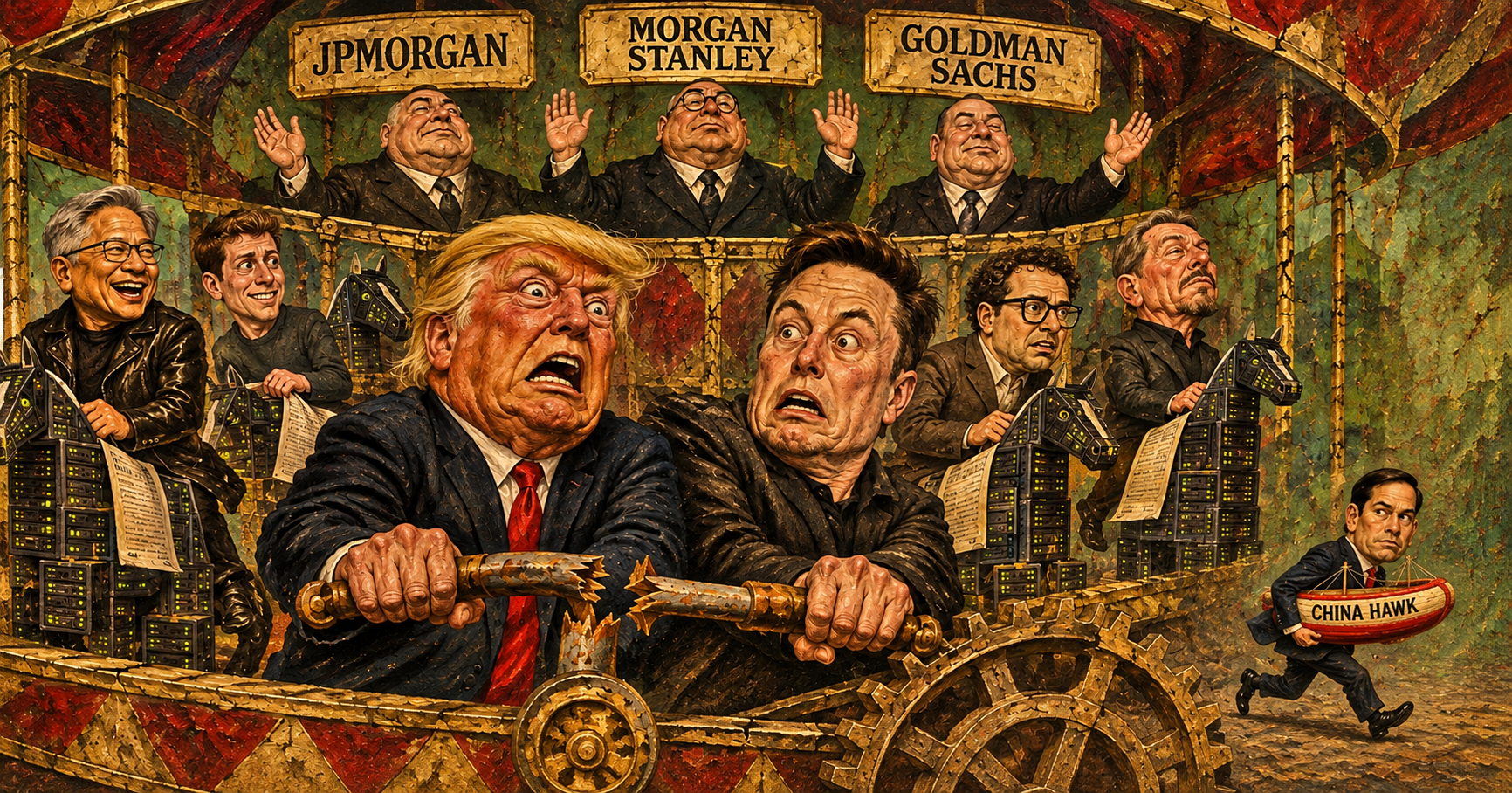
They called it America’s AI future. They built a machine for enriching themselves and leaving everyone else with the bill.
Trump sold the fantasy. Musk and the tech bros piled up commitments. Wall Street’s finest blessed the transactions, collected their fees, and sold the public a ticket to the carousel. Now Chinese competition threatens the prices that hold their rentier daydream together, and voters have rejected the arrogance of an industry that treats their communities as expendable.
Watch them scramble. The tech bros want to preserve the financing. The bankers want the next offering. Trump wants applause. Bessent and Lutnick want the blame to land somewhere else.
And Little Marco? He’s scrambling off Trump’s ship into an anti-China lifeboat to save his hat, ass, and bicycle, preferably with a presidential nomination tucked under the seat.
Don’t mistake the escape for a break with the servility. He’ll keep toadying to Trump until he calculates that abandonment pays better, then ask whatever remains of the Republican Party to call it leadership. If he’ll stand on his head for that orange bamboozler, imagine the contortions he’ll perform for Washington’s special interests. He isn’t trying to escape the business of serving power. He’s auditioning for the top job.
What enrages me is the presumption beneath it all: their fortunes are private, their power is sacred, and their losses are somehow our problem.
No. Useful technology does not entitle these people to our money, our water, our electricity, or our surrender. Let the men who built this carousel explain why the rest of us should pay when it stops.
Their Poorly Planned AI Grab, Your Bill
Trump sold the expansion. Wall Street financed the claims. Chinese competition threatens the returns; voters want limits; and Little Marco is reaching for an anti-China life raft.
They called it an American imperative. They structured it as an investment opportunity.
Trump supplied political access and the promise of rapid expansion. Jensen Huang supplied the equipment and an expanding set of financial commitments. Elon Musk supplied the spectacle. The investment banks and asset managers supplied ways to turn that spectacle into securities, loans, fees, and claims on future payments (Nvidia’s financing-platform announcement).
Now, the public is objecting to the construction; Chinese competitors are attacking the pricing; and the people who promoted the arrangement are preparing different explanations for why the consequences belong to someone else.
Secretary of State Marco Rubio has an anti-China raft within reach. Treasury Secretary Scott Bessent has identified Commerce Secretary Howard Lutnick’s department as the place where enforcement stalled. Huang’s supporters want their indispensable executive back. The public should not confuse this struggle for personal survival with an economic alternative (CNN on the Cabinet dispute).
Follow the contracts, the family connections, and the payments. The people selling this expansion as a national necessity are arranging private claims on its proceeds. The public is entitled to know who gets paid, who controls the assets, and who is expected to absorb the losses.
The bankers are not scenery
Start with the institutions. On August 10, Nvidia announced agreements in principle with Apollo, BlackRock, Blackstone, Brookfield, Goldman Sachs, and KKR to mobilize more than $500 billion in outside capital for AI infrastructure. These were proposed financing platforms subject to final agreements, not $500 billion already invested. The plan nevertheless made the objective explicit: dedicated financing for Nvidia customers, durable usage-linked revenue, and credit backed by computing equipment (Nvidia financing-platform announcement).
Apollo’s Jim Zelter, BlackRock’s Larry Fink, Blackstone’s Jon Gray, Brookfield’s Bruce Flatt, Goldman Sachs’ David Solomon, and KKR’s Joe Bae and Scott Nuttall put their names behind the announcement. Huang condensed the sales pitch into 5 words: “In AI, compute is revenue” (Nvidia financing-platform announcement).
No. Computing capacity costs money. Revenue arrives when a customer pays. Profit requires collecting enough to cover the equipment, the electricity, the buildings, the employees, the financing, and replacement of machinery that becomes obsolete.
The slogan skips the difficult part. The financial firms proposed to finance it.
This is the rentier ambition in plain English. Control AI assets that others must repeatedly pay to use, then collect from the payments. It does not require every participant to hold the same instrument. A bank can earn an underwriting fee. A private-credit fund can collect interest. An infrastructure owner can collect rent. A manager can collect fees while its investors bear losses. A technology company can protect sales by helping finance its customers.
Different contracts. Related incentives. The critical unmet need for customers who can ultimately pay remains the same.
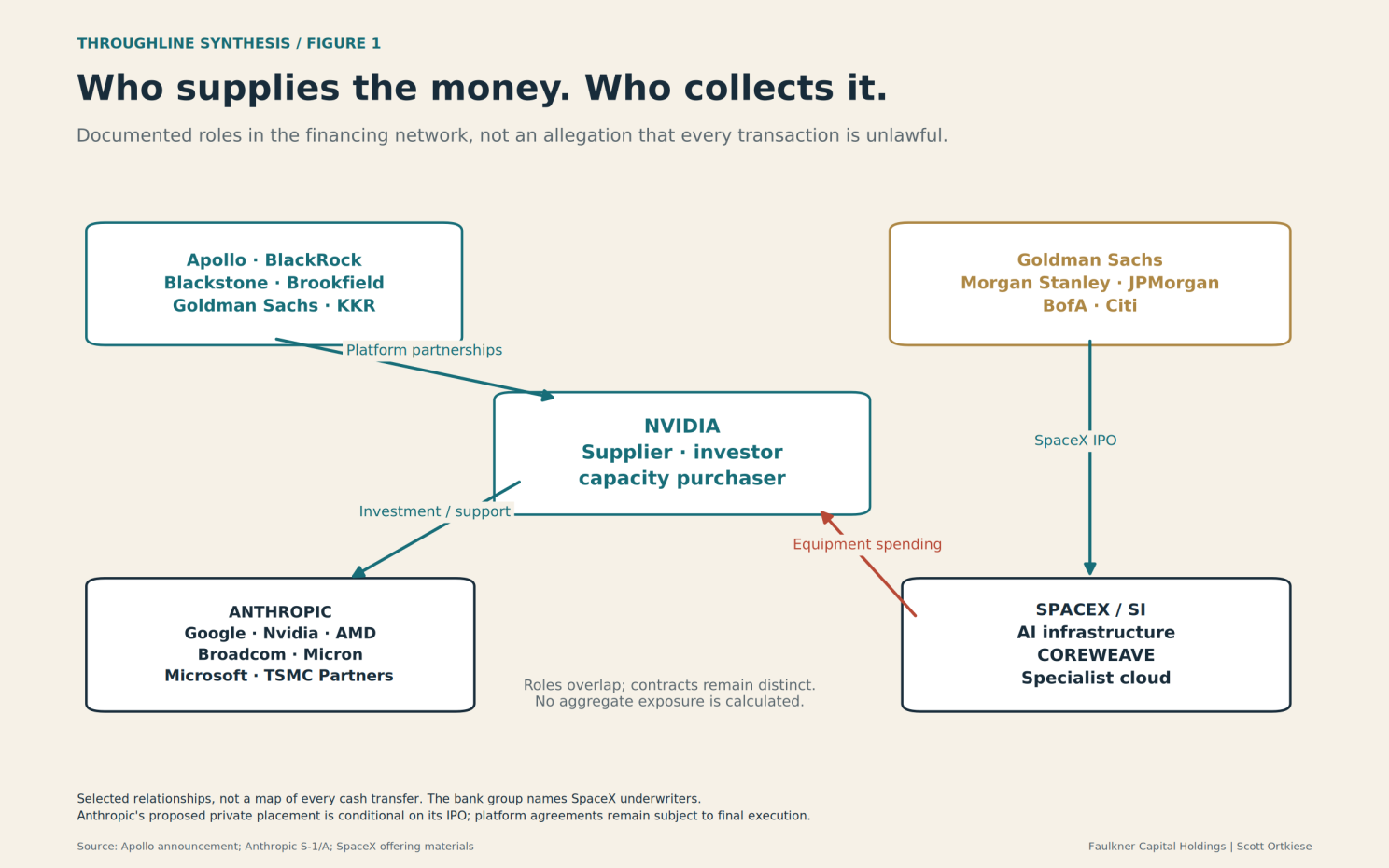
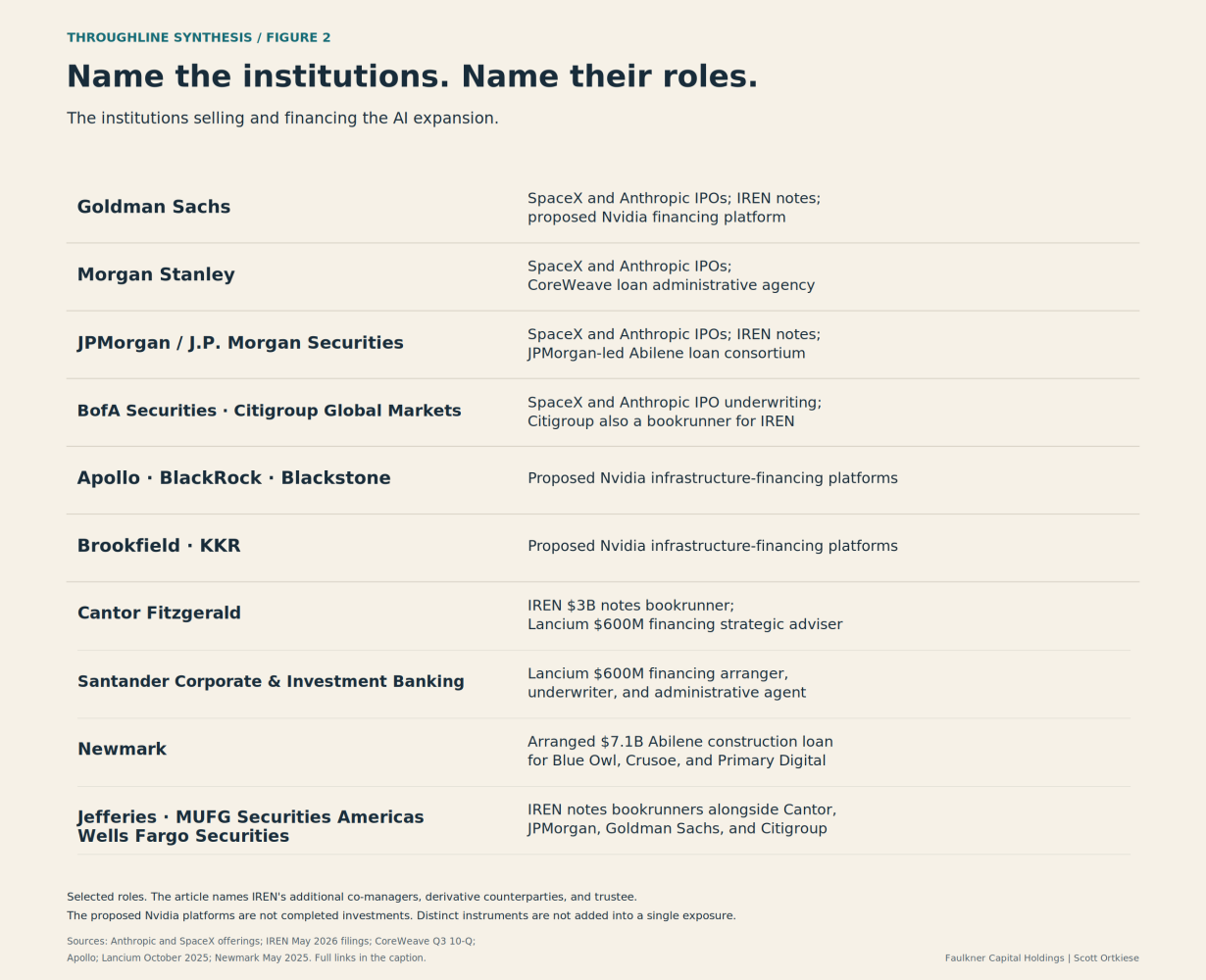
Goldman Sachs and Morgan Stanley appear in the IPO machinery and the wider AI story. Both were named as joint book-running managers for Anthropic’s offering. Goldman Sachs, Morgan Stanley, J.P. Morgan Securities, BofA Securities, and Citigroup Global Markets were also named in SpaceX’s IPO underwriting materials. Morgan Stanley Senior Funding appears as administrative agent for a CoreWeave loan facility. These institutions are arranging and distributing the claims (Anthropic’s filed underwriting roles; SpaceX’s filed underwriting roster; CoreWeave’s financing disclosures).
Goldman, therefore, deserves more than a cameo. It appears in the proposed Nvidia financing platform and in the distribution of AI-linked equity. Morgan Stanley belongs in the account of underwriting and financing. JPMorgan belongs in the SpaceX underwriting account. Their jobs are to arrange, price, finance, or distribute these claims. None of those jobs constitutes an independent guarantee that the ultimate investment will earn an adequate return.
Cantor Fitzgerald was not watching from the cheap seats. It helped build the financing machinery. Howard Lutnick left its leadership for the Commerce Department. His sons Brandon Lutnick and Kyle Lutnick became chairman and executive vice chairman of the holding company, respectively; Cantor later announced a transfer of Howard’s ownership through trusts benefiting his adult children, with Brandon as controlling trustee (Cantor’s leadership announcement; Cantor’s ownership announcement). The family name did not disappear from Wall Street. It acquired a Cabinet office.
Start with IREN, which operates data centers and rents out AI computing capacity. It announced a 5-year, $3.4 billion Nvidia cloud contract and granted Nvidia a conditional right to purchase up to $2.1 billion of its shares (IREN’s filed partnership announcement). On May 14, 2026, IREN closed a $3 billion convertible-note offering, with Cantor, J.P. Morgan Securities, Goldman Sachs, Citigroup, Jefferies, MUFG Securities Americas, and Wells Fargo Securities as bookrunners (IREN’s closing announcement). The notes could convert into shares, another way to finance the expansion (IREN’s conversion terms). The supplier’s contract and potential investment stood beside Wall Street’s borrowing machinery; calling that arrangement an ecosystem does not answer who ultimately pays for it.
The supporting cast deserves its names, too. BBVA Securities, Credit Agricole Securities (USA), BTIG, Canaccord Genuity, Macquarie Capital (USA), and Moelis & Company served as co-managers of IREN’s offering (IREN’s complete offering roster). Banco Santander, Bank of Montreal, Citibank, Crédit Agricole Corporate and Investment Bank, Mizuho Markets Americas, The Bank of Nova Scotia, and UBS’s London branch supplied the associated capped-call contracts, which were designed to limit dilution or conversion-related cash costs up to a specified share price (IREN’s derivative counterparties and terms).
IREN used $201.3 million of the approximately $2.96 billion in net offering proceeds to pay for those contracts, with the remainder intended for general corporate purposes and working capital; U.S. Bank Trust Company, National Association, served as indenture trustee (IREN’s proceeds and trustee disclosures). Bookrunners organize a securities sale. Derivative counterparties provide a separate financial contract. A trustee administers the bond agreement. Those distinctions tell us where to look for fees, obligations, and risk; they are not reasons to let the institutions disappear behind the phrase “Wall Street.”
Follow the same financial family into the buildings. In October 2025, Cantor served as sole strategic adviser on Lancium’s $600 million debt financing, while Santander Corporate & Investment Banking arranged, structured, and underwrote the transaction and served as administrative agent (Lancium’s financing announcement). In May 2025, Newmark, part of the Cantor-controlled group, separately arranged a $7.1 billion construction loan for Blue Owl, Crusoe, and Primary Digital Infrastructure’s Abilene development, supplied by a consortium led by JPMorgan (Cantor’s group structure; Newmark’s transaction announcement). Advising, underwriting, arranging, lending: different jobs in the same expansion.
The salesmanship asks the public to admire the scale. The public should inspect the obligations. Who earns the fees? Who holds the collateral? Who must keep paying when the next financing round fails? A banker can complete a transaction long before anyone establishes that the assets will earn their keep. National greatness is a convenient slogan for selling private claims on somebody else’s future payments.
The question for each institution is specific. What did it earn? What risk did it retain? What risk did it distribute? Which of its businesses had an interest in keeping the expansion going? The available records do not supply every answer. A proper investigation keeps those blanks visible rather than manufacturing a single exposure figure.
SpaceX makes the political theater particularly useful. Reuters reported that Musk combined SpaceX and xAI in February in a transaction valuing the former at $1 trillion and the latter at $250 billion. The same controlling figure stood on both sides of the combination. The transaction brought the AI venture inside a company whose public identity rested on rockets and satellite communications (Reuters on SpaceX’s acquisition of xAI).
The rocket business is real. The satellites are real. Calling the financial sales pitch a sham is not a claim that those businesses are imaginary. The issue is what investors were being asked to finance under their name.
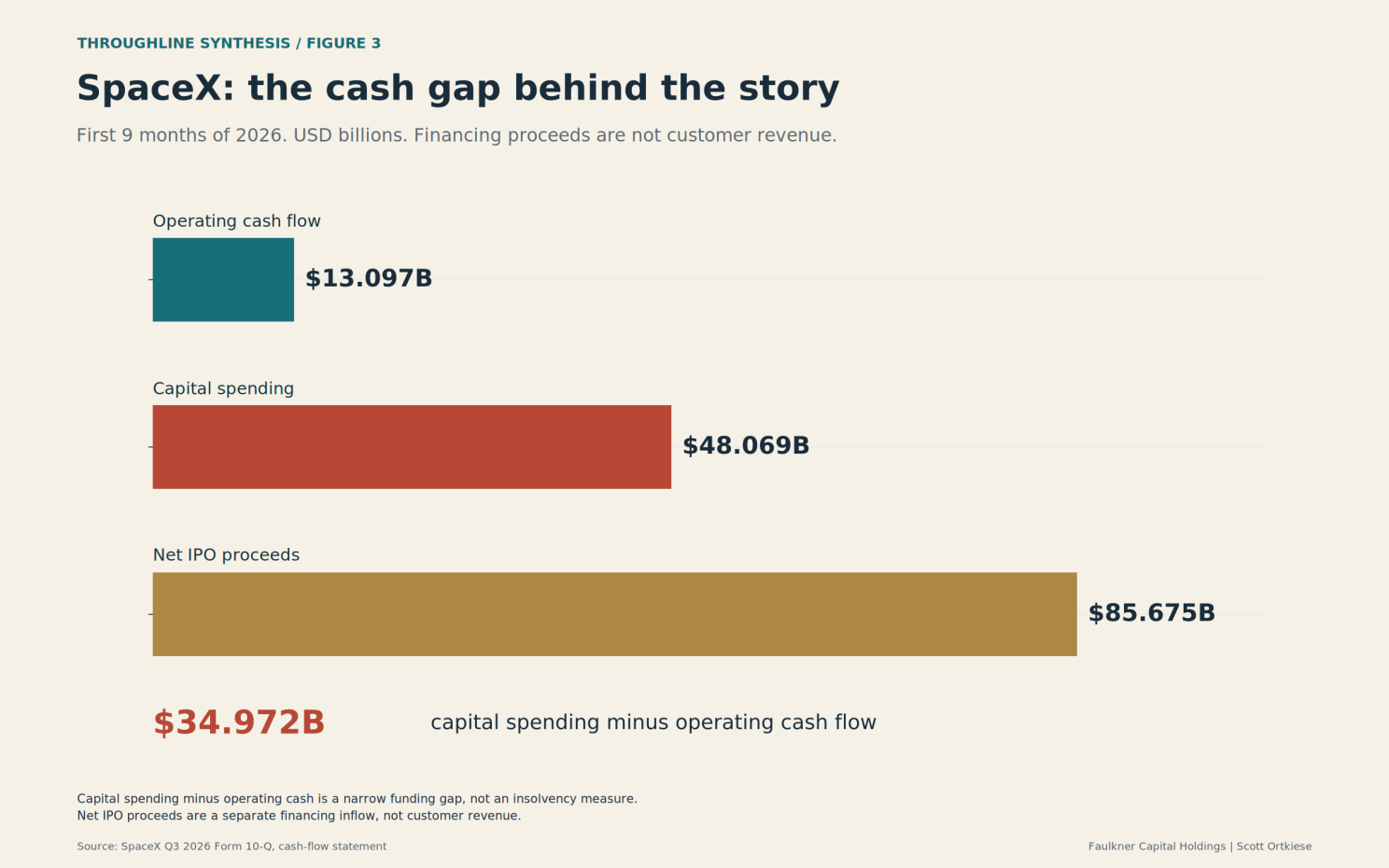
SpaceX’s September quarterly filing provides a blunt answer. During the first 9 months of 2026, operating activities produced $13.097 billion in cash. Capital spending consumed $48.069 billion. The difference was $34.972 billion. The IPO supplied $85.675 billion in net proceeds. That was an enormous source of financing, but it was not cash earned from customers (SpaceX September 2026 Form 10-Q).
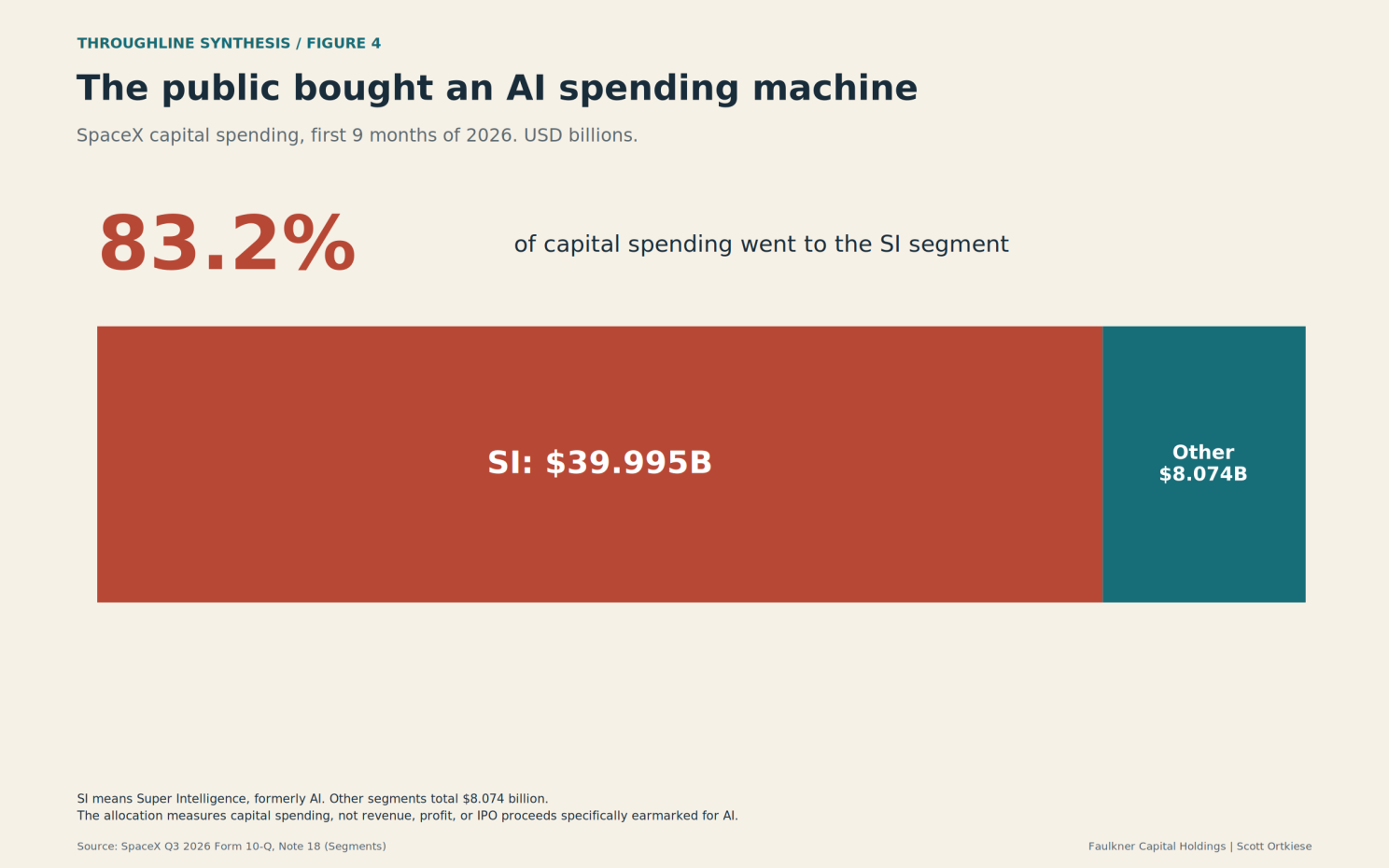
Of that $48.069 billion in capital spending, $39.995 billion went to the Super Intelligence segment, formerly called AI: 83.2%. This is not an allocation of specific IPO dollars, and it is not the AI share of company revenue. It is the capital-spending allocation disclosed for the period (SpaceX September 2026 Form 10-Q).
The important question is not whether Musk can raise money. He demonstrably can. It is whether the assets bought with that money will earn enough to justify their cost before they need replacement. A prestigious space business does not answer that question for a massive AI buildout.
The bankers’ participation cannot answer it either. A successful offering establishes that securities were sold. It does not establish that the machinery those securities finance will earn the promised return.
Follow the contracts, not the applause
Anthropic’s offering puts the same distinction between new money and sustainable revenue into a different structure.
Its proposed IPO consists of 801,351,354 new shares and 23,648,646 shares sold by existing holders, excluding the overallotment option. At the $74 midpoint of the proposed range, the selling holders’ portion would generate roughly $1.75 billion before fees. Most of the offer is company fundraising, not an insider cash-out. That distinction matters because precision is more damaging than an exaggerated accusation (Anthropic amended S-1, November 10).
A concurrent proposed $26 billion private placement brings Google, Nvidia, AMD, Broadcom, Micron, Microsoft, and TSMC Partners into the transaction. The placement depends on the offering’s completion and other conditions. Google’s and AMD’s purchases reduce previously agreed funding commitments (Anthropic’s funding and commitment disclosures). These are suppliers, commercial partners, and investors helping finance a company whose spending contributes to the market for their own products and services (Anthropic amended S-1, November 10).
Public investors do not receive proportionate control. Anthropic’s founders’ entity will hold a special share carrying 50.1% of general voting power, while the Long-Term Benefit Trust generally elects a majority of the board. Outside capital enters a governance structure designed to preserve control elsewhere (Anthropic amended S-1, November 10).
That is not ordinary ownership with an unusual slogan. It deliberately separates who supplies money from who commands the company.
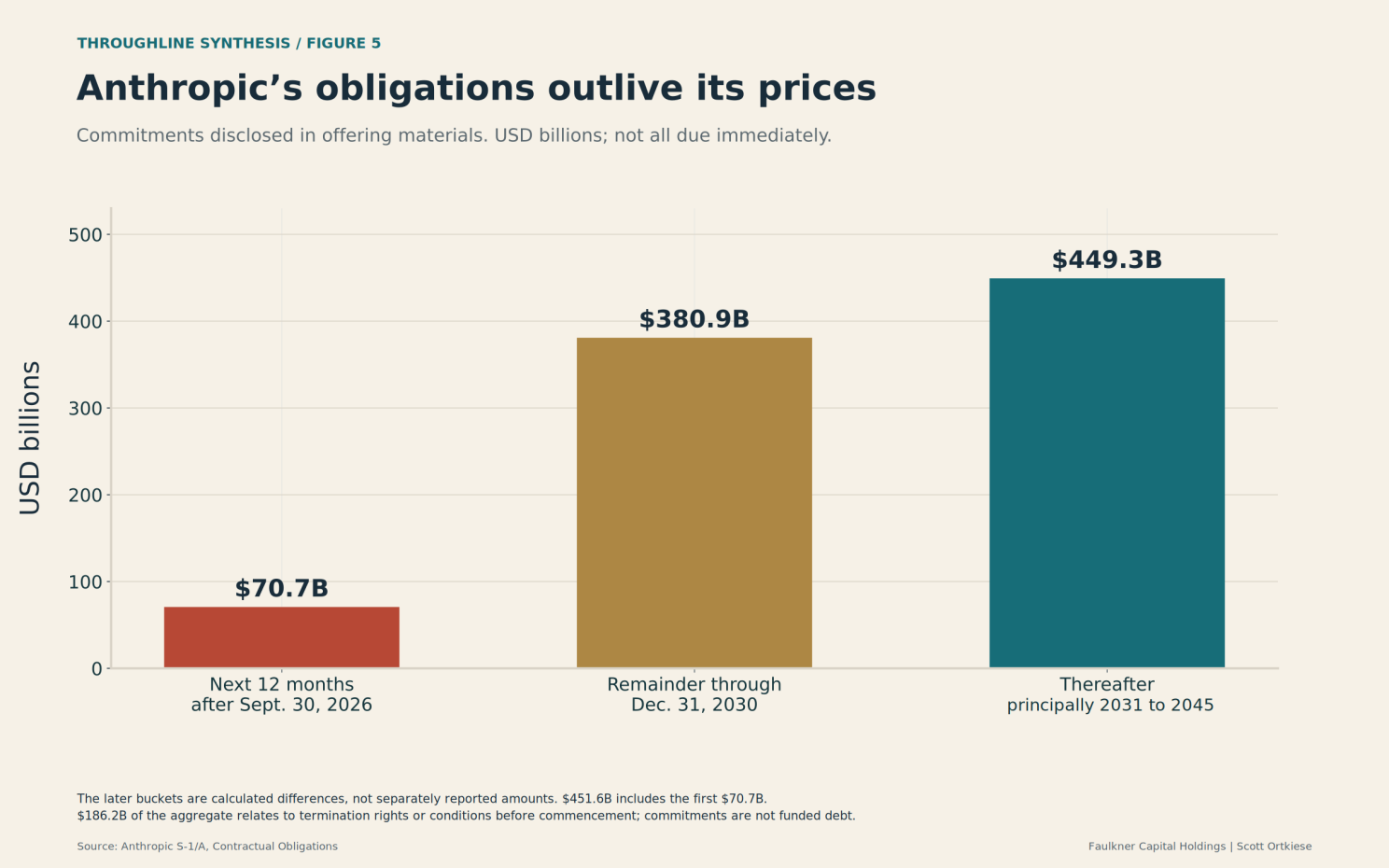
The scale of the obligations makes the fundraising consequential. Anthropic’s offering materials disclose approximately $900.9 billion in commitments, largely for computing and infrastructure. About $70.7 billion falls within 12 months after September 30, 2026. Approximately $451.6 billion is expected before the end of 2030, with substantially all the remainder extending into 2031 through 2045 (Anthropic offering commitments disclosure).
Those are not $900.9 billion in bills due tomorrow. They are not all funded debt. Approximately $186.2 billion relates to arrangements subject to exercisable termination rights or conditions before commencement (Anthropic’s funding and commitment disclosures). These obligations extend across years in which the price customers will pay for AI can change radically.
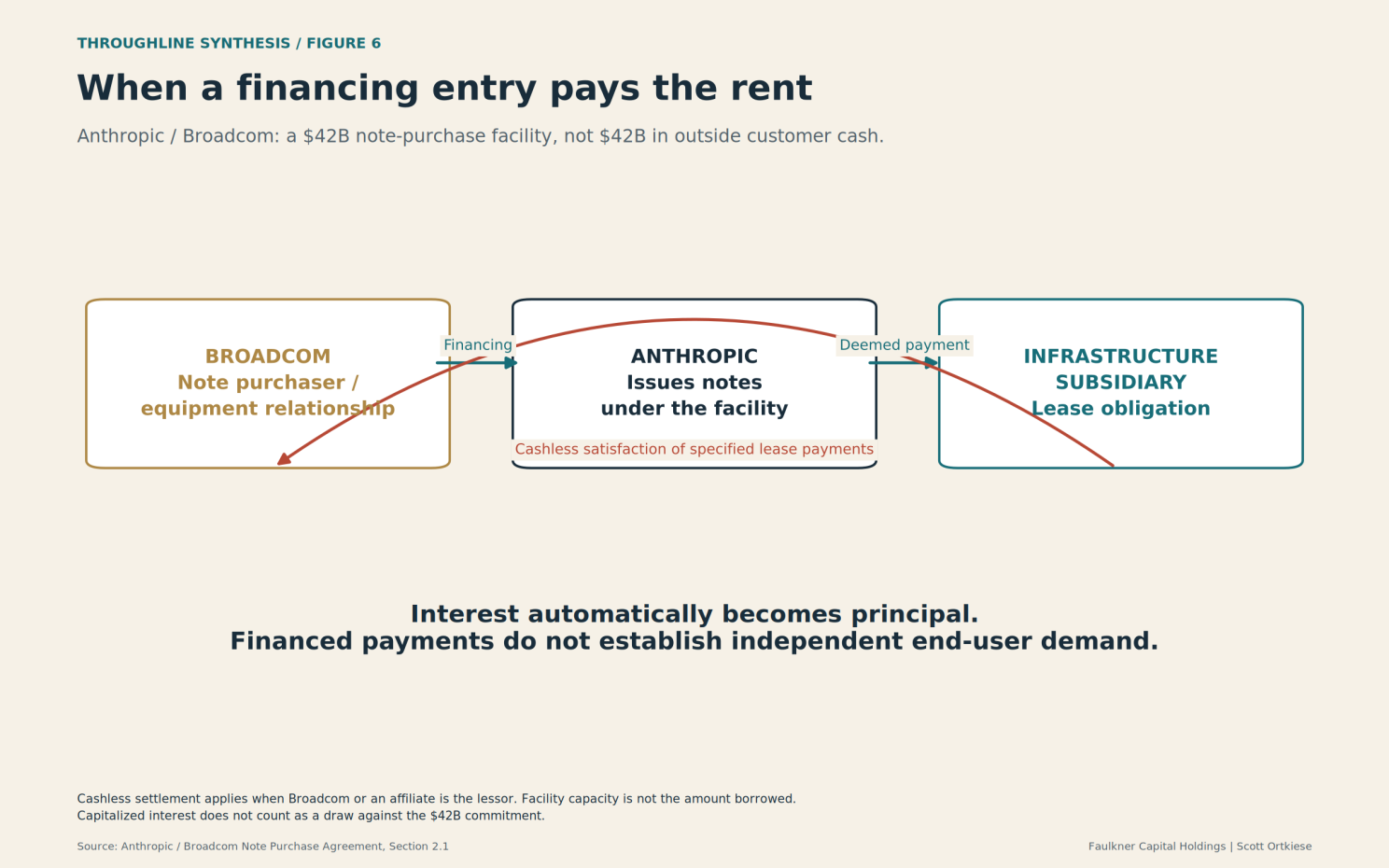
The Broadcom agreement exposes the mechanism more sharply than a total on a balance sheet. Its $42 billion note-purchase facility allows notes to satisfy specified equipment-lease payments through a cashless contractual process when Broadcom or an affiliate is the lessor. The notes are deemed to pay an infrastructure subsidiary, which is deemed to satisfy lease obligations. The arrangement automatically adds interest to principal rather than requiring current cash interest payments. Facility capacity is not the same as the amount drawn (Anthropic-Broadcom note agreement, Exhibit 4.4).
A financed payment preserves the supplier’s claim. It does not prove that an independent end customer has paid enough to support the system. Adding interest to principal preserves cash today by enlarging tomorrow’s obligation.
That is what circular financing means here. It is not a magical accusation that every entry is fake. It is the practical problem of treating sales supported by supplier financing as if they were independent evidence of self-sustaining demand.
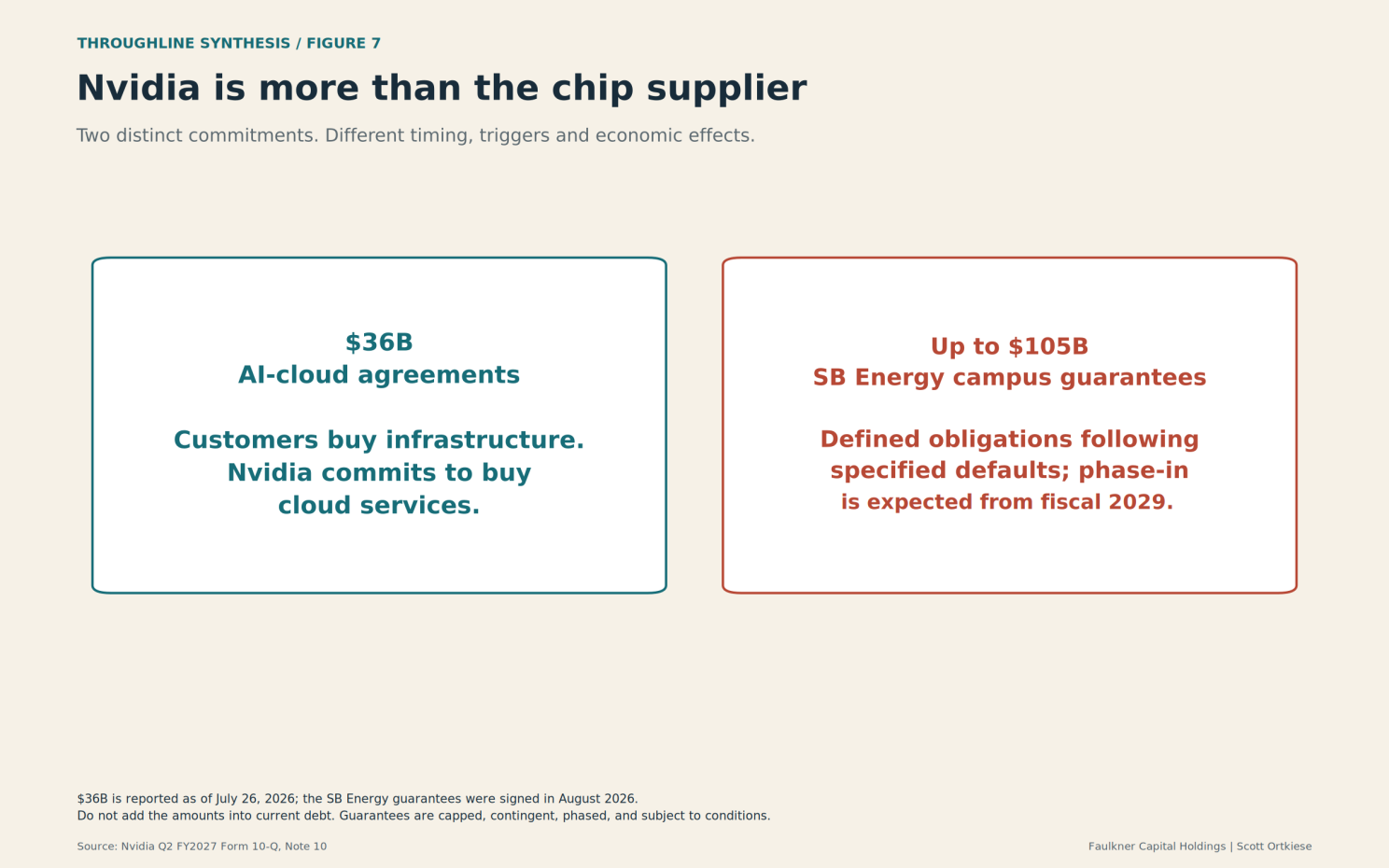
Nvidia’s commitments note is equally revealing. Under $36 billion of AI-cloud agreements, customers buy Nvidia infrastructure while Nvidia commits to purchase cloud services from them. The operators can release capacity to outside customers on better terms; Nvidia’s commitments fall as external customers take capacity or Nvidia uses it (Nvidia commitments and contingencies, July 26, 2026).
The chip supplier is helping support the customers buying its chips. If independent demand materializes, the support can recede. If it does not, the supplier remains exposed to the arrangement that supported its sales.
The same disclosure describes capped guarantees of $105 billion for an SB Energy campus serving an OpenAI affiliate. These guarantees phase in as construction is completed and leases commence, with the first phase expected in fiscal 2029. They cover specified lease and power obligations and depend on defined defaults. In return, the campus will host Nvidia infrastructure exclusively, subject to limited exceptions. They are not $105 billion already spent (Nvidia commitments and contingencies, July 26, 2026).
OpenAI and SB Energy therefore belong on the transaction map, along with Nvidia. Sam Altman’s place in this story rests on the obligations of the company and its affiliates, not merely his position in a procession of familiar faces.
The danger becomes clearer when the supplier starts closing the checkbook. The Wall Street Journal reports that Huang began reassessing Nvidia’s financial support for the AI economy before leaving, and that startups dependent on that support expect a greater pullback under interim chief executive Colette Kress (Journal reporting on Nvidia’s financing pullback). A company built around the expectation of the next helping hand has a problem when the hand withdraws.
Jack Gamble makes this financing dependence central to his November 16 Nobody Special Finance broadcast, “Silicon Valley Bootlickers Launch Campaign to Bring Back Jensen Huang”, in which he discloses a short position in Nvidia. His question cuts through the sales pitch. Can the buyers keep buying when the seller stops helping them pay?
The details matter. In the Journal’s account, Gamble describes Huang telling cloud-company executives in Berlin to demand upfront customer payments and charge more for their computing capacity; Huang reportedly compared their prices with Musk’s and said he could give the capacity to Musk instead (Gamble’s reading of the Berlin account; reproduced Journal report). That is not a declaration that useful computing has disappeared. It is a supplier demanding that somebody else supply the cash.
Gamble connects the reported offer to Musk’s campaign to restore Huang (Gamble on Musk’s interest). The connection is commercially obvious. A man who might receive preferential access to scarce computing capacity is not an impartial judge of whether the executive offering it deserves another chance.
The scale of Nvidia’s investment activity makes the dependence harder to dismiss. The Journal account cited by Gamble reports participation in 129 venture-capital deals through November 10, with those deals accounting for 27% of global venture-capital deal value, compared with 49 deals in 2023 (PitchBook figures in the reproduced Journal report). That measures the combined value of deals in which Nvidia participated, not a claim that Nvidia itself supplied 27% of the world’s venture capital. It is still an extraordinary concentration of financing influence around the company selling the machinery.
Gamble’s reaction is disgust. He asks whether the boom is a market supported by customers or a financial merry-go-round sustained by money moving around the same circle (Gamble’s circular-financing criticism). A supplier’s investment can be real; its customer’s purchase can be real; and the supposed demonstration of independent demand can still be hollow.
Nscale supplies a concrete test. The report describes negotiations with Nvidia and other investors to finance a $45 billion Anthropic data-center project in West Virginia; Gamble predicts that the project probably will not happen if the financial support disappears (Nscale negotiations in the reproduced Journal report; Gamble’s Nscale assessment). Negotiations are not completed financing. The vulnerability is precisely that the next enormous project may require the next enormous promise from the same narrow group.
A supplier can help manufacture the financing conditions for its own sales. It cannot manufacture an unlimited supply of solvent end customers. If new support recedes, projects must find replacement equity, replacement credit, or customers prepared to pay more and pay sooner. The machinery does not become cheaper merely because the next financing announcement fails to arrive.
The distinction between new support and existing obligations is crucial. A new chief executive can refuse another investment or another guarantee. That alone does not cancel contracts already signed. Yesterday’s commitments can keep consuming cash while tomorrow’s financing disappears.
That is the collision the patriotic sales pitch conceals. The system needs customers to pay more and commit earlier, just as competition gives those customers reasons to pay less and keep their options open. Calling the expansion inevitable does not resolve the contradiction.
Do not add Anthropic’s commitments, Nvidia’s guarantees, the proposed financing platforms, and every supplier contract into one giant number. The same underlying spending can appear as one party’s purchase commitment, another’s revenue expectation, and a third party’s guarantee. Counting it repeatedly produces a dramatic total and bad analysis.
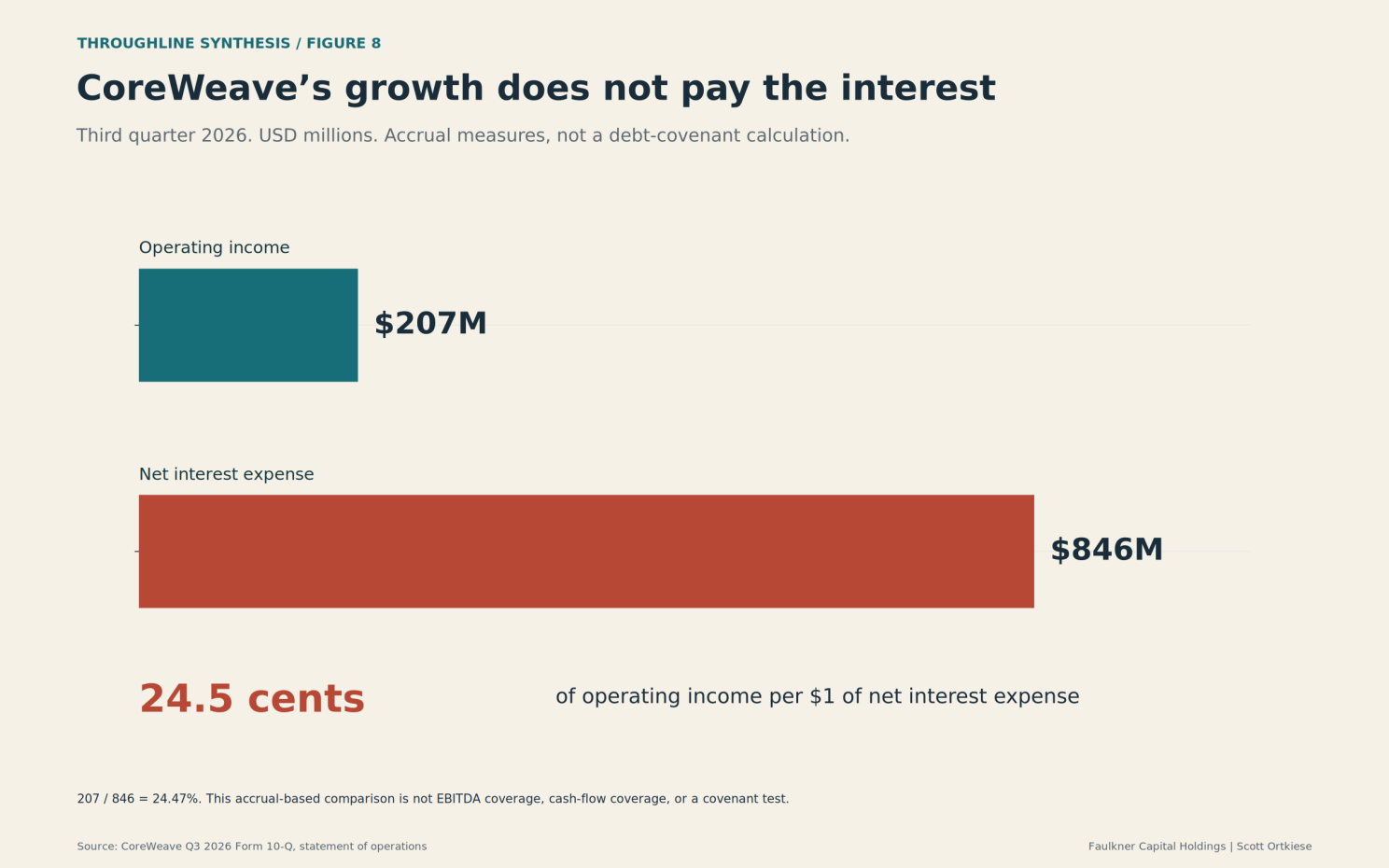
CoreWeave provides an existing test of the economics. Michael Intrator’s company reported third-quarter revenue of $3.661 billion, operating income of $207 million, and net interest expense of $846 million. Operating income covered about 24.5% of that interest expense. This is an accrual-based comparison, not a loan-covenant test (CoreWeave September 2026 Form 10-Q).
Growth has not abolished the financing bill. Nor does calling a facility investment-grade transform every borrower or project in the system into an equally safe investment. Contract terms, collateral, priority, guarantees, and the customer’s cash-producing capacity matter.
Musk, Huang, Altman, Anthropic’s Dario Amodei, and the specialist cloud operators do not occupy identical positions. Neither do Larry Ellison’s Oracle, Microsoft’s Satya Nadella, Alphabet’s Sundar Pichai, Amazon’s Andy Jassy, or Meta’s Mark Zuckerberg. Some control diversified businesses that generate substantial cash. That distinction is exactly why the first failures, if they occur, need not arrive at the largest companies.
Larger companies can still suffer from weak investment returns, customer failures, unused capacity, or continued subsidies to businesses that do not support themselves. The smaller, more heavily financed operators have less room to absorb the same disappointment.
China threatens the promised rent
Chinese competition does not need to make American AI disappear. It needs to make useful AI cheap enough that the promised premium returns become difficult to collect.
There is no single Chinese pricing model. Some providers charge premium prices. Others compete aggressively on cost. Open-weight releases allow additional providers to run and adapt a model under its license. The common challenge to the rentier story is greater substitutability. Customers gain alternatives to a proprietary service whose owner expects an exceptional return.
The posted prices, checked on November 16, 2026, illustrate the pressure. Claude Sonnet 5.5 lists standard rates of $2 per million uncached input tokens and $10 per million output tokens. Its batch rates are $1 and $5. DeepSeek V4.1 Flash lists peak rates of $0.30 and $1.20, falling off-peak to $0.15 and $0.60. Claude Haiku 5.5 itself competes at $0.10 and $0.50 for requests with prompts no longer than 100,000 tokens (Claude posted API pricing; DeepSeek posted API pricing).
For an illustrative workload of 100 million uncached input tokens and 20 million output tokens, those rates generate bills of $400 for standard Sonnet, $200 for batch Sonnet, $54 for peak DeepSeek Flash, $27 for off-peak Flash, and $20 for the specified Haiku tier, assuming every Haiku request stays within the prompt limit (Haiku pricing conditions).
Those are billing comparisons, not claims that the models perform identically. Tokens are pieces of text; equal quantities do not guarantee equal task completion. Retries, reliability, tool fees, security requirements, latency, and human correction matter. The buyer’s relevant number is cost per successfully completed task, not a cherry-picked token price.
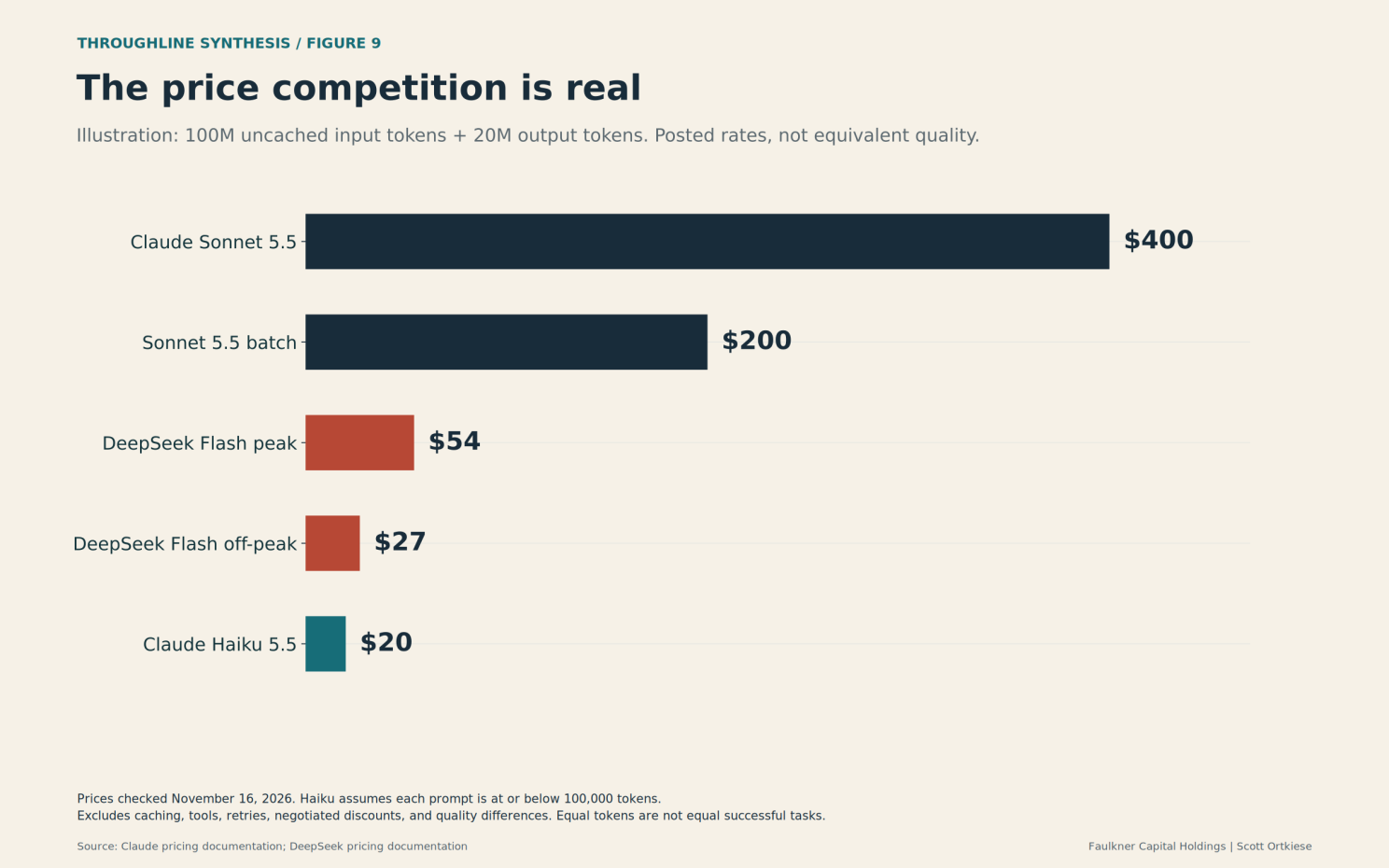
Including Haiku is essential. American companies can compete cheaply too. That is not a defense of permanent premium pricing. It is evidence that the competition reaches inside their own product lines.
Menlo Ventures estimates that open models account for 19% of tokens but 4% of model spending, with average token prices falling by a factor of 3.3. Chinese models account for 89% of spending within that open-model category. Those are market estimates, not audited totals, and Menlo invests in Anthropic (Menlo Ventures 2026 enterprise AI report).
The same report estimates that Anthropic and OpenAI together captured 86% of enterprise language-model API spending. That evidence does not support declaring the American model business already dead. It supports a narrower and more consequential conclusion. Valuable premium businesses coexist with an expanding competitive market that can reduce the money collected for a given amount of useful work (Menlo Ventures 2026 enterprise AI report).
Now, connect pricing to contracts. A model company can cut its customer prices this month. It may remain committed to minimum infrastructure payments for years. Rising usage helps only if the incremental work generates enough cash to cover its incremental costs.
Consider a hypothetical business performing 1 million tasks at $10 each. It collects $10 million, pays $4 million in variable costs and $5 million in fixed cash charges, and retains $1 million. Competition cuts the selling price to $6. Efficiency improves enough to reduce unit variable cost from $4 to $2.50. At unchanged volume, the business collects $6 million but spends $7.5 million. The surplus becomes a $1.5 million deficit.
It needs about 1.71 million tasks, 71.4% more volume, merely to restore the original $1 million surplus. That generous illustration assumes higher volume requires no additional fixed investment. It is not a forecast for any named company.
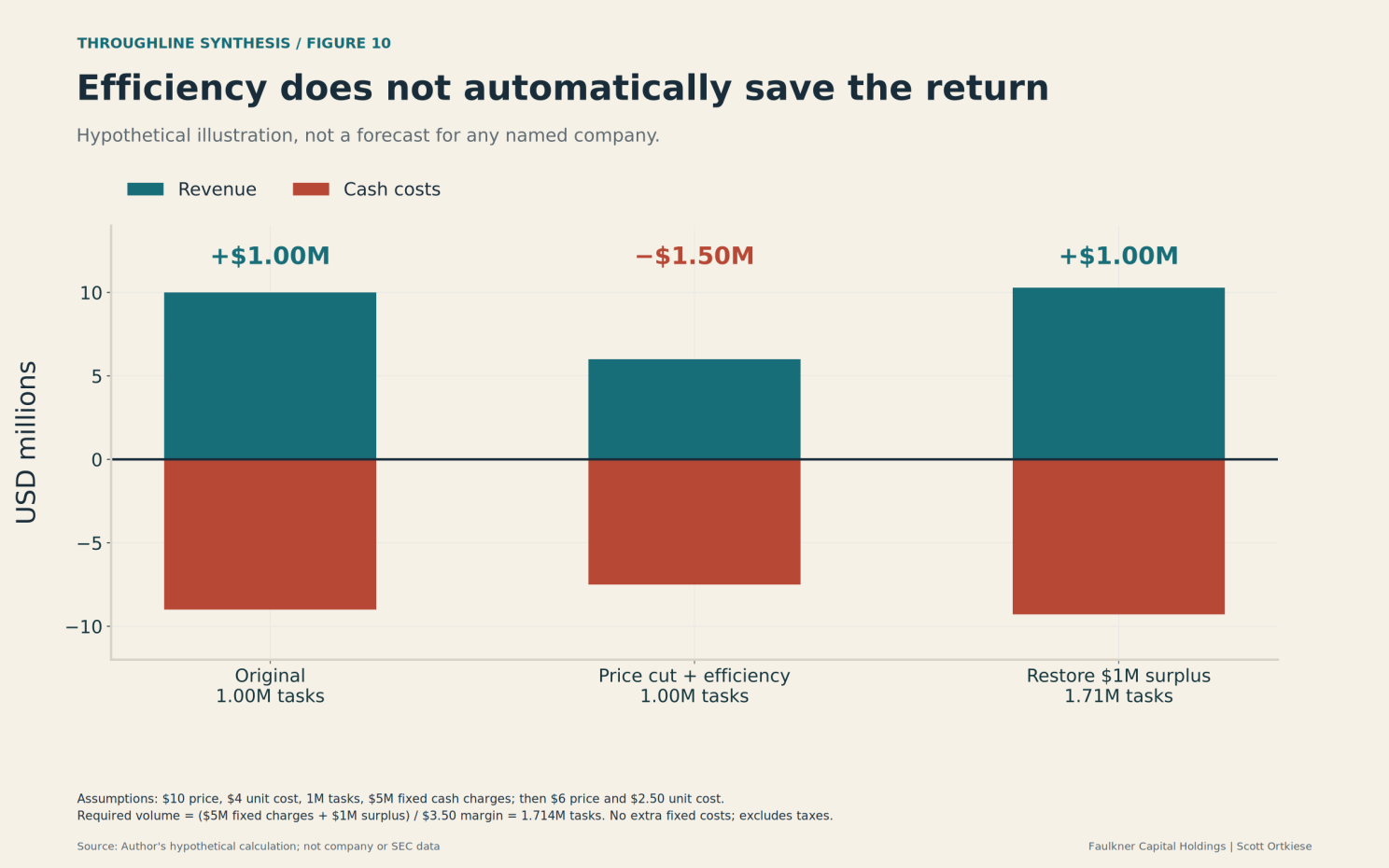
Here is the hard medicine. More intelligence does not necessarily produce more rent. Better technology can make the service cheaper, reduce what customers need to purchase, and transfer the economic benefit to users rather than the investors who financed expensive capacity.
The industry’s defense is that usage will grow faster than prices fall and efficiency will improve faster than margins compress. Sometimes it will. Hosting Chinese models can also generate revenue for American infrastructure owners (Google Cloud’s DeepSeek hosting documentation). None of that establishes that every asset purchased at yesterday’s price will earn an adequate return.
The claim that every hyperscaler must collapse is not established by these filings. The claim that premium pricing cannot be assumed while fixed commitments accumulate is. The most vulnerable borrowers can fail without Microsoft or Amazon going bankrupt. Diversified giants can remain solvent while destroying enormous amounts of investment capital.
The rentier daydream is not that AI will be useful. It is that usefulness must pass through their tollbooths at the prices their financial promises require. Competition attacks that second proposition.
Gamble’s wider economic discussion belongs beside that distinction. He describes weak Chinese retail demand, slowing industrial growth, a contracting property-and-infrastructure investment cycle, and car manufacturers producing into an overcrowded market (Gamble’s China discussion). His point is not that more factories or more units automatically create prosperity. Rather, producers can expand capacity faster than customers can absorb it at profitable prices.
He then turns to Tata Motors Passenger Vehicles and Jaguar Land Rover, describing a reduced profit outlook and expected cash burn despite revenue growth, alongside pressure on Mercedes-Benz, BMW, Audi, and Volkswagen (Gamble’s automotive comparison). These are not parties to Nvidia’s financing transactions. They are an uncomfortable comparison for anyone who thinks technological sophistication, prestigious brands, or a rising sales headline abolish the arithmetic of margins and cash.
Japan supplies another part of his argument. Gamble describes an economy squeezed by expensive imported energy and a central bank caught between inflation, a weak currency, and the risk of making a contraction worse by raising rates (Gamble’s Japan discussion). Energy bills and financing costs are not background scenery. They are claims on the money that customers and businesses might otherwise spend on the next supposedly inevitable expansion.
The voters, the raft, the bill: the AI growth party is over
The public had already objected before the election. A September Reuters/Ipsos poll found 73% worried that AI companies had not done enough to prevent serious harm and 55% supporting slower development. On September 29, Trump promoted rapid data-center expansion alongside executives including Amodei, Brockman, Zuckerberg, Pichai, and Huang. The agreement emphasized voluntary safety standards (Reuters on the voluntary AI pact and data-center expansion).
The companies were not ignorant of opposition. They behaved as if presidential access, investment announcements, and campaign spending could overcome it.
Harvard’s Ash Center reports that 40 of 41 local data-center ballot measures that passed across 10 states favored restrictions. In 30 contests, the restrictive side won more than 70% of the vote. These are not national opinion-poll results and do not show that AI alone determined the midterms. They do show communities rejecting unrestricted expansion where they could vote directly on it (Harvard Ash Center midterm technology-policy analysis).
CNBC reported at least $474 million in Musk midterm spending, including $224 million in Texas. Abbott and Paxton lost. Its early count found America PAC’s federal candidates had lost 29 contests, won 3, and still awaited 12 results. Greg and Anna Brockman contributed $25 million to Leading the Future, and Andreessen Horowitz contributed $50 million. Those financial commitments belong in the account of an industry trying to influence the rules under which it expands (CNBC campaign-finance analysis, November 4).
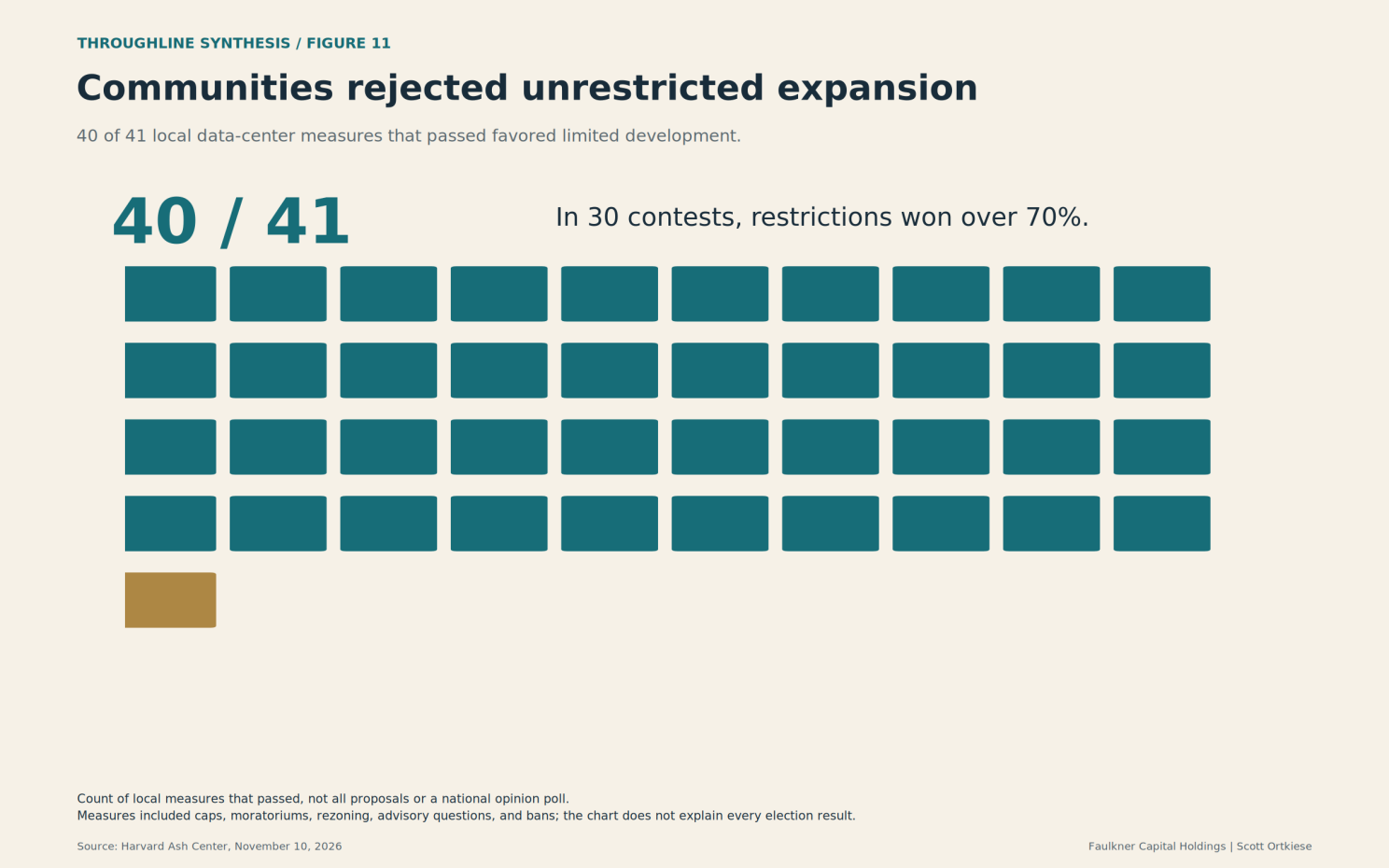
A construction delay has a cost. So does requiring developers to pay their own electricity and water expenses. So does ending a tax preference. The public’s resistance threatens investment economics precisely where the promoters treated public accommodation as an input they could secure.
Rubio’s anti-China positioning offers no necessary break with that financial structure. CNN reports that he warned Trump about concerns involving Huang and China before Huang joined Trump’s May trip to Beijing. Politico reports a growing post-midterm effort among Republican lawmakers to recruit Rubio for 2028. One Republican said, “I hope he makes his break from Trump and JD early next year.” Rubio has not announced a candidacy (CNN reporting on Lutnick, Huang, and export controls; Politico reporting on the Draft Marco effort).
The political opportunity is obvious without pretending to read his private thoughts. He can attack export policy while avoiding a confrontation with concentrated wealth. He can advertise his reported warning while leaving the financing arrangements largely untouched. His raft can carry his ambitions without carrying the public’s interests.
Bessent has chosen a more immediate target. He says Treasury and other departments supported action against Megaspeed, while Commerce “has the pen.” CNN reports that Lutnick cultivated Huang’s relationship with Trump and that David Sacks joined the push for technology exports. Trump negotiated the arrangement requiring Nvidia to pay the government 15% of its China chip revenue. CNN also reports Nvidia’s $25 million contribution to Trump’s ballroom project. These are documented relationships, not proof of an unlawful exchange (CNN reporting on Lutnick, Huang, and export controls).
Bessent’s demand goes beyond finding another executive willing to bless the same arrangements. He called for a “dramatic shakeup” and an outside chief executive, asking whether Nvidia had pursued seemingly illicit sales to “goose their revenues and their earnings” (CNBC’s Bessent interview). He also questioned the company’s geographic disclosures after Singapore revenue rose as China sales fell; Nvidia said its switch from billing addresses to customer headquarters better represented its sales geography (CNBC on Nvidia’s geographic disclosures). The issue is the corporate machinery, not just the empty chair at the top.
Axios describes Trump approving action against suspected diversion in May, August, and again on November 5, while Lutnick and Commerce official Jeffrey Kessler resisted; it also reports that a highly classified warning about Huang’s relationship with Alice Huang circulated in May (Axios’s account of repeated approvals and resistance). In the November confrontation, Musk supported the case for controls, even though he subsequently backed Huang’s return (Axios on Musk’s position; CNBC on Musk’s reinstatement support). Their interests do not require them to agree on every tactical decision. They can fight over export policy while defending the investment system surrounding it.
Put the dates beside the family names. Cantor reported 3,492,970 Nvidia shares on September 30, 2025, and 1,778,504 on March 31, 2026, excluding options: a 49.1% reduction (Cantor’s amended September filing; Cantor’s March filing). Axios reports that White House and intelligence officials had been pressing Howard Lutnick to act against Megaspeed since the fall of 2025 and that he resisted (Axios’s account of the enforcement pressure). Government warnings, a department resisting action, and a family firm’s changing holdings belong in the same investigation, not in separate public-relations folders.
Gamble’s accusation is insider trading. He alleges that sensitive government knowledge and regulatory delay benefited the Lutnick family’s financial interests, and he accuses Cantor of promoting Nvidia while reducing its disclosed holdings, leaving public buyers as “exit liquidity” (Gamble’s Cantor accusation). That is the accusation to confront, not bury beneath a recital of job titles. A family firm’s access to power is not a substitute for an explanation of what its decision-makers knew and when they acted.
Investigate insider trading. Obtain the trading instructions, the underlying client transactions, the communications, and the dates on which officials and decision-makers received sensitive information. Establish who ordered each change, what that person knew, and whether government information crossed into private trading. The quarterly positions are the starting point. Obtain the underlying transactions, including the derivatives, and identify the people responsible. The answer is compulsory disclosure, not an invitation to take the family firm’s word.
Cantor says the disclosed positions arose from client swaps rather than substantial stand-alone proprietary bets, while Commerce specifically denied that Bessent confronted Lutnick and did not immediately address the other allegations (Cantor’s response; Commerce’s response). Test those explanations against the records. Neither an official denial nor a financial label should close an investigation before it starts.
The commercial embrace continued after the share-count reduction. Cantor hosted Huang and other Nvidia executives in late September 2026, and analyst C.J. Muse’s October 3 research note maintained an overweight rating and a $350 target, according to the report that reviewed the note (CNBC on Cantor’s meetings and research). That later promotion is not the same event as the earlier holdings changes. It is another reason to examine the whole relationship rather than letting each fragment disappear into its own convenient explanation.
Public office is not a family asset. National-security information is not a private trading resource. Those who control either should face scrutiny proportionate to their power, not the presumption that their prestige supplies the missing answers.
The affairs are the tabloid entrance to this story, not its economic or political center. Gamble explicitly says to stop treating them as the main issue; he accuses Huang of enabling a shell-company network and changing financial reporting to obscure the diversion of technology; and he raises the prospect of a racketeering case while predicting imprisonment (Gamble’s accusation and demand for accountability). His accusation concerns using corporate and political power to evade controls for private gain. That charge deserves evidence, answers, and investigation, not a celebrity rehabilitation campaign.
The enforcement record needs names, dates, and jurisdictions. In Taiwan, prosecutors accused an Nvidia manager with the surname Chang of helping divert 74 servers containing Nvidia chips to China and attempting to divert another 56 intercepted by the Coast Guard; Bloomberg reported that prosecutors arrested him in July and indicted him in August (Bloomberg’s account of the Taiwan prosecution). Nvidia approached political officials to dispute the case and said its investigation found no indication that its employee knew of the alleged diversion; the officials told the company they had no role in the proceedings (Bloomberg on Nvidia’s intervention and response). A corporation’s confidence in its employee is not a substitute for the court’s work.
The Taiwan report identifies Chang as 1 of 9 defendants and describes forgery and breach-of-trust charges (Bloomberg’s account of the charges). The company’s private declaration of confidence does not entitle it to have a public prosecution switched off.
The separate Supermicro-related U.S. indictment unsealed on March 19 charged Yih-Shyan “Wally” Liaw, Ruei-Tsang “Steven” Chang, and Ting-Wei “Willy” Sun with an alleged scheme to divert advanced servers to China (Justice Department’s charging announcement; Supermicro’s identification of the defendants). Prosecutors alleged that a customer company bought approximately $2.5 billion in servers during 2024 and 2025 and that at least approximately $510 million in servers were diverted between late April and mid-May 2025 (Justice Department’s account of the alleged transactions). The accusation included false end-user records, repackaging, and dummy servers staged to deceive inspectors (Justice Department’s description of the alleged concealment). These are specific charges to adjudicate, not a vague dispute about whether technology executives deserve more admiration.
Megaspeed is another investigation. Reuters reported that Indonesian police raided its local subsidiary earlier in 2026 at the request of U.S. authorities, citing The Straits Times; the report also stated that there had been no public finding of a rules violation (Reuters on the Indonesian raid). Megaspeed says it conducts a legitimate, lawful business, and Singapore says its investigation into the company and 6 individuals continues (Reuters on Megaspeed’s response and the continuing investigation).
The reported search result is the point. Reuters’ fuller account says Indonesian police found unopened server racks but no graphics processing units, citing The Straits Times and an unnamed Indonesian government source (Reuters’ full account). Reuters also reviewed ImportGenius shipping records showing imports of Nvidia hardware, including H100 processors and components, during 2024 to 2026, with suppliers including Gigabyte subsidiary Giga Computing (Reuters on the shipping records). The newspaper’s source alleged onward movement to China, possibly by private jet (Reuters account of the alleged diversion route). Imports on paper and absent processors at the purported destination demand a chain-of-custody explanation, not applause for finding nothing.
Gamble attacks the suggestion that an empty office exonerates Nvidia. He says the missing hardware exposes false end-user documentation and rejects the idea that Nvidia can discharge its responsibility merely by asking customers to obey the law (Gamble’s missing-hardware argument). Where did the equipment go? Who checked? Who certified its destination? Who kept selling while those questions accumulated?
Follow the government contacts as closely as the hardware. Bloomberg reports that Nvidia general counsel Tim Teter called Commerce official Jeffrey Kessler about Alice Huang’s detention in Singapore and that the call ultimately led the Bureau of Industry and Security to pause its investigation and transfer the matter to the Justice Department by the end of 2025; Nvidia says Teter did not know about Jensen Huang’s affair at the time (Bloomberg’s account of the call and investigative pause). A transfer between agencies does not tell the public why an investigation stopped in one department, what work continued elsewhere, or who made the decisions. Those questions require records.
Gamble identifies a recurring method in the Taiwan and U.S. accounts. When scrutiny becomes dangerous, Nvidia calls people in government and asks them to intervene (Gamble on political protection). That is why the contacts belong in the same account as the transactions. A corporation should not be able to turn political access into a private appeal court.
The policy history makes the scramble uglier. Commerce announced the rescission and non-enforcement of the AI Diffusion Rule on May 13, 2025, after the rule had been issued that January (Commerce’s announcement). Gamble criticizes the administration for dismantling controls and now trying to rebuild barriers after the damage (Gamble on the rollback). The chronology is January and May 2025, not 2024. The political indictment survives the correction. Selling deregulation as liberation does not excuse the people who must later repair its consequences.
The regulatory issue extends beyond boxes crossing borders. SBS, citing The Information, reports that Commerce is preparing restrictions covering advanced chips and remote access to computing capacity in Singapore, Malaysia, Thailand, Indonesia, Brazil, Norway, and South Africa (SBS on the proposed 7-country controls). That is a reported proposal, not a rule already shown to be in force. Renting a chip’s computing power from abroad and physically diverting the chip are different mechanisms, but both belong in a serious discussion of what export restrictions actually control.
Gamble’s discussion names Blackwell and Rubin and asks why Norway, Brazil, and South Africa join the Southeast Asian destinations in the proposed restrictions (Gamble on the products and countries). His surprise is not proof of a smuggling route. It is a demand for an explanation of how a supposedly controlled system became geographically sprawling enough to require another round of controls.
Rubio can pose as the man who saw China coming. That still doesn’t answer who benefited from a system where financing, political access, and enforcement decisions crowded around the same companies. An anti-China speech does not change a supplier-financing contract or pay a community’s electricity bill.
The campaign to restore Huang is the financial establishment trying to save its own ass. Gamble calls it “the fakest in the history of fake” and describes Silicon Valley investors willing to sell out the public to protect their fortunes (Gamble’s opening attack). His contempt is not an incidental flourish. It identifies the difference between defending useful technology and demanding immunity for the people who monetized it.
The “Stand with Jensen” campaign asks the public to see loyalty and genius where Gamble sees financial self-preservation (Gamble on the campaign). Altimeter Capital’s Brad Gerstner and Atreides Management’s Gavin Baker asked Nvidia’s board to preserve the possibility of Huang’s return, while Musk signed the reinstatement petition and warned that “critical deals will be lost” without him (CNBC on the investor letter and Musk’s statements). Musk’s phrase is more revealing than another tribute to genius. The defense also centers on keeping transactions alive.
The personal-handshake defense makes the case worse. Gamble quotes KCM Trade analyst Tim Waterer’s description of supply commitments associated with Huang’s personal handshakes, then ridicules the notion that enormous deals should depend on restoring 1 man’s authority (Gamble’s handshake critique). If the economics require a celebrity to keep all the promises aligned, that is a governance failure, not an argument for his indispensability.
Gerstner has already demonstrated how quickly a financing question can turn into a loyalty ritual. In the earlier BG2 interview, Altman responded to his question about OpenAI’s spending commitments by offering to find a buyer for his shares; Gerstner interjected that he wanted to buy more (TechCrunch on the Altman-Gerstner exchange). Gamble describes that performance as Gerstner backing down (Gamble’s criticism of Gerstner). Offering to find the next buyer doesn’t explain how the business will pay its bills.
Gamble also invokes Baker’s history at Fidelity (Gamble on Baker). Contemporary reporting described Baker’s 2017 departure amid allegations of sexual harassment, which he denied (CNBC on Baker’s Fidelity departure and denial). Gamble uses that history to attack the rescue campaign’s moral authority. The financial conflict remains the central issue, but the demand that everyone defer to this circle’s judgment deserves no ceremonial bow.
Gerstner’s disclosed exposure is measurable. Altimeter’s June 30, 2026 filing reported approximately $1.884 billion in Nvidia shares within $9.830 billion in reported holdings, about 19.2% of that disclosed total (Altimeter’s Nvidia holding; Altimeter’s reporting date and total). Its disclosed holdings also included Cerebras, Meta, TSMC, CoreWeave, Arm, Amazon, Uber, Snowflake, Microsoft, and SpaceX (Altimeter’s holdings table). The date matters, and so does the common exposure. Gamble mocks the appearance of diversification across companies whose fortunes depend on the same AI expansion (Gamble on the concentrated trade). Different names do not produce independent sources of repayment. The rescuer standing beside Huang may be standing in front of his own portfolio.
Baker’s financial interest deserves the same inspection. Atreides’ June 30, 2026, filing reported 1,249,291 Nvidia shares valued at $249,970,636 (Atreides’ Nvidia position; Atreides’ June 30 reporting date). That is nearly $250 million attached directly to the company whose board he was asking to keep Huang’s return possible. Baker wasn’t just another admirer signing a character reference.
The larger exposure connects him to Musk. The same Atreides filing disclosed approximately $4.670 billion in SpaceX shares, $821.1 million in Micron, $687.3 million in Cerebras, $587.7 million in Astera Labs, and $211.5 million in CoreWeave (Atreides’ disclosed common-stock positions). These are the firm’s reported stock positions, separate from the options listed elsewhere in its filing. Baker’s disclosed financial constituency extended well beyond Nvidia to Musk’s combined space-and-AI company, memory, processors, connectivity, and rented computing capacity. The campaign is defending an executive whose relationships and financing decisions matter across that investment field.
Put the 2 managers together. Their firms reported approximately $2.134 billion in Nvidia stock as of that June reporting date, based on Altimeter’s $1,883,565,023 and Atreides’ $249,970,636 (Altimeter’s holding; Atreides’ holding). Both also disclosed holdings in SpaceX, CoreWeave, Cerebras, Meta, Amazon, and Micron (Altimeter’s holdings; Atreides’ holdings). Their shared interest isn’t an abstract affection for innovation. They manage claims on businesses tied to the expansion Huang helped organize.
Their letter’s mechanism was delay. It asked the board for a “slow, measured, and deliberate process” that preserved the possibility of Huang’s return, rather than demanding immediate reinstatement (CNBC on the Gerstner-Baker letter). That distinction does not make the intervention disinterested. Keeping the door open protects the possibility of restoring the dealmaker while the board, regulators, and customers confront the consequences of his conduct.
This is Gamble’s indictment of the rescue effort. The men preaching patience have money tied to the arrangements under scrutiny, and he accuses them of putting those fortunes ahead of the public (Gamble on the managers’ conflicting interests). Their portfolios give that criticism a concrete foundation. The public is being asked to treat the preservation of their investment story as a national duty. It should refuse. These are interested parties defending their position, not neutral referees deciding what the country needs.
Bill Ackman also defended Huang, while acknowledging that a national-security issue would be a real problem (Ackman’s defense; Ackman’s statement on national security). These men need not agree on every export restriction to share an interest in sustaining the AI investment story. Their preferred chief executive is not a public entitlement.
Gamble reserves no reverence for Ackman, either, and ridicules the petition’s reported 165,000 names as “bots” before correcting himself to names; he also mocks the paid promoters he expects in his comments and complains that criticizing Musk hurts his reach on X (Gamble’s attacks on the campaign and its promoters). Those are his attacks, not an independent count of automated signatures. The substantive point needs no bot count. A chorus of interested investors does not become a public mandate because it is loud.
Gamble welcomes Bessent’s demand for outside leadership and asks whether defenders will continue dismissing critics as conspiracy theorists even when a sitting Treasury secretary questions the company’s conduct (Gamble’s response to Bessent). The public owes these men neither a restoration nor a reputation-management service. Their preferred chief executive is not too important to lose his job.
The calendar now places those interests under scrutiny. Nvidia reports on Tuesday, November 17, with a 5 p.m. Eastern call. Anthropic’s filed U.K. timetable anticipates pricing on November 18 and trading on November 19, subject to change. Those are scheduled events, not completed outcomes (Nvidia earnings date announcement; Anthropic November 10 U.K. offering materials).

Gamble makes a sharper earnings prediction. He expects the backward-looking numbers to look impressive, then asks whether management will maintain, cut, or withdraw guidance once Huang’s financing arrangements lose their champion (Gamble’s earnings argument). That is a forecast, not a result already announced. It identifies the question the reinstatement campaign would rather disguise as a personality contest. Can the company sustain the sales without continuing to finance the conditions that produced them?
His market discussion also describes falling risk assets, a stronger dollar, changing Treasury yields, and weakness across commodities, followed by Bitcoin and Ether liquidations (Gamble’s market and cryptocurrency discussion). He raises the possibility that some crypto selling could be funding Anthropic purchases, comparing it to trading before SpaceX’s offering (Gamble’s IPO-funding hypothesis). That is his hypothesis, not a tracing of sale proceeds. Even as a hypothesis, it asks the right financing question. Is the next spectacular offering drawing on new purchasing power or simply moving speculative money from 1 crowded promise to another?
Nvidia’s revenue headline will not settle whether its customers can support themselves. The revealing questions concern cash collection, customer financing, capacity purchases, guarantees, and the amount of demand supported by independent end users. More sales accompanied by greater financial dependence would strengthen the criticism. Better cash conversion and less reliance on financing would weaken it.
Anthropic’s offering asks a parallel question. Can new public and strategic capital finance a business whose obligations run far beyond the period in which current prices can be assumed? A successful offering buys time. It does not prove the eventual return.
The bankers’ job is to close the transaction. The public’s job is not to mistake that accomplishment for a certificate of economic necessity.
The contrast with ordinary customers is brutal. Gamble discusses rising failures of U.K. gym-membership debits and RBC Capital Markets analyst Benjamin Toms’ concern that household stress could spread to credit-card and mortgage payments, affecting lenders such as NatWest and Lloyds (Gamble’s household-stress discussion). He connects the pressure to energy costs and suspects a similar squeeze in the United States (Gamble’s household-stress interpretation). These lenders appear in a consumer-credit comparison, not as newly identified participants in Nvidia’s transactions. The economic point is simple. Families cannot keep expanding their payments merely because financiers have expanded their claims.
The same salesmanship looks uglier from the payroll line. The story of a separate military-robot startup shows what happens when political prestige and technological promises outrun the capacity to pay people. CNBC reports that Foundation Future Industries, the military-robot startup backed and advised by Eric Trump, missed its October 30 payroll after its founder and chief executive, Sankaet Pathak, had borrowed $4.6 million from the company the previous year to buy a home; Pathak was also its sole board member (CNBC’s Foundation investigation).
As of the November 14 report, employees were still waiting for their pay (CNBC on Foundation’s missed payroll). The contrast is obscene. A company that reportedly financed its founder’s home could not meet its wage bill.
The fundraising ambition makes the wage failure more grotesque. CNBC reports that Pathak sought hundreds of millions of dollars at a $3 billion valuation while workers waited for pay, and that the company also missed payroll in August before obtaining a bridge loan (Foundation’s fundraising and earlier payroll failure). The same report identifies the October 2025 purchase of the Sausalito home through an LLC naming Pathak as sole principal (CNBC on Pathak’s home-purchase records). Billions in aspirational valuation, millions available for the founder’s house, and employees waiting for wages. That is not technological destiny. It is a hierarchy of who gets paid.
The military sales story concerned discussions about up to 1,000 robots for Israel, according to reporting quoting Foundation co-founder Mike LeBlanc; the same account includes the company’s later statement that exploratory conversations produced no agreement and that it was not negotiating a supply deal (Telegraph’s report and company response). The promises were grand. A reported sales discussion still left no cash available for payroll.
Gamble ridicules the gulf between the military sales pitch and demonstrated capability. He questions how robots he says cannot get up after falling would clear tunnels in Gaza and contrasts the proposed deployment with his claim that only 40 had been built (Gamble’s robot-capability criticism). Those capability and production claims remain his account, not an engineering test conducted for this article. The commercial demand is straightforward. Demonstrate the machine before turning battlefield promises into an investment pitch.
CNBC also traced the company’s widely repeated $24 million Pentagon-contract claim to contracts held by Boardwalk Robotics, which Foundation acquired in 2024, rather than newly won Foundation contracts (CNBC on Foundation’s Pentagon-contract claim). Eric Trump’s spokesperson denied any role in government-contract procurement or company operations (CNBC on Eric Trump’s response). Neither political branding nor a borrowed contract pedigree turns a company into a machine that can pay its workers.
Gamble’s political accusation is that Foundation is trading on access to Trump, with Eric Trump’s involvement functioning as what he calls an “implicit guarantee” (Gamble on access and influence). He describes the reassurance political proximity sells, not a signed federal guarantee. The sales pitch is ugly enough in its own terms. Investors are invited to admire access while employees wait for the company to honor its most elementary obligation.
Pathak had previously founded Synapse, whose collapse trapped customers’ access to money held through bank-fintech arrangements; the FDIC has described the resulting consumer harm and recordkeeping failures (CNBC on Pathak’s history; FDIC’s account of the Synapse failure). Deposit insurance protects against an insured bank’s failure, not every failure of a nonbank intermediary (FDIC explanation of deposit-insurance coverage). Prestige and promises travel quickly. The people waiting for wages or savings can be left standing still.
Gamble names Yotta and its promoter Graham Stephan in tracing how ordinary savers encountered the Synapse machinery (Gamble’s account of the promotional chain). His anger is directed at the succession of promises, and the people left unable to reach their savings, while the founder proceeds to another grand venture. CNBC reports that thousands remained without access after more than 2 years and that the bankruptcy trustee had identified as much as $96 million in missing customer funds (CNBC’s account of the unresolved Synapse losses). The problem is not simply that the money was safe but temporarily unlabeled. Customers were left with an unresolved shortfall and a fight over who was responsible.
The sequence is the indictment. Another company, another technological promise, another set of influential backers, and another group of ordinary people told to wait. The people selling the future keep finding a way to finance their own present.
The alternative to this system is not the disappearance of useful AI. It is refusing to confuse useful technology with a public duty to protect every private investment built around it. Creditors should bear the risks they priced. Shareholders should bear the risks they bought. Communities should retain the authority to reject costs they did not agree to absorb.
Trump sold the expansion as national greatness. The technology executives sold it as inevitability. The financiers sold it as durable income. Rubio can sell his distance from the wreckage as foresight.
None of those sales pitches pays the bill.
The circular-finance carousel does not need another patriotic speech, another celebrity founder, or another banker blessing the offering. It needs customers whose payments can support the machinery without endless financial assistance.
Until that proposition is demonstrated, the public should refuse the final role these arrangements can prepare for it: involuntary buyer of last resort.
Rubio’s raft is not a rescue boat for the public. The public has no obligation to rescue the fortunes of the people who built the carousel.