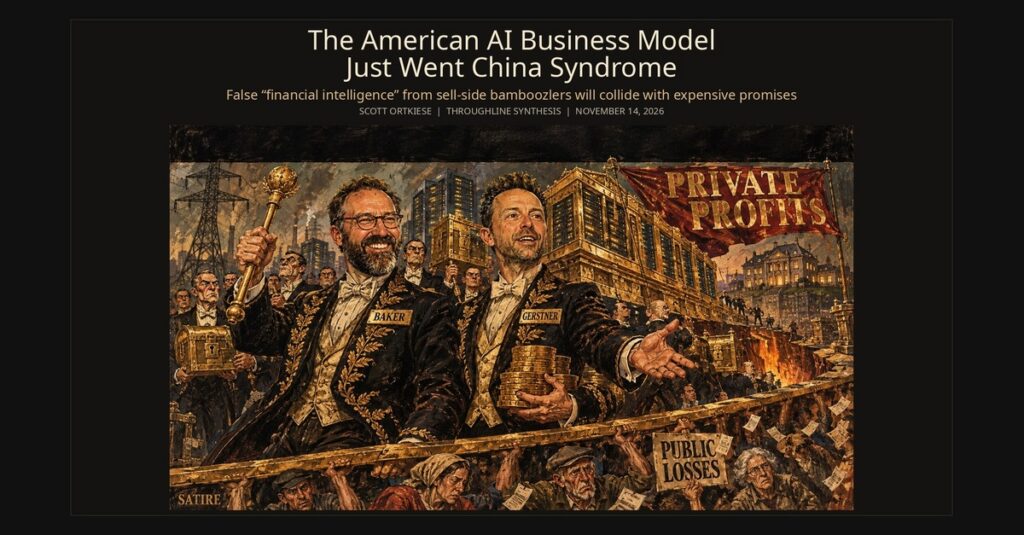
False “financial intelligence” from sell-side bamboozlers will collide with expensive promises
The American AI business model will collapse before artificial intelligence stops working. It will begin when customers refuse to pay enough to support the American machinery built around it. Better software does not redeem a bad investment. A cheaper answer does not cancel a data-center lease. A useful model does not guarantee a solvent business.
The failure will move through prices, contracts, credit, construction, and public budgets. The people who financed the expansion will fight to preserve their claims. The people who work for these companies, buy their services, finance their suppliers, and live beside their infrastructure will be handed the consequences.
Customers pay less. Contracts keep charging.
First, the revenue available to support the machinery falls short of the promises made to finance it. Falling prices, disappointing utilization, or customers doing the work more cheaply elsewhere all lead to the same financial collision: less money collected against payments that do not fall automatically.
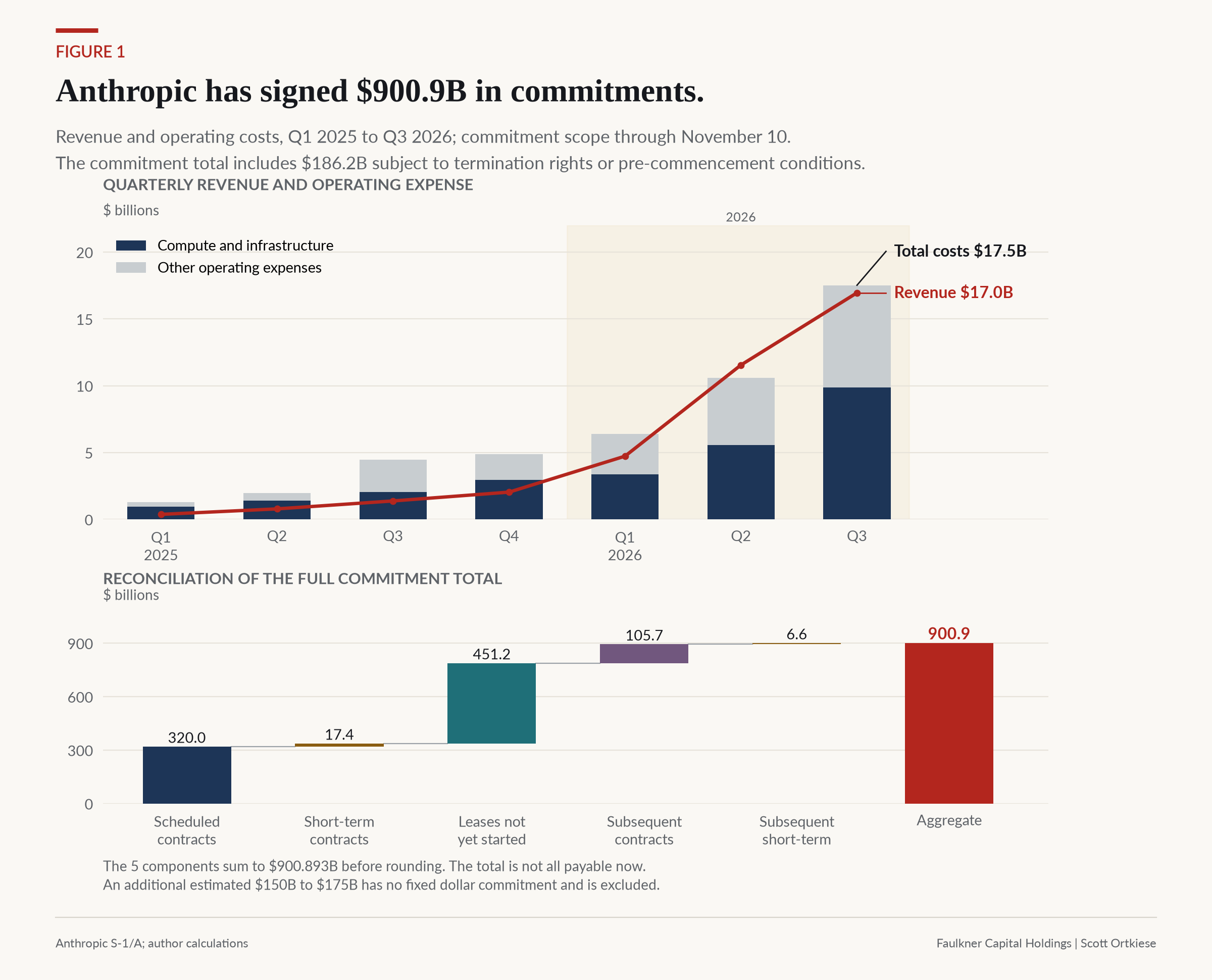
Anthropic, the company behind Claude, discloses approximately $900.9 billion in commitments, including $70.7 billion expected in the 12 months following September 30, 2026; $186.2 billion of the aggregate is subject to termination rights or pre-commencement conditions, not a blanket right to walk away (Anthropic prospectus, contractual obligations). Its minimum cloud commitments include $110 billion to Amazon, approximately $121.3 billion to Google, and at least $47.2 billion to Microsoft, with payment obligations that do not simply disappear when usage disappoints (Anthropic prospectus, cloud agreements).
That is the first transfer of risk. The customer sells a service in a competitive market. The supplier holds a contract.
Investors finance the gap.
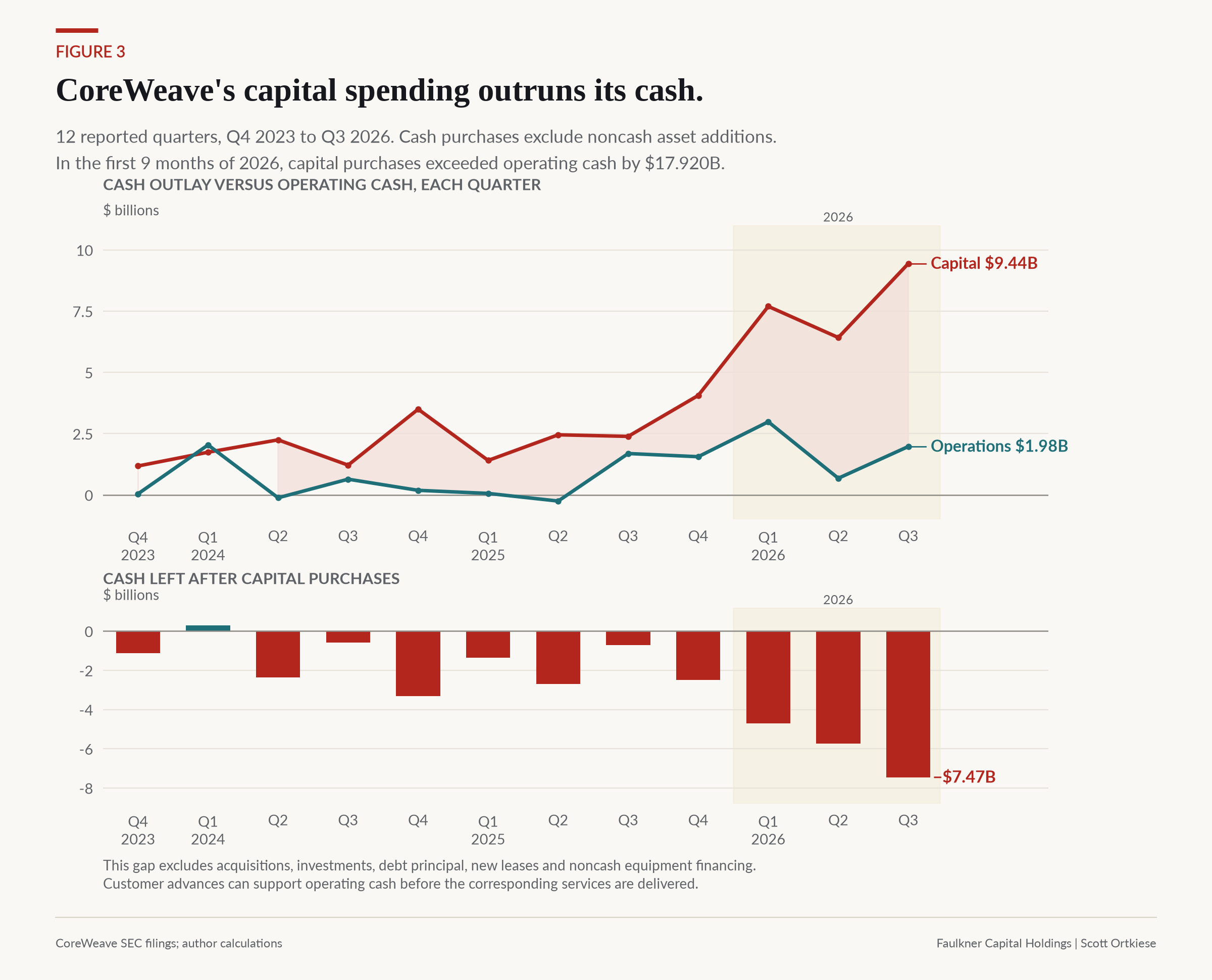
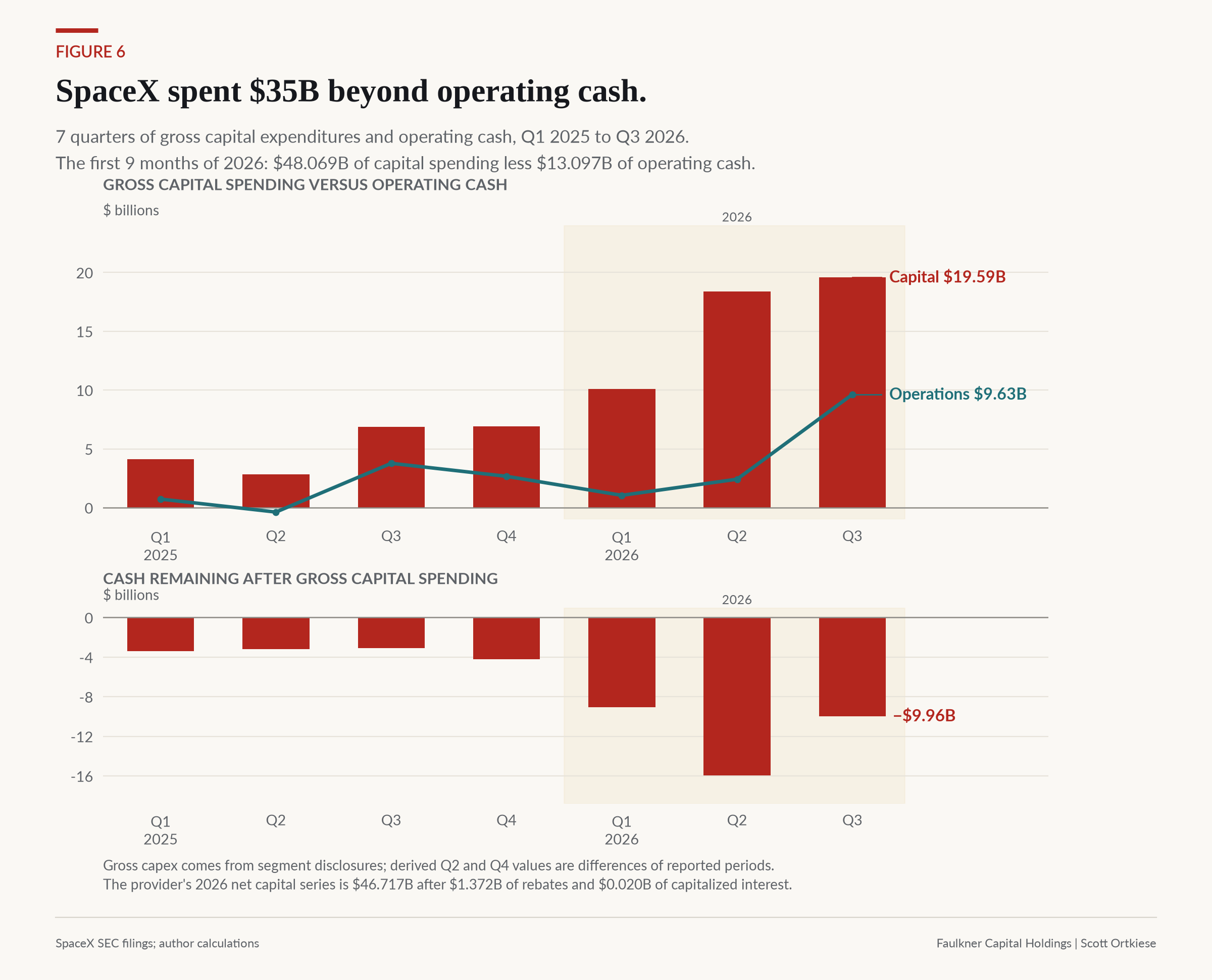
Second, the companies turn to investors for the money their operations do not supply. CoreWeave, which rents computing infrastructure, spent $23.558 billion on capital purchases during the first 9 months of 2026 and generated $5.638 billion in operating cash, leaving a $17.920 billion difference before other cash requirements (CoreWeave quarterly filing, cash flows). SpaceX spent $48.069 billion versus $13.097 billion in operating cash during the same period, a $34.972 billion difference; its AI segment accounted for $39.995 billion, or 83.2%, of that capital spending (SpaceX quarterly filing, cash flows, and segments).
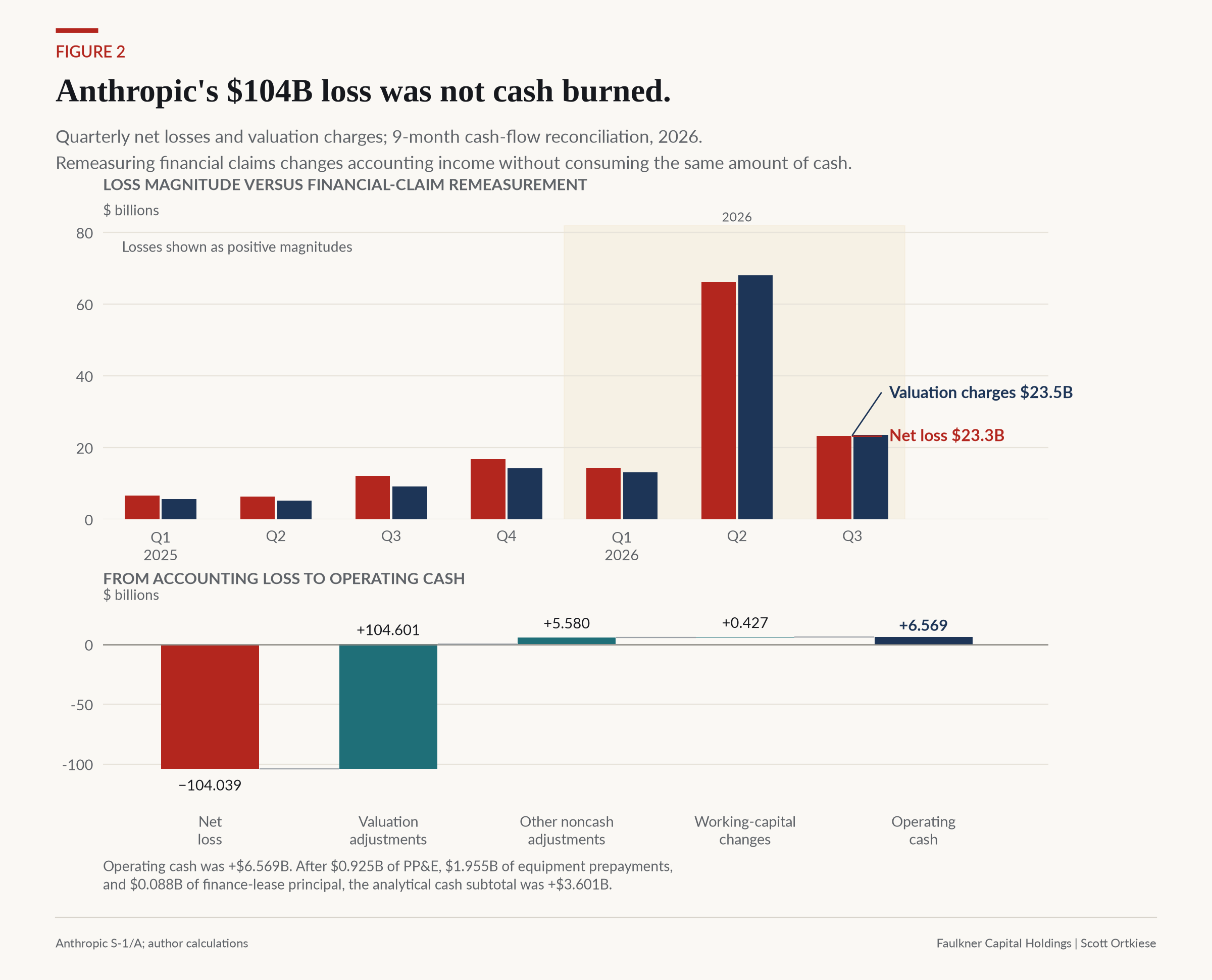
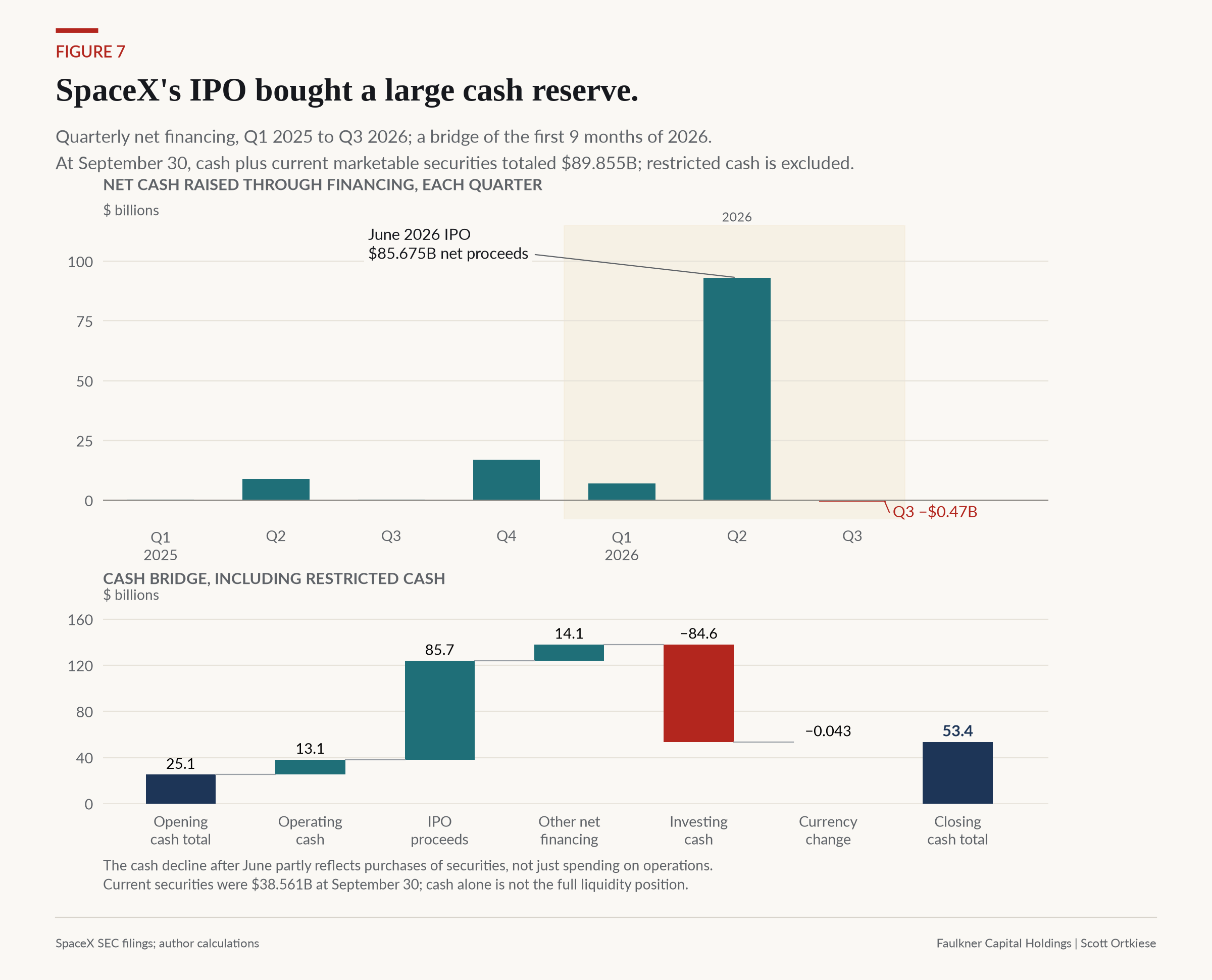
Do not confuse an accounting loss with an empty bank account. Anthropic reported a $104.039 billion net loss but positive operating cash of $6.569 billion, and held $131.845 billion in cash and short-term investments at September 30 (Anthropic prospectus, financial statements). SpaceX held $89.855 billion in cash and current securities after receiving $85.675 billion in net initial-public-offering proceeds (SpaceX quarterly filing, liquidity and financing). Those reserves buy time. They do not establish that the investments will earn their cost.
The supplier becomes the financier.
Third, financing and sales become harder to separate. Anthropic’s proposed $26 billion private placement, a sale to selected investors outside the public offering, includes Google, Nvidia, AMD, Broadcom, Micron, Microsoft, and TSMC; Google’s $10 billion purchase reduces its separate financing availability by the same amount (Anthropic prospectus, concurrent private placement). This is not $10 billion twice. Nor is the proposed financing money already received.
Broadcom’s $42 billion facility provides an especially clear mechanism. Anthropic can issue notes to finance specified equipment-lease payments, with interest added to the amount owed at 9%, or 13% for notes issued during a defined breach period (Broadcom note-purchase agreement). Financing the rent preserves the supplier’s sale while enlarging the claim against the customer. It does not turn the rent into profit.
The indictment must follow both sides of these transactions. A supplier’s revenue and an investor’s enthusiasm are not independent proof that the ultimate customer can pay.
Credit tightens before the machinery stops.
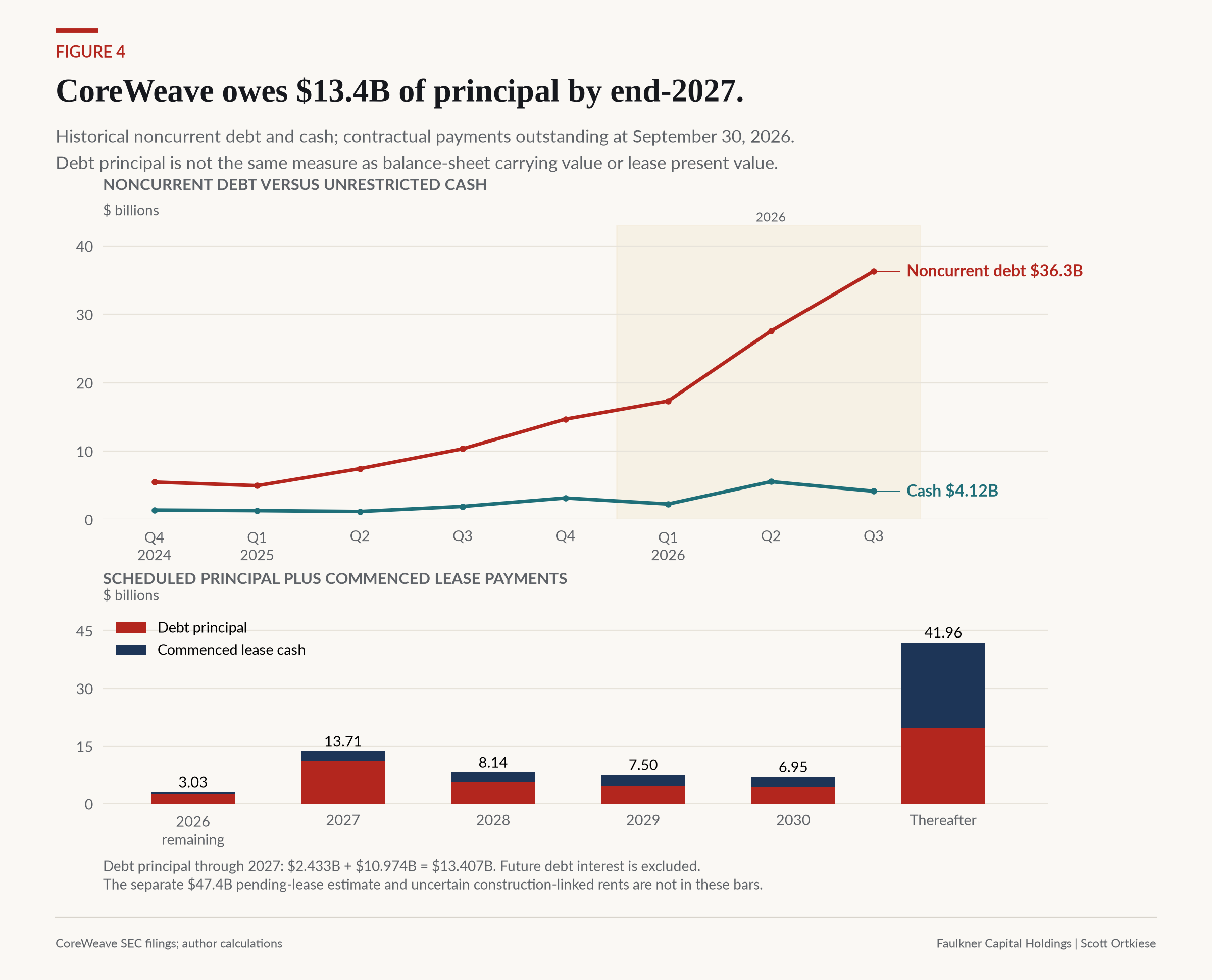
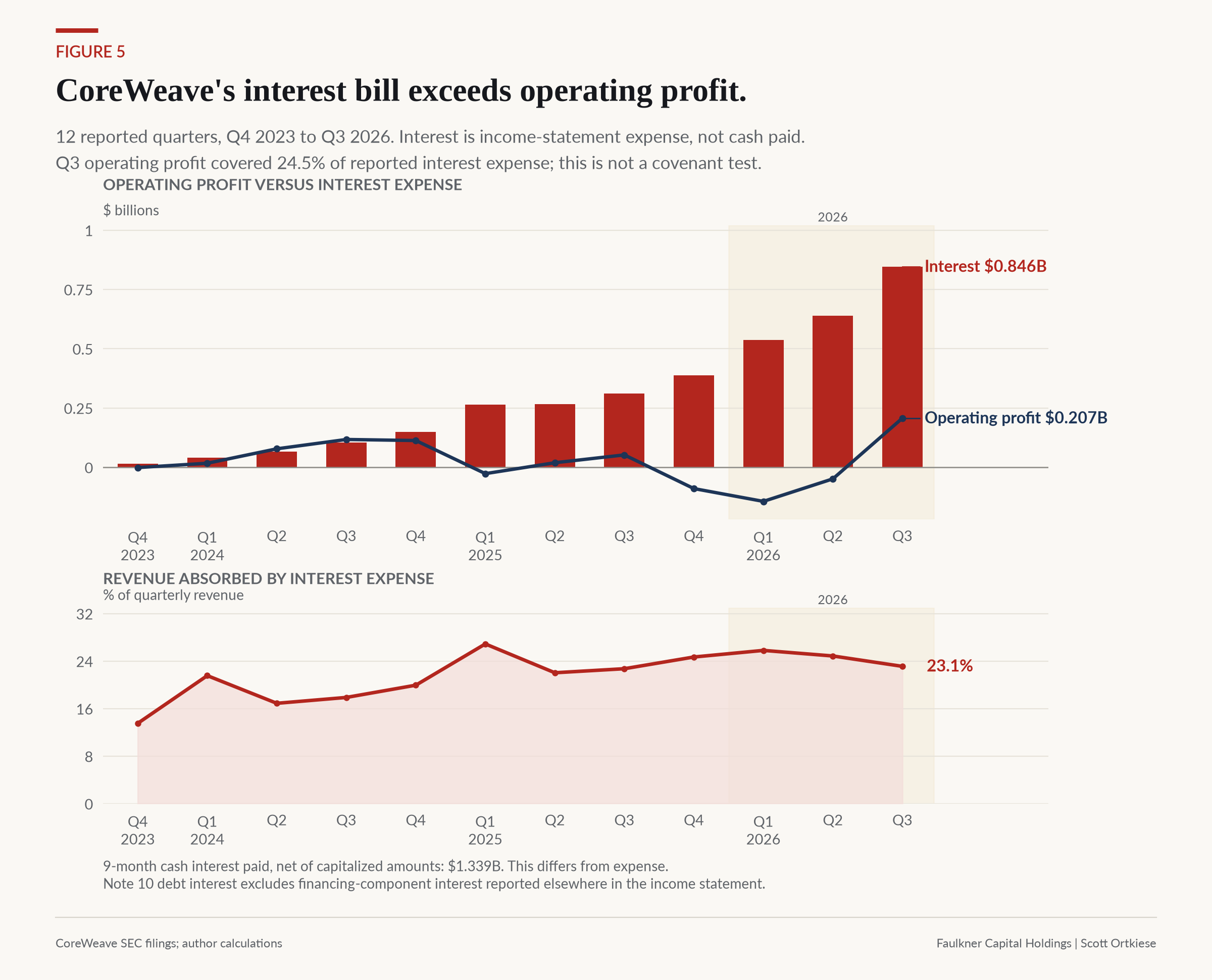
Fourth, lenders demand protection as operating returns disappoint. CoreWeave owes $13.407 billion of principal, the borrowed amount excluding future interest, from October 2026 through the end of 2027; in the third quarter, its $207 million operating profit covered only about 24.5% of its $846 million income-statement interest expense (CoreWeave quarterly filing, debt maturities and operations). These are different tests of pressure, not interchangeable measures of cash insolvency.
Its DDTL 5.5 delayed-draw term loan supplies funds as financing conditions are met, through a special-purpose borrower backed by a CoreWeave parent payment guarantee and lender cash controls (CoreWeave credit agreement; CoreWeave parent guarantee). When those protections operate, money retained for creditors is money unavailable for something else. The adjustment reaches expansion, hiring, purchasing, and shareholders before every server goes dark.
Retrenchment spreads the loss.
Fifth, the response to financial pressure becomes somebody else’s revenue collapse. Canceled expansion hits equipment orders, construction contracts, property developers, and power projects. Layoffs cut household income. Weaker purchases hit suppliers abroad. The damage spreads beyond the balance sheets that started it.
Shareholders bear the decline in equity value. Creditors bear unrecovered claims after collateral, guarantees, and contractual priority do their work. Employees bear lost wages and damaged equity compensation. Suppliers bear unpaid invoices and reduced orders. Customers bear disrupted services, migration costs, and attempts to extract higher prices.
The legal entities matter. Anthropic’s commitments are not personal debts of Dario or Daniela Amodei. CoreWeave’s corporate guarantee is not proof that every bank arranging its debt retains the exposure. SpaceX’s obligations are not automatically Elon Musk’s personal obligations. Responsibility for the decisions and legal liability for the bills are different questions.
The rescue campaign moves the fight into public budgets.
Finally, private losses become a political demand. The industry will seek public protection for infrastructure and financing that private customers cannot adequately support. Trump and Congress should be judged by whether they protect essential services or protect the investors who priced those services badly.
Taxpayers pay when the government assumes private risk. Ratepayers pay when regulators place unrecovered infrastructure costs in utility bills. Public workers and beneficiaries pay when rescue spending displaces other priorities. Those transfers will be political choices, not unavoidable consequences of better software.
OpenAI, Microsoft, Google, Amazon, Meta, Oracle, Anthropic, CoreWeave, SpaceX, and the hardware suppliers belong in the same investigation, but not in a fictitious consolidated balance sheet. The question for each is precise: who owes the money, what customer cash will repay it, who guarantees the shortfall, and who owns the claim when repayment fails?
AI can survive this collapse. The financing model does not deserve protection merely because the technology remains useful. The public must not become the final customer for promises it never made.
Anthropic sells the future while the payment dates approach
Dario and Daniela Amodei do not have to persuade every customer that their infrastructure deserves its financing cost. They have to collect enough cash, at the right dates, to meet the obligations they have already accepted. Enthusiasm for Claude does not answer that question.
The $900.9 billion commitment total is not a single debt maturing tomorrow. Anthropic expects approximately $451.6 billion before December 31, 2030, and substantially all the remainder between 2031 and 2045; the $70.7 billion expected over the next 12 months includes $4.2 billion subject to conditions or termination rights (Anthropic payment schedule and qualifications). The danger is the collision between those dates and the cash the business can earn, not a theatrical comparison between a multiyear total and a single quarter’s revenue.
The accounts also deny the lazy bearish claim that a $104 billion accounting loss means $104 billion disappeared from the bank. Financial-claim remeasurement and other financial-instrument adjustments contributed $104.601 billion to the reconciliation from Anthropic’s 9-month loss to positive operating cash; subtracting equipment purchases, equipment prepayments, and finance-lease principal from operating cash leaves a $3.601 billion analytical subtotal (Anthropic cash-flow reconciliation). That subtotal measures a defined past period. It does not pay for the next decade’s commitments.
The sharper indictment is that an enterprise can display ample liquidity while remaining dependent on investors underwriting a vast expansion. Anthropic’s first 9 months of 2026 included $110.735 billion in financing inflows, compared with $6.569 billion in operating cash (Anthropic financing and operating cash flows). Fresh capital can keep an investment alive long after its promoter has stopped explaining how customers will finance the promised return.
The proposed IPO combines capital raising with shareholder liquidity, but the distinction matters. The offering allocates 801,351,354 shares to company fundraising and 23,648,646 to selling stockholders; Anthropic receives no proceeds from the selling holders’ shares (Anthropic offering structure). Calling all the proceeds an insider cash-out would be wrong. Calling a public listing disinterested generosity toward new investors would be absurd.
Public money does not buy ordinary public control. The proposed founder share carries 50.1% of general voting power, while the Long-Term Benefit Trust elects a board majority (Anthropic governance arrangements). Investors finance the enterprise without acquiring authority proportionate to their financial exposure. Mission language does not change that distribution of power.
The $26 billion concurrent placement makes the commercial circle explicit: Google and Nvidia propose $10 billion each; AMD, $2.5 billion; Broadcom, Micron, and Microsoft, $1 billion each; and TSMC, $0.5 billion (Anthropic placement allocations). Supplier investment is not automatically sham revenue. It is also not independent confirmation that an outside customer will pay enough to sustain everyone in the circle.
CoreWeave borrows for longer than customers have promised to stay
Jack Gamble’s description of neoclouds as “WeWork with GPUs” identifies the maturity problem: long-lived financial obligations supported by shorter customer rentals (Gamble’s comparison and accounting critique). CoreWeave’s own financing announcement puts numbers on it: a roughly 5-year, $2.6 billion loan supported by customer contracts averaging approximately 3 years, with lenders underwriting renewal risk (CoreWeave’s financing announcement). A contractual promise to pay the lender survives the end of a customer’s initial commitment.
The first question is not how impressive the equipment looks. It is how much money operations leave after buying the equipment. Across 12 reported quarters, the chart separates CoreWeave’s operating collections from cash capital purchases; in the first 9 months of 2026, the latter exceeded the former by $17.920 billion (CoreWeave cash-flow statements; historical financial statements). Debt principal, acquisitions, and other requirements still have to be dealt with outside that comparison.
JPMorgan and MUFG helped arrange the DDTL 5.5 financing, but the borrower is CoreWeave Financing DDTL V-V, LLC, and CoreWeave, Inc. provides the parent guarantee (credit agreement; parent guarantee). A subsidiary name does not make the parent promise disappear. An arranger’s prestigious name does not identify the final holder of every loan.
The agreement gives creditors a payment hierarchy and control over specified cash accounts; customer-contract expiry without a qualifying replacement can trigger mandatory prepayment tied to projected debt-service and contract-value coverage (CoreWeave cash priorities and renewal provisions). These are protections for the financing. They are not promises to protect employment, minority shareholders, or the local economy.
Gamble and Noble are also right to attack EBITDA as a substitute for the economics of this business (their accounting discussion). EBITDA means earnings before interest, taxes, depreciation, and amortization. Interest is the cost of financing the machinery. Depreciation allocates the cost of wearing it out or making it obsolete. Removing those costs from a performance measure does not remove them from the business.
Depreciation is not a cash payment made every quarter. But equipment must ultimately earn back its acquisition cost, and replacing it requires money. Stock compensation is likewise not a current cash wage, but it transfers part of the owners’ claim to employees. A presentation that excludes these costs still needs to explain who absorbs them.
CoreWeave’s third-quarter interest expense consumed 23.1% of revenue, and operating profit covered only 24.5% of that expense (CoreWeave income statement). Those are accounting ratios, not covenant calculations. They nevertheless expose what a triumphant adjusted-earnings headline leaves outside the frame.
Musk’s useful businesses do not redeem every claim sold around them
Gamble makes the ownership problem plain. Buying SpaceX is not the same transaction as buying Starlink on its own, and admiration for a communications network does not establish the value of the AI businesses packaged beside it (Gamble and Noble on SpaceX and Starlink). The product, the corporate perimeter, and the security being sold are different things.
SpaceX’s first 9 months of 2026 produced a $34.972 billion difference between operating cash and gross capital spending (SpaceX cash-flow and segment disclosures). The following series shows when that gap widened, rather than burying it inside a story about rockets. A useful operating franchise can sit inside a group whose investment program depends on outside capital.
The June IPO supplied $85.675 billion in net proceeds, and September cash plus current marketable securities totaled $89.855 billion (SpaceX financing and liquidity disclosures). The cash reserve is real. So is the distinction between money supplied by investors and money earned from customers.
The next figure separates operating cash, IPO proceeds, other financing, investing outflows, and currency effects. Purchases of marketable securities move money into another liquid asset; they are not automatically money burned. Counting them as operating failures would weaken the case against an expansion that already supplies ample evidence of financing dependence.
The AI/SI segment absorbed 83.2% of SpaceX’s 9-month capital spending while reporting a $3.295 billion operating loss; Connectivity generated $5.211 billion in operating profit over that period (SpaceX segment results). AI/SI denotes artificial intelligence and superintelligence. The group’s capital allocation is not a minor side bet attached to the space business.
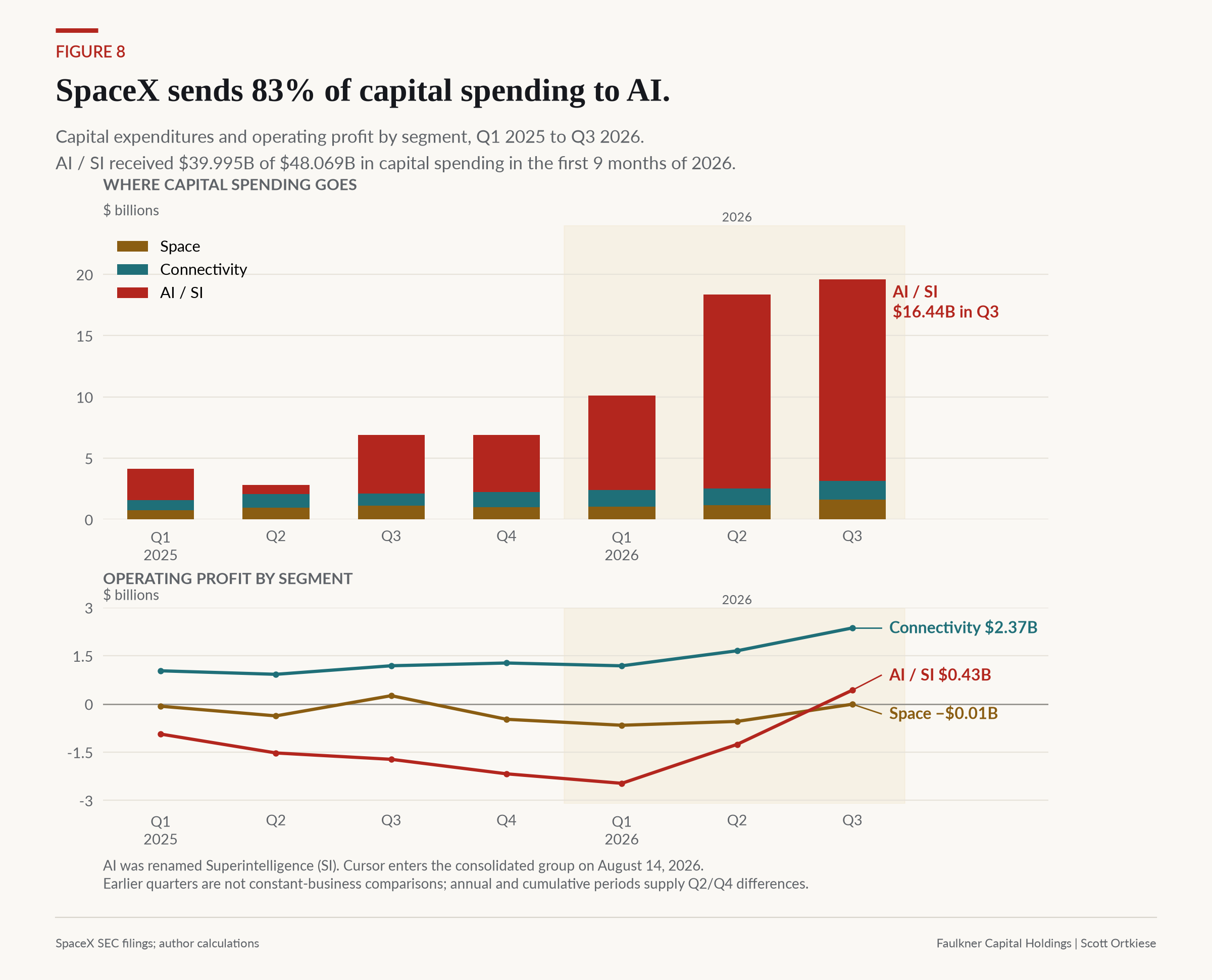
Musk’s personal wealth is not a guarantee of these corporate obligations. Nor does common influence over SpaceX, xAI, X, and Tesla make their assets interchangeable for every creditor. The documents, guarantees, legal entities, and shareholder rights determine where a claim can reach. The cult of the founder is no substitute for reading them.
Noble’s attack on Tesla is an argument about distorted capital allocation, not merely a dislike of electric vehicles (Noble on Musk and market prices). A business funded on exceptional expectations can outbid rivals for people, equipment, and political attention before demonstrating the corresponding economic return. That advantage has real consequences even when the eventual valuation collapses.
Microsoft, Google, Amazon, Meta, and Oracle cannot plead innocence by size
The platforms are not a single insolvent company. They are different businesses making connected capital-allocation decisions. The correct comparison is each company’s operating cash, capital outlay, obligations, and financing, not a fictional combined borrower.
Microsoft’s Satya Nadella and Amy Hood, Alphabet’s Sundar Pichai and Anat Ashkenazi, Amazon’s Andy Jassy and Brian Olsavsky, Meta’s Mark Zuckerberg and Susan Li, and Oracle’s Larry Ellison and executive leadership belong in that accounting of decisions (Microsoft finance leadership; Alphabet’s quarterly leadership presentation; Amazon leadership; Meta leadership; Oracle leadership). Their companies’ scale increases the consequences of poor capital allocation. It does not repeal the obligation to earn the cost of capital.
The heatmap compares capital cash outlay with operating cash for 5 companies over 12 reported quarters. It identifies when investment consumes the quarter’s operating cash and where the pressure is concentrated. Oracle’s fiscal dates are offset by 1 month, so its observations remain separately identified.
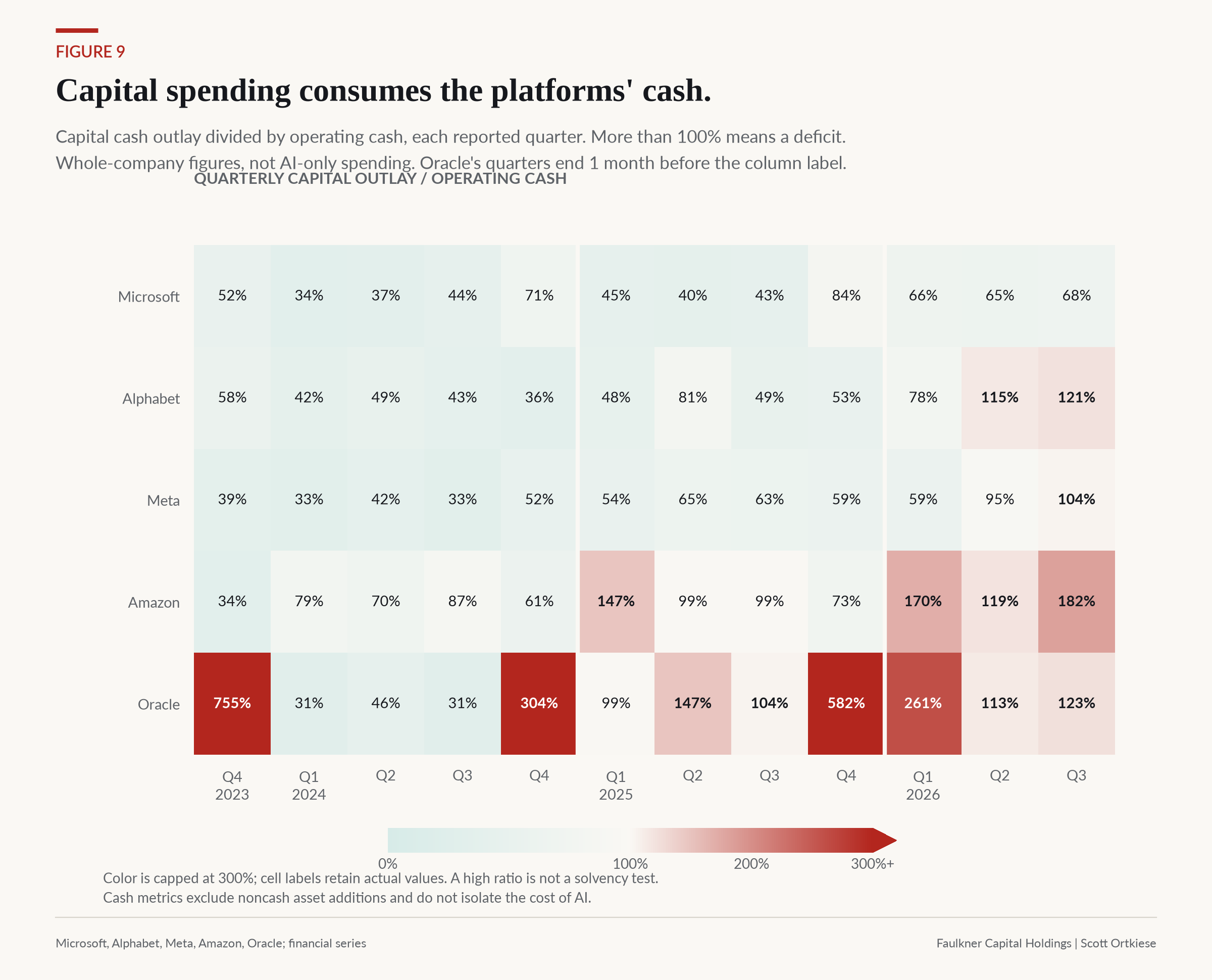
Microsoft retains a cash surplus on this narrow measure in the latest quarter, while Alphabet, Meta, Amazon, and Oracle show deficits in their respective latest periods (Microsoft filings; Alphabet financial reports; Meta financial reports; Amazon filings; Oracle filings). That difference matters. A strong supplier can continue collecting while a weak customer searches for financing, and a diversified platform can subsidize an investment that would not survive alone.
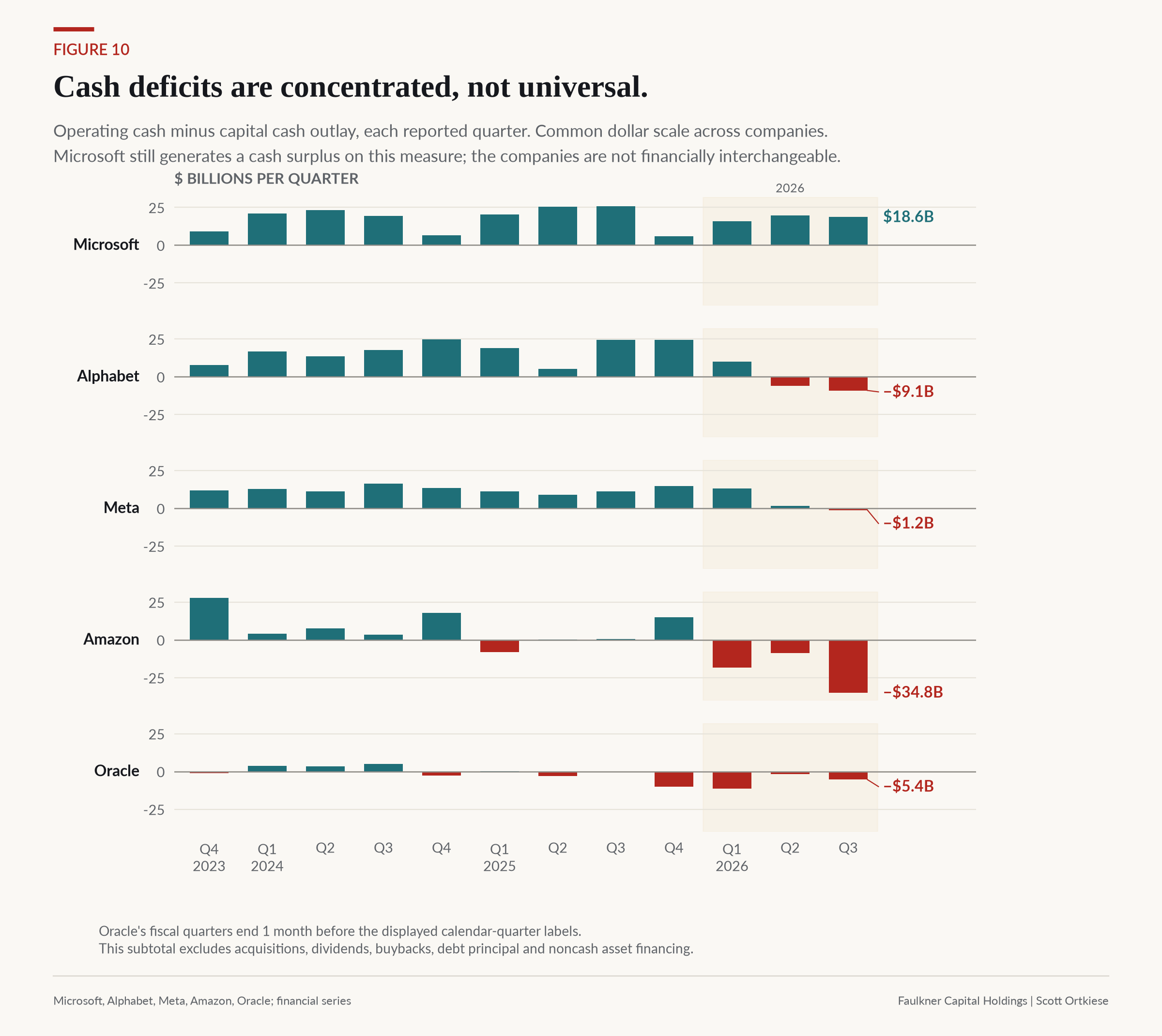
For Microsoft, Google, and Amazon, the supplier-investor overlap is visible in Anthropic’s commercial and financing arrangements (Anthropic’s cloud and investor agreements). For Meta, the question is whether capital committed under concentrated founder authority earns its cost. For Oracle, it is whether the customer cash arrives on a schedule that supports the infrastructure and borrowing. A backlog, a model demonstration, and a market valuation are not cash-flow statements.
Noncurrent debt adds another dimension. The figure shows both the dollar balances and their growth from each company’s starting quarter, separating a large existing debt stock from a rapid increase off a smaller base. It excludes obligations outside that balance-sheet line rather than pretending to measure every promise.
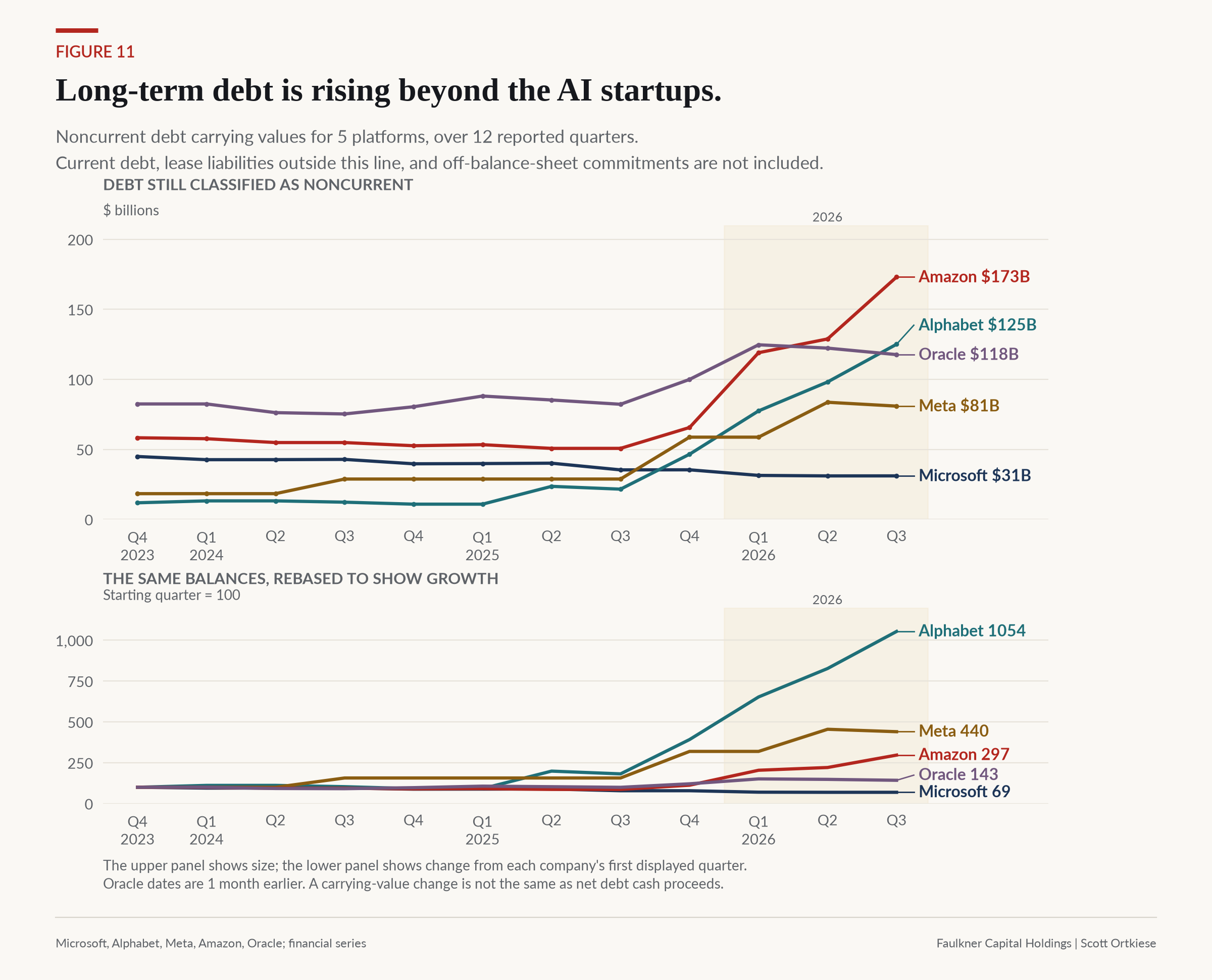
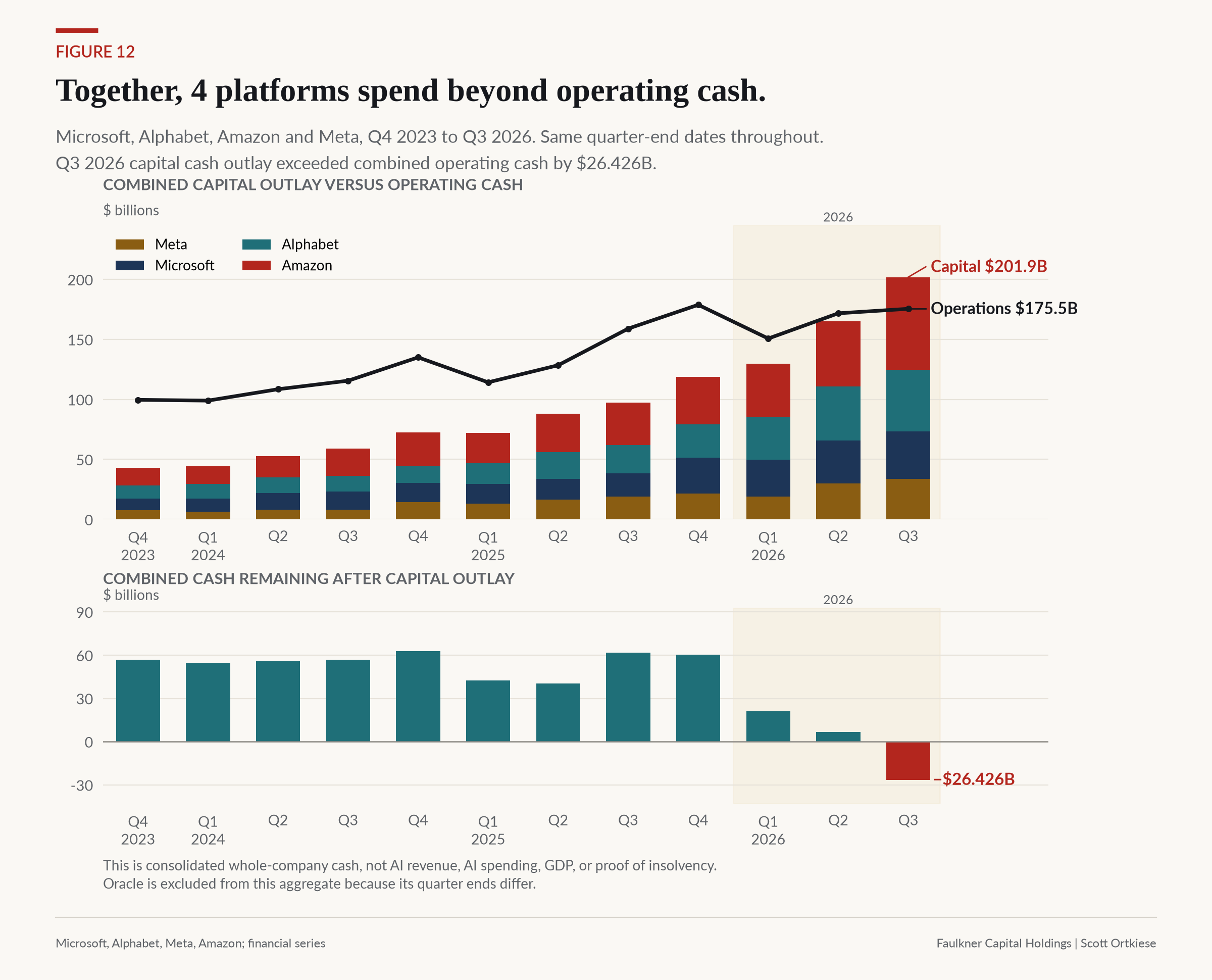
For Microsoft, Alphabet, Amazon, and Meta together, capital cash outlay in Q3 2026 totaled $201.923 billion, while operating cash totaled $175.497 billion, a $26.426 billion deficit on this measure (Microsoft filings; Alphabet financial reports; Amazon filings; Meta financial reports). This is company-wide spending, not an estimate of AI-only investment or a $26.426 billion loss of national output. The aggregate shows a financing requirement without pretending every constituent has the same problem.
OpenAI’s Sam Altman and its governing Foundation belong in the same examination. The Foundation appoints and can replace the commercial company’s board, making governance power distinct from the economic claims sold to investors (OpenAI’s governance structure). Altman’s promise to find Gerstner a buyer for his shares did not address how OpenAI would pay its computing commitments. An investor’s exit and a company’s repayment capacity are separate questions.
SoftBank’s Masayoshi Son is not outside this structure merely because investment announcements are presented as national industrial ambition; he is SoftBank Group’s chairman and CEO (SoftBank’s leadership record). Announced capital, committed capital, cash delivered, deposits at risk, and cancellable construction are different quantities. Son and every infrastructure sponsor should be judged on those quantities, not the size of a ceremonial announcement.
The bankers’ names do not tell us who is left holding the loan
The financing profession sells confidence at every stage: arranging debt, distributing securities, producing valuation arguments, and treating participation by another prestigious institution as validation. The relevant question is what each institution earned, what it represented, what it retained, and what it passed to someone else.
Anthropic’s offering materials disclose that affiliates of Goldman Sachs, Morgan Stanley, JPMorgan, Cantor Fitzgerald, and TD Securities hold securities while their firms participate as underwriters (Anthropic underwriter interests and restrictions). The same materials distinguish those holdings from shares sold in the offering and describe applicable transfer restrictions (Anthropic underwriting disclosures). The overlap deserves examination, not a presumption that every dollar raised goes into a banker’s pocket.
Blackstone, KKR, and Apollo appear in Baker’s defense of sophisticated private-capital participation (Baker’s financing discussion). Their reputations cannot substitute for disclosure of the actual fund, borrower, guarantor, collateral, leverage provider, and beneficial investor. A manager’s entire asset base is not the exposure of a particular fund.
The same discipline applies to insurers and pensions. An insurer can hold a loan directly, invest through a fund, or provide financing elsewhere in the chain. A pension can hold listed shares without holding the borrower’s debt. Those routes create different claims and different loss priorities. Calling all of them “Wall Street” conceals the people whose savings sit behind the institutions.
This opacity is itself a public accountability problem. Americans are asked to trust the system’s sophistication while crucial allocations and contract schedules remain undisclosed. No missing disclosure should be silently converted into either zero exposure or an invented catastrophe total.
Gerstner and Baker are defending the fraud machine they helped finance
Brad Gerstner and Gavin Baker are not innocent spectators watching an AI accident. They invested in the machinery, promoted its bogus economics, and are now lobbying to preserve a route back to power for its chief architect. Their funds’ holdings, public arguments, and November 13 letter to Nvidia’s board establish that sequence (Altimeter holdings, Atreides holdings, Gerstner’s interview, Baker’s argument, their letter).
George Noble calls the letter evidence of panic among Nvidia’s biggest bulls (Noble’s November 14 article). I agree. This is portfolio defense dressed as public responsibility. The investors who sold confidence in the machine are demanding special solicitude for the man who built it.
Read what they chose to defend
Gerstner, Altimeter Capital Management’s CEO, and Baker, Atreides Management’s managing partner and chief investment officer, begin their letter by identifying themselves as shareholders and claiming that their view is widely shared by other shareholders (signed letter). They supply no shareholder survey or vote. They speak for their own interests and wrap those interests in an asserted constituency.
They invoke former CEO Jensen Huang’s extraordinary success, call for a “slow, measured and deliberate process,” and insist that the board preserve “the potential return of Jensen Huang” (signed letter). Past success becomes a claim on future indulgence. The question becomes what the founder deserves rather than what the company, its customers, and the public need to be protected from.
The letter concedes that interim CEO Colette Kress and her team can lead the company capably, acknowledges that the board can ultimately reject Huang’s return, and says there are more questions than answers (signed letter). Those concessions destroy any argument that an immediate restoration is necessary to keep Nvidia functioning. An independent investigation can proceed without reserving a throne.
Their stated concern is that replacing Huang too quickly would undermine shareholders’ interests; the letter requests no chip-tracing audit, disclosure of financing dependencies, or new safeguards against conflicts involving major customers (signed letter). That is the hierarchy they chose to put on paper. Protect the restoration option first.
Baker then stripped away the procedural camouflage. He wrote: “I also support the petition to immediately reinstate Jensen while awaiting the results of the independent investigation,” explaining that the joint letter was a constructive starting point for dialogue with the board (Baker’s follow-up). The letter does not demand immediate reinstatement. Baker does.
That is not waiting for the facts. It is choosing the outcome before the facts arrive. Gerstner described their letter as setting the board’s “minimum acceptable standards,” and Baker publicly endorsed that formulation (Gerstner’s post, Baker’s post). Their minimum standard is remarkably attentive to the founder and remarkably silent about the people exposed to the system around him.
Their money was spread across the same machine
As of June 30, 2026, Altimeter disclosed $1,883,565,023 of Nvidia shares, its largest listed position, and Atreides disclosed $249,970,636, a combined $2,133,535,659 (Altimeter’s June holdings, Atreides’ June holdings). Those are dated portfolio values, not a claim about what either firm owned when the letter was written.
Their exposure extended beyond the chip seller. The same filings show combined CoreWeave shares worth $816.1 million and SpaceX shares worth $4.974 billion, bringing their disclosed shares in those 3 companies to $7.923 billion at June 30 (Altimeter’s holdings, Atreides’ holdings). They were invested across the supplier, the computing lessor, and the Musk enterprise.
Gerstner subsequently said he no longer owned CoreWeave and had reduced AI exposure after the rally, while still describing its AI-chip-backed borrowing as “rock solid and relatively cheap” and identifying potential opportunities in its equity and debt (October 15 interview, approximately 23:51 to 25:06). A professional manager can reduce exposure, move capital, and keep selling the long-term story. The audience does not receive the same portfolio at the same price or the same exit.
Noble calls the eventual buyer “exit liquidity”: the person whose money allows an earlier owner to sell (Noble’s article). His tulip comparison attacks a market in which promotion supplies fresh buyers for claims on a glorious future. The public is encouraged to confuse an insider’s conviction about a technology with a commitment to remain exposed to its financial consequences.
They understood the financing problem
Gerstner cannot plead that nobody asked how the commitments would be paid. On October 31, 2025, he asked Sam Altman how OpenAI could support approximately $1.4 trillion in multiyear computing commitments versus a reported $13 billion in annual revenue; Altman disputed the revenue premise and replied, “Brad, if you want to sell your shares, I’ll find you a buyer” (BG2 interview, approximately 11:35 to 14:00). Finding a buyer for the investor is not an answer about repayment by the business.
Gerstner identified the financing problem and then kept defending the expansion, including CoreWeave’s capital structure and prospects in October 2026 (Gerstner’s later interview). His own question establishes that he understood the problem.
Baker was equally explicit. In an October 2025 interview, he said round-tripping was “objectively happening,” explained it as competition rather than financing necessity, and dismissed the concerns as overblown; he also argued that high utilization, valuations, and rising corporate returns showed there was no AI bubble (Baker’s published interview). Round-tripping here means capital supplied to another company returning through purchases within the same commercial network. Explaining why Nvidia wants that arrangement does not prove that an independent end customer will ultimately pay for it.
High utilization is not the same as profitable utilization. A server can be busy serving a loss-making customer. A supplier can report attractive returns while its customers borrow to keep purchasing. Company-wide returns also do not isolate the return on the newest AI investment. Baker’s defenses answer different questions from the one that determines whether this expansion pays its bills.
In a later discussion, Baker defended the involvement of private-capital firms Blackstone, KKR, and Apollo and illustrated a $50 billion Nvidia data center financed with $15 billion of equity and $35 billion of debt, alongside supplier support for the equipment’s residual value, its worth after use (interview transcript, original episode). That example is 70% debt-financed. Prestigious lenders do not manufacture repayment cash. Supplier guarantees do not eliminate losses; they allocate them.
On October 13, 2026, Baker advertised a future in which almost everyone could win and called Huang the “trainer of last resort,” the supplier willing to sustain model development that generates demand for its infrastructure (Baker’s post). That phrase exposes the dependency. If the chip seller must keep financing the activity that consumes its chips, reported demand is not independent confirmation of the investment case.
Baker’s argument also relied on higher renewal prices, a modeled 37% annual investment return despite 40% yearly rental-price declines, and his claim that Anthropic’s annualized revenue could readily support an averaged cloud-spending figure (Baker’s post). A modeled return is not cash received. Annualized revenue is not cash available after every operating expense and payment obligation. Spreading a commitment over years does not change the dates on which the actual bills arrive.
He acknowledged overbuilding as the central danger but treated shortages of electricity, chips, and capital as forces that could prolong a healthier expansion (Baker’s post). That is the optimism I reject. Scarcity can restrain construction while simultaneously raising costs and breaking the finances of companies already committed to deliver.
Nvidia financed customers and booked the benefits
Noble’s description of Nvidia as the bank of the AI boom has a concrete balance-sheet foundation. As of July 26, 2026, Nvidia held $98.897 billion across marketable equity securities, nonmarketable securities, and publicly held investments classified in other assets; it reported $23.707 billion in net equity-security gains for the first 6 months of its fiscal year (Nvidia’s quarterly filing, balance sheet, and Notes 5 to 7).
Those gains were primarily unrealized, not cash collected from selling chips or investments; the separate cash-flow statement records $42.404 billion spent purchasing equity securities and $7.241 billion received from equity-security sales during those 6 months (Nvidia’s filing). The portfolio’s carrying value, its accounting gains, and the cash Nvidia invested are 3 different quantities. None should be counted twice.
CoreWeave makes the connection tangible. It received $2 billion from Nvidia in a January 2026 private share placement and disclosed that all graphics processors in its infrastructure were Nvidia products, as specified by its customer contracts (CoreWeave’s quarterly filing). Nvidia was financing a company whose operations required Nvidia hardware.
The support extends beyond buying shares. Nvidia disclosed $36 billion of additional AI-cloud agreements that support capacity later usable by outside customers, and an August arrangement with guarantees capped at $105 billion for an SB Energy development serving an OpenAI affiliate, subject to construction, lease, and other conditions (Nvidia’s filing, Note 10 and management discussion). These are different contractual exposures, not cash already paid, and not amounts to add indiscriminately to the investment portfolio.
This is how the supplier becomes more than a supplier. It supports the buyer’s funding, the capacity, and parts of the property and power obligations. When promoters cite the resulting expansion as proof that the market has spoken, they leave out how much help the market received.
They cannot invoke national security and then excuse its inconvenience
Huang’s resignation was effective November 11 and announced November 12; Nvidia appointed Kress interim CEO and longtime director Harvey Jones board chair (Nvidia’s November 12 filing). Reporting connects the crisis to Huang’s relationship with former Megaspeed executive Alice Huang, whom U.S. intelligence reportedly suspects of ties to China’s Ministry of State Security, and to a federal investigation into possible diversion of restricted chips through Megaspeed (reporting on the investigation, Noble’s account). Senator Jack Reed’s statement reports that Megaspeed bought more than $4.8 billion in advanced Nvidia chips beginning in June 2024 (Reed’s statement).
Nvidia denies participating in illegal transfers, and its board said it had no reason to believe national security or company secrets had been compromised while announcing an independent investigation (Noble’s account of Nvidia’s denial, Nvidia’s November 8 statement). An unfinished investigation is no clearance to restore the executive before the facts arrive.
Noble is right to turn the industry’s danger claims against its defenders. Anthropic’s prospectus warns of “catastrophic or existential risks to humanity,” including misuse and weaponization, while Axios reported Anthropic CEO Dario Amodei’s estimate of a 10% to 25% probability of AI destroying humanity (Anthropic’s prospectus, Axios’s account).
On that industry’s own terms, diversion of the restricted hardware into China is a national-security matter, not an embarrassing interruption to a stock-market story. The same people cannot invoke existential stakes to justify the race and then treat scrutiny of the machinery behind that race as an intolerable burden. If the danger is real, accountability is urgent. If the danger is being exaggerated to protect commercial dominance, that exaggeration belongs in the indictment, too.
The political protection deserves the same scrutiny. Senator Jack Reed of Rhode Island, the ranking Democrat on the U.S. Senate Armed Services Committee, has demanded an accounting of what Trump and the administration knew, criticized export-policy reversals, and called for examination of Nvidia’s financing network and its implications for retirement savings, banks, and credit markets (Reed’s November 12 statement). The public is owed that accounting, not another tribute to the founder.
The financing reversal reaches everyone else
Noble expects Kress and Jones to curb Nvidia’s financing generosity and tighter scrutiny of Asian distributors to obstruct demand that had been reaching China; he forecasts neocloud bankruptcies, Nvidia revenue 30% to 40% below what it otherwise would have been, and a collapse in its growth rate (Noble’s forecast). Neoclouds are specialized providers that buy computing infrastructure and rent access to it. His revenue forecast is a shortfall from a hypothetical path, not necessarily a 30% to 40% decline from the previous year’s revenue.
I agree. The financing supports purchases. Tighten the financing, and the purchases weaken. The companies still owe interest, rent, power payments, and principal. Refinancing becomes harder just as the industry needs more of it. Defaults then damage the lenders, suppliers, and investors whose claims rested on continued expansion. This is financial dependence turning into financial contagion.
The new management does not inherit a clean slate. Kress had been Nvidia’s CFO since 2013, and Jones had served on its board since 1993 (Nvidia’s leadership filing). They inherit the contracts and the decisions, not merely the task of replacing a famous face. Removing Huang does not extinguish the obligations he helped create.
Noble discloses that he has been shorting neoclouds since June and reports that CoreWeave fell 50% after his call; a short position profits when the security’s price falls (Noble’s position and performance disclosure). His position belongs in the record, just as the bulls’ positions do. The financial case stands on the obligations and cash flows, not on treating either side’s trading record as authority.
Nvidia’s next earnings event is scheduled for November 17, 2026, and Noble expects AI shares to suffer into year-end as institutional investors retreat from risk (Nvidia’s event announcement, Noble’s outlook). The catastrophe I am describing is larger than the next earnings reaction: wasted capital, broken financing chains, canceled construction, lost jobs, damaged savings, and the demand that the public protect the system after its owners have collected the upside.
Gerstner’s influence also reaches the machinery that brings households into the market. U.S. Treasury Secretary Scott Bessent credited him with helping develop Trump Accounts, and Treasury selected an S&P 500 index fund as the program’s launch default (Bessent’s January 28 remarks, Treasury’s July 1 investment announcement). This is broad stock-market participation, not a direct instruction to buy Nvidia. It nevertheless makes the distinction between private portfolio advocacy and public responsibility more important, not less.
The people who lose jobs cannot sell next quarter’s paycheck before a plant closes. Communities cannot trade out of a stranded grid investment. Households do not receive a veto over the corporate decisions embedded in the funds they own. When losses reach them, the promoters’ freedom to change positions offers no protection.
Gamble’s warning is about the machinery, not the gossip
Jack Gamble spent the interview demanding that investors follow the chips, the money, and the people who dismissed the warning signs (Gamble’s account of the Singapore trail). His central point is stronger than the personal scandal. If demand depends on financing supplied by the seller or on channels that face enforcement, the revenue forecast depends on those arrangements continuing.
A billing address is not the same as a physical delivery, and a delivery is not proof of the ultimate end user. The investigation needs all 3. Invoice records, shipping records, beneficial ownership, customers’ capacity to use the equipment, and communications with intermediaries are the evidence that can establish the chain. A geographical revenue anomaly is a reason to investigate, not permission to declare every transaction criminal.
Noble’s Enron comparison concerns confidence, financing dependencies, and what happens when a new management team has to open the books (Noble’s governance argument). I accept that warning. But stock-market value destroyed, cash missing, unpaid contractual claims, and proven fraud losses are not interchangeable measures. The indictment does not need a false arithmetic competition with past scandals.
Gamble’s allegations about political protection and the timing of coverage demand records, not another round of personality theater (the interview’s political discussion). Who knew what? Who sought an exemption? Who delayed an inquiry? Who represented that the controls worked? Those questions reach executives, regulators, elected officials, analysts, and newsrooms. The relevant response is disclosure, not an invitation to admire the founder.
A falling share price does not make a broken forecast cheap
The sell-side failure Noble and Gamble describe is not merely an optimistic target that proved wrong. It is the habit of selling reassurance until the financing mechanism breaks, then presenting a late downgrade as fresh financial intelligence (their discussion of analyst reversals). A lower price can accompany an even larger reduction in the business’s earning power.
Consider a hypothetical company valued at $140 on expected earnings of $10 a share. It trades at 14 times those earnings. If the shares fall to $70 but sustainable earnings fall to $2, the multiple becomes 35 times earnings. The price has halved while the claim on sustainable profit has become more expensive. This is an illustration, not an Nvidia valuation.
Noble’s shipping analogy makes the same point about peak margins. In his example, a vessel costing $15,000 a day to operate earns $20,000 in daily revenue, leaving $5,000; a temporary $50,000 rate raises that profit to $35,000 without making the windfall permanent (Noble’s valuation example). Capitalizing the peak as though it were normal turns a cyclical shortage into a fantasy annuity.
The argument applies to memory suppliers as well as GPU sellers. Scarcity prices attract capital, encourage customers to secure supply, and reward vendors before the resulting capacity arrives. The danger lies in underwriting permanent returns from temporary scarcity, not in denying that the current sales occurred.
Gamble also connects unused equipment, power shortages, and replacement cycles (his discussion of idle GPUs and infrastructure). A chip without power or a usable facility cannot generate rental cash. Meanwhile, new equipment can alter what customers will pay for the older equipment securing a loan. The financing clock does not pause while the substation, permit, or grid connection catches up.
That is why residual-value promises deserve scrutiny. A guarantee is a claim on another balance sheet, not the abolition of the loss. If the guarantor is exposed to the same equipment cycle, its ability to honor the promise can weaken when the promise matters most.
IPOs distribute claims. Index funds distribute the exposure.
Gamble and Noble connect the IPO calendar to insiders’ need for liquidity and the market’s capacity to absorb new securities (their IPO discussion). That is the right economic question. The completion of an offering proves that securities found buyers at the offered terms. It does not prove that the underlying investment will earn those buyers an adequate return.
Their warning about lockups also requires the actual terms. Anthropic’s materials say the concurrent private-placement shares have no underwriter lockup, but remain restricted securities; directors, officers, and holders of substantially all existing capital are covered by lockup or market-standoff arrangements with exceptions (Anthropic transfer restrictions). No lockup on 1 class does not mean every insider can sell every share immediately. The questions are whose shares, which restriction, what exception, and when.
The price-to-sales argument is just as stark without extravagant projections. In a no-growth illustration, paying 10 times annual revenue would require 10 years of every revenue dollar merely to recover the price, before wages, equipment, interest, taxes, or the time value of money. Paying 100 times revenue makes that 100 years. Investors are buying the future improvement needed to overcome those costs, not an exemption from them.
Index investing changes how that exposure reaches households. A fund tracking an index follows its constituent and weighting rules; when a newly listed company enters that particular index, the fund’s implementation of those rules transmits exposure to its investors. The mechanism applies to the affected funds, not automatically to every pension, IRA, or 401(k). Gamble’s concern is the gap between a household’s intention to diversify and the concentrated economic risks inside the product it owns (Gamble on benchmark exposure).
Diversifying company names does not necessarily diversify the underlying bet. A chip supplier, a cloud landlord, a model developer, a power-equipment maker, and a private-credit fund can all depend on the same expansion continuing. The certificates look different. The customer's cash supporting them can be closely connected.
Noble and Gamble also point to stalled offerings and infrastructure projects as signs that capital supply and physical delivery are failing to keep pace with the promises (their discussion of IPO and power-project failures). The mechanism deserves attention without treating every anecdote as an audited loss. A failed flotation deprives a company of expected financing. A missed power date delays usable capacity. A forfeited deposit consumes capital before the asset produces revenue. Those failures strike different parts of the same investment chain.
The GDP story becomes the bailout story
The catastrophe will not remain a screen full of falling share prices. Investment retrenchment removes orders from construction firms, electrical-equipment manufacturers, chipmakers, landlords, and energy suppliers. Their employees lose income. Their suppliers lose orders. Lenders reassess collateral and charge more for refinancing. Local governments confront weaker expected revenue alongside the infrastructure they have already committed to support.
Gross domestic product measures production during a period. It does not certify that every investment made during that period will earn its cost. Building an uneconomic data center still employs people while it is being built. The failure arrives when the expected customer cash does not support the assets, financing, and follow-on spending built around it.
That distinction matters in reverse, too. A stock-market loss is not a dollar-for-dollar GDP loss. A fall in domestic construction directly reduces activity; canceled imported equipment reduces foreign producers’ sales; weaker household spending and tighter credit create further effects. The scale depends on those channels, not on adding market capitalization to debt and calling the result lost national output.
The international damage follows suppliers and financing claims across borders. American customers can cancel or shrink orders for Asian chips and memory, European electrical equipment, and services supplied elsewhere. Foreign funds can hold American securities without being the direct lenders to the operating company. Currency movements and refinancing costs can amplify the adjustment. The exposure must be traced, not assigned by nationality.
Trump and Congress will face demands to call the entire investment structure essential. Essential communications, computing access, and power reliability are public interests. Preserving a founder’s voting power, a venture investor’s valuation, or an underwriter’s reputation is not. Those interests must be separated before emergency language fuses them together.
Support for workers is not a bailout of equity. Keeping a useful service operating is not a promise to honor every speculative price paid for its owner. Bankruptcy, restructuring, replacement management, and changes in ownership can preserve assets while imposing losses on the people who financed them. A rescue that protects control and upside while exporting the losses would repeat the bargain the promoters are already preparing to sell.
Capital preservation is not another sales pitch
Gamble disclosed that he was short Nvidia and favored cash and Treasury bills; Noble discussed energy, precious-metal exposure, and shorts in Wayfair, Wingstop, and Warby Parker (their portfolio and position disclosures). These are their positions, not a command that every reader copy their portfolios. A short sale can lose money as a price rises, and being right about an enterprise’s economics does not supply a precise trading date.
Their broader warning is sound. A 50% loss requires a 100% gain to recover. Fear of missing out is no financial plan. Nor does selling a technology stock eliminate an exposure retained through an index, a credit fund, an employer, or a local infrastructure commitment.
Gamble expects the official response to socialize losses through renewed monetary support and inflation; Noble connects the financial reversal to the real economy and the political demand for liquidity (their discussion of the policy response). That is a forecast of policy choices, not a law of nature. It identifies the coming fight. Who gets protected, whose purchasing power erodes, and which public priorities lose funding will be decisions made by identifiable officials.
Hostility toward critics, seasonal stock-market slogans, and excitement before an IPO do not answer a cash-flow question. Noble and Gamble describe those behavioral defenses because they help keep capital committed after the underlying case weakens (their discussion of sentiment and offering incentives). An insult is not evidence, but neither is a crowd’s confidence.
My conclusion does not depend on every company failing on the same day or every short seller making money. This expansion has turned claims on future customer spending into present rewards for owners, financiers, and suppliers. The reckoning will destroy capital and transmit losses far beyond the people who controlled the decisions. The public’s task is not to preserve their fortunes. It is to stop those fortunes from becoming claims on everyone else’s future.
Gerstner and Baker want deliberation for the founder. The public deserves an accounting of the entire machine. They helped finance it, defended its economics, and now lobby for its architect’s return. That is complicity in the system I am indicting, not innocence conferred by a carefully worded letter.
The hustle is to call the upside private enterprise and the wreckage a national emergency. Building useful technology does not entitle its financiers to send everyone else the bill.