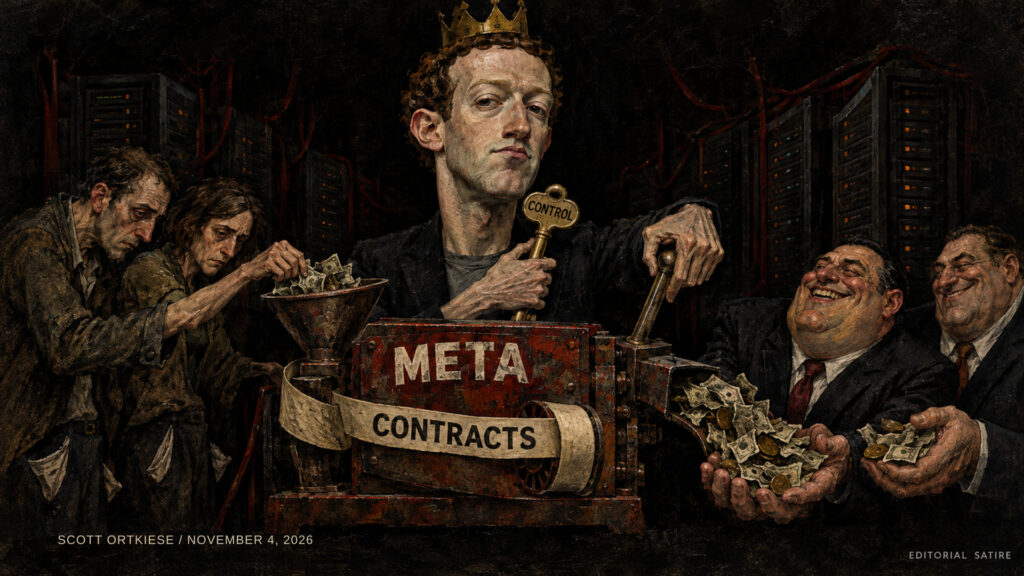
Suppliers get paid. Zuckerberg keeps control. Investors carry the risk.

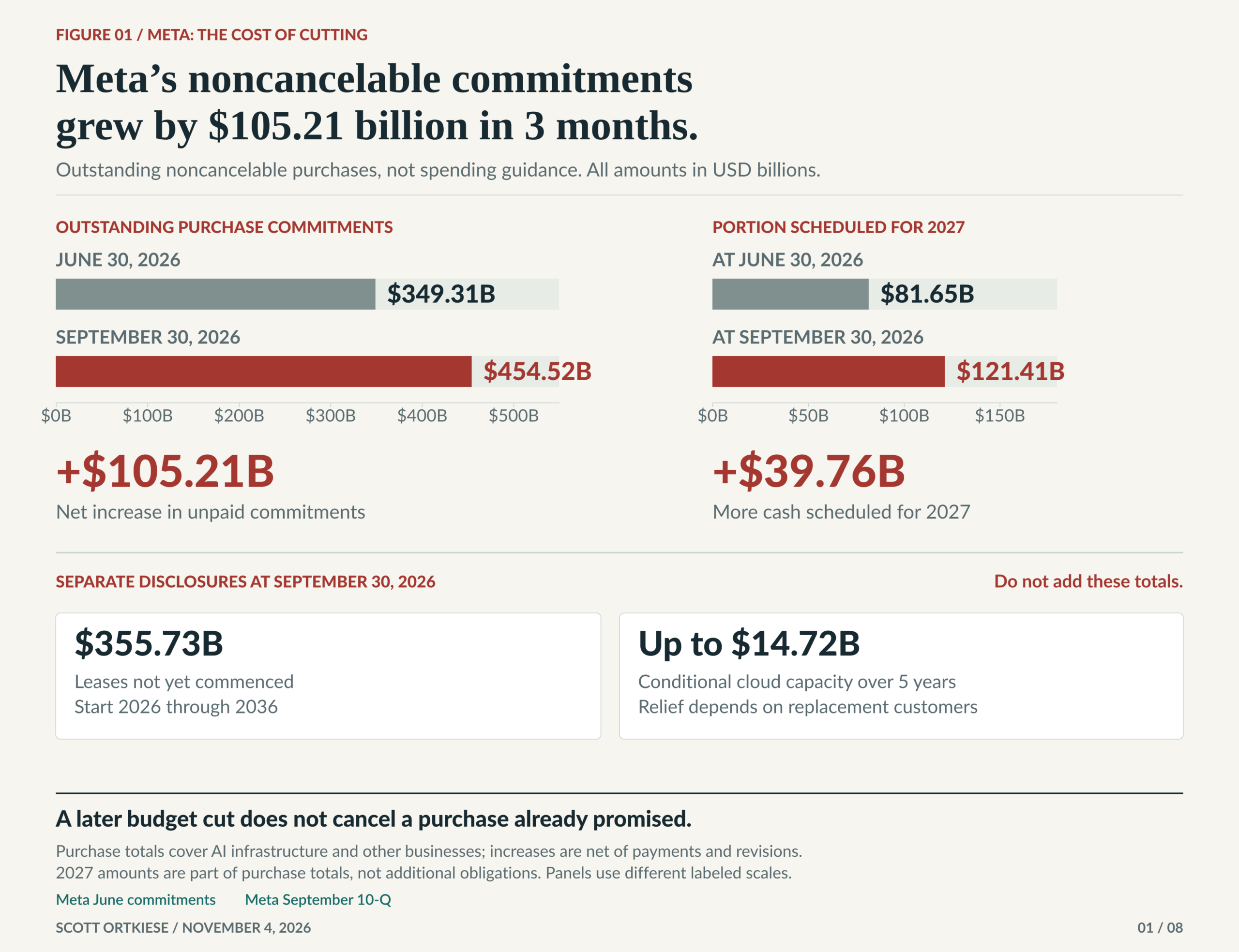
Meta has signed contracts that keep it paying after management decides to spend less. As of September 30, 2026, it reported $454.52 billion of noncancelable purchases, including cloud computing capacity, servers, network equipment, energy services and consumer hardware. Of that total, $121.41 billion was due in 2027. (Meta’s Q3 commitments disclosure)
Cutting the next construction budget will not cancel those bills. Suppliers with enforceable contracts can keep collecting while Meta earns too little from what it bought. Meta and its shareholders bear the loss.
Meta is also preparing to raise money through shares that generally carry no votes. Its special committee explicitly connects the proposed structure to financing the investment program without reducing Mark Zuckerberg’s control. (Meta’s November 2 information statement)
Meta’s defenders confuse the right to stop ordering with the right to stop paying
Nicolas Bolsinger’s “The State of the AI Trade: Someone Has to Pay the Bill” distinguishes the large technology buyers from the suppliers dependent on their spending. His argument treats the buyers’ ability to stop spending as protection that their suppliers lack. (Bolsinger’s analysis)
That protection shrinks when the buyer signs a noncancelable contract. The supplier can finance expansion against the customer’s promise to pay, even if the customer later needs less capacity.
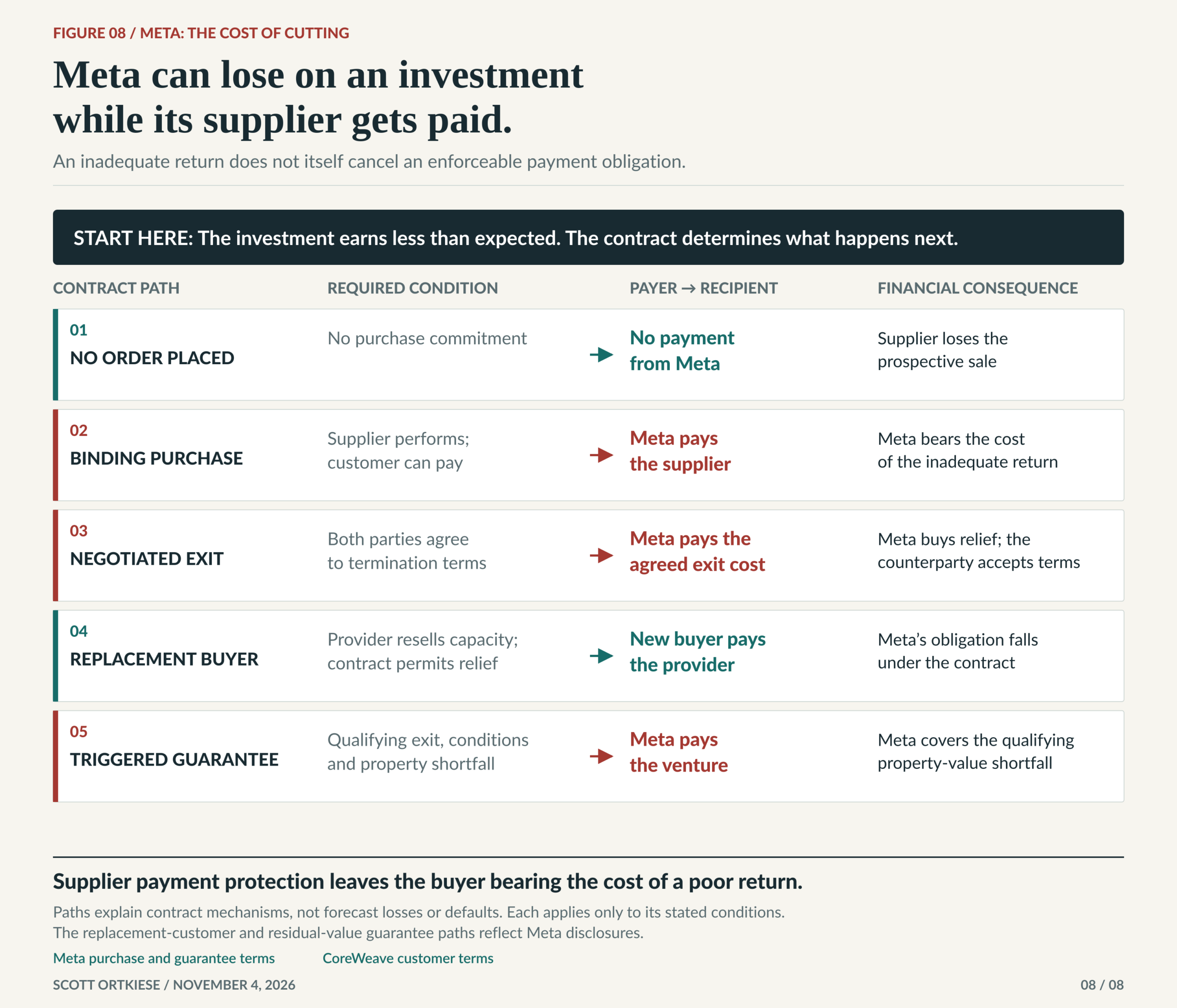
An exit right tied to supplier failure does not give the buyer permission to leave because its own forecasts were wrong. If the provider delivers what it promised, the customer cannot establish that failure merely by using less. The relevant question is what event releases the payment obligation. Poor investment returns and supplier nonperformance are different events. A contract protecting against nonperformance can leave the buyer fully exposed to poor returns.
Meta’s noncancelable commitments rose from $349.31 billion at June 30 to $454.52 billion at September 30, a net increase of $105.21 billion; the amount scheduled for 2027 rose from $81.65 billion to $121.41 billion. (Meta’s June commitments note; Meta’s September commitments note)
Those increases are net of payments and contract revisions during the quarter. More of Meta’s future cash was already committed.
The cash consequence follows the payment schedule, not management’s next presentation. A board can reject a proposed expansion before signing for it. Once the company promises payment, rejecting the same expansion requires an exit right, an agreed settlement or a breach of contract. Those are different decisions with different costs. Treating them all as “cutting spending” hides the moment when management gives up its freedom to choose.
The $454.52 billion covers purchases for AI infrastructure and other businesses over multiple years, including $45.85 billion due during the remainder of 2026. It is a total of purchase commitments, not a single loan. (Meta’s Q3 commitments disclosure)
Meta separately reported $355.73 billion of operating and finance leases that had not yet started, covering data centers, energy-related infrastructure, colocations and certain network infrastructure. Those leases begin from the remainder of 2026 through 2036, with terms extending from more than 1 year to 30 years. (Meta’s uncommenced lease disclosure)
A lease can commit the company before a lease liability appears on its balance sheet. These leases, purchase commitments and guarantees cannot be added together without reconciling overlaps and payment conditions.
Meta has separate conditional obligations to purchase up to $14.72 billion of cloud capacity over 5 years, reducible if the provider sells that capacity to other customers. (Meta’s contingent capacity disclosure) Someone else must buy before Meta receives that relief.
During a downturn, providers seeking replacement customers compete for the same diminished demand. Meta has a conditional resale arrangement, not a unilateral right to cancel.
The contract transfers part of the supplier’s demand risk to Meta. Without a committed buyer, the supplier must sell capacity or absorb the loss. With an enforceable purchase promise, it can demand payment from Meta instead. That protection helps explain why a supplier would build before demand is proven: the customer has promised to pay. The buyer has not eliminated the risk by choosing a strong supplier. It has accepted a bill that can survive disappointing demand.
Leaving a data center can trigger another payment
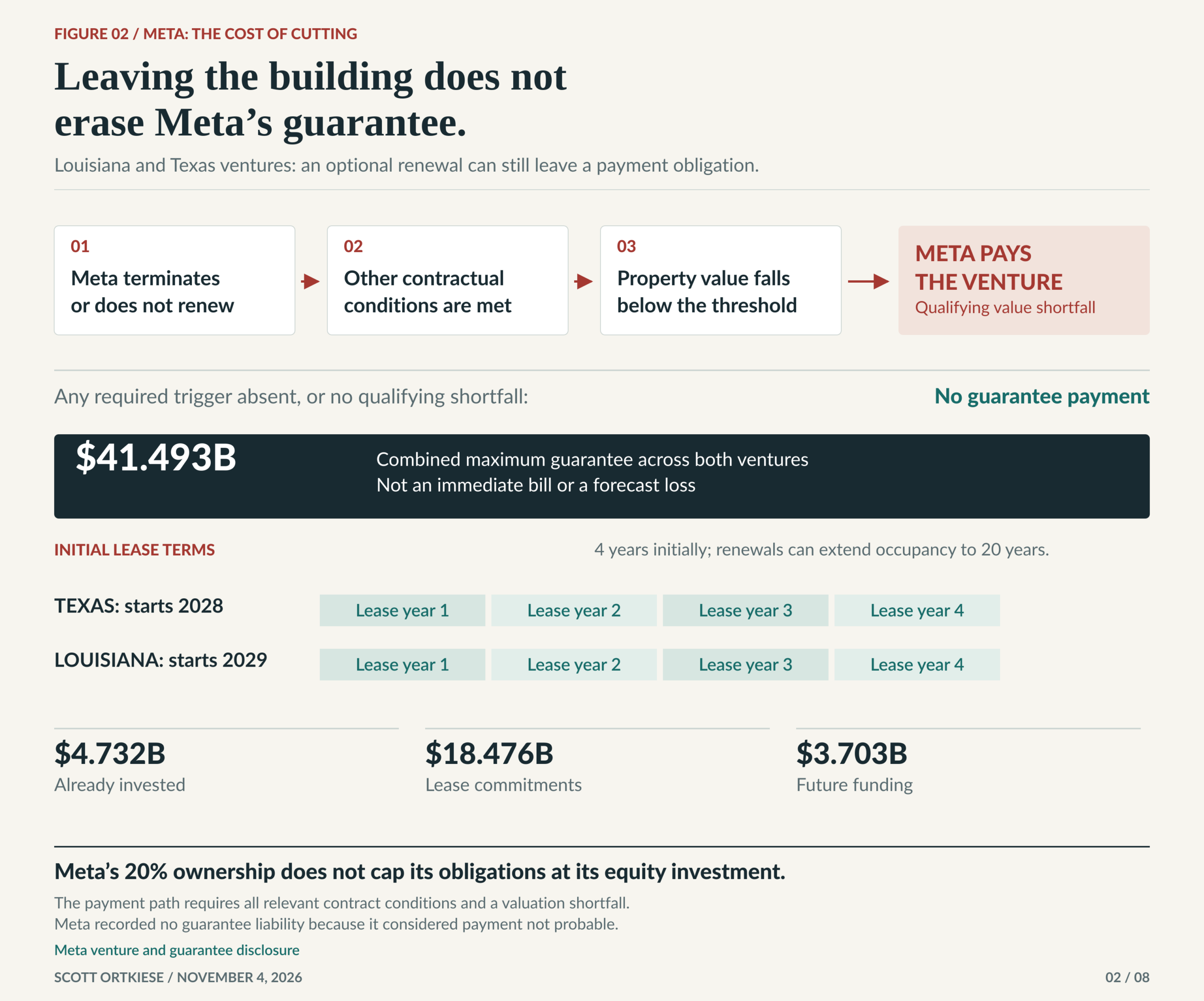
Meta calls its Louisiana and Texas data-center ventures sources of “strategic optionality and flexibility.” It owns 20% of each, and the parties are committed to funding their respective shares of estimated development costs of $27 billion in Louisiana and $14 billion in Texas. (Meta’s venture disclosure)
The leases begin in Texas in 2028 and Louisiana in 2029, each with an initial 4-year term and renewal options that allow up to 20 years. Meta has also given both ventures residual-value guarantees: promises to cover specified shortfalls in the properties’ future values. (Meta’s lease and guarantee terms)
Meta says that if it terminates or does not renew a lease, and other contractual conditions are met, its maximum payment equals the shortfall between the property’s fair value and the guarantee threshold. Across the 2 ventures, it reports $41.493 billion of maximum residual-value guarantees. (Meta’s residual-value guarantee disclosure)
Meta can leave the building and still owe money under the guarantee. The outside owners have obtained protection against a property loss that would otherwise remain with them.
If Meta wants less capacity because it no longer earns enough, other prospective tenants may reach the same conclusion. Lower demand can reduce the property’s value and increase Meta’s guarantee payment just when it wants to cut spending.
Meta has recorded no liability because it considers guarantee payments not probable. (Meta’s guarantee accounting disclosure) That judgment does not release it from the contracts; $41.493 billion is the maximum exposure, not an expected loss.
The venture table also reports $18.476 billion in lease commitments, $3.703 billion in future funding commitments, and $4.732 billion already invested. Its $68.404 billion total combines existing investment, promised payments and conditional guarantees across both ventures. (Meta’s venture obligations table)
Meta’s 20% ownership does not limit its exposure to its equity investment. Rent, funding commitments and guarantees add separate obligations.
Meta also says it does not control the decisions most important to the ventures’ financial results, including finding future tenants and selling properties, and therefore does not combine their accounts with its own financial statements. (Meta’s venture accounting disclosure) It has promised payments tied to properties whose future leasing and sales decisions it says it does not control.
The public summary omits trigger conditions and valuation rules needed to price a particular exit. Calling the arrangement flexible does not disclose what leaving would cost.
The distinction matters when the same downturn weakens both Meta’s need for the property and the price another tenant will pay. Leaving can stop an unprofitable operation without eliminating the resulting property loss. The guarantee determines how much of that loss comes back to Meta. The economic test is therefore not whether management can hand back the keys. It is whether doing so leaves the company better off after the exit payment.
Advertisers can cut their spending before Meta can cut its bills
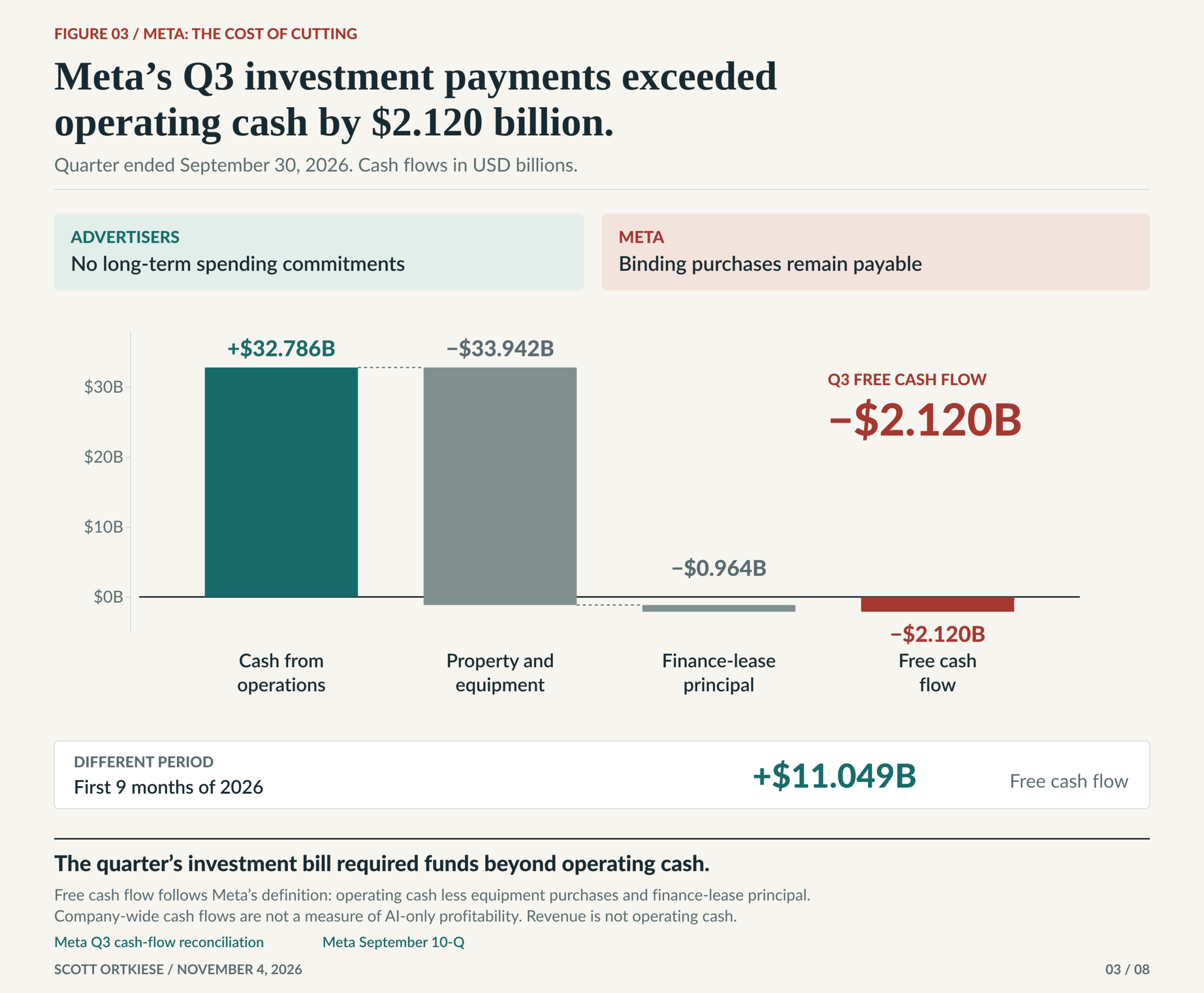
Advertising supplied $63.061 billion of Meta’s $64.601 billion in September-quarter revenue, or approximately 97.6%. Yet advertisers make no long-term commitments and can cut budgets if they’re dissatisfied with results. (Meta’s revenue and advertising-risk disclosures)
Meta promises suppliers years of payments while advertisers retain the right to cut spending. A revenue decline does not cancel those purchases.
Management says AI is increasing advertising revenue. (Meta’s Q3 earnings release) More sales do not establish that the new servers, buildings, electricity and services earn their cost.
In the September quarter, Meta generated $32.786 billion of operating cash, spent $33.942 billion on property and equipment, and paid $964 million of finance-lease principal, leaving negative $2.120 billion of company-defined free cash flow. (Meta’s Q3 cash-flow reconciliation)
For the first 9 months, the same calculation remained positive: $96.873 billion of operating cash minus $83.055 billion of property and equipment purchases and $2.769 billion of finance-lease principal left $11.049 billion. (Meta’s 9-month cash-flow statement)
Meta reported $82.45 billion of cash, cash equivalents and marketable securities at September 30. It separately disclosed $10.80 billion of restricted money-market funds under infrastructure purchase agreements, unavailable for general corporate use and expected to be released between 2028 and 2030 as the agreements’ requirements are met. (Meta’s liquidity and escrow disclosures)
The restricted funds cannot pay unrelated bills. Meta’s unrestricted cash helps it meet commitments, not escape them.
A company need not run out of cash for its investment program to damage shareholders. It can pay every supplier on time while spending more than the investment earns. Cash reserves then finance the shortfall; borrowing adds future interest; selling shares spreads the investment’s results across more owners. Solvency answers whether creditors can collect. It does not answer whether shareholders should have funded the project.
Some purchases adjust with use, including clean and renewable energy agreements lasting 9 to 25 years with no fixed or minimum volume requirement. (Meta’s renewable-energy disclosure) Noncancelable purchases deny Meta that freedom.
The other buyers have also traded spending freedom for supply
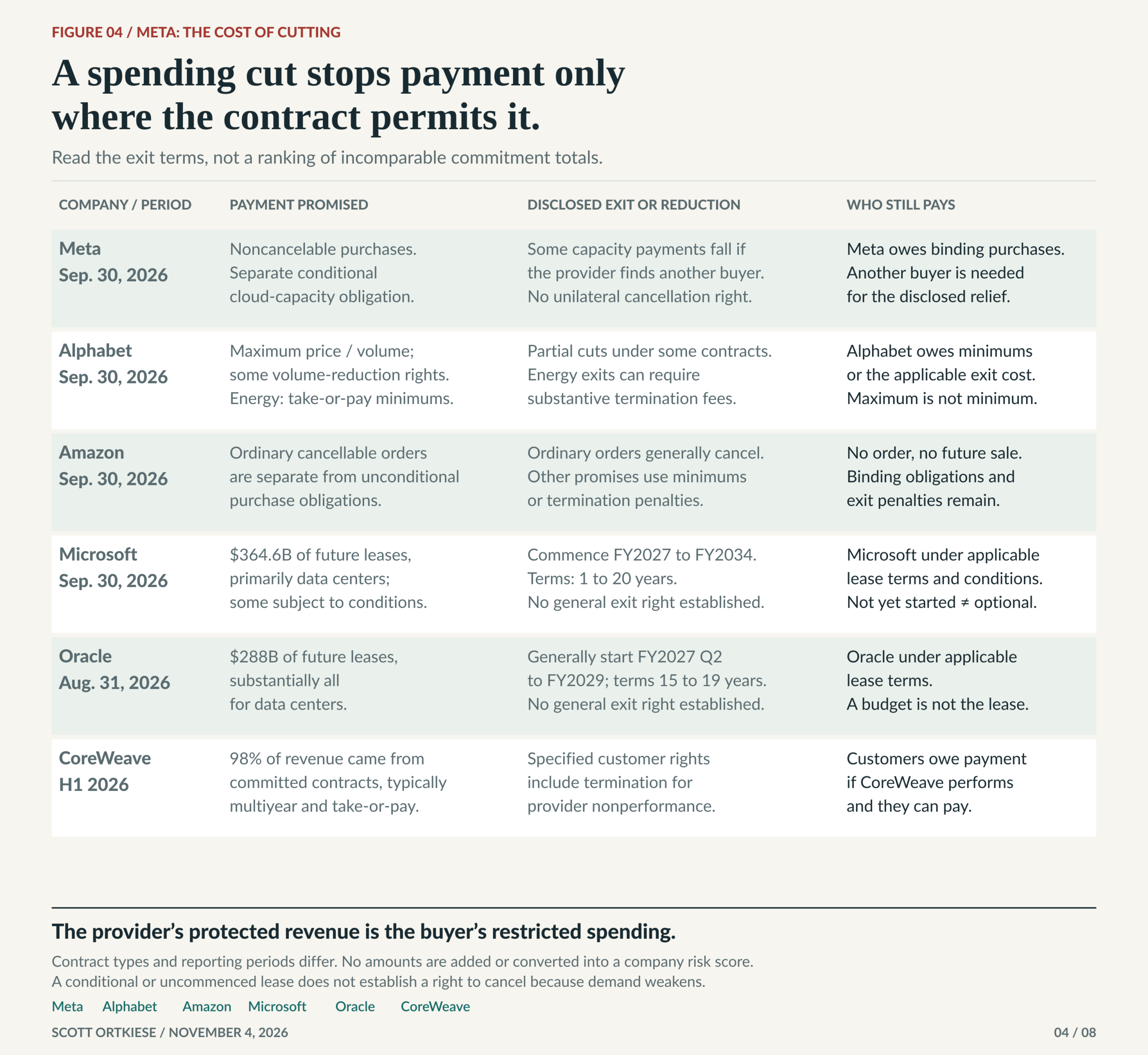
Alphabet, Google’s parent, reported $802.1 billion in commitments under contracts with more than 1 year remaining as of September 30. These chiefly involve production capacity for technical infrastructure and inventory components; the figure uses maximum contractual pricing and volumes, and some agreements allow partial volume reductions. (Alphabet’s commitments disclosure)
Alphabet’s energy contracts extend to 2054 and generally include minimum take-or-pay requirements and substantial termination fees. It promises minimum payments rather than paying solely for what it uses. (Alphabet’s energy commitments)
Alphabet also promises to cover specified data-center rent and some energy payments if other parties default, under agreements with up to 15 years remaining. It can take over leases, rent capacity to others, or, under specified conditions, make a termination payment to end the promise. (Alphabet’s credit-backstop disclosure)
Taking over a lease means taking over rent; subletting requires another tenant; termination requires payment. None is equivalent to canceling an uncommitted purchase.
Amazon explicitly separates purchases that are “generally cancellable” from unconditional obligations in its commitments table. It also uses minimum prices, quantities or termination penalties for certain variable agreements, unlike Alphabet’s maximum-based measurement. (Amazon’s commitments and footnotes)
A maximum possible purchase and a minimum required payment measure different things. Ranking companies by those totals would conceal their actual cancellation rights.
Microsoft reported $364.6 billion in additional leases, primarily for data centers, that had not started as of September 30, with some subject to contractual conditions. They are expected to begin between fiscal 2027 and fiscal 2034, with terms of 1 to 20 years. (Microsoft’s lease disclosure)
Oracle reported $288 billion of additional leases, substantially all for data centers, generally starting from Q2 of fiscal 2027 through fiscal 2029 for terms of 15 to 19 years. (Oracle’s lease disclosure) Those agreements commit companies to facilities over periods much longer than the next annual spending forecast.
Oracle’s $664 billion of remaining performance obligations at August 31 represents contracted revenue still to be recognized, with approximately 13% expected over the next 12 months. (Oracle’s revenue commitments disclosure) A multiyear revenue promise is not cash available for the next construction bill.
Contracted revenue also measures sales, not the cash left after delivering them. Buildings, equipment, electricity and service costs consume part of each payment. Financing costs take another share when construction depends on borrowing. A large future sales figure can therefore coexist with a need to raise money today and a poor return tomorrow. To judge the investment, investors need the timing and cost of delivery, not just the amount customers have agreed to buy.
Oracle’s subsequent funding plan includes suppliers financing purchases, customers supplying hardware and customers paying in advance; its announced limits on additional capital raising exclude refinancing existing debt. (Oracle’s Investor Day funding plan)
Customer-supplied hardware removes a purchase Oracle would otherwise make. Supplier financing postpones payment. A customer prepayment supplies cash early but leaves Oracle owing the service. These are different financial outcomes, not interchangeable spending cuts.
Approximately 98% of cloud provider CoreWeave’s first-half 2026 revenue came from committed customer contracts, typically multiyear and take-or-pay, with cancellation rights in specified circumstances such as failure to perform. (CoreWeave’s contract disclosures)
If CoreWeave delivers and its customer can pay, reduced use does not automatically reduce the bill. The same agreement cannot be secure income for financing the provider and optional spending when assessing the buyer.
The buyer’s financial strength can actually strengthen the supplier’s protection. A purchase promise from a customer able to pay is more useful than a promise from one already in distress. Describing the buyer as wealthy therefore does not establish spending freedom. It explains why the supplier expects payment. Analysts must separate the customer’s capacity to honor the contract from its right to reduce the payment. Confusing them turns evidence supporting the supplier’s claim into supposed protection for the buyer.
Cheaper AI does not cancel earlier bills
A lower price for new equipment does not reduce the price in an earlier purchase contract. A more efficient AI model can need fewer servers without reducing the minimum payment for servers already rented.
Cheaper alternatives give the customer a reason to renegotiate. The provider has a reason to enforce the original price.
A lender selling older servers after a default may recover less. A landlord may have to lower rent to attract a replacement tenant.
Meta acknowledges that excess infrastructure can lead to asset impairments and that some AI and other investments have generated limited revenue while reducing cash flow, margins and profitability. It also notes that those investments depend on profits from other parts of the company. (Meta’s infrastructure and investment-risk disclosures)
Writing down an asset reduces its recorded value, not the amount owed under a separate purchase or lease agreement. Spreading its cost over more years changes depreciation expense, not the payment schedule.
An AI service can work, attract users and generate revenue while earning less than its buildings, equipment, energy and financing costs. The contract requires payment, not a profitable investment.
Falling technology costs can make that problem worse for early buyers. A competitor acquiring cheaper equipment can offer lower prices while the incumbent remains committed to yesterday’s costs. The incumbent then faces pressure on revenue without equivalent relief on payments. Technical progress benefits the new purchase; it does not rewrite the old agreement. “AI is getting cheaper” is therefore not an answer to whether existing capacity will earn enough to cover its contractual cost.
New financing pays bills without proving the investment works
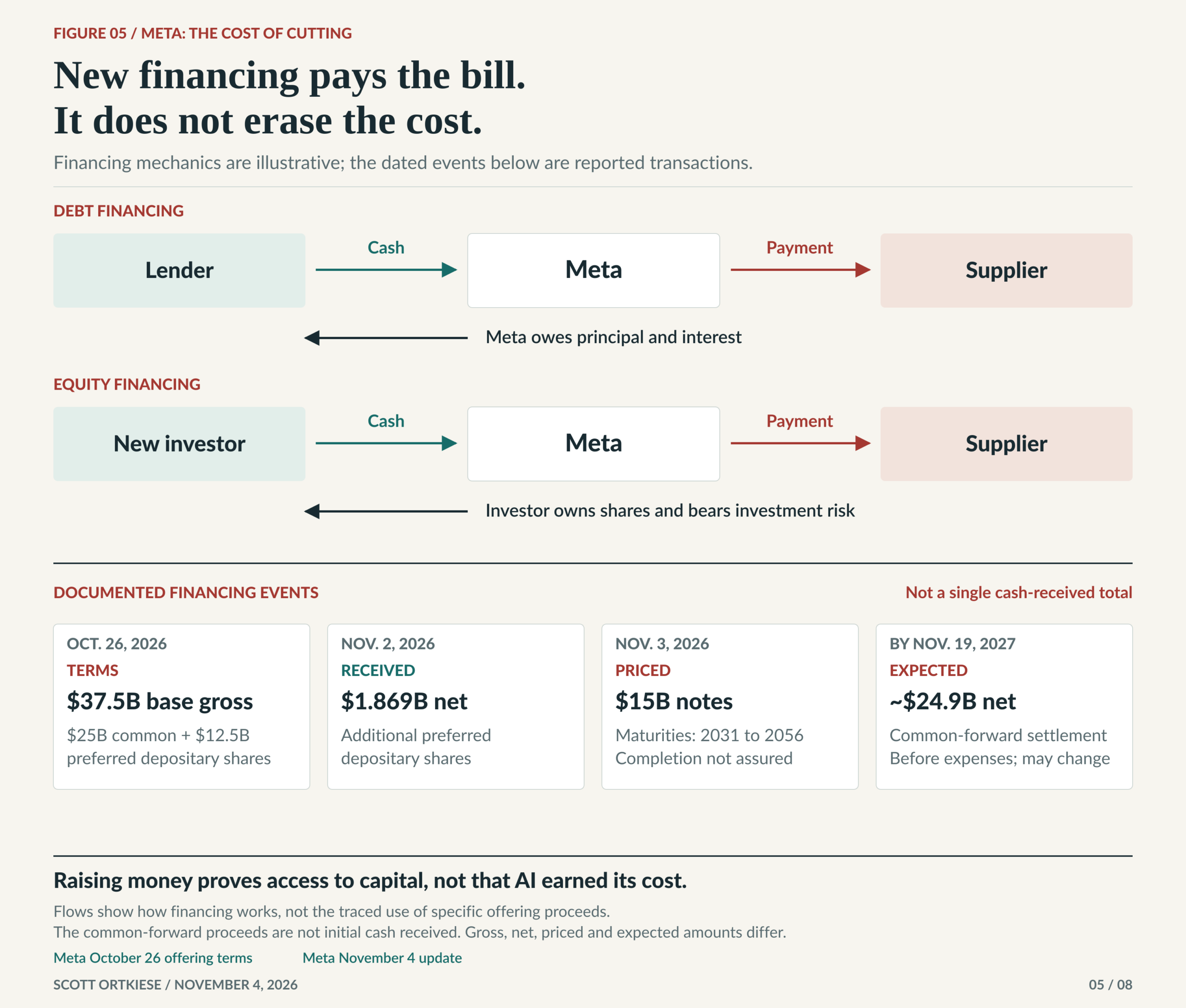
Meta’s October 26 term sheet specified a $25 billion base common-share offering and $12.5 billion of depositary shares representing mandatory convertible preferred stock. That is $37.5 billion before additional options and expenses, not the roughly $97 billion described in Bolsinger’s discussion of the linked transaction. (Meta’s October 26 term sheet)
The common-share transaction uses forward sales: Meta does not expect the initial sales to deliver proceeds to the company. It expects approximately $24.9 billion of net proceeds before expenses, subject to adjustments, when the agreements settle on or before November 19, 2027. (Meta’s forward-sale terms)
The expected proceeds are not cash available now. Meta must cover bills due before settlement from other sources.
A November 4 filing records approximately $1.869 billion of net proceeds received on November 2 from additional preferred depositary shares. It also reports pricing a separate $15 billion dollar-denominated bond offering on November 3, with maturities from 2031 through 2056, while stating completion was not assured. (Meta’s November 4 prospectus filing)
When Meta borrows to pay an equipment supplier, the supplier collects, and Meta owes the lender. When it sells shares, new investors supply cash and bear the risk of losing their investment.
Continued financing can prolong a bad investment by paying bills the project cannot cover from its earnings. Raising money shows access to capital, not an adequate return.
The test is what happens after the financing arrives. Equipment suppliers receive cash for delivery. Lenders acquire claims to future payments. Shareholders own what remains after the company meets its obligations. If the investment disappoints, an equity raise can keep suppliers whole while reducing the value attributable to each existing share. The transaction succeeds as financing and fails as investment. Calling the capital raise successful says nothing about which of those outcomes shareholders will receive.
Zuckerberg demands financing that preserves his control
Meta’s special committee says Zuckerberg would not support a significant equity financing that reduced his voting power. It also records his opposition to actions that would cause him to lose control. (Meta’s recapitalization negotiations)
He held approximately 60.6% of voting power on October 1. The committee expressly says his control was not about to disappear. (Meta’s special-committee account)
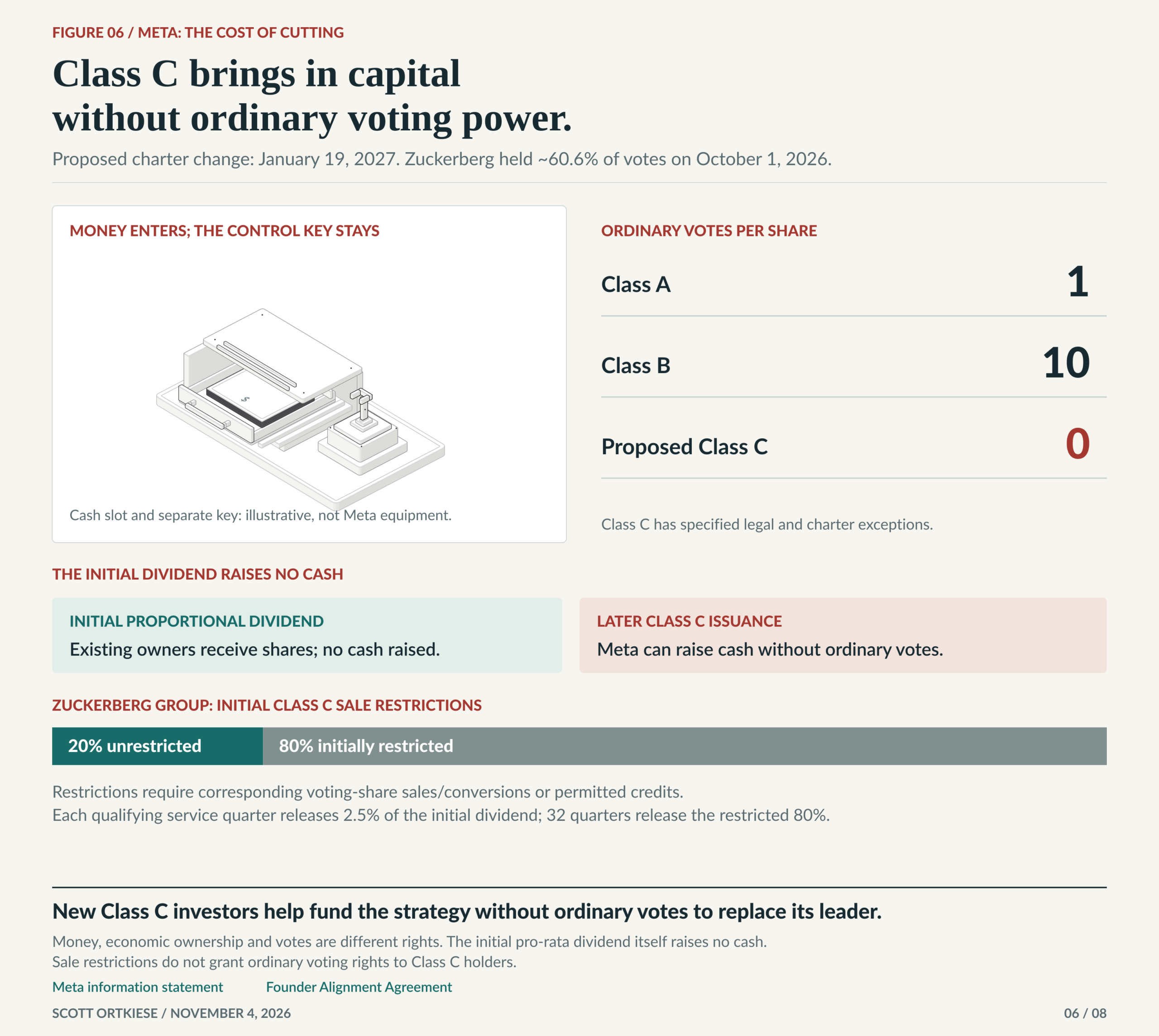
Class A has 1 vote per share, Class B has 10, and the proposed Class C generally has none, subject to specified legal and charter exceptions. The charter change is intended to take effect January 19, 2027. (Meta’s information statement; Meta’s recapitalization filing)
The initial proportional stock dividend distributes shares to existing owners without raising cash. Subsequent Class C issuance would let Meta raise money, pay employees or buy businesses without giving recipients ordinary votes. (Meta’s information statement)
Zuckerberg’s shareholding group could sell 20% of its initial Class C dividend without the agreement’s sale restriction. The remaining 80% initially requires corresponding sales or conversions of voting shares, or permitted credits, with an additional 2.5% of the initial dividend released for each qualifying quarter of continued leadership. (Founder Alignment Agreement)
Those restrictions govern how he sells shares. They do not give Class C investors ordinary votes to replace him.
This is why founder control belongs in the spending investigation. Investors can provide money that sustains commitments they cannot overturn through ordinary votes attached to those shares. Selling their shares transfers that position to another buyer; it does not cancel Meta’s contract or replace its leadership. Zuckerberg remains exposed to losses through his ownership, but sharing the financial downside is not the same as sharing authority over future investment decisions. The proposed structure preserves his authority while bringing in outside money.
A spending-cut announcement can overstate the cash saved
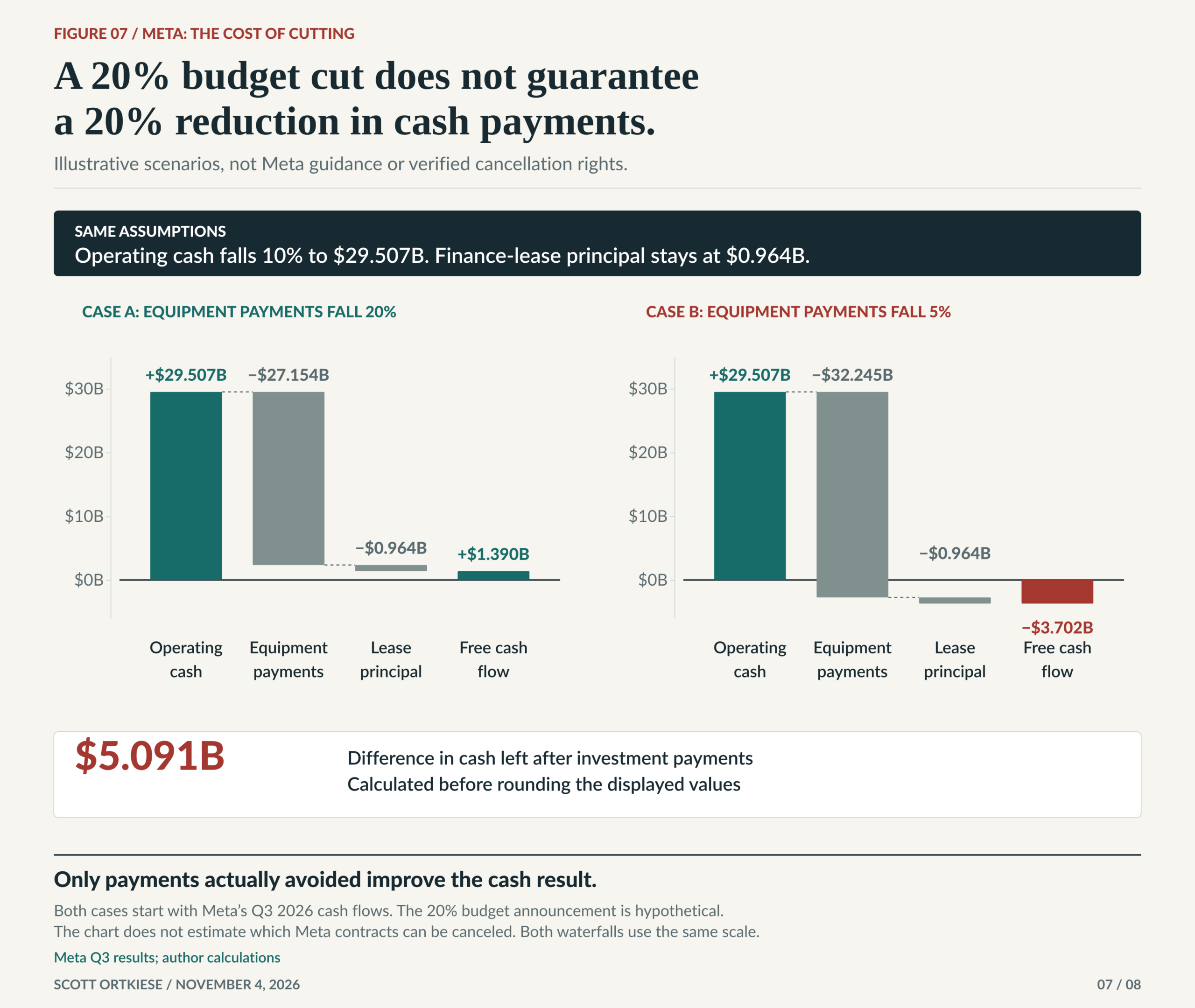
Using Meta’s September-quarter figures, suppose operating cash falls 10%, property and equipment cash payments fall 20%, and finance-lease principal stays unchanged. Free cash flow would be approximately positive $1.390 billion. (Author calculation using Meta’s Q3 results)
Now, suppose management announces the same investment cut but reduces those cash payments by only 5%. With the same operating-cash decline and lease principal, free cash flow would be approximately negative $3.702 billion, a difference of $5.091 billion calculated before rounding. (Author calculations using Meta’s Q3 results)
These are hypothetical reductions, not forecasts or verified cancellation rights. The same headline cut produces different cash results because the payments actually avoided differ.
Cancellation fees reduce the savings. Delayed payments, rentals and supplier financing leave bills to be paid, even when the capital-expenditure forecast falls.
A useful spending announcement would identify the payments eliminated, the period in which cash is saved and the price paid for release. It would distinguish orders never placed from existing contracts canceled. It would also separate savings from postponements and disclose any new payment or guarantee accepted in exchange. Without that reconciliation, investors cannot tell whether management has reduced the cost of its mistake or changed when and where the cost appears.
Meta reports no Class A repurchases in the first 9 months of 2026, alongside $4.06 billion of dividends and dividend equivalents paid; its repurchase authorization can be suspended or discontinued. (Meta’s capital-return disclosure)
Canceling unused buyback authority saves no cash. Cutting a dividend does, but shareholders receive less while the supplier’s bill remains.
The contracts decide who takes the loss
A supplier waiting for a new order can lose the sale when Meta slows spending. A provider with an enforceable payment promise can collect while Meta earns too little from the service.
Renegotiation requires a concession from the other party. A lower payment may require a longer contract, a new guarantee or more money later; a lender may accept a loss. Those bargains redistribute the cost of a mistake. They do not make the original spending optional.
For shareholders, the decisive disclosure is the payment they cannot avoid when the investment no longer earns its cost. A multiyear commitment total identifies exposure. The contract explains how that exposure becomes a cash demand. Neither rising AI revenue nor a successful bond sale answers that question. Management must show which payments disappear when it cuts spending and which continue because somebody else holds the right to collect.
Meta’s contracts protect suppliers by keeping the company liable for payment. Its proposed share structure protects Zuckerberg’s control while bringing in more investor money. New Class C investors would help pay for those commitments without receiving ordinary votes to remove the leader who made them. (Meta’s payment commitments; Meta’s share plan)
Meta has promised $454.52 billion in noncancelable purchases, including $121.41 billion due in 2027. Those are contractual payments, not spending targets management can simply withdraw. Its September-quarter investment payments already exceeded operating cash by $2.120 billion. Meanwhile, Zuckerberg held 60.6% of voting power, and the proposed nonvoting shares would let Meta raise more capital without surrendering his control. That is the foundation of a too-big-to-fail demand: commitments large enough for investors and lenders to portray their losses as everyone else’s emergency. It is not proof that a rescue will occur. It identifies what a rescue would protect: private financial claims arising from private investment decisions. If Meta’s investors and lenders eventually demand public support, the question is not whether their losses would hurt. It is why the public should assume risks they accepted while control remained concentrated in Zuckerberg’s hands. (Meta’s commitments disclosure; Meta’s cash-flow reconciliation; Meta’s information statement)