
Pension and insurance money is financing the AI debt boom. Banks are earning fees, and OpenAI has asked for federal loan guarantees. Who pays if the boom breaks?
Scott Ortkiese | Throughline Synthesis | Houston,
October 21, 2026
In September, average weekly trading in credit default swaps tied to
7 AI-linked companies exceeded $9 billion, up from less than $2 billion
in July (Morgan
Stanley Research, via Investing.com). That figure measures the face
amount of contracts traded, not insurance premiums paid or losses
already incurred (BIS).
The price of this protection is a public warning signal, not proof that
a crash is inevitable.
This primer explains the 2 forces behind that signal: credit demand,
meaning how much AI companies need to borrow, and credit default swaps,
meaning what lenders pay to protect themselves. It then traces what a
crash would mean for ordinary Americans and Europeans.
The Fees Are
Real. The Bailout Is Not Agreed.
The money chain is documented. CDPQ, the Canadian pension and
insurance investment manager now called La Caisse, disclosed
participation in CoreWeave’s $7.5 billion debt facility (CDPQ).
In the United States, Bloomberg connected Apollo’s AI financing to its
annuity business and quoted its access to “permanent capital from our
insurance ecosystem” (Bloomberg,
hosted by Apollo).
Banks are earning fees before those long-term investments have proved
themselves. Reuters reported that Citigroup earned more than $70 million
from SK Hynix’s securities offering, an equity transaction, not a total
for AI private-credit fees (Reuters).
The request for public backing is also explicit. OpenAI wrote:
“OpenAI supports expanding US loan guarantees to allow AI companies to
confidently purchase US-made chips at scale” (OpenAI
infrastructure blueprint, p. 5). Its subsequent policy submission
requested grants, loans, and loan guarantees for manufacturing capacity
(OpenAI,
October 27, 2025, p. 4).
A request is not an approved bailout. OpenAI CEO Sam Altman
subsequently denied seeking government guarantees for its data centers
and said companies making bad decisions should fail (Reuters).
Analysis: the issue is who bears losses under the actual contracts and
any public guarantees, not whether every fee earner escapes every
risk.
The Short Version
- AI companies borrowed an estimated $466 billion so far in 2026, up
from $101 billion in the same period of 2025 (Morgan
Stanley, via Investing.com). - The price of insurance on that debt has doubled or more. Oracle’s
rose from 144 basis points in January to 322 on October 19. CoreWeave’s
crossed 1,000, the level analysts treat as distress (CNBC). - Stock investors are closing the other door. A South Korean AI firm
fell 30% on its first trading day, and an Australian one pulled its
stock offering (CNBC). - Spending runs far ahead of revenue. Gartner, the technology research
firm, sees a $4.9 trillion shortfall through 2030 (Gartner,
via Xenospectrum). - Analysis: households can be exposed through retirement investments,
insurers, jobs, and borrowing conditions. The channels differ, and
exposure does not guarantee a loss.
Key Terms
- Bond: a loan sold to investors. The borrower pays
interest, called the coupon, and repays the principal at maturity. - Yield: the annual return a buyer earns at today’s
bond price. When a bond’s price falls, its yield rises. - Spread: the extra yield a company pays above a US
Treasury bond of the same maturity. The spread compensates for credit
risk and other costs, including how easily the bond can be sold. - Basis point (bp): 1/100 of 1 percentage point. 100
bp equals 1%; 322 bp equals 3.22%. - Investment grade: a credit rating of BBB minus or
higher from S&P Global Ratings. Investment mandates and insurance
capital rules can limit lower-rated holdings; the restrictions differ by
institution. - Junk, or high yield: a rating below BBB minus. Junk
borrowers pay more and lose access to many buyers. - Hyperscaler: a company running cloud computing at
enormous scale: Amazon, Microsoft, Alphabet, Meta, and Oracle. - Neocloud: a newer company that rents AI chips by
the hour, such as CoreWeave. Neoclouds borrow heavily to buy chips. - Private credit: loans made by investment funds, not
banks. These loans do not trade publicly, so their prices update
slowly. - Default: a borrower misses a payment or goes
bankrupt.
Credit Demand: Why AI
Needs Borrowed Money
Credit demand is the amount of money borrowers seek. Credit supply is
the amount lenders will provide at a given price. When borrowers want
more than lenders want to give, the price of credit, meaning the
interest rate and the spread, rises.
AI’s credit demand has exploded:
- AI borrowing more than quadrupled. The $466 billion
borrowed so far in 2026 compares with $101 billion in the same 2025
period (Morgan
Stanley, via Investing.com). - The biggest names borrowed record sums. Amazon,
Alphabet, Meta, and Oracle issued about $194 billion in bonds in 2026
through July 7, up 79% from about $108 billion in all of 2025 (Reuters). - Next year is bigger. Goldman Sachs expects gross
hyperscaler debt issuance to hit a record $420 billion in 2027, up 60%
from its 2026 estimate (Reuters). - The total bill is in the trillions. McKinsey
estimates $7 trillion in AI infrastructure investment by 2030, requiring
about $760 billion in annual profit to justify it (Economic
Times). J.P. Morgan Asset Management estimates $5.5 trillion by
2030; company cash flow and stock sales cover about 1/4. Investment
grade bonds would supply $2.1 trillion, and junk bonds, leveraged loans,
and securitization another $700 billion (J.P.
Morgan Asset Management).
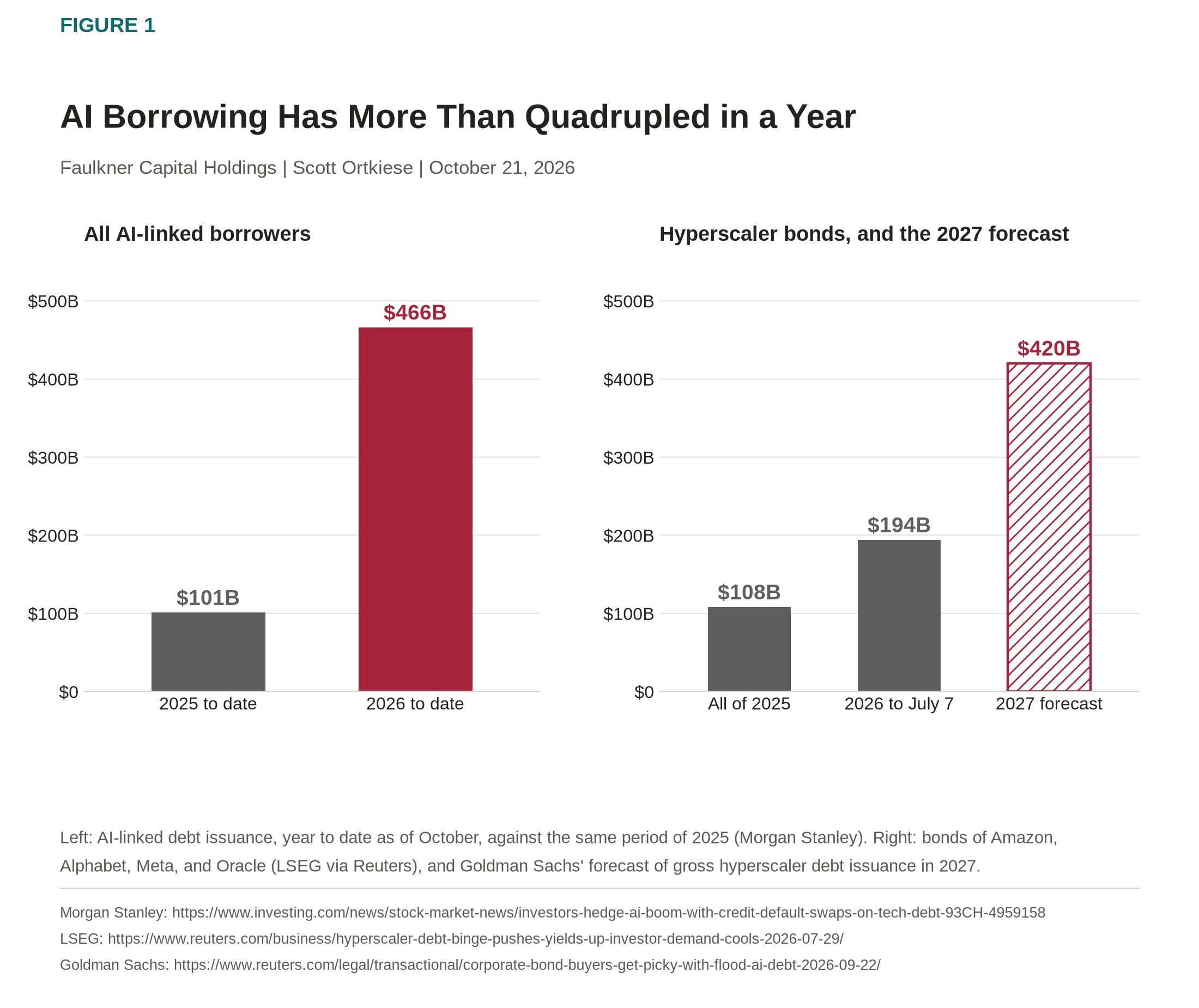
Year
AI-linked issuance and hyperscaler bond totals use
different borrower
groups and reporting periods; the 2027 figure is a forecast, not
completed borrowing. Sources:
Morgan
Stanley, via Investing.com;
Reuters,
July;
Reuters,
September.
Lenders have started to push back. Bonds of AI issuers pay spreads of
about 115 bp, versus 78 bp for the broad investment grade market.
“Investors are only able to digest so much, so fast,” said Lon Erickson,
portfolio manager at Thornburg Investment Management (Reuters).
The alternative to borrowing is selling stock. That door is
narrowing:
- Elice Group, a South Korean AI cloud firm, fell 30%
in its October 20 debut after raising 201.1 billion won ($150 million)
(CNBC). - Firmus, an Australian AI data center operator
backed by Nvidia, withdrew its listing in October. It had sought a
valuation of about $30.6 billion (Reuters). - AirTrunk, backed by Blackstone, postponed a
Singapore listing, and SB Energy, a SoftBank unit,
shelved its US listing plans (CNBC).
A company that cannot sell stock must find another source of cash,
sell assets, reduce spending, or abandon projects. Additional borrowing
is 1 option, not an automatic outcome.
Credit Default Swaps:
Insurance on a Loan
A credit default swap (CDS) is a financial contract that transfers
specified credit risk. The buyer pays for protection; after a covered
credit event, such as a qualifying default, the seller owes the
contractual settlement, which depends on the debt’s recovery value (BIS).
“Insurance” is an analogy, not the legal classification. The buyer
need not own the debt, and the seller’s ability to pay remains a
separate risk (ISDA;
BIS).
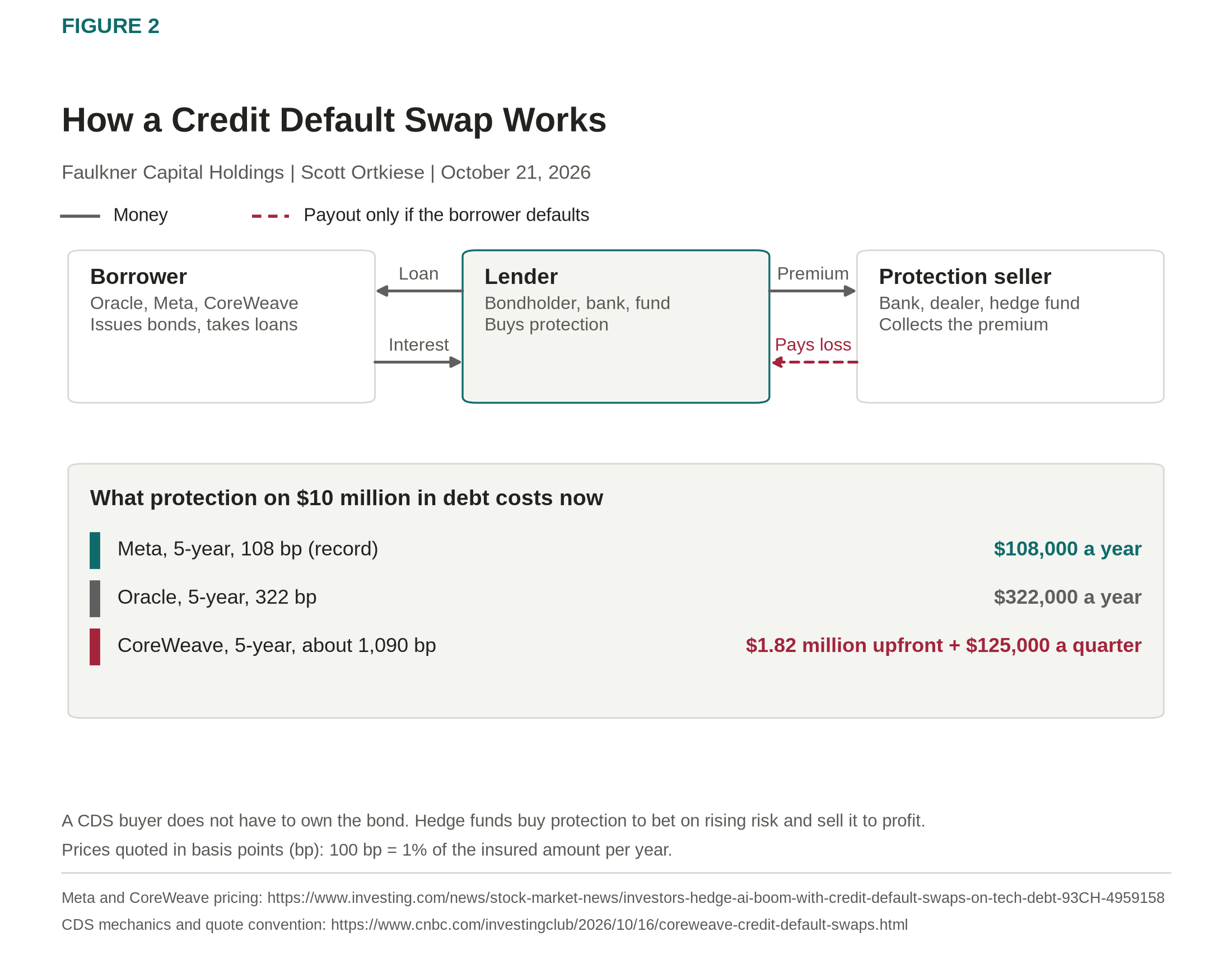
The
diagram explains protection payments and contractual settlement.
Annual spread-equivalent costs are not necessarily the actual
coupon
schedule; standard contracts can include an upfront payment. Sources:
Investing.com;
BIS.
3 features make a CDS different from car insurance:
- The buyer need not own the debt. A hedge fund can
buy protection on Oracle as a bet that Oracle’s risk will rise, then
sell the contract at a profit. - The price moves every day. The premium is quoted in
basis points a year. Protection on $1 million at 100 bp costs $10,000 a
year (CNBC).
Rising spreads generally increase the value of existing protection,
before transaction costs. - The price implies model-based odds of default.
Bloomberg’s calculation put CoreWeave’s implied 5-year probability near
60% (CNBC).
Such estimates depend on recovery assumptions and market pricing of
risk; they are not a measured probability of bankruptcy (BIS).
Standard CDS contracts can combine an upfront payment with a fixed
periodic coupon; that structure is not limited to distressed borrowers
(BIS).
Protection on $10 million in CoreWeave debt at about 1,090 bp required
$1.82 million upfront plus $125,000 a quarter (Investing.com).
What the Market Is Signaling
Prices
- Oracle: 322 bp on October 19, up from 144 bp at the
start of the year (Investing.com),
an increase of 124%. In July, Oracle’s CDS hit its highest level in
nearly 18 years, a level last seen in 2008 (Bloomberg).
S&P cut Oracle to BBB minus, its lowest investment grade rating, in
July. Oracle carries $118 billion in long-term debt plus $39 billion in
lease obligations, and analysts expect negative free cash flow of $23.7
billion this year (CNBC). - SpaceX: a record 226 bp, up from 110 bp when
trading began in late June (Investing.com). - Meta and Nvidia: records of 108 bp and 101 bp.
Protection on Alphabet, Amazon, and Microsoft also hit all-time highs
(Investing.com). - CoreWeave: above 1,140 bp at one point and near
1,038 bp on October 15, up 164% in a year. “A spread of 1,000 basis
points or above is generally a sign of credit distress,” according to
Gavan Nolan, executive director at S&P Global Market Intelligence
(CNBC).
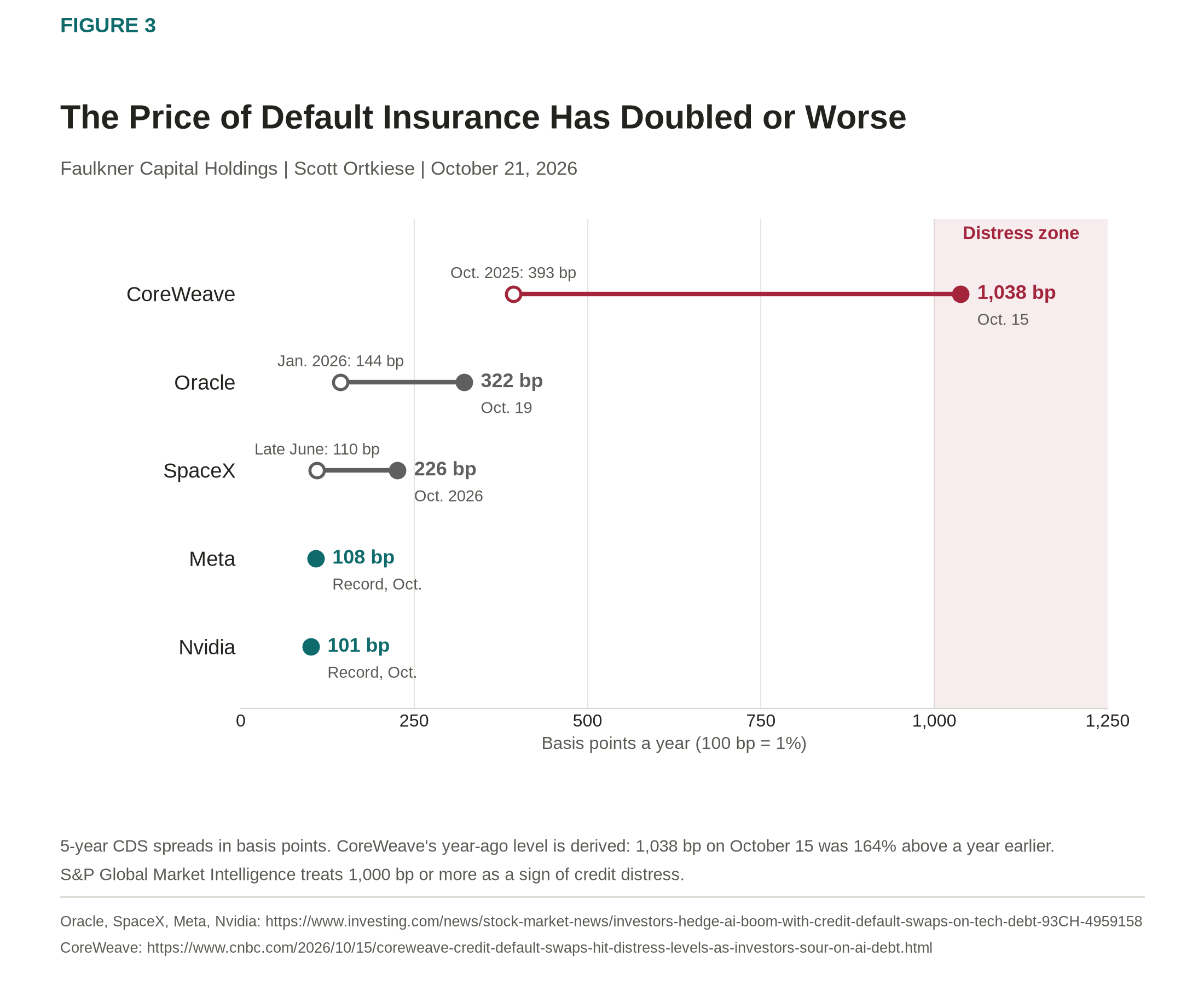
Worse
Selected 5-year CDS quotes show different starting
dates and October
observation dates, not simultaneous prices. CoreWeave’s earlier value
is
derived from the reported annual percentage increase. Sources:
Investing.com;
CNBC.
Volume
Weekly trading on the 7 names (Oracle, SpaceX, Alphabet, Amazon,
Meta, Broadcom, and Nvidia) rose from under $2 billion in July to more
than $9 billion in September (Morgan
Stanley Research, via Investing.com). Trading per company rose from
$50 million to $100 million a week in 2025 to hundreds of millions of
dollars a day (TokenPost).
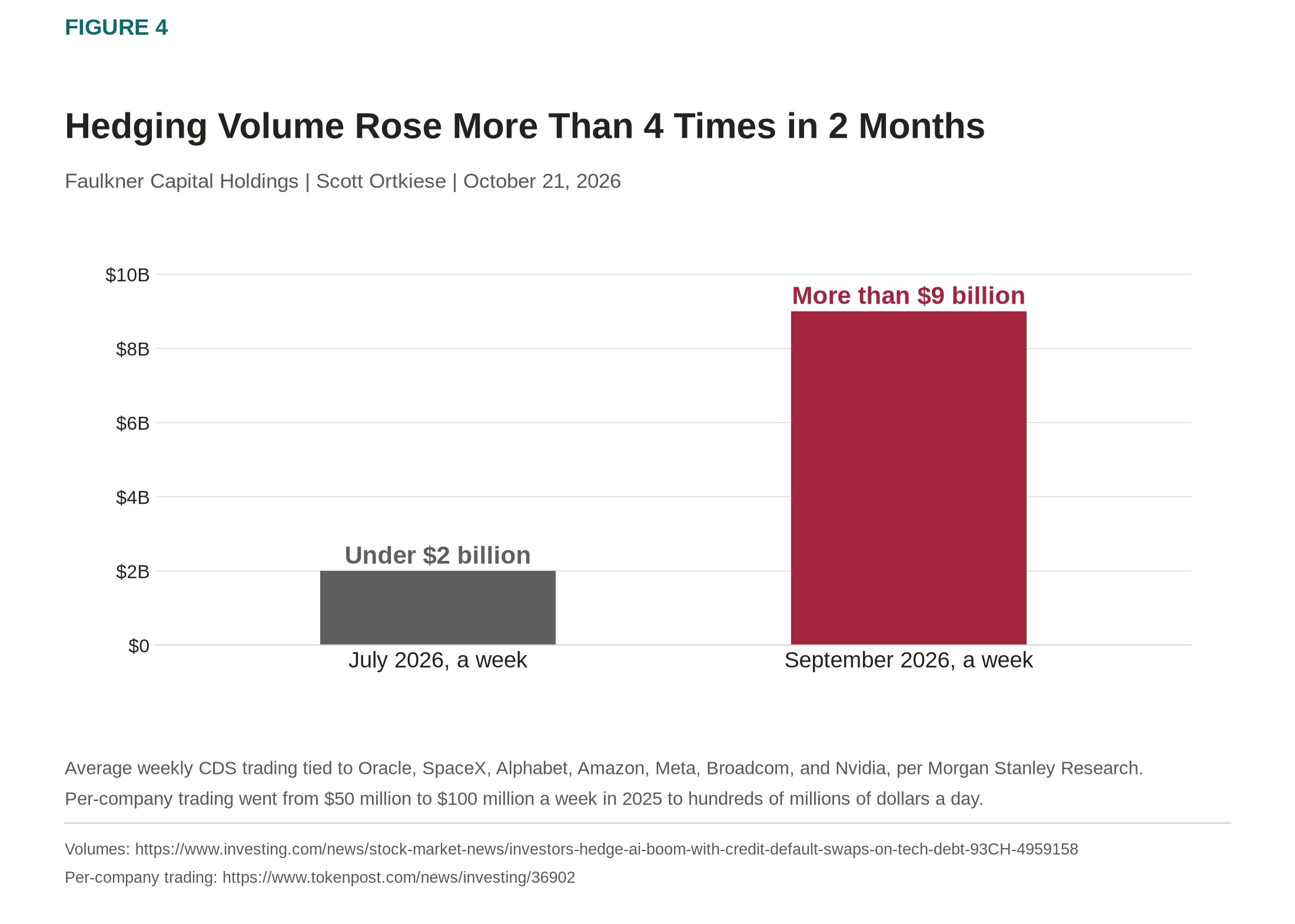
Months
Average weekly CDS trading rose from under $2
billion to more than $9
billion. This is contract trading volume, not premiums paid, net
exposure, or realized losses. Sources:
Morgan
Stanley, via Investing.com;
BIS.
CoreWeave: A Potential First
Domino
CoreWeave rents Nvidia chips to Microsoft, OpenAI, and other AI
developers. It carries about $50 billion in debt, has never turned a
profit, and plans $35 billion to $39 billion in capital spending this
year. Its 2031 junk bonds yield about 16% (Reuters).
The company issued those bonds in April at 9.75% (CNBC).
Nvidia sits on both sides of CoreWeave. It sells CoreWeave the chips,
owns about 11% of its shares (Yahoo
Finance), and agreed to buy CoreWeave’s unsold capacity through
April 2032 (Reuters).
CoreWeave’s chief executive, Mike Intrator, wrote in a memo: “We are
confident in our backlog which more than supports all of our debt
obligations.” The backlog exceeds $100 billion. Jim Reid, global head of
macro and thematic research at Deutsche Bank, warned: “The problem is
this kind of concern can prove to be a self-fulfilling prophecy, and
risks triggering broader issues in other AI-related names” (CNBC).
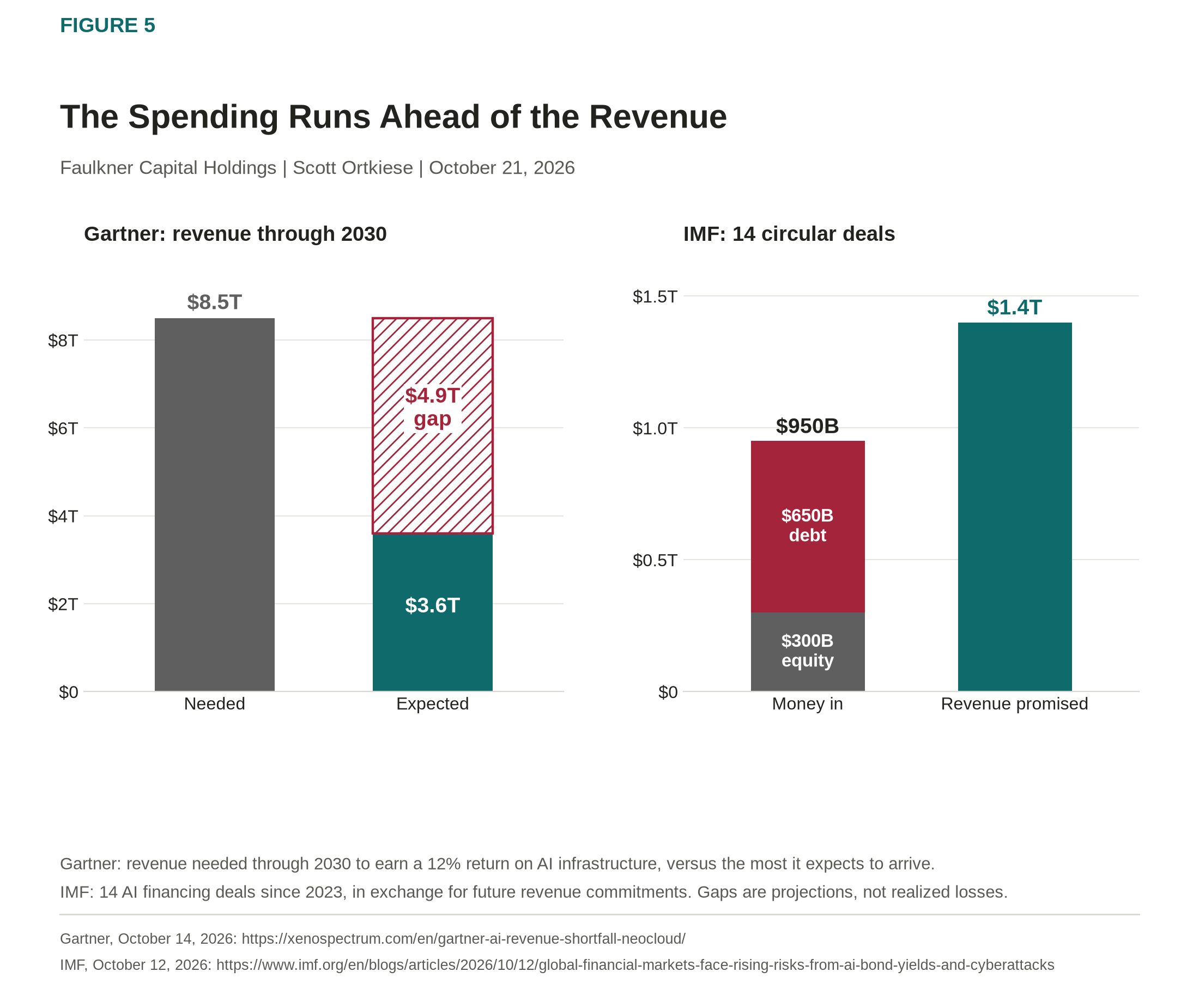
Circular deals compound the risk. The International Monetary Fund
(IMF) reviewed 14 AI financing deals since 2023, totaling about $300
billion in equity and $650 billion in debt in exchange for $1.4 trillion
in future revenue commitments. Stress at a key recipient “would lower
revenue forecasts and investment valuations, weakening the value of the
accumulated debt in those deals” (IMF).
Revenue
Gartner’s projected revenue gap and the IMF’s
financing-deal sample
describe different populations and cannot be added together.
Neither
measures realized losses. Sources:
Gartner,
via Xenospectrum;
IMF.
Gartner calculates that AI infrastructure needs $8.5 trillion in
revenue through 2030 to earn a 12% return, versus at most $3.6 trillion
expected. Gartner also predicts that more than 80% of neoclouds will
cease operating independently by 2030, through failure, merger, or
acquisition (Gartner,
via Xenospectrum).
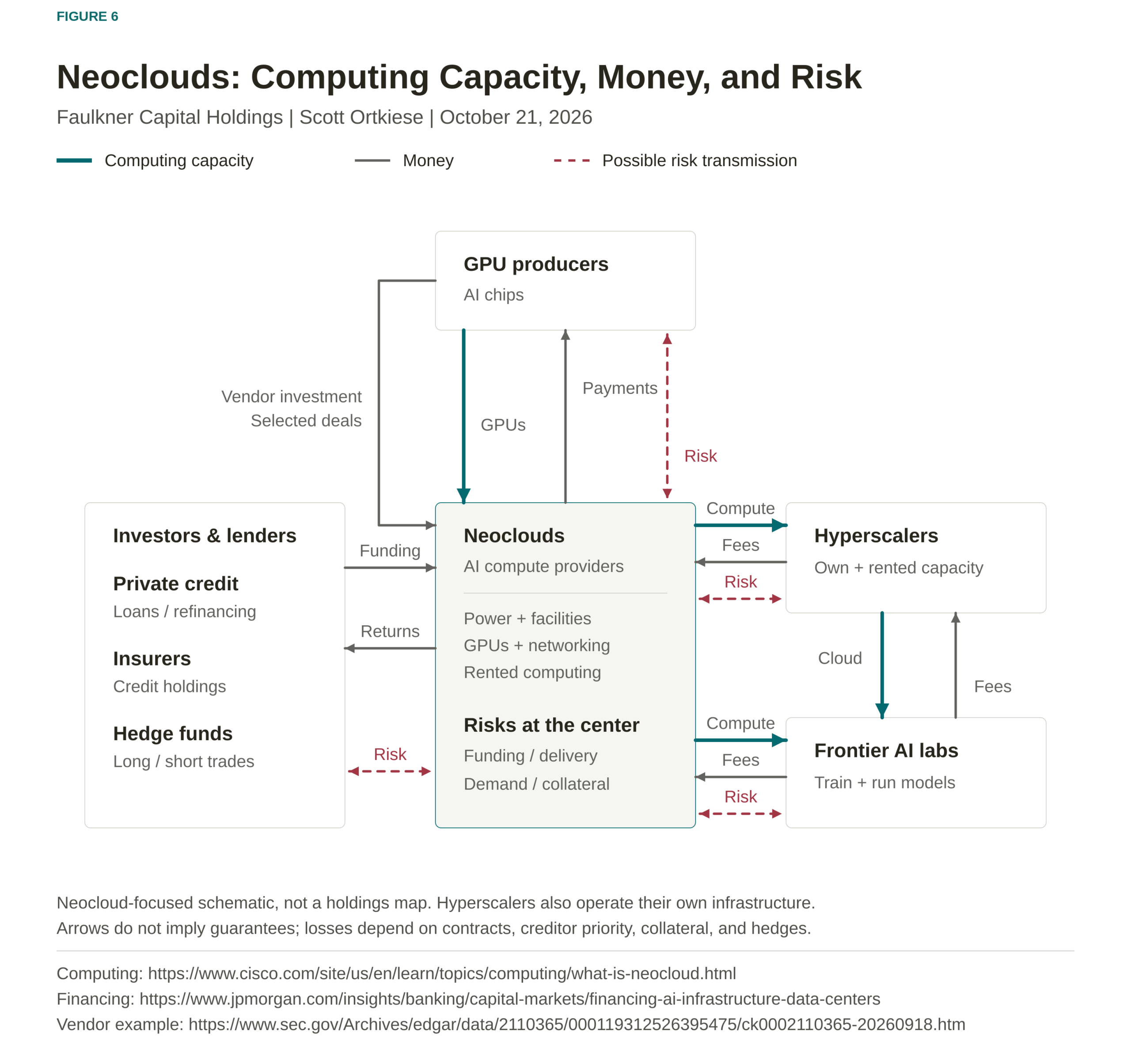
Risk
Computing capacity, money, and possible risk
transmission follow
different paths. This is a conceptual schematic, not a map of
actual
holdings or automatic guarantees. Sources:
Cisco;
J.P.
Morgan.
Private Credit: The
Lender Nobody Sees
Private credit is lending by investment funds, not banks. Managers
such as Apollo, Blackstone, Blue Owl, KKR, and Carlyle raise money from
insurers, pension funds, and wealthy individuals, then lend it directly
to companies. The loans do not trade on an exchange, so no daily price
reveals losses. Private credit funds grew from about $100 billion in
assets in 2010 to more than $2.2 trillion (BIS).
The Bank for International Settlements (BIS) is the central bank for
central banks, based in Basel, Switzerland.
How Much Private Credit Is in
AI
- Outstanding loans. Private credit loans to
AI-related firms rose from near zero to more than $200 billion, almost
8% of all private credit loans (BIS). - New lending. Funds lent more than $40 billion to
AI-related companies in 2025, up from about $3 billion in 2010. The BIS
projects $300 billion to $600 billion outstanding by 2030 (BIS). - The need. Morgan Stanley projects $2.9 trillion in
global data center spending from 2025 through 2028, with a $1.5 trillion
gap beyond what hyperscaler cash flow covers. It expects private credit
to fill about $800 billion of the gap (Morgan
Stanley). Carlyle puts the private credit need at roughly $1
trillion, more than half the industry’s current assets (Reuters). - The money keeps coming. Direct lending funds raised
$129.15 billion in the first 9 months of 2026, up 35% and the most since
Preqin’s data begin in 2016 (Reuters).
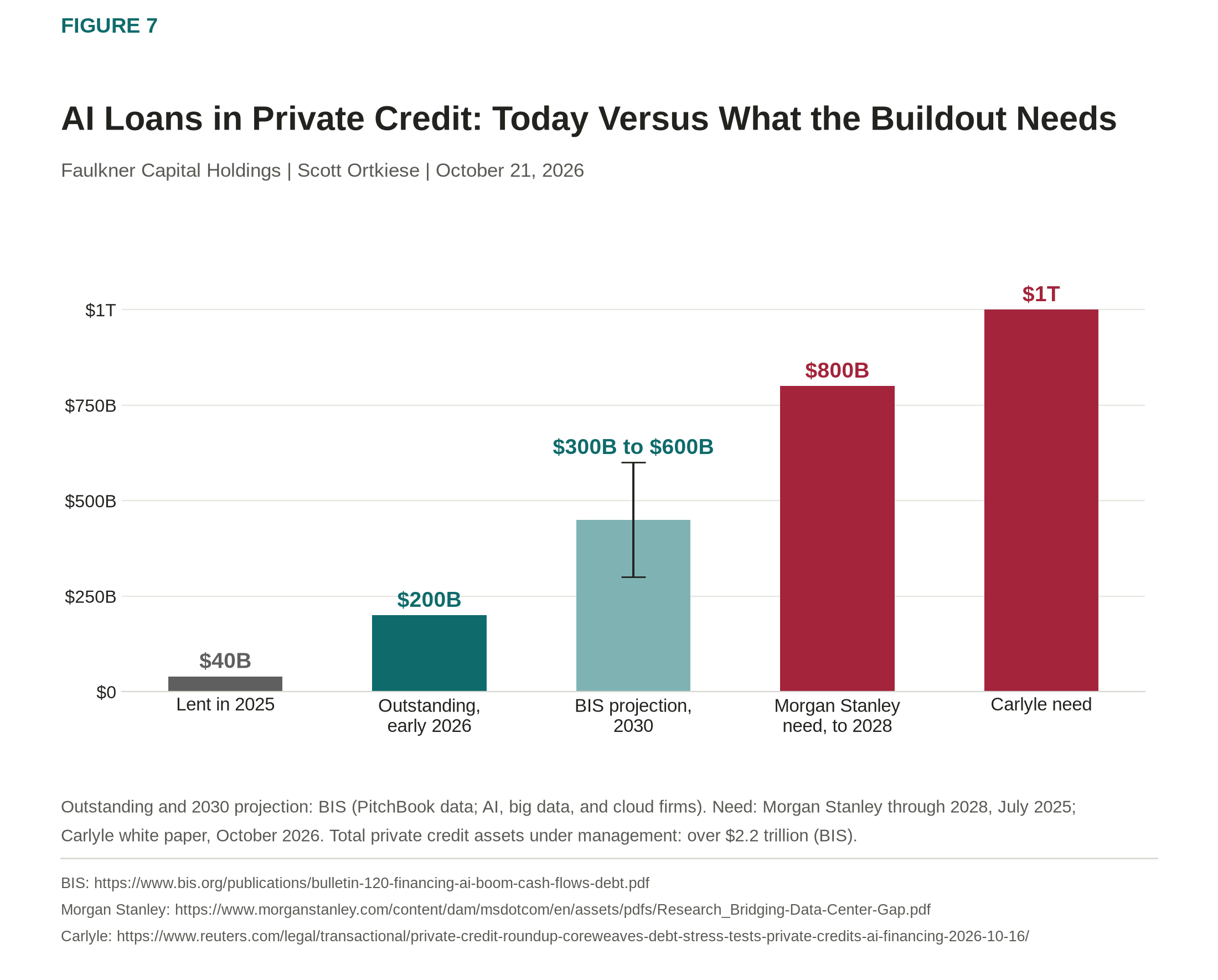
Buildout Needs
Annual lending, outstanding loans,
projected balances, and estimated
funding needs are different measures. The bars preserve their
stated
periods and scopes and should not be treated as a single time
series.
Sources:
BIS;
Morgan
Stanley;
Reuters.
9 Concepts Behind the Risk
- Special purpose vehicle (SPV). An SPV is a separate
legal entity created for a defined transaction, asset, or pool of
assets. Whether its debt appears on a sponsor’s balance sheet depends on
the structure and accounting rules; separation does not erase guarantees
or contractual obligations. Meta’s Hyperion data center in Louisiana
sits in an SPV that is 80% owned by Blue Owl funds and 20% by Meta. The
SPV issued about $27.3 billion in debt rated A+ (Investing.com).
In June, Apollo and Blackstone led a $35 billion deal, the largest
private credit deal on record, in which an SPV bought about 1 million
Google AI chips and leased them to Anthropic. Broadcom supports the
senior notes and Google backstops the site leases (UBS). - Off-balance-sheet debt. UBS calculates that
hyperscaler obligations rise from about $800 billion in reported debt to
roughly $3.5 trillion once off-balance-sheet commitments are included
(UBS).
These are different categories of obligation, not interchangeable
measures of outstanding debt. A balance sheet alone does not capture
every future contractual payment. - Residual value guarantee. Meta promised Hyperion’s
lenders about $28 billion if the campus loses value, a guarantee that
steps down over time (Investing.com).
The guarantee transfers specified residual-value risk to Meta. It should
not be described as unconditional protection for every lender loss or
the rating’s sole basis. - GPU-backed loans. Lenders accept AI chips as
collateral. CoreWeave borrowed $2.3 billion in August 2023 from lenders
led by Magnetar Capital and Blackstone, $7.5 billion in May 2024, and a
series of delayed draw term loans through August 2026 (Reuters).
A delayed draw term loan lets the borrower take the money in stages as
it buys chips. - Depreciation and collateral value. CoreWeave writes
its GPUs off over 6 years; Nebius, a rival neocloud, writes comparable
chips off over 4. Chips 2 to 3 years old resell for roughly 1/2 to 2/3
their new cost, and a wave of distressed sales could cut recovery to
about 1/3 of what lenders assumed (AI
Insiders). A longer accounting life leaves a higher book value, all
else equal. Book value is not a resale quote, and lenders can value
collateral differently. - Contract concentration. Customer contracts, not
chips, carry most of the credit weight. That reduces reliance on chip
resale values, but it concentrates risk in a few customers, such as
Microsoft, OpenAI, and Meta, continuing to pay and renew (Reuters). - Vendor financing. In August, Nvidia signed
agreements with Apollo, BlackRock, Blackstone, Brookfield, Goldman
Sachs, and KKR to raise more than $500 billion for AI computing, and
said it may back no more than 25% of the financing (Reuters).
A chipmaker that guarantees its customers’ loans is lending its own
credit to sell its own chips. - Payment in kind (PIK). A PIK provision lets a
borrower add interest to the amount owed instead of paying it in cash.
It can be agreed at origination or introduced during a restructuring;
its existence alone does not prove distress. The share of business
development company (BDC) loans using PIK rose from about 6% in early
2022 to roughly 10% in early 2026; in construction, it rose from under
5% to nearly 20% (Federal
Reserve Bank of Boston). A BDC is a publicly registered private
credit fund, often sold to individual investors. - Marks and gates. Managers value their own loans
quarterly. BDC loan values held near 100% of cost, yet BDC stocks fell
about 20% relative to the S&P 500 from early 2025 to mid-2026 (Federal
Reserve Bank of Boston). Analysis: the divergence signals investor
concern, but relative stock underperformance does not measure the amount
by which loan values are overstated. Many perpetually nontraded BDCs
limit quarterly repurchases to 5%; actual terms and treatment of unmet
requests depend on the fund (Fitch
Ratings). Investors sought to withdraw $4.2 billion from 2 Blue Owl
funds in the third quarter, down from $4.7 billion in the second (Reuters).
The Double Exposure
Private credit lends to AI and to the companies AI threatens. Loans
to software-as-a-service firms grew from almost $8 billion in 2015 to
more than $500 billion by the end of 2025, 19% of all direct loans.
Software stocks fell almost 30% from October 2025 to February 2026 on
fears that AI would replace their products (BIS).
Analysis: disruption of software borrowers and disappointment in AI
investments create 2 distinct loss channels. Neither outcome means every
loan in either group fails.
Who Stands Behind the Funds
- Life insurers. Life insurers held $849 billion in
private credit in 2024, 14% of their balance sheets, up from $386
billion in 2014 (Federal
Reserve Bank of Chicago; MarketWatch).
Moody’s broader measure put private credit at about 35% of portfolios at
the end of 2022 (Wall
Street Journal). Blackstone Credit & Insurance anchored
CoreWeave’s $8.5 billion loan in March 2026 (Reuters).
Apollo and KKR own insurance companies that invest in private debt (TheStreet). - Banks. Banks lent $1.7 trillion to nonbank lenders
as of the first quarter of 2026, 12% of all bank loans, up from $100
billion 15 years earlier (Federal
Reserve Bank of Boston). European banks lent $1.7 trillion to
nonbanks in 2025 (IMF).
Private credit is not separate from the banking system; banks finance
it. - The warning. Michael Burry, the investor known for
predicting the 2008 housing collapse, said on October 8 that he hears
“creaks and groans” and “some loud snapping and crackling” in private
credit, and that some insurers hold “too many bad assets” (TheStreet).
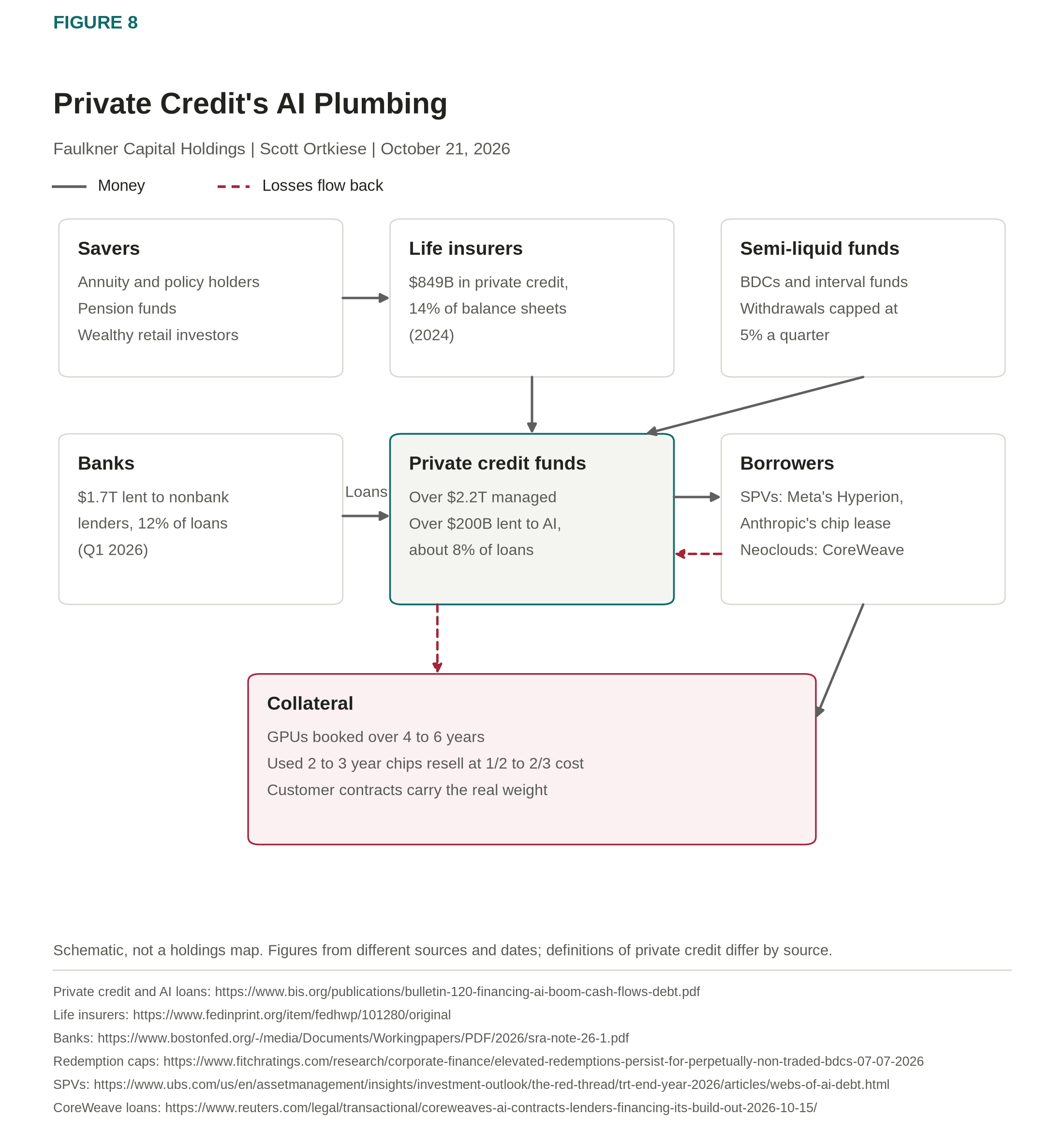
The
schematic identifies possible funding and loss channels, not a
complete holdings map. Bank lending to nonbanks is broader than AI
lending, and the withdrawal limits shown apply to relevant fund
structures, not every private-credit vehicle. Sources:
Boston
Fed;
Fitch.
Is This 2008?
Fact. In 2008, American International Group (AIG),
the insurer, had sold credit default swaps on mortgage securities
without protecting itself adequately (PRMIA).
When the mortgages failed, the government committed $182 billion to
rescue AIG, much of it paid to AIG’s Wall Street trading partners on
those swaps (NPR).
Analysis. 3 differences and 3 similarities
matter.
Differences:
- In 2008, mortgage-credit losses traveled through securities and
derivatives to financial institutions. This article examines corporate
CDS tied to named AI-linked borrowers, not the entire CDS market. - Today’s largest borrowers, Amazon, Alphabet, Microsoft, and Meta,
earn enormous cash from businesses other than AI. - Weekly trading volume, outstanding debt, and net credit exposure
measure different things. Their dollar amounts cannot establish safety
through a simple comparison.
Similarities:
- Public disclosures do not provide a complete, current map of every
risk holder. Much AI lending sits in private credit, whose prices update
slowly. - The money is circular. Suppliers invest in customers who buy the
suppliers’ products. - Insurance prices are rising while official ratings remain investment
grade, as they did in 2007.
The danger lies less in the swaps themselves than in the debt beneath
them and the savers who hold it.
If the
Bubble Bursts: What It Means for the Everyman
A bubble forms when prices rise beyond what future cash can repay. A
crash happens when lenders and investors decide the cash will not
arrive. The channels below explain how a financing shock can reach
households. Exposure depends on holdings, contracts, and loss
protections; a failed offering is not itself a default.
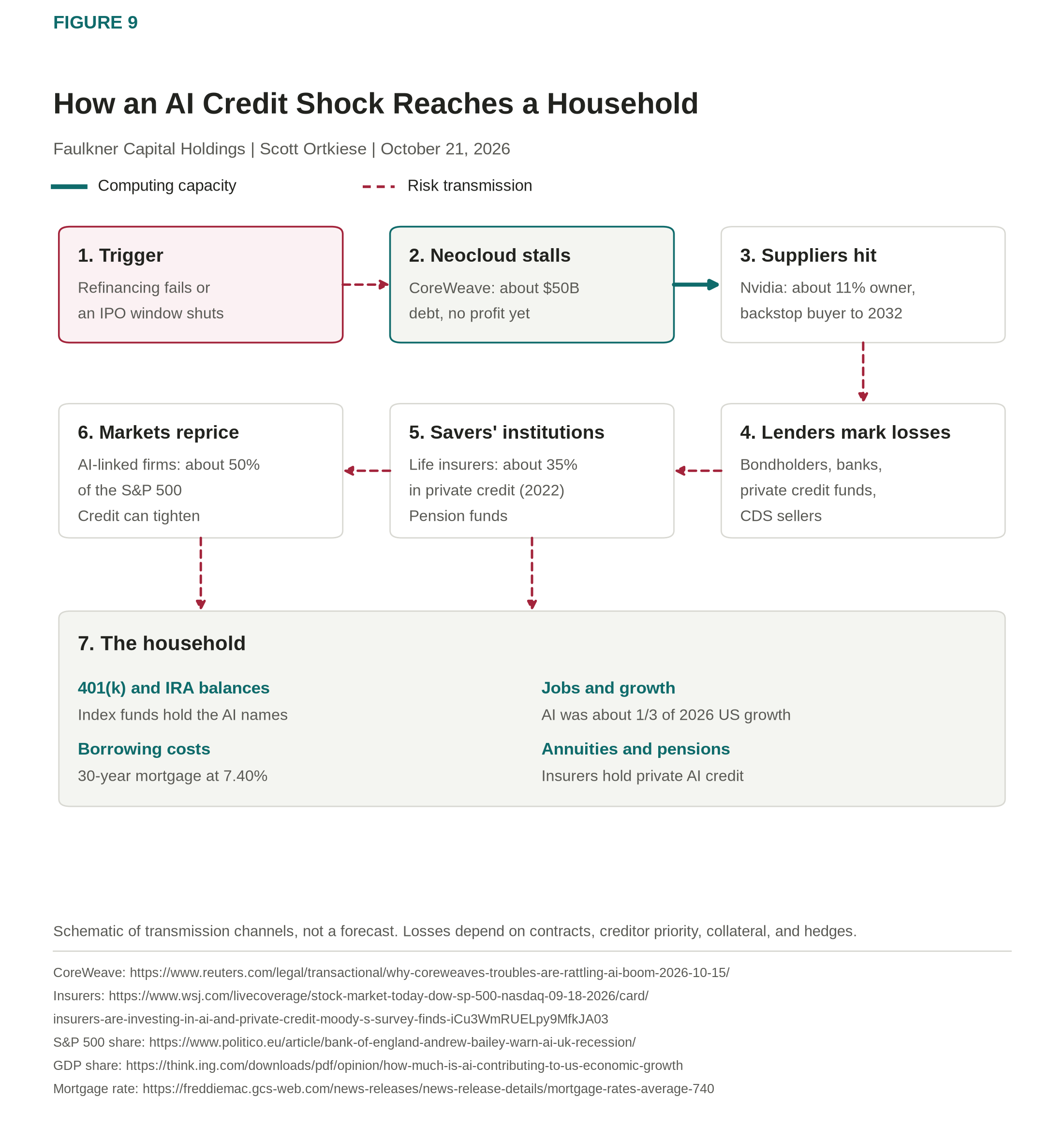
Household
These are potential transmission channels, not a
predicted sequence
of failures. Losses depend on ownership, contracts, collateral,
hedges,
and benefit protections. Sources:
Reuters;
NOLHGA.
- Retirement accounts. AI companies now make up about
half the S&P 500 index, up from 1/4 in 2022 (Politico).
Anyone holding an S&P 500 index fund in a 401(k) owns that
concentration. - Annuities and life insurance. Private credit made
up about 35% of life insurers’ portfolios as of the end of 2022.
Insurers hold about $8 billion in data center assets and roughly $26
billion in AI-linked energy projects, according to Moody’s (Wall
Street Journal). Meta’s Louisiana data center alone drew $27 billion
in private debt, with BlackRock among the biggest buyers (Wall
Street Journal). - Jobs and growth. AI investment accounts for about
1/3 of US economic growth in 2026, by ING’s estimate (ING).
UBS puts the direct contribution at about 0.75 percentage points of
growth in the first half of 2026 (BusinessLine).
Analysis: canceled or delayed projects reduce demand for construction,
electrical, and equipment work. Baringa, the consulting firm, models a
2027 AI valuation shock cutting US growth to about 0.3%, or producing a
contraction of about 1.0% (Baringa). - Borrowing costs. The shock arrives when money
already costs more. Consumer prices rose 3.7% in the year to September,
with gasoline up 34.2% as the US and Israeli war with Iran, launched in
late February, drove energy prices higher (CNBC).
The Federal Reserve raised its target range to 3.75% to 4% in September
(J.P.
Morgan), and nearly all economists polled by Reuters expect another
increase in December (US
News, via Reuters). The 30-year mortgage averaged 7.40% on October 8
(Freddie
Mac). Analysis: a credit shock can raise risk premiums and tighten
loan availability for households and businesses. Falling benchmark rates
can partly offset higher spreads, so not every borrowing rate must
rise. - Electricity bills. Data centers raise electricity
prices, “particularly for households” (CEPR).
Analysis: if projects fail after utilities build lines and plants for
them, ratepayers can be left paying for the grid. - Wealth and spending. Since November 2022, AI-driven
stock gains added about $144 billion a year in household spending, by
ING’s estimate (ING).
A stock crash reverses that.
An insurer’s investment loss is not automatically an equal reduction
in a policyholder’s benefit. In an insolvency, state guaranty protection
depends on the product, state law, and coverage limits (NOLHGA).
The American and European
Buildouts
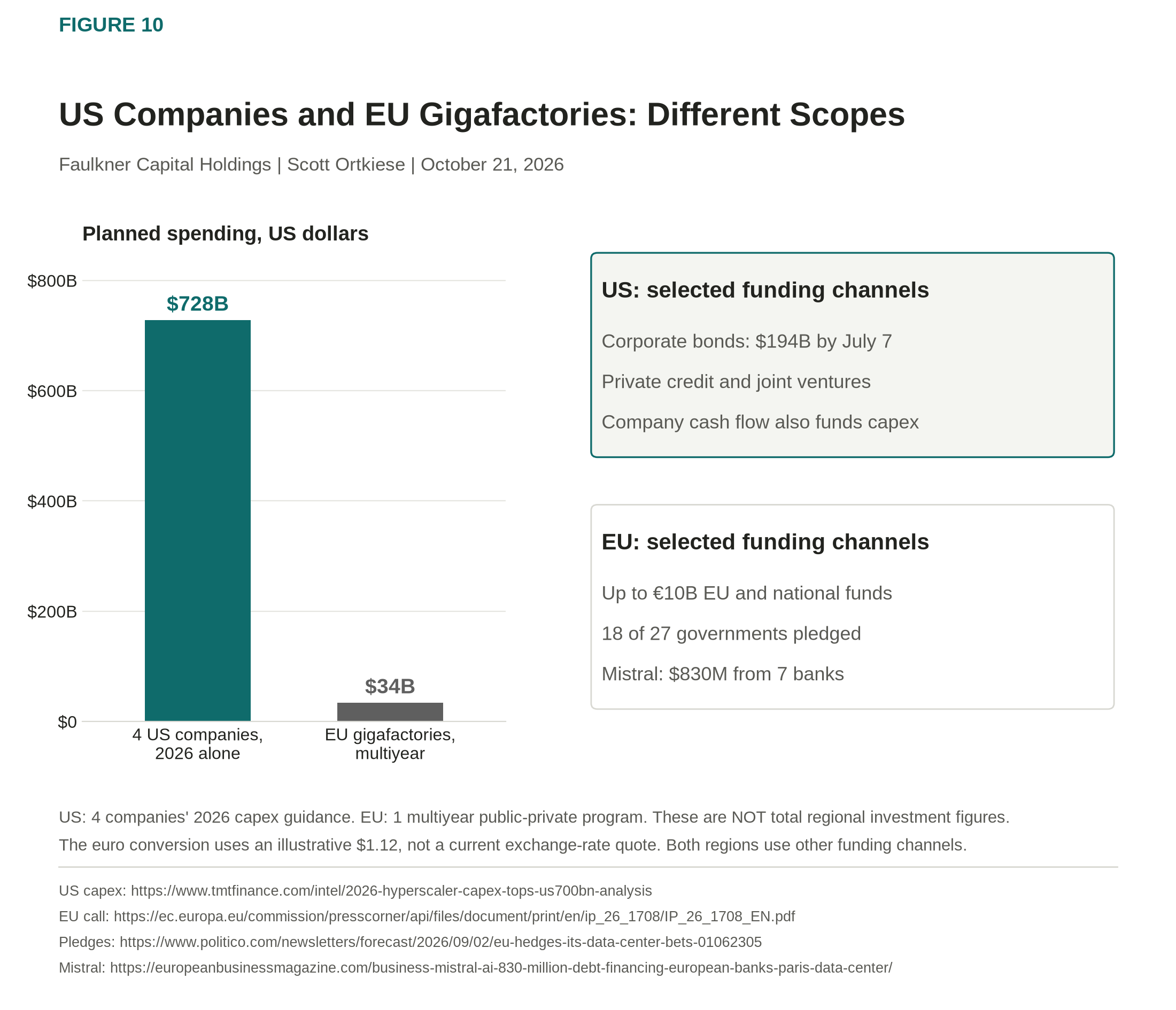
Scopes
The chart contrasts 4 US companies’ annual capital
spending with a
specific multiyear EU program, not total investment in each region.
Its
dollar conversion uses an illustrative $1.12 per euro, not a
current
exchange-rate quote; both regions also use other funding channels.
Sources:
TMT
Finance;
European
Commission.
United States
- Scale. Amazon, Alphabet, Microsoft, and Meta guide
to $710 billion to $745 billion in 2026 capital spending, up from about
$410 billion in 2025 (TMT
Finance). - Funding. The US buildout combines company cash flow
with corporate bonds, private credit, joint ventures, and data center
securitizations. Securitization pools asset cash flows into securities
sold to investors. Securitizations of data center debt totaled $46
billion from 2018 to April 2026 (TokenPost). - What breaks first. Projects that depend on borrowed
money stall first: neoclouds, joint ventures, and speculative sites. The
hyperscalers can keep building from cash flow, but more slowly and at
higher cost. Oracle sits between the 2 groups, 1 notch above junk.
Europe
- Scale. The European Union (EU) opened a call on
July 30 for up to 7 AI Gigafactories, targeting more than €30 billion in
investment: up to €10 billion in EU and national money and €20 billion
in private capital. The call closes November 12 (European
Commission; EU
Digital Skills and Jobs Platform). - Funding. 18 of 27 EU governments pledged money;
Germany committed €1 billion in total, and the Netherlands declined (Politico).
Mistral AI, the French AI developer, borrowed $830 million from 7
European banks for its first data center (European
Business Magazine). European lenders remain cautious on AI and
neoclouds (PFI). - Exposure. Europe is exposed 3 ways. First, the €20
billion private share of the gigafactories depends on investor appetite,
which a credit shock would cut. Second, European stocks fell with the
October tech rout (Reuters),
and bank stock valuations already declined in early 2026 on private
market exposure and AI disruption fears (European
Central Bank). Third, Andrew Bailey, governor of the Bank of
England, the United Kingdom’s central bank, warned of a “triple whammy”
of AI risks, and Britain is at risk of recession if the bubble pops (Politico).
The Bank of England’s Financial Policy Committee said the “rapid
increase” in AI debt issuance has raised capital markets’ exposure to AI
(Reuters).
Analysis. Both regions use private capital, bank
lending, and public support; the mix differs by project. The US company
spending figures and the EU gigafactory program measure different scopes
and periods, so their chart is not a comparison of total regional AI
investment. A US financing shock can reach Europe through asset prices,
lenders, and access to private funding. Distressed capacity could become
cheaper, but physical access, power, and contract terms determine who
can use it.
What to Watch
- CoreWeave’s CDS. A sustained level above 1,000 bp
means lenders expect losses. - Oracle’s rating. S&P said leverage above 4
times, or no path to positive free cash flow by fiscal 2029, could
trigger another cut (CNBC).
A cut to junk could trigger sales by investment-grade-only mandates; the
timing and exceptions depend on each mandate. - The Federal Reserve. It meets October 27 and 28,
and markets expect a December increase (CNBC). - The stock offering window. More withdrawn offerings
mean a narrower funding route, with pressure to borrow, sell assets, or
cut spending. - Big Tech earnings. Any cut to 2027 spending plans
would hit chipmakers, neoclouds, and their lenders at once.