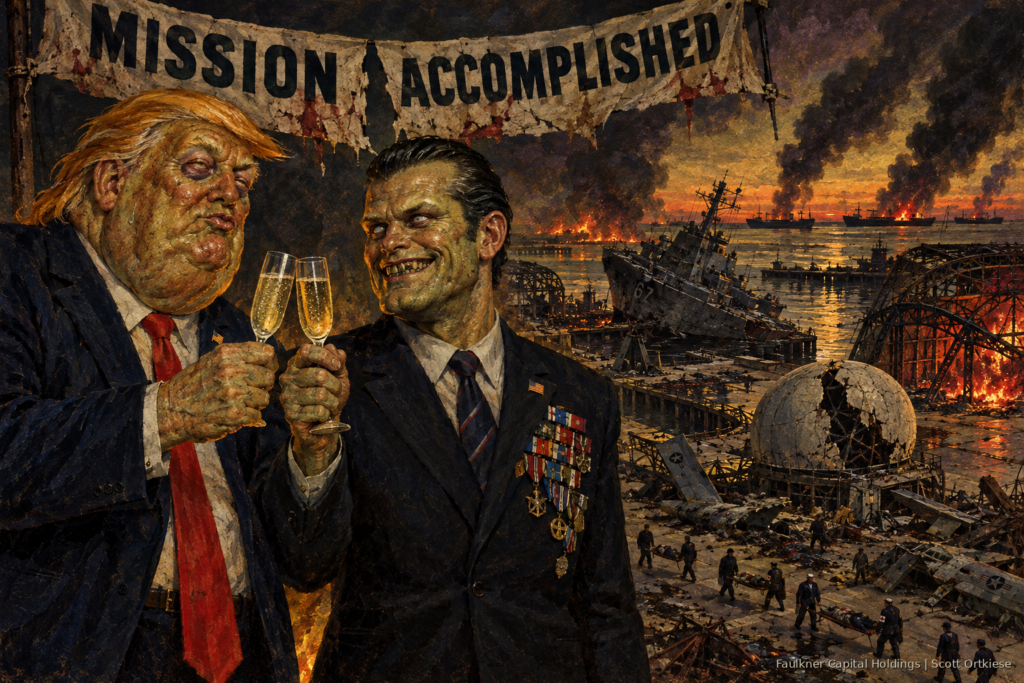
Trump and his administration lied to us by omission and by telling outright lies, telling us that Iran was defeated and its military capability destroyed. Now the Houthis are grabbing vast swaths of Saudi Arabia, and Iran still controls the strait.
Scott Ortkiese | Throughline Synthesis | Houston, September 13, 2026
- On 8 April 2026, Secretary of War Pete Hegseth said from the Pentagon podium that Operation Epic Fury had “decimated Iran’s military and rendered it combat ineffective for years to come,” that “Iran’s navy is at the bottom of the sea,” and that “We’ll be staying put. We’re not departing.” (Department of War transcript, Politico)
- On 9 September 2026, acting Secretary of the Navy Hung Cao said of the headquarters of the US Fifth Fleet: “They blew the hell out of Bahrain.” (The Epoch Times)
- Independent radar measurement of 12 US installations, run for this article against European Space Agency Sentinel-1 data, found persistent structural change on 8.65 hectares of the built-up footprint at Naval Support Activity Bahrain, with 0.00 hectares of change in the prewar control period at the same site on the same satellite track.
- The Washington Post verified damage to 217 structures and 11 pieces of equipment at 15 US sites through 14 April 2026 alone (Washington Post).
- Before the war, 120 to 140 ships a day transited the Strait of Hormuz. In August 2026, the best month since the fighting resumed, the weekly average was 78 transits, roughly 11 ships a day, a reduction on the order of 90% (Lloyd’s List Intelligence, CNN). On 10 August 2026 the President said, “We control the Strait, 100%” (whitehouse.gov).
- On 21 July 2026 the President said of the Houthis, “we’ve done that with the Houthis before, and we haven’t heard from them in a while” (Washington Times). Seven weeks later they wounded 73 people in 4 Saudi cities, set Aramco facilities on fire, seized Yemen’s western coast, took Perim island in the middle of the Bab al-Mandeb Strait, and prompted Crown Prince Mohammed bin Salman to telephone the President asking for direct US military help, which Washington declined (Reuters, Reuters).
- The Pentagon’s public casualty database was revised downward twice, 4 dead service members were removed from it by name, and a new reporting category was created to split 1 war into 2. Reporting put the wounded near 700 by 6 August 2026, most with traumatic brain injuries (PBS NewsHour). The chief Pentagon spokesman called them “minor concussions” (CNN).
- Iran destroyed 2 of the 13 AN/TPY-2 missile defense radars the United States has ever fielded, roughly 15% of the national inventory, in the first week of the war, and the $500 million AN/FPS-132 early warning radar in Qatar was struck on the opening day, 28 February 2026, on the array face covering airspace toward Iran (Al Jazeera Centre for Studies, CNN). Combined Patriot and THAAD interceptor stocks fell from 2,800 to about 1,100, roughly 60%, with 3 to 4 years required to rebuild. The chief Pentagon spokesman called reports of a shortage “false” (LA Times).
- In the week of 20 April 2026 the President said, “Don’t forget, we’re having some fake inflation because of the fuel, the energy prices” (Yahoo Finance). The Bureau of Labor Statistics published 7 monthly reports during the war. Consumer prices peaked at 4.2% year on year in May with gasoline up 40.5%, core inflation rose for 4 consecutive months, and on 13 September 2026 diesel reached $6.2040 a gallon, the highest price ever recorded in the United States (Bureau of Labor Statistics, AAA).
The victory that was declared
The declaration came on 8 April 2026, 40 days into the war, from the Pentagon briefing room. Hegseth read the results as a finished account.
“By any measure, Epic Fury decimated Iran’s military and rendered it combat ineffective for years to come,” he said. “Iran’s navy is at the bottom of the sea. Iran’s air force has been wiped out. We own their skies. Their missile program is functionally destroyed, launchers, production facilities and existing stockpiles depleted and decimated and almost completely ineffective.” He called it “a historic military victory.” He said, “Together with our Israeli allies, the U.S. military accomplished every single goal.” And he said the force would stay: “We’ll be staying put. We’re not departing.”
General Dan Caine, Chairman of the Joint Chiefs of Staff, put numbers to it the same day: more than 13,000 targets struck, 80% of Iran’s air defenses destroyed, 90% of its fleet sunk, 13 Americans killed in action (Department of War transcript).
The language had been building for weeks. On 13 March 2026, at his first war briefing, Hegseth said: “Iran has no air defenses. Iran has no air force. Iran has no Navy. Their missile volume is down 90%.” He added that “Never before has a modern, capable military been so quickly destroyed” (Department of War transcript, Time). On 9 March 2026, in a telephone interview with CBS News, the President said, “If you look, they have nothing left. There’s nothing left in a military sense,” and “I think the war is very complete, pretty much” (CBS News). On 31 March 2026 he said American forces “will be leaving very soon, within two to three weeks” (Reuters).
One senior officer declined to say it. At the same 13 March briefing where Hegseth said Iran had no navy, Caine said: “We’ve made progress, but Iran still has the capability to harm friendly forces in commercial shipping and our work on this effort continues” (Department of War transcript). That single sentence, from the officer with access to the targeting data, is the only part of the 13 March briefing that has aged well.
Everything after it is the record of what an administration says when the facts stop cooperating. On 30 April 2026, testifying to the Senate Armed Services Committee, Hegseth identified the problem: “the biggest adversary we face at this point are the reckless naysayers and defeatist words of congressional Democrats and some Republicans.” Senator Jack Reed told him, “I am concerned that you have been telling the president what he wants to hear, instead of what he needs to hear.” When Senator Gary Peters called the strategy a failure, Hegseth answered, “Shame on you and others who call this a quagmire and a failure.” Peters answered him: “You, sir, are the failure. You don’t have a strategy. You don’t have a long-term plan to actually win this war” (Al Jazeera, The Guardian).
On 9 September 2026, 5 months after the victory declaration and 6 months after the war was to end in 2 to 3 weeks, the President said before Air Force One: “This war will end immediately after our election” (Al Jazeera).
What was actually hit
The physical record is now large enough that no single source is required to carry it.
The Washington Post, working from commercial satellite imagery, verified damage to or destruction of 217 structures and 11 pieces of equipment across 15 US sites through 14 April 2026. Later tallies put the figure at 228 or more structures and pieces of equipment, and the count stopped being current because the attacks did not stop. An analysis reported by the BBC put damage from Iranian strikes on bases used by the United States at about $800 million in the first 2 weeks alone (BBC, Washington Examiner).
Naval Support Activity Bahrain. This is the shore headquarters of the US Fifth Fleet and the center of American naval command for the Persian Gulf, the Red Sea and the Arabian Sea. The Wall Street Journal, working from satellite imagery, verified social media video and interviews with service members, concluded that Iranian strikes caused extensive damage the Pentagon did not immediately acknowledge, and that the command center and at least a dozen other buildings were hit hard. Damage has been put at roughly $400 million. The base has been described as virtually uninhabitable. In-port personnel presence fell from about 10,000 to about 2,000, and headquarters functions were moved to MacDill Air Force Base in Florida. On 31 August 2026, Chief of Naval Operations Admiral Daryl Caudle said the Navy would not be returning to Bahrain anytime soon. On 9 September 2026 the acting Secretary of the Navy, Hung Cao, told a reporter in Philadelphia, “They blew the hell out of Bahrain,” and said, “I have a task force that’s looking at that.” He also said the Fifth Fleet’s carrier had no place to pull in (The Wall Street Journal, Military Times, Al Jazeera).
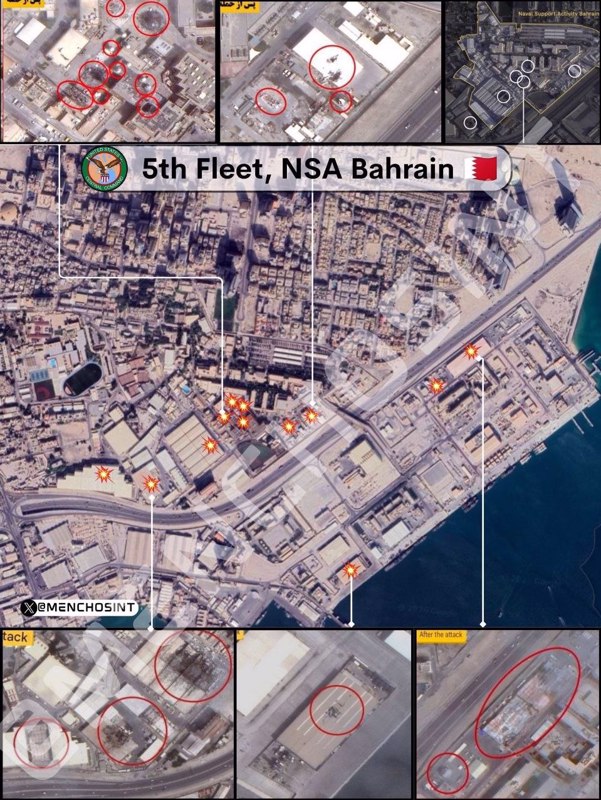
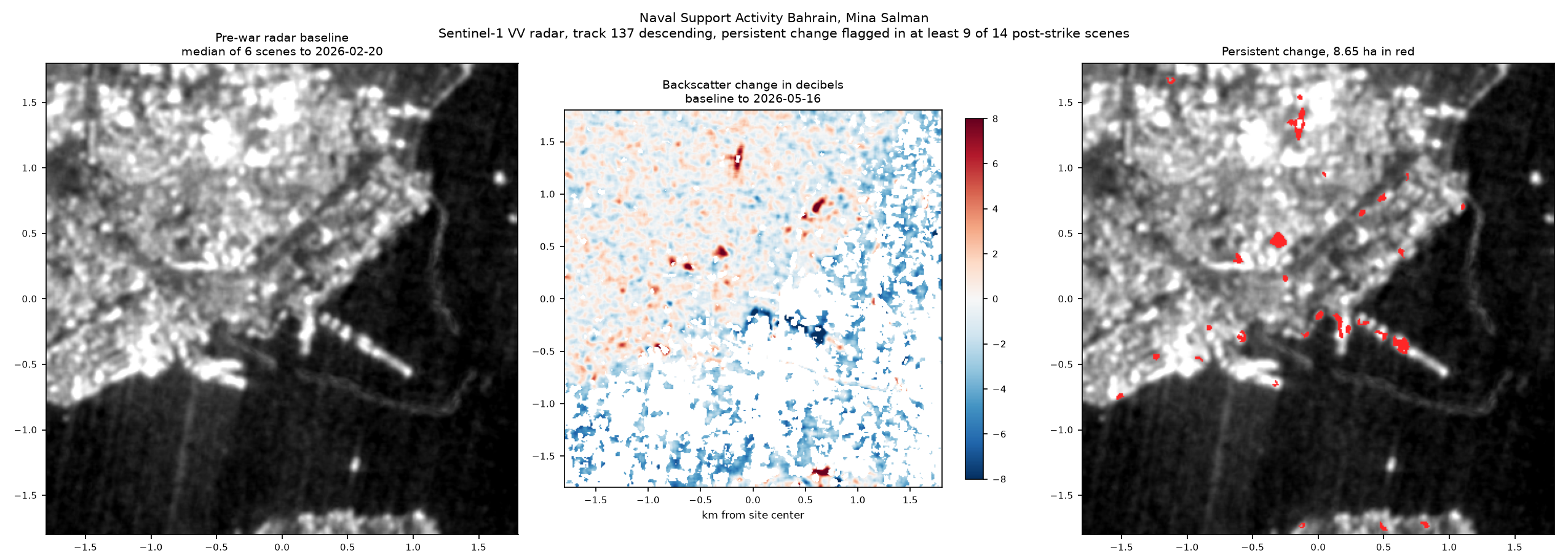
The radar measurement above was made from free public data, months after commercial providers stopped releasing pictures of this base. It puts 8.65 hectares of persistent structural change inside the built-up footprint, in compact patches sitting on buildings, against 0.00 hectares in the prewar control period at the same site on the same satellite track. The method is described further below. The point here is narrower: the evidence that the Fifth Fleet headquarters was wrecked was available to anyone with an internet connection while the Pentagon was declining to discuss battle damage.
Al Udeid Air Base, Qatar. The Combined Air Operations Center, the facility from which American air operations across the region are planned and directed, took a direct hit from multiple missiles at the start of the war. Roughly 10,000 US personnel were stationed at Al Udeid before the conflict. The facility was empty when the missiles arrived, and no one was injured, because the United States had anticipated that Iran would target Al Udeid and had run the air campaign from Shaw Air Force Base in South Carolina from the opening day of Operation Epic Fury on 28 February 2026. Personnel had been moved out before the fighting started (Air and Space Forces Magazine, Washington Examiner).
Muwaffaq Salti Air Base, Al Azraq, Jordan. An AN/TPY-2 radar, the X-band tracking radar that feeds the THAAD missile defense system, was destroyed here. All 5 of its trailers were hit and 2 craters roughly 13 feet across were left in the pad. The system cost just under $500 million. Three US troops were killed at the base in Iranian attacks on 17 and 18 July 2026. On the night of 8 to 9 September 2026, Jordan’s Armed Forces engaged 20 incoming ballistic missiles and intercepted 18, with 2 falling in unpopulated areas. The 2 that got through still did damage: 1 A-10 lost a wing and 8 F-15s sustained light damage, and about 30 Patriot interceptors were expended. US Central Command confirmed 2 American service members killed in action there, 1 missing and 4 injured (CNN, Al Jazeera, The Intercept).
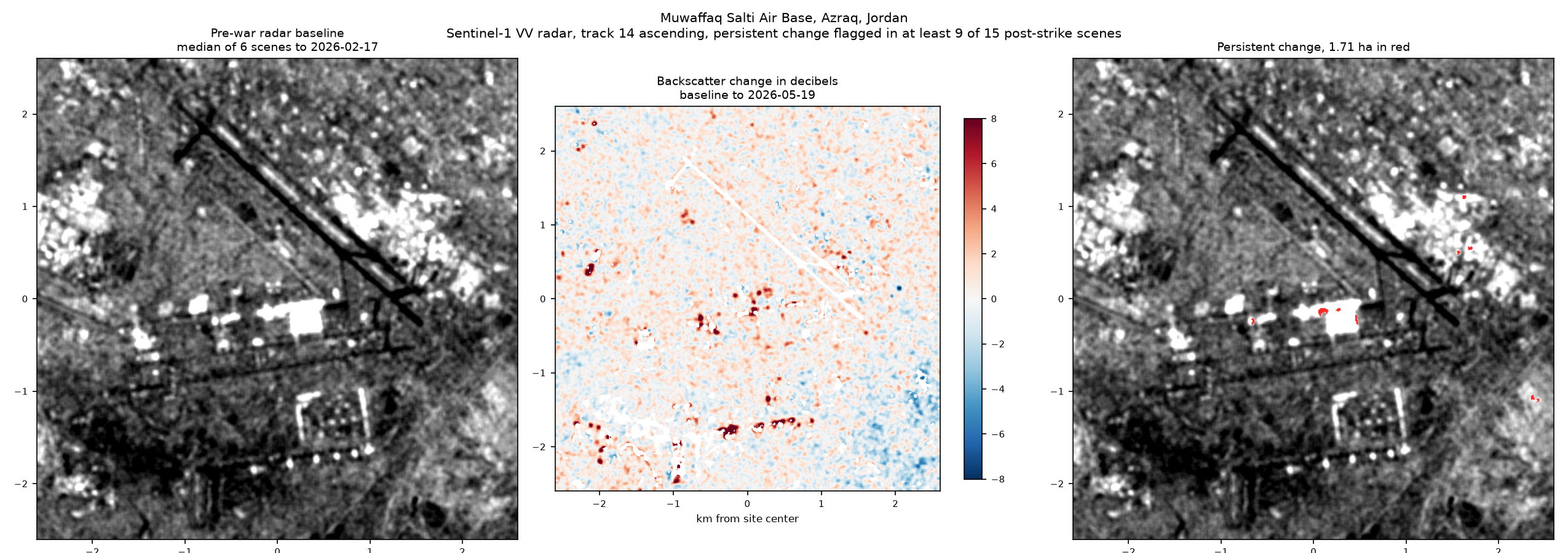
The radar signature at Muwaffaq Salti is the one that matches a destroyed radar and launcher array rather than a damaged building. Only 1.71 hectares of persistent change falls inside the built-up footprint. Across the unrestricted footprint, which includes the open ground where the trailers stood, it is 18.16 hectares. That is what just under $500 million of air defense equipment looks like after it has been taken off the board, measured from a public satellite by anyone who cared to look.
Prince Sultan Air Base, Saudi Arabia. An E-3 Sentry airborne early warning aircraft, tail number 81-0005, was destroyed on the ground on 27 March 2026 (NBC News).
Port Shuaiba, Kuwait. On 1 March 2026, an Iranian drone struck a building where American personnel were working. Six service members were killed. One Army colonel and 2 general officers, Brigadier General Clint Barnes and Major General Brad Hinson, sustained head trauma. A wounded colonel described it plainly: “Everybody inside the building was in a concussive blast.” He added, “We broke all the tactical-level rules” (The War Horse).
Ali Al Salem Air Base, Kuwait. An Iranian Fateh-110 short-range ballistic missile struck near the base on or about 30 May 2026. Debris damaged infrastructure, about 5 people including contractors were injured, and Reaper drones were damaged (Militarnyi).
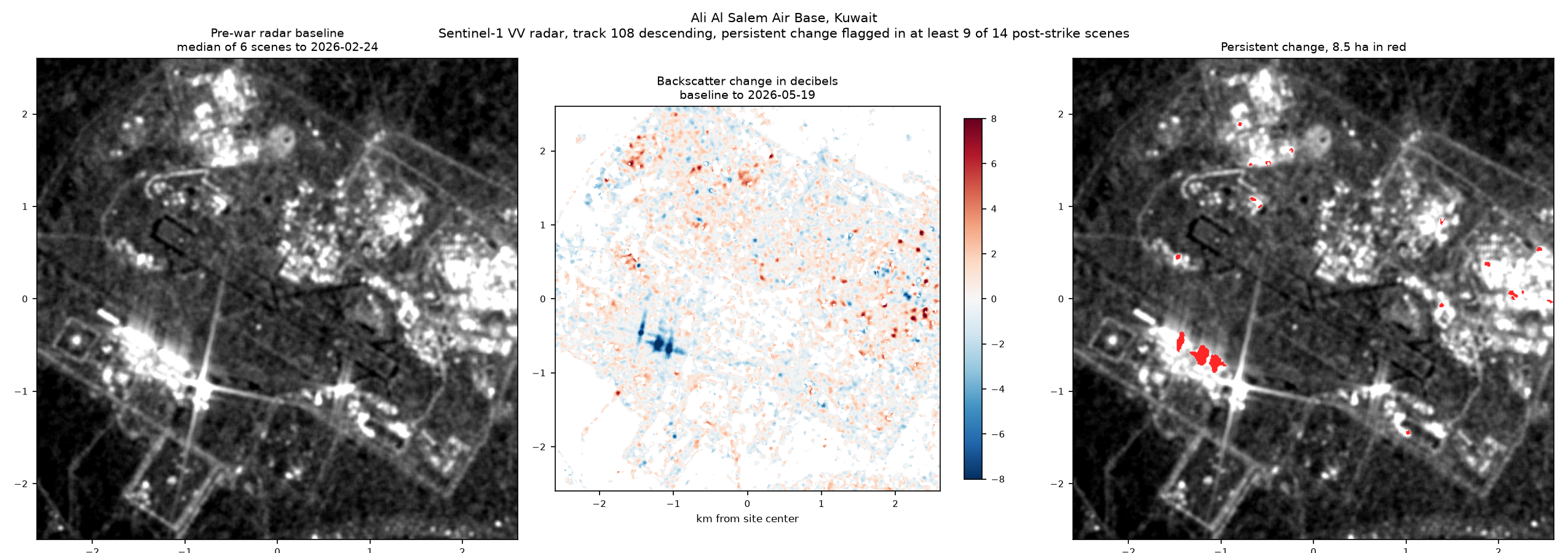
That is the official account of Ali Al Salem: a missile landing near the base, damaged debris, 5 injuries, some drones. The radar records 8.50 hectares of persistent structural change inside the built-up footprint, 6.2% of it, the highest proportional figure of any base measured for this article, confirmed on a second orbit at 3.31 hectares, against a control of 0.00 hectares.
Retired General David Petraeus, who commanded US Central Command, has since said that current American outposts in the Middle East “are no longer viable.” His reasoning was not political. “This is a result of the Iranians having capabilities they didn’t have before, in terms of the numbers of drones and the numbers of missiles with the range required to hold our facilities at risk and to strike them and to kill our soldiers and wound them” (The Epoch Times).
That is a direct contradiction of “Their missile program is functionally destroyed,” delivered by the officer with the strongest claim to know what the posture was designed to withstand.
The defense of the bases also consumed the means of defending them. American interceptor stocks in theater fell from about 2,800 to about 1,100. Tom Karako of the Center for Strategic and International Studies called it a generational annihilation of inventory.
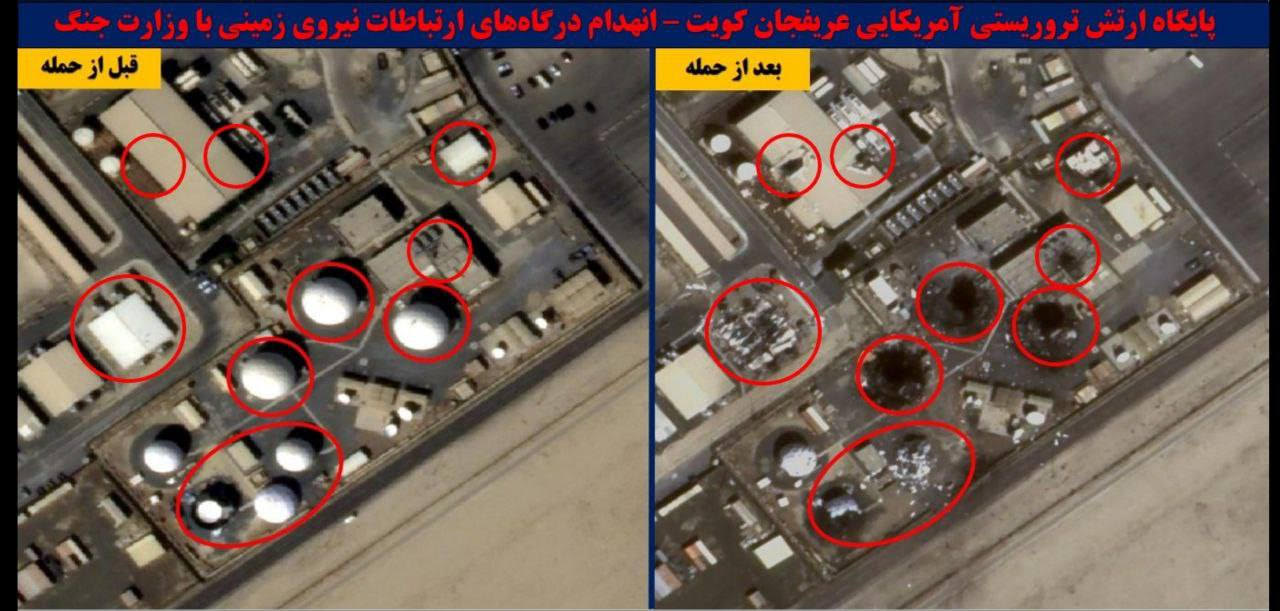
Against all of this, the public line held. On 11 June 2026 a Pentagon official, speaking without a name, said: “We do not discuss battle damage assessments for operation security reasons,” and “Our forces remain fully operational, and we continue to execute our mission with the same readiness and combat effectiveness” (Washington Examiner).
The radars went first, and the command post had already moved to South Carolina
The strikes on the bases were not a scattering of lucky hits. In the first week Iran went after the sensing layer, in sequence, and the Islamic Revolutionary Guard Corps announced each one as it went.
On Saturday 28 February 2026, the opening day of the war, the IRGC announced a missile strike on the AN/FPS-132 early warning radar in Qatar. That is the long range strategic radar Qatar bought from the United States in 2013, the instrument that watches for launches. Satellite imagery indicated the strike concentrated on the northern sector of the installation, the array covering the airspace toward Iran. By 3 March, Iranian forces had struck the THAAD batteries at Al Ruwais and at Abu Dhabi in the United Arab Emirates, concentrating on the AN/TPY-2 detection and tracking radars rather than the launchers. The New York Times reported on 3 March, citing satellite imagery, that the AN/TPY-2 radar at one of the 2 Emirati sites had been destroyed. On Tuesday 3 March the IRGC announced a second operation against THAAD, this time the battery southeast of Riyadh near Prince Sultan Air Base, again concentrated on the radar position. On Wednesday 4 March it was the AN/TPY-2 in the southern sector of Muwaffaq Salti in Jordan (Al Jazeera Centre for Studies).
Read the dates in order and the intent is not ambiguous. Five days, 5 sensing nodes, 4 countries, and the aim point inside each installation was the radar. The Al Jazeera Centre for Studies assessment of that campaign was that it was designed to degrade regional detection, which is a polite way of saying the architecture was being blinded before the shooting war over the bases began.
Only 13 AN/TPY-2 radars have ever been delivered to the United States. Two of them, the Emirati one and the Jordanian one, were destroyed in the first week. That is roughly 15% of the national inventory of the instrument the entire THAAD system depends on to see, gone in 5 days, and it has never been described to the American public in those terms (Small Wars Journal, CNN).
The command layer went the same way, with one difference that matters more than anything else in this article. The Combined Air Operations Center at Al Udeid, the facility from which American air operations across the Middle East had been planned and directed for more than 2 decades, took multiple Iranian missiles in the early weeks and was rendered inoperable. It was empty. Nobody was hurt. The reason is that the United States had expected Iran to hit Al Udeid and had been running Operation Epic Fury from the CAOC at Shaw Air Force Base in South Carolina since the opening day, 28 February 2026, with personnel moved out of Qatar before the fighting started. The damage was not reported publicly until Air and Space Forces Magazine disclosed it on 5 June 2026 (Air and Space Forces Magazine).
That single fact disposes of the official story. The administration that told the public in April that the military had “accomplished every single goal” had judged, before the first American aircraft took off, that its principal regional air command center could not survive the war it was about to start. It emptied the building and ran the campaign from South Carolina. It did not tell the country that the forward posture had already been written off as indefensible. It told the country that its forces “remain fully operational, and we continue to execute our mission with the same readiness and combat effectiveness.”
Retired Lieutenant General David A. Deptula put the lesson plainly: “Any facility that’s above ground is vulnerable today, and so any critical nodes we build in the future need to be built underground, and be hardened.” He also said, of the campaign as actually fought, “Epic Fury was run from the United States to a large degree” (Air and Space Forces Magazine).
The naval command layer did not have the benefit of foresight. The Fifth Fleet headquarters building at Naval Support Activity Bahrain was hit, along with barracks, warehouses, a potable water tank and a satellite dish, and Fifth Fleet headquarters functions were relocated to MacDill Air Force Base in Tampa, Florida, the home of US Central Command. Amazon Web Services data centers in Bahrain supporting joint force operations were struck by multiple Iranian drones and missiles in early March and April (Türkiye Today, DefenseScoop, Dawn).
The distribution of the damage is itself an indictment of the basing arrangement. Of the 228 damaged or destroyed items the Washington Post documented across 15 sites, more than half fell on 4 bases: NSA Bahrain, Ali Al Salem, Camp Arifjan and Camp Buehring. A US official gave the reason: those locations were hit hardest because they permitted American offensive operations from their territory, including the use of the High Mobility Artillery Rocket System. The bases that let the United States shoot from their soil are the bases that got hit, which is the part of collective basing that host governments now understand and the American public has not been told (Türkiye Today).
Those 4 names are worth holding against the radar work in this article. Independent measurement from free public satellite data put the largest absolute structural change at NSA Bahrain, 8.65 hectares, and the largest proportional change at Ali Al Salem, 8.50 hectares or 6.2% of its built-up footprint, with Camp Arifjan present at 2.00 hectares. Three of the 4 hardest hit bases in the Washington Post count are the top 3 in the radar measurement, arrived at independently and months later. The fourth, Camp Buehring, returned approximately 0 hectares, because Camp Buehring is a tent installation and radar cannot see the destruction of canvas. The instrument’s known blind spot falls precisely on 1 of the 4 worst hit bases, which is stated here rather than buried.
What the architecture damage produced was not a repair program. It was a retreat under another name. The American Enterprise Institute put Iranian strike damage at roughly $5 billion across 70 structures at 11 American installations in 7 countries. The Pentagon began weighing whether to move key command centers underground at NSA Bahrain, whether to reinforce hardened facilities, and in some cases whether to rebuild damaged structures at all. It weighed shifting parts of the Middle East footprint farther west, potentially to Israel, where American military aircraft had been stationed at Ben Gurion Airport since the buildup, and reassessing the presence in Kuwait and Saudi Arabia. Two officials said American forces “may never return to regional bases in large numbers.” Retired General David Petraeus, who commanded Central Command, said the outposts “are no longer viable” (Dawn, Türkiye Today).
There is a smaller detail that says as much as the $5 billion. The State Department ordered military families out of Bahrain in March 2026. By late August they still did not know where they were going or when their household goods would follow. On 27 August, Under Secretary of Defense for Personnel and Readiness Anthony Tata and his deputy Sean O’Keefe issued a memorandum to sort out their relocation, 6 months after the evacuation order. At a worldwide town hall that Monday, a sailor displaced from Bahrain had to stand up and ask the Chief of Naval Operations, Admiral Daryl Caudle, for an update on his household goods (DefenseScoop).
Every single goal was accomplished.
They withheld the pictures, so the radar was used instead
Commercial satellite operators restricted the release of imagery over the affected sites for roughly 4 months, from about 9 March to 3 July 2026. Ten installations, including Isa Air Base and Riffa in Bahrain, Ahmad al-Jaber in Kuwait and Tower 22 in Jordan, have no post-cutoff frame available from any named Western commercial provider.
Radar does not depend on those providers. The European Space Agency’s Sentinel-1 satellites carry synthetic aperture radar, an instrument that measures the roughness and geometry of the ground rather than photographing it, and the data is public. Structural change leaves a persistent signature in radar backscatter: the intensity of the return from a given patch of ground shifts and stays shifted, because the structure that produced the old return is gone.
For this article, Sentinel-1 radiometrically terrain-corrected data was pulled for 12 US installations and processed to isolate persistent change inside each base’s built-up footprint, with a control period drawn from the same site on the same satellite track before the war. The control is the discipline: if the method were simply reporting noise, the prewar period would light up too. At every site and on every track, the control returned 0.00 hectares.
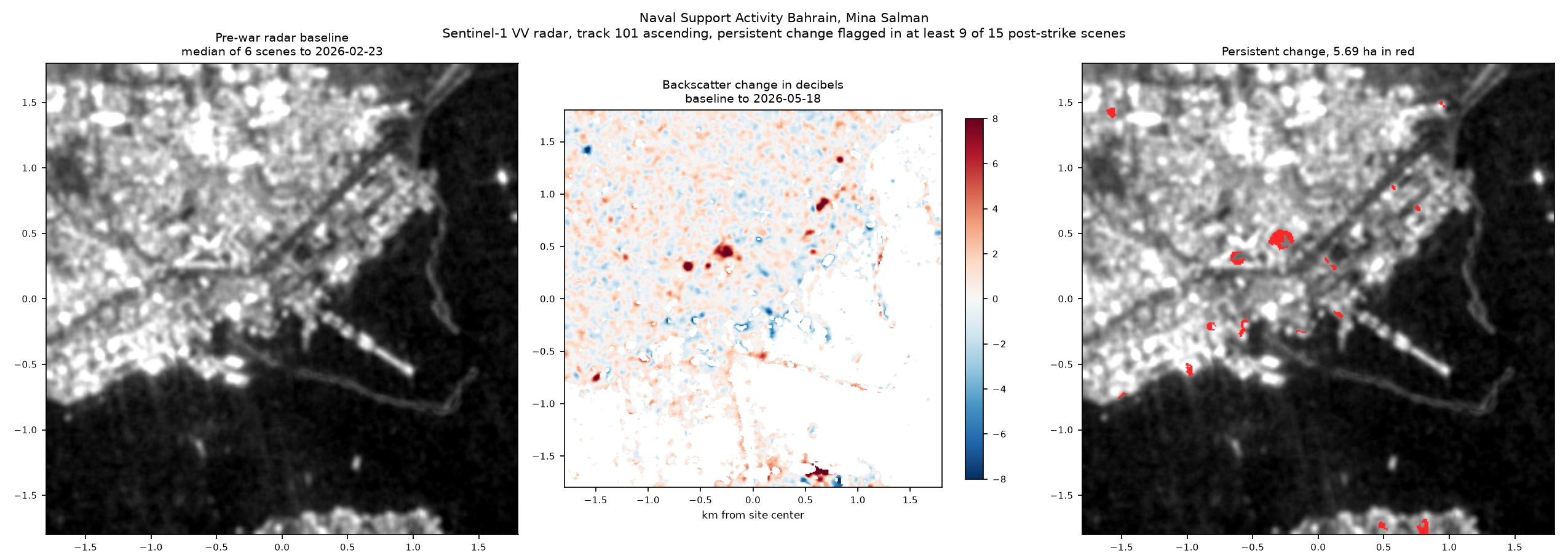
Every finding below was measured twice, from two different satellite orbits, and reported only where both agreed. The results that hold up under those 2 independent viewing geometries:
| Site | Persistent change in built-up footprint | Second track | Reading |
|---|---|---|---|
| Naval Support Activity Bahrain | 8.65 ha, 2.0% of built-up area | 5.69 ha, 1.3% | Compact patches sitting on structures, consistent with the reported destruction of the command center and surrounding buildings |
| Ali Al Salem, Kuwait | 8.50 ha, 6.2% of built-up area | 3.31 ha | Highest proportional change of any site measured |
| Al Udeid, Qatar | 2.21 ha | 1.72 ha | Change concentrated in the cantonment area, not on the runways, consistent with a strike on the operations center rather than the airfield |
| Isa Air Base, Bahrain | 1.21 ha | 1.29 ha | Both geometries agree at a site with no published confirmed damage and no available post-cutoff commercial imagery |
| Camp Arifjan, Kuwait | 2.00 ha | 0.30 ha | Change present, magnitude unresolved |
| Muwaffaq Salti, Jordan | 1.71 ha built-up | 18.16 ha unrestricted | The large unrestricted figure falls on open ground rather than buildings, the signature expected from the destruction of a radar and launcher array |
| Prince Sultan, Saudi Arabia | 0.71 ha | not measured | Small, consistent with the loss of a single aircraft and its immediate surroundings |
Al Dhafra in the United Arab Emirates returned the largest raw figure in the study, 27.05 hectares on 1 track and 8.93 on another, and has been thrown out. Free Sentinel-2 optical imagery from 24 February and 27 April 2026 shows that change footprint sitting on the base perimeter, exactly where new irrigation ponds and spring vegetation appear between the 2 dates, and not on the runways, aprons or hangars. Seasonal ground cover moves radar backscatter the same way structural damage does. Al Dhafra is excluded, which is what a cross check is for. Erbil, Shuaiba Port, Camp Buehring and Tower 22 are also excluded, for reasons set out in the note at the end.
Every surviving site was then put through the same optical test that removed Al Dhafra, and every one of them passed. Camp Arifjan carries the strongest seasonal signal in the set, Kuwaiti winter grass green in February and burned off by May, and none of the radar change falls on it: all 2.00 hectares sit inside the cantonment. At Isa, a large wet area spreads across the salt flat to the southwest and the radar ignores it, clustering on the buildings west of the runway. At Al Udeid the irrigated patches are on the western edge and the change is on cantonment structures to the east. Prince Sultan and Ali Al Salem show no seasonal signal at all.
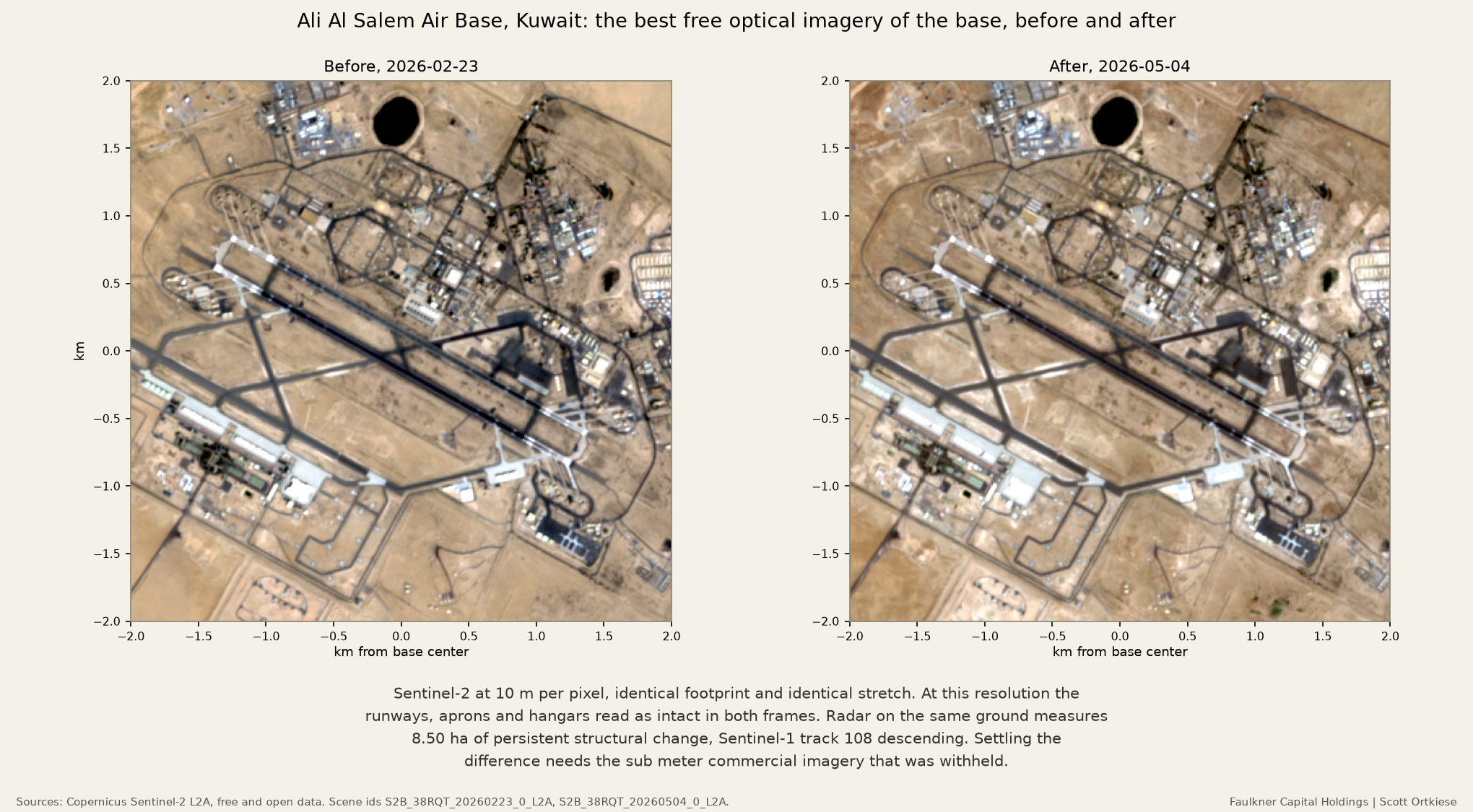
The honest summary of the radar work is narrower than the reporting it corroborates and harder to argue with. At Bahrain, Ali Al Salem, Al Udeid and Isa, structural change is measurable, repeatable across viewing geometries, absent from the prewar control, and not attributable to seasonal ground cover. Isa is the finding that matters most, because there is no published damage assessment for Isa at all, and no commercial photograph of it after 9 March 2026.
The casualty count that would not stay still
On 22 July 2026, the Defense Casualty Analysis System, the Pentagon’s public casualty database, showed 18 US service members killed and 482 wounded. On 23 July 2026 it showed 14 killed and 420 wounded. Four deaths and 62 wounded had disappeared overnight.
The 4 removed deaths had names: Sergeant Angel Rampersad, Private First Class Isabella Gonzales, First Lieutenant Tyler Feehan, Sergeant Michael Emmanuel Swinton. All 4 were killed in Jordan and Iraq after the fighting resumed in July. Two of them had been described in a Pentagon press release as supporting Operation Inherent Resolve; the Pentagon website was later changed to say they were supporting overseas operations in Jordan.
Over the weekend of 25 to 26 July the database restored the 4 deaths and added more than 140 wounded, but placed them in a newly created category called Overseas Operations, covering casualties beginning 7 July 2026, rather than under Operation Epic Fury. The effect was to split a single continuous war into 2, keeping the headline Epic Fury figures at 14 killed and just over 400 wounded while the combined total since 28 February stood at 18 killed and 624 wounded (ABC News, The Guardian, CNN).
Representative Thomas Massie described the arrangement on 23 July: “The Pentagon is pretending there have been two Iran wars separated by a brief cease-fire.” He called it an absurd ruse and said that by passing 90 days without congressional authorization, Hegseth was breaking the law. Senator Mazie Hirono and 11 other Senate Armed Services Committee Democrats wrote to Hegseth the same day: “The American people, Congress, service members, and their families are entitled to a full and accurate accounting of the human costs of war.” Governor Kathy Hochul of New York, on the removal of Sergeant Rampersad’s name, said: “The Trump administration does not get to revise the human cost of this war because it has become politically inconvenient. Sgt. Rampersad gave her life in service to this country. Changing a website does not rewrite the truth of her sacrifice” (ABC News).
The real numbers were always larger than the published ones. Defense Department records obtained by The War Horse under the Freedom of Information Act showed more than 400 recorded casualties between 28 February and 8 April 2026, at least 17 of them life threatening, and at least 170 troops with head trauma by early April (The War Horse). By 30 July the Defense Department reported 653 wounded since the war began, with traumatic brain injury the leading injury (ABC11). By 6 August, public statements from military officials put the figure at nearly 700 wounded, most of them with traumatic brain injuries (PBS NewsHour).
Traumatic brain injury is the signature wound of this war because the weapon is the blast wave, not the fragment. A ballistic missile or a drone detonating against a hardened building transmits overpressure through the structure into everyone inside it, which is why 2 general officers and a colonel were concussed in a single strike at Port Shuaiba.
Sean Parnell, the chief Pentagon spokesman, characterized nearly 100 injuries as minor concussions and said 96% of those affected returned to duty. Senator Tammy Baldwin described the same population differently: “I spoke directly with Wisconsinites who sustained traumatic brain injuries from Trump’s war in Iran and went weeks without so much as a screening, let alone specialized care, for their injuries” (PBS NewsHour).
The arsenal they spent, and the shortage they called false
The bases were not the only thing consumed. Holding the line over them burned through munitions the United States cannot quickly replace, and the administration’s response to the resulting shortage was to deny it.
The expenditure is documented system by system. Patriot PAC-3 MSE interceptors cost about $4 million each. Between 28 February and 8 April 2026, roughly 1,060 were fired, about 43% of the prewar stock. By 11 August the New York Times put the running total at over 1,500 fired with fewer than 1,700 remaining. American Patriot batteries averaged more than 31 launches a day across the 39 day first phase, a rate that would have emptied the entire prewar stock in about 75 days of sustained fire. On 11 August alone, about 50 Patriots were fired, roughly $200 million of interceptors in 24 hours. In the Jordan engagement of 8 to 9 September, about 30 more went out, roughly $120 million (Small Wars Journal, Washington Post, JINSA, Reuters).
THAAD interceptors cost about $15.5 million each. CNN reported on 4 August that the prewar inventory of 452 was nearly 80% used. SM-3 interceptors cost about $28.7 million each and roughly half the stock of 410 went. SM-6 at about $5.3 million each lost nearly a third of 1,160 (CNN, Small Wars Journal).
The Los Angeles Times reported that combined Patriot and THAAD inventory fell from about 2,800 to about 1,100 by the end of July, roughly 60% depleted. Patriot production runs at about 620 a year and restoring the stock takes at least 3 years. THAAD production runs at 96 a year against a planned 400, and restoring that stock takes at least 4 (Los Angeles Times).
What was traded for that expenditure was a roughly 90% intercept rate at American bases, which still left about 10% leakage, and CSIS assessed that across all incoming munitions the interception rate was 40% to 60%. Lieutenant General John Rafferty, commander of Army Space and Missile Defense Command, said on 11 August that the United States had neutralized 1,200 Iranian missiles and drones since February. The Wall Street Journal estimated Iran launched roughly 1,700 ballistic missiles and one way drones in the first phase alone (CSIS, JINSA, Small Wars Journal).
The physical losses are separately catalogued. The Washington Post identified at least 228 damaged or destroyed items, 217 structures and 11 pieces of equipment, across 15 American sites between 28 February and 14 April. Patriot equipment was hit at Riffa and Isa in Bahrain and at Ali Al Salem in Kuwait. THAAD radar and equipment were destroyed at Muwaffaq Salti in Jordan and at 2 sites in the United Arab Emirates, Al Ruwais and Al Sader. Satellite communications sites were hit at Al Udeid. The power plant was hit at Camp Buehring, a radome at Camp Arifjan, a radome and buildings at Naval Support Activity Bahrain, and an E-3 Sentry, a tanker and a THAAD radar tent at Prince Sultan. Fuel storage was destroyed at 5 fuel bladder sites across 3 bases. Al Jazeera and the BBC put the number of damaged American sites at at least 20 (Washington Post, Al Jazeera).
Only 13 AN/TPY-2 radars have ever been delivered to the United States, which is why the destruction of 1 at Muwaffaq Salti is not an equipment writeoff but a capability subtraction (Small Wars Journal, CSIS).
The carriers paid in a different currency. The USS Abraham Lincoln left San Diego in November 2025 on a planned 7 month deployment, was extended twice, and reached 269 days, including 200 consecutive days at sea without a port call, flying more than 10,000 sorties. Former Pentagon comptroller Elaine McCusker put the cost at about $5.5 million a day, nearly $1.5 billion for the deployment. Jennifer Kavanagh of Defense Priorities put the contingency figure as high as $12 million a day. Reporting described shortages of food, parts and mail, a crew mental health crisis, and 2 sailors going overboard (Newsweek, Financial Express). Hegseth extended the deployments of approximately 50,000 American personnel in the region into 2027 (2026 Iran war). By 17 August 2026 there were no American carriers in the Asia-Pacific at all (Stars and Stripes).
Against every one of those numbers, the official line was that there was no problem. President Trump said in July that the United States has “far more munitions than anyone in the world.” Pentagon spokesman Sean Parnell called shortage claims “false” and asserted a “deep, ready arsenal” (Los Angeles Times, Axios).
The Pentagon did not dispute the CSIS figures it was calling false (Los Angeles Times). Meanwhile a US defense official described the shortfall left for European defense as “beyond critical,” and a Heritage Foundation analysis concluded the Pentagon’s missile inventory would run out “within the first week of a Taiwan conflict” (Los Angeles Times, Boston Globe).
That is the accounting the phrase “accomplished every single goal” was built to cover. More than 600 Patriots had already gone to Ukraine before this war started. What the Gulf campaign spent was not a surplus. It was the stock held against a war with China, and the people who spent it have told the public there is nothing to discuss.
The strait that is still Iran’s
The Strait of Hormuz is the 21-mile-wide channel between Iran and Oman through which roughly a fifth of the world’s oil moves. Before the war, 120 to 140 ships a day transited it, carrying about 20 million barrels of oil a day. The United Nations Conference on Trade and Development measured the immediate prewar rate precisely: an average of 141 transits a day from 1 to 27 February 2026 (UNCTAD).
What the President said about it, in sequence:
- 10 August 2026: “The only one that has control of the Strait of Hormuz right now is the United States Navy. We have a blockade that’s been infallible. It’s a steel wall. We control the Strait, 100%.”
- 12 August 2026, on Truth Social: “The U.S.A. has total control over the Strait of Hormuz. I THINK WE WILL KEEP IT! Our Naval Blockade is being called, by everyone, ‘A WALL OF STEEL,’ and there is nothing Iran can do about it.”
- 12 August 2026, to reporters: “They don’t have control. We have total control. We own it, and at some point, maybe they’ll do something, and then they get blown away.”
- 14 August 2026: “In the true sense, we own the Hormuz Strait, and we only allow boats to come in if we want them to come in.”
- 17 August 2026: “The Strait is open.”
- 27 August 2026: “Iran is not getting anything; nothing is going through.”
On 29 August 2026 the White House published a release titled “President Trump Was Right: America Controls the Strait of Hormuz” (whitehouse.gov, Reuters, CNN).
What the traffic data showed over the same period. On 11 August 2026, 8 ships transited. On 12 August, the day of the total control post, the 10-day average was about 12 ships a day. On the Tuesday of that week, 14 vessels crossed (Al Jazeera, CNN). Lloyd’s List Intelligence recorded 25 transits by ships with no Iranian link in the week of 13 to 19 July, down from 108 the week before, and 39 in the week of 20 to 26 July. August 2026 was a post-conflict record, with at least 346 transits by non-Iranian-linked vessels in the month and a weekly average of 78, roughly 11 ships a day. Lloyd’s List wrote that the increase “does not indicate a broad return to pre-conflict trading patterns” (Lloyd’s List Intelligence). The 78 figure, the best week-average of the war, is about 92% below the prewar norm.
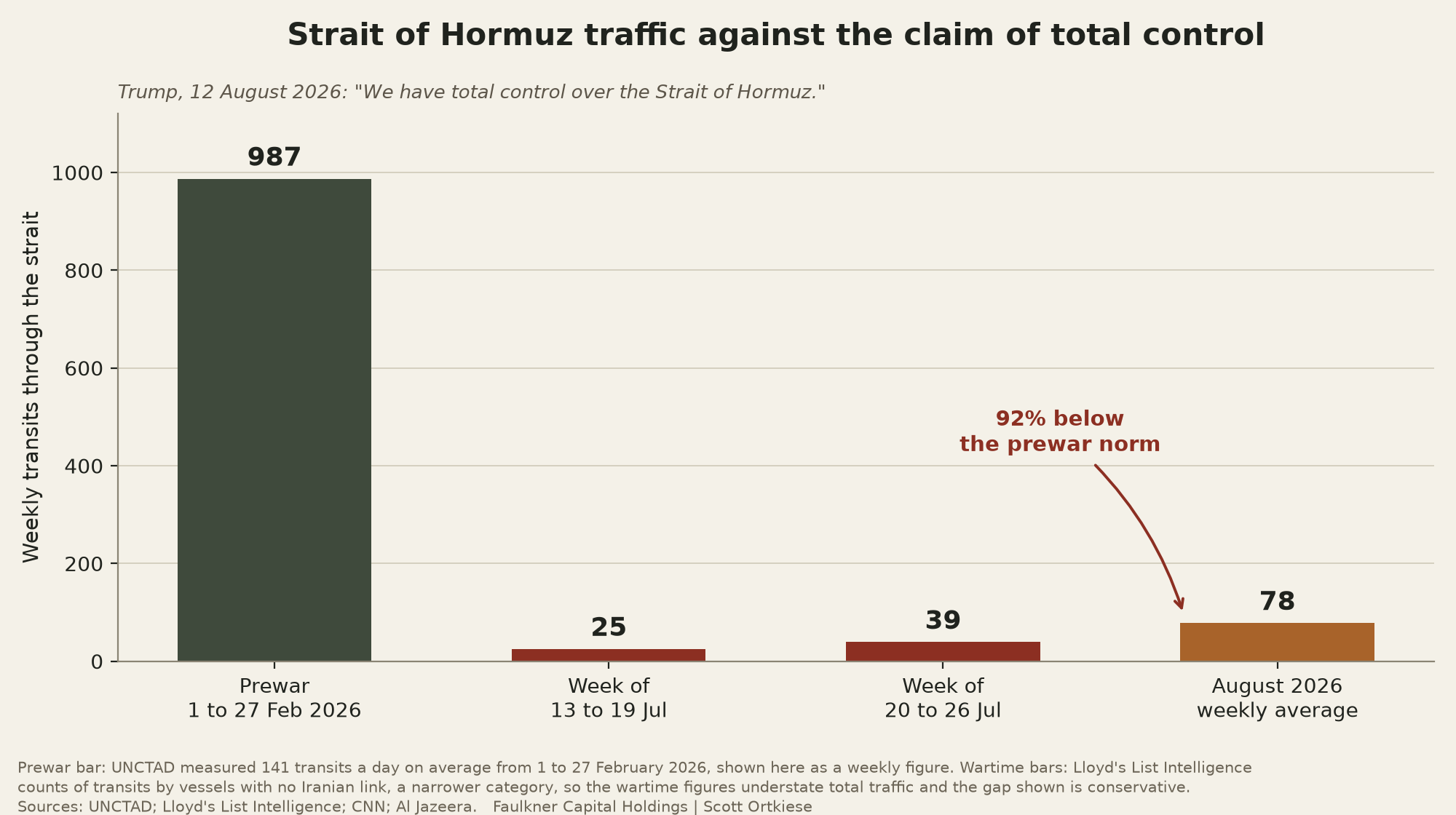
On 27 August, Admiral Brad Cooper of Central Command said, “Internationally recognized transit routes in the strait are free of Iranian sea mines” (The Hill). On 1 September, the US Navy led Joint Maritime Information Center advised that traffic remained far below baseline, rated the risk severe, warned of the continued risk of drifting or uncharted mines, and noted that the majority of late-August crossings were dark, meaning the vessels had switched off their automatic identification transponders (Al Jazeera). Ships that believe they are protected do not run dark.
Carl Schuster, former director of the Joint Intelligence Center at US Pacific Command, gave the operational definition: “Until you can ensure safe use of the strait, you do not have total control” (CNN).
Iran, for its part, has been administering the strait as a jurisdiction. Its Persian Gulf Strait Authority publishes a list of banned vessels, about 56 ships after 11 were added, requires Iranian clearance and payment for transit, and has threatened blacklisted tankers with fines, detention and cargo confiscation. On 6 September 2026, Mohsen Rezaei, secretary of Iran’s Supreme National Security Council, announced a restricted zone extending from the line of the US naval blockade into the Gulf, along with a new shipping corridor through the strait, to remain in force as long as the blockade does. Rezaei stated the terms: “We will only commit to the Strait of Hormuz being open when they stop the sabotage, threats and attacks on Iran” (Reuters, Reuters, Institute for the Study of War).
A country with no navy does not issue transit permits.
It also does not fire on warships. On 5 September 2026 the Islamic Revolutionary Guard Corps Aerospace Force launched ballistic missiles at a US aircraft carrier and a destroyer enforcing the blockade. The missiles missed and caused no casualties. Central Command disabled 2 Iranian oil tankers and destroyed a third in response. On 8 and 9 September, after the Guard targeted a US warship with ballistic missiles twice in 2 days, Central Command destroyed 5 Iranian crude oil carriers, the Kaviz, the Charminar, the Horizon 1 and the Riesco in the Gulf of Oman, and the Derya near Kharg Island. Iran’s parliament speaker, Mohammad Baqer Qalibaf, replied on 7 September: “Strike our assets and you get struck. It’s simple: the oil and gas production chain here is sprawling, accessible, and exposed. American oil and gas companies across these waters and facilities share that exposure” (CENTCOM, Al Jazeera, Reuters).
The blockade does work in 1 measurable direction. Iranian crude stored on vessels outside it fell from roughly 90 million barrels in mid-July to about 29 million barrels by 7 September (Institute for the Study of War). Iran is being strangled. It is not being controlled, and the strait is not open.
Who the Houthis are
Most Americans first heard the word Houthi in connection with attacks on ships in the Red Sea, with no idea who was firing. The group is not a new militia and not an Iranian invention, and understanding what it actually is explains why 11 years of Saudi and American bombing has not dislodged it.
The movement’s formal name is Ansar Allah, which translates as Supporters of God or Partisans of God, adopted in 2011. Houthi is a family name. The movement comes from the Zaydi branch of Shia Islam, which exists almost exclusively in Yemen and is doctrinally distinct from the Twelver Shiism practiced in Iran. Zaydis are sometimes called Fivers, after a difference over the line of succession from the Prophet’s family. They make up roughly 34% of Yemen’s population against a Sunni majority of about 65%, and they are concentrated in the northern highlands. Zaydi imams ruled Yemen for approximately 1,000 years, until a revolution in 1962 ended the imamate (Middle East Research and Information Project, Combating Terrorism Center at West Point).
This is the part that gets lost. The Houthis are not Hezbollah. Unlike the Lebanese movement, they do not accept Iran’s supreme leader as their ultimate religious authority, and Houthi figures have publicly criticized Iranian Twelver doctrine. The relationship with Tehran is an alliance of interest and supply, not a chain of command (The Economic Times).
The movement began as a revival. In 1992, in the northern governorate of Saada, Hussein al-Houthi founded the Believing Youth, in Arabic Muntada al-Shabab al-Mu’min, a network of religious summer camps that at its height drew 15,000 to 20,000 young Yemenis. It grew in direct competition with Saudi-funded Salafi proselytizing in the same region, centered on the Dar al-Hadith institute founded in the early 1980s by Muqbil al-Wadi’i, a Yemeni Zaydi who converted to Salafism after being radicalized in Saudi Arabia. Riyadh paid to plant a rival creed in the Zaydi heartland, and the Believing Youth was the answer. The slogan the movement adopted in late 2000 was “Death to America, Death to Israel, Curse upon the Jews, Victory to Islam” (Combating Terrorism Center at West Point, Middle East Research and Information Project).
Then came the wars. Between 2004 and 2010 the Houthis fought 6 separate rounds against the government of President Ali Abdullah Saleh. Hussein al-Houthi was killed in September 2004, and his brother Abdul Malik al-Houthi has led the movement ever since, commanding what is now a force of tens of thousands. In 2009 and 2010 the fighting crossed into Saudi Arabia itself, and the Houthis held their own against the Saudi military on Saudi ground. That is the storied past: Riyadh has been trying to subdue this movement for 17 years and has never managed it (Combating Terrorism Center at West Point, The Economic Times).
After 2012 the Houthis allied with Saleh, the man who had spent 6 years trying to destroy them, and used the alliance to take the capital, Sanaa, on 21 September 2014. In 2017 they killed him. On 26 March 2015, a Saudi led coalition launched Operation Decisive Storm to reverse the takeover, with American logistical, intelligence and munitions support. It failed. The United Nations Development Programme estimated 377,000 deaths in Yemen from 2014 through the end of 2021, about 154,000 of them direct combat deaths and the remainder from hunger, disease and the collapse of health care. A United Nations brokered truce took hold in 2022 (Al Jazeera, France 24, Deutsche Welle).
Along the way the Houthis demonstrated reach that had nothing to do with Yemen’s borders. On 14 September 2019, drones and cruise missiles struck the Abqaiq and Khurais oil processing facilities in eastern Saudi Arabia and briefly removed about half of Saudi oil production from the market. From November 2023 they attacked commercial shipping in the Red Sea in connection with the war in Gaza, and from 12 January 2024 the United States and the United Kingdom began striking Yemen in response. The United Nations Panel of Experts on Yemen has documented Iranian technical assistance, training, weapons and financial support throughout (United Nations Panel of Experts report).
So the Iranian connection is real: Tehran supplies the missiles, the drone technology and the money, and the Houthis supply the strategic geography and the willingness. What Tehran does not supply is the motive. The Houthis fight Saudi Arabia because they have been fighting Saudi Arabia since before most Americans had heard of them.
What the Houthis did next
On 21 July 2026, in the Oval Office, the President said: “we’ve done that with the Houthis before, and we haven’t heard from them in a while.”
On 8 September 2026, Houthi ballistic missiles and drones struck the southern Saudi cities of Abha, Khamis Mushait, Jazan and Najran. Seventy-three people were wounded, including women and children. Fires were set at oil facilities and utilities, operations halted at several energy facilities, and Saudi Arabia shut a pipeline. Houthi spokesman Yahya Saree said the offensive targeted Saudi Aramco facilities at Abha, Najran and Jizan along with an air base at Khamis Mushait. Colonel Turki al-Malki, spokesman for the Saudi led coalition, called the escalation dangerous and said, “The coalition will take all necessary operational measures to deter this terrorist militia and resolutely confront its hostile approach.” Brent crude rose $1 to $98 a barrel and US crude rose more than $2 to $93.65 (Reuters, Deutsche Welle).
On 10 September the Houthis seized the Red Sea port city of Mocha. On 11 September they took Mayun island, also known as Perim, in the middle of the Bab al-Mandeb Strait, as Yemeni government forces withdrew. Perim is 13 square kilometers of volcanic rock that splits the strait into 2 navigable channels, and holding it means holding the chokepoint. The movement now controls Yemen’s entire western coastline, including Dhubab and Zuqar, and claims 5,400 square kilometers seized. On 13 September a Houthi projectile hit al-Tuwal in the Jazan region, damaging a mosque and wounding 2 people (Reuters, The Economic Times).
The entire advance took 36 hours.
The Bab al-Mandeb is the 18-mile-wide strait between Yemen and Djibouti through which everything moving between the Mediterranean and the Indian Ocean must pass, by way of the Suez Canal. Its closure would constrain roughly 7% of global petroleum supplies and about 12% of global trade. Edmund Fitton Brown, the former British ambassador to Yemen, said what should have been obvious: “It should have been obvious that Bab Al Mandab and the Strait of Hormuz are linked to each other” (The Economic Times).
Two chokepoints. One hostile alliance. Both ends of the same shipping route. And the second one was the workaround for the first: since the war began, Saudi Arabia has been re-routing some of its exports through the Bab al-Mandeb specifically to avoid Hormuz (CNN). The Houthis took the bypass.
Nobody can say they were not told
The claim that the Houthis had gone quiet was not a reasonable reading of ambiguous information. It was contradicted in public, under a byline, 4 months before it was made.
On 16 March 2026, Fatima Abo Alasrar, a senior analyst at the Washington Center for Yemeni Studies who writes at The Ideology Machine, published an assessment of what the movement was actually doing while its missile capacity degraded. Her answer: “So what are they doing instead? Building a ground army.” She documented military training courses branded as Al-Aqsa Flood programs running “across every governorate in northern Yemen,” pulling from ministries, universities, hospitals and telecom companies. She was explicit about what kind of force it was: “This is not a missile force. It is infantry.” And she separated the noise from the movement: “The rhetoric points seaward. The mobilization points landward” (The Ideology Machine).
That was published 4 months and 5 days before the President said, “we haven’t heard from them in a while.” On 12 September, after Perim fell, Abo Alasrar wrote that the advance “is playing out exactly as they scripted it, and it should come as no surprise,” and that what unfolded “was built in plain sight” (The Ideology Machine).
The people who lost the ground said the same thing. Mohammed al-Basha, a risk analyst covering the Arabian Peninsula, told CNN: “I think everybody was aware of the Houthis’ push towards the west coast. The writings on the wall were very clear.” He also described why the awareness produced nothing: “There is no political cohesion,” and “There’s no united command and control in Yemen” (CNN).
How Mocha actually fell
The collapse was not a Houthi military triumph over a defended position. It was a defended position that turned out not to exist.
Houthi fighters reached Mocha on Thursday 10 September and found Yemeni battalions whose rosters were “filled with ‘ghost names’ receiving salaries,” with actual strength “only about 20% of what it was on paper,” according to a Western source with knowledge of the operations. A senior Yemeni source attached to the government’s military forces described the assault: “The Houthis committed everything they had, waves upon waves of fighters, along with their available ballistic missiles and weapons.” He said he had warned US Central Command repeatedly over the preceding days that the situation was becoming critical, and that Central Command assured him the United States was watching closely and that Saudi air support was coming. His account of what happened next is 2 sentences: “But the air support never came. And Mocha has now fallen” (CNN).
A regional source told CNN there was “not one air strike throughout the day yesterday” by Saudi support forces, “although there were minute-by-minute updates.” The Saudi military had been placed on high alert 3 weeks earlier and, according to a Western source, “never deployed the necessary service personnel to control and direct combat aircraft in the event of a serious attack.” That source’s summary: “The Saudis threw the Yemenis under the bus.” The regional source’s summary: “The failure this time is not with the Yemenis. It’s a disaster made in DC and Riyadh,” and “It’s a Saudi-American f**k up of epic proportions” (CNN).
More than 100 US military advisers had been sent to Saudi Arabia to provide intelligence and targeting support for the campaign, with total US personnel in the kingdom estimated at roughly 200 troops. The United Arab Emirates, which had supplied the ground forces that held this coast for years, withdrew its remaining troops from Yemen in January 2026, and nobody filled the gap. Amr Al-Bidh, the top official of Yemen’s Southern Transitional Council, described the arithmetic: “It doesn’t make sense. I mean, you have the main backer of the militaries on the ground, who are really doing all of this work for 10 years, and suddenly you ask them to leave, and you don’t fill that vacuum.” He called it “just lack of strategy and poor management” (CNN).
On the significance of what was lost, Al-Bidh was blunt about how little it now takes to close the strait: “They don’t need to use advanced weapons to close Bab al-Mandeb. They can just use a cannon on a car.” He added, “It’s a leverage that they have without using advanced weapons. And they will keep it” (CNN).
An adviser to Iran’s supreme leader called the advance a clear victory and wrote that “the American people and Washington’s allies are paying the price for the economic crisis and Trump’s ambitions” (CNN).
On Thursday 10 September 2026, as Mocha was falling, Crown Prince Mohammed bin Salman spoke with the President twice and urged him to strike the Houthis. The President declined. Washington said it would not intervene directly for now but would assist with intelligence (CNN, Reuters). A senior administration official said the United States was focused on “ensuring freedom of navigation in the Red Sea while empowering our regional partners to take the lead in managing and resolving regional security challenges” (Reuters).
“Empowering our regional partners to take the lead” is what an administration says when the ally it armed asks for help twice in one day and the answer is no both times. Saudi Arabia has spent 11 years and an enormous amount of American ordnance failing to subdue this movement, and the movement has just taken the strait.
Two days later, on Saturday 12 September, the President explained the refusal himself: “The Houthis called us, and they let us know that they don’t want to fight with us. They don’t want me to go after them.” He added that the Houthis were letting most ships through, that there was “one country that they’re not too happy with,” and that he would “get that straightened out” (Middle East Eye).
Take the components separately.
The movement the administration said it had not heard from in a while is described by the President as having initiated contact with the United States in order to establish that it does not wish to fight. That is not the posture of a defeated force. It is the posture of a force that has taken what it came for and is now setting terms.
The phrase “one country that they’re not too happy with” is the President of the United States characterizing Saudi Arabia as a third party grievance to be managed, 48 hours after declining its Crown Prince twice in a single day. The offer to get it straightened out was made to reporters rather than to Riyadh.
And “letting most ships through” concedes the whole question. Ships do not pass the Bab al-Mandeb because the United States Navy controls it. They pass because Ansar Allah permits it. The word “letting” was the President’s own.
The kingdom then ran the campaign by itself. The Houthis claim 129 Saudi air strikes across 7 Yemeni provinces in 48 hours, a figure Al Jazeera’s own count put at more than 100 over the same period, following 54 strikes in 12 hours on 9 September (Yeni Safak, Al Jazeera, Al Jazeera). Eleven years of that campaign, flown with American munitions and American targeting support, had already failed to dislodge the movement from the northern highlands. It is being run again now, without American aircraft, against a movement that has since acquired the coastline.
Then the overland bypass went down too
Saudi Arabia had a third route out, and it was the one that was never supposed to be vulnerable. The East to West Crude Oil Pipeline, known as Petroline, runs roughly 750 miles across the Arabian peninsula from the Abqaiq processing complex on the Gulf coast to the Red Sea port of Yanbu. Its design capacity is about 7 million barrels a day. Its entire strategic purpose is to move Saudi crude to market without entering the Strait of Hormuz at all (CNBC).
Since the war began the kingdom had been pushing about 5 million barrels a day through it, for one reason. CNN stated the reason without qualification: Saudi Arabia rerouted that volume to Yanbu “because Iran had effectively shuttered the Strait of Hormuz” (CNN). That sentence, published by a major American network on 11 September, is the operative fact of this section. The administration says the United States has total control of the strait. The largest oil exporter in the Gulf had spent 6 months rebuilding its export logistics on the assumption that the strait was closed.
On the morning of 10 September 2026, several drones struck pump stations along the pipeline in the Riyadh and Medina regions. Several people were injured. Saudi Arabia shut Petroline down as a precautionary measure, confirmed on 11 September (CNN, CNBC).
The drones did not come from Yemen. Saudi Arabia’s Ministry of Foreign Affairs said the pipeline was attacked by “several drones coming from Iraq.” The office of the Iraqi Prime Minister said its own investigation confirmed the launch point was in Maysan Governorate in southern Iraq, and Iraqi security forces located drone launchers at al-Tib, near the Iranian border (Middle East Eye). Asked whether Iran was behind it, the President said, “I think they are, probably they are” (CNN).
That answer deserves to be held still for a moment. Six months after declaring Iranian military capability destroyed, the President of the United States attributed a successful strike on the most important piece of oil infrastructure in Saudi Arabia to Iran, in the form of a guess.
Then came the pictures, and they followed the pattern the bases had already established. Satellite imagery of the damage to Petroline was distributed commercially through Getty Images on 13 September and reported the following day (CNBC). A commercial vendor published the damage. No American department did.
So count the routes out of the Gulf. Hormuz, the primary artery for a fifth of the world’s oil, running roughly 92% below its prewar rate and administered by an Iranian transit authority that issues clearances. The Bab al-Mandeb, the alternate sea route Riyadh turned to when Hormuz closed, with the island that splits its navigable channels in Houthi hands as of 11 September. Petroline, the overland route built precisely so that neither strait would matter, shut down on 11 September after drones flew out of Iraq. Three ways out. Between 10 and 11 September 2026, a span of 48 hours, all 3 were closed, contested or taken offline.
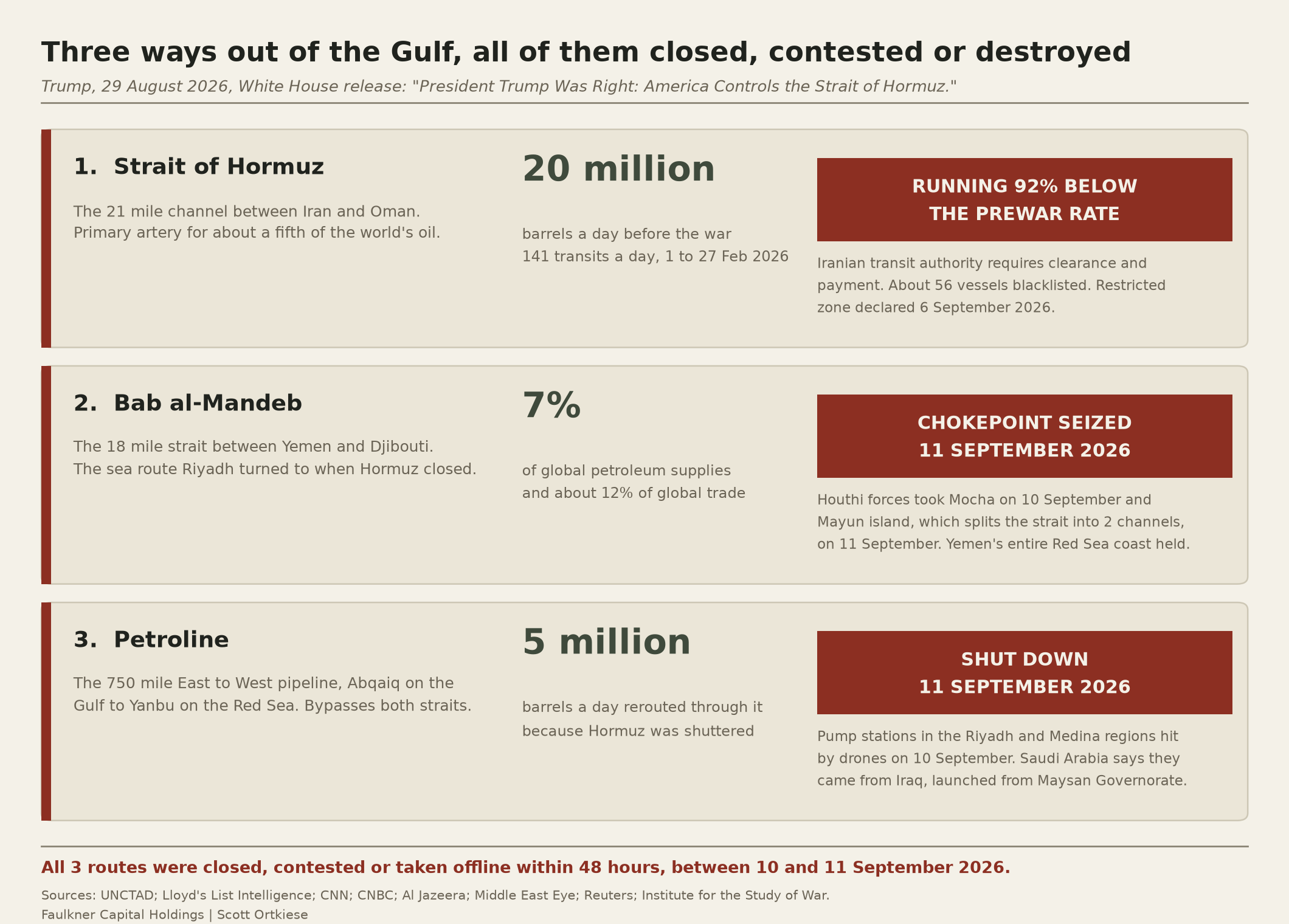
This is the practical content of the claim that every single goal was accomplished. The stated goal, repeated from the podium for 6 months, was freedom of navigation and the elimination of Iran’s capacity to threaten it. What exists instead is a Gulf in which the primary strait requires Iranian clearance, the secondary strait is held by an Iranian aligned movement, and the pipeline that was built to bypass both was taken offline by an Iranian aligned militia firing from a third country.
The nuclear program that was obliterated
On 13 February 2026 the President described the objective as “achieving total obliteration of the Iran nuclear potential capability, totally obliterated.” At a NATO summit in Turkey during the week of 9 July he said, “I call it, we denuclearize Iran. And that’s happened; they will never have a nuclear weapon” (CNN, Al Jazeera).
Before the attacks, the International Atomic Energy Agency had accounted for 440.9 kilograms of uranium enriched to as much as 60%. That is a short technical step from weapons grade. More than 200 kilograms of it is believed to remain at a single site, which is enough material for approximately 10 weapons, and the agency cannot verify any of it. Director General Rafael Grossi wrote in his report of 1 September 2026: “The Agency’s lack of information about these facilities and associated nuclear material and our inability to conduct verification activities at these facilities is a matter of serious proliferation concern” (Reuters, Institute for Science and International Security).
On 9 September 2026 the IAEA Board of Governors referred Iran to the United Nations Security Council for non-compliance, by a vote of 23 in favor, 3 against and 8 abstentions. It was the first such referral in 20 years (Al Jazeera, NPR).
Satellite imagery reviewed by CNN in late May 2026 showed Iran using bulldozers and dump trucks to reopen buried entrances to underground missile sites (CNN).
A program is not obliterated when 200 kilograms of 60% enriched uranium is unaccounted for and the inspectors are locked out.
How the omissions were arranged
An administration cannot maintain a claim this far from the measured record without controlling who gets to measure. That control was built deliberately, and a federal judge has said so in a ruling.
On 20 March 2026, Judge Friedman of the US District Court for the District of Columbia struck down the Pentagon’s press credentialing policy as a violation of the First Amendment, finding that “the undisputed evidence reflects the Policy’s true purpose and practical effect: to weed out disfavored journalists.” On 9 April 2026 he found that the Department’s revised policy continued to flout that order (Politico, Associated Press).
The sequence he was ruling on: in January 2026 the Defense Department stripped Pentagon workspaces from credentialed outlets including The New York Times, CNN, Politico, NBC and NPR, and reassigned them to Breitbart, One America News Network, the New York Post and HuffPost, the last of which did not have a Pentagon correspondent. In May, Hegseth further restricted the areas of the building open to reporters. In September, the Department announced it would credential journalists only if they pledged not to publish information the Pentagon had not approved for release. Nearly every major outlet refused, surrendered its credentials, and was replaced by commentators and influencers friendly to the administration (Poynter).
Then the war began, and the restrictions tightened around it specifically. Photographers were admitted to the first Pentagon press conference after the attack on Iran, including those from Bloomberg, the Associated Press, Getty Images and Reuters. They were barred from every briefing after that. When Pentagon officials invited the replacement press corps to a briefing, they had to arrange a pool camera for the television networks after discovering, as the Pentagon Press Association’s attorney David Schulz put it, that “none of those individuals could effectively disseminate information to TV networks and others as they lacked a camera” (The New York Times). By late July the Pentagon had not held a press briefing in 2 and a half months (The Guardian).
The New York Times reported on 12 September 2026 that the apparatus now extends well past access. The Justice Department has sent FBI agents to reporters’ homes to serve subpoenas, and in at least 1 case agents flashed a warrant to seize devices. The Pentagon fired the editor and publisher of Stars and Stripes, traditionally an independent newspaper for the armed forces, and blocked access to journalists who refused to sign pledges limiting their reporting. Regulatory agencies have used their authority to pressure media organizations over content. Funding has been stripped from public television and radio. The White House has taken control of the previously independent press pool that covers the President and now decides which outlets may participate. Poynter, tracking this since the start of the term, has documented more than 100 federal actions affecting journalists and access to news, with more than 15 lawsuits filed in response (The New York Times, Poynter).
The people who have run wars said what this was for. Leon Panetta, former Secretary of Defense and CIA Director, who held weekly Pentagon briefings during Afghanistan and Iraq: “There’s a deliberate effort here to basically withhold information from the American people, and I think it represents in many ways a shameful approach to sharing the responsibility that we all have when it comes to fighting a war.” He added that officials were “trying to tiptoe past the graveyard, so to speak, in the sense that they’re hoping that the less they say, the less controversy they’ll be involved in,” and that “they can dodge, bob and weave, they can hide it, but my experience is that no matter how much you try to hide it, in the end the truth comes out” (The Guardian).
Ned Price, former State Department spokesman, named the object: “This goes beyond a run-of-the-mill administration distrust toward and hostility against the press. This is more about shielding the American people from the true and total cost of this war.” He continued: “But what they don’t know, unless they’re really digging, is the full extent of casualties that our men and women in uniform have suffered as a result of this decision to take our country to war without clear objectives and certainly without a clear off-ramp” (The Guardian).
Mark Schoeff, president of the National Press Club: “What is happening at the Pentagon is unique in my 34 years in Washington. We’ve not seen these kinds of restrictions on the media at the Pentagon. Even during Desert Storm and the war in Afghanistan, I can’t recall a time when the Pentagon tried to shut down press access like this” (The Guardian).
Clayton Weimers of Reporters Without Borders: “I don’t think it’s an exaggeration to say this Pentagon has been more hostile to the news media than any other Pentagon in recent memory” (The Guardian).
Janessa Goldbeck of the Vet Voice Foundation put the timing in political terms: “We deserve to know exactly what’s happened and it raises questions about why they wouldn’t be reporting these casualties in a timely manner. My assumption is that it’s about controlling the political narrative before a major national election” (The Guardian).
The Pentagon’s answer, through Parnell: “The Department of War and US Central Command has consistently provided comprehensive, real-time updates to the world on the United States’ strikes and operations in Iran. President Trump and Secretary Hegseth have been constantly providing updates directly to the media and the American people online, delivering clear, unfiltered insight into our objectives and decisive actions” (The Guardian).
This is the mechanism that makes the lie by omission work. Strip the workspaces. Bar the photographers. Stop the briefings. Replace the press corps with people who will not ask. Pull the commercial satellite imagery. Then say the forces remain fully operational, and let the absence of pictures do the rest.
The number that moved every time somebody asked
The cost of this war has been stated four times by the government that is running it, and it has gone up every time, always under questioning, never voluntarily.
On 28 April 2026, the Pentagon’s acting comptroller Jules Hurst told lawmakers the first 2 months had cost $25 billion. In May, Hurst revised that to $29 billion, of which $24 billion was equipment repair and replacement. On 30 June, the director of the Office of Management and Budget, Russ Vought, put it at roughly $30 billion. On 21 July, Hegseth told the Senate Appropriations Committee $37.5 billion, a figure The Wall Street Journal noted was $9 billion above the Pentagon’s previous update (Military Times, Reuters, The Wall Street Journal).
The $37.5 billion was not a measurement of what had been spent. It was a projection through the end of September, and it excluded damage to American bases (Al-Monitor). The single largest category of physical loss was left out of the headline number, which is the same category the imagery was withheld for and the same category the press was barred from photographing.
What it costs to leave it out can be calculated, because the same institution that estimated the war’s price estimated the repairs. The Center for Strategic and International Studies put American equipment losses and damage at $1.8 billion to $3.5 billion, mostly aircraft, including one mobile radar. It put base repair and rebuilding separately at $4.0 billion to $9.4 billion. CBS News, citing internal government officials, put full asset losses including bases and specialized equipment at roughly $11.9 billion (CSIS, CSIS).
The White House sent Congress an $87.6 billion supplemental request on 24 June 2026, with $67.1 billion for defense. Reuters recorded the timing: the request arrived the day after a bipartisan Senate vote to end the war (Reuters, Breaking Defense).
Then the analysts opened it. CSIS found that only about one third of the $87.6 billion, roughly $32.7 billion, was actually driven by the Iran war. Of the $21 billion munitions line, only about $7.6 billion replaces munitions expended in the fighting. The $2.4 billion drone line does not replace the 25 MQ-9 Reapers lost. And there is no military construction money in it at all, against that $4.0 billion to $9.4 billion repair estimate (CSIS).
Read that last item against the public position. An administration that says the bases performed well and the war achieved every goal submitted an emergency war funding request containing no money to rebuild the bases. Either the damage does not exist, in which case the radar record and the Navy’s own acting secretary are wrong, or it exists and was left out of the bill so that a line item would not have to be defended in public.
There is also the question of whether they can spend what they have. Of $7.7 billion appropriated through the One Big Beautiful Bill for low-cost missiles and drones, more than 90% remained unspent as of early September, according to Michael C. Horowitz of the Council on Foreign Relations (Los Angeles Times). The exchange arithmetic is the reason the money runs out. A PAC-3 MSE interceptor costs about $4 million. The one-way attack drones it is fired at cost about $30,000 (CNBC).
Linda Bilmes of the Harvard Kennedy School, who costed the Iraq war, puts the decade cost of this one at $1 trillion. She calculates about $2 billion a day during the 40 days of live conflict, and says the Pentagon’s $11.3 billion for the first 6 days is closer to $16 billion once replacement costs are counted. She expects at least $100 billion a year to be added to the base defense budget regardless of what Congress does with the supplemental (CNBC).
For scale, the $11.3 billion spent in the first 6 days exceeded the entire budget of the National Cancer Institute, at $7.4 billion, and came close to the $12.4 billion spent on Head Start (USA Today).
The aluminum in your kitchen drawer
The clearest way to see what this war did to American prices is to follow one metal.
Aluminum smelting runs on uninterrupted cheap gas, and the pot lines are ruined if the power stops. That is why a large share of the world’s primary aluminum is made in the Persian Gulf: Emirates Global Aluminium in the United Arab Emirates, Aluminium Bahrain at Askar, Ma’aden in Saudi Arabia, Qatalum in Qatar, and Sohar Aluminium in Oman. In 2025 those countries produced about 6.16 million metric tons of primary aluminum, roughly 8% of global output. More than 5 million metric tons of metal a year leaves through the Strait of Hormuz, with bauxite and alumina traveling the other way to feed the smelters (S&P Global, Reuters).
The United States bought about 21% of its primary aluminum imports from those countries in 2025, and about 16% of its imported flat-rolled aluminum, which is the category that becomes foil, cans and packaging (S&P Global).
What happened to that supply is a matter of public record, in order.
On 2 March 2026, QatarEnergy halted LNG production after Iranian drone attacks on its facilities. On 3 March, Qatalum, a 648,000 metric ton a year smelter half owned by Norsk Hydro, was told its gas was about to be cut and began a controlled shutdown. Hydro issued force majeure to its customers and said a full restart could take 6 to 12 months (Kitco, Reuters).
On 4 March, Aluminium Bahrain, the largest smelter outside China at 1.62 million metric tons in 2025, halted shipments and declared force majeure. Its spokesperson was precise about the cause: “It’s because what’s happening in the Strait of Hormuz, we are not able to ship. So we’re producing, but the metal is here in Alba.” The company was explicit that this was not damage: “The force majeure is not due to any disruption or damage to the smelter facility.” London Metal Exchange aluminum rose as much as 5.1% to $3,418 a ton on the news (Reuters).
On 12 March, Qatalum stopped curtailing and settled at about 60% of capacity on reduced gas. Benchmark three month aluminum rose to $3,546.50 a ton, the highest in almost 4 years (Kitco).
On 15 March, Alba shut Reduction Lines 1, 2 and 3, which is 19% of its capacity, to stretch the alumina it had left, because the closed strait was also stopping raw material from coming in. Between them, Alba and Qatalum powered down some 570,000 tons of annual capacity (Reuters, Reuters).
Then, on Saturday 28 March, the Islamic Revolutionary Guard Corps claimed responsibility for missile and drone strikes on Alba and on Emirates Global Aluminium’s Al Taweelah smelter. EGA said Al Taweelah “sustained significant damage.” Three fires broke out at the Khalifa Economic Zone Abu Dhabi after interceptions. EGA employees were injured, none of the injuries life threatening. Its chief executive, Abdulnasser Bin Kalban, said the company was “deeply saddened and are assessing the damage to our facilities.” Alba reported 2 employees with minor injuries. Bahrain Steel and Foulath Holding declared force majeure the same weekend. Al Taweelah had produced 1.6 million tonnes of cast metal in 2025 (Reuters, The National).
The price record follows the supply record exactly. European duty paid premiums reached $450 a ton over the London Metal Exchange cash price, the highest since late 2022, and European billet premiums passed LME cash plus $700 a ton, the highest since December 2022, specifically after Qatalum and Alba declared force majeure. Japanese buyers who had balked at $250 over the exchange price were taking $350, a 28% increase on the previous quarter’s terms. The United States Midwest premium, which is what an American buyer pays above the exchange price to get physical metal delivered, reached $2,400 a ton over the LME. The exchange itself flipped into backwardation, with cash metal $18 a ton dearer than metal three months out, which is the market’s way of saying the shortage is now, not later (Reuters, S&P Global).
Aluminum becomes packaging. EGA alone has more than 400 customers in over 50 countries, and lists packaging among the main uses of its metal (The National). A two pack of household foil on an American shelf is the last link in that chain, and it is priced off the same Midwest premium that went to $2,400 a ton.
None of this was presented to the public as a cost of the war. The strikes on Alba and Al Taweelah were attacks on the industrial base of two countries the United States was nominally defending, carried out in the third week of a war that would be declared won 11 days later. They were reported by Reuters and by an Abu Dhabi newspaper. They were not in a Pentagon briefing, because by then the briefings had been narrowed to friendly outlets and photographers had been barred.
They called it fake inflation, and the Bureau of Labor Statistics printed the numbers anyway
This is the part of the war that reached every American who has never been near the Persian Gulf, and it is the part the administration denied most consistently, in the most specific language, with the government’s own price statistics being published on a fixed schedule the whole time.
Begin with what was promised. On 10 March 2026, 10 days into the war, in the James S. Brady briefing room, Press Secretary Karoline Leavitt said, “Americans will see oil and gas prices decrease rapidly,” and, “Rest assured to the American people, the recent increase in oil and gas prices is temporary and this operation will result in lower gas prices in the long-term.” Gasoline was $3.48 that day against $2.98 before the war (Bakersfield Now). Three days later, at a Pentagon press briefing on Friday 13 March, Secretary Hegseth was asked about the closure of the Strait of Hormuz and said, “We have been dealing with it, and don’t need to worry about it” (CNBC).
On 13 September 2026, the day this article closes, the American Automobile Association recorded the national average for diesel at $6.2040 a gallon. That is the highest diesel price ever recorded in the United States. Regular gasoline stood at $4.3130 against $3.1790 a year earlier. Diesel had been $5.8970 a week earlier and $5.4043 a month earlier, so the record was set on a rising line, not a spike (AAA Fuel Prices). On Labor Day, 7 September, regular gasoline hit $4.15, a Labor Day record against the previous $3.82 set in 2012, and the first time the price had ever been above $4 on that holiday (CNBC).
Diesel is the number that matters, and it is the one least discussed. Gasoline is what voters see. Diesel is what moves food. Patrick De Haan of GasBuddy put it plainly in material submitted to the Senate: diesel is “far more impactful to CPI numbers, to what you pay at the grocery store to what you pay the delivery guy” (Senate Committee on Small Business and Entrepreneurship). In August 2026 alone, the Producer Price Index for diesel fuel rose 24.1% in a single month (Bureau of Labor Statistics).
Now the denials, in sequence, each against the print that followed it.
On Friday 10 April 2026, the Bureau of Labor Statistics reported that consumer prices rose 0.9% in March. The energy index rose 10.9% in one month, the steepest monthly energy increase in more than 20 years, and gasoline rose 21.2%, the largest single-month gasoline increase in the history of the index (Bureau of Labor Statistics, The Washington Post). That same day, National Economic Council Director Kevin Hassett said on Fox Business, “Once we return to the usual pace, we anticipate a return to normalcy,” and White House spokesman Kush Desai said, “President Trump has consistently been transparent about the short-term disruptions caused by Operation Epic Fury” (The Washington Post).
Four days later, on 14 April at the Semafor World Economy Summit in Washington, Treasury Secretary Scott Bessent said he was “highly confident that the core inflation, which is quite under control and actually dropping in many categories, will continue to go down” (CNBC). Core inflation, which strips out food and energy and is therefore the measure that tests whether an energy shock has become general, did not drop. It went from 2.5% in February to 2.6% in March, 2.8% in April and 2.9% in May (Bureau of Labor Statistics).
On 16 April, on the South Lawn before boarding Marine One, the President was asked about gas prices and said, “Well, they are not very high,” and, “Gas prices have come down very much in the last three or four days.” The AAA national average for regular that day was $4.093, up 49% since the start of the year (CNBC).
The week of 20 April, at an event in Las Vegas, he introduced the formulation that should be the epitaph of the entire economic argument: “Don’t forget, we’re having some fake inflation because of the fuel, the energy prices” (Yahoo Finance).
On Tuesday 19 May, after the Group of Seven finance meeting in Paris, Bessent told Reuters, “From my perspective, I don’t feel the need to sound alarmed. This situation seems remarkably temporary,” and, “I expect headline inflation to remain elevated as long as the conflict persists. However, I don’t anticipate that it will spill over into core inflation within the next three to four months” (Reuters). The war had begun 11 weeks earlier and would still be running 16 weeks later.
On 12 and 13 May, before Marine One, the President said, “If you go back to just before the war, for the last three months, inflation was at 1.7%,” and, “as soon as this war is over, you’re going to see inflation go down to probably 1.5%.” A week later, at the White House picnic, the figure had moved: “We had, inflation was at 1.6% for the last three months just prior to the war.” He also said, “You know, I had gasoline down to $1.85 in Iowa.” The AAA national average that Wednesday was $4.56 and Iowa was $4.28 (CNN, CNN).
The pre-war figure he cited does not exist in the record. The February 2026 print, the last full month before the war, was 2.4% (Bureau of Labor Statistics).
On 10 June 2026, the Bureau of Labor Statistics reported May consumer prices up 4.2% year on year, a 3 year high, with gasoline up 40.5% year on year and the energy index accounting for more than 60% of the monthly increase (Bureau of Labor Statistics, USA Today). That day, in the Oval Office, the President said, “I love it, the numbers were great,” and then, “You know what I really love? I love the inflation,” and, “That’s why oil is at $85 a barrel,” and that inflation was “going to come down like a rock” (Reuters, CNBC). At a congressional hearing the same day, his own Energy Secretary, Chris Wright, said he was “not aware of the U.S. taking millions of barrels out of Iran,” contradicting the premise (CNBC).
He had already said, in May, what the calculation was: “I don’t think about Americans’ financial situation. I don’t think about anybody. I think about one thing: We cannot let Iran have a nuclear weapon” (BBC). That is the clearest sentence any of them produced. It is also an admission that the domestic cost was understood and accepted, which is the opposite of the position taken from the podium for the following 4 months.
On Tuesday 1 September 2026, at the Group of Twenty meeting in Asheville, North Carolina, Bessent said, “Inflation expectations are flat-to-down. This is a growth story. Growth, I believe, is reaccelerating,” and, “We have temporary, elevated energy prices, and these prices will come down. I don’t know whether it’s today, tomorrow, or next week,” and, “We will get to the other side of this.” Long-term interest rates at that moment were higher than at any point since the George W. Bush administration. Republican Representative Pete Sessions of Texas, asked about the politics, said, “The war has not been helpful to the price of gasoline, nor a number of other factors. So, are [voters] going to hold us accountable? I think it’s entirely possible that that could be a factor that is not in our advantage” (Politico).
At the Republican National Committee midterm convention in Dallas in early September, the President called the affordability crisis “fake,” “because I’m bringing the prices way down,” and said “food prices and almost every other item are rapidly going down.” Consumer prices were up 4.3% since January 2025, groceries 3.4% and gasoline 31% (Business Insider). The 11 September release, 11 days later, showed gasoline up 27.4% year on year and the energy index up 16.3% (Bureau of Labor Statistics).
Here is the full series, which is public, monthly, and was available to everyone quoted above at the moment they spoke.
| Reference month | All items, year on year | Core, year on year | Energy, month on month | Gasoline, year on year |
|---|---|---|---|---|
| February 2026 | 2.4% | 2.5% | 0.6% | -5.6% |
| March 2026 | 3.3% | 2.6% | 10.9% | 18.9% |
| April 2026 | 3.8% | 2.8% | 3.8% | 28.4% |
| May 2026 | 4.2% | 2.9% | 3.9% | 40.5% |
| June 2026 | 3.5% | 2.6% | -5.7% | 26.7% |
| July 2026 | 3.4% | 2.5% | -1.5% | 24.6% |
| August 2026 | 3.4% | 2.4% | 2.1% | 27.4% |
Sources for the table, in order of reference month: 11 March, 10 April, 12 May, 10 June, 14 July, 12 August and 11 September 2026.
The claim that the shock stayed in energy and never reached anything else is refuted by the import price data. In July 2026, non-fuel import prices, which exclude petroleum and gas entirely, were up 4.5% year on year, and the Bureau of Labor Statistics described that as “the largest over-the-year advance since June 2022.” Natural gas import prices were up 74.3% and petroleum 26.3% (Bureau of Labor Statistics). Producer prices in August were up 5.4% year on year on final demand, and the core measure, excluding food, energy and trade services, was up 4.7% (Bureau of Labor Statistics). A shock confined to fuel does not show up in the core producer price index at 4.7%.
The Federal Reserve said so in writing while the denials were being issued. The minutes of the 17 to 18 March 2026 meeting record that “many participants pointed to the risk of inflation remaining elevated for longer than expected amid a persistent increase in oil prices,” that if higher energy prices persisted “higher input costs would be more likely to pass through to core inflation,” and that participants “judged that the risk of inflation running persistently above the Committee’s objective had increased.” Some participants saw a case for signalling possible rate increases (Reuters). By early September the administration was publicly pressing the Fed not to raise rates at all (CNBC).
The pass-through is not a theory. It is in earnings calls and securities filings, stated by the executives of companies that sell Americans things they buy every week.
Reynolds Consumer Products, which makes aluminum foil, took roughly 20 points of pricing in each of the first 2 quarters of 2026 to recover aluminum costs. Chief Financial Officer Nathan Lowe said, “We now expect approximately $400 million of commodity headwinds on an annualized basis, up from $200 million when we reported in April.” Foil volumes fell 4% to 5% while retail dollars rose by low double digits, which is the arithmetic of people buying less of the same thing for more money (Reynolds Consumer Products earnings call).
Molson Coors Chief Financial Officer Tracey Joubert, on the 6 August 2026 call: “The Midwest Premium remained elevated, adding approximately $40 million of year-on-year cost increase to second quarter cost of goods sold,” and, “For the full year, we expect Midwest Premium inflation to be in excess of $130 million.” Chief Executive Rahul Goyal said “the unanticipated energy and inflation shock associated with the conflict in Iran demonstrated how quickly global consumer sentiment and behavior can shift” (Molson Coors earnings call).
Coca-Cola Consolidated, the largest Coca-Cola bottler in the United States, told the Securities and Exchange Commission in its quarterly filing that it absorbed roughly $45 million in additional input costs in the second quarter against the same quarter of 2025, and about $80 million in the first half, from higher aluminum costs “caused by geopolitical conflicts, supply constraints and the impact of elevated tariffs,” which “outpaced our annual pricing actions” (Coca-Cola Consolidated quarterly report).
Ford’s Chief Financial Officer Sherry House, in late April: “It’s going to be a bit hard to be able to predict 2027… With respect to steel and aluminum, in particular, even before the Middle East situation started, we were already seeing global industry shortages.” Ford’s commodity headwind guidance went above $2 billion, roughly double its prior estimate (CNBC).
Maersk Chief Executive Vincent Clerc, on 11 March 2026, described the mechanism without a euphemism in it: the war meant “anything from a 15% to a 20% increase on some of the freight cost,” and “ultimately, in this case, these increases will pass to our customers and will pass on to the consumers” (BBC). United Airlines Chief Executive Scott Kirby told employees on 20 March that jet fuel prices had “more than doubled in the last three weeks” and that at that level it would mean “an extra $11 billion in annual expense just for jet fuel,” noting that “in United’s best year ever, we made less than $5 billion” (CNN). Amazon added a 3.5% “fuel- and logistics-related surcharge” to third party sellers using its shipping services (CNN). Reuters counted at least $25 billion in Iran war costs across global companies by 18 May 2026, and was still counting (Reuters).
The canned food aisle deserves its own sentence, because it is the cheapest food in the store and the tariff and the war stack on top of each other there. The can is roughly one third of the wholesale cost of canned fruits and vegetables, tin plate is entirely imported, and the 50% Section 232 steel duty applies to it. Scott Breen, president of the Can Manufacturers Institute: “We are required to import all this tin plate,” and “There’s no increase in domestic production compared to before” (The New York Times). On the aluminum side he said, “We expect greater price increases in 2026 than we saw last year,” citing the Midwest premium (Packaging Dive).
And the premium is the transfer. Alcoa Chief Financial Officer Molly Beerman, on 10 September 2026 at the Jefferies Global Industrials Conference: “Even if we were to have a favorable rate with Canada, we don’t see the Midwest [Premium] dropping significantly. It might come off a little bit, but we wouldn’t see it returning to pre-tariff levels.” She added, “The US needs to import 4 million metric tons of supply. Canada only has the possibility to supply about 3 million of that” (S&P Global). Emirates Global Aluminium’s Chief Financial Officer Pal Kildemo described the cost of trucking metal around the closed strait as a “massive logistical operation” whose costs were “more than covered by higher premiums” (Reuters). Read those 2 statements together. The producer was made whole by a premium. The premium was paid by American buyers. The war removed the supply. Nobody in the administration described this arrangement to the people paying for it.
One more thing about the statistics themselves, because the numbers above depend on an agency that was under pressure the entire period. Trump fired Commissioner Erika McEntarfer on 1 August 2025 after a jobs report he considered unflattering (Economic Policy Institute). Brett Matsumoto was not confirmed as Commissioner until 7 August 2026, taking office on 11 August, which means the Bureau of Labor Statistics measured the inflationary shock of a major war for more than 5 months without a confirmed head (Bureau of Labor Statistics). Senator Edward J. Markey put on the record “deep concerns about ongoing political interference in what should be non-partisan offices, including the federal statistical system in general and BLS in particular,” and that “Baseless firings of ethical civil servants and manipulation of data reduce trust in what should be objective economic research” (Senate Committee on Small Business and Entrepreneurship).
Meanwhile the agency was collecting prices in 75 urban areas from about 6,000 housing units and 22,000 retail establishments, having already suspended collection entirely in Lincoln, Nebraska, Provo, Utah and Buffalo, New York during 2025; October and November 2025 values are missing outright because of the lapse in appropriations; and 36 of 81 components were not seasonally adjusted for 2026 (Bureau of Labor Statistics, Bureau of Labor Statistics). The measurement of the war’s cost to American households was therefore being carried out by a thinned agency with no confirmed commissioner, and it still contradicted the administration every single month.
Justin Wolfers of the University of Michigan said what the record supports: “His policies are hurting the American people and he doesn’t want to admit it. It’s as simple as that.” He added, on the specific matter of the fake inflation formulation, “You can’t get confused by the price of gas. It’s really expensive right now” (Yahoo Finance).
Seven monthly releases, each one published on schedule, each one contradicting a statement made by a named official in the weeks around it. No retraction was ever issued for any of those statements. The record is the reason “fake inflation” is the most expensive phrase of the war.
What the war did to countries that had no part in it
The administration’s account of the war has no third parties in it. There is Iran, there is America, there are allies who were protected. The people who actually absorbed the largest share of the cost are not mentioned, because they cannot vote and their governments are not going to say so out loud.
Start with the number that a United Nations agency put in writing before most of the damage happened. On 17 March 2026 the World Food Programme projected that almost 45 million additional people would fall into acute food insecurity or worse during 2026 if the conflict did not end by mid-year and oil stayed above $100 a barrel. It broke that down: 17.7 million more in East and Southern Africa, 10.4 million in West and Central Africa, 9.1 million in Asia, 5.2 million in the Middle East and North Africa, 2.2 million in Latin America and the Caribbean, on top of 318 million people already food insecure (World Food Programme).
Both conditions were met. The conflict did not end by mid-year. Brent peaked at $126.41 on 30 April 2026. By 27 May the WFP total at risk of acute hunger had reached 363 million, with 45 million of them attributed to this war and the oil price it produced (The Guardian). Carl Skau, the WFP’s acting executive director, said it on the record in a United Nations briefing: “Already some 6 to 8 weeks ago, we raised alarm that should the crisis continue, and the price of energy remains, or the price of oil remains over $100 a barrel until July, some 45 million people will be pushed into hunger” (United Nations).
That is a forecast that was published, met its own stated trigger, and was never mentioned from a White House podium.
What it looks like on the ground is governments rationing the modern world. On 9 March 2026, Prime Minister Shehbaz Sharif of Pakistan announced that schools would close for 2 weeks from 16 March, that 60% of government vehicles would come off the road, that official fuel allowances would be cut in half, and that the government would move to a 4 day week, all to save fuel (Reuters). Three weeks later Pakistan raised diesel 54.9% to Rs520.35 a litre and gasoline 42.7%, after the state had already spent Rs129 billion on fuel subsidy in 3 weeks (Reuters). Sri Lanka rationed petrol by number plate, made every Wednesday a public holiday, and moved to a 4 day week from 18 March (Reuters). President Ferdinand Marcos Jr. declared a national energy emergency in the Philippines on 24 March with diesel above 120 pesos a litre and 39 days of jet fuel left in reserve (The New York Times).
In Bangladesh, load shedding hit a record 3,767 megawatts on 10 August 2026, and on 27 August 62 of the country’s 137 power plants were disrupted (2026 Bangladeshi energy crisis). Pakistan lost the use of roughly 5,000 megawatts of gas fired capacity, because liquefied natural gas supplies more than 21% of its generation and the gas comes through Hormuz (Dawn). Nigeria’s pump prices rose 65%, the largest increase in Africa (Reuters). Ethiopia’s fuel subsidy reached nearly 272 billion birr while the country paid premiums of up to $92.88 a barrel for emergency spot cargoes against $9.25 under its long term contracts, and 120,000 metric tons of diesel bound for Ethiopia sat stranded in the Arabian Gulf (Capital Ethiopia). South Sudan, which generates 96% of its electricity from oil, began rotational blackouts in Juba (BBC).
India, the country the administration most wants as a strategic partner, paid an additional $22.5 billion in fossil fuel import costs from March to August 2026, a net $14.4 billion after export gains, equal to 0.38% of its gross domestic product (Revoi). Its first quarter crude import bill rose 61.2% year on year to $49.8 billion on an average landed price of $113 a barrel against $67 the year before, and fuel and power wholesale inflation ran at 30.3% in May 2026 (The Indian Express).
The fertilizer channel is the one that turns an energy shock into a hunger shock, and almost nobody in American politics has explained it. Roughly one third of global fertilizer trade moves through the Strait of Hormuz, and Qatar alone supplies around 14% of global supply. When Qatar’s gas went down, its urea plants went down with it. Urea passed $850 a tonne in April 2026, up 80% since February and the highest since April 2022. The World Bank’s fertilizer index reached its highest level since October 2022 and was projected to rise more than 30% across the year. Egyptian urea went from $484 to $780 a tonne (World Bank, IFDC, The Guardian). India buys more than 40% of its urea and phosphate from the Middle East, and 3 Indian plants cut output (Reuters). Fertilizer bought at those prices, or not bought at all, becomes next year’s harvest.
The United Nations Food and Agriculture Organization has already recorded the result. Its Food Price Index stood at 133.3 points in August 2026, the highest since November 2022, with wheat up 15.0% year on year, and the FAO explicitly attributed part of the increase in maize prices to “disruptions to inputs because of the closure of the Strait of Hormuz” (FAO).
There is one transfer in this war that is worth stating without ornament. War risk insurance premiums for Gulf transits ran at 0.1% to 0.25% of hull value before the war. By July they were 7.5% to 10%. Insuring a 270,000 tonne tanker now costs about $21 million. One Suezmax paid a $7.5 million insurance premium against $6.5 million in freight, meaning the underwriters earned more from the voyage than the shipowner did for carrying the oil. Jefferies measured the increase at more than 1,000% (S&P Global, Al Jazeera, Insurance Journal). Tanker rates hit a record near Worldscale 450 on 11 September 2026 (Reuters). Freight on the Gulf to China route ran $77.96 a tonne against a 5 year average of $18.91. The money moves from African and South Asian farmers and drivers to London underwriters, and the President who started the war calls the strait his.
Up to 6,000 mariners were still trapped in the Gulf in July, down from 20,000 at the start of the war (AGBI).
The institutional verdict is on the record and it is not ambiguous. Kristalina Georgieva, Managing Director of the International Monetary Fund, said on 9 April 2026: “But now, even our most hopeful scenario involves a growth downgrade. Even in a best case, there will be no neat and clean return to the status quo.” She added: “What we do know is that growth will be slower, even if the new peace is durable” (The Guardian). She noted that 85% of IMF member countries are energy importers (Reuters). The IMF cut 2026 global growth twice, to 3.1% on 14 April and 3.0% on 8 July, from 3.3% in January (AP, Al Jazeera).
The World Bank projected that by the end of 2026 one quarter of developing economies, one third of low income countries and half of all fragile and conflict affected states will be poorer than they were in 2019 (World Bank). Masato Kanda, President of the Asian Development Bank, called the damage “systemic, enduring disruptions to global energy and trade networks, rather than mere temporary fluctuations” (Reuters). Fitch moved its global sovereign sector outlook to “deteriorating” on 8 June 2026 (Fitch Ratings). Secretary-General Antonio Guterres identified 61 vulnerable economies exposed to both oil and cereal import shocks and said: “These shocks will be felt for many months, with developing countries bearing the heaviest impacts” (United Nations).
The smallest facts are the ones that should end the argument. In Malawi, Partners In Health documented ambulances delayed, surgeries at Lisungwi Community Hospital postponed because there was no fuel to move specialist doctors, and an outreach clinic at Kambale cancelled outright, which removed antenatal care, childhood immunizations, HIV testing and family planning from the village that week. Drivers slept at filling stations waiting for deliveries (Partners In Health). In Somalia, Doctors Without Borders spent 20% more on fuel in March than in February just to keep hospitals running, water trucking in Baidoa went from $50 to $70 a trip, and the cost of importing medication for acute child malnutrition tripled (Doctors Without Borders, The Guardian). And $130,000 of pharmaceutical supplies intended for 20,000 people in Sudan sat in a warehouse in Dubai, while ready to use therapeutic food for more than 1,000 severely malnourished children sat in India, because the shipping lanes those goods move on are the ones the President says America controls 100% (Euronews).
The World Food Programme then cut its own Afghanistan caseload from 10 million people to 2 million and laid off 5,000 staff, cut Sudan from 5 million to 3.5 million against a $646 million funding gap, and halved West Bank food aid to 200,000 people on 1 September 2026 (The Guardian, Reuters, Reuters).
At least 17 civilians were killed across the Gulf states by 27 March 2026, and 10 of them were migrant workers from Bangladesh, India, Nepal and Pakistan. Two of them have names in the record: Dibas Shrestha, 29, a Nepali security guard, and Saleh Ahmed, 48, a Bangladeshi water delivery driver (Foreign Policy).
One more thing, because it is the part that has not arrived yet. Remittances from the Gulf have not collapsed. Pakistan’s inflows actually rose 8.5% over the first 10 months of its 2026 fiscal year and Bangladesh booked a record of more than $35 billion, because workers already in place are sending home their savings under stress (GIDS, BangladeshExport). What has collapsed is the pipeline behind them. Bangladeshi worker clearances for Saudi Arabia fell 44% in a single month. Philippine deployments to Kuwait fell 64.5%. Philippine deployments to the Middle East overall fell 35%, from about 507,000 to 332,374 (TBS News, Arab News Pakistan). India’s Kerala state, which took 19.7% of the country’s $118.7 billion in inward remittances, expects a decline of around 20% (The Hindu).
That bill lands in 2027, in villages in Kerala and Punjab and Bicol, long after the administration that caused it has stopped talking about the war it says it won.
The Shanghai Cooperation Organisation condemned the strikes, and BRICS moved on the dollar
The administration’s position is that the war was won and the matter is closed. Two multilateral summits held 11 days apart put the opposite on paper, signed, with the United States named in substance if not always by name.
The Shanghai Cooperation Organisation is a 10 member security and economic bloc led by China and Russia, with Iran a full member since 2023. Its leaders met in Bishkek, Kyrgyzstan, and signed the Bishkek Declaration on 1 September 2026. The declaration condemned “military strikes on the territory of the Islamic Republic of Iran, which have resulted in numerous civilian casualties and significant damage to the country’s economy,” and stated that the United States and Israeli attacks on Iran “violate the principles and norms of international law and the UN Charter and create serious risks to international peace, security and stability.” It reaffirmed member states’ “support for the sovereignty and territorial integrity of the Islamic Republic of Iran” and advocated resolution “solely through political and diplomatic means.” It offered condolences “on the tragic death of Supreme Leader Seyyed Ali Khamenei,” killed in the opening strikes of 28 February (Al Jazeera). The same document described the war as hobbling trade through the Strait of Hormuz and upending global supply chains, energy markets and financial markets.
That is not a call for calm. It is 10 governments, 2 of them nuclear armed permanent members of the United Nations Security Council, putting their names to a finding that the United States broke the UN Charter.
The 18th BRICS summit followed in New Delhi on 12 and 13 September 2026. BRICS is an 11 member economic bloc whose members include Brazil, Russia, India, China, South Africa, Iran and the United Arab Emirates. Iran and the UAE sat on opposite sides of the war, and the UAE hosts American forces at Al Dhafra Air Base. Both signed. The 140 point New Delhi Declaration was adopted unanimously on the first day (Outlook India), after what India’s own press called sharp divisions between Tehran and Abu Dhabi (The Hindu). Prime Minister Narendra Modi said no member had objected to the text (South China Morning Post).
The declaration does not name the United States. It does not have to. It expresses “serious concern over deliberate attacks on civilian infrastructure and peaceful nuclear facilities under full safeguards of the International Atomic Energy Agency (IAEA), in violation of international law and relevant resolutions of the IAEA,” and adds that “nuclear safeguards, safety, and security must always be upheld, including in armed conflicts.” Exactly 1 set of belligerents bombed IAEA safeguarded nuclear facilities in 2026. On sanctions the text is blunter: it condemns “unilateral coercive measures that are contrary to international law,” specifically “in the form of unilateral economic sanctions and secondary sanctions,” and calls “for the elimination of such unlawful measures, which undermine international law and the principles and purposes of the UN Charter.” On tariffs it warns that “indiscriminate rising of tariffs and non-tariff measures” threatens “to further reduce global trade, disrupt global supply chains, and introduce uncertainty into international economic and trade activities” (India Today, full text).
Then the bloc acted on payments. BRICS members agreed to expand trade and settlement in local currencies and to push a cheaper and faster cross border payments system, a further step away from dollar clearing (South China Morning Post). There is no common BRICS currency and India has explicitly steered away from one, preferring national currencies and digital payment rails to cut transaction costs (CNBC). The distinction matters less than the direction. Trump has called BRICS an “attack on the dollar” and threatened tariffs against any member that moved against the currency (CNBC). They moved anyway, 6 months into a war fought partly to demonstrate that such things carry a cost.
The closing statements were not diplomatic boilerplate. President Vladimir Putin accused countries “accustomed to thinking in colonial categories” of using tariffs, sanctions and “brute force” to contain emerging competitors, and called BRICS “a powerful driving force towards creating a new, fairer and multipolar world order” (Reuters). President Xi Jinping said the war “does not serve the common interests of the international community,” and announced that China would lead a BRICS AI Open Source Zone covering large language models and AI training, alongside a proposed BRICS Special Economic Zone partnership (Al Jazeera). Iranian President Masoud Pezeshkian met the Crown Prince of Abu Dhabi on the sidelines to discuss de-escalation (Reuters).
The image that traveled was not from the declaration. On 12 September, Modi posted a photograph of himself standing between Xi and Putin, holding hands with both, at Bharat Mandapam. He put it on his own Instagram account and it circulated worldwide within hours (Moneycontrol, Indian Express). India is a Quad member and a designated major defense partner of the United States. Its prime minister chose that frame, in his own capital, while American forward bases sat damaged and unphotographed 2,000 miles to the west.
Set the 2 documents against the sentence the administration has never retracted. Every single goal was accomplished. The measurable results 6 months on are 10 governments recording a violation of the UN Charter, 11 more economies recording a violation of international law over attacks on safeguarded nuclear sites, a unanimous demand for the elimination of American secondary sanctions, another step away from dollar settlement, and a host nation for American aircraft signing all of it.
The record against the sentence they never retracted
Outside the budget, Brent crude peaked at $126.41 a barrel and stood at $101.21 on 9 September 2026. Diesel reached $6.2040 a gallon on 13 September 2026, the highest price ever recorded in the United States, which is a freight cost before it is a fuel cost, and freight costs are embedded in the price of food (AAA). The additional energy cost to the United States has run to roughly $115 billion, or about $860 per household (Fox Business, Costs of War Project, Brown University, CNN).
Set it all in one place. Eighteen to 19 dead depending on which version of the database is consulted, nearly 700 wounded, most with brain injuries. Two hundred twenty eight or more structures and pieces of equipment destroyed across 15 sites, more than half of them on the 4 bases that let American offensive operations fly from their soil. The Fifth Fleet headquarters uninhabitable, its functions moved to Florida, its families still waiting 6 months later to be told where they live. The regional air operations center hit, its work already running from South Carolina before the first missile landed. A $500 million early warning radar cratered on the opening day, 2 of only 13 AN/TPY-2 radars the United States has ever fielded destroyed inside a week, an E-3 Sentry burned on a taxiway it had been parked on repeatedly. Interceptor stocks down about 60%, with 3 to 4 years to rebuild, no carrier in the Asia-Pacific by August, and a Pentagon spokesman calling the shortage “false.”
Then the part that reached people who will never see a base. Gasoline at $4.3130 and diesel at $6.2040, the highest diesel price ever recorded in the United States, on the day this was written. Consumer prices up 4.2% in May with gasoline up 40.5% year on year. Core inflation rising for 4 straight months while the Treasury Secretary said it was dropping. Non-fuel import prices posting their largest annual rise since 2022. Roughly $115 billion in extra energy cost, about $860 per household, plus $400 million of commodity cost at one foil maker, $130 million at one brewer, $80 million at one bottler in half a year, all of it moving through a Midwest premium that Alcoa says is not going back down. And 45 million people pushed into acute hunger in countries that had no part in the war, on a forecast the World Food Programme published in March with the trigger written into it, a trigger the oil price met on 30 April.
And at the far end of the sea route the President says America controls 100%: Iran issuing transit permits and publishing a banned vessel list, traffic 92% below where it started, the Houthis sitting on Perim island, on ground a named analyst said in March they were mobilizing to take, while the Crown Prince of Saudi Arabia asks for help twice in one day and is turned down twice.
Against that, the official position, from 8 April 2026 and never retracted: “Together with our Israeli allies, the U.S. military accomplished every single goal.”
The measurements are public. The transit counts are published weekly. The radar data is free. The Consumer Price Index comes out on a fixed schedule and came out 7 times during this war, contradicting a named official every month. The casualty records came out under the Freedom of Information Act. The Navy’s own acting secretary said they blew the hell out of Bahrain. What was withheld was not the evidence. It was the pictures, the briefings, the press corps, and the time it would take for anyone to assemble the rest.
They did not need to falsify a single number. They only needed nobody to put them next to each other.
Note on excluded sites. Four installations were measured and are not reported as findings. Erbil in Iraq returned 40.23 hectares on 1 track and 5.18 and 3.42 on 2 others, a disagreement wide enough to make the site unusable. Shuaiba Port returned 7.16 hectares on 1 track and 0.53 on another, a factor of 13 apart, and is unconfirmed. Camp Buehring and Tower 22 returned approximately 0 hectares of built-up change, which is what this instrument returns for a tent installation: radar cannot see the destruction of canvas, so those 2 sites are blind spots in the method rather than clean results. Al Dhafra is excluded for the reason given above. Reporting them here rather than dropping them silently is the point of a control.
Radar analysis by the author from European Space Agency Sentinel-1 data via Microsoft Planetary Computer, with method and per-site results published in full. Contact: so@throughlinesynthesis.com