One weaponizes the dollar system against Iran and the Chinese banks that clear its oil. The other suppresses the memo warning that the AI bubble could take the dollar system down. They share a Secretary. What Kurt Campbell’s five scenarios, the SCO ledger, and the 1914 record show about how the trade breaks.
Scott Ortkiese | Throughline Synthesis | Houston, September 2, 2026
Two scholars sat down on the Duran on September 1, 2026 and, for the better part of an hour, described a country that had confused its stock market for its state, its sanctions list for a foreign policy, and its bond desk for a general staff. Jeffrey Sachs supplied the diagnostic. “There’s almost nothing that’s truthful anymore about any word that is said by any of our governments. It’s not a kind of fifty fifty proposition. It’s that you cannot listen to a word without being shocked if you know the story, because it bears no recognizable connection with the realities that are now present.” Alexander Mercouris supplied the connecting phrase: “where megalomania goes paranoia follows.”
Eleven threads run through the conversation. Each one, followed to its documentary end, leads to the same wager: that America can carry, at once, a $40 trillion debt, a $700 billion annual AI capital program funded on debt, a two-front economic war against Iran and China, a policy of civilizational retreat to the Western Hemisphere, a fleet of jets that will not fly, and a public information system in which “you cannot listen to a word without being shocked if you know the story.” That is the 1914 trade. It has been made before.
I. The Prospectus
The essay is called “How Alliances Survive: The Case Against Pessimism and the Path to a New Allied Order,” and Kurt M. Campbell and Rush Doshi published it in the September and October 2026 issue of Foreign Affairs on August 18, 2026 (Almendron mirror of the full text). Campbell, until recently the twenty-second Deputy Secretary of State, is not a pundit. He is the man who, over twelve years and five essays, wrote the intellectual scaffolding for the entire American pivot to Asia (State Department biography). “How Alliances Survive” is his prospectus for the next American offering. Its five scenarios are the covenants and the risk factors.
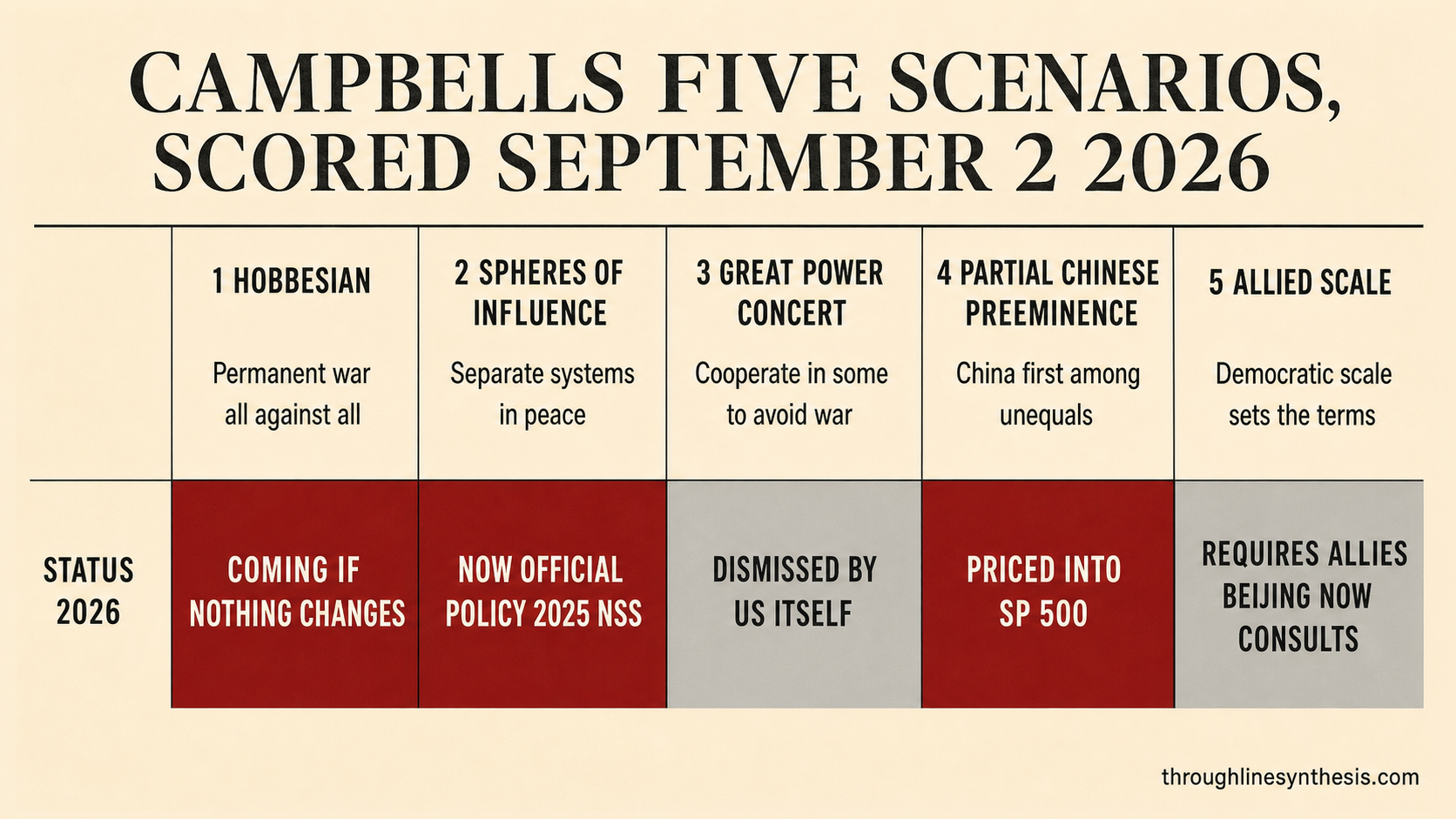
Campbell and Doshi score five worlds. It is worth walking through each of them, because most of the essayists paraphrasing the piece stop at two.
Scenario one, “global multipolarity,” they call Hobbesian and hang, at the top of the page, on a wall reserved for one specific ghost. “This Hobbesian scenario could produce catastrophic war, as it did before World War I. It would cause small states to lose sovereignty, middle powers to acquire nuclear weapons, and great powers to pursue arms races” (Foreign Affairs at Almendron).
Scenario two, “spheres of influence,” adds a bit of stabilizing structure. Each great power governs its own neighborhood. In the American version, “the United States retreats to the Western Hemisphere” (same).
Scenario three, “a great-power concert,” supplies still more order in principle and is dismissed in a single working sentence. “This seems implausible today, when great powers cannot even cooperate on addressing climate change” (same). The essay does not pause on the fact that the United States is the country that walked out of the Paris Agreement, twice.
Scenario four, “partial Chinese preeminence,” the authors judge “more likely than all three” and describe with the essay’s most quantitative passage: “China has twice the United States’ manufacturing capacity, an economy 30 percent larger by purchasing power, the world’s largest navy, an unprecedented $1.2 trillion global goods surplus, and a commanding lead in technologies from electric vehicles to robotics.” Left unopposed it would leave the United States and its partners “hollowed out industrially, surpassed technologically, displaced commercially, possibly defeated militarily, and stripped of well-paying jobs. The resulting dependencies on China would cause the United States and its partners to slide down the global value chain into real estate, tourism, commodities, finance, and perhaps transnational tax evasion” (same).
Scenario five, “allied scale,” is offered as the alternative to the four worse worlds. A coalition with “more than twice China’s GDP adjusted for purchasing power and more than twice its military spending,” accounting for “half of global manufacturing to China’s one-third” (same).
The five scenarios, scored on the facts already in the public record as of September 2, 2026: scenario one is what Campbell warns is coming if nothing changes, and it is the one his own book runner is accelerating with sanctions that fragment global finance. Scenario two is not a hypothesis; it is written into the December 2025 National Security Strategy, which is organized around a “Trump Corollary to the Monroe Doctrine” and the phrase “civilizational erasure” (2025 NSS). Scenario three, cooperation, is dismissed by the country that is single-handedly making it impossible. Scenario four is the world the Federal Reserve’s own Financial Stability Report says the American index is priced against. And scenario five, the one Campbell wants, requires allies who read the same essay and the December NSS on the same day, and now consult with Beijing about how to survive the American Treasury.
Of the five scenarios in Campbell’s own scoring, four are actively being locked in by the administration that fired him. The essay reads not as a policy paper but as an offering document with its own risk factors already realized.
The through-line matters. In 2014 Campbell wrote, of the pivot to Asia, “None of this suggests an effort to encircle or weaken China” (Foreign Affairs, 2014). In 2018, with Ely Ratner, he declared engagement dead (USC Institute PDF). In 2019, with Jake Sullivan, he named the substitute: “coexistence means accepting competition as a condition to be managed rather than a problem to be solved” (Foreign Affairs, 2019). In 2025 he introduced “allied scale” (Campbell and Doshi, 2025 PDF). And in 2026 he elevates allied scale from a strategy to the last available exit before 1914.
The reader is meant to feel the exit closing. That, more than anything else in the essay, is the tell.
II. The Book Runner
While Campbell drafted, Scott Bessent moved. On August 19, 2026, Donald Trump used the phrase on Truth Social. On August 23, Bessent used it in a Financial Times op-ed. On August 24, at a Treasury press conference, he announced it: an “economic D-Day,” “the single greatest financial offensive ever marshalled against an adversary” (Wikipedia’s compilation of the Economic D-Day rollout). The name of the operation was Economic Outcast. The target was Iran. The mechanism was five sectoral determinations covering digital assets, technology, gold, aviation, and shipping, with more than sixty entities, individuals, and vessels designated (Treasury press release sb0614).
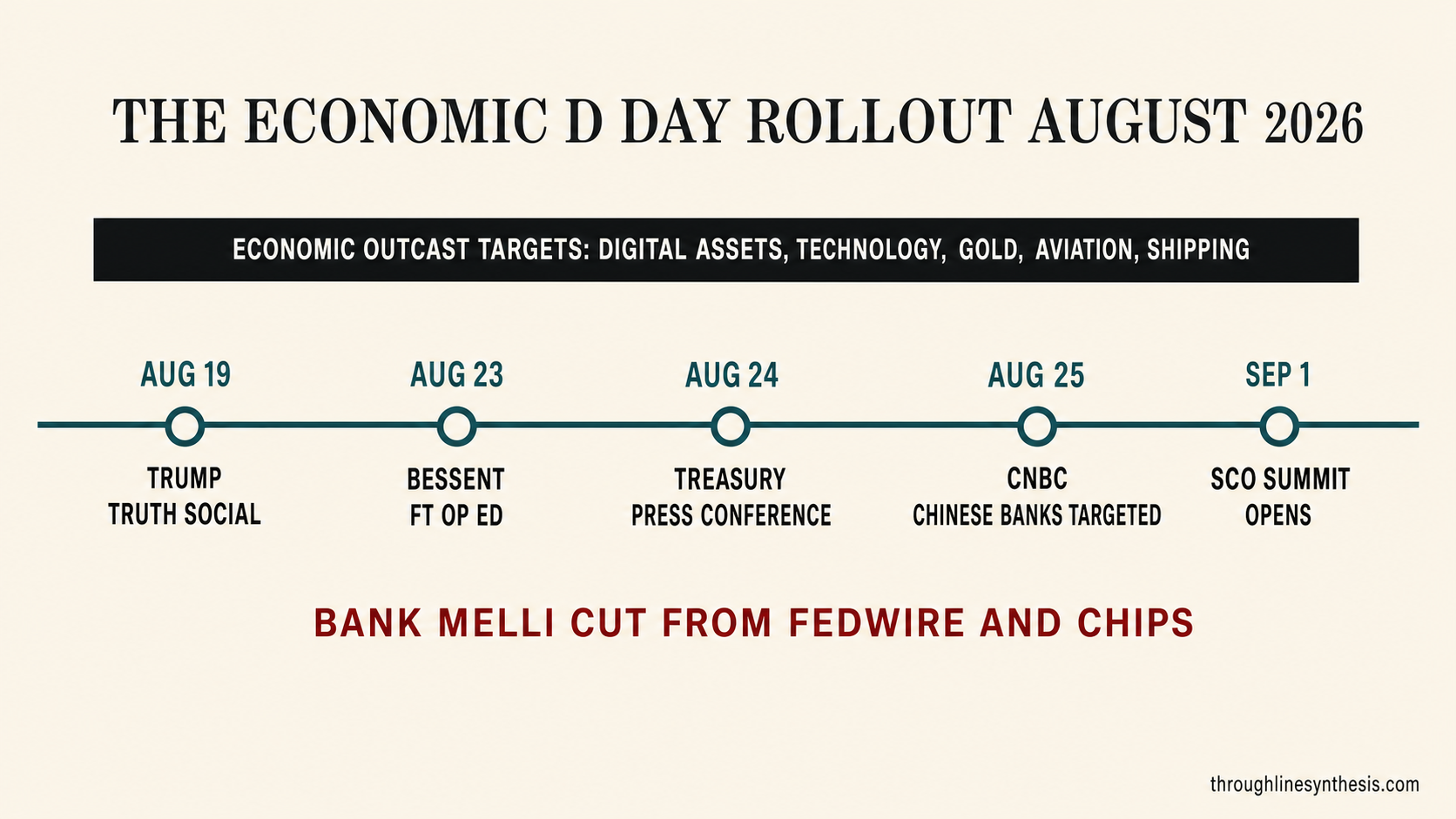
The instrument is not the sanctions list. The instrument is Fedwire and CHIPS, the two dollar real-time gross settlement systems through which every correspondent bank in the world eventually routes. The tool that bars a bank from that plumbing is the Comprehensive Iran Sanctions, Accountability, and Divestment Act, and it operates through Office of Foreign Assets Control frequently asked question 967: foreign financial institutions can be cut off from opening or maintaining correspondent accounts in the United States (OFAC FAQ 967).
Bessent said what that means: “sever every economic lifeline that sustains this tyrannical regime until Tehran stands alone.” And: “any entity that facilitates money laundering on behalf of Iran will be removed from the U.S. dollar system. The clock is ticking.” And, of the Bank Melli branch structure worldwide: “every Bank Melli branch must be shuttered” (Treasury sb0614).
Asked whether he intended to break the global financial system, the Treasury Secretary produced a three-word rebuttal that will be quoted for a decade: “Why would I want to blow up the global financial system?” (Politico, August 24, 2026).
Ask the question the other way. On the same day, Bessent confirmed that China buys roughly ninety percent of Iran’s oil exports (Politico). On August 25, on CNBC, he explained where the campaign would run next: “If they facilitate transactions and are part of the ecosystem that turns Iranian oil into money, into repression, they will be targeted” (CNBC, August 25, 2026). “They” is the Chinese banks. The route from Bank Melli to a Chinese bank on the CIPS payment rail is precisely the route Treasury proposes to close.
The other thing worth noticing about Bessent is what he is defending on the other side of his desk. On June 24, 2026, at the conclusion of Treasury’s own AI Innovation Series, he issued the department’s official position that “Artificial intelligence will be a key driver of America’s new Golden Age” (Treasury sb0540). Two weeks later, the New York Post reported that Treasury had suppressed an internal staff draft warning about the AI bubble, and quoted the department’s own spokesperson repeating the official line (New York Post, July 7, 2026). Bessent had already dismissed bubble concerns in November 2025 with the assurance that “AI build out has been tremendous” and “Historically, CapEx always leads to more jobs” (Benzinga, November 26, 2025).
One Treasury weaponizes the dollar system against Iran and, next, against the Chinese banks that clear Iran’s oil. The other Treasury insists there is no AI bubble whose collapse could take the dollar system with it. The two Treasuries share a Secretary.
His doctrine has a name. He gave it at the Economic Club of Dallas on February 20, 2026: “We are in an existential battle to maintain and accelerate technological dominance” (Treasury sb0403). And at his No Money for Terror address in May: “sanctions are not acts of aggression, they are instruments of peace” (Treasury sb0500).
Instruments of peace. On August 24, 2026, one such instrument was dropped from ten thousand feet on the correspondent-banking infrastructure of the second-largest economy in the world.
III. Two Bubbles, One Balance Sheet
The Mag7 snapshot on September 2, 2026 reads as follows: Apple at 4.773 trillion dollars, Microsoft at 3.689, Alphabet at 4.080, Amazon at 2.743, Nvidia at 5.435, Meta at 1.510, Tesla at 1.410. The Shiller cyclically adjusted price to earnings ratio stood at 41.74 on September 1, 2026 (multpl). By mid-July 2026 the ten largest S&P 500 companies were forty-three percent of the index’s weight, “a record” (InvestmentNews, July 16, 2026). RBC Wealth Management put it this way at end-2025: “more than $40 of every $100 invested flows into just 10 companies, creating a feedback loop where passive inflows disproportionately support the largest stocks, increasing their weights and reinforcing performance leadership regardless of fundamentals” (RBC).
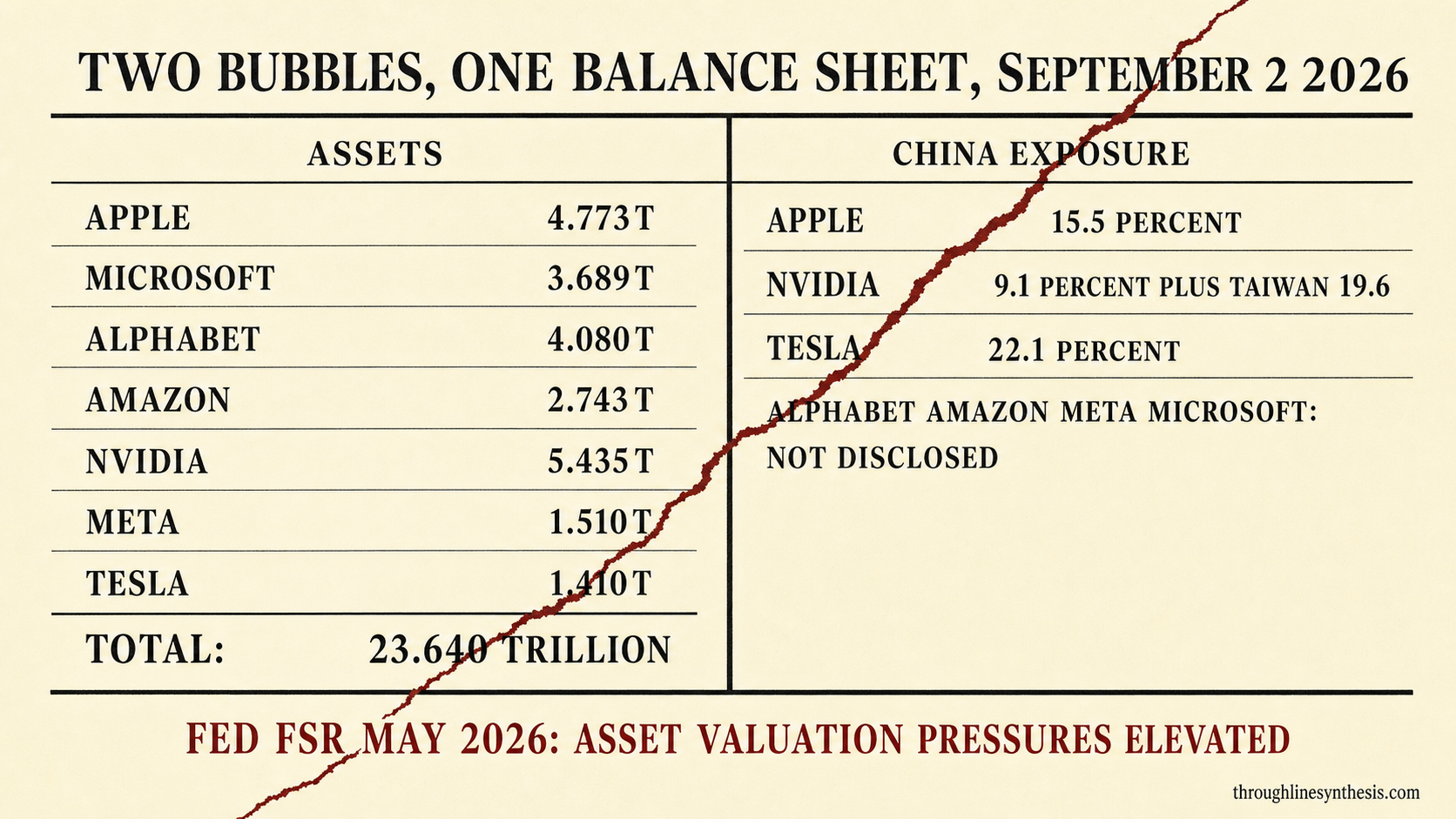
Now look at where those companies book their revenue. Apple’s Greater China revenue was 15.5 percent of $416.2 billion in fiscal 2025. Nvidia disclosed 9.1 percent of its $215.9 billion in China and Hong Kong, and, more revealingly, 19.6 percent in Taiwan, meaning its direct dependence on the island the Pentagon has begun listing as a “negotiating chip” is more than twice its direct dependence on the mainland. Tesla booked 22.1 percent of $94.8 billion in China. Alphabet does not disclose a China line but reports 16.8 percent of revenue from the Asia-Pacific region. Meta, similarly, does not disclose China but shows 26.8 percent from Asia-Pacific. Microsoft and Amazon do not disclose a China line at all. Four of the seven largest companies in the American index thus do not tell the market what a rupture with China would cost. The market prices them anyway.
This is the two-bubbles-one-balance-sheet problem. The valuations depend on the premises Campbell and Doshi want to break. Every one of the companies at the top of the American index derives some non-trivial share of its earnings from the very thing scenarios one through four presume ends. Under scenario one, the Hobbesian one, the supply chain running from a TSMC fab in Hsinchu to an Nvidia H200 in a Louisiana data center financed by Blue Owl and insured by Athene simply severs. Under scenario two, the United States withdraws to the Western Hemisphere and China’s technology exports finish the job Nvidia’s export controls started. Under scenario four, partial Chinese preeminence, allied capital slides “down the global value chain into real estate, tourism, commodities, finance, and perhaps transnational tax evasion” (Campbell and Doshi).
The Federal Reserve knows. Its May 2026 Financial Stability Report, reflecting data as of April 23, is unusually plain: “Asset valuation pressures were elevated” (Fed overview). Its near-term risks section records that market contacts named as risks “AI, including equity valuations; that capital expenditures are increasingly funded by debt, creating leverage in the system; and that widespread adoption of AI may contribute to labor market weakness” (Fed near-term risks). “Leverage at the largest life insurers stayed well into the upper quartile of its historical distribution” (Fed overview).
The financing plumbing under all of it is worth naming. Nvidia’s compute-financing platforms aim to raise more than $500 billion in third-party capital, with Nvidia itself able to backstop up to $125 billion. Apollo and Blackstone are financing a $35 billion Anthropic expansion. Meta struck a $27 billion financing with Blue Owl. Bank of America estimates that Broadcom’s chip-financing vehicle will grow to $370 billion of senior debt by mid-2029 (Reuters, August 14, 2026). The four hyperscalers spent more than $416 billion of capex in 2025, up 66 percent, and are guided to $700 to $760 billion in 2026 (Platformonomics 2025 retrospective; Futurum Group).
The end holders are American insurers. Private-placement bonds rose to 23.4 percent of insurers’ total admitted bonds in 2025 from 18.3 percent in 2021, and the National Association of Insurance Commissioners has opened a review of data-center credit ratings, including tenant creditworthiness, lease-exit clauses, and construction delays (Insurance Business, June 12, 2026). CFRA warns that Apollo, Ares, and Blue Owl carry the concentrated exposure (CFRA, March 2026). Moody’s data show life insurer private credit holdings up more than twenty percent in 2025, and the Proskauer Private Credit Default Index reported a 2.73 percent default rate in the first quarter of 2026 against 1.84 percent two quarters earlier (Policyrix summary).
The old joke about the man who owed his bank a thousand dollars and the man who owed it a million becomes, at this scale, load-bearing. The American life-insurance industry has become a subprime lender to the American AI industry, whose valuations depend on a China posture that the American National Security Strategy has already retired.
IV. July 1914
There is a document that says the quiet part. It is not by Kurt Campbell. It was written on New Year’s Day, 1907, by a Foreign Office clerk named Eyre Crowe, filed as F.O. 371/257, and printed as Appendix A to the third volume of British Documents on the Origins of the War, 1898 to 1914, edited by G. P. Gooch and Harold Temperley (Internet Archive text). It runs to more than sixteen thousand words. It is the shortest analytical distance between Whitehall in 1907 and the Foreign Affairs website in 2026.
Crowe begins with geography. “The general character of England’s foreign policy is determined by the immutable conditions of her geographical situation on the ocean flank of Europe as an island State with vast oversea colonies and dependencies, whose existence and survival as an independent community are inseparably bound up with the possession of preponderant sea power” (BDOW Vol. III, Appendix A).
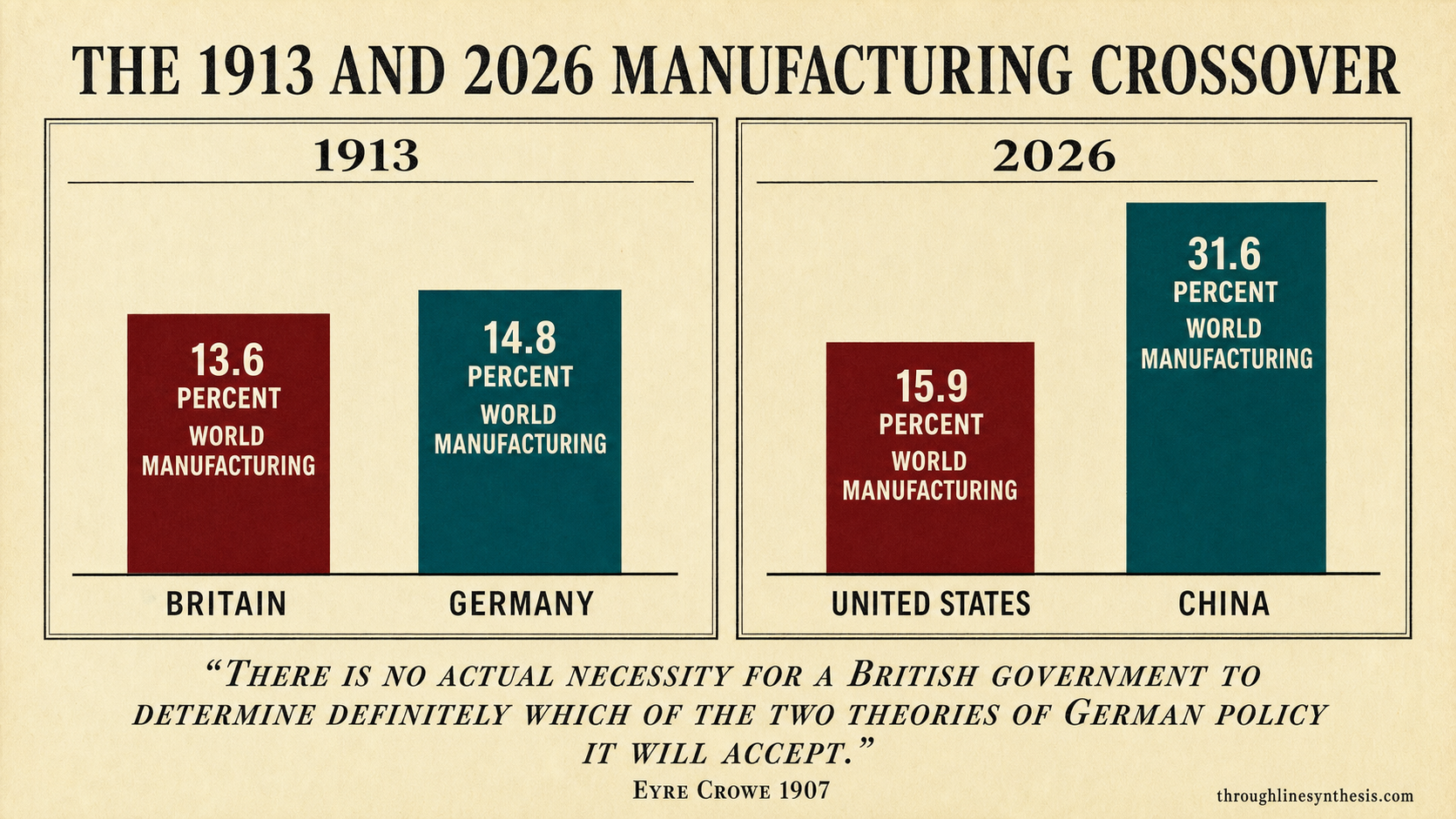
From geography he derives a natural law. “The opposition into which England must inevitably be driven to any country aspiring to such a dictatorship assumes almost the form of a law of nature.” Then comes the decisive analytical move, the one every commentator on Crowe has to reckon with, because it is the move Campbell and Doshi have now repeated. Intentions, Crowe writes, are irrelevant. “There is no actual necessity for a British Government to determine definitely which of the two theories of German policy it will accept.” Whether Germany plans hegemony or merely evolves into it, “the position thereby accruing to Germany would obviously constitute as formidable a menace to the rest of the world as would be presented by any deliberate conquest of a similar position by ‘malice aforethought.’ It appears, then, that the element of danger present as a visible factor in one case, also enters, though under some disguise, into the second; and against such danger, whether actual or contingent, the same general line of conduct seems prescribed” (BDOW Vol. III).
That is the sentence that made 1914. Not the shooting at Sarajevo. Not the Kaiser’s telegrams. The prior decision that a rising power’s conduct was analytically irrelevant, because the position itself was menace enough.
Foreign Secretary Sir Edward Grey received the memorandum and minuted it: “This Memorandum by Mr. Crowe is most valuable. The review of the present situation is both interesting and suggestive, and the connected account of the diplomatic incidents of past years is most helpful as a guide to policy” (BDOW Vol. III). It became policy. Britain by 1913 was a country whose share of world manufacturing had fallen from 22.9 percent in 1880 to 13.6 percent, while Germany’s had risen from 4.9 to 14.8, a crossing point in exactly the decade the strategy hardened (Crafts, University of Warwick working paper 1295). Britain had a two-to-one advantage in capital ships in August 1914 (Anglo-German naval arms race), which is precisely the margin Crowe promised to preserve. Crafts, running the counterfactual a century later, produces the sentence a Foreign Affairs essayist ought to be made to memorize: “There is no strong reason to think that Germany’s successful economic development had important adverse effects on the British economy even though by the early 20th century Germany’s industrial strength was increasingly regarded as a threat by British commentators and politicians” (Crafts).
The threat was perceptual. The response was consequential. Britain won both wars against the power Crowe named and was left with roughly $6.3 billion in foreign obligations by 1945 and commercial exports that had fallen from £471 million in 1938 to £258 million in 1944, dependent for reconstruction on American credit (World Bank on external debt of the United Kingdom; NBER on the Effects of War on Lombard Street). That is the price of winning Crowe’s argument.
There is no need to reason by analogy alone. The Council on Geostrategy, a London policy shop, has proposed a “New Crowe Memo” as the template for Western strategy against authoritarian revisionism (Council on Geostrategy policy paper). At Brookings in November 2013, Robert Kagan mapped it directly onto the present: the United States “plays the British role in East Asia” and must be clear to allies “the France of their day whether it’s Japan or Korea or other countries in the region” and to China “which is the Germany of the time” (Brookings transcript).
Thomas Sanderson, former Permanent Under-Secretary at the Foreign Office, sent Grey a written rebuttal at the time. It has aged rather better than Crowe’s memorandum. “A country which looks to each change as a possible chance of self-aggrandizement is not much more open to criticism than one which sees in every such a change a menace to its own interests, existing or potential” (Classics of Strategy on the 1907 memorandum).
Campbell in 2026, quietly, is Crowe in 1907. He wrote it more elegantly, and with better citations, but the animating premise is identical: intention does not matter, only position does. That is the trade. Britain took it and won every battle and lost every century. Grey’s minute is the receipt.
V. The Cult of Lying: Where Megalomania Goes, Paranoia Follows
Sachs offered a diagnostic worth quoting at length before anyone counts the words in the strategy documents. “There’s almost nothing that’s truthful anymore about any word that is said by any of our governments. It’s not a kind of fifty fifty proposition. It’s that you cannot listen to a word without being shocked if you know the story, because it bears no recognizable connection with the realities that are now present” (The Duran, September 1, 2026). Mercouris supplied the mechanism in a single Mencken-ready line: “where megalomania goes paranoia follows.”
Call the phenomenon what it is. A cult of lying is not the ordinary hypocrisy of politics. It is the systemic replacement of factual claims about the world with narratives designed to defend a market capitalization and a self-image. Its markers, all present in the Trump II administration, are these: officials who state as fact conclusions their own departments have documented to be false; a suppressed Treasury AI-bubble memo whose findings were replaced with the phrase “Golden Age” (New York Post, July 7, 2026); a Pentagon that reports F-35 mission-capable rates the Government Accountability Office contradicts in the same month (GAO 26-108113); a Defense Intelligence Agency assessment of the Iran strikes leaked as showing months of setback that the president publicly recharacterized as “obliteration” (CNN, June 24, 2025); and, at the top of the ledger, a president whose Washington Post fact-checking count reached 30,573 false or misleading statements across his first term (Washington Post, January 24, 2021).
Sachs’s charge, in other words, is not rhetorical. It is a description of a governing method. The method has an operating cost. Every one of the strategic documents produced by that method has to be read as a bond prospectus with the risk factors removed. “Ukraine is winning the war.” “We have defeated Iran.” “AI build out has been tremendous.” “Instruments of peace.”
Read the strategy documents through that lens and count the words. The lexicon itself becomes the tell.
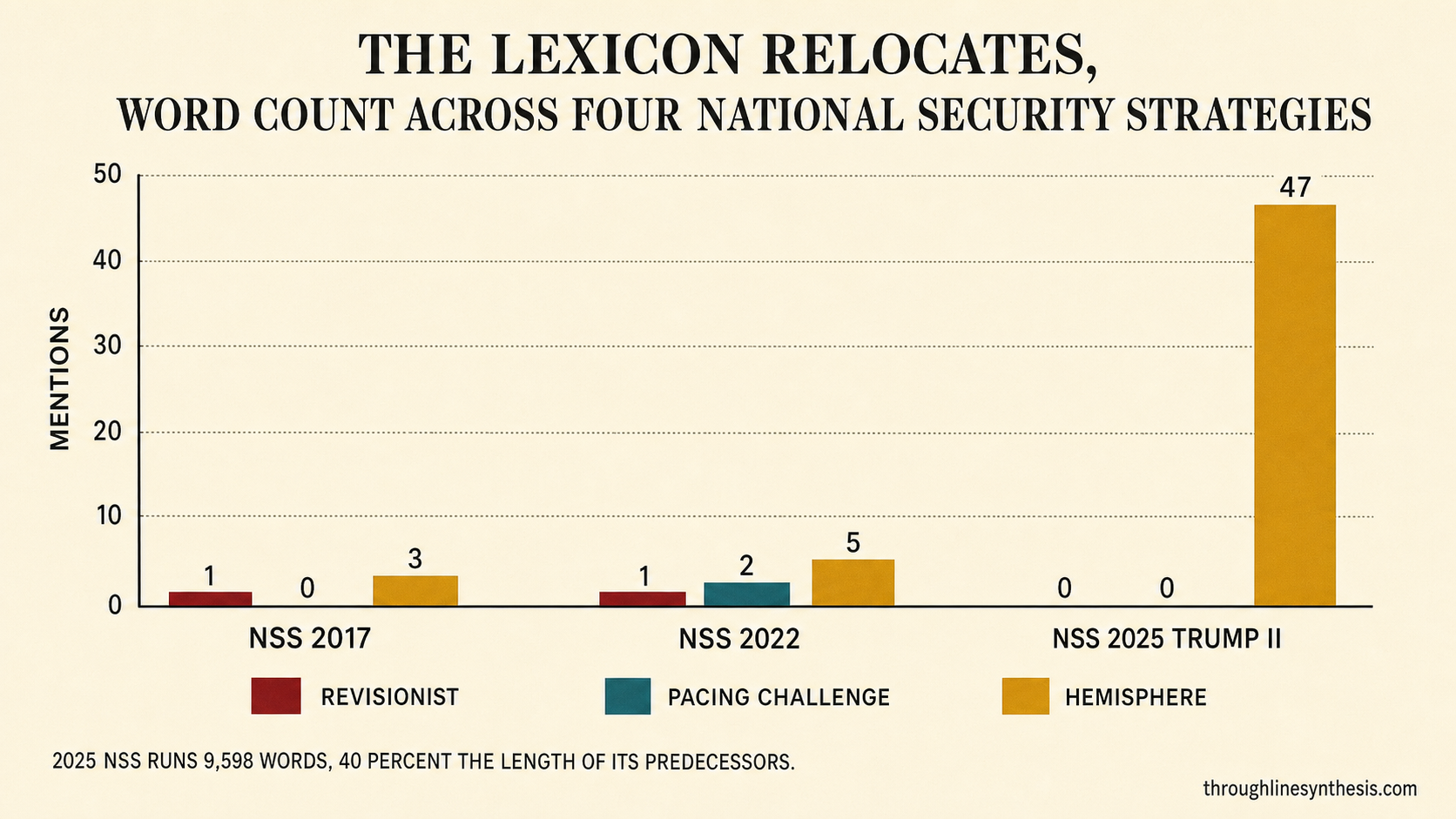
The 2017 National Security Strategy, the first Trump edition, ran to 23,992 words and used “revisionist” once and “China” thirty-three times, in a document that named “revisionist powers” of “China and Russia” as one of “three main sets of challengers” (2017 NSS). The 2018 National Defense Strategy summary used “revisionist” four times and made the point flatly: “Inter-state strategic competition, not terrorism, is now the primary concern in U.S. national security” (2018 NDS summary).
The 2022 Biden documents dropped “revisionist” to one instance in the NSS and introduced a new phrase, “pacing challenge,” used twice in the NSS and nine times in the NDS bundle. The 2022 NSS said the PRC “is the only competitor with both the intent to reshape the international order and, increasingly, the economic, diplomatic, military, and technological power to advance that objective” (2022 NSS). The 2022 NDS repeated the phrase: “the People’s Republic of China (PRC) as the pacing challenge for the Department” (2022 NDS).
Then the December 2025 Trump II National Security Strategy came out, and the count reset. It ran to 9,598 words, or roughly forty percent the length of either of its predecessors (2025 NSS). “Revisionist” appeared zero times. “Pacing challenge” appeared zero times. “China” fell to twenty-one. What rose in their place was hemispheric and civilizational.
“Western Hemisphere: The Trump Corollary to the Monroe Doctrine. After years of neglect, the United States will reassert and enforce the Monroe Doctrine to restore American preeminence in the Western Hemisphere, and to protect our homeland and our access to key geographies throughout the region. We will deny non-Hemispheric competitors the ability to position forces or other threatening capabilities, or to own or control strategically vital assets, in our Hemisphere” (2025 NSS). And, on Europe: “Continental Europe has been losing share of global GDP, down from 25 percent in 1990 to 14 percent today, partly owing to national and transnational regulations that undermine creativity and industriousness. But this economic decline is eclipsed by the real and more stark prospect of civilizational erasure.” And: “Should present trends continue, the continent will be unrecognizable in 20 years or less.” And: “The days of the United States propping up the entire world order like Atlas are over” (2025 NSS).
Heather Williams of CSIS supplied the summary a month later: “The bumper sticker for me of this National Security Strategy is burden sharing to burden shifting” (CSIS event on the 2025 NSS).
The paranoia has not intensified in the old register. It has relocated. It moved from a global system to a hemisphere, and from state competition to civilization. That is not a synonym for spheres of influence. That is spheres of influence. The 2025 NSS is scenario two, taken out of Campbell’s typology and installed as national policy.
The final tell is Elbridge Colby, Undersecretary of Defense for Policy, on the January 2026 NDS. Colby’s language is “needless confrontation” and a wish to “strive for a stable, peaceful relationship with China” (CSIS on the 2026 NDS). A scholar at the China Institute of International Studies read the wording as “a significant softening of U.S. rhetoric.” That is Beijing’s read, correctly, of a document that assigns most of Europe’s conventional defense to Europe and orients American power toward the Panama Canal.
Follow the shift. The country that Campbell’s essay tries to save is already halfway inside the scenario his essay names as second-worst.
VI. Not the Kaiser
There is a single number that decides whether the analogy Campbell and Crowe want to run holds. Overseas military bases. David Vine’s census for the Quincy Institute puts the American figure at roughly 750 bases in 80 foreign countries and colonies, and adds the frame directly: “The United States has at least three times as many overseas bases as all other countries combined.” Russia has “two to three dozen.” China has five (Quincy Institute Brief No. 16, September 2021).
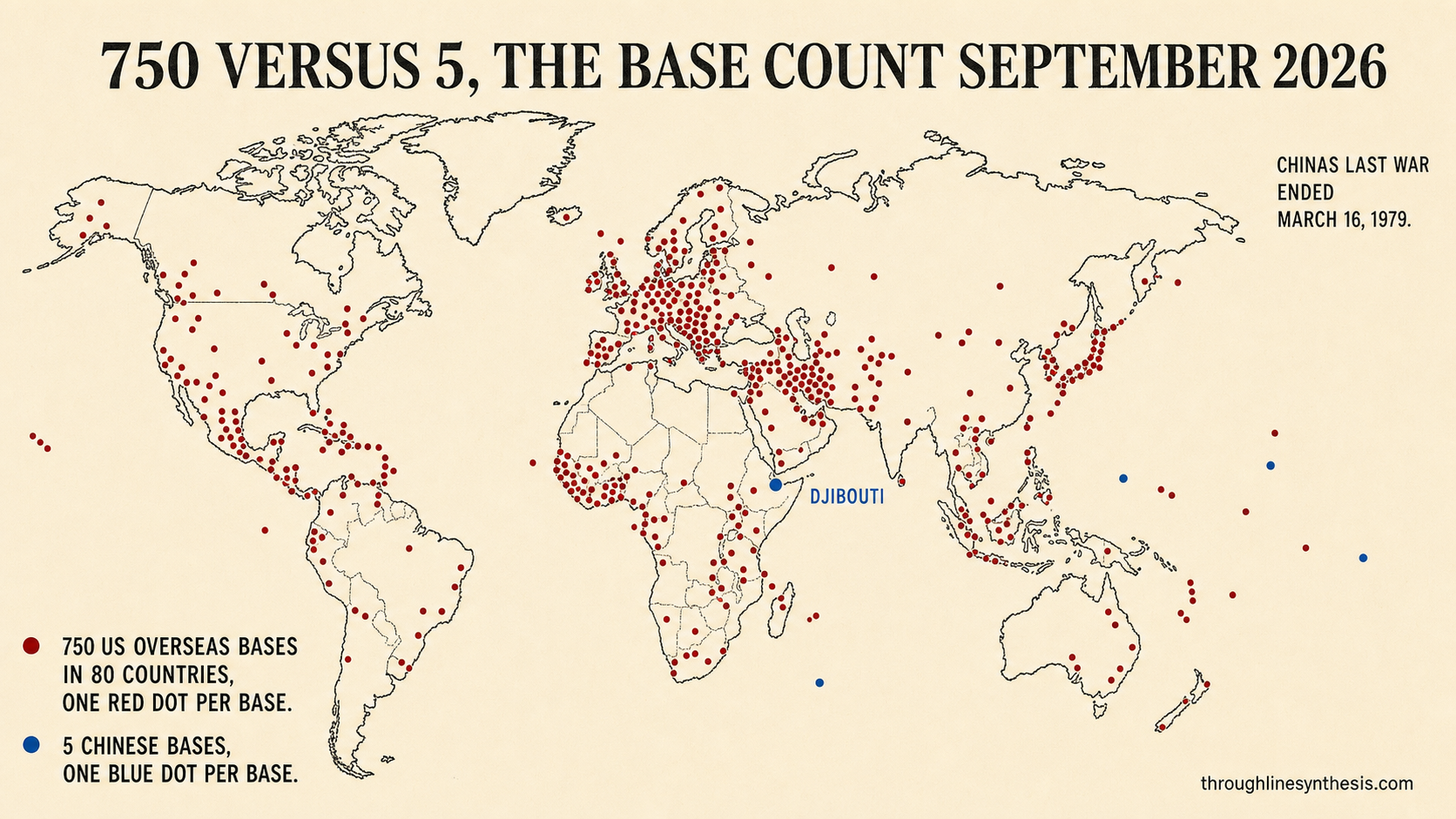
The Kaiser, in 1913, had a fleet designed to command the North Sea, three African possessions, coaling stations in the Pacific, and a stated ambition to build a Berlin-Baghdad railway. He was, by the standards of an imperial century, a rising power. China in 2026 has one acknowledged foreign base, in Djibouti, opened in 2017, and one dual-use logistics facility, Ream, in Cambodia, described by Chinese state media as its “second officially recognized overseas military base” and opened in April 2025 (Newsweek). The United States Navy sent a warship to visit Ream in February 2026 (Defense News).
The last war China fought was the Sino-Vietnamese War, from February 17 to March 16, 1979 (Wikipedia on the Sino-Vietnamese War). Since March 16, 1979, the United States has conducted the following operations against sovereign states, in chronological order, from a fetched Wikipedia timeline of American military operations. The list is not comprehensive; it is a filter for named campaigns. Iran 1980 (Eagle Claw). Grenada 1983 (Urgent Fury). Libya 1986 (El Dorado Canyon). Iran again 1987 and 1988 (Praying Mantis). Panama 1989. Iraq and Kuwait 1990 and 1991. Northern Iraq 1991 through 1996. Bosnia 1992 through 1996. Somalia 1993. Haiti 1994 and 1995. Bosnia again in 1995. Afghanistan, Sudan, and Iraq in 1998. Serbia and Kosovo in 1999. Afghanistan 2001 through 2021. Iraq 2003 through 2011. Somalia 2007 to present. Libya 2011. Iraq and Syria 2014 to present. Iraq in 2020. The Red Sea from 2023. Yemen in 2024 and 2025. Iran 2025 (Midnight Hammer). Venezuela 2026 (Absolute Resolve). Iran 2026 (Epic Fury, Roaring Lion, Project Freedom) (Wikipedia, Timeline of United States military operations).
The scholarly Military Intervention Project counts roughly 400 American military interventions since 1776, with about half between 1950 and 2019 (Journal of Conflict Resolution). SIPRI’s 2026 fact sheet puts the American share of global arms exports at 42 percent for 2021 through 2025, up from 36 percent in 2016 through 2020, while China sits at 5.6 percent, in fifth place. Sixty-one percent of Chinese arms exports go to a single state, Pakistan. The United States supplies 77 percent of Saudi Arabia’s arms and 48 percent of Qatar’s (SIPRI 2025 fact sheet).
China’s alternative is different. Its Belt and Road Initiative reached cumulative engagement of $1.399 trillion by end-2025, with $837 billion in construction contracts and $561 billion in investments across 150 BRI countries, of which $213.5 billion came in 2025 alone (Griffith Asia Institute and Green Finance Development Center BRI Investment Report 2025). It is a strategy of ports and pipelines, not garrisons.
To call China “the Germany of the time,” as Robert Kagan did at Brookings in 2013 (Brookings transcript), one has to swallow the base count. The Kaiser did not have five bases. The Kaiser wanted the world. He built the fleet to prove it. China has spent the last forty-seven years selling infrastructure to the countries the United States is bombing. That is a different animal. Crowe’s rule that intention does not matter, only position, is what makes it look the same. It is not the same.
VII. Bishkek
The 26th Council of Heads of State of the Shanghai Cooperation Organization met in Bishkek on August 31 and September 1, 2026, under the chairmanship of Kyrgyzstan and the motto “Together for Sustainable Peace, Development and Prosperity” (Al Jazeera preview; Wikipedia summary of the 2026 Bishkek SCO summit). Xi Jinping was there. Vladimir Putin was there. Narendra Modi was there. Masoud Pezeshkian was there. Kassym-Jomart Tokayev, Shehbaz Sharif, Alexander Lukashenko, Emomali Rahmon, and Shavkat Mirziyoyev were there. Recep Tayyip Erdogan, Ilham Aliyev, and Nikol Pashinyan appeared as SCO Plus. Antonio Guterres attended as United Nations Secretary-General. Leaders from seventeen countries in total. The Bishkek Declaration and twenty-seven additional documents were adopted, and the chairmanship passed to Pakistan for 2027 (Wikipedia; CGTN reports twenty-eight outcome documents).
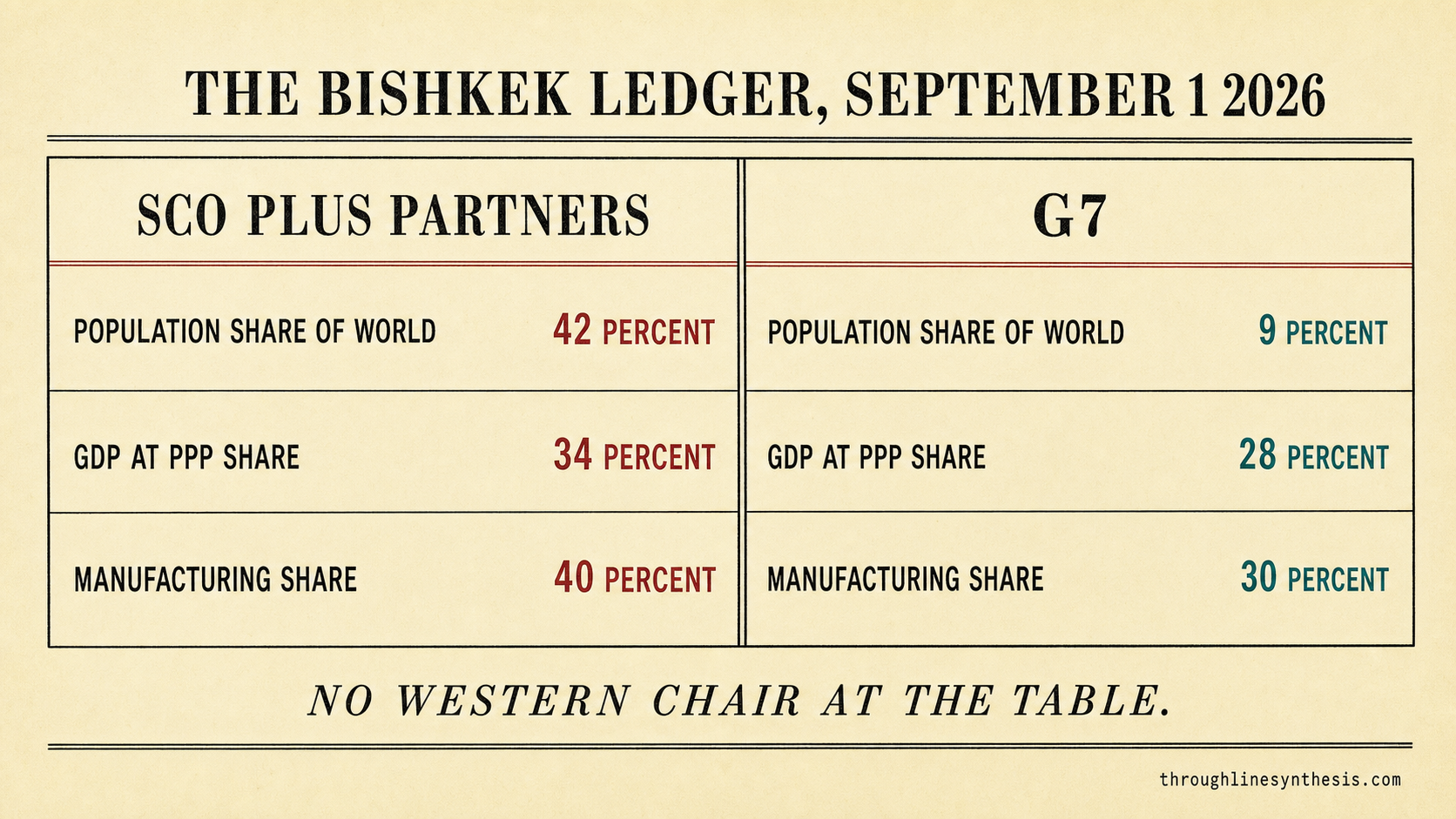
Set the weights side by side. The ten SCO members hold 42.1 percent of the world’s population against 9.65 percent for the G7 (computed from World Bank population data). They hold 34.26 percent of world GDP at purchasing power parity against 27.96 percent for the G7 (computed from IMF WEO PPPSH datamapper). They hold 20.3 percent of proven oil reserves against 14.2 percent, and 43.9 percent of proven natural gas reserves against 9.9 percent (computed from Oil and Gas Journal reserves table). China alone runs 17.8 percent of the world’s oil refining capacity, at 18.48 million barrels per day, against 17.7 percent for the United States; add Russia and India, and the SCO’s combined refining share reaches roughly thirty percent (refinery capacity compilation). China holds 44 million tonnes of rare earth reserves out of a world total above 75 million, and produced 270,000 tonnes of the world’s 390,000 in 2025, roughly 69 percent (USGS Mineral Commodity Summaries 2026).
President Sadyr Japarov of Kyrgyzstan supplied the frame on September 1: SCO states “account for more than 40% of the world’s population and about one-third of global GDP” (Trend). The independently computed figures corroborate him within a percentage point.
The plumbing matters more than the arithmetic. The declaration endorses a “Roadmap for a gradual increase in the share of national currencies in mutual settlements,” notes an Iranian bank joining the SCO Interbank Association, and reports “progress on the establishment of the SCO Development Bank in the format of interested member states during the chairmanship of the Kyrgyz Republic” (Bishkek Declaration text). The bank is not yet operational. The political consensus to create it was reached at Tianjin on September 1, 2025, and a third round of interested-state consultation, with twenty countries, took place in Bishkek on May 28, 2026 (SCO Secretariat). Kazakhstan offered Astana as headquarters. Iran proposed an SCO energy consortium (SpecialEurasia summit analysis).
Currency settlement is already moving. Russia reports more than 98 percent of its settlements with SCO partners now in national currencies, on trade above $400 billion (SpecialEurasia). Russia and China specifically settle more than 99 percent of their bilateral trade in national currencies (RT). China-SCO trade reached $523.5 billion in 2025 (CGTN). The People’s Bank of China holds bilateral local-currency swap arrangements with 32 countries and regions (PBoC data as of September 30, 2025).
Xi’s keynote title, on the last day, was “Toward Higher-Quality Development of the Shanghai Cooperation Organization” (CGTN). No one in Bishkek said the word “dedollarization.” The word for what happened is on the checklist Campbell would want kept out of the prospectus. Population, GDP, oil, gas, refining, rare earths, and a payment plumbing bypass. The scoreboard, on August 31 and September 1, 2026, ran nine to seven in favor of the room that America’s economic D-Day is trying to break.
VIII. The Iran Line
The economic D-Day was preceded by eight years of maximum pressure and a war. The results are on the record.
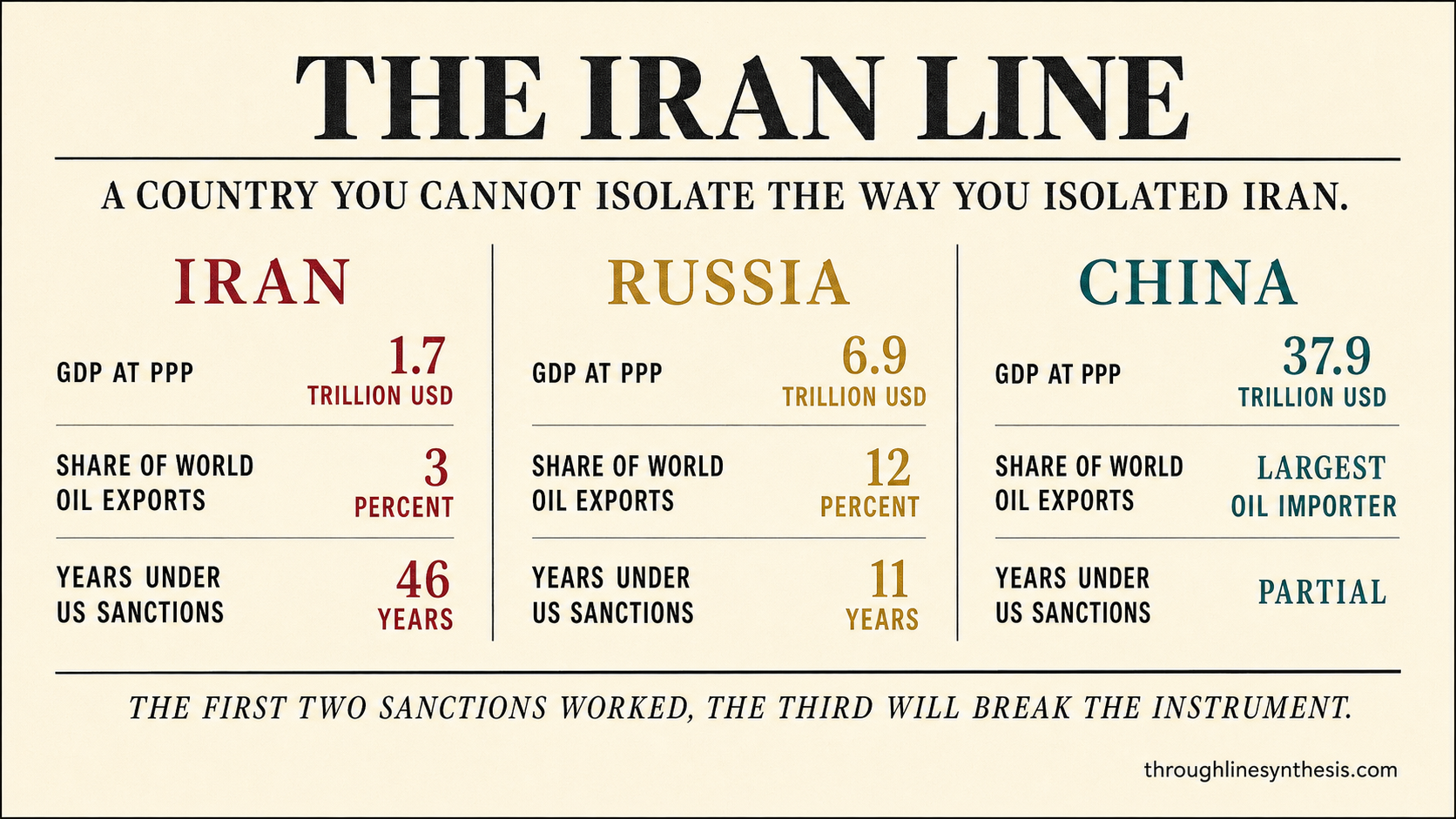
Iran’s nominal GDP in current dollars was $347.99 billion in 2019 and $362.68 billion in 2025, having peaked at $475.25 billion in 2024 before the 2026 war (World Bank series for Iran). GDP per capita in current dollars fell from $3,997 to $3,924 on a population of 92.4 million. In constant terms output grew, from $431.1 billion to $519.1 billion. The World Bank puts the 2025 to 2026 contraction at 2.7 percent (World Bank Iran page). Poverty at the $8.30 per day line reached 36.0 percent (World Bank poverty and equity brief).
The rial priced it in. The parallel market rate was 129,500 rials per dollar in 2019 (Wikipedia, Iranian rial). It crossed 1,000,000 in March 2025 (Reuters), touched roughly 1,150,000 by October 2025, hit 1.25 million in December (Reuters), and traded at 1.4 to 1.47 million in January 2026 (Anadolu). Roughly an eleven-fold depreciation in six years.
The state-run ILNA agency, quoted through Iran Focus, reported the wage collapse: “The base wage of $238 in 2016 has dropped to $91. In other words, the real wage this year is only 0.38 of what workers received in 2016.” With benefits, roughly $300 became $110. The 2025 minimum wage covered 12.43 percent of basic living costs, or five to six days per month (Iran Focus summary of ILNA). Farzanegan and Habibi, in the European Journal of Political Economy, estimate that sanctions cut the middle-class share of Iran’s population by twelve to seventeen percentage points per year on average, and by a cumulative twenty-eight points by 2019 (ERF Forum summary).
Then look at what the country still does. Iran ranks third in the world in engineering graduates, at roughly 230,000 a year (Juan Cole; institutional anchor at UNESCO Science Report 2021 Iran). Iran produced 897,627 passenger cars in the fiscal year to March 20, 2025 (Press TV; Tehran Times). Iran produces more than 97 percent of its own medicines (Press TV; TV BRICS).
And then the timeline of the wars. Trump signed the maximum-pressure memorandum on February 4, 2025 with the observation, “I’m going to sign it, but hopefully we’re not going to have to use it very much” (USIP Iran Primer timeline). Israeli strikes ran June 13 to 24, 2025, with 1,270 sorties and 935 Iranians killed (USIP). US strikes resumed in late February 2026. The naval blockade ran from April 13 to June 18, 2026 and was reinstated on July 14, 2026, “the entirety of the Iranian coastline,” with vessels subject to “interception, diversion, and capture” (Wikipedia, 2026 United States naval blockade of Iran). CENTCOM described it as “fully implemented,” cutting ninety percent of Iran’s seaborne trade (CNBC).
Iran’s oil exports in March 2026 approached 1.84 million barrels per day, worth about $5.13 billion. They fell to 1.34 million in April and to below 300,000 in May, worth roughly $837 million, roughly an eighty-four percent revenue collapse and $5.8 billion lost in two months (Al Jazeera).
Iran did not fold. The Iranian-born population living abroad rose from 1,442,650 in 2020 to 1,733,468 by mid-2024, about 291,000 in four years (UN DESA International Migrant Stock 2024). Cyrus II inherited the Achaemenid throne in 559 BCE. The empire fell in 330 BCE (Britannica, Achaemenian Empire). Two hundred and thirty years. American maximum pressure is now in its eighth. Bessent said, on the D-Day announcement, “sever every economic lifeline that sustains this tyrannical regime until Tehran stands alone” (Treasury sb0614). The record of the previous eight years suggests the second half of that sentence is not on offer.
What is on offer instead is a Chinese banking crisis, if Bessent decides to test whether he can push the CIPS integration figures far enough to matter. On which see the next section.
IX. The Run in Slow Motion
The dollar has not fallen. What has happened is quieter than a fall and more expensive to reverse.
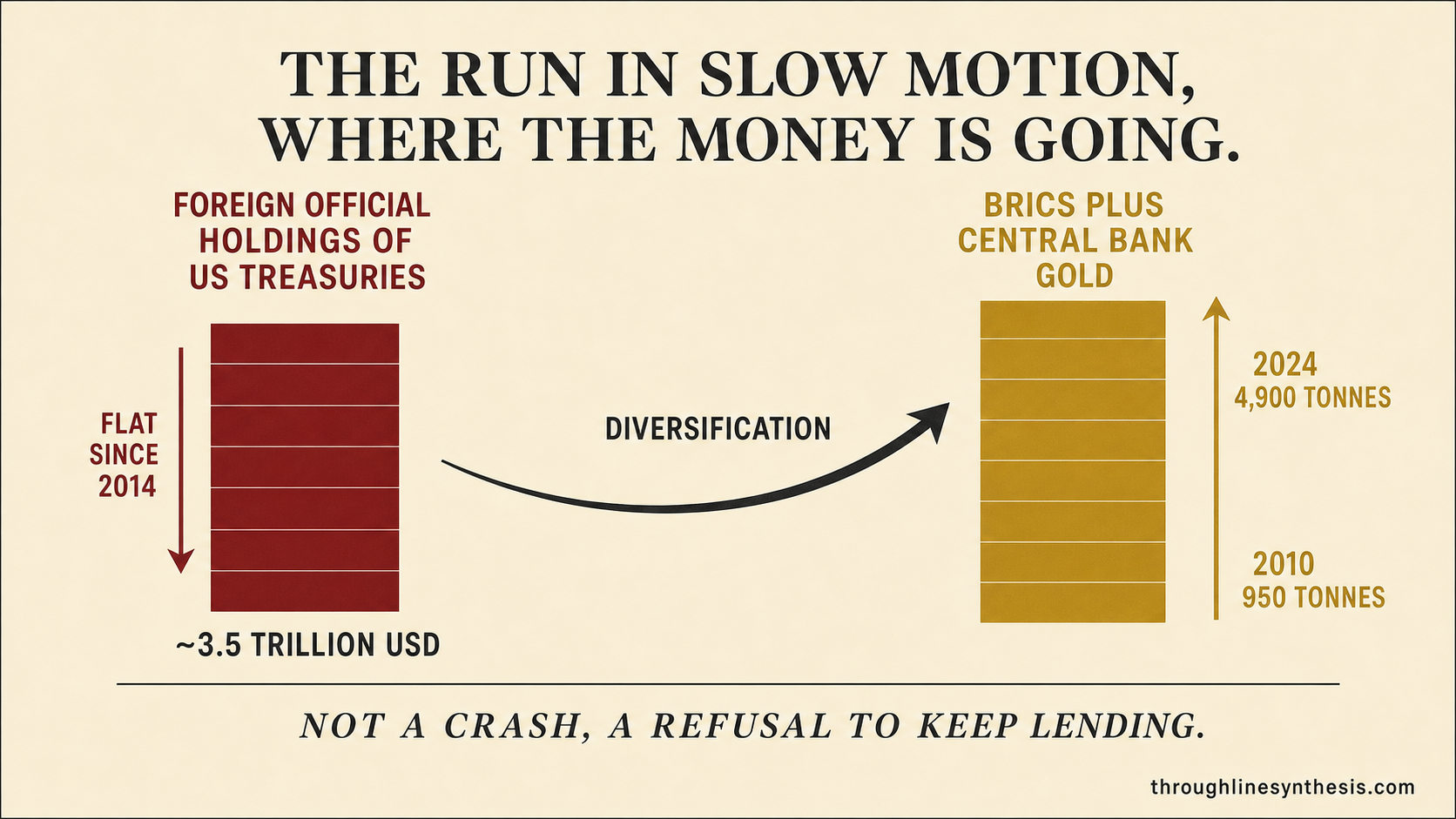
The European Central Bank’s June 2026 review put gold at 27 percent of total global official reserves at end-2025, ahead of US Treasuries at 22 percent and the euro at 15 percent. Valued at end-2023 gold prices, the same portfolios would show gold at 16 percent and Treasuries at 26 percent. Gold rose 60 percent in 2025 after 30 percent in 2024, so the reweighting is heavily a price effect (ECB International Role of the Euro, June 2026). The IMF’s own July 2026 data brief states the flat conclusion: “In 2025, gold surpassed US Treasuries as a share of official reserves” (IMF data brief, July 1, 2026).
Central banks bought roughly 863.3 tonnes of gold in 2025, down from 1,092.4 tonnes in 2024 and about 1,050 tonnes in 2023. Since 2022 China has added more than 350 tonnes, Poland 320, Turkiye 220, India 130. The People’s Bank of China holds 2,306 tonnes as of end-2025 (World Gold Council Gold Demand Trends FY2025). BullionStar puts Chinese reserves at 2,366 tonnes by mid-2026 after twenty-one consecutive months of purchases (BullionStar). Poland alone bought 102 tonnes in 2025, reaching 550 tonnes, or 28 percent of its reserves, with a 700-tonne target (World Gold Council).
The dollar’s own share of allocated reserves was 56.42 percent in the fourth quarter of 2025 and 57.13 percent in the first quarter of 2026 (IMF data brief, July 1, 2026). That is a lower reading than the 71.19 percent recorded in the first quarter of 1999 or the 72.13 percent peak in the second quarter of 1999 (FinObservatory compilation of IMF COFER). The IMF’s own analytical line supplies the fair-minded counterpoint: “statistical tests do not indicate an accelerating decline in the dollar’s reserve share, contrary to claims that US financial sanctions have accelerated movement away from the greenback” (IMF blog on dollar dominance). The same blog notes that renminbi internationalization “shows signs of stalling out.” Both are fair. Both are true. Neither addresses the question. The question is what happens if the American Treasury adds a specific, named, sovereign-scale financial institution to the SDN list under the CAPTA framework and forces a foreign central bank to choose.
The rails that would decide the answer are already partly in place. China’s Cross-Border Interbank Payment System processed 8.4419 million transactions worth RMB 180.15 trillion in 2025, up from 8.2169 million and RMB 175.49 trillion in 2024 (Wikipedia CIPS entry compiling CIPS annual reports; FXC Intelligence). CIPS had 176 direct and 1,514 indirect participants across 121 countries as of June 2025, business covering more than 4,900 banking institutions in 189 countries. The Atlantic Council’s monitor counts 193 direct and 1,573 indirect participants by December 2025 (Atlantic Council Dollar Dominance Monitor). Project mBridge cumulative volume reached $55.49 billion by November 2025, from $22 million in 2022. Russia’s SPFS was connected to 550 organizations across twenty countries by 2024 (Atlantic Council).
The dependency is documented, and it is the strongest single argument that a rupture would be manageable for Washington. “CIPS relies on SWIFT’s messaging service for over 80% of its transactions” (Wikipedia CIPS). On SWIFT itself, the renminbi was 2.73 percent of global payments by value in December 2025 and 3.10 percent by July 2026, in fifth place (SWIFT RMB Tracker, January 2026; Trade Treasury Payments).
But every reserve manager in the world priced the February 26, 2022 event. On March 13, 2022, Russian Finance Minister Anton Siluanov said sanctions had frozen around $300 billion of Russia’s roughly $640 billion in reserves (Reuters). The REPO Task Force estimate is $280 billion. Euroclear manages roughly $200 billion, about ninety percent of the EU-held total; the United States holds around $5 billion; most of the securities have matured into cash which Euroclear invests at short-term rates; neither the REPO countries nor the EU has agreed to outright seizure, citing legal barriers and fear of eroding international norms (Brookings). Only about $67 billion, roughly 11 percent, was in dollars in the first place (Reuters).
The run on the dollar is not a run. It is a slow-motion reallocation, mostly by price, in a system in which the choice of exit ramp is limited and the exit ramp itself carries frictions and messaging dependencies on the very system being exited. That is fair, and the IMF has said as much. The other thing that is fair, and that no IMF blog post can say cleanly, is that the American Treasury on August 25, 2026 announced it would test the ceiling. The Chinese banks that clear Iran’s oil sit on CIPS, and CIPS clears through SWIFT. If Bessent designates a real Chinese bank, the market will find out how thin the plumbing actually is.
The 2022 move was small money by the numbers. It was priced anyway.
X. The Sunk-Cost Cabinet
Four commitments cannot be reversed at the same time without one of them breaking. That is the elementary observation on the American strategic ledger in 2026. Every one of them is bipartisan. Every one of them is expensive. All four are still growing.
Ukraine. The Congressional Research Service reports $67.8 billion in US security assistance committed to Ukraine from February 2022 through March 2026. The delivered value, CRS states, “is not publicly available” (CRS IF12040). Presidential Drawdown Authority runs up to $31.7 billion of that, Ukraine Security Assistance Initiative to $33.5 billion, Foreign Military Financing to $3.7 billion, with $45.8 billion appropriated for stockpile replenishment. Across five supplementals, $174.2 billion was appropriated and $163.6 billion allocated (Ukraine Oversight). Senator Dick Durbin’s office reported $400 million in approved 2025 military aid withheld and undelivered (NV Business).
The F-35. Lots 18 and 19 cover 296 aircraft for $24.3 billion, or $82.4 million average per airframe before engines (Breaking Defense; MigFlug). A separate $2.88 billion for 141 F135 engines pushes the effective unit cost above $100 million (Defence Industry Europe). Program acquisition cost has reached roughly $536 billion (Aerospace Global News), against a lifetime figure above $2 trillion even as the services plan to fly the aircraft less (GAO). GAO’s June 11, 2026 sustainment report found the full mission capable rate at 24.6 percent in fiscal 2025, down from 38.1 percent in 2021, and the mission capable rate at 44.1 percent, down from 66.8 percent. GAO’s own summary is: the current sustainment system “cannot fully support the F-35 fleet” (Air and Space Forces Magazine). One in four can fly all missions.
AI capex. Amazon, Google, Meta, and Microsoft spent more than $416 billion in 2025, up 66 percent from $251 billion in 2024. Amazon $134.7 billion. Microsoft $118 billion, of which about $29 billion came via finance leases. Google $91.5 billion. Meta $72.2 billion. AWS capex alone was $96.5 billion, exceeding 75 percent of AWS revenue. Capex reached 44 percent of Meta’s revenue and 39 percent of Microsoft’s (Platformonomics 2025 retrospective). Aggregate 2026 guidance is roughly $700 to $760 billion for the four (Statista; Futurum Group).
Taiwan. The United States has notified more than $39 billion in Foreign Military Sales to Taiwan since 2015, including eight notifications totaling $11.1 billion on December 17, 2025, the largest to date. A further $14 billion package was discussed before Trump’s May 14 and 15, 2026 summit with Xi Jinping. Eight senators said Congress had already “pre-approved” the sales; Trump said they were being held “in abeyance” and called them “a very good negotiating chip for us, frankly.” Acting Navy Secretary Hung Cao said on May 21, 2026, “We’re doing a pause” on FMS to Taiwan to preserve munitions for Operation Epic Fury; Secretary of State Marco Rubio said on June 3 that the sale was “not on a pause” but “simply under a review” (CRS IF12481).
Fold the Iran campaign in, because it is on the same ledger. Defense Secretary Pete Hegseth testified on July 21, 2026 to $37.5 billion in direct costs. The broader accounting reaches more than $42 billion, including $6.4 billion for the naval blockade and $11.3 billion in munitions. A $87.6 billion supplemental was requested on May 19, 2026. Independent estimates run to $113 billion. The Costs of War project at Brown puts the total at $150 to $200 billion (Costs of War). The Wall Street Journal put the blockade’s running cost at about $435 million a day (Shafaq News summary of the WSJ figure).
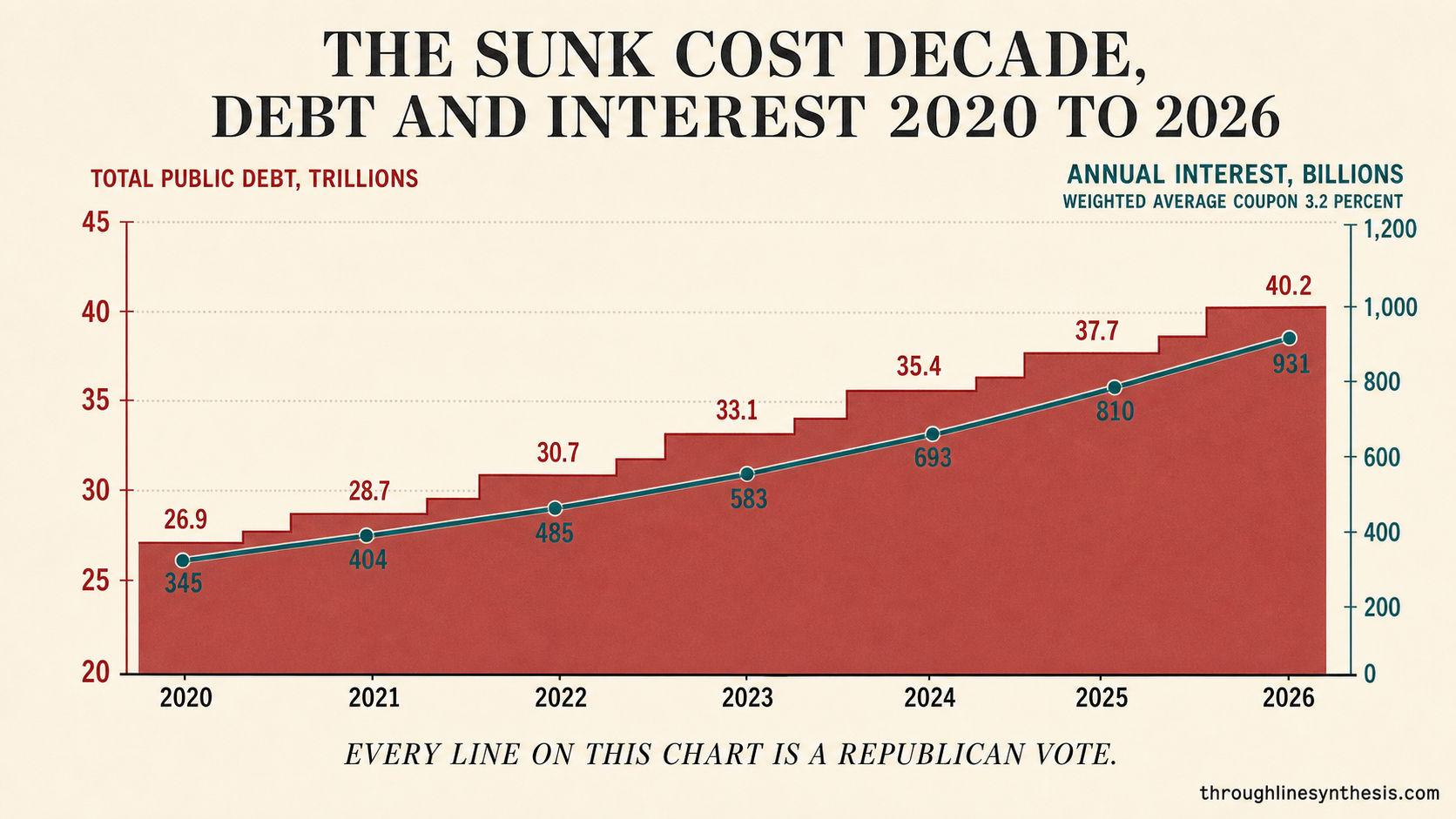
And it all gets financed against a shifted denominator. Total public debt outstanding was $26,945,391,194,615.15 on September 30, 2020 and $40,175,641,071,634.14 on August 31, 2026, an increase of roughly $13.2 trillion in six years (US Treasury Fiscal Data). Net interest was $345 billion in fiscal 2020, 1.6 percent of GDP (Congressional Budget Office). Interest costs reached $931 billion through July in fiscal 2026 after $970 billion in all of fiscal 2025, running at 3.2 percent of GDP (Peter G. Peterson Foundation interest tracker). The Congressional Budget Office says the government now spends more than $3 billion a day on interest (Fortune).
That is the ledger. Now watch the Treasury try to work it.
On August 19, 2026, Bessent raised the maximum size of Treasury buybacks of long-term debt from $2 billion to at least $4 billion per operation, targeting the ten- to thirty-year sector, without specifying how the buybacks would be funded. Market participants expect the repurchased bonds to be replaced with short-term bills. Wellington’s Brij Khurana pointed out that Treasury would have to issue more bills to fund the buybacks because it cannot print money. Treasury said on August 5 that it would keep issuing relatively more short-term debt. Bills are already 22.2 percent of outstanding Treasury debt, above the roughly 20 percent ceiling recommended by Treasury’s own Borrowing Advisory Committee. The Committee’s own minutes: “The Committee feels strongly that issuance is the primary tool for managing the debt profile.” Bessent criticized Janet Yellen in 2024 for exactly this kind of issuance skew. A 30-year bond issued in May 2020 with 24 years remaining traded at roughly 45 cents on the dollar (CNBC). CNBC’s follow-up on August 20, 2026: the efforts had not worked (CNBC).
That is what a sunk-cost cabinet does when it cannot pick. It shortens duration.
XI. Elite Overproduction, and the Path Out
Peter Turchin does not need convincing about the state of the American ruling class. In End Times: “When the equilibrium between ruling elites and the majority tips too far in favor of elites, political instability is all but inevitable.” Or: “In America, the wealth pump has been operating full blast for two generations” (peterturchin.com). The proxies he prefers are two: multi-millionaire households, which rose from 66,000 in 1983 to 350,000 in 2010, and law degrees, of which American law schools produce, “every year,” twice as many as there are jobs for, or about 25,000 “surplus” lawyers, many in debt (Turchin on cliodynamics and the 2016 election). The Complexity Science Hub adds the driver list: “stagnating or declining real wages, a growing gap between rich and poor, and overproduction of young graduates with advanced degrees” (CSH).
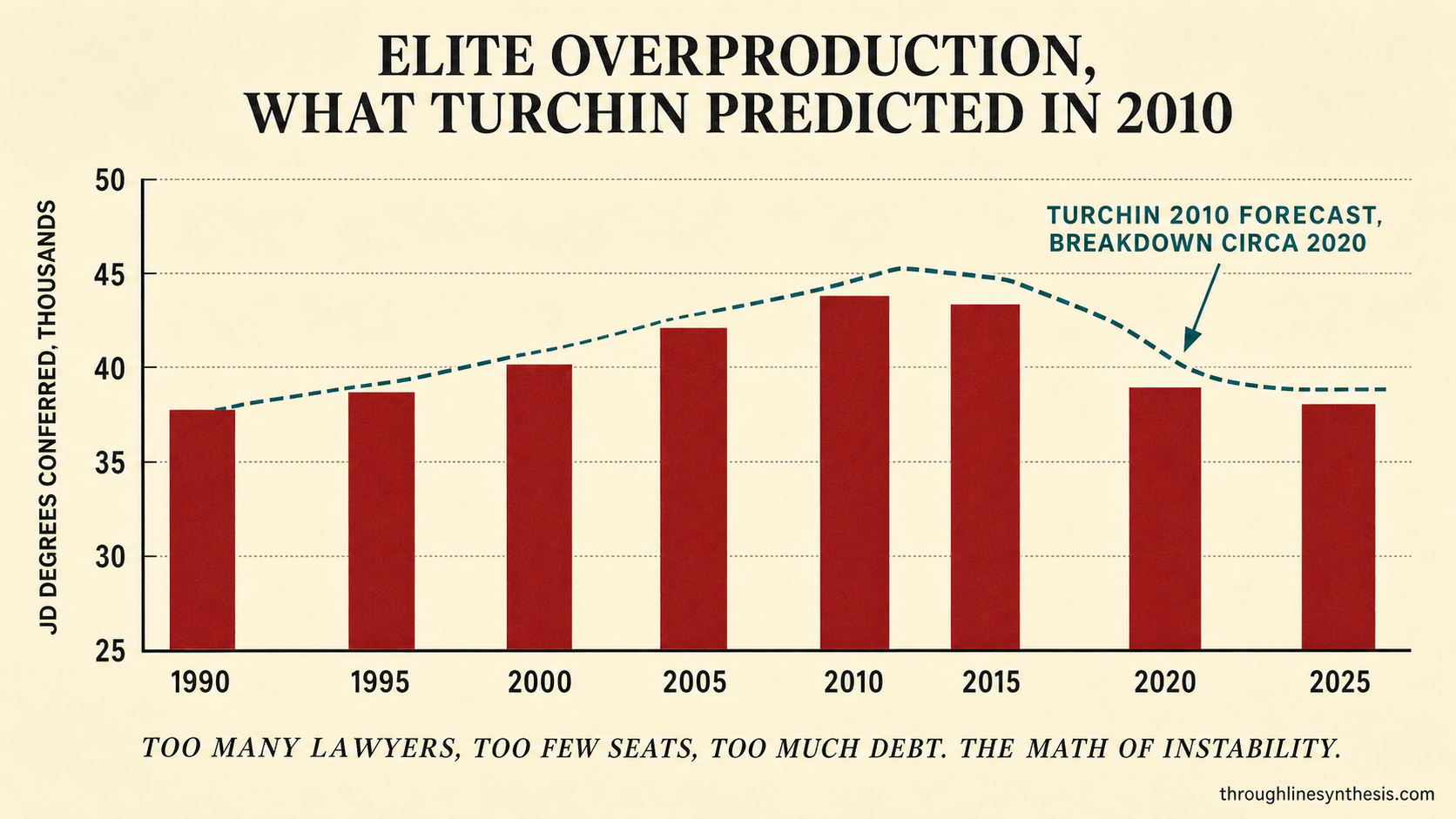
Turchin’s academic paper on the mechanism calls it, plainly, “a perverse ‘wealth pump’ that, under certain conditions, begins to transfer wealth from the ’99 percent’ to ‘1 percent'” (Turchin academic talk). The scarcity side, the fact that positions do not multiply with credentials, is his line: “only one POTUS, only nine high justices, 100 senators” (Turchin on the same). Fortune caught him in May 2026 with the update: “The benefits that you get with wealth are now being diluted because there are just too many wealth holders.” And: “There is overproduction of university degrees and the value of a university degree actually declines” (Fortune, May 3, 2026).
Read Campbell against Turchin. The Foreign Affairs essay is a document produced under precisely the conditions Turchin describes: too many strategists, too few empires, and a wealth pump that has ceased delivering new positions for the credentialed class. “How Alliances Survive” is not the work of a man designing a policy. It is a bid for a position, in a system where the number of positions has shrunk. Every senior appointment for a China hand under two administrations is now competed for by three or four ranks of hands beneath. The essays intensify to match the competition, not the threat.
The single most useful sentence in the Turchin corpus, for the present moment, may be his 2010 Nature forecast, from a paper written sixteen years ago: he predicted “a breakdown in the political order circa 2020” (peterturchin.com). He was, if anything, late by a year. But the prediction was not, in Turchin’s own account, about a discrete political rupture. It was about the beginning of a process that unfolds over decades, whose signature move is not one civil war but a permanent inability of the ruling class to hold its coalition together long enough to reverse a slide it can see clearly and analyze correctly.
That, at the end, is what “The 1914 Trade” actually looks like. It is not a war. It is a series of decisions, each defensible, each carefully footnoted, each written by a Deputy Secretary or a Treasury Secretary or a Foreign Office clerk, that in aggregate lock a rich, over-committed, over-credentialed empire into a posture from which retreat becomes impossible without the retreat itself confirming the loss.
Sachs and Mercouris, in September 2026, gave the case a language. The case is older than either of them. The Foreign Office made it in 1907 and won every war and lost the century. The American book runner and his prospectus writer have picked up the same pen.
They will not sell many of these bonds abroad. The buyers in Bishkek are, one is entitled to assume, done for the season.
Contact: so@throughlinesynthesis.com
The transcript of the September 1, 2026 Duran Podcast conversation with Jeffrey Sachs and Alexander Mercouris that seeded this article is available on request.