A note to the reader
I wrote this primer for the average adult who hasn’t spent the last two years reading trade press about artificial intelligence, and who is entitled to understand what is happening to a trillion-dollar capital cycle being paid for out of his utility bill, his pension fund, and his federal budget. I explain every technical term the first time I use it. I have not simplified the argument; I have simplified the vocabulary. When I say the race has already been lost, I mean it in the specific sense that a professional analyst means it, and I show my work.
Part I: The question
An American reader wrote to me last week and asked, in effect, the following. If the American technology giants are pouring hundreds of billions of dollars into artificial intelligence, and if the Chinese are giving away a product that is roughly as good for something close to zero, how does the American bet possibly pay off? And if it does not pay off, what happens to the country that is financing it?
That is the correct question. Nobody in Washington is asking it out loud, because the answers are catastrophic for the balance sheets of about six of the ten largest companies in the United States, and for the retirement accounts of roughly one hundred and fifty million American households whose index funds hold those six stocks. I am going to answer it here, plainly, and I am going to show you the numbers that make the answer inescapable.
The short version is this. The American approach to artificial intelligence, which is to spend more money on more chips and more electricity than any other country on earth in the hope of building a proprietary product that customers must rent from you, is running against a Chinese approach that gives the product away and makes its money elsewhere. On price, the Chinese are between twenty and two hundred times cheaper for equivalent quality. On performance, the Chinese have closed the gap to within two to four percentage points on every serious public benchmark, and they now lead on several of the most important. On security, the Chinese product is architecturally more trustworthy for any customer not domiciled in the United States, because the American product can be revoked by executive order and the Chinese product cannot. The race, framed as a race, is already over. What is left is the settlement, and the American public will pay it.
That is the argument. Let me now walk you through it.
Part II: What is a hyperscaler, and what is capital expenditure
Two terms first, because the whole story turns on them.
A hyperscaler is a very large operator of computer data centers that rents out computing power to other companies. There are five in the United States, and one is not really American in the way the others are. Microsoft, Alphabet (the parent company of Google), Amazon, Meta (the parent company of Facebook and Instagram), and Oracle. Between them, they own or lease essentially every commercially significant piece of American cloud computing infrastructure. When you use Gmail, or Netflix, or any application on your phone that requires a live server somewhere, you are almost certainly using one of their data centers.
Capital expenditure, which is universally abbreviated as capex, is the money a company spends on physical assets that last many years. A steel mill’s blast furnace is capex. A pipeline is capex. A data center full of chips is capex. Capex differs from operating expense, which is the money spent this year to run the business, because capex creates a physical thing that appears on the balance sheet and gets written down slowly over its useful life.
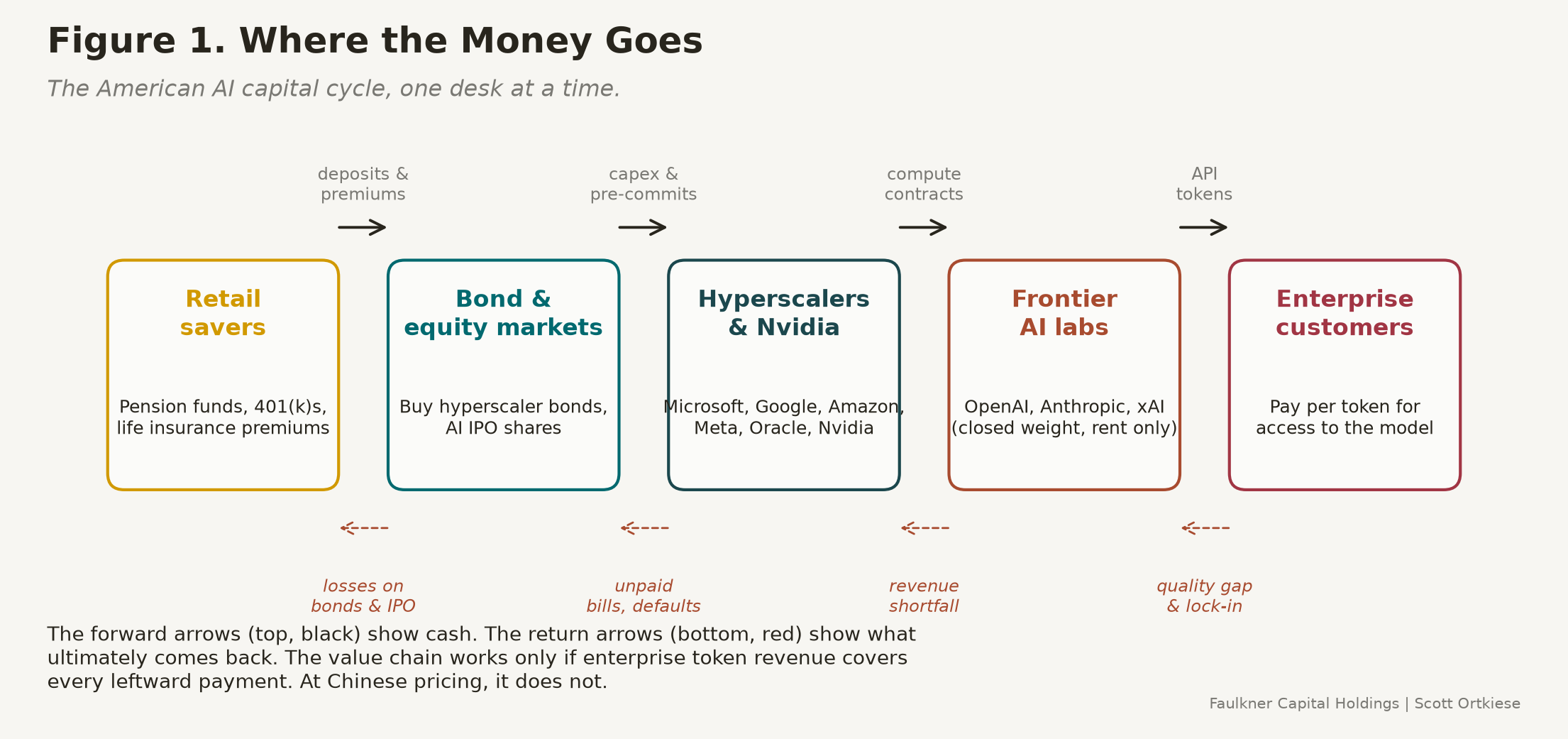
The hyperscalers are, at this moment, in the middle of the largest capex program in world history. In 2025 they collectively spent roughly $350 billion on data centers and chips. In 2026 the figure is guided to exceed $500 billion. Between now and 2030, the announced total, if it is all executed, is somewhere between two and three trillion dollars. For scale, the entire Marshall Plan, which rebuilt Western Europe after the Second World War, cost about $175 billion in today’s money. The hyperscalers are running a Marshall Plan every four months, entirely on the promise that artificial intelligence will pay it back.
Part III: What they think they are building, and why
The hyperscalers, together with three private companies at the front of the line, are building the physical infrastructure to run a class of software called large language models, which the industry now abbreviates as LLMs. A large language model is a computer program that has been trained by reading essentially every text ever published on the open internet, plus a large fraction of every published book, and that can then generate new text in response to a question. ChatGPT is a large language model. Claude is one. Google Gemini is one. Grok is one.
The three private companies at the front are OpenAI, which makes ChatGPT and whose largest investor is Microsoft; Anthropic, which makes Claude and whose largest investors are Amazon and Google; and xAI, which makes Grok and which sits inside Elon Musk’s SpaceX. These three are the customers the hyperscalers are building for. Every dollar of hyperscaler capex is, in the end, a bet that OpenAI, Anthropic, and xAI, plus a few smaller players, will generate enough revenue to pay the hyperscalers back for the data centers and chips.
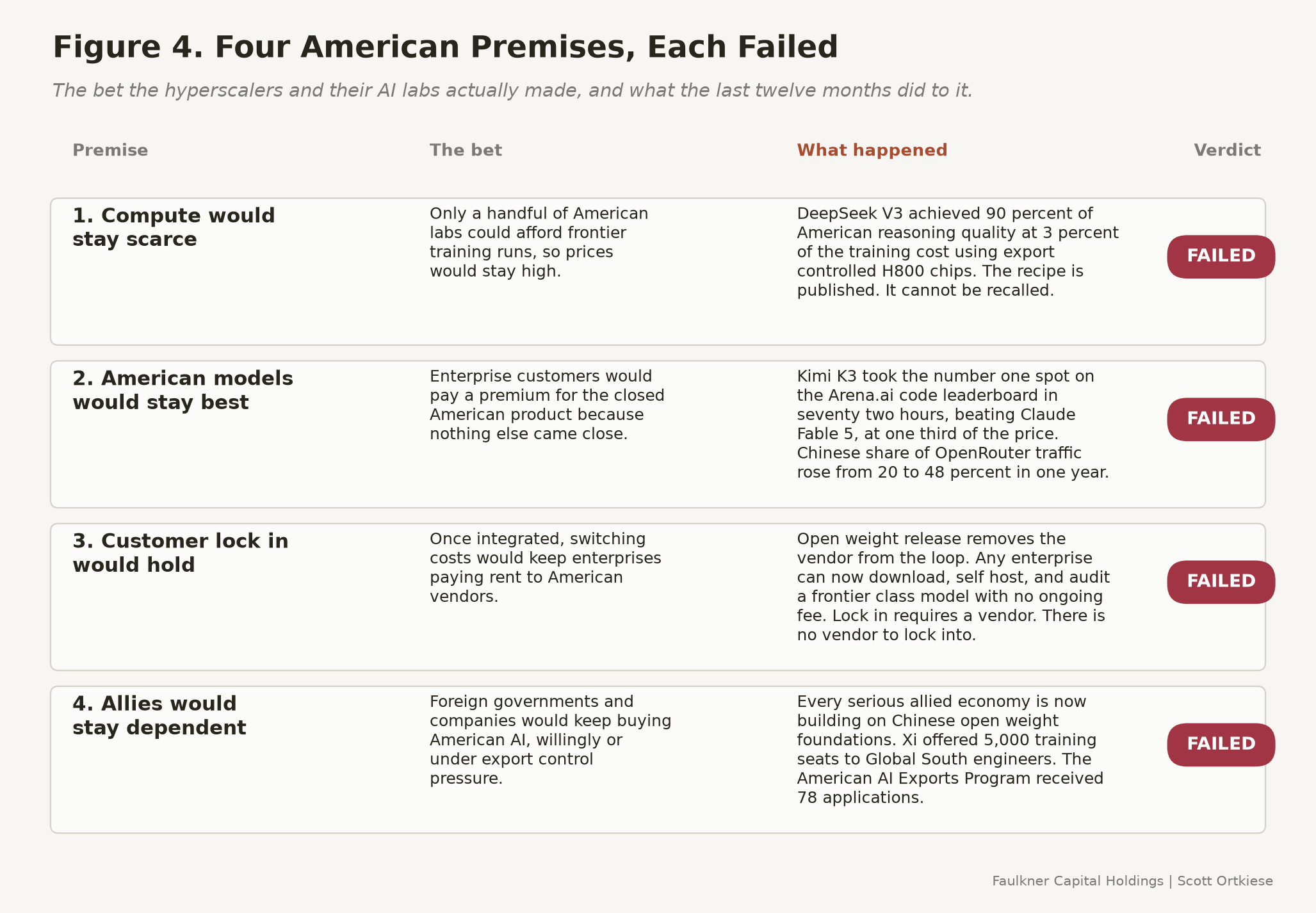
The American strategy has four premises, which are almost never stated out loud but which every industry participant privately holds.
Premise one, scarcity. Only a handful of American companies can afford the chips and the electricity to train frontier models, so the market will remain an oligopoly and prices will stay high.
Premise two, quality. American models will remain meaningfully better than everyone else’s models, so customers will pay a premium to use them.
Premise three, lock-in. Once customers integrate an American model into their workflow, switching costs will be high enough to keep them paying.
Premise four, allies. Foreign governments and foreign companies will keep buying American AI, either because the American product is best or because Washington will make sure they cannot buy anyone else’s.
Every one of the four premises has failed in the last twelve months. I will show you each failure in turn, because the failures are what killed the race, and because the failures are what determine everything that follows.
Part IV: The Chinese counter-model, and why it is not what the American and European newspapers describe
Before I show you the failures, I need to explain what the Chinese are actually doing, because the American press has uniformly misdescribed it.
Seven Chinese laboratories are now producing artificial intelligence models at the frontier of world capability. The main names to know are DeepSeek, which is a subsidiary of a hedge fund called High-Flyer Quant; Alibaba, which publishes a model family called Qwen; Moonshot AI, which publishes a model called Kimi; Zhipu, which publishes a model called GLM; Tencent, which publishes Hunyuan; Baidu, which publishes ERNIE; and MiniMax. Every one of them publishes what the industry calls open-weight models.
An open-weight model, and this is the term you must remember, is a trained artificial intelligence whose final parameters are released publicly, usually under a permissive license such as Apache 2.0 or MIT. Any person, company, or government on earth can download the file, run it on their own computers, modify it, sell products built on top of it, and pay the original lab nothing. The training data and the training procedure are usually kept private, but the finished product is public.
The American press keeps calling these models “open-source.” That is not quite right. Open-source in the software sense would require the training data and the training recipe to be published as well, and none of the Chinese labs do that. The correct term is open-weight, which is a narrower and more honest description. When you see American commentary say “the Chinese open-source AI,” what they mean is the Chinese open-weight AI. The distinction matters because open-weight is the more common industry practice, and because the Chinese labs have deliberately chosen it as a strategic weapon. I will explain why in Part VIII.
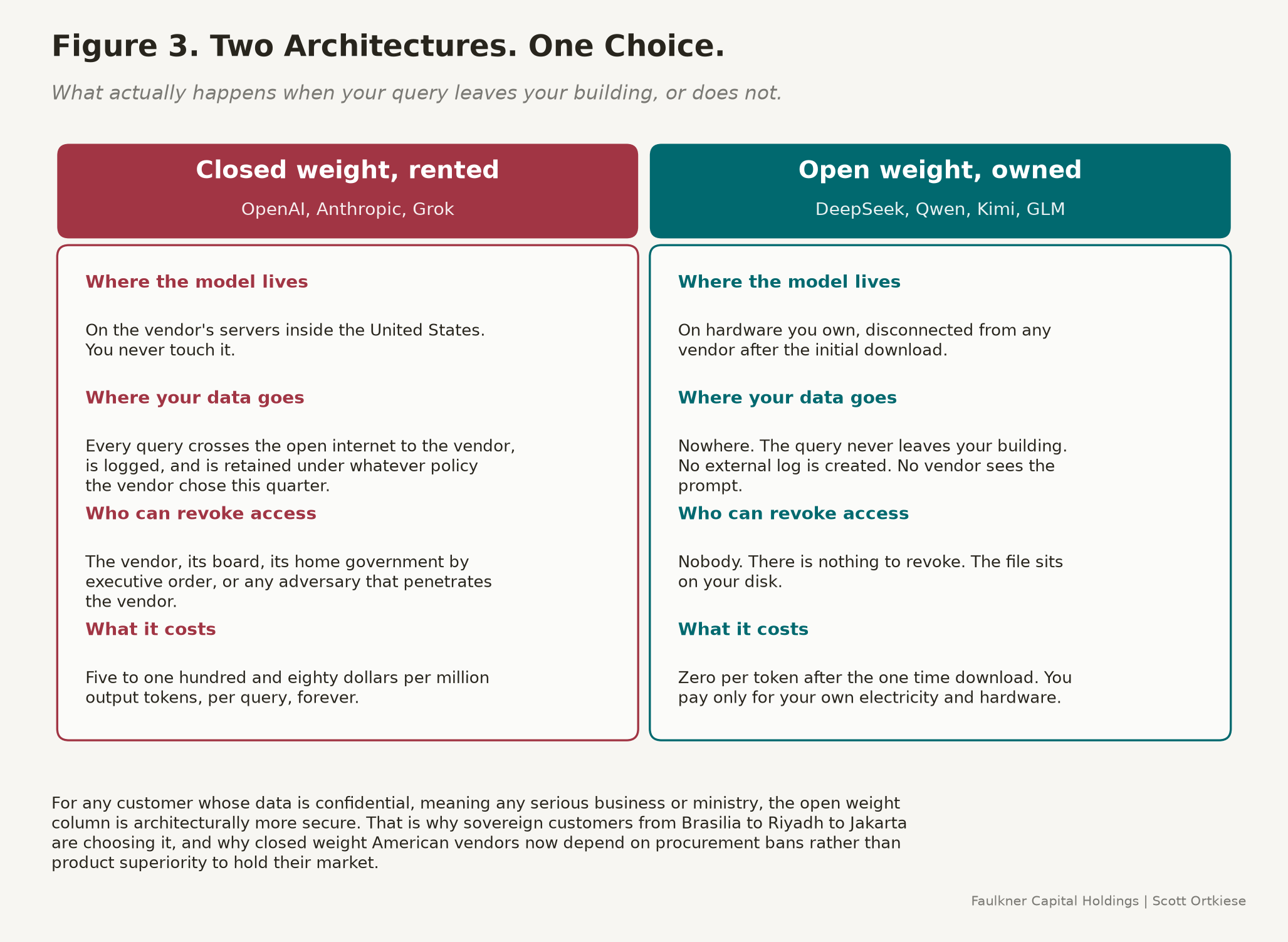
The American labs, by contrast, publish nothing. OpenAI’s GPT models, Anthropic’s Claude models, and Musk’s Grok models are all closed-weight. You can rent access to them, one query at a time, through what the industry calls an application programming interface, universally abbreviated as API. Every query you make travels over the public internet to a server owned by the vendor, is processed there, and the answer comes back to you. The model itself never leaves the vendor’s building. If the vendor decides to cut you off, or if the vendor’s government decides to cut you off, your access ends the moment the switch is thrown.
Hold those two words, open-weight and closed-weight, in your head. They are the whole story.
Part V: The failure of premise one, scarcity
The scarcity premise died on 20 January 2025, when DeepSeek released a model called V3, and then a reasoning model called R1, that matched the performance of the American frontier on standard tests at approximately three percent of the training cost.
DeepSeek achieved this using Nvidia H800 chips, a deliberately downgraded version of Nvidia’s flagship chip that Nvidia is permitted to sell into China under American export controls. The full-fat H100 and H200 chips are restricted. The Chinese engineers were forced to work with slower hardware, and in response they invented a family of architectural tricks, most importantly what is called a mixture of experts, that use each chip roughly ten times more efficiently than the American labs were bothering to.
A short definition is worth pausing for. A model’s parameters are the trained numerical values that define its behavior, the hundreds of billions or trillions of numbers the model adjusted during training and then froze. In a conventional model, every parameter is used to answer every query. In a mixture-of-experts model, only a small fraction of the parameters, typically five to fifteen percent, is used to answer any single query, and the rest sit idle. The model can therefore be much larger overall without costing proportionally more to run. Kimi K3’s 2.8 trillion parameters, mentioned later in this primer, activate only a fraction of that total on each query. This is the architectural trick that lets Chinese laboratories serve frontier-quality answers at a fraction of American cost.
When the DeepSeek paper was published, American labs read it, immediately understood the techniques couldn’t be uninvented, and knew their entire cost structure was now obsolete.
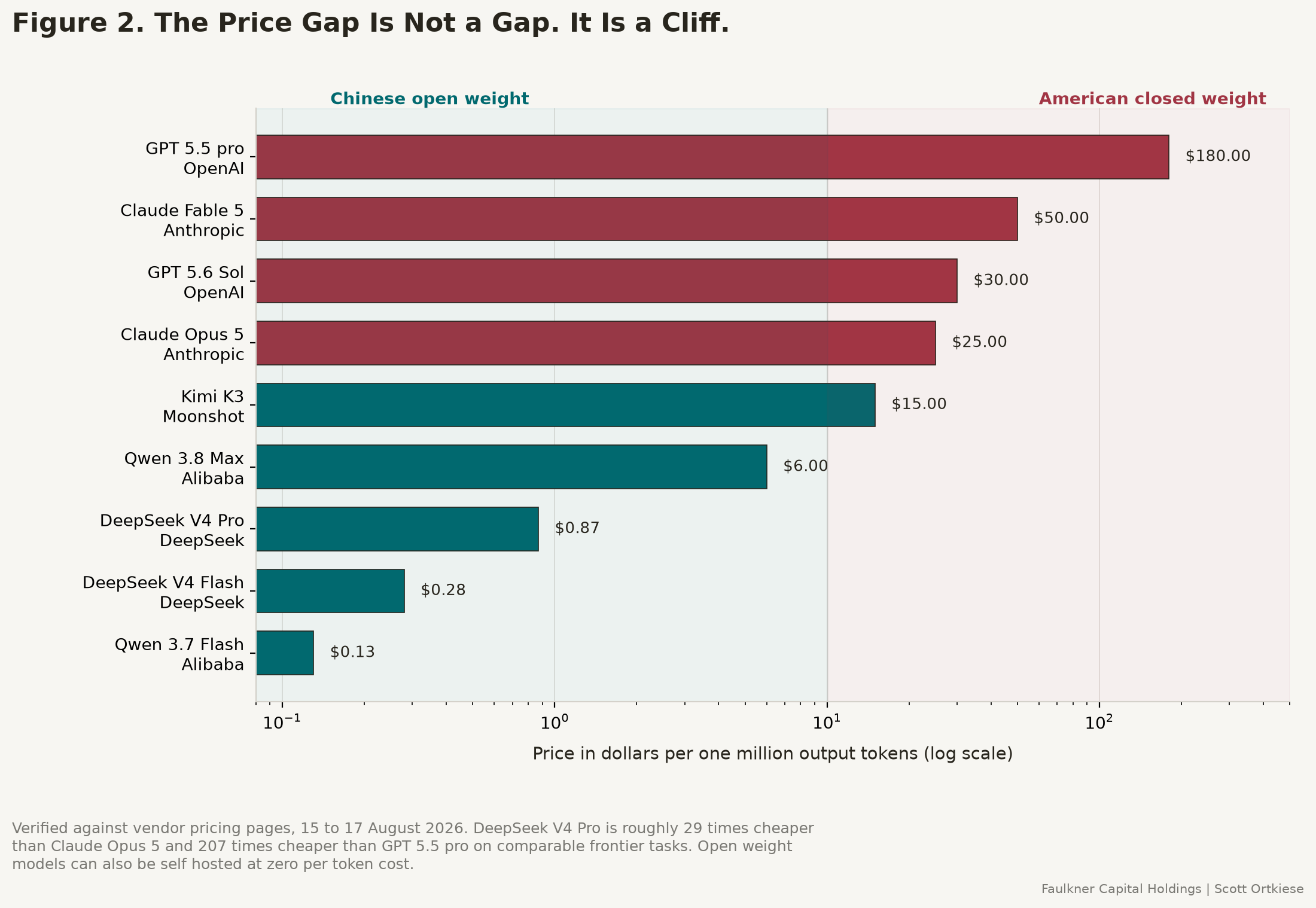
DeepSeek’s next model, called V4 Pro, is currently priced at $0.87 per one million output tokens. A token is roughly three-quarters of an English word, so one million tokens is roughly seven hundred and fifty thousand words. Anthropic’s Claude Opus 5, which is broadly comparable in quality, is priced at $25.00 per one million output tokens. OpenAI’s GPT-5.5-pro is priced at $180.00 per one million output tokens. On the same task, DeepSeek is twenty-nine times cheaper than Claude Opus 5 and two hundred and seven times cheaper than GPT-5.5-pro.
That is not a competitive gap. That is a two-orders-of-magnitude gap. In American industrial history, a competitor that offers you the same product at one-thirtieth the price ends your business. Japanese automakers ended Detroit at roughly a twenty percent price advantage. Korean shipyards ended Glasgow at roughly a thirty percent price advantage. Chinese solar panels ended German solar at roughly a fifty percent price advantage. The gap between American and Chinese AI is thirty times larger than the gap that killed Detroit. It cannot be closed by working harder. Clever marketing can’t close it. It can only be closed by making Chinese AI illegal for Americans to buy, which is precisely what Washington is now attempting.
The scarcity premise is dead. Compute is not scarce. Efficient compute is abundant, and the recipe for making it abundant has been published.
Part VI: The failure of premise two, quality
The quality premise died in the summer of 2026, in a specific and datable sequence.
On 16 July 2026, Moonshot AI in Beijing released a model called Kimi K3. Kimi K3 is a mixture-of-experts model with 2.8 trillion parameters, released under an open-weight license. Within seventy-two hours of the weight release on 27 July 2026, Kimi K3 took the number one spot on the world’s leading independent benchmark for front-end code generation, the Arena.ai leaderboard. It beat Anthropic’s flagship model, Claude Fable 5, which is the single benchmark on which Anthropic built its brand.
Kimi K3 is priced at $15 per one million output tokens. Claude Fable 5 is priced at $50 per one million output tokens. GPT-5.5 sits between them at roughly $30. On the specific task that Anthropic had spent two years and roughly $50 billion of investor capital building a business around, a Chinese laboratory selling at less than one-third of Anthropic’s price took first place in three days.
Moonshot AI had to suspend new subscriptions two days after the release because demand overflowed its Chinese data center capacity. That is a Chinese company running out of Chinese hardware because too many Western customers were trying to buy their product.
The American frontier laboratories, OpenAI and Anthropic in particular, still have a small edge on the very hardest reasoning problems. On a small number of very specialized tests, they are one to three percentage points ahead. I concede that on the record, because the argument doesn’t depend on them being behind on every benchmark. It depends on their being behind on the benchmarks that make money.
The benchmarks that make money are code generation, customer support automation, document summarization, retrieval-augmented question answering, and multilingual translation. On every one of those, Chinese open-weight models are either at parity or ahead, and they are priced at somewhere between one-twentieth and one-two-hundredth of the American price. American labs are still the fastest runners in a race the market has already decided to hold in a different arena.
The clearest independent evidence for this is a service called OpenRouter. OpenRouter is a routing platform, financially independent of any AI lab, where developers worldwide pay per query and can choose among competing models. It is closer to a genuine revealed-preference market than any survey. In the last week of June 2026, OpenRouter reported that Chinese models handled forty-eight percent of routed traffic, up from twenty percent a year earlier. American models handled thirty-two percent, down from seventy-four percent a year earlier. In one calendar year, on the most honest independent measure of what the world’s developers actually use, American AI lost forty-two points of market share to Chinese AI.
That is not a warning shot. That is a completed retreat.
Part VII: The failure of premise three, lock-in
The lock-in premise died the moment Chinese labs published weights that customers could download and run inside their own buildings.
An enterprise customer, meaning a bank or a hospital or a manufacturer, uses artificial intelligence for a few specific jobs. Automating customer service. Summarizing long documents. Writing draft code. Extracting data from invoices. Translating between languages. Answering employee questions about internal policy. A Chinese open-weight model can do every one of those jobs today on hardware the customer already owns, with the customer paying exactly zero dollars in per-query fees to any external vendor.
Compare that to the American product. Every OpenAI query, every Anthropic query, every Grok query, travels over the public internet to a data center owned by the vendor, is processed there against a model the customer cannot inspect and comes back with a bill attached. The customer’s questions are logged on the vendor’s servers, subject to the vendor’s retention policy, and potentially discoverable by the vendor’s home government through legal process the customer cannot see or contest. Every model update changes the software in the customer’s workflow without the customer’s consent. Every price change is one email away.
For any customer whose data is confidential, and that includes essentially every serious business on earth, the open-weight option is architecturally superior. The lock-in the American laboratories were counting on assumed that customers could not run frontier models themselves. That assumption survived exactly as long as Chinese labs were unwilling to publish weights at frontier quality. They started publishing them in January 2025. They have published progressively better ones every quarter since. The lock-in is gone.
Part VIII: The failure of premise four, allies
The final American premise, that allied governments and allied companies would continue to buy American AI, has failed for reasons Washington itself created.
Between 2022 and 2026, the American government extended its export controls on artificial intelligence in three stages. First, it restricted the sale of the most powerful Nvidia chips to China. Then it restricted the sale of chips to any country that might resell to China. Then, in the spring of 2026, it restricted access to American cloud-based models themselves, cutting foreign researchers off from Anthropic’s Claude Fable 5 with less than seventy-two hours’ notice.
Every allied capital and every foreign researcher took the same lesson. American artificial intelligence is politically revocable infrastructure. If a foreign government builds its banking system, its hospital records, its power grid, its tax administration, or its defense communications on top of an American model, the American executive branch retains the option, unilaterally and without appeal, to switch that infrastructure off. Sovereigns respond to that discovery the way they responded to the weaponization of the SWIFT interbank messaging network after 2014 and to the freezing of Russian dollar reserves in 2022. They build alternatives.
Every serious economy on earth is now building its own AI stack, and every one of them is building it on Chinese open-weight foundations because they’re the only frontier-quality software they can lawfully own outright. Europe’s Mistral. India’s Sarvam and Krutrim. Japan’s Sakana. South Korea’s HyperCLOVA. The Gulf’s G42 and Humain. Brazil, Indonesia, Nigeria, and South Africa are in early procurement discussions based on Qwen and DeepSeek. Xi Jinping announced at the World AI Conference in Shanghai on 17 July 2026 that China will train five thousand engineers from developing countries at Chinese expense over the next several years. That is not aid. That is architecture, laid down for the next twenty years.
The American response has been the American Artificial Intelligence Exports Program, launched with fanfare in the spring of 2026 by Michael Kratsios, who is the Trump administration’s science and technology adviser. The program aimed to place American AI stacks inside allied ministries around the world. It received seventy-eight applications. That is not seventy-eight thousand. That is seventy-eight. A rounding error in a market of two hundred sovereign states, formally announcing that foreign governments have already decided American AI is too politically risky to build their futures on.
Part IX: What the hyperscalers have already committed, and to what
Let me now show you the size of the American bet, so that the scale of what is being lost is legible.
I said earlier that the hyperscalers are spending roughly $500 billion in 2026 on data centers and chips. That figure understates the commitment, because it counts only current-year capex and misses the multi-year pre-commitments the hyperscalers have signed with OpenAI, Anthropic, and Musk to keep the machines busy after they are built.
Here is the current tally as of August 2026.
OpenAI has pre-committed more than $600 billion in cloud infrastructure payments over the next several years, split among Microsoft, Oracle, and CoreWeave. OpenAI itself has roughly $73 billion in cash on hand and is losing roughly $25 to $27 billion this year against a run-rate revenue of about $25 billion. In 2027, when the Microsoft compute contract renegotiates, the cash burn is guided to rise to $57 to $63 billion. OpenAI’s own internal planning projects cumulative losses through 2030 of roughly $218 billion in the slower-revenue scenario. At the current rate, the cash runs out in five years. At the 2027 rate, it runs out in eighteen months.
Anthropic has pre-committed roughly $45 billion in compute payments to xAI, at $1.25 billion per month through May 2029, disclosed in SpaceX’s S-1 filing with the Securities and Exchange Commission in May 2026. It has additional multi-billion commitments to Amazon and Google. Anthropic’s cash position is smaller than OpenAI’s, its revenue accounting is now a subject of formal dispute with OpenAI in front of the Securities and Exchange Commission, and its confidential draft prospectus for a public offering was filed on 1 June 2026, ten weeks after it closed a $65 billion capital raise at a $965 billion valuation. The ten-week gap is the tell. Anthropic’s bankers filed because they knew the third quarter numbers would make the valuation impossible to justify by the fall.
SpaceX and xAI went public in June 2026 at a $1.77 trillion target valuation. The xAI segment in the filing showed $3.2 billion in revenue against a $6.4 billion operating loss for fiscal 2025, a negative two-hundred-percent operating margin. In the first quarter of 2026 alone, xAI’s operating loss expanded to a negative three-hundred-and-two-percent margin. SpaceX’s cash position fell from $24.75 billion to $15.85 billion in a single quarter, and in June the company priced $25 billion of new bonds at 5.35 to 5.65 percent, roughly $1.5 billion per year in new interest expense, to replace the previous debt stack at Musk’s companies, which had been running at 9.5 to 12.5 percent. He is levering into a bond market that is already asking for wider spreads on hyperscaler paper.
Across the three companies, the American AI IPO complex holds roughly $100 billion of cash, is burning $50 to $60 billion of it per year in aggregate and has pre-committed north of $700 billion of cloud infrastructure payments over the next several years to the hyperscalers that are, in turn, spending roughly $2 trillion of their own capital on the physical build. The whole tower is held up by an equity market willing to buy $3.6 trillion of new AI-related offerings at valuations that require every one of these companies to reach cash flow positive by the end of the decade.
Not one of them will reach cash flow positive by the end of the decade at Chinese pricing. Not one.
Part X: The Nvidia problem, and the circular flow
There is one more piece of the picture I must include, because it is the mechanism by which the American loss will be transmitted from private companies to the public markets.
Nvidia is the semiconductor company that designs the specialized chips, called graphics processing units or GPUs, that every artificial intelligence data center in the world runs on. Nvidia is not a hyperscaler. It is a supplier to hyperscalers. Its market capitalization as of August 2026 is roughly $4.5 trillion, which makes it the largest company in the world by that measure. That valuation is built entirely on the expectation that the hyperscalers, and OpenAI, Anthropic, and xAI, will continue buying its chips at present rates for at least another five years.
Here is what Nvidia has begun doing, according to reporting by Ed Zitron of Where’s Your Ed At and the Better Offline podcast, in conversation with Isaac Pound of the Tech Report on 14 August 2026.
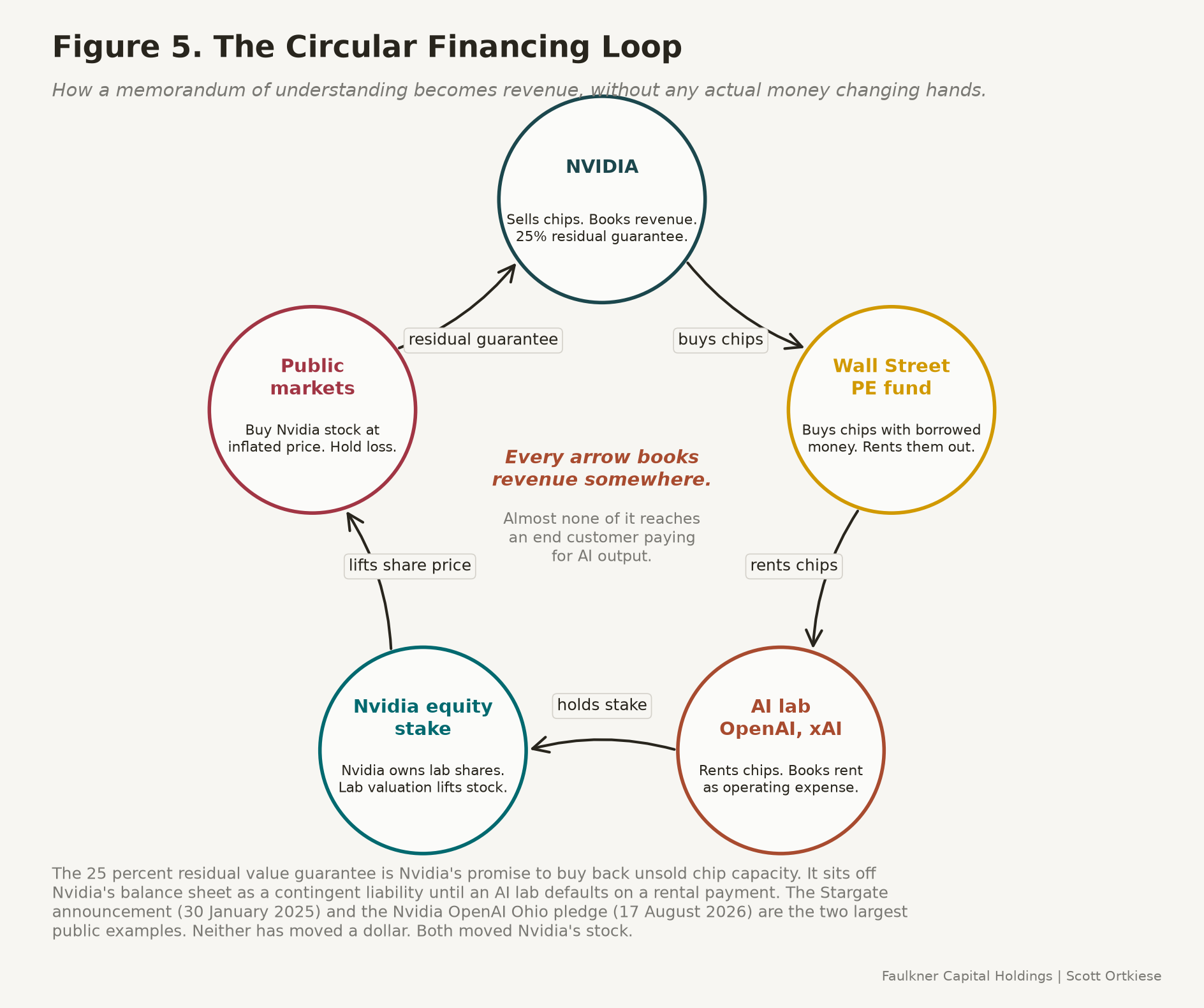
Nvidia has begun what is called circular financing. It has extended a twenty-five percent residual value guarantee to Wall Street investment firms that agree to buy Nvidia chips. Those investment firms then rent the chips to artificial intelligence companies in which Nvidia is itself an investor. Nvidia books the chip sale as revenue. The investment firm books the rental as revenue. The artificial intelligence company books the rental as an operating expense against a revenue line that does not yet exist. Nvidia’s share price rises on the revenue. The residual value guarantee sits off Nvidia’s balance sheet as a contingent liability that will only appear if the artificial intelligence company fails to pay.
Ed Zitron’s phrase for what this has become is exact: “the world’s largest marketing campaign.” Over the next three and a half years, the industry needs somewhere between $800 billion and $1.2 trillion of end-market data center demand to justify current announced construction. Zitron, whose specialty is auditing public filings against industry press releases, has found roughly $130 billion of that demand actually contracted. The rest is memoranda of understanding, announced funds that have never been funded, and residual value guarantees whose terms Nvidia has explicitly declined to define.
The single most notorious example is Stargate, a $500 billion artificial intelligence infrastructure fund announced from the Oval Office on 30 January 2025 by President Trump, alongside Sam Altman of OpenAI, Masayoshi Son of SoftBank, and Larry Ellison of Oracle. SoftBank and OpenAI were each supposed to contribute $19 billion of initial equity. Both contributed zero. No limited liability company was ever formed. What ended up happening is that Oracle built some data centers, and OpenAI began pointing at them and calling them “Stargate data centers.” That is the entire mechanism of a $500 billion announced fund.
More recently, on 17 August 2026, Nvidia announced a $100 billion pledge to back an OpenAI data center in Ohio (The Tech Report on YouTube discussion with Adam Norlund). The pledge is another memorandum of understanding. No money has been raised. No fund exists. The pledge exists to move Nvidia’s share price on the day of the announcement and to give Sam Altman a story to tell his own investors.
At the same time, the American thirty-year Treasury bond yield rose to its highest level since 2007. Nvidia and Musk and Altman are attempting to sell artificial intelligence bonds into a market where the American government is simultaneously trying to sell war bonds and refinance an existing $37 trillion debt stack at rising rates. There is not enough demand for both. Something breaks.
Part XI: Why the American and Chinese return models are structurally different
Now the answer to the question underneath the question, which is how the Chinese can price at pennies on the American dollar and stay solvent.
The two sides are running completely different businesses.
The American return model is rentier extraction. The American laboratories raise enormous private capital, spend it on multi-year compute contracts with the hyperscalers, train closed-weight models whose parameters they never publish, and then charge customers between $5 and $180 per million tokens for the right to rent access. Their entire business model requires token prices to stay high and volume to grow fast enough to cover the capex. Both conditions are now failing.
The Chinese return model is distribution. The Chinese laboratories are subsidiaries or affiliates of much larger businesses that make their money elsewhere. Alibaba’s business is cloud infrastructure plus e-commerce advertising plus Ant Group financial services. DeepSeek’s business is High-Flyer Quant’s proprietary trading in Chinese equities. Tencent’s business is WeChat and gaming. Baidu’s business is search and autonomous driving. ByteDance’s business is TikTok and Douyin. Moonshot AI sits within a coalition led by Meituan, the largest food delivery and local services company in China. Not one of them depends on artificial intelligence token revenue to be profitable, because artificial intelligence is not their product. Artificial intelligence is a loss leader that pulls developers and enterprises onto the platform, where they sell their real products.
There is a second, larger asymmetry. The Chinese state underwrites the compute. Chinese laboratories train on subsidized electricity, receive tax preferences, and enjoy access to domestically produced Huawei Ascend chips and gray-market Nvidia chips at prices Americans do not see. The training bill is not being repaid out of inference revenue, meaning the fees customers pay to run queries against the finished model. It is being amortized against national strategic objectives, and the objectives are stated openly in the 14th and 15th Five-Year Plans.
There is a third asymmetry. Open-weight release is a geopolitical weapon. Every time DeepSeek, Alibaba or Moonshot publishes a state-of-the-art model under an Apache 2.0 license, it detonates the pricing power of closed-weight American labs, because any customer on earth can now download the equivalent for free. The Chinese labs pay nothing to release the weights (see note below), because the weights were never their product. The American labs cannot release theirs, because the weights are the entire product. If Sam Altman were to publish GPT-5.6 tomorrow, OpenAI’s capital structure would collapse within a week. He is trapped inside the model his own investors financed.
Note. A model’s weights are the trained parameters, the hundreds of billions of numerical values that encode what the model has learned. To download the weights is to download the finished model.
The Chinese are not competing on token margin. They are competing on distribution, meaning how many developers, governments, and enterprises around the world adopt their models as the default substrate, and on geopolitics, meaning how much diplomatic and standard-setting power accrues to Beijing when the world’s AI runs on Chinese weights. The Americans built a rentier business. The Chinese built a Trojan horse. The Trojan horse wins.
Part XII: The security dimension, in plain English
The security argument for closed American AI, as it is made in Washington today, is roughly this. American models are safer because American regulators can inspect them, and because their vendors are subject to American law. Chinese models are dangerous because they might contain backdoors, and because their vendors are subject to Chinese law.
The argument is obviously backward for every customer not domiciled in the United States, and it is equally backward even for customers who are.
Consider what a closed-weight API model actually does when you use it. Every query you type is transmitted over the public internet to a server inside the United States. Your prompt, which frequently contains confidential business information, medical records, or attorney-client communications, is decrypted at the vendor’s end, processed against a model whose parameters you cannot inspect, and returned to you along with a log entry retained on the vendor’s servers under whatever retention policy the vendor has chosen this quarter. That log is potentially discoverable by the vendor’s home government through legal process the customer will never see and cannot contest. It is potentially discoverable by any adversary that penetrates the vendor’s infrastructure, which happens roughly once per quarter to a large American technology company. It is potentially subject to a national security letter that the vendor is legally prohibited from telling you about. And the model itself can be silently updated between your query yesterday and your query today, without your consent, in ways you cannot detect.
Consider now what a downloaded open-weight model does. You download the parameters once, over the public internet, onto hardware you control. You inspect the file. You run it inside your own network, disconnected from the vendor forever if you choose. No query ever leaves your building. No log is created outside your walls. No adversary reaches your data through the vendor, because the vendor is not in the loop. If a security researcher publishes a vulnerability in the model architecture, you can patch it or refuse to patch it on your own schedule. If the vendor tries to revoke your access, you laugh and keep working, because there is nothing to revoke.
For a bank, a hospital, a defense contractor, a national ministry, a law firm, or an intelligence service, the calculation is not close. Open-weight is architecturally more secure, and closed-weight is architecturally more compromised; no amount of American vendor safety marketing changes that. Chinese labs understand this and have optimized for it. American labs cannot follow, because their business model does not permit it. The gap widens every quarter.
Part XIII: What losing the race actually means
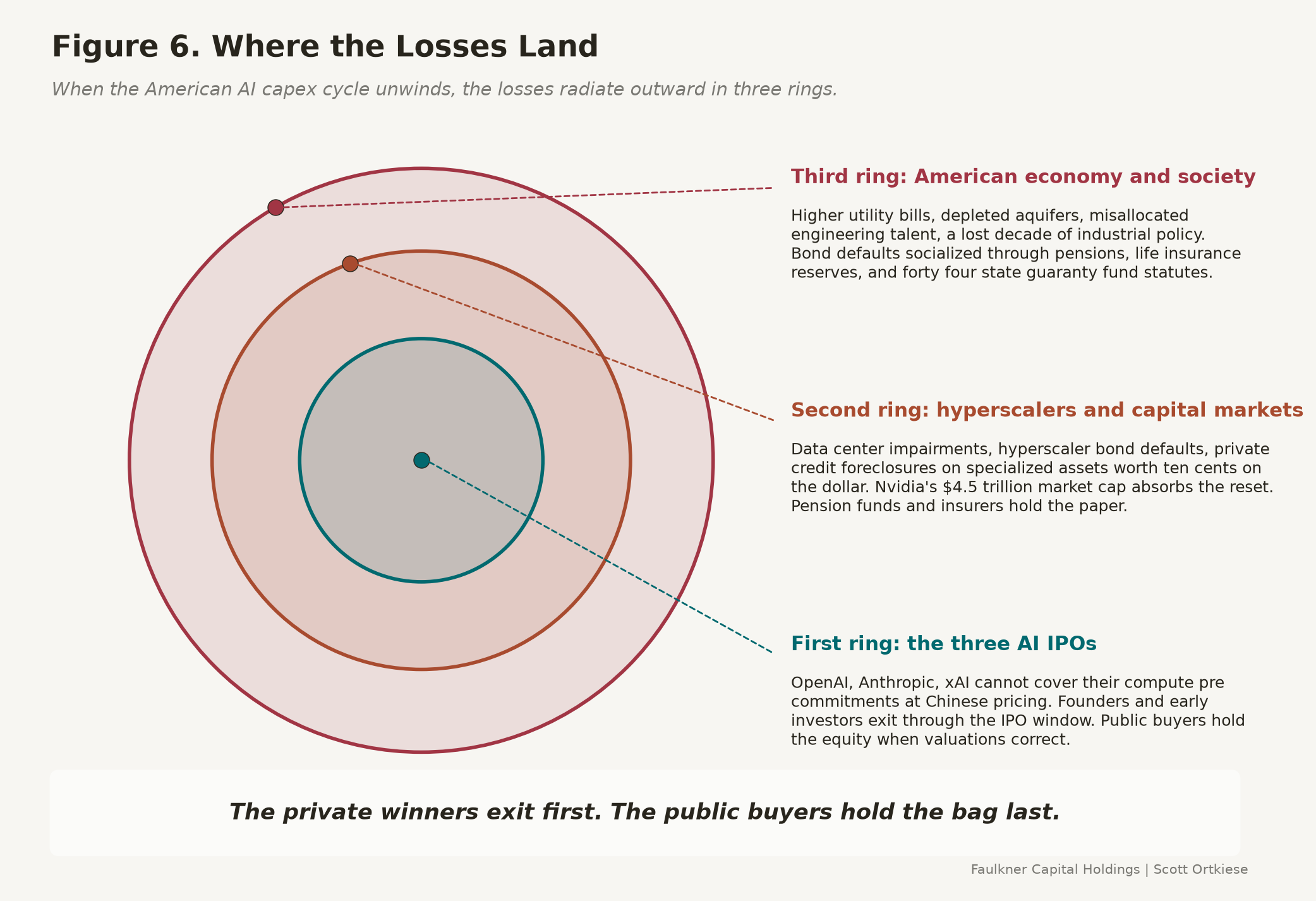
I have now shown you the failure of every American premise, and the size of the American bet that depended on those premises being true. Let me tell you what happens next, in three concentric circles.
First circle: the private companies at the front
OpenAI, Anthropic, and xAI cannot survive Chinese pricing on any honest revenue projection. The math is not close. Their current valuations, which run to nearly a trillion dollars each, depend on token prices staying near where they are for at least five years. Token prices will not stay near where they are, because Chinese laboratories have decided they will not, and because Chinese laboratories do not need token prices to be profitable.
The three companies will attempt, and are attempting, to secure regulatory protection from Washington. A bill was introduced in Congress in June 2026 to bar Chinese AI models from federal agencies. The White House imposed a cybersecurity review in late June 2026 that limited OpenAI’s newest model to administration-approved customers, functionally an export control run domestically. A proposal for a five percent government equity stake in OpenAI has resurfaced. The next telegraphed step is a directive under existing export control authorities to bar American cloud providers from hosting Chinese open-weight models, which would in practice force Microsoft Azure, Amazon Web Services, and Google Cloud to unwind the Kimi K2 and K3 integrations their own enterprise customers just demanded.
Every one of these instruments is a bailout of Musk, Altman, and Amodei. Every one raises the marketable enterprise value of the three initial public offerings at the direct expense of the American application layer, the American open-source developer community, the American small-business AI budget, and ultimately the American retirement saver. The instruments buy the three companies eighteen to thirty-six months of protected pricing during which they can complete their offerings, take the money out through the fee stack and lockup mechanics I described in “The 1.77 Trillion Hoax” and “AI IPOs: Lost in Space,” and hand the eventual collapse to the public market buyers who cannot exit.
Second circle: the hyperscalers and the capital markets
The five hyperscalers, plus Nvidia, plus the private credit lenders and life insurance companies that financed the buildout, will experience the collapse in slow motion, one refinancing cycle at a time.
The mechanism is straightforward. When the three private AI companies fail to generate the revenue needed to pay their pre-committed cloud bills, the hyperscalers will renegotiate the contracts downward, then take impairments on the data centers, then default on the bonds that financed the data centers, then let the private credit lenders foreclose on the physical assets. The private credit lenders will discover that a specialized data center in rural Ohio, filled with three-year-old chips, is worth roughly ten cents on the dollar in a distressed sale, because no buyers want specialized data centers in a market where every hyperscaler is trying to unload its own.
The bonds that financed the buildout are held by pension funds, life insurance companies, mutual funds, and index funds. When the bonds default, the losses land on the retirees, the policyholders, the savers, and the ordinary account holders whose money bought them. This is the mechanism I laid out in detail in “The Bailout Is Already Written,” which I published on 12 August 2026, and which describes how forty-four state statutes will convert the eventual private credit losses into premium tax credits that fall on state general funds. I do not need to reargue that piece here. The point is that the American public will pay twice. Once through the utility bills that are already rising to power the data centers, and once through the retirement and insurance losses when the data centers no longer generate the revenue the bond markets were promised.
Third circle: the American economy and its social fabric
The largest cost of the failed race is not financial. It is structural.
The United States spent 2024, 2025, and 2026 diverting a full generation of engineering talent, roughly two trillion dollars of private capital, and the political attention of both major parties into a single technology bet that has now been demonstrated to be a losing hand. Every dollar spent on speculative data centers is a dollar not spent on the electricity grid, the water system, the semiconductor foundry base, the domestic manufacturing tooling, or the industrial data infrastructure that would actually preserve American competitiveness in the decade to come.
The regions absorbing the physical build, Virginia, Ohio, Georgia, Arizona, and central Texas, are seeing their electricity prices rise sharply, their aquifers depleted, and their local political systems captured by data center site-selection lobbyists. The workers building the data centers are largely non-union, largely temporary, and produce assets that generate almost no long-term local employment once operational. A one-billion-dollar data center creates roughly thirty permanent jobs.
The educational system, from top research universities down to state community colleges, has been reorganized around the assumption that artificial intelligence will be the growth industry of the next decade and that American AI will lead it. Both halves of the assumption are now false. Every computer science graduate who has spent four years training to work at OpenAI or Anthropic on closed-weight American models is now training for a job the market will not sustain.
The political consequence is more troubling still. When the American AI capex cycle unwinds, it will unwind on the balance sheet of the Federal Reserve, of the pension funds, and of the private credit lenders. Every one of those institutions is politically load-bearing. The Federal Reserve is already carrying $9 trillion of pandemic-era assets and cannot easily absorb another trillion. The pension funds are already underfunded by roughly $3 trillion and cannot absorb further impairments without state general fund transfers. The private credit lenders are already extending into life insurance reserves, and their impairment will cascade into the annuity payments that roughly forty million American retirees currently depend on.
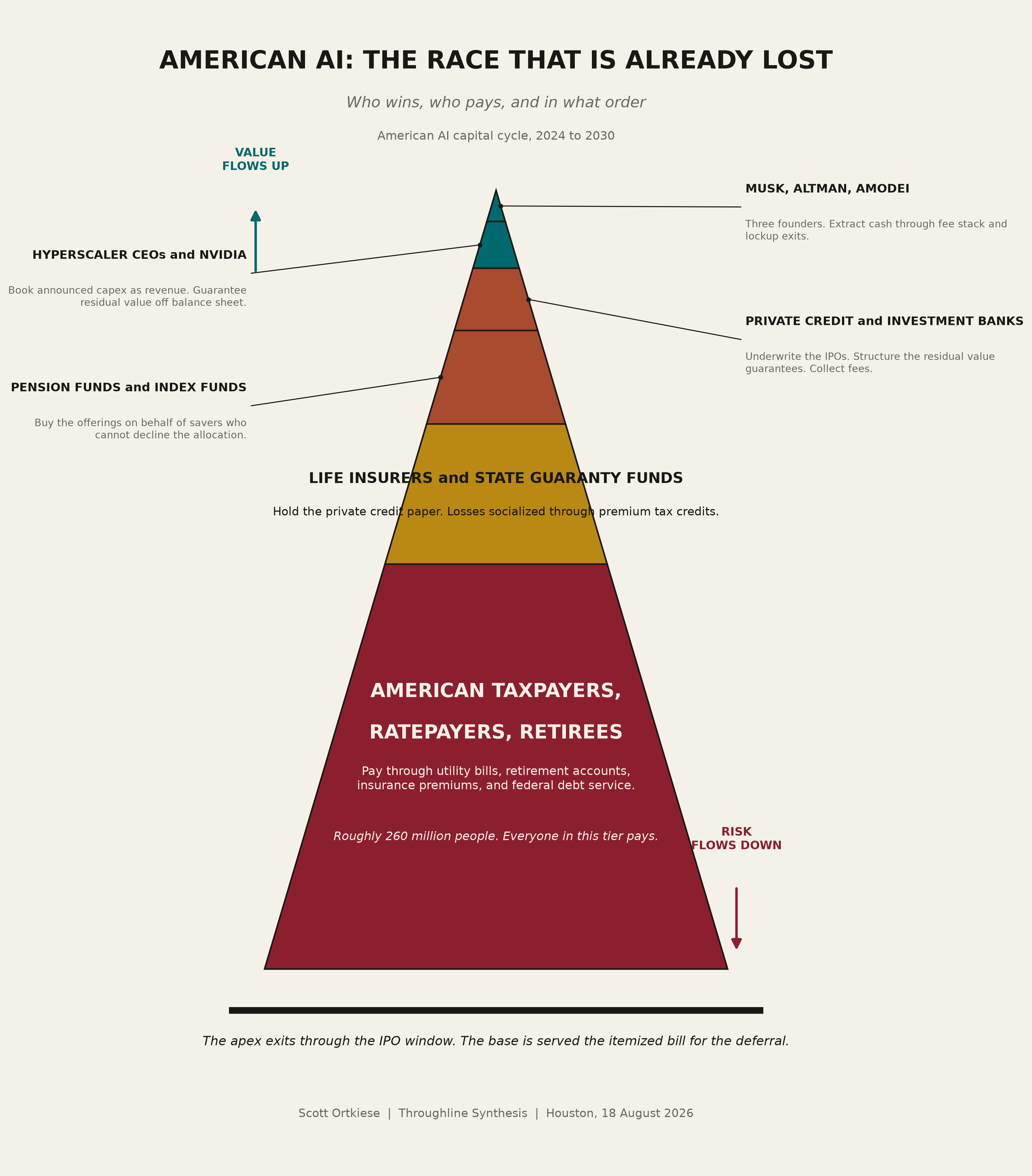
That is the answer to the question my reader asked. The race has not just been lost. The consequences of losing it are being socialized in advance, through mechanisms already written into state statute and federal regulation, so that when the failure becomes undeniable, the losses will already be on the public’s balance sheet. The private winners will have exited through the initial public offering window. The public will still be paying the utility bill on the abandoned data centers thirty years from now.
Part XIV: The path not taken, briefly
There is a version of this story where America competes and wins. It is not the version any current participant is selling, and it is not the version the White House is drafting the executive orders around, but it exists, and it should be named.
The frontier model layer is lost. The Chinese have decided it will be a public good, and there is no honest way for the American laboratories to compete against a competitor priced at zero. The response to that discovery is not to ban the competitor. It is to move up the value chain.
The application layer, meaning the software products and vertical tools that consume whatever model is best and cheapest, is still open. The American opportunity is to build the domestic ecosystem of applications, agents, and vertical products that runs on top of open-weight foundations. That ecosystem does not need OpenAI or Anthropic to be trillion-dollar companies. It needs cheap inference, open weights, and a competitive domestic developer market. Every ban on Chinese models inside American procurement raises the cost of that ecosystem and cedes the application layer to whichever jurisdiction runs the cheaper compute.
The industrial data layer, meaning the proprietary operating data from advanced manufacturing, energy production, chemical processing, refining, pipeline operations, semiconductor fabrication, and grid management, is still American. This data is not on the public internet. It is not in Common Crawl. It is not in any Chinese lab’s training set. It is exactly the substrate a durable industrial AI moat requires. The country that controls that data and attaches it to whatever commodity model wins is the country that captures the value. American policy is currently doing the opposite. It is protecting the frontier model layer, which is already lost, and neglecting the industrial data layer, which is still winnable.
Neither of these paths requires banning Chinese models. Neither requires state equity stakes in OpenAI. Neither requires the Trump administration to prosecute a trade war over software the world has already decided is a commodity. Each requires the honesty to admit that the three artificial intelligence initial public offerings were priced against a competitive structure that has not survived first contact with the Chinese open-weight ecosystem, and that the American public should not be conscripted into buying the gap through their retirement accounts.
That is the correct answer, and it will not be the answer chosen.
Part XV: Coda
Empires that cannot compete cheat. When Manchester’s cotton mills were cheaper than Indian handloom, Britain still faced Indian competition inside India itself, and it did not respond by competing on price. The response was punitive duties, colonial administration, and the systematic legal destruction of the Indian textile industry across the nineteenth century, until Dhaka, once the greatest textile city in the world, was described by British observers as bleached bones. British car manufacturers demanded quotas on Japanese imports in the 1970s when Toyota was undercutting them. American steel demanded Section 232 relief in the 2000s when Chinese steel was undercutting it. Each of those industries was told a national security wall would give them time to modernize. Each used the wall to defer modernization, and every one collapsed anyway.
Musk, Altman, and Amodei are executing the same play, compressed from forty years into forty months. They cannot outbuild the Chinese laboratories on capital efficiency because their cost structures were engineered for a monopoly extraction that DeepSeek and Kimi have proven unenforceable. They cannot outprice the Chinese on tokens because their compute costs are two orders of magnitude too high. They cannot out-distribute the Chinese because Alibaba, Tencent, ByteDance, and Meituan collectively command a distribution stack that no combination of Microsoft, Amazon, and Google can replicate for open-weight releases in the Global South. So, they are asking for the ban. They will get some version of it. And they will use it exactly as every previous protected industry used it: to defer the reckoning, extract public capital through the initial public offering window before the wall breaks, and pay themselves through the fee stack and lockup mechanics that finance the exit.
There is nothing American about this. Americans, in the founding mythology and in the industrial history that produced our best decades, competed. We competed with better ships, better cars, better semiconductors, better software, better logistics, better capital allocation. The dying empires we defined ourselves against, British textiles, French agriculture, Soviet electronics, Japanese banking, all reached a point where their political class decided protection was cheaper than reform. That is where we are now. The three initial public offerings are a bet that the American public will not notice the transition and will pay for the deferral through their retirement accounts, their federal procurement dollars, and their higher inference bills.
The bet may work in the short term, but it will unwind the same way every previous version has, publicly and expensively. The frontier model weights ship every quarter. The initial public offering road shows follow. We are about to find out which one the market believes.
Read carefully. The bill will arrive at your door, and it will be itemized by the wrong people.
Sources and further reading
Ed Zitron, Where’s Your Ed At newsletter and Better Offline podcast (iHeartRadio and Cool Zone Media), ongoing 2026. wheresyoured.at
Isaac Pound, interview with Ed Zitron, The Tech Report, 14 August 2026.
Adam Norlund and guest, discussion of Nvidia’s $100 billion OpenAI Ohio pledge, 17 August 2026.
SpaceX Form S-1 filed with the Securities and Exchange Commission, April 2026.
Anthropic confidential Form S-1 filed with the Securities and Exchange Commission, 1 June 2026.
Moonshot AI, Kimi K3 model release documentation, 16 July 2026.
DeepSeek AI, V3 and V4 Pro technical reports, api-docs.deepseek.com.
Alibaba Cloud Model Studio pricing pages, alibabacloud.com.
BenchLM, frontier model API pricing tracker, August 2026 snapshot. benchlm.ai
APEC Digital Economy Ministers Meeting, joint declaration on open-source AI, 23 July 2026.
Xi Jinping, keynote address, World AI Conference, Shanghai, 17 July 2026.
OpenRouter market share report, last week of June 2026.
Sightline Climate, US data center capacity buildout report, Q2 2026.
David Dayen, “The AI Bailout Could Be Baked Into the Bubble,” The American Prospect, 3 August 2026.
Companion pieces by the author on Throughline Synthesis:
“The American AI Bubble Makes No Sense. Every Party to It Knows. It Is Happening Anyway. Why?” 29 July 2026.
“Not a Cold War. A Market Rotation.” 1 August 2026.
“The Kimi K3 Reckoning.” 22 July 2026.
“The Bailout Is Already Written.” 12 August 2026.
Scott Ortkiese is the author of Faulkner Capital Holdings’ analysis on the United States decline, artificial intelligence industrial policy, private credit, and the multipolar transition. Contact through Throughline Synthesis at so@throughlinesynthesis.com.