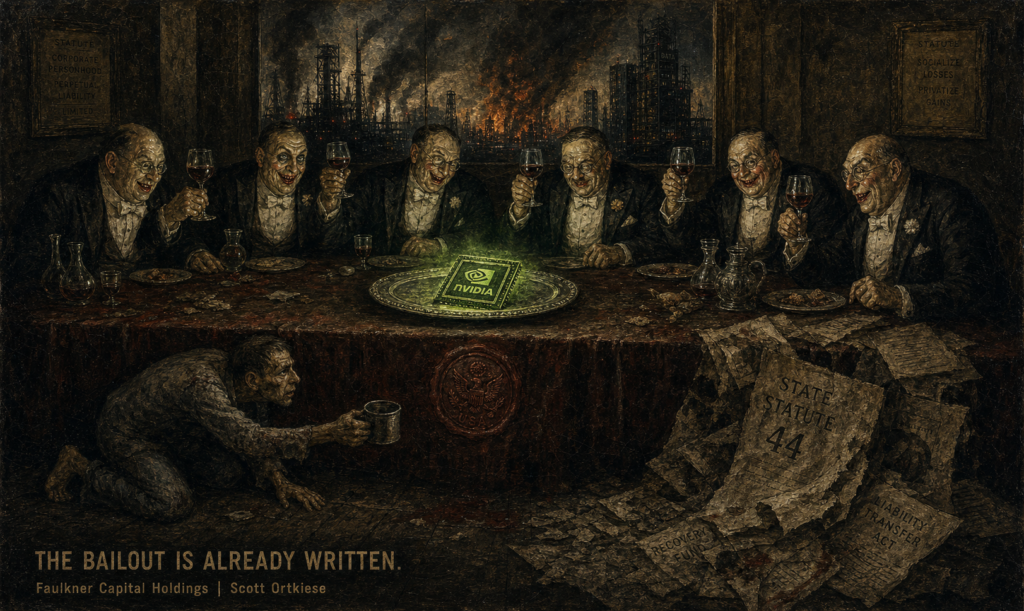
Private equity built a shadow banking system, filled it with the loans banks refused to hold, hid it inside your life insurance company, and pointed the fuse at Nvidia’s data centers. The match has already been struck. The statute that turns the ashes into your tax bill was written before you were born.
Scott Ortkiese | Throughline Synthesis | Houston, 12 August 2026
The classroom, not the newsroom
I want to teach this like a course, because the American public has been sold a debate that skips the mechanism. The tape you have been watching goes: AI is a bubble, or AI is not a bubble, valuations are stretched, valuations are justified, capital expenditure is the new revenue, and so on. It is theater. The important story is not whether the bubble pops. The important story is who pays when it does, and the answer has already been written into state law, into private credit fund documents, into life insurer balance sheets, and into the memoranda of understanding that Nvidia and six Wall Street firms signed on 10 August 2026, one day before this article was written.
The answer is you.
By the end of this article you will understand five things well enough to explain them at a dinner table without hedging. First, what private credit actually is, and why it was designed to be opaque. Second, how the largest private equity firms, Apollo, KKR, Blackstone, Brookfield, and Ares, quietly bought the life insurance industry and turned policyholder premiums into a permanent funding line for their lending business. Third, how those same firms became the balance-sheet backbone of the AI data center buildout, financing chip vendors, hyperscalers, and neoclouds through the same private credit pipes. Fourth, how the mechanism designed in the 1970s to protect widows and children from insolvent life insurers has been quietly repurposed into a fifty-state backdoor bailout of private equity’s worst loans, with a 100 percent tax credit written into the code of 44 states. And fifth, why this fails everyone in the loop, including the private credit issuers themselves, when it detonates.
This is not conspiracy. It is not speculation. Every fact below is on the public record. It is documented in Andrew Granato and Pranjal Drall’s 65-page academic paper for the University of Texas at Austin and Yale, published in July 2026, in David Dayen’s 3 August 2026 explainer for The American Prospect, in the National Association of Insurance Commissioners’ own capital-markets bulletins, in the Chicago Federal Reserve’s working paper 2025-09, and in the 10 August 2026 Nvidia press release announcing that Apollo, BlackRock, Blackstone, Brookfield, Goldman Sachs, and KKR will mobilize $500 billion of third-party capital to finance AI compute infrastructure as an asset class (American Prospect; Granato and Drall, SSRN; Nvidia; Chicago Fed WP 2025-09).
The named individuals are Marc Rowan of Apollo, Jim Zelter of Apollo, Stephen Schwarzman and Jonathan Gray of Blackstone, Henry Kravis, George Roberts and Joe Bae of KKR, Larry Fink of BlackRock, Bruce Flatt of Brookfield, David Solomon of Goldman Sachs, Michael Arougheti of Ares, Marc Lipschultz of Blue Owl, and Jensen Huang of Nvidia. They will not answer for this in a court. They will answer for it in the tape, and eventually in the tax bill sent to a school district in Ohio or a public utility rate case in Virginia.
Roll up your sleeves. The lecture begins.
Lecture 1. Private credit is a bank without any of the discipline
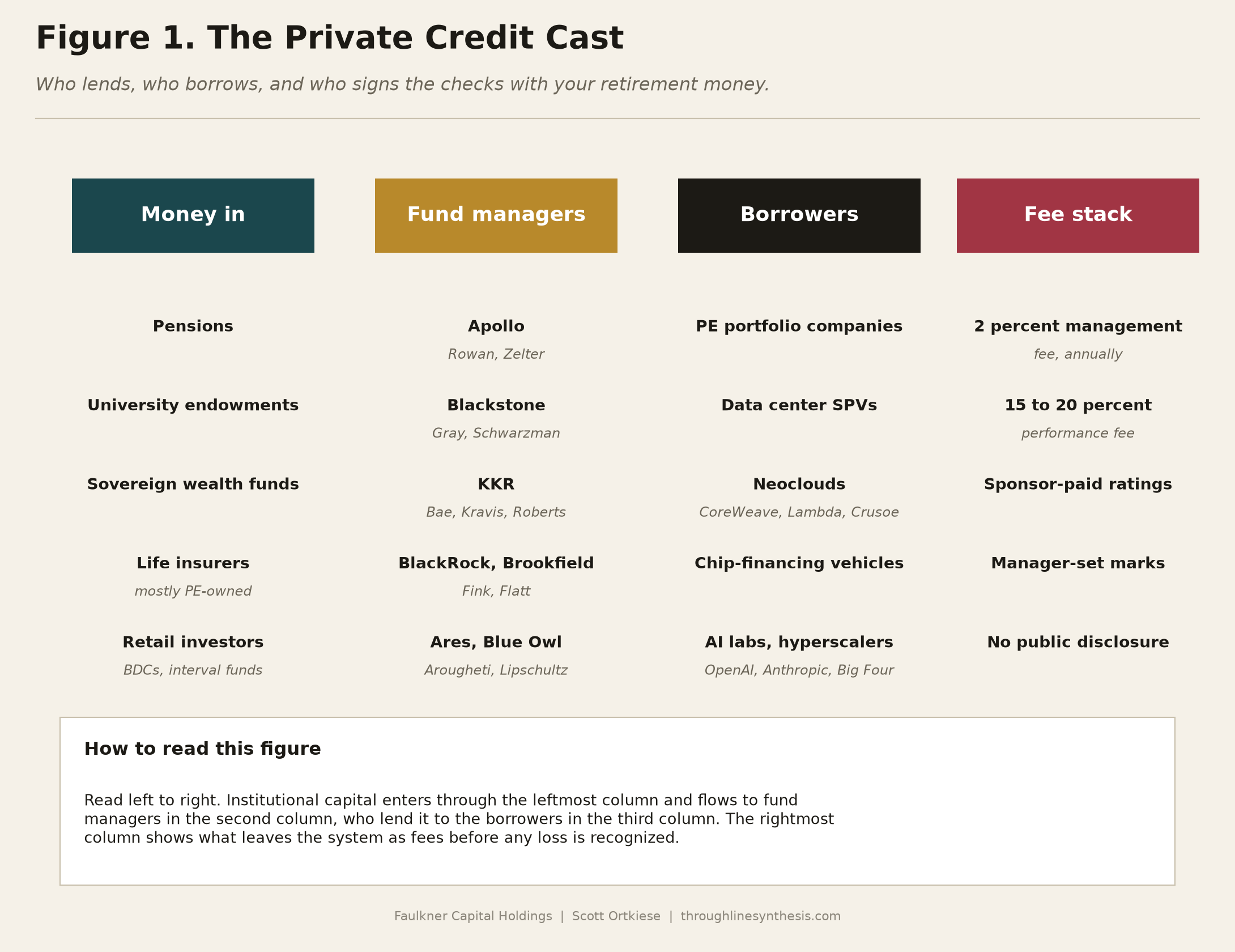
Start with the simplest possible definition, because the industry lobby has spent a decade obscuring it. Private credit is a loan made by a fund, not a bank, to a company, using money raised from institutional investors and, increasingly, from life insurance premiums, without any of the disclosure, capital, or examination regimes that apply to banks.
Read that sentence twice. Every clause is doing work.
A bank that makes a loan is required to hold regulatory capital against the loan, to disclose it in call reports, to be examined by the Federal Reserve or the Office of the Comptroller of the Currency, to mark impaired loans down on a documented cadence, and to fail into an FDIC receivership when it becomes insolvent. A private credit fund that makes the same loan does none of these things. It holds essentially no regulatory capital. It reports fair value once a quarter using a mark chosen by the manager. It is examined by nobody. It is rated by bespoke agencies retained and paid by the borrower’s own private equity sponsor. It does not fail through the FDIC, because the FDIC does not touch it. If it fails, it fails on the books of whoever holds the fund’s units, which is where the story turns.
The private credit market crossed $1.8 trillion in 2024 and is on a trajectory to $3 trillion by 2028 on Morgan Stanley’s own numbers (ABF Journal). That is not a niche. It is now larger than the entire U.S. high-yield bond market. It has grown that fast for three reasons, and all three matter for what comes next.
- The banks pulled back. After the 2008 crisis, Basel III, Dodd-Frank, and the Volcker Rule made mid-market lending by regulated banks capital-expensive. Banks kept the fee income and the syndication desks and quietly outsourced the credit itself to funds that live outside the perimeter. That is where private credit stepped in. It is not competing with the banks. It is doing the loans the banks were told to stop holding.
- Yield-hungry pensions and endowments needed somewhere to go. After a decade of near-zero interest rates, institutional allocators needed 6 to 9 percent yields to hit their return assumptions. Private credit offered that yield without the mark-to-market volatility of public bonds. The lack of volatility was not because the risk was lower. It was because the marks were discretionary. That is a feature, not a bug.
- Private equity discovered that lending was more profitable than owning. A private equity firm that runs a leveraged buyout collects 2 and 20 on the equity fund, roughly 2 percent of assets under management annually plus 20 percent of the gains. The same firm running a private credit fund collects 1 and 15 on the debt, but the assets churn faster, the durations are shorter, and the fee stream compounds against a larger permanent capital base. Apollo, Blackstone, and KKR did the math sometime around 2015 and pivoted. Private credit is now the growth engine of the big alternative asset managers, not the traditional buyout.
Now stack the three together. Private credit is a system in which the loans that banks were regulated out of holding are made instead by funds that are not regulated at all, funded by pensions and insurers hunting yield, marked to model by the managers who collect fees on the reported value, rated by agencies the borrower pays, and reported quarterly on a schedule the manager controls. Every discretionary handle in that sentence sits with the party that has the most to lose if the truth comes out. That is the shape of the machine.
Financial innovation. The phrase Ed Zitron used to describe the current AI credit stack in his late-July interview. It is worth quoting Zitron here because his vocabulary tells you where the cycle is. Financial innovation is what the industry called collateralized debt obligations in 2005, CDO-squared products in 2006, and synthetic mortgage exposures in 2007. It is what a system says when it has run out of real customers and has begun to invent them.
Lecture 2. The insurance company as a permanent funding line for the shadow bank
Here is the trick, and it is the trick, so pay attention.
An insurance company sells a policy today and expects to pay a claim, on average, in 20 to 30 years. In the meantime it holds premiums as reserves. Those reserves are enormous. U.S. life insurers held $8.98 trillion in total cash and invested assets at year-end 2024 (NAIC Capital Markets Bureau). That is a river of permanent, long-duration capital that never needs to be redeemed on a Tuesday afternoon.
If you were a private equity firm that had discovered lending was more profitable than owning, and you needed a permanent, low-cost, non-redeemable funding line to make loans against, would you rather rely on institutional limited partners who can pull commitments every three to five years, or would you buy the life insurance company itself and turn the policyholders into your funding base?
That is the question Apollo asked in 2009 when it seeded Athene Holding, and the question every major private equity firm has answered the same way since. Apollo now controls Athene, which had roughly $299 billion in assets at year-end 2024. KKR bought Global Atlantic in 2021 and expanded to full ownership in 2024. Blackstone signed a strategic partnership with Corebridge, the former AIG Life and Retirement business, and has a controlling stake in Fortitude Re. Brookfield bought American National and American Equity Investment Life. Ares owns Aspida (Chicago Fed WP 2025-09; KKR Insurance; Hans Goldstein annuity briefing).
Add it up. Private equity today owns life insurance assets north of $1.5 trillion, roughly a fifth of the U.S. life industry, and the fastest-growing segment inside it (American Prospect). The Moody’s Ratings tally at year-end 2025 put U.S. life insurers’ private credit and illiquid asset holdings at $807 billion, or 20 percent of their $4 trillion fixed-income book, and identified private-equity-owned insurers as the segment driving the growth (Wall Street Journal).
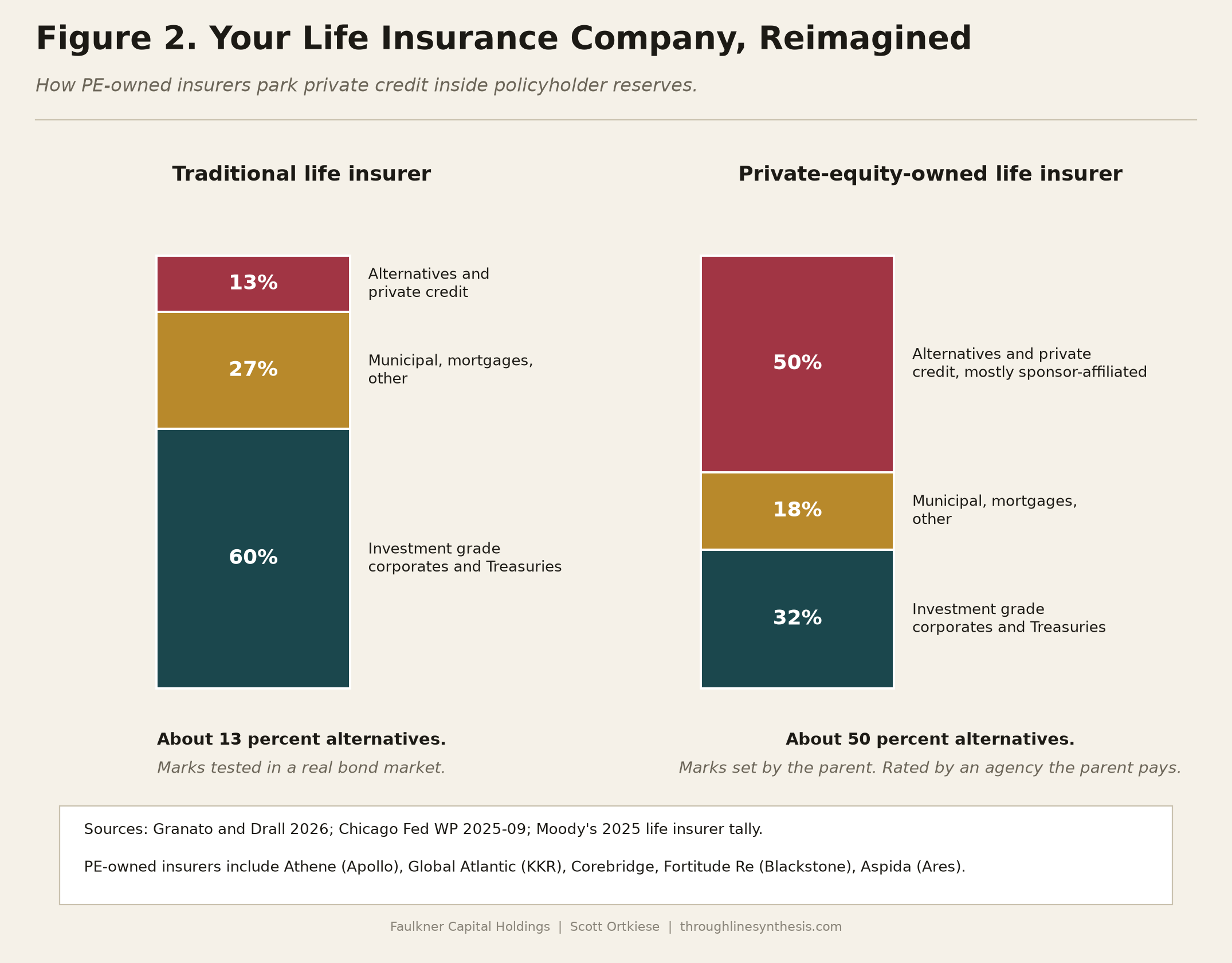
Now the punchline. A traditional, mutual, or publicly traded life insurer holds roughly 13 percent of its portfolio in alternatives, meaning private placements, private credit, private-label structured products, and similar. A private-equity-owned life insurer holds roughly half of its portfolio in the same categories, and inside that half sits a heavier concentration of loans originated or sponsored by its own parent private equity firm (Granato and Drall via American Prospect; Chicago Fed WP 2025-09).
Read that again. Half the balance sheet of the life insurer that will pay your family’s death benefit is loans originated by the same firm that owns the insurer, rated by an agency that firm pays, marked at a value that firm chose. And the loans, increasingly, are collateralized by data centers, chip fleets, and compute purchase commitments from a two-name customer credit portfolio, OpenAI and Anthropic, whose end-market revenue does not remotely cover the compute bill.
That is not a life insurance company. It is a private credit fund wearing a life insurance company as a costume, so that the money never has to leave and the regulators never really get in.
Lecture 3. The AI closed loop, financed with your grandmother’s annuity
Now graft the two systems together. This is where the AI story stops being an equity valuation debate and becomes a credit story.
Sam Altman and Dario Amodei have collectively booked roughly $1.1 trillion in compute commitments through 2030 against combined 2025 revenue of about $17 billion and combined 2025 losses of about $26 billion. I documented this in Part II of The Revocable Empire on 2 August 2026 (Throughline Synthesis). That gap between what OpenAI and Anthropic have promised to spend and what they earn is not a rounding error. It is the entire story. Somebody has to lend the difference, and the somebodies are the chip vendors, the hyperscalers, and the private credit funds, all of whom are collecting fees on the ride down.
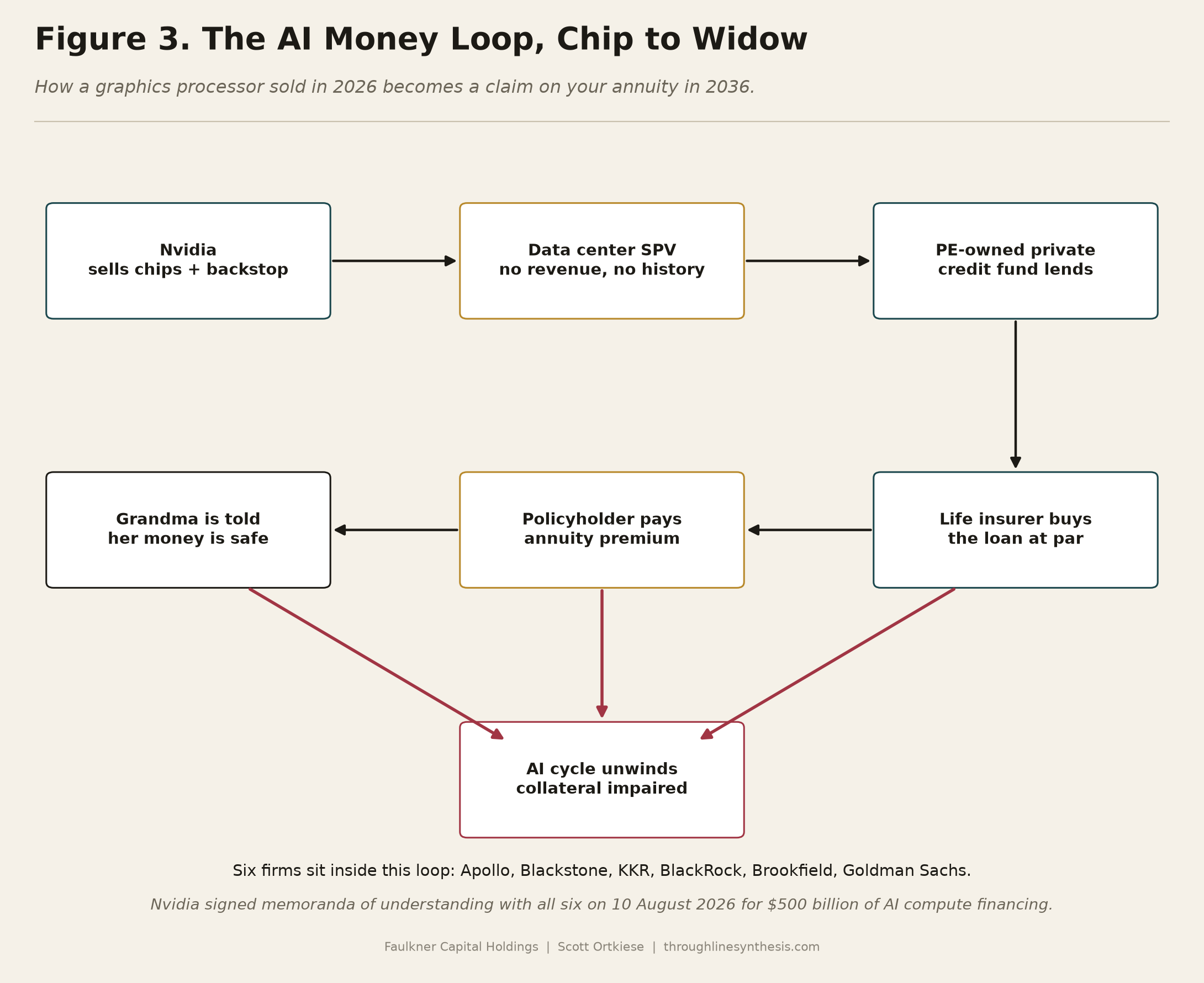
The 10 August 2026 announcement is where the machinery becomes visible on a single sheet of paper. Nvidia signed memoranda of understanding with Apollo, BlackRock, Blackstone, Brookfield, Goldman Sachs, and KKR to mobilize more than $500 billion of third-party capital for AI compute financing. Jensen Huang, in the same statement, disclosed that Nvidia has the option to backstop up to $125 billion, or 25 percent, of the potential deals (Nvidia; Reuters; BBC). Jim Zelter, president of Apollo, called modern compute a scarce, mission-critical asset class. He did not mention that Apollo’s largest single funding source for the loans that will be poured into those data centers is Athene’s policyholder reserves, and that the same funding stack terminates, when it terminates badly, in a state insurance guaranty fund and a tax credit on 44 state general funds.
Here is what the closed loop looks like once you draw the arrows.
- Nvidia sells chips to a data center developer. The developer is often a special purpose vehicle set up specifically to house the chips and pay Nvidia. The SPV has no operating history, no cash flow, and no non-Nvidia revenue.
- A private credit fund lends to the SPV. The loan is secured by the chips, by a hyperscaler take-or-pay lease, or by an AI lab’s compute purchase commitment. The fund is inside a family of vehicles run by Apollo, KKR, Blackstone, Ares, Blue Owl, Brookfield, or Sixth Street. On paper the loan yields 9 to 12 percent. On paper the collateral is worth par.
- Nvidia backstops the transaction. It guarantees a residual value on the chips, or a floor on the customer’s payments, or both. Jensen Huang’s $125 billion is not scattered across borrowers. It is concentrated on a small number of counterparties. Apollo and its peers wrap that backstop into the credit rating and the mark.
- The private credit fund sells the loan into a life insurance company balance sheet. In most cases the insurer is owned by the same private equity manager that runs the fund. Athene buys Apollo loans. Global Atlantic buys KKR loans. Corebridge and Fortitude Re buy Blackstone loans. Aspida buys Ares loans. The mark on the loan is not tested against a secondary market, because there is no secondary market. It is tested against the manager’s model.
- The insurer books an asset yielding 9 to 12 percent against liabilities, mostly fixed annuities, priced at 4 to 5 percent. The spread is real accounting income today. The credit risk is disclosed in the footnotes to a filing state insurance commissioners are not staffed to read.
- When the AI cycle unwinds, and it will, the collateral turns out to be worth a fraction of the loan. The insurer is holding paper marked at par against reality worth 40 to 60 cents. Reserves are impaired. Ratings drop. Policyholder demand for surrenders and withdrawals spikes at the moment the assets can least be sold. This is the classic insurance run, only now with a chip fleet as the underlying, not a portfolio of blue-chip corporate bonds.
- The state guaranty fund catches the fall. Which is Lecture 4.
The five-hundred-billion-dollar Nvidia consortium is not a coincidence with the private equity ownership of life insurance. It is a single financing loop drawn on a single ledger, and the ledger connects the chip vendor at the top to the policyholder at the bottom through six firms whose interests align on the way up and diverge from every other party on the way down.
Lecture 4. The bailout that has already been written into law
Now the part the AI investment coalition does not want you to understand, because if you understood it you would not buy the pitch that AI capex is somebody else’s problem.
Banks fail into the FDIC. Broker-dealers fail into the Securities Investor Protection Corporation. Public companies fail into bankruptcy court. Every one of those regimes has a pre-funded pool, a statutory priority scheme, and a body of case law thick enough to guide a receiver on a bad day.
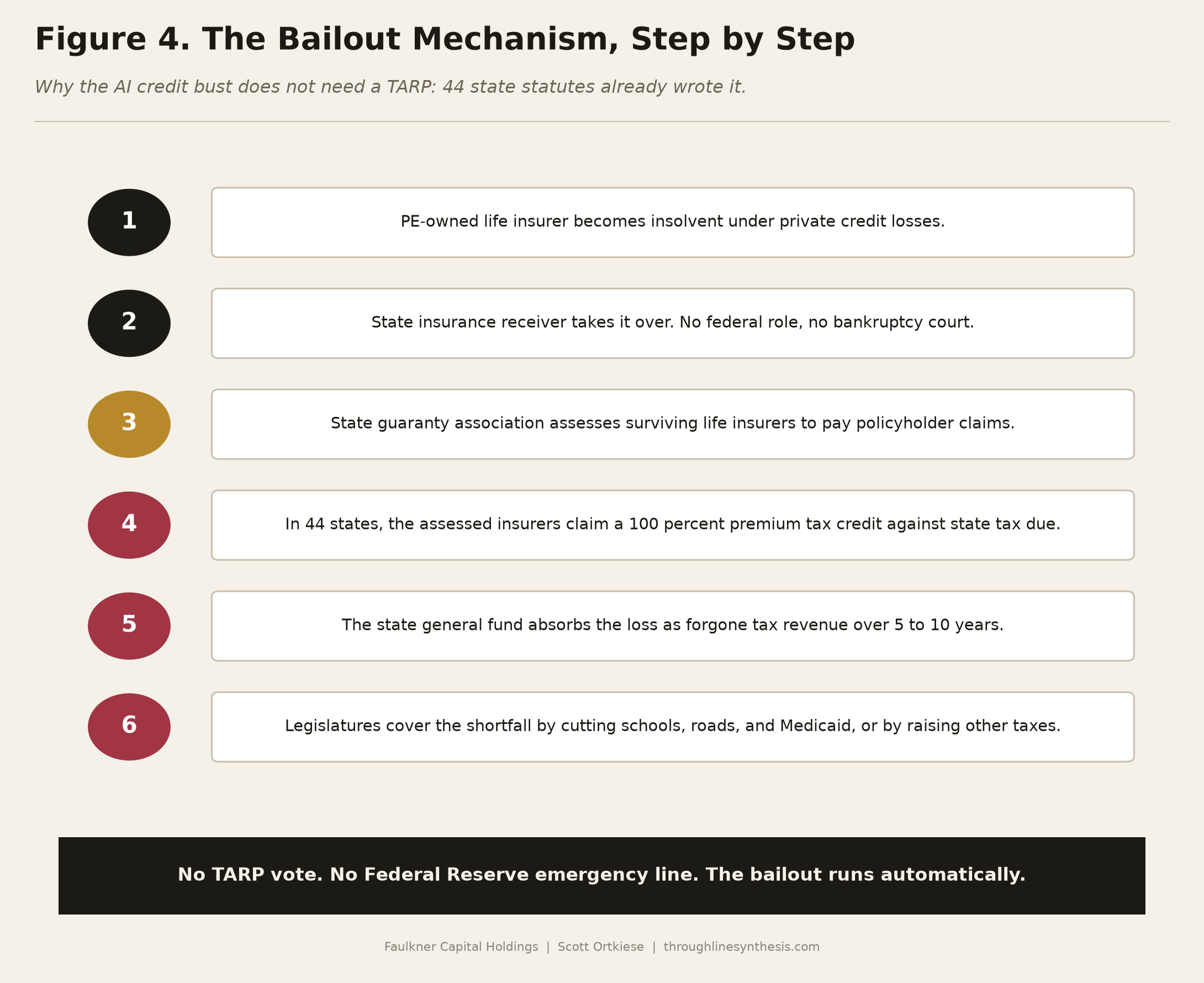
Life insurance companies do not fail into any of those. They fail into a state-by-state system of guaranty associations, called into existence over the 1970s and 1980s by the National Association of Insurance Commissioners, in which the surviving life insurers in the state of insolvency are required to pay assessments to make policyholders whole. The purpose was decent. Widows and orphans should not lose the death benefit because the insurer picked bad bonds. But the design was, and remains, an after-the-fact, unfunded, industry-mutual insurance scheme, layered on top of state-level guaranty limits per policyholder, with no federal backstop.
Read the design in slow motion. The insurance company fails. The state receiver takes it over. The receiver estimates the shortfall. The receiver assesses the surviving insurers domiciled in the state, up to a statutory percentage of their in-state premium volume each year, and applies the money to policyholder claims. The surviving insurers pay.
That is not the story. This is the story. In 44 states, once the surviving insurer pays the assessment, it may claim a state premium-tax credit equal to 100 percent of that assessment, typically over five to ten years (American Prospect; Granato and Drall, via TAP summary; NOLHGA and state statute compilations).
Say it in English. The industry pays first. The state general fund pays second. State taxpayers pay last, through forgone premium-tax revenue that has to be replaced from other tax lines, from other spending cuts, or from higher borrowing. The premium tax credit is not a rebate to policyholders. It is a rebate to the surviving insurers, who take the loss out of their income statement and hand it to the state legislature to solve for the next decade.
This is the sentence that should end the private credit party. In the American life insurance system, the bailout has already been legislated. It does not require a TARP. It does not require a Federal Reserve emergency line. It does not require a congressional vote in the middle of a crisis. It runs automatically, jurisdiction by jurisdiction, the moment the receiver’s assessment goes out.
Granato and Drall’s paper for the University of Texas at Austin School of Law and Yale, titled Private Credit’s State Backstop: How Private Equity Socializes Risk Through Insurers, is 65 pages of documentation of this mechanism. Andrew Granato is an assistant professor at the University of Texas at Austin School of Law. Pranjal Drall is a JD-PhD candidate in financial economics at Yale (Granato, X; Bloomberg Odd Lots; Bit.fan summary; Michael Burry annotation). Their conclusion, which I share, is that the guaranty-fund plus tax-credit architecture was not designed to bail out shadow-bank losses booked into insurance company balance sheets. It was designed to make policyholders whole after ordinary insolvencies. It has been quietly repurposed by private equity into an off-ramp for its riskiest loans, and neither Congress, the state insurance commissioners, nor the American public has been consulted.
That is the answer to the host’s question in the Breaking Points interview. Is the cake baked? The cake is baked. The bailout does not have to be voted for. It runs on 44 state statutes that already exist, and it runs at the worst possible moment, in the middle of a systemic credit reprice, when the surviving insurers can least afford to be assessed and the state general funds can least afford to hand out premium-tax credits.
Lecture 5. What actually detonates first, and in what order
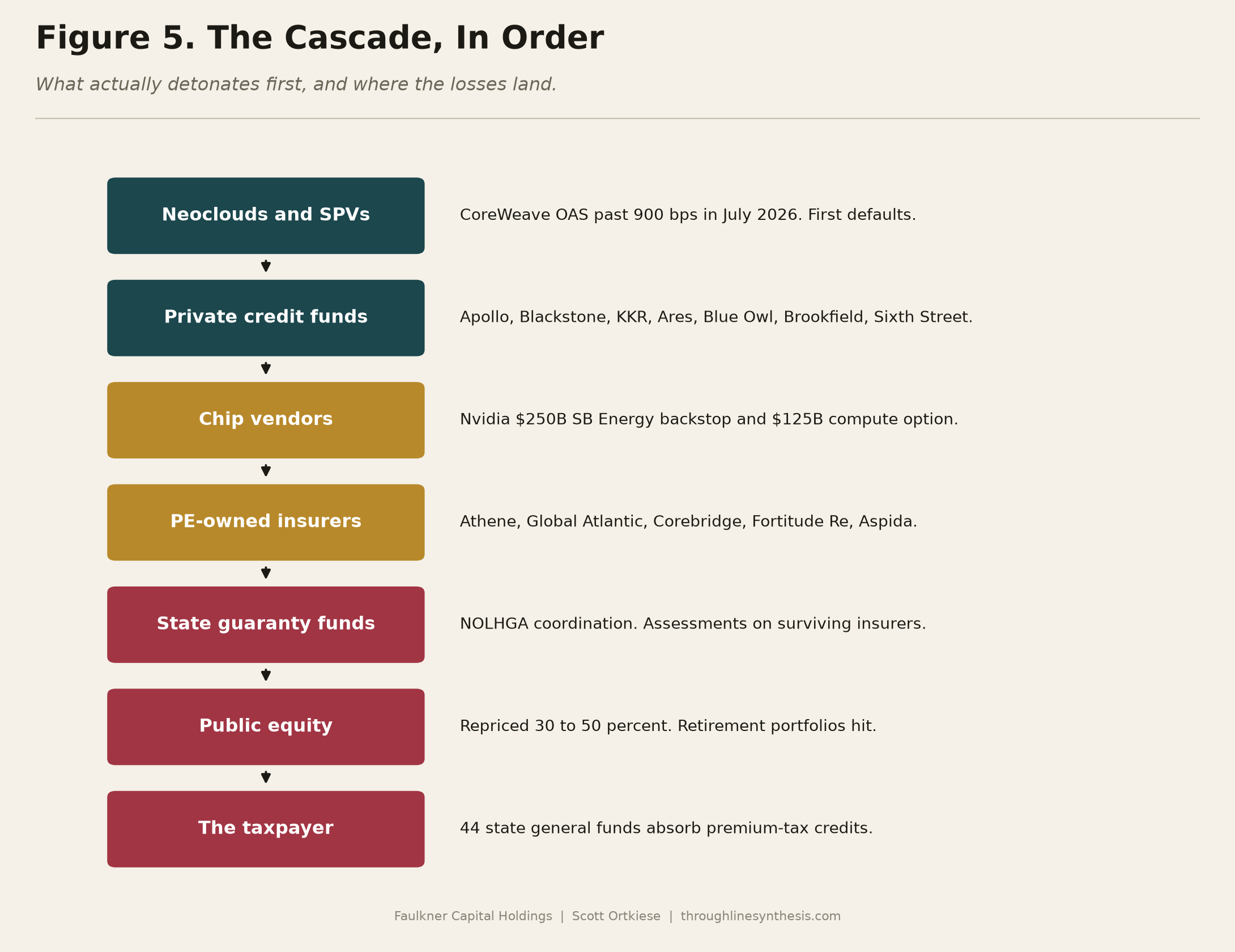
If the machine unwinds, and I argued in American AI Domination? Not So Fast. that it has begun to unwind, it will unwind in a specific order. The order matters, because it tells you where the political fight lands.
- Neoclouds and data center SPVs first. CoreWeave, Lambda, Crusoe, and their peers hold the thinnest capital cushions, the most concentrated customer bases, and the credit spreads that already say the market has priced them for impairment. CoreWeave option-adjusted spreads passed 900 basis points in July 2026 while equity investors were still trading it as an AI growth story (Throughline Synthesis, Part II). The first defaults are here.
- Private credit funds second. Once the SPV defaults, the fund holding the loan has to mark it. Apollo, Blackstone, KKR, Ares, Blue Owl, Brookfield, and Sixth Street will all be tested, not on whether they eat the loss, but on how fast they can transfer the loss to the insurance balance sheets they control. That transfer is limited by state insurance regulations that Granato and Drall document have been serially waived, exempted, or ignored by the National Association of Insurance Commissioners over the past decade.
- Chip vendors third. Nvidia’s $125 billion backstop of the compute financing consortium and its separate $250 billion guarantee of the SoftBank/SB Energy data center are the largest such exposures ever underwritten by a semiconductor company (Throughline Synthesis, Part II). Advanced Micro Devices and Broadcom carry smaller but nontrivial backstops. When the customers they underwrote cannot pay, the backstops move from footnotes to income statements.
- PE-owned life insurers fourth. Athene, Global Atlantic, Corebridge, Fortitude Re, Aspida, and American National are the names to watch. If any one of them enters resolution, the guaranty-fund plus tax-credit machinery of Lecture 4 activates automatically in every state where it is domiciled or admitted.
- State guaranty funds and state general funds fifth. This is the sleeper. The National Organization of Life and Health Insurance Guaranty Associations, or NOLHGA, coordinates multistate insolvencies, but the funding falls back on each state’s surviving insurers and, through the tax credit, on each state’s general fund. A midsize PE-owned insurer failing in a stress environment could exceed the annual assessment capacity of several small-state guaranty funds simultaneously.
- Public equity sixth. As always. The equity market prices this last, because the equity market is a rumor-driven instrument and the credit market is a numbers-driven instrument.
- The retirement portfolio last. Magnificent Seven concentration inside the median American household’s equity holdings is now 30 to 40 percent, and the wealth destruction of a 30 to 50 percent reprice of the coalition is $8 to $12 trillion at the household level. Retirees between 55 and 65 take the hit at the least recoverable point in the retirement lifecycle (Throughline Synthesis, Part II). This is the political detonator.
The point of the order is not that every step is inevitable. The point is that once step three completes, steps four through seven run on autopilot, because the statutes and the fund documents already say what happens.
Lecture 6. Why this fails the issuers too
I want to close the lectures by dismantling the last defense of the private credit issuers, which is that even if the mechanism runs badly for taxpayers and policyholders, at least it runs well for them. It does not.
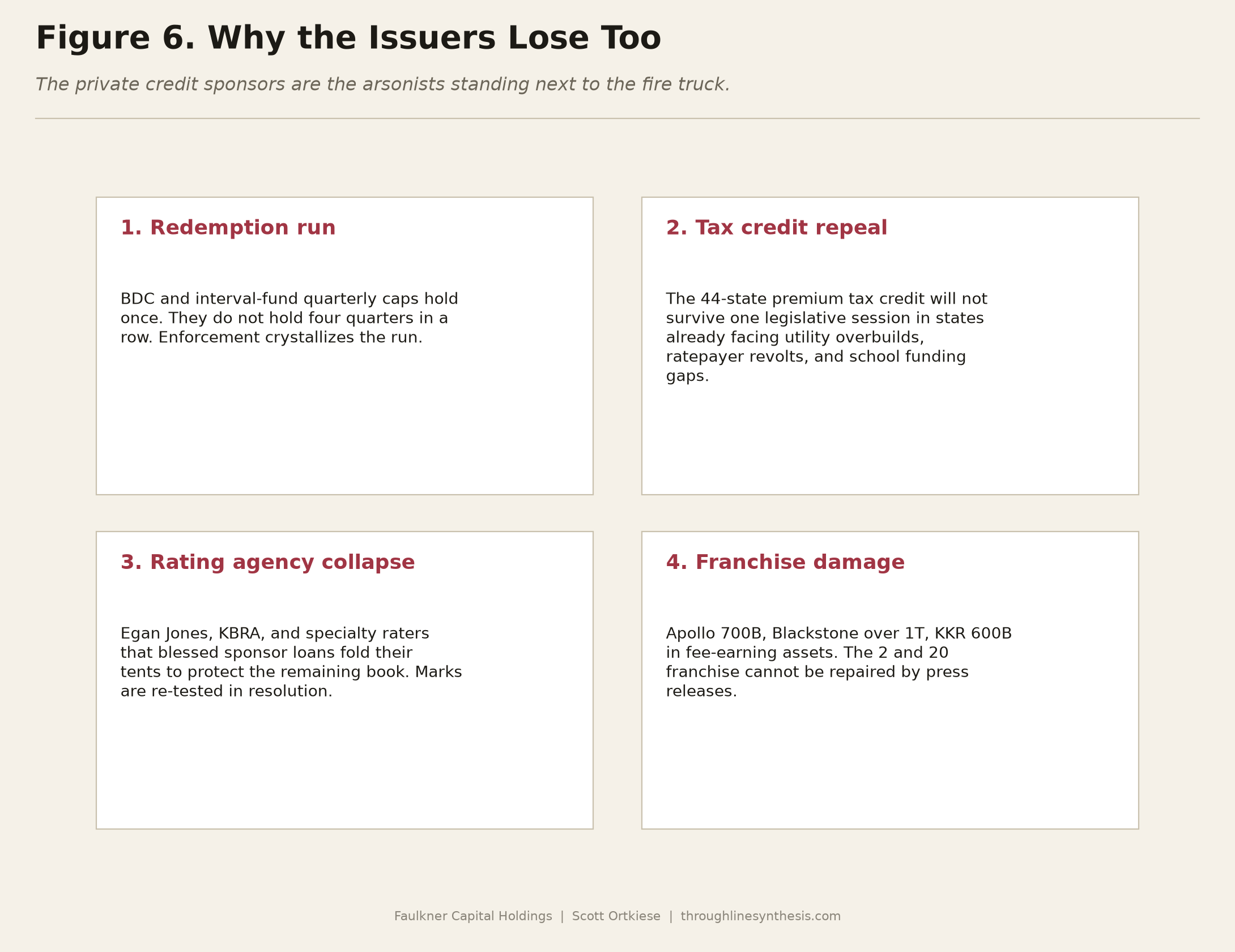
Marc Rowan of Apollo, Jim Zelter of Apollo, Jonathan Gray of Blackstone, Joe Bae of KKR, Bruce Flatt of Brookfield, and Michael Arougheti of Ares have built asset gathering machines whose fee streams are calibrated to a permanent risk-on regime. When the regime turns, four things happen to them that they cannot spin away.
- Redemptions arrive at the semi-liquid vehicles at the worst possible moment. Business Development Companies, or BDCs, and interval funds have soft quarterly redemption caps. The caps hold for one quarter. They do not hold for four. When investors realize the marks are wrong, they line up to get out, and the caps have to be enforced. Enforcement crystallizes the run. Blackstone’s BREIT went through a dress rehearsal of this in 2022. The AI credit vehicles will not have a Wall Street sponsor discreetly buying units back this time.
- The tax credit mechanism is politically radioactive. The 44-state statute set was written in an era of unwatched state legislatures and modest insurance industry insolvency. A wave of PE-owned insurer failures triggering hundreds of millions of dollars of premium-tax credits in states already under fiscal stress from AI-linked utility overbuilds, ratepayer revolts, and school funding shortfalls will not survive a single legislative session in most jurisdictions. Repeals or narrowings, applied retroactively to open assessments, are legally aggressive but politically inevitable. The issuers cannot count on the statute being there when they need it.
- The credit rating shell game collapses. Egan Jones, KBRA, and the smaller specialty raters that private credit sponsors have paid to bless their loans are already under Securities and Exchange Commission and Department of Justice scrutiny. When the marks are challenged in the receiver’s forum, the ratings will not hold, and the ratings agencies will fold their tents to protect their remaining book. Every PE-owned insurer that relied on those ratings will be re-marked in resolution to something between distressed corporate paper and salvage. The paper trail of internal e-mail traffic on the marks will follow.
- The reputational damage compounds across the platform. Apollo does not just run Athene. It runs a $700 billion asset management platform. Blackstone runs $1 trillion plus. KKR runs $600 billion. The 2 and 20 franchise depends on institutional allocators trusting that the fee stream is safe. When the state guaranty funds start writing checks against PE-owned insurers whose parents also run the loans that killed them, the fee franchise is not repaired by press releases from Marc Rowan or Jonathan Gray. It is repaired, if at all, by decades of costly restraint.
The private credit issuers are the arsonists standing next to the fire truck, insisting they be paid to hose down the building they set alight. That trade also has a payout profile, and it is not the one they think.
Coda. What to do about it, plainly
I do not write to leave the reader without a course of action. Here is mine.
- The National Association of Insurance Commissioners must publish, jurisdiction by jurisdiction, the private credit and Schedule BA concentration inside every PE-owned life insurer, with the sponsor identity, the mark methodology, and the counterparty concentration, on a quarterly cadence and with a look-back to 2015. The Chicago Fed’s working paper 2025-09 already tells you the aggregate story. What is missing is the name-by-name detail. Every state legislator with a district and a general fund at risk should demand it.
- The 44 states with the 100 percent premium-tax credit for guaranty-fund assessments should statutorily disqualify assessments arising from PE-owned insurers whose alternative-asset concentration exceeds a defined threshold, or from loans marked by rating agencies paid by the sponsor. This is not a full repeal. It is a targeted carve-out that restores the original intent of the statute, which was to protect ordinary policyholders from ordinary insurer misjudgments, not to socialize losses from a shadow-bank strategy.
- The Securities and Exchange Commission should require BDCs and interval funds with material AI infrastructure exposure to disclose the full counterparty stack, the residual-value guarantees, and the sponsor-affiliate flows, on a quarterly basis and in plain English. The word “financial innovation” should be a legal predicate to enhanced disclosure, not a shield against it.
- The Department of Justice and the state attorneys general should treat mark manipulation, rating agency capture, and affiliate-loan concealment inside PE-owned insurers as the potential criminal violations they are. The Manhattan U.S. Attorney’s ongoing look at BlackRock TCP Capital’s marks is a template. It should not be an outlier.
- The American public should stop letting itself be told that the AI capex cycle is a private-sector project. It is not. It is being financed by the deferred wages of retirees, by the reserves of policyholders, by the balance sheets of state general funds, and by the utility rates and water tables of communities that will pay for the buildout for a generation. If the private sector wants to write $500 billion of memoranda of understanding for a compute asset class, the private sector can also be told to take the losses when the class turns out to be less scarce, and less mission-critical, than Jensen Huang’s press release insists.
I do not expect Marc Rowan or Jonathan Gray or Joe Bae to accept these ideas. I expect them to be furious, in that quiet Park Avenue way, that anyone has spelled out the mechanism in this level of detail for a reader who is not paid to look the other way.
Fine. Be furious. Be furious in the tape, if that is where the answer lands. The rest of us will be reading the state statute, and the guaranty-fund coordination page at NOLHGA, and the quarterly filings at Athene and Global Atlantic and Corebridge, and the private credit disclosures at Apollo and Blackstone and KKR, and we will be doing the math nobody paid us to do, on a mechanism that was designed to be too boring to check.
The bailout has been written. The signatures are on state statutes forty years old. The trigger is a private credit stack that six firms built, that Nvidia signed the papers for on 10 August 2026, and that the American public has never voted for and does not understand.
Now you do. Teach it to somebody else this week.
Scott Ortkiese
Throughline Synthesis | Houston, Texas
so@throughlinesynthesis.com
12 August 2026
Author’s note. This article draws on the Breaking Points interview with David Dayen, dated 11 August 2026; David Dayen, “The AI Bailout Could Be Baked Into the AI Bubble,” The American Prospect, 3 August 2026; Andrew Granato and Pranjal Drall, “Private Credit’s State Backstop: How Private Equity Socializes Risk Through Insurers,” working paper, University of Texas at Austin School of Law and Yale, July 2026; the Chicago Federal Reserve’s working paper 2025-09, “Life Insurers’ Private Credit Investments and Annuity Concentration”; the National Association of Insurance Commissioners’ Global Insurance Market Report 2025; the S&P Global Market Intelligence coverage of NAIC private credit scrutiny; Moody’s Ratings’ 2025 tally of private-equity-owned life insurer private credit exposure; and the 10 August 2026 Nvidia press release announcing the $500 billion AI compute infrastructure financing consortium with Apollo, BlackRock, Blackstone, Brookfield, Goldman Sachs, and KKR. All figures reported here are as of the published source date unless otherwise noted. Part I of the current AI series was “Not an AI Cold War. A Market Rotation.” Part II was “American AI Domination? Not So Fast.” This is Part III.