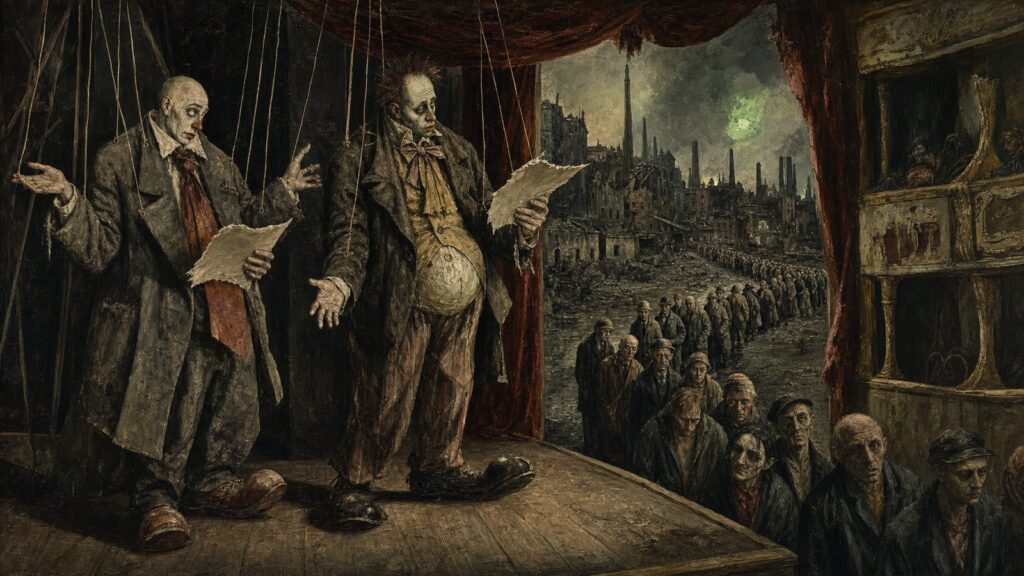
No Exit: How Two Cornered Script Readers and a Captured Democracy Blew Up the World Economy
APR 01, 2026
By Scott Ortkiese | April 1, 2026
so@throughlinesynthesis.com | www.throughlinesynthesis.com
Author’s note:
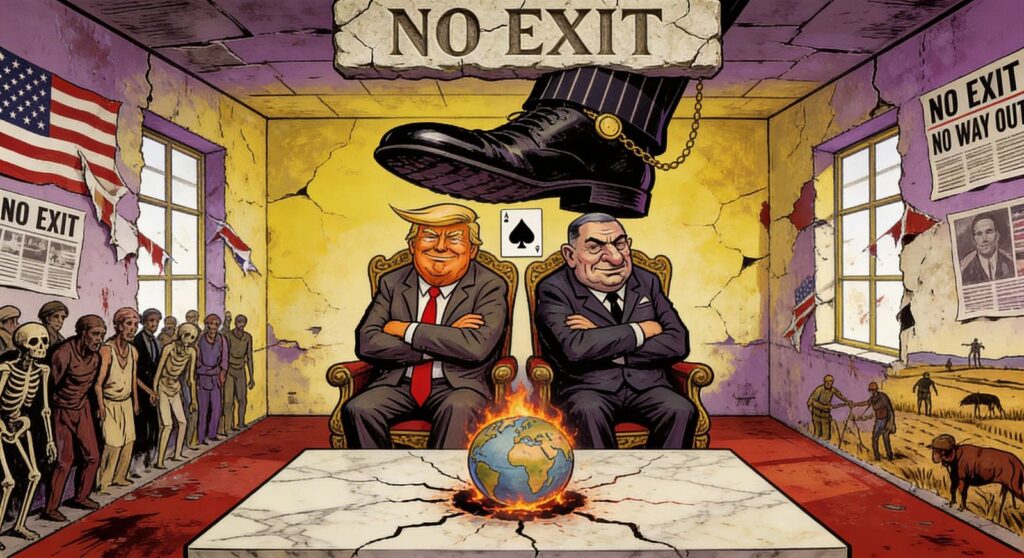
Sartre’s characters in No Exit do not suffer because the door is locked. They suffer because they finally understand it was never going to open. That is where we are.
The war on Iran could end today. The Strait could reopen tomorrow. It would not matter. The fertilizer that was not shipped cannot be unshipped into fields whose planting windows have already closed. The helium infrastructure does not reassemble. The debt pyramid does not un-leverage. The payment chains that have snapped do not reconnect on a diplomat’s handshake. The trust required to coordinate a response does not return because a president gives a speech.
What is coming will be called the Greatest Depression, and the name will be earned. The Great Depression of 1929 took years to metastasize. This one arrived fully formed, in weeks, across every system simultaneously.
The door was never going to open. We are already inside the room.
Scott Ortkiese
They Called It a Victory
They called it a security operation. They called it denuclearization. They called it, briefly and embarrassingly, a victory. What Benjamin Netanyahu and Donald Trump actually did on February 28, 2026, was launch an unprovoked first strike on a sovereign nation that was sitting at a peace table in Geneva and, in doing so, detonate the largest economic explosion since the 1930s. The mushroom cloud they produced was not nuclear. It was financial, agricultural, and structural. And unlike the ordnance Iran has been delivering with increasing precision to Israeli and American installations across the Middle East, this explosion cannot be undone by a ceasefire.
The depression they triggered is already locked in. The fertilizer that was not shipped cannot be retroactively applied to fields already past their planting window. The helium infrastructure that was bombed will not reassemble itself upon the signing of a memorandum of understanding. The debt cascades already in motion will not pause out of diplomatic courtesy. And the ten-trillion-dollar economic shock now radiating through China, India, Japan, and the Global South will not reverse because Trump posted something hopeful on Truth Social.
This is the story of how two men, one a cornered politician facing criminal prosecution at home and the other a transactional dealmaker who confused leverage with strategy, were maneuvered by a concentrated donor class into a war that America’s own generals, diplomats, and weapons scientists had warned against. And this is the story of what they broke in the process, and what horror that breakage portends for the billions of people who had no say in any of it.
Who Is Saying This, and Why You Should Listen
Before proceeding, a credential check is warranted. Because the moment an economist forecasts another Great Depression, the reflex of comfortable people is to dismiss him as a crank.
Michael Hudson is not a crank. Hudson spent decades as a balance-of-payments economist on Wall Street, analyzing the debt capacity of Third World countries for Chase Manhattan Bank, knowledge he later used to expose the structural trap those debts represented. In 1972, he published Super Imperialism: The Economic Strategy of American Empire, an analysis of how the United States exploited the post-Bretton Woods dollar system to extract tribute from the rest of the world without producing equivalent value. The Pentagon was so impressed that it purchased copies and used the book as a planning manual. Hudson has since served as an economic adviser to the U.S. Congress, the United Nations, and multiple foreign governments. His track record of predictions on the 2008 mortgage crisis, on the structural fragility of zero-interest-rate financialization, and on the inevitability of dollar hegemony’s collapse is documented and verifiable. When Hudson states, in plain language, that the world is going into the most serious depression since the Great Depression of the 1930s and that there is no way of avoiding it, he is not emoting. He is delivering a technical assessment based on a supply-chain and debt-deflation framework that has proven correct repeatedly over fifty years.
But Hudson is not alone. The chorus of scholarly warnings has grown loud enough that dismissing them all now requires a deliberate act of institutional deafness.
John Mearsheimer, the R. Wendell Harrison Distinguished Service Professor of Political Science at the University of Chicago and the most consequential offensive realist theorist of the past four decades, stated in March 2026, without equivocation, that the United States has already lost the Iran war and that there is no off-ramp in sight. Mearsheimer’s analytical framework, built across decades of scholarship including The Tragedy of Great Power Politics and The Great Delusion, holds that states pursuing hegemony beyond their means inevitably generate countervailing coalitions and self-defeating blowback. America’s Iran war is the textbook expression of that thesis.
Jeffrey Sachs, professor at Columbia University and one of the most decorated development economists in the world, was equally blunt on February 28, 2026, the day the bombs fell: “The US will fail.” Sachs has spent years documenting what he describes as the delusional architecture of American imperial overreach, arguing that the United States “has the delusion they run the show” in a world that has already moved toward multipolarity. At Davos in January 2026, Sachs described the U.S. empire as “unhinged” and European leaders as complicit in their own subordination, accepting American policy dictates that serve Washington’s financial architecture at the direct expense of European living standards.
Richard Wolff, professor of economics emeritus at the University of Massachusetts Amherst and one of America’s foremost Marxist economists, warned as early as April 2025 that Trump’s tariff escalation would produce grave economic effects on American consumers and trigger a recession. Wolff described the logic as structurally comparable to pouring accelerant on an already unstable system: tariffs raise consumer prices, which reduce purchasing power, which shed jobs, which reduce consumption further, which deepen the downturn. Wolff has since argued, alongside Hudson, that the Iran conflict represents not merely a regional miscalculation but a civilizational turning point, the moment at which American imperial decline stops being gradual and becomes a crash.
Steve Keen, the economist who correctly modeled the 2008 financial crisis using Hyman Minsky’s framework of endogenous money and private debt dynamics, has argued since late 2025 that the conditions for a catastrophic debt deflation event have been building for years. Keen’s analysis of the 1929 to 1933 collapse is precise: U.S. credit shifted from positive 8 to 10 percent of GDP in the 1920s to negative 30 percent in the early 1930s; the more debtors tried to pay down their loans, the heavier their real debt burden became as deflation intensified. He calls this Irving Fisher’s “debt disease and price-level disease” operating in lethal combination. His warning is stark: the only thing that has stood between the post-2008 economy and a repeat of that dynamic is government spending acting as an automatic stabilizer, and that stabilizer is now being dismantled by austerity politics at the worst possible moment.
Nouriel Roubini, the economist who predicted the 2008 subprime collapse years before it occurred and earned the name “Dr. Doom” from those who preferred not to hear bad news, has been cataloguing what he calls ten large-scale, mutually reinforcing dangers that could collide over the current decade. Chief among them: a “Mother of All Debt Crises” as global public and private sector leverage exceeds 350 percent of world GDP, a sustained stagflationary decade combining supply shocks with entrenched inflation, and currency system turmoil as the waning dollar faces structural competition from alternative settlement architectures.
Richard Sakwa, professor of Russian and European politics at the University of Kent and author of Frontline Ukraine, has argued consistently that the failure of Western strategic imagination, the refusal to take seriously the security concerns of states outside the liberal order, has been producing compounding geopolitical disasters whose end product is a more dangerous and less stable world. The Iran war is the latest and most consequential expression of that failure.
These are not ideologues on the fringe. They are among the most credentialed scholars in their respective fields. They are in agreement on the essential diagnosis. The world is in a depression. It cannot be reversed. And the institutional system that produced it has not corrected itself, because it cannot.
The War Was Launched Against Iran’s Peace Delegation
The nuclear pretext for this war was always false, and by March 2026 even Washington’s own intelligence apparatus could no longer maintain the fiction. Iran was not building a nuclear weapon. The IAEA found no credible evidence of a weapons program. And in the weeks before the February 28 attack, Iran was not threatening. Iran was negotiating.
The Omani government had arranged back-channel talks in Geneva. Iran arrived with a substantive proposal: a regional security framework in which Iran would accept enhanced nuclear transparency in exchange for the lifting of sanctions, a drawdown of U.S. military presence from the Gulf, and guaranteed non-interference in Iranian governance. It was, by every account of participants, a serious offer. Had it been accepted, everything that followed would have been avoided.
Netanyahu killed it. Not because the offer was inadequate. Because accepting it would have removed the justification for the military action his government had been planning, and because his domestic legal survival, as he faces serious criminal charges in Israeli courts, is bound up with the continuation of a wartime footing that suspends normal political accountability. A peace deal in Geneva was, for Netanyahu personally, a catastrophe to be avoided at any cost.
Trump was, in the clinical assessment of Theodore Postol, professor of science, technology, and national security policy at MIT and one of the world’s foremost authorities on missile systems, a tractable partner for this maneuver. Speaking in March 2026, Postol stated without hedging that both Israel and the United States “made a tremendous strategic blunder” and that the war “is not going well for either” party. Mearsheimer’s assessment was identical: Iran has both the incentive and the means to turn this into a protracted war of attrition, and there is no off-ramp available to Washington that does not require acknowledging a defeat.
Sachs, framing it within the longer arc of American imperial strategy, observed that every U.S. regime-change operation in the region, Iraq in 2003, Libya in 2011, Syria throughout the 2010s, has produced outcomes that were worse than the situation it replaced, while creating new adversaries, destabilizing neighbors, and consuming resources that could not be replaced. The Iran operation is that pattern at maximum scale.
The Machinery That Made This Possible
To understand how two men could drag the world’s largest economy into an unwinnable war against the explicit advice of its military and diplomatic professionals, one must understand the institutional architecture that made them capable of doing so. That architecture has a name, and it is not democracy.
The Princeton political scientists Martin Gilens and Benjamin Page published a landmark study in 2014 analyzing nearly 1,800 policy decisions made between 1981 and 2002. Their finding was unambiguous: the preferences of average citizens have only a “miniscule, near-zero, statistically non-significant impact upon public policy.” Whether zero percent or one hundred percent of the public supports a policy makes essentially no difference in whether it becomes law. What does determine outcomes is the preferences of economic elites and organized business interest groups. The American public still possesses the legal mechanism of the vote. What it does not possess is the functional power the vote is supposed to represent.
This is not a recent development produced by a single Supreme Court ruling. Gilens and Page trace it back decades, identifying a long-term structural drift from representative democracy toward what they carefully call “economic-elite domination.” A peer-reviewed IZA working paper published in 2025 is less cautious: “The West is increasingly resembling an oligarchy. In an oligarchy, wealth and power is concentrated in the hands of an elite, who use their wealth for political power, and their political power for wealth.” The paper documents how the digital tech oligarchy specifically has translated economic dominance into political power, eroding democratic governance in measurable, documented ways.
Noam Chomsky and Edward Herman described the operating mechanism of this system with forensic precision in Manufacturing Consent in 1988. The media that inform American democratic participation are not independent arbiters of fact. They are profit-seeking corporate entities whose ownership structures, advertiser dependencies, elite-sourcing relationships, and sensitivity to institutional “flak” systematically produce coverage that serves the interests of the concentrated power structures that fund and own them. The propaganda model Chomsky and Herman described has not weakened with time. It has been amplified by the consolidation of media ownership into the portfolios of the same asset management firms that dominate every other sector of the economy.
AIPAC, the American Israel Public Affairs Committee, spent over 126 million dollars in the 2024 election cycle on congressional races. Any donor consortium with the capacity to move targeted primary spending against incumbent members operates with leverage no constituent relationship can match. With paper-thin House and Senate majorities, twenty votes, in some cases five, determine whether any legislation passes. The congressional unanimity on Israel-related votes, which held even as the costs of those commitments became catastrophic, is not democratic consensus. It is institutional capture operating precisely as Gilens and Page’s data predicted it would.
Trump is not the architect of this system. He is its current instrument. The Miriam Adelson 250-million-dollar investment in Trump-aligned political operations was not a coincidence. The Jared Kushner Saudi investment fund, leveraged into Trump family financial interests, was not a coincidence. These are the connecting tissues of a decision that was made not in the Situation Room but in the network of donor relationships that preceded any deliberation.
The Biden and Trump administrations together completed a generation in which lies became the operating standard of American political communication. The consequence is not merely cynicism. It is the functional collapse of the precondition for any recovery. Any solution to a depression of this magnitude requires coordinated public action, which requires institutional trust, which requires a minimum baseline of honest information. Pew Research Center data from 2025 shows that only 17 percent of Americans trust the federal government to do what is right most of the time, down from 44 percent in 2003. Gallup’s surveys show confidence in Congress at a record low of 29 percent, while one independent survey places that figure at 8 percent. The foundation of democratic crisis management has been systematically demolished by the very officials who would need to lead any response.
1929, Revisited
To grasp what is now unfolding, one must understand the structural architecture of the last comparable catastrophe, and how closely the present moment mirrors its preconditions.
The Great Depression of the 1930s was not caused by a single event. It was the product of overlapping structural vulnerabilities colliding in a compressed period: a stock market bubble built on margin lending and financial speculation, a banking system with no federal deposit insurance, a Federal Reserve that responded to the initial crash by raising interest rates and contracting money supply, a global gold standard that transmitted deflation across borders without relief valves, and a Congress that responded to gathering crisis by passing the Smoot-Hawley Tariff Act of 1930.
The Smoot-Hawley Act raised tariffs on over 20,000 imported goods to record levels. The response was immediate and devastating. Over 25 countries retaliated with their own tariffs specifically targeted at key U.S. exports. The Cato Institute’s quantitative analysis shows that retaliating countries reduced their imports from the United States by an average of 28 to 32 percent, with chief U.S. exports to retaliating markets falling by an additional 33 percent after the tariff passage. Global trade volumes fell by more than 60 percent between 1929 and 1932. The U.S. stock market lost nearly 89 percent of its value over the same period, and did not return to pre-crash levels for 25 years. Unemployment peaked above 25 percent. Hoover signed Smoot-Hawley against the advice of many senior economists, yielding to political pressure from his party and business lobbies. Trump’s tariff escalation, combined with an active oil supply disruption the 1930s never faced, represents the same policy class of protectionist overreach hitting an already overleveraged financial system, with an active shooting war compounding every variable.
Gabriel Zucman, professor of economics at UC Berkeley and one of the world’s leading scholars of wealth distribution, has documented that U.S. wealth concentration has reverted to levels comparable to the Roaring Twenties. The top 0.1 percent in 1929, just before the crash, held approximately 25 percent of total household assets. Those levels fell during the Depression and World War II, reaching their lowest point in the 1970s. They have since recovered fully. A 2025 Congressional Budget Office report confirms that wealth inequality is now at its highest point since 1929. The top 0.1 percent hold as much wealth as the bottom 90 percent combined.
The structural significance of this data is not merely moral. It is mechanical. Extreme wealth concentration suppresses consumer demand by concentrating income gains at the top of the distribution where the marginal propensity to consume is lowest. In 1929, as in 2026, the economic system was running on debt-fueled consumption at the middle and bottom, asset-price inflation at the top, and the fiction that these were equivalent forms of prosperity. Irving Fisher described the resulting dynamic in 1933: when debt levels are high and deflation begins, the act of paying down debt makes real debt burdens heavier, which forces further asset liquidation, which drives prices lower, which makes real burdens heavier still. Steve Keen calls this the debt disease and the price-level disease operating in lethal combination, and notes that the only departure from a repeat of 1933 since 2008 has been massive government deficit spending acting as an automatic stabilizer. That stabilizer is now politically under assault.
The one difference commentators reach for is that today’s economy is more service-based, less dependent on manufacturing and agriculture, and therefore supposedly more resilient. This argument misses the nature of the shock. The 2026 disruption is not primarily a demand shock of the 1929 type. It is a simultaneous supply shock across energy, food, industrial inputs, and financial systems, combined with a debt pyramid meeting interest rates it cannot support, and a collapse of the institutional trust required to coordinate any response. That is not a milder version of 1929. That is 1929 with additional layers of catastrophe stacked on top of it.
The Physical Damage Is Irreversible
The commodity disruptions now hitting this fragile financial system are not psychological. They are physical. And physics does not negotiate.
The United Nations estimates that approximately one third of global seaborne fertilizer trade transits through the Strait of Hormuz. Iran has been systematically disrupting those shipments while extracting a two-million-dollar passage fee per oil vessel. The oil disruption, painful as it is, is partially reroutable. A missed fertilizer shipment during planting season operates on entirely different logic. Nitrogen, phosphate, and potassium fertilizers are not inputs that can be deferred. They are applied before planting. The window is closing.
The CSIS documented that approximately 20 percent of global phosphate fertilizer trade originates from countries affected by the Strait’s disruptions, with Saudi Arabia and Israel together accounting for 17 percent of global phosphate exports. Approximately 45 percent of global sulfur trade, a critical byproduct of oil and gas processing essential to phosphate fertilizer production, is affected by the conflict’s disruptions. Urea prices surged by 50 percent in the first weeks of conflict, while ammonia prices increased by 20 percent. Fertilizer plants in India, Algeria, and Slovakia have halted operations or cut output due to surging natural gas costs.
Raj Patel, a food systems economist at the University of Texas, is direct: “The planting season is now. The fertilizer isn’t there.” Ethiopia gets over 90 percent of its nitrogen fertilizer from the Gulf through Djibouti, a supply route that was strained even before the war began. Carl Skau, deputy executive director of the World Food Program, stated plainly: “In the worst case, this means lower yields and crop failures next season.” That assessment was issued in March 2026. In terms of agricultural reality, the worst case is now the base case. No ceasefire signed today changes what has already not been planted. The yields that will fall this year will fall regardless of what diplomats agree to. The famine arriving in the Global South is not a risk. It is a calendar event.
The oil shock is historically unprecedented in scale. The International Energy Agency described the Strait of Hormuz disruption as “the largest supply disruption in the history of the global oil market.” Oil prices skyrocketed from approximately sixty dollars per barrel in January 2026 to well over one hundred dollars per barrel by late March. For countries that run current account deficits and carry dollar-denominated foreign debt, this is not merely an inconvenience. It is a balance-of-payments crisis arriving simultaneously with an agricultural crisis, while the debt service on those foreign obligations is compounding at elevated interest rates.
Then there is helium. Middle Eastern helium processing and liquefaction infrastructure, built over four years and now destroyed by Iranian strikes targeting the Qatar facilities hosting American military bases, has been eliminated from the global supply chain. Helium is critical for semiconductor fabrication, MRI machines, and fiber optic cable production. Companies globally have already implemented rationing protocols. There is no diplomatic timeline that produces replacement infrastructure before the chip sector, the medical sector, and advanced manufacturing experience cascading shortages. The AI boom, already the primary driver of U.S. equity market valuations, is being struck at its infrastructure foundation simultaneously.
Hudson’s assessment of market optimism is withering: “It’s as if somehow they can’t come to terms with the fact that the actions taken by the United States and Israel are irreversible.” The market is pricing in a world where this resolves neatly. The market is wrong.
The Ponzi Scheme Meets Reality
To understand why this particular war, at this particular moment, is so economically catastrophic, one must understand the structure of the financial system it is hitting. That structure is not healthy. It has not been healthy since 2008. What it has been, for seventeen years, is a Ponzi scheme held together by near-zero interest rates, which confused asset-price inflation with genuine economic growth and called the difference prosperity.
After the 2008 mortgage crisis, the policy choice was not to restructure debt, rebuild American industry, or restore wages. It was to rescue the financial sector through zero-interest-rate policy. At near-zero rates, borrowing became essentially free. Banks lent against real estate, stocks, and bonds. Asset prices rose. The collateral backing the loans appreciated. The banks looked solvent. The recovery was declared. What actually happened was something quite different. American wages have been effectively flat since 2008. Forty percent of Americans today have zero savings. All of the apparent growth in wealth over this period was financialized: portfolio statements, not paychecks; real estate appreciation for those who already owned property, not productive investment.
The U.S. national debt has crossed 34 trillion dollars in 2026. Federal interest payments alone are projected to exceed one trillion dollars annually. American households carry more than 17 trillion dollars in total household debt, including mortgages, student loans, credit cards, and auto loans, with average credit card interest rates now above 20 percent. Roubini identified this architecture as his first danger: a “Mother of All Debt Crises” as public and private sector leverage exceeds 350 percent of global GDP.
The pyramid functions only as long as interest rates stay near zero. The reason is straightforward: the only way to keep highly leveraged debtors from defaulting is to keep lending them the money to pay their interest. That is structurally a Ponzi scheme. It functions until it does not, and when it stops, it stops catastrophically. Now thirty-year mortgage rates have crossed 5 percent. Ten-year Treasury securities are at 4.5 percent. The era of free money is over.
Trump and Netanyahu did not merely trigger a war. They triggered a war against a forty-trillion-dollar debt pyramid that was already trembling.
The Payment Chains Are Breaking
Hudson describes the mechanism of what follows with clinical precision: “These breaks in the chain of payments are going to lead to defaults, and once there’s a default you have this exponential growth process of debt reversed, and you have exponential shrinkage on the way down. That’s what a depression is.”
The prior conservative estimate for economic impact of a six-month Strait of Hormuz closure exceeded ten trillion dollars on China, India, and Japan alone, factoring in lost trade volume, emergency supply rerouting costs, and downstream manufacturing disruptions in chip and auto production. That figure assumed a relatively contained temporary disruption. What is actually occurring is broader: simultaneous commodity disruption, financial system stress, and a political impasse with no near-term resolution.
Countries with heavy foreign-currency debt face a compounded version of this problem. Rising import bills for oil, gas, fertilizer, and industrial inputs, all priced in dollars, against declining export revenues and rising debt service costs. For these countries, the payment chains that connected global trade are snapping at multiple points simultaneously. The Iraq War cost an estimated eight trillion dollars over twenty years. The Iran war’s economic damage is tracking multiples of that figure, and the active military phase has barely concluded.
Europe Is Committing Economic Suicide
The European response to this crisis, austerity at home and military escalation abroad, is, in Hudson’s analysis, institutional self-destruction being executed in slow motion.
Germany’s GDP has been declining since 2022, when the decision to sever Russian gas in solidarity with U.S. sanctions policy began the deindustrialization of Europe’s largest economy. Rather than recognizing that decision as the catastrophic error it was, European governments are doubling down: cutting social spending to fund military budgets, maintaining every sanctions regime Washington requests, and following NATO directives that serve American strategic interests rather than European economic survival. Sachs has documented this subordination at length, arguing that European leaders have failed to understand American imperialism and are paying for that failure with their populations’ living standards.
The NATO alliance’s coherence is already in an advanced state of dissolution. Ukraine, a non-NATO country, cut gas pipeline supply to Hungary, an actual NATO member, by refusing to renew the Brotherhood Pipeline transit contract. An alliance that cannot protect one of its own members from energy warfare conducted by a country it arms and finances is not a functional security arrangement. Sakwa’s analysis of NATO’s structural incoherence, developed across his scholarship on Ukraine and European security, finds its fullest confirmation in this pattern.
Hudson summarizes the European leadership calculus, cutting living standards to fund military operations while accepting American energy dependency that has become existential, as the behavior of a political class that has stopped serving its own populations and started serving an imperial architecture that is collapsing around it.
The Crash, Not the Decline
One final conceptual clarification matters, and Hudson insists on it with unusual force.
The word “decline” has been used for decades by analysts forecasting the eventual reduction of American power. Hudson argues this vocabulary is structurally misleading. A decline implies a gradual, cyclical process: ascent, peak, slow descent, eventual recovery. The analysts who used it were implicitly assuming that American power would moderate gracefully, that the institutions it built would adapt, that the transition to a multipolar world would be managed by rational actors over a reasonable timeline.
What is happening instead is a crash. “The ending of American power did not result from any foreign war against American dominance,” Hudson notes. “The end came from the United States itself, in trying to juxtapose its interest to every other country.” By sanctioning essentially the whole world simultaneously, Iran, Russia, Venezuela, China, while launching a war against the one country whose acquiescence would have completed the petrodollar project, the United States has not declined. It has crashed itself, abruptly, and taken the architecture it built with it.
The petrodollar replacement system is already running: mBridge at growing transaction volumes challenging the Fed-dominated system in cross-border settlement, CIPS operating in 119 countries, gold displacing U.S. Treasuries as the world’s primary reserve asset for central banks outside the Western alliance. But as Hudson observes, there has been so little thought about what replaces the collapsing architecture. No alternative international monetary framework has been designed. No replacement for the UN, IMF, World Bank, or World Court has been constructed. No non-Western defense architecture exists that can prevent the next coerced invasion. “Nobody’s talking about what kind of monetary system, financial system, trade system, new body of international law will replace the United Nations,” Hudson says, noting that the UN is now “as obsolete as the League of Nations had become by World War II.”
The AI Salvation Fantasy
There is one more delusion worth puncturing, because it is currently functioning as the principal argument for why this time will be different, why the depression will be contained, why American technological dynamism will generate a rescue that makes the structural damage irrelevant.
The argument goes: artificial intelligence will drive a productivity revolution of such magnitude that it will offset the supply chain disruptions, the debt burden, and the geopolitical collapse. American tech dominance in AI will create such enormous economic surpluses that the old economy’s problems will simply become less relevant.
This argument has three fatal problems.
The first is that the infrastructure upon which America’s AI ambitions depend is being systematically destroyed. The tech monopolies leading today’s equity market valuations had solved their energy problem by relocating data center infrastructure to Saudi Arabia, the UAE, and Bahrain, where energy is cheap and politically connected to U.S. interests. Google, Amazon, Microsoft, and others had made major infrastructure commitments across the Gulf. Iran has been systematically targeting that infrastructure, understanding that as long as GCC sovereign wealth funds recycle oil revenues into American Treasuries and AI data centers, the Gulf monarchies remain a security threat to Tehran. The symbiosis between U.S. tech capital and Gulf petrostates, the recycling loop that simultaneously underwrites American deficits and the AI equity bubble, is being destroyed.
The second is that AI is not an exclusively American asset and never will be. China’s DeepSeek demonstrated in January 2025 that it could produce AI models with performance comparable to frontier American systems at a fraction of the cost, using less-advanced chips. By 2026, the US-China AI race has intensified into a genuinely multipolar contest, with China holding key structural advantages: a commanding lead in open-source AI models that countries can access freely, a focus on applied AI that delivers immediately deployable solutions, and deep integration with the developing economies that will constitute most of the world’s growth this decade. Multiple major American technology companies are already using Chinese large language models in their applications. The Atlantic Council documents that China’s open-source AI strategy represents “a particularly effective geopolitical tool” that creates technology dependencies and influence pathways operating entirely outside traditional trade and diplomatic channels.
The third is the most damning. In a world where the United States attacked a country that was sitting at a peace table, disrupted global supply chains on which every nation depends, damaged the fragile economic architecture that sustained the post-war order, and triggered famine, war deaths, a new Cold War alignment, and the most severe oil shock in recorded history, the question is not whether American AI is technically capable. The question is why the rest of the world would allow American corporations to have exclusive ownership of a technology stack that a destabilized, sanctioning, and militaristically erratic superpower controls. The answer is: they would not. They will not. And they are building the alternatives right now.
The Rotted Foundation: How Democracy Became a Costume
None of what has happened in this country over the past two decades is explicable without understanding what American democracy has actually become, as opposed to what its mythology claims it to be.
The Gilens and Page finding is the starting point. The preferences of average citizens have near-zero statistical impact on policy outcomes. Economic elites and organized business interest groups determine what becomes law. But the deeper structural explanation runs through the education system, the media system, and the sociology of a populace deliberately kept too distracted, too indebted, and too poorly educated to exercise the nominal political power it theoretically holds.
The IZA paper on capitalism and democratic decline identifies the mechanism precisely: oligarchs do not merely need to influence politicians. They need to undermine democracy itself, because “the will of the majority is largely at odds with the desires of the oligarchy.” The result is a system in which elections occur on schedule, parties compete for donations, and policy outcomes serve concentrated wealth regardless of how the votes are distributed. The vote is not meaningless because it is suppressed. It is meaningless because the policy channel between electoral outcomes and actual governance has been captured at every chokepoint.
Chomsky’s five filters of media production, ownership concentration, advertiser dependency, elite sourcing, institutional “flak,” and the manufacture of ideological consensus, describe the information environment in which this electorate makes its nominal choices. An electorate that consumes news produced by corporations owned by the same asset managers who own the banks, the defense contractors, the pharmaceutical companies, and the hedge funds is not an electorate capable of producing democratic accountability for the concentrated interests those corporations serve. It is an audience being managed.
The collapse of trust that results is now documented across every major public opinion research program. Trust in the federal government to do what is right most of the time stands at 17 percent. Confidence in Congress, depending on the survey, runs from 8 to 29 percent. The University of Southampton’s comprehensive analysis of 3,377 surveys across 143 countries found trust in representative institutions declining in 36 democracies globally, including every major Western democracy. GlobeScan’s 2026 data confirm that trust in national governments is approaching a historic low after briefly peaking during the pandemic.
This is the precondition for catastrophe that neither policymakers nor analysts have adequately confronted. Every serious depression in modern history has required a coordinated public response: fiscal expansion, institutional reform, enforcement of accountability. The New Deal required Roosevelt to be believed. The post-war reconstruction required governments to function as agents of their populations rather than their donors. The 2008 near-miss required central banks and treasuries to act with authority derived from whatever residual institutional trust remained. None of those preconditions exist today in the United States. The population has given up, not irrationally, because the evidence for giving up is overwhelming, and because the act of giving up is the only rational response to an institutional system that has spent forty years demonstrating that its decisions are made elsewhere.
The Verdict
Bibi Netanyahu needed a war to stay out of prison and in power. Donald Trump needed a donor base to maintain razor-thin congressional majorities. AIPAC provided the institutional mechanism. Concentrated tech oligarch money provided the financial leverage. Iran, sitting peacefully at a Geneva peace table under Omani mediation, provided the pretext.
The result was an unprovoked first strike on a sovereign nation that was operating under the rule of law, exercising its right to negotiate its own security. A war with no defined political end state, no exit strategy, and no honest accounting of what it would cost the rest of the world. A war against the advice of America’s military commanders, its intelligence professionals, and its weapons scientists, including a decorated MIT professor who stated publicly that both Israel and the United States had made a tremendous strategic blunder.
The depression now bearing down on the global economy is not a future risk. It is an outcome already written into the physical world: into fields past their planting window, into helium processing plants that no longer exist, into debt pyramids meeting interest rates they cannot survive, into payment chains that have already snapped.
Hudson called it. Mearsheimer called it. Sachs called it. Wolff called it. Postol called it. Keen called it. Roubini called it. The analysis that appeared in this publication beginning in February 2026 called it: the petrodollar chain reaction, the seven phases, the ten-trillion-dollar-plus shock, the AI boom’s dependency on the very Gulf infrastructure Iran was targeting. It was all knowable before it happened. Several people said so, in print, before it happened.
What they could not predict was the depth of the institutional failure that allowed two cornered politicians, leveraged by concentrated donor money operating outside democratic accountability, to make the worst possible decision at the worst possible moment and call the wreckage a victory.
The two bulls left the china cabinet. The china is on the floor. The historians who write about this period, if historians still function in the world that follows, will not struggle to identify the causes. They will struggle to explain how a civilization that had been warned, repeatedly, in detail, by some of its most accomplished scholars, managed to proceed as if none of it were true.
That explanation will begin with the captured press, pass through the hollowed-out educational system, arrive at the concentrated donor architecture, and end with the simple and terrible fact that in an oligarchy wearing a democracy’s clothes, warnings from the governed do not reach the governing. They never did.
Scott Ortkiese is a geopolitical analyst and independent journalist. He publishes at Throughline Synthesis and on Substack at @scottortkiese. This article draws on public scholarship and commentary by Michael Hudson, Theodore Postol, John Mearsheimer, Jeffrey Sachs, Richard Wolff, Steve Keen, Nouriel Roubini, Richard Sakwa, Noam Chomsky, Martin Gilens, Benjamin Page, and Ben Norton, as well as reporting from the New York Times, KPBS, Al Jazeera, the Center for Strategic and International Studies, CNBC, and Geopolitical Economy Report.
Related reading
- Not Stagflation. A Just Depression
- Генерал «Предай-США» (Betray-U.S.), он же Дэвид Петреус, идеально иллюстрирует оксюморон: военная разведка
- General Betray-Us, aka David Petraeus, Perfectly Illustrates the Oxymoron: Military Intelligence
- AI Revenue Was Always the Lie, and the Time Bomb Is T-Minus 18 Months and Counting, Not Four Years