A Global Accounting of American Strategic Suicide and the Multipolar Order Rising From the Wreckage
APR 16, 2026
By Scott Ortkiese | so@throughlinesynthesis.com | www.throughlinesynthesis.com
Executive Summary
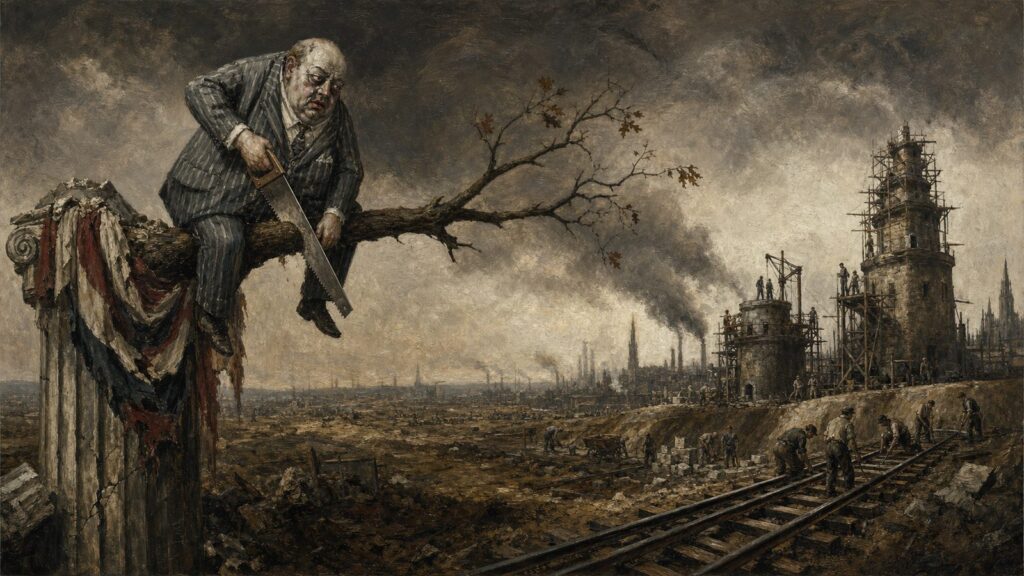
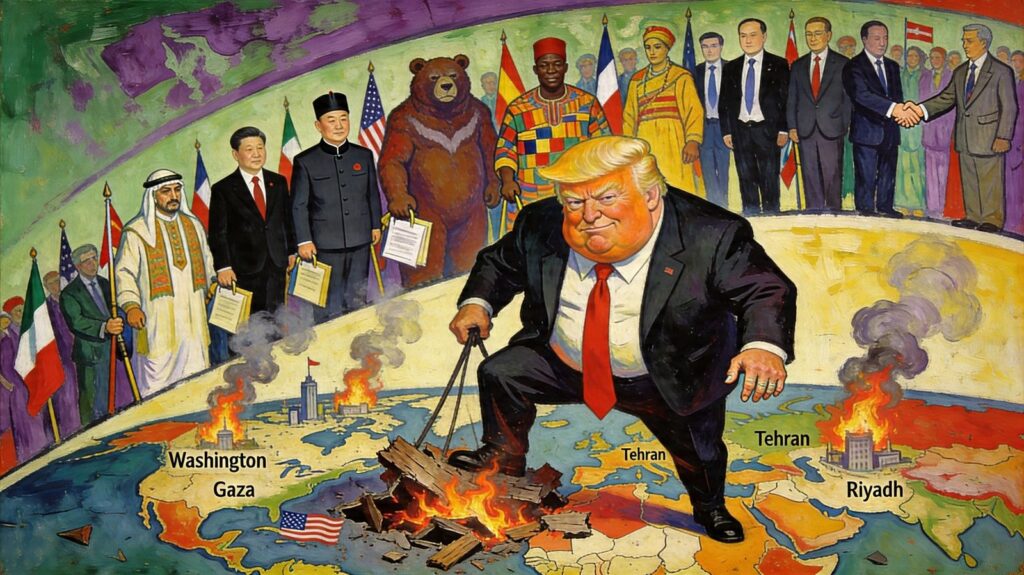
The post-Cold War unipolar era anchored by American primacy is not eroding gradually. It is collapsing under the weight of Washington’s own choices. By mid-April 2026, a cascade of ruptures that might individually appear tactical have fused into a structural transformation spanning every inhabited continent. European states once considered Washington’s most loyal partners are abandoning Atlantic reflexes. Gulf monarchies that hosted US military bases are questioning whether those arrangements still provide deterrence or merely exposure. Key Asian mid-powers are recalibrating alignments under economic duress and strategic realism. The China-Russia-Iran axis has been institutionally codified into a trilateral strategic pact. And the United States, consumed by domestic polarization, fiscal overextension, an unpopular war in Iran, and the compulsive alienation of every ally it might once have deployed in a containment strategy, is the grand loser of this reconfiguration. Not through military defeat. Through strategic self-immolation.
The old world order is circulating old news as a placeholder. The new one is being built in real time.
India: The Indispensable Pole
No country better illustrates the architecture of genuine multipolarity than India, and no country has been more systematically underestimated in Western analyses of the emerging order. India in 2026 is simultaneously the chair of BRICS+, a participant in the Quad, a strategic partner of Russia, a deepening partner of France and the EU, and the self-appointed institutional voice of the Global South. It is not hedging between poles. It has become one.
India holds the 2026 BRICS+ presidency at a moment of maximum leverage. Prime Minister Modi hosting both the BRICS and Quad foreign ministers’ meetings in May 2026 is the clearest single illustration of India’s unique positioning: no other country on earth commands the diplomatic standing to convene, in the same season, the core multilateral institution of the Global South and the primary security architecture of the Indo-Pacific. Modi has reframed BRICS as “Building Resilience and Innovation for Cooperation and Sustainability,” and his formulation that BRICS must not become anti-G7, and G7 must not become anti-BRICS, is the defining statement of what responsible multipolar architecture looks like when managed with strategic competence.
The India-Russia relationship has deepened under pressure from Washington. When Trump’s administration imposed tariffs as high as 50% on Indian goods and penalized New Delhi for importing Russian crude oil, India responded not by capitulating but by rebalancing. Modi held hands with Xi Jinping and Putin at the Shanghai Cooperation Organization summit in Tianjin in 2025, signaling publicly that India’s multi-alignment is non-negotiable. Former Indian Ambassador Meera Shankar described New Delhi’s posture as “neither confrontation nor capitulation” with Washington, while maintaining that disruption in US-India ties “would provide a fillip to China’s growing sway.”
French President Macron made a three-day state visit to India in February 2026, deepening bilateral trade and defense ties and signing frameworks for strategic cooperation. French Foreign Minister Jean-Noel Barrot met Indian External Affairs Minister Jaishankar and observed that France, chairing the G7, and India, chairing BRICS, were uniquely positioned to “build bridges” between those institutions. Macron’s explicit declaration that “BRICS countries must not become anti-G7” reflects a recognition that India is the only major power capable of preventing institutional confrontation from becoming systemic war.
Jeffrey Sachs stated plainly in March 2026: “If India, China, or Russia stand up together and say, end the war, it will actually end.” That India has not yet done so reflects a deliberate choice to preserve diplomatic optionality rather than absence of capability. India commands critical weight with all parties in the Iran war: as a major purchaser of Iranian oil prior to sanctions, as Pakistan’s neighbor and interlocutor, as a country with which neither China nor Russia wish to antagonize, and as the one BRICS member Washington cannot afford to fully alienate. India’s strategic autonomy, rooted in what Modi calls “Vasudhaiva Kutumbakam” (the world is one family), is not abstentionism. It is calculated positioning for maximum influence across the full spectrum of the emerging order.
The Foundational Axis: China, Russia, and Iran
The structural backbone of the new order was institutionalized on February 2, 2026, when Iran, China, and Russia signed a comprehensive trilateral strategic pact, described by all three governments as “a cornerstone for a new multipolar order.” This built on Iran and Russia’s 20-year Comprehensive Strategic Partnership (entered into force 2025) and on China’s 25-year cooperation agreement with Tehran targeting trade, infrastructure, and energy integration. These agreements constitute a multi-generational institutional architecture designed explicitly to reduce vulnerability to the US dollar-centric financial system.
China-Russia bilateral trade reached a record $244 billion in 2024, deepening along complementary lines: Russian energy and land-connectivity anchoring Chinese commercial expansion westward. Xi Jinping, meeting Russian Foreign Minister Lavrov in Beijing on April 15, 2026, described the China-Russia relationship as “precious” amid global uncertainty. BRICS+, encompassing Brazil, China, Egypt, Ethiopia, India, Indonesia, Iran, Russia, South Africa, and the UAE, now accounts for nearly half of the world’s population and approximately 40% of global GDP, comparable to the G7. Sino-Russian coordination extends beyond trade into joint military exercises, diplomatic signaling, and the construction of alternative financial infrastructure, including the CIPS cross-border payment system that now processes over half of China’s international trade outside SWIFT.
The European Multipolar Vanguard: Spain, France, and Italy
Spain: Multipolarity as Doctrine
Spain under Pedro Sanchez has staked out the most ideologically explicit European endorsement of multipolarity. Delivering a keynote at Tsinghua University on April 13, 2026, Sanchez declared that “multipolarity is not a hypothesis but the new reality in which the world lives” and that “what is happening today is not a transfer of hegemonies; it is a multiplication of poles.” After meeting Xi at the Great Hall of the People, both leaders openly critiqued US policy, with Xi describing a “crumbling world order” and a struggle “between justice and strength.” Sanchez has explicitly positioned Spain as “an architect of rapprochement between Beijing and the European Union.” Spain’s enormous trade exposure to China, where Beijing accounts for 74% of Spain’s total trade deficit, gives this pivot structural logic rather than mere rhetorical cover.
France: Architect of the Third Bloc
France represents the most strategically ambitious European repositioning. After Macron’s December 2025 visit to Beijing, Xi described France and China as sharing responsibility to “jointly inject much-needed stability into the world.” France is building what analysts describe as a “third bloc”: a middle-power coalition rejecting both American hegemony and Chinese dominance. In Seoul in April 2026, Macron called on Japan, India, Australia, and other global middle powers to “reject hegemonic dominance of both the US and China,” and signed a critical minerals cooperation roadmap with Japan in Tokyo. France sided with Russia and China at the UN Security Council to veto a US-backed resolution on the Iran conflict. Macron has proposed a European nuclear deterrence framework independent of the United States and argued that relying on American hardware makes Europe “a vassal rather than a partner.” For France’s political elite, Trump’s hostility toward Europe “vindicates the vision of a strategically autonomous continent held by generations of French leaders.”
Italy: The Bridge Has Burned
Giorgia Meloni, long presented as Trump’s closest European ally, executed one of the most dramatic diplomatic ruptures of the year in the week of April 13 to 15, 2026. When Trump attacked the newly elected Pope Leo XIV, an American, Meloni called his remarks “unacceptable” publicly. Trump retaliated in an interview with Corriere della Sera: “I thought she had courage. I was wrong.” On Fox News he confirmed: “She’s been negative. Anyone who rejected our assistance regarding the Iran issue no longer shares the same connection with us.” Bloomberg documented the verdict: Meloni has “given up on courting Trump” after the Iran war and his attack on Pope Leo hammered Italian public opinion, with Trump’s approval among Italians falling from 35% to 19%.
The break was institutional. Italy denied US bombers permission to refuel at Sigonella air base in Sicily. Meloni declared publicly that Italy would not participate in the Iran war. She suspended Italy’s defense cooperation agreement with Israel on April 14. The China relationship had already been quietly rebuilt: as early as July 2024, Meloni signed a three-year China-Italy bilateral action plan and told Xi personally that China was “an important interlocutor.” The convergence between Sanchez, Macron, and Meloni on the critical issues of April 2026 is now substantive: opposition to the Iran war, rejection of US basing demands, and pursuit of European strategic independence. Ideological distances between a socialist multipolarist and a post-fascist pragmatist remain on paper; the policy outcomes have converged in practice.
Germany: The Last to Admit It
Germany will be the last major European power to fully recognize that Washington is no longer calling its shots, arriving at that recognition through economic necessity and institutional humiliation rather than geopolitical foresight. The structural rupture is already complete. The Pentagon cut off all working-level communication with Germany’s Defense Ministry, forcing Berlin to route military coordination through its Washington embassy. Germany was excluded from battlefield planning, denied access to military intelligence, and not informed when Washington halted weapons shipments to Ukraine.
Germany’s response has been consequential but characteristically gradualist. Chancellor Merz confirmed early-stage talks with France and the UK on a European nuclear deterrence framework independent of the United States. Germany’s Stiftung Wissenschaft und Politik concluded plainly that “the Pax Americana, which guaranteed the security of Germany and Europe after the Second World War, is coming to an end.” The EU’s “two-speed Europe” framework advanced at Munich in February 2026 proposes allowing willing member states to integrate security policy faster, explicitly accommodating German institutional conservatism. Germany’s awakening is coming. It will be the caboose on this train, not the locomotive.
The UK: The Special Relationship Is No Longer Special
The United Kingdom’s “special relationship” with the United States is now acknowledged as functionally extinct across the British political establishment. Lord Ricketts, former national security adviser, declared on April 8 that the Iran war had been “a huge wake-up call” and warned Britain must “completely forget” the idea of a special relationship. Trump called the relationship “quite disappointing” in an April 15 interview and described UK posture as absent when the US needed it. When Starmer eventually granted limited defensive access to UK bases for US operations, “it was not enough for President Trump.”
Starmer has simultaneously been extending commercial feelers toward Beijing. His January 2026 visit to China, the first by a UK prime minister in eight years, secured what his government described as “billions in exports and investment deals.” Despite formally classifying China as a “threat,” London has acknowledged it must do business with Beijing.
The self-defeating dimension is the Russophobia. Britain’s hostility toward Russia has become an institutionalized condition with a political economy attached. Billions in Russian oligarch money laundered through London over two decades created the very interference networks that now dominate parliamentary inquiry, generating a feedback loop in which British institutions that profited from Russian capital must perform maximum hostility toward Moscow to avoid accountability for how that capital was processed. Starmer called the Ukraine war “the most critical issue of our age” as late as February 2026 and warned Europe “must be able to fight.” The cost is concrete. The UK is locked out of the Moscow-to-Beijing-to-Tehran corridor precisely when that corridor is becoming the central nervous system of the new order. A Britain capable of genuine engagement with Russia could serve as a uniquely positioned bridge: English-speaking, European, post-Atlantic, with historical ties to every node in the system. Instead, it clings to a transatlantic relationship whose other party publicly insults its prime minister. The road to UK-Russia normalization requires not merely a change of government but a generational reckoning, and probably a full public accounting of the London money-laundering infrastructure that Russia’s elites spent two decades constructing.
Israel: The Author of Its Own Isolation
Israel is the proximate trigger of the current global reconfiguration and its most strategically exposed casualty. The Gaza war, entering its third year, has killed more than 72,000 Palestinians and produced what even Israeli lawmakers describe as a “pariah state” trajectory. At the UN General Assembly in September 2024, 124 nations voted to demand Israeli withdrawal from occupied territories; only fourteen voted against. By February 2026, Israel had formally annexed the West Bank in defiance of universal international condemnation. ICC indictments against Netanyahu and former defense ministers are active. 145 countries have recognized a Palestinian state, with nineteen doing so in 2024 and 2025 alone.
The Iran war, launched by Israel and the United States in a joint strike on February 28, 2026 that killed Supreme Leader Khamenei, generated the exact regional conflagration that every responsible analyst warned against. Iran retaliated across Gulf infrastructure and US military installations in Saudi Arabia, the UAE, Qatar, Kuwait, Bahrain, Iraq, and Oman. The Strait of Hormuz closed. Global energy markets convulsed. Israel’s international support, once sufficient to shield it from institutional consequences, has fractured even among traditional European backers. Spain, Italy, the Netherlands, Ireland, France, and the UK have all implemented or are actively pursuing arms embargoes. Norway’s sovereign wealth fund, the world’s largest, has begun divesting Israeli holdings. Netanyahu himself acknowledged in late 2025 that Israel was encountering “a type of isolation that could persist for years.”
The deeper strategic tragedy is that Israel’s absolute dependence on a single patron has left it without a fallback as that patron’s global credibility erodes. The Gaza war did not merely cost Israel international legitimacy. It spent the political capital that might otherwise have anchored new relationships in the emerging multipolar order.
The Gulf States: Caught in the Crossfire They Opposed
The Gulf Cooperation Council states represent the most acutely destabilized bloc in the current conflict. Every one of them opposed the US-Israel war on Iran before it started. Every one of them has been targeted by Iranian missiles and drones since it began. The structural logic of their predicament is merciless: they host US military installations that make them Iranian targets, but those installations have neither deterred the war nor protected Gulf infrastructure from retaliatory strikes.
Saudi Arabia has pursued strategic multi-alignment with the most formal architecture. Riyadh joined BRICS in 2024 alongside the UAE and Iran, now sharing institutional membership with its principal regional rival in a forum that promotes dialogue. The Kingdom participates simultaneously in China’s BRI and India’s Middle East-Europe Economic Corridor (IMEC), positioning itself as a central hub linking Asia, the Gulf, and Europe. Iranian drone strikes hit the Ras Tanura refinery, and Hormuz closure blocked 15 million barrels of Saudi crude that normally transits the strait daily, forcing dependence on the east-west pipeline to Yanbu.
The UAE has moved most decisively into the multipolar architecture. UAE-Russia trade exceeded $12 billion in 2025, a historical record, with services trade having grown sevenfold over five years. In August 2025, the UAE and Russia signed a Trade in Services and Investment Agreement opening 64 UAE sectors to Russian business. On April 14, 2026, the UAE and China signed 24 agreements spanning economic, trade, and investment relations, with bilateral trade targeted to reach $300 billion by 2030. The UAE is simultaneously a BRICS full member, a major US military partner, and Russia’s top-ten trading partner: the ultimate multi-aligned state.
Qatar is in the most exposed position. Iran struck the Al-Udeid airbase, the largest US air force installation in the Middle East, in the prior Twelve-Day War of June 2025. During the current conflict, Qatar’s Doha airport was targeted, and Iran attacked Qatar despite its diplomatic role hosting indirect US-Iran communications, a deliberate message about the futility of half-measures in mediation.
Kuwait and Bahrain remain within the US security framework but face the same structural question haunting every GCC state: does hosting US bases provide deterrence, or merely designation as a target?
Oman is the Gulf’s most consequential actor in the current moment, not through military alignment but through principled neutrality. One month into the Iran war, Sultan Haitham bin Tariq has refused to join the anti-Iran coalition even as Omani soil absorbs Iranian strikes. On March 9, 2026, Haitham became the first Arab leader to congratulate Mojtaba Khamenei on his appointment as Iran’s new Supreme Leader, a signal that Oman’s channel to Tehran remains open regardless of who holds power. Every realistic ceasefire scenario runs through Muscat. Oman does not propose terms; it provides the room. It is the Gulf’s most valuable and most fragile strategic asset.
Yemen’s Houthis, formally Ansar Allah, entered the war on March 28, 2026, launching strikes against Israel in solidarity with Iran. Red Sea shipping attacks have been held in reserve as leverage, with roughly 30 tankers near Yanbu operating within Houthi missile range. Oil prices surged 3% on news of Houthi involvement. Iranian calculus appears to be preserving the Red Sea card for a moment when maximum pressure on Gulf states and the US is needed, rather than deploying it prematurely.
Iraq sits on the fulcrum. Iranian strikes have targeted US military installations on Iraqi soil, reigniting domestic pressure to expel US forces. Iraq’s formal government has no enthusiasm for the war; its Iran-aligned militias have considerable capacity to accelerate it.
Iran itself, though militarily battered, has accomplished several of its core strategic objectives. The killing of its Supreme Leader by a US-Israeli strike generated international condemnation of the attackers rather than isolation of Tehran. Russia condemned the strikes. China condemned the strikes. The Global South condemned the strikes. European allies declined to endorse the operation. A Pakistan-brokered ceasefire now under negotiation for extension leaves Iran positioned to regroup while the US bears the reputational costs of a war it started without international legitimacy.
Pakistan: The Diplomatic Coup of the Year
Pakistan executed the most significant diplomatic achievement of the Iran war by brokering the April 7 to 8 ceasefire between Washington and Tehran. PM Shehbaz Sharif and Field Marshal Asim Munir leveraged longstanding ties to Iran and a newly cultivated relationship with the Trump administration to bridge two parties separated by enormous positional gaps. Trump announced the ceasefire crediting Pakistani mediation directly; Iran’s Foreign Minister expressed “gratitude for tireless efforts.” Bloomberg described it as demonstrating “Pakistan’s central role in global politics,” a remarkable transformation for a country Trump once described as a source of “nothing but lies and deceit.” Pakistan is now mediating a potential 45-day two-phase truce framework and hosting the Islamabad Talks. Its success demonstrates what mid-sized powers with cross-bloc relationships can achieve when they have pre-built diplomatic capital on all sides.
Asian Middle Powers: Hedging, Drifting, Deciding
Malaysia’s positioning is the most sophisticated in the Asian theater and the clearest template for mid-sized power survival in the multipolar transition. Total trade reached RM2.88 trillion in 2024, up 9.2% year-on-year. Malaysia joined BRICS as a partner country and oriented 2025 trade targets explicitly toward BRICS nations, FTA partners, and emerging markets. When the Iran conflict disrupted Strait of Hormuz navigation, PM Anwar Ibrahim personally negotiated with Tehran to secure Iranian permission for Malaysian vessels to transit the strait, a direct demonstration of the diplomatic capital that pre-built relationships with adversary states provide. Malaysia simultaneously deepened Russian nuclear energy cooperation with bilateral trade up nearly 63% year-on-year, maintained $80 billion in annual US trade, and welcomed Iran’s ten-point peace plan. This portfolio of Washington commerce, Moscow energy, Tehran access, and Beijing engagement is the least exposed strategic position among Asian mid-sized economies.
Vietnam: Choreographed Drift
President To Lam made China his first state visit upon assuming the presidency in April 2026, deliberately mirroring the pattern he set when he became general secretary and “traveled north first.” The ISEAS State of Southeast Asia 2026 survey found a slim majority of Southeast Asian respondents would now side with China over the US if forced to choose. Yet Vietnam purchased at least 24 F-16 fighter jets from the United States in mid-2025 even as it deepened institutional frameworks with Beijing. The “Beijing first, Washington next” choreography is precisely calibrated hedging: directional but not yet irreversible.
Indonesia: BRICS Member, Strategic Agnostic
Indonesia officially joined BRICS+ in early 2025 as the bloc’s first Southeast Asian member. Yet Jakarta’s foreign policy posture shows consistent soft hedging: pursuing diplomatic, economic, and security dimensions simultaneously without formal alignment to either bloc. Institutional incoherence among key state actors erodes the credibility of its hedging while preserving flexibility.
South Korea and Japan: Economically Entangled, Formally Anchored
South Korea and Japan remain formally US-anchored but economically entangled with China beyond the point of clean decoupling. South Korea’s trade with China reached $272.9 billion in 2024 under the China-South Korea FTA. Japan is simultaneously deepening security cooperation with the US and Quad partners while pursuing independent economic diplomacy, most notably the April 2026 critical minerals roadmap signed with Macron in Tokyo. Both are multi-aligning under economic duress, not formally realigning, but the direction of drift is visible.
Turkey: The NATO Defector Who Never Left
Turkey remains NATO’s most structurally anomalous member: formally inside the alliance while pursuing BRICS+ membership, maintaining trade with Russia in defiance of Western sanction frameworks, conducting independent military operations in Syria and Libya, and positioning itself as a pivotal middle power spanning Europe, Asia, and the Middle East. Ankara’s BRICS+ application is not a break from the West but an attempt to expand agency, mirroring the hedging strategies of the UAE, Brazil, and Pakistan. Turkey’s geographic position, commanding the only naval passage between the Black Sea and the Mediterranean, makes it irreplaceable to any European security architecture. That irreplaceability is precisely what Brussels tolerates when Ankara pushes boundaries.
Africa and the Global South: From Object to Actor
Africa enters 2026 as globally indispensable but institutionally fragmented. The continent holds approximately 50% of the world’s cobalt reserves, 79% of platinum group metals, and 60% of the world’s best solar resources, inputs indispensable to the green energy transition that every major power covets. The United States, China, Russia, Gulf states, and emerging middle powers are competing openly for African minerals, votes in multilateral fora, military access, and trade routes.
The multipolar transition is creating genuine strategic space for African agency. Unlike the Cold War’s rigid bloc structure, today’s landscape allows multi-alignment, and the most sophisticated African governments are exploiting it. Egypt and Ethiopia joined BRICS in 2024; South Africa is a founding member. The African Union expressed support for the Pakistan-China ceasefire proposal during the Iran war, demonstrating the continent’s growing capacity to act as a collective diplomatic voice rather than a passive object of great-power competition. India’s admission of the African Union to the G20 during its 2023 presidency was a structurally significant act, expanding the table at which Global South interests are formally represented.
Brazil anchors the Latin American node, having held the BRICS presidency in 2025 and overseen Indonesia’s accession. The Global South’s demand for reform of the UN system, the international financial architecture, and trade settlement mechanisms is no longer a petition to the powerful. It is a structural pressure from a bloc that collectively represents half of humanity.
The Petrodollar’s Structural Erosion
The dollar’s position in global trade and reserves is the financial infrastructure of the old order, and its erosion is accelerating. The dollar’s share of global foreign exchange reserves declined to a two-decade low through Q4 2025 per IMF COFER data. Its share of global trade has fallen from roughly one-third in 2000 to approximately one-quarter today. Over half of China’s international trade is now processed through CIPS, bypassing SWIFT. India-Russia trade settles in rupees; UAE-India, Brazil-Argentina, and Indonesia-Malaysia blocs are piloting local currency settlements.
The dollar is not collapsing. It posted its best quarter since late 2024 in Q1 2026, boosted by Iran conflict safe-haven demand. But the structural pressure is unmistakable and accelerating. J.P. Morgan Research confirmed that de-dollarization could “shift the balance of power among countries, reshaping the global economy.” The Iran-China-Russia trilateral pact specifically targets reduction of dollar-centric financial vulnerability. BRICS+ accounting for 40% of global GDP provides an institutional base for alternative settlement frameworks that simply did not exist a decade ago.
The United States: Strategic Self-Marginalization
Washington’s grand strategic posture under Trump 2.0 has produced the precise outcome that multipolarists long anticipated: an accelerating consolidation of alternative poles, driven not by their ideological coherence but by the shared experience of American unreliability. The December 2025 National Security Strategy redirected US grand strategy toward the Western Hemisphere, set a 2027 deadline for “Europe-led NATO,” and accused the EU of threatening “political freedom and sovereignty,” announcing withdrawal from European security commitments while simultaneously insulting the allies asked to fill the vacuum.
Trump declared China a “peer rival” at the November 2025 APEC summit, the first such acknowledgment since the Cold War, while simultaneously alienating every partner capable of forming a containment coalition. The Iran war was launched without consultation of Gulf allies who had specifically lobbied against it, alienating the very states whose basing infrastructure the US depends on for Middle Eastern power projection. Those states are now questioning whether hosting US military assets provides deterrence or merely designation as a target.
Europe is “moving, cautiously but decisively, toward a security future that no longer depends on the US.” The Iran war and Trump’s Greenland ambitions triggered what analysts describe as “the deepest fracture in the 77-year history of the NATO alliance.” European governments are openly discussing restricting US access to military bases, airspace, and ports. The European Parliament’s own research unit concluded that transatlantic relations are now defined by “pronounced divergence in regulatory approaches, mounting commercial and geopolitical tensions, and a shrinking yet still meaningful space for US-EU cooperation.”
The world circulating in Washington as settled reality (American primacy, dollar hegemony, NATO unity, Gulf deference, Asian dependency, Global South passivity, and Indian loyalty) is not simply becoming obsolete. It is being actively superseded by institutional architecture that its principal beneficiary helped destroy.