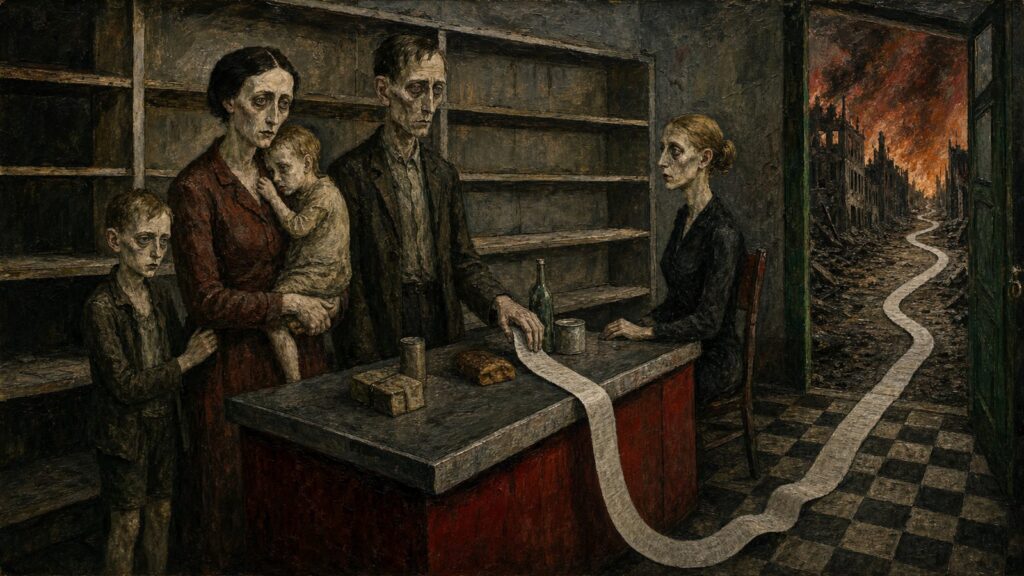

The Global Order America Built Is Collapsing, and Nobody in Washington Will Tell You, What Replaces It or What It Will Cost You
APR 16, 2026
By Scott Ortkiese · so@throughlinesynthesis.com · www.throughlinesynthesis.com
* * *
CODA: THE WALLS COMING DOWN IN KABUL
Four days before his conversation with Glenn Diesen, Timofei Bordachev was in Kabul watching ordinary residents tear down the massive concrete blast walls they had built around their homes through decades of Soviet occupation, civil war, and American military presence. Those walls were built for survival: to absorb blast waves, to hide from aerial surveillance, to create defensible space under conditions of perpetual external threat. Their demolition means ordinary Afghans have concluded, collectively and without any official announcement, that the period requiring those walls has ended.
No Western threat assessment tracks this. No NATO intelligence brief monitors construction practices in Afghan residential neighborhoods. No IMF stability index captures the observable behavior of people who have survived decades of foreign occupation and are now making long-term investments in the openness of their living spaces. And yet this single observation tells us more about actual political conditions in Afghanistan than any official metric Western institutions produce.
The walls coming down in Kabul are the smallest possible unit of evidence for the largest possible claim: that the world the United States built through coercion is being quietly, patiently, and practically dismantled, neighborhood by neighborhood, trade corridor by trade corridor, payment system by payment system.
* * *
PREFACE: WHY THIS CONVERSATION MATTERS NOW
On March 25, 2026, Timofei Bordachev published “Eurasia’s Ghosts of the Great Game” in the Valdai Discussion Club. Within days, he sat down with Glenn Diesen to discuss it on camera. The conversation was recorded as US-Israeli air campaigns against Iran were reshaping the geopolitical architecture of the Middle East, disrupting the International North-South Transport Corridor, and sending shockwaves through the global energy and financial system. The timing is not incidental. Bordachev’s article is a substantive contribution to an accelerating realignment of governments, written by the foremost articulator of Russian foreign policy, in the precise moment the new world order is being assembled.
This analysis proceeds in four layers: the biography of the participants in context; an examination of the arguments advanced; an analysis of the live geopolitical data that confirm, complicate, or extend Bordachev’s argument; and a synthesis of what it all means for the sovereigns navigating this transition.
* * *
PART ONE: WHO IS SPEAKING, AND WHY IT MATTERS
Timofei Bordachev: The Man Who Writes Russia’s Strategic Vision
Timofei Bordachev is Program Director of the Valdai Discussion Club, Russia’s most important platform for communicating its foreign policy worldview to international audiences. The Valdai Club is not a propaganda organ. It maintains genuine scholarly independence. It is the primary forum through which the Kremlin tests, refines, and disseminates its worldview to foreign audiences. When Putin addresses Valdai annually, he is not speaking to academics. He is announcing doctrine.
Bordachev is the theoretician behind Putin’s strategic declarations. His October 2024 report, “The World Majority and Its Interests,” introduced the most consequential new concept in Russian foreign policy since “sovereign democracy” in the early 2000s. His December 2025 Valdai piece on Russia’s non-messianic foreign policy culture and his March 2026 Great Game article form a coherent intellectual project: a systematic deconstruction of the Anglo-American geopolitical narrative that has structured Western strategy since the 19th century, combined with a positive theory of what a post-hegemonic world order looks like and how Russia fits within it.
The 2025 Valdai annual conference, titled “The Polycentric World: Instructions for Use,” marked Russia’s intellectual transition from critiquing the existing order to designing the next one. Russia no longer theorizes global transformation as a reaction to Western decline. It theorizes it as a self-sustaining process in which Russia participates as an equal, not a revolutionary. Bordachev is the chief architect of Russia’s vision of the New World Order.
Glenn Diesen: The Western Scholar Who Agrees With the Diagnosis
Glenn Diesen, a professor at the University of South-Eastern Norway, has emerged as the most intellectually rigorous Western scholar of Eurasian multipolarity. His argument is that the post-Cold War unipolar order was structurally unstable from its first day. The cause was not rival conspiracy but predictable logic: every great power has security requirements it considers non-negotiable. Russia cannot accept a hostile NATO military alliance on its western border. China cannot accept external control over Taiwan and the South China Sea. In a world of multiple great powers, those powers negotiate over these limits, and nobody gets everything, but everybody gets enough for coexistence to hold.
By refusing to accommodate Russian and Chinese core security requirements after 1991, the United States gave both countries every rational incentive to build the countervailing coalitions and alternative institutions that would eventually erode American dominance. American imperial decline was the predictable consequence of what hegemony does to the diplomatic architecture that stable great-power coexistence requires. When you refuse to let anyone else have a limit, you eventually make everyone else draw one.
The Russians cite Diesen not because he agrees with them, but because a Norwegian academic using Western analytical tools arrived independently at the same conclusion Russian strategists reached from their own experience: that American hegemony was self-defeating and a multipolar world was not a threat to be managed but an inevitability to be designed around. Diesen asks the hard questions a hostile interviewer would ask, but without the hostility, so Bordachev answers them.
* * *
PART TWO: THE GREAT GAME THESIS
The Myth That Ate Strategy
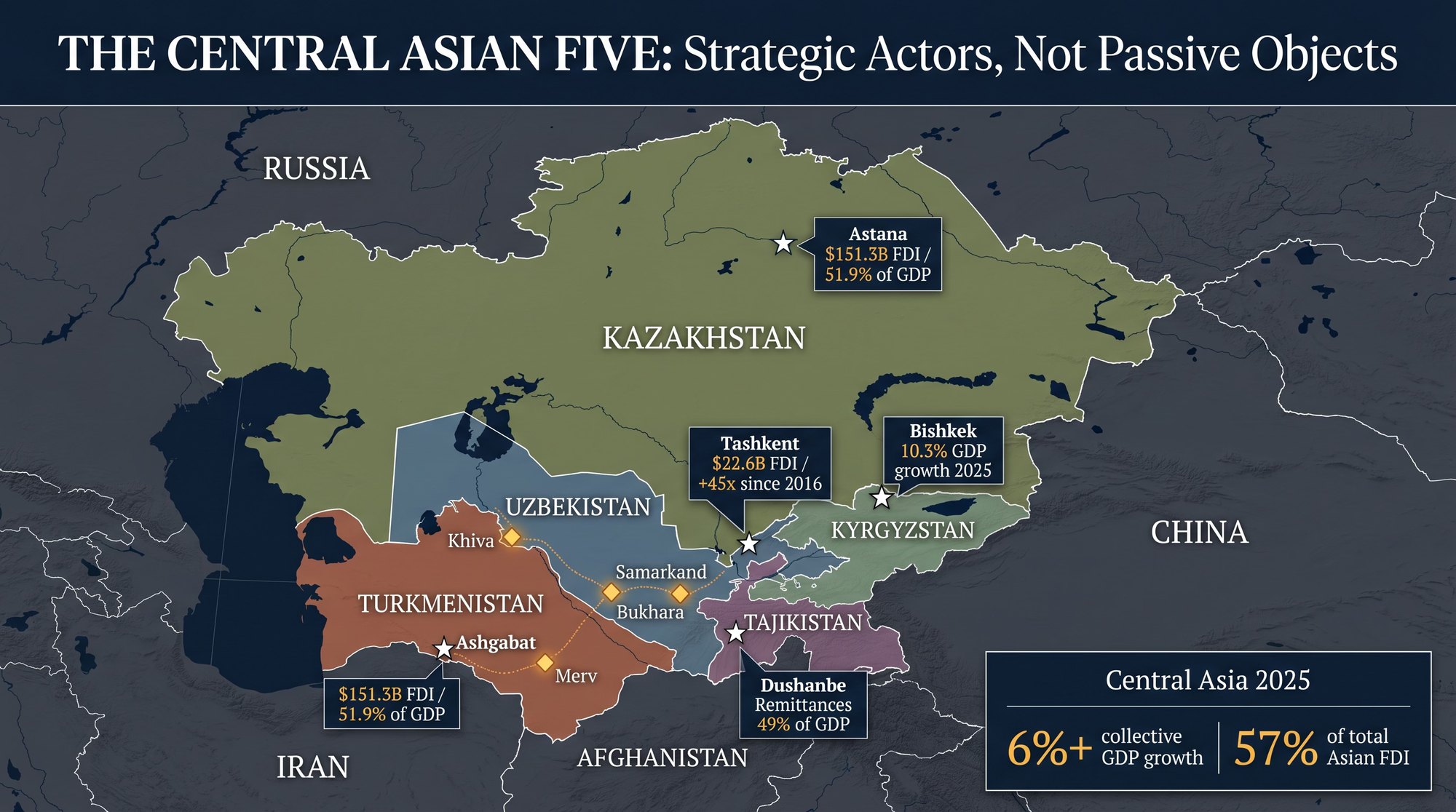
MAP 1The Central Asian Five, republics, capital cities, FDI data, and Silk Road historical city markers.
Bordachev’s central claim requires careful unpacking. The “Great Game” concept was introduced by Arthur Conolly, a young British intelligence officer who traveled to the Bukhara Emirate between 1837 and 1840. Conolly was arrested, held in a pit for months, and executed in the central square of Bukhara in 1841. The Emirate of Bukhara was one of the last independent Islamic kingdoms of Central Asia, centered on the ancient Silk Road city of Bukhara in what is now Uzbekistan.
Bordachev’s point is simple and devastating: the Great Game was mostly theater. Britain and Russia never actually fought each other in Central Asia in any serious way. What determined whether Britain or Russia rose or fell was what happened in Europe: who won the Crimean War, who controlled the Balkans after the Congress of Berlin in 1878, whether a newly unified Germany would tilt toward London or St. Petersburg. Those were the stakes that actually mattered.
The Great Game was not a description of real strategic stakes. It was an agreement to stage a low-cost competitive performance in a theater that neither empire could afford to treat as genuinely vital.
The contemporary resonance is unmistakable. When Western governments frame engagement in Central Asia as a competition to “liberate” the region from Russian or Chinese influence, they are reproducing precisely this narrative structure: elevating a secondary theater into existential drama, serving domestic political purposes while lacking the capabilities, will, or genuine strategic interest to make the competition real.
Mackinder, Mahan, and Spykman: The Maps That Still Govern Western Strategy
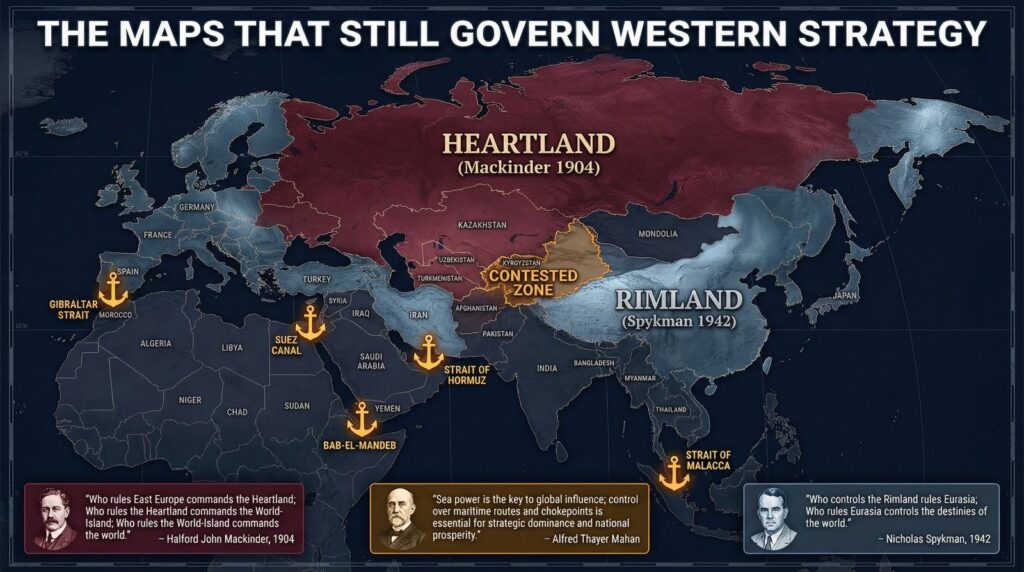
MAP 2Mackinder’s Heartland (burgundy), Spykman’s Rimland (steel blue), Mahan’s sea lane chokepoints, and the Contested Zone (amber).
Halford Mackinder (1904, 1919) articulated the Heartland Theory: “Who rules East Europe commands the Heartland; who rules the Heartland commands the World-Island; who rules the World-Island commands the World.” The theory shaped British Imperial strategy in Central Asia, Nazi Germany’s Lebensraum doctrine, Soviet strategic thought, and US Cold War containment policy, all of which were, at their core, attempts either to control the Heartland or to prevent someone else from doing so.
Alfred Thayer Mahan (1890) argued the opposite: naval supremacy, control of sea lanes, overseas bases, and a robust merchant marine constituted the true foundation of global power. Theodore Roosevelt read Mahan in galley proofs; the acquisition of Hawaii, the Philippines, and Guam followed directly from his logic. Today, the US carrier strike group network and the strategic fixation on the Strait of Hormuz, Strait of Malacca, and Bab-el-Mandeb are all Mahan’s architecture, still operational.
Nicholas Spykman (1942, 1944) synthesized and overturned both predecessors with his Rimland Theory: “Who controls the Rimland rules Eurasia; who rules Eurasia controls the destinies of the world.” Spykman’s framework became the blueprint for NATO, SEATO, CENTO, and Cold War containment strategy, all of which aimed to hold the Rimland coastal states and deny the Soviet interior access to warm water and global markets.
Mackinder further argued that the Pivot Area should be surrounded by “so many bridgeheads”, a crescent of crisis flashpoints. Alex Krainer, writing on April 10, 2026, traces the explicit continuity: Brzezinski wrote in The Grand Chessboard (1997) that “For America, the chief geopolitical prize is Eurasia.” Krainer documents the sequence: Ukraine against Russia first; had that succeeded, Russia would have been directed against China. Iran is the current target in the same unbroken series, because Iran is the pivot power of Western Asia and the land corridor through which Eurasian connectivity must pass. The deliberate targeting of the China-Iran Railway in 2026 is the operational expression of Mackinder’s 1904 doctrine, still running.
Connectivity: The Argument That Supersedes All Three Maps
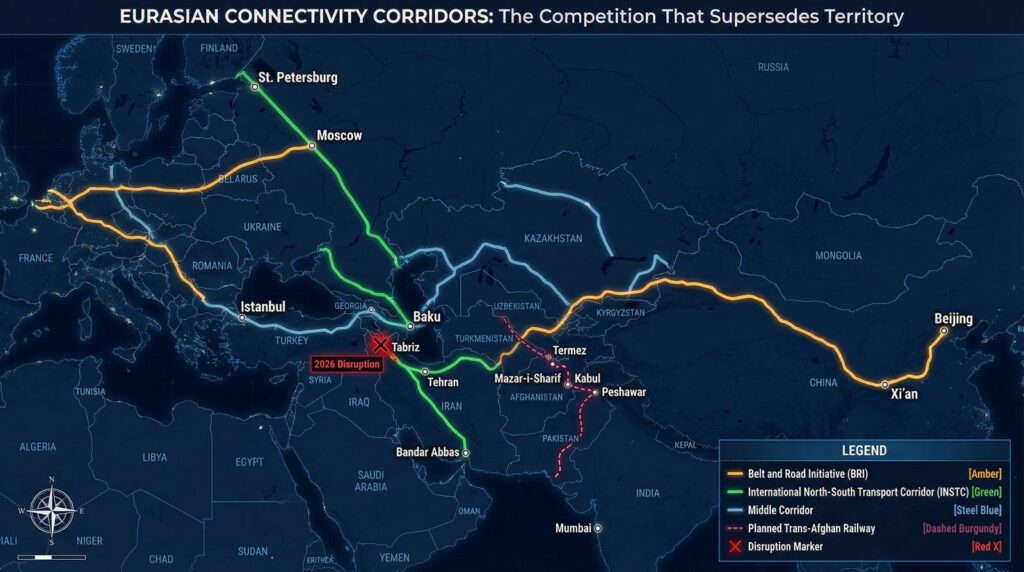
MAP 3Eurasian Connectivity Corridors, BRI (amber), INSTC (green), Middle Corridor (blue), Trans-Afghan Railway (dashed burgundy), with the 2026 INSTC disruption point.
Bordachev claims what neither Mackinder, Mahan, nor Spykman made explicit: in the era of nuclear deterrence and economic interdependence, the decisive variable is not territorial control but connectivity. The question is no longer who occupies the Heartland or holds the coastal rim. It is who builds the roads, railways, ports, pipelines, and digital payment systems through which trade flows and financial dependencies form. Connectivity creates influence without requiring hegemonic control.
The United States occupied Afghanistan for twenty years and left no railways, no pipelines, no payment infrastructure, and no permanent trade architecture. Russia’s General Prosecutor’s Office moved in early 2025 to delist the Taliban as a terrorist organization. China has signed Belt and Road framework agreements with Kabul while positioning Afghan lithium and copper reserves as inputs to its electric vehicle supply chain. A $10 billion lithium deal is already on the table. The trans-Afghan railway from Termez to Peshawar is projected to handle cargo volumes of 8 to 15 million tons annually.
Russia and China’s advantage is not military. It is geographical and commercial. Both share borders with Afghanistan or its immediate neighbors. The West’s leverage depends on international recognition, multilateral lending institutions, and governance conditionality that the Taliban government is ineligible to meet. Russia and China, operating outside those institutions, face no such constraint.
* * *
PART THREE: THE CENTRAL ASIAN STATES AS STRATEGIC ACTORS
Civilizational Depth as Political Strategy
Bordachev invokes the great Russian orientalist Vasili Bartold’s observation that Central Asian civilization is at least four times older than Russia’s own. When Russian and Northern European ancestors were foraging in forests, the cities of Samarkand, Bukhara, Merv, and Khiva were centers of Islamic learning, mathematics, astronomy, and intercontinental trade. This is not historical nostalgia. It is a claim about political culture: peoples with multi-millennium traditions of statehood have internalized political wisdom that Western analysis consistently underestimates.
The Central Asian Five have each mastered the art of refusing to choose sides. They trade with Russia without endorsing its war in Ukraine. They deepen Chinese investment relationships without becoming Chinese satellites. They negotiate with Western governments without submitting to Western political conditions. They court Gulf capital without adopting Gulf foreign policy preferences. Each great power gets enough to stay engaged; none gets enough to claim dominance. That deliberate ambiguity is leverage.
In 2025, Central Asia grew by more than 6% collectively, outpacing advanced economies and most emerging-market peers. Kazakhstan attracted nearly 70% of all foreign direct investment flowing into Central Asia, with a total FDI stock of $151.3 billion, equivalent to 51.9% of GDP. The Kyrgyz Republic emerged as the region’s fastest-growing economy with GDP expanding 10.3% in 2025. These are not the numbers of a passive object of great power competition.
The Ukraine Comparison: Why Central Asia Is Different
At the hard security level, the geography is simply different. Ukraine shared a direct border with four NATO members, which meant Western weapons could be driven across the border on trucks the same day they were authorized. Central Asia has no such access. To move military hardware into Kazakhstan or Uzbekistan, you would have to cross either Russia or China first. The geography is a veto.
At the cultural and political level, the comparison fails on the civilizational depth argument: Ukraine was a country with a deeply divided national identity that could be politically cleaved and converted into a Western project. The Central Asian states have demonstrated consistent resistance to such cleavage. The South Caucasus complicates the picture: Armenia borders NATO member Turkey, and Azerbaijan produces energy that Europe desperately needs. Neither condition applies to Central Asia, which is landlocked, does not border NATO, and whose energy and raw material exports must transit through Russia or China regardless of political orientation.
* * *
Continues in Part 2: Why the French journalist who could not understand the SCO holds the key to the entire geopolitical divide. Why Col. Lawrence Wilkerson’s testimony about what is actually being bombed in Iran is the clearest confirmation of Bordachev’s thesis. Why Alex Krainer’s near-term prognosis is far darker than Bordachev’s long arc, and why both are right. And the five load-bearing claims about the world that is already arriving.
* * *
Scott Ortkiese is the founder of Throughline Synthesis Group, which produces geopolitical and financial analysis for institutional clients navigating the transition to a multipolar order.
so@throughlinesynthesis.com · www.throughlinesynthesis.com