Why Every American Should Read This
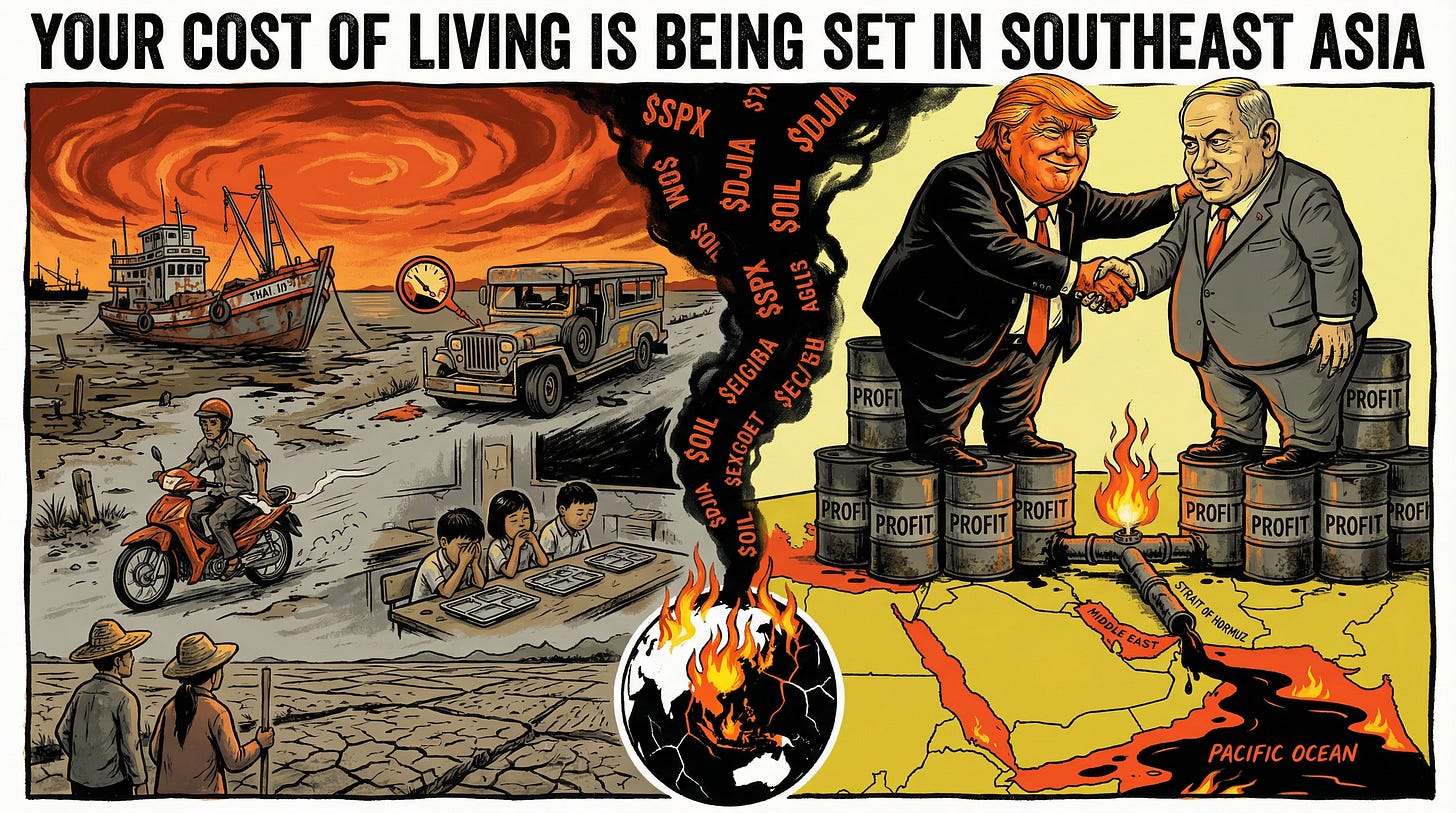
Here is what is happening right now, today, as a direct consequence of the war the United States and Israel chose to start on February 28, 2026. In the Philippines, jeepney drivers cannot cover their fuel costs. In Thailand, an entire national fishing fleet has come to shore and may never return to sea. In Vietnam, gig workers earning nine dollars a day are spending half of it on gasoline and have stopped working entirely. In Indonesia, 60 million children lost their free school meal because the government had to redirect the money to emergency fuel subsidies. In Cambodia, farming families are selling their land and livestock to service microfinance debts they took out before diesel prices doubled. In Laos, 40% of gas stations have closed and schools have cut to a four-day week. In Singapore, the economy contracted in the first quarter and the central bank has tightened monetary policy for the first time in four years. In Taiwan, the power grid that runs TSMC, the factory that makes 90% of the world’s most advanced chips, is running on emergency coal reserves while its primary LNG supply from Qatar sits cut off.
This is the hidden toll of the Iran war. Not the bombs, not the missiles, not the casualty counts that dominate the news cycle. The toll that the American media has almost entirely ignored is the economic destruction radiating outward from the Strait of Hormuz through the most energy-dependent region on earth, into the supply chains, the food systems, the household budgets, and the futures of nearly two billion people across Southeast Asia and the Pacific. And from there, directly back into the American economy, the American consumer, and the American worker.
The United Nations Development Programme has confirmed that known, already-inflicted damage has set in irreversible motion the conditions that will push 32.5 million people into starvation and destitution. Every nation on earth is now absorbing the triple shock of energy collapse, food system failure, and economic contraction. This is not a forecast. It is a process already underway that no ceasefire, no diplomatic gesture, and no amount of Washington spin can stop. The damage is done. It will get worse. There is no off-ramp.
To understand what that means for Americans, follow the shock wave from the Strait of Hormuz through Southeast Asia. That is where the global system is breaking. And that is where the American economy quietly depends on it holding together.
Southeast Asia is where the global system is breaking. Nine nations across the Asia-Pacific are now in varying stages of energy emergency, supply chain collapse, food system stress, and fiscal crisis. Countries holding only 20 to 50 days of oil and gas reserves, with little or no domestic refining capacity and subsidy systems built for a stable world that no longer exists, are the first casualties of Washington and Tel Aviv’s decision. The region is not heading toward a crisis. It is already in one.
The Asia-Pacific collapse is the transmission belt into your economy. When Vietnamese gig workers cannot afford fuel and stop working, when Thai fishing fleets dock permanently, when Malaysian rubber factories run out of chemical inputs, when Filipino jeepney drivers park their vehicles, those disruptions travel directly into the supply chains feeding US retailers, automakers, and e-commerce warehouses. Deloitte states it plainly: with nearly 20% of global oil and gas moving through a now-contested Strait of Hormuz, the Iran war is a present, ongoing, worsening roadblock to the global supply chains that American consumers depend on every day.
The chip that runs America’s AI economy is made in a Taiwan now running on emergency coal. TSMC, which produces 90% of the world’s most advanced semiconductors, consumes 9% of Taiwan’s electricity. Taiwan’s primary LNG supply from Qatar is cut off. It is burning coal to keep the lights on through summer. If power rationing reaches the fabs, every AI server, every automobile, every smartphone, and every weapons guidance system that depends on TSMC output faces supply disruption. That is not a Southeast Asian problem. That is a direct assault on the hardware foundation of the US economy and US military capability.
The Asia-Pacific shock is now baked into US costs for years. Oxford Economics has cut US consumer spending forecasts. Austan Goolsbee warns transport cost surges will “bleed through in other prices” across the American economy. Noah Smith states the macro outcome plainly: inflation near 4%, growth near 1.5%, a self-inflicted wound that cannot be quickly unwound. Supply chain disruptions of this magnitude do not reverse in months. The agricultural input failures, the energy infrastructure damage, and the reserve depletion across Asia will work through every connected economy for years.
The profits are flowing to a handful of American corporations while the losses are being distributed to the poorest people on earth. US LNG exporters are buying gas at $3 per MMBtu and selling it to desperate Asian buyers at $20. Energy analyst Seb Kennedy calculates US LNG windfall profits will exceed $33 billion above pre-war averages in the first four months, rising to $108 billion over eight months. US arms manufacturers are running at capacity. Meanwhile, the UNDP has confirmed that the damage already inflicted has set in irreversible motion the starvation and destitution of 32.5 million people. The triple shock of energy collapse, food system failure, and economic contraction is underway. It cannot be stopped by a ceasefire. It cannot be reversed by a peace deal. The damage is done.
A War of Choice: The Case Against the Official Narrative
The Diplomacy That Was Deliberately Destroyed
The Trump administration’s claim that Iran was an imminent nuclear threat leaving no option but war is not a disputed interpretation. It is a documented lie. On February 26, 2026, two days before the first US and Israeli bombs fell, Oman’s Foreign Minister Badr Al Busaidi was in Washington briefing Vice President JD Vance on what he described as a “breakthrough” achieved at the Geneva talks. Iran had agreed to zero stockpiling of uranium and to convert its existing enriched material into fuel rods. These were concessions Al Busaidi said meant “if the ultimate objective is to ensure forever that Iran cannot have a nuclear bomb, I think we have cracked that problem.” He estimated three months to finalize a deal.
Washington then ordered the bombs dropped the following morning. US B-2 bombers and Israeli F-35 jets struck over 20 Iranian nuclear facilities in coordinated pre-dawn strikes. Iran had not attacked the United States or Israel at any point prior to those strikes. The Arms Control Association published its verdict the same day: “There was no imminent nuclear threat from Iran that justifies this reckless, brazen attack.” UN special rapporteur Ben Saul was equally unambiguous: “This is not lawful self-defence against an armed attack by Iran, and the UN Security Council has not authorised it.”
The Center for International Policy stripped away every pretense: “This is, once again, a war of choice launched by the US with a push from Israel. Israel has pushed the US to attack Iran for two decades, and they finally got it.” The New York Times documented that on February 11, 2026, Netanyahu entered the Oval Office with a single mission: lock Trump into military action and ensure that the ongoing diplomatic progress would not be allowed to succeed. Jurist.org added the domestic political dimension: Trump’s war came precisely as Epstein file revelations threatened his political standing, while Netanyahu’s military timeline was synchronized with Israeli elections in which a criminal conviction would end his career. This was not strategic necessity. It was political survival dressed as national security.
The Lemke Institute for the Prevention of Genocide characterized the attacks as “a crime of aggression” and charged Trump separately with “the crime of perfidy,” the deliberate betrayal of good-faith diplomatic negotiations. Finland, Norway, Colombia, Russia, Senegal, Switzerland, Ireland, and Spain all condemned the attack as illegal under international law. Oman’s Foreign Minister, whose diplomatic breakthrough was incinerated along with the Iranian facilities, expressed being “dismayed” and issued the warning that has since proven exactly correct: “This is not your war.”
No serious analyst, no credible international institution, and no honest reading of the available record supports the claim that the United States and Israel did everything in their power to pursue a negotiated settlement. They did the opposite. They sabotaged an active negotiation in its final stages, then bombed the country they had been negotiating with. The United States and Israel have waged continuous, wantonly destructive aggression against Iran, Lebanon, and Gaza, with no sincere effort toward peace at any point. That is not an opinion. It is what the documented record shows.
Nothing Was Gained, and Nothing Can Be
After 40 days of war and a ceasefire on April 7 that no one trusts, the ledger is empty. Netanyahu declared the objective was to “eliminate the threat posed by the Ayatollah regime in Iran.” The regime survived. The BBC confirmed that Netanyahu’s stated goals (regime change, removal of enriched uranium, elimination of missile capabilities) were not achieved. Al Jazeera’s analysis was direct: Israel left Iran standing and strategically stronger.
The 19FortyFive assessment by Dr. Andrew Latham captured the permanent nature of the failure: “The regime survives, its core structures intact. Its ability to inflict harm on its adversaries is reduced, but not eliminated. The knowledge base remains, and the technical expertise behind the program has not disappeared. Restarting it would take time and money. It would not, however, be out of reach.” CNN confirmed that Iran retains “hundreds of kilograms of the essential materials required for bomb construction, along with decades of technical know-how.” The centrifuges never stopped spinning.
Trump’s war aims shifted throughout the conflict, a sure sign they were never coherent to begin with. General Dan Caine declared the objectives “achieved” on April 8 while the broader goals Trump had publicly stated remained unmet. Ynet News put it plainly: “Trump is folding on Iran as war goals still unmet and regime remains.”
This is not a Pyrrhic victory. A Pyrrhic victory at least produces the victory. What the United States and Israel have produced is this: fishing fleets permanently docked in Thailand, gig workers in Vietnam choosing between fuel and food, 60 million Indonesian children losing school meals, Cambodian farm families selling their land, Filipino OFW remittances collapsing, Singaporean GDP contracting, Malaysian manufacturers watching their supply pipelines break, and Taiwanese chip fabs burning coal to stay online. That is the ledger. That is what 40 days of bombing Iran without authorization, without legal justification, and over the objections of a completed diplomatic negotiation has purchased. Trump did not get regime change. Netanyahu did not get regime change. Neither dismantled Iran’s nuclear program. Iran’s leadership is intact. Its nuclear knowledge base is permanent. Its determination has hardened into certainty that deterrence is the only guarantee of sovereignty against American and Israeli aggression. What has been achieved is a regional economic catastrophe, an irreversible global poverty shock, a permanently destabilized Middle East, and an American consumer paying $4.15 a gallon for the privilege of funding it.
The Transmission Belt: How Washington’s War Becomes Starvation in Southeast Asia
The mechanism through which this war becomes poverty and hunger in Southeast Asia is simple and brutal. About 84% of the crude oil and 83% of the LNG passing through the Strait of Hormuz was bound for Asia. The Strait is not a shipping lane. It is the artery through which the entire Asian economic order draws breath. When Iran blockaded it in early March 2026, the IEA described what followed as “the largest supply disruption in the history of the global oil market,” with global supply dropping by eight million barrels per day.
Southeast Asian nations are the most exposed economies on earth to exactly this kind of disruption. They hold 20 to 50 days of oil and gas reserves. They have little or no domestic refining capacity. Their subsidy systems were built for a world of stable commodity prices, not the world that Washington and Tel Aviv have now permanently created. Every government in the region is now competing for the same dwindling spot-market cargoes against wealthier buyers in Europe and Northeast Asia who can simply outbid them. ERIA energy economist Alloyius Joko Purwanto stated it without qualification: “The small countries with small refining capacity are the countries that will suffer the most.”
They are already suffering. And it will get worse.
Malaysia: The Net Exporter That Still Got Burned
Malaysia is the most economically resilient nation in this analysis, and even Malaysia is in serious trouble. Bank Negara Malaysia raised its 2026 growth forecast to 4 to 5%, supported by its status as a net energy exporter and strong domestic demand. BNM Governor Abdul Rasheed Ghaffour stated “Malaysia enters 2026 from a position of strength.” MIDA Chairman Zafrul Aziz told Bloomberg TV on April 14 that the government has fiscal space to support affected industries.
What those statements do not capture is the reality on the ground. Malaysia imports nearly 70% of its crude oil from the Gulf. When the Hormuz closed, the fuel subsidy bill surged more than fourfold within a week. Diesel rose 80 sen to RM3.92 per litre on March 12. Prime Minister Anwar Ibrahim ordered civil servants and private sector workers to work from home. The reassuring language from government spokespeople and the FMM survey showing 90% of manufacturers expecting imminent supply chain disruptions describe the same country. One is the official face; the other is what is actually happening.
Anwar’s Diplomatic Pivot
Anwar Ibrahim executed the most effective regional diplomatic response to the crisis, because Malaysia had unique leverage: its Muslim-majority status and its longstanding refusal to join Western condemnations of Iran. He spoke directly with Iranian President Masoud Pezeshkian, secured Iran’s agreement for Malaysian tankers to pass through the Strait with “early clearance,” and announced on April 7 that Malaysia’s fuel supply was guaranteed until June. He reaffirmed Iran’s right to defend its sovereignty and rejected US pressure to condemn Tehran.
Let that sink in. The only reason Malaysia’s fuel supply is secured is because its prime minister refused to follow Washington’s lead, went directly to Tehran, and leveraged an independent foreign policy that the United States has spent decades trying to undermine across the Global South. Anwar’s maneuver worked precisely because he was willing to say publicly what Washington forbids its allies to say: that Iran had the right to defend itself.
The Manufacturing Alarm: 90% Expect Disruptions
The Federation of Malaysian Manufacturers surveyed more than 200 manufacturers in early April 2026. Nine in ten expected supply chain disruptions within two weeks. Nearly 70% anticipated raw material shortages within four weeks. More than 8% had less than two weeks of critical stocks remaining. FMM President Jacob Lee Chor Kok identified three simultaneous crises: logistical collapse, energy and fuel cost surges, and raw material shortages already breaking restocking cycles. The FMM’s own statement was unambiguous: “The supply pipeline is thinning and in several cases it is already broken.”
Plastics and chemical manufacturers face shortages of naphtha, LPG, and sulphur. Malaysia’s rubber sector, including the world-leading gloves and tyre industries, confronts collapsed supplies of chemical accelerators and processing oils. Food processing manufacturers face shortages of palm-based additives, dairy inputs, and packaging materials. These are not risks. They are documented, current supply failures in one of Southeast Asia’s most diversified industrial economies.
The Palm Oil Cascade
Malaysia is the world’s second-largest palm oil producer, and the Iran war is in the process of destroying that industry from the roots up. Fertilizer producers FGV Holdings and Union Harvest immediately suspended all sales of urea, ammonium sulfate, and muriate of potash when the Hormuz closed. Raw material prices for fertilizers surged 100% to 150% in two weeks. Forty percent of Malaysian palm oil is produced by smallholders who cannot absorb price shocks of this magnitude. The Malaysian Palm Oil Board warned that smallholders will be forced to skip fertilization cycles, with the resulting yield collapses arriving in months, not years.
Meanwhile, shipping route closures have already damaged demand from Pakistan, Egypt, Saudi Arabia, Turkey, UAE, and Iran, collectively representing up to 15% of global palm oil consumption. Palm oil stocks fell 8% month-on-month in March. The Galen Centre for Health and Social Policy documented the downstream food price consequences: higher costs for vegetables, rice, chicken, eggs, and flour across Malaysian markets. Malay Mail consumer reporting documented the behavioral evidence already visible: Malaysian families shifting from premium grocers to budget stores, cutting protein, and eliminating discretionary food spending. This is happening now, before the full supply chain effects have even reached shelves.
The Semiconductor Sector: Resilient Only Until It Is Not
Malaysia’s semiconductor sector, anchored by Intel’s Penang facility and Infineon’s Kulim plant, has not yet experienced direct disruption. ISIS Malaysia analyst Jaideep Singh attributes this to Malaysia’s role in assembly, packaging, and testing rather than fabrication using Gulf-sourced inputs. Infineon describes its situation as “stable with minor impact.”
That stability has a shelf life. The Qatar LNG cutoff is already squeezing helium supplies critical to TSMC and SK Hynix fabrication. Those companies currently have sufficient inventory. If the Qatari shutdown extends, that inventory runs out, the fabs in Taiwan and South Korea face input shortages, and the testing and assembly operations in Malaysia that depend on a steady flow of finished wafers will face their own supply collapse. Intel’s new advanced manufacturing facility in Penang is scheduled for commissioning in late 2026, arriving precisely into an energy and supply chain environment that could not be less favorable.
Singapore: The City-State That Cannot Hedge Its Location
Singapore’s exposure is structural and inescapable. No domestic energy production. No agricultural base. An economy built entirely on trade, logistics, and finance. Every unit of global disruption passes directly into Singapore’s cost structure with nothing to absorb the shock.
The first quarter GDP reading tells the story: 4.6% growth year-on-year, with a 0.3% contraction quarter-on-quarter, a sharp reversal from Q4 2025’s 1.3% expansion. The Monetary Authority of Singapore tightened monetary policy on April 14, its first tightening since 2022, acknowledging “significant uncertainties surrounding the inflation and growth outlook.” MAS stated explicitly that 2026 GDP growth “is likely to step down from the above-trend pace of growth recorded in 2025.” RHB Group Chief Economist Barnabas Gan places the 2026 forecast at 3% with active downside risk toward 2.5%, revised down from pre-war projections of 2 to 4%.
Jet fuel running at $193 per barrel is not a temporary disruption for Singapore’s aviation sector. It is a structural repricing of one of Singapore’s most critical industries. Deputy Prime Minister Gan Kim Yong acknowledged to Parliament that manufacturing, transport, and retail are “most directly exposed.” Singapore holds 20 to 50 days of petroleum reserves and has no geopolitical leverage to secure preferential access as Malaysia did. It cannot invoke Islamic solidarity. It has no domestic production. It is entirely dependent on a global market that has been permanently repriced by a war it did not choose and cannot influence.
Indonesia: The Perfect Storm Hits Land
Indonesia entered the Iran war already in distress. MSCI downgrade fears, trade tensions, currency pressure from the Danantara sovereign wealth fund controversy, and a new administration still consolidating power created the pre-conditions for exactly the kind of compound crisis that has now arrived.
The fiscal arithmetic is devastating. Indonesia’s 2026 energy subsidy budget assumed oil at $70 per barrel. Oil is above $100. The government had allocated 381.3 trillion rupiah, roughly $22.5 billion, to maintain fuel and electricity affordability. Reuters confirmed on April 1 that an additional $5.9 billion in emergency energy subsidies is now required. Finance Minister Purbaya Yudhi Sadewa told Parliament on April 6 to “not panic,” insisting the government has made its calculations. The Asia-Pacific Solidarity Network’s analysis described this as a government performing stability it does not have: emergency fuel rationing at 50 liters per vehicle per day, mandatory WFH for civil servants, and a budget model that breaks down if oil stays above $100 for more than a few months.
Indonesia’s fiscal deficit ceiling is 3% of GDP. Sustaining current subsidy levels at $100 oil breaches that ceiling. Cutting subsidies at $100 oil produces social unrest in a nation of 280 million people where fuel prices are a political flashpoint. There is no good option. There is only the management of a crisis created entirely by decisions made in Washington and Tel Aviv.
Prabowo’s signature program, free school meals for 60 million Indonesian children, has been cut. Sixty million children are eating less today because the United States and Israel chose to bomb Iran on February 28, 2026. That sentence should require no elaboration.
Philippines: The Worst-Hit Economy in All of Asia
ING Group ranked the Philippines as the single most vulnerable economy in all of Asia to this war. The numbers explain why: 90% of oil imported from the Middle East, 50 to 60 days of supply, a substantial current account deficit, 2.4 million OFWs in the Gulf region, and 18% of total national remittances originating from Middle East workers.
President Marcos declared a national energy emergency. He suspended excise taxes on petroleum products, authorized emergency fuel subsidies for transport, agriculture, and fisheries, and directed agencies to monitor OFW safety in conflict-adjacent zones. His public statement on the war was the most honest assessment from any head of government in the region: “We are victims of a war that is not our choosing.”
MUFG Research warned that USD/PHP will likely exceed 60, simultaneously raising the peso cost of oil imports and shrinking the dollar value of remittances sent home to Filipino families. University of the Philippines professor Benjamin Velasco acknowledged what this means in plain terms: OFWs will be repatriated, income will be lost, and families that depend on Gulf remittances will face income collapse. In Manila, government workers shifted to a four-day workweek. Coastal fishermen like 48-year-old Ricky, who has fished his entire life, are looking for other work because the fuel economics of fishing have broken down permanently. The government distributed $84 emergency payments to motorcycle taxi and jeepney operators, a Band-Aid on an arterial wound.
Vietnam: Seven Million Motorcycles and Nowhere to Go
Vietnam imported 80% of its oil from the Middle East before the war. When the Hormuz closed, the price consequences were immediate and severe: gasoline up 32%, diesel up 56%, kerosene up 80%, documented by Petrolimex, the country’s dominant fuel trader. Vietnam holds 30 to 45 days of reserves, among the thinnest buffers in the region.
Long lines formed at every petrol station in Hanoi and Ho Chi Minh City, a city where 7 million motorcycles are not a transportation choice but the economic infrastructure of daily survival. The Trade Ministry urged remote work. Prime Minister Pham Minh Chinh suspended fuel taxes. Neither measure changes the underlying arithmetic.
Al Jazeera documented the human reality precisely. E-hailing driver Nguyen earns 240,000 Vietnamese dong per day (roughly $9.11) and now spends 120,000 dong ($4.56) on fuel alone. Half his income, gone. “I can’t make ends meet,” he said. His response, shared by thousands of gig workers across the country, was to stop working entirely: turn off the app, go home, wait. In the Mekong Delta, families replaced cooking gas with wood fires because LPG became unaffordable. In Binh Thuan, a fisherman’s catch revenue fell from 800,000 dong ($30) to 650,000 dong ($24) while his fuel costs doubled. The bus system in Ho Chi Minh City ran at a loss because diesel costs exceeded the price caps written into its government contracts. The operator could not stop running routes. It simply bled money.
Thailand: A Fishing Industry in Permanent Collapse
Thailand’s $7 billion fishing industry, employing hundreds of thousands across 22 coastal provinces, is not “near a standstill.” It is in the process of permanent structural collapse. At Samut Sakhon, Thailand’s largest fishing harbor, over half the trawlers are docked. The rest are following.
Diesel hit 38.5 baht per liter, up from 29.94 baht before the war. The threshold at which fishing trips become economically irrational is 40 baht. That threshold has been crossed. Fishmonger association president Jumpol Kanawaree stated the consequence plainly: “After April 1, you may see that there may be no fish sold because the fishing boats can no longer bear the cost of their crewmen, their families.”
Boat owner Wittaya Lekdee has not left port all month. His fuel costs are up 75%. Captain Boonchoo Lonluy sails more slowly to reduce consumption and catches less as a result: “We cannot sustain this way of life.” Truck driver Prayoon Srisawat’s income is cut in half. Fishermen’s association leader Suchart Kendang in Samut Sakhon said what everyone in the region understands: “It’s a crisis abroad. But we are the ones who get screwed.”
Thailand holds approximately 100 days of oil reserves, better than Vietnam or the Philippines, but that buffer is being consumed daily. GDP growth forecasts have been slashed from 2.5 to 3% to as low as 0.5%. Civil servants are working from home. Office thermostats are capped. A temporary diesel price cap has been imposed. None of these measures address the underlying reality: Thailand’s fishing economy, which took generations to build, is being destroyed by a war 4,000 miles away that served no Thai interest and was never submitted to any Thai judgment.
Taiwan: The Chip That Could Break the Global Economy
Taiwan’s exposure is categorically different from every other country in this analysis. What is at risk is not Taiwan’s economic comfort. It is the operational continuity of the global semiconductor industry. TSMC produces approximately 90% of the world’s most advanced chips, used in AI servers, automobiles, medical equipment, military guidance systems, and every smartphone on earth. The semiconductor sector represents roughly 20% of Taiwan’s GDP. TSMC alone consumes 9% of Taiwan’s total electricity output.
Taiwan relied on Qatar for more than one-third of its LNG before the war. Qatar’s Ras Laffan terminal shut down when the conflict began. Taiwan has secured alternative LNG through April, inked a new 1.2 million metric ton annual contract with the US, and restarted coal-fired generators to reduce gas demand. It holds approximately 150 days of oil reserves.
That buffer runs to summer. Electricity demand in July is historically 40% higher than in February. If Hormuz disruptions continue into the summer, Taiwan, South Korea, and Japan will be competing simultaneously for whatever LNG remains available on global spot markets, against each other and against European buyers. Craig Singleton of the Foundation for Defense of Democracies stated the consequence without ambiguity: “Power cuts could ripple directly into global chip supply chains that underpin everything from AI servers to autos.” The China-Russia Report’s energy security analysis confirmed that Iran’s war consequences “appear highly likely to continue for months, at minimum,” and that the energy crisis “will have unpredictable second and third-order consequences, including for the artificial intelligence buildout.” That buildout is the central pillar of the US economic strategy for the next decade. Washington bombed it.
Cambodia and Laos: The War’s Most Defenseless Victims
Cambodia and Laos have no oil production, no refining capacity, and no reserves. They import fuel from Thailand, which is itself in crisis. The Iran war did not hit these countries with an economic shock. It is hitting them with a humanitarian catastrophe.
Over 40% of gas stations in Laos have closed. The government imposed a four-day school week. In Cambodia, a third of gas stations have shut. In Phnom Penh, teenager Daniel Gech told the South China Morning Post that fuel has gone from 3,400 to 5,400 riel per liter, a 59% increase, “and it’s getting worse each day.” He is not wrong. It is getting worse.
Al Jazeera documented the trap that Cambodian farming families are now caught in. Nearly 3.1 million of Cambodia’s 3.8 million households carry microfinance debt totaling $18 billion, at interest rates of up to 5% per month. The Iran war arrived at the exact moment those families needed to buy diesel for planting season irrigation. Diesel costs doubled. Families are now selling land and livestock to service debts incurred before the price spike, locked into a debt spiral with no exit. Rights groups documented that predatory lenders are accelerating foreclosures. This is the direct, documented human consequence of the decision made in Washington and Tel Aviv on February 28, 2026.
The Accounting: Who Won, Who Lost, and What Was Destroyed
The distribution of this war’s economic damage is not random. It is structured. Those who started the war are profiting. Everyone else is paying.
US LNG exporters are buying natural gas at roughly $3 per MMBtu and selling it to desperate Asian buyers at around $20. Columbia University’s Ira Joseph described the result as “a huge influx of cash for all of these companies.” Energy analyst Seb Kennedy’s calculations show windfall profits of more than $33 billion above pre-war averages over four months, rising to $108 billion over eight months, and approaching $170 billion in an extended scenario. Reuters confirmed that Brent crude averaged $97 per barrel in March, 33% above February levels, with Chevron and Shell earnings forecasts being upgraded. US arms manufacturers are operating at capacity. A handful of American corporations are getting very rich from a war that is impoverishing the planet.
On the other side of that ledger, the UNDP has confirmed that the damage already inflicted by the Iran war has set in irreversible motion the conditions for 32.5 million people globally to be pushed into starvation and destitution. This is not a projection conditional on war continuation. The triple shock of energy disruption, food system failure, and economic contraction is already underway. The agricultural input failures documented in Malaysia, Cambodia, and Vietnam will not be corrected when a ceasefire is signed. Fertilizer not applied in March 2026 cannot be retroactively applied. Crops not planted cannot be retroactively grown. Children who went without school meals in Indonesia and the Philippines cannot retroactively be fed. Iran has already lost an estimated one and a half years of human development gains in the first month of conflict alone. UNDP Administrator Alexander De Croo stated the obvious: “War represents a regression in development. Conflicts can erase years of progress in mere weeks.” The damage is done.
For Americans, the war’s domestic costs are already recorded: a record-low consumer sentiment index, the largest single-month energy price jump since 2005, the biggest wholesale price increase in three years, and gasoline at $4.15 a gallon. These costs were incurred for a war that Congress never authorized, the American people never supported, the United Nations never sanctioned, and that began by bombing a country in the middle of active peace negotiations. The Arms Control Association’s day-of verdict stands: “President Trump’s premeditated, illegal attack on Iran aimed at regime change is an illegal war of choice. It was not authorized by Congress as required by Article 1, Section 8 of the Constitution and the 1973 War Powers Act. It is a grave violation of international law.” The Jurist added: “Trump and Netanyahu’s recent deadly strikes were politically-motivated attacks” producing predictable reprisals, accelerating cycles of violence, and a region permanently more dangerous.
Nobody, including the people who started it, can argue that the United States and Israel did everything possible to avoid this war. They did the opposite: they rejected a completed negotiation, they bombed a country that had not attacked them, they continue to prosecute aggressive military campaigns in Iran, Lebanon, and Gaza simultaneously, and they have given no indication of any sincere interest in a durable peace. This is a forever war of their choosing. The damage is already irreversible. It will get worse. And every American paying $4.15 for gas, every Filipino family without remittances, every Thai fisherman who cannot afford to leave port, every Cambodian farmer selling land to pay for diesel, and every Indonesian child eating one fewer meal per day is paying the price for decisions they had no part in making.

