The War Nobody Authorized, the 92 Million Who Didn’t Start It, and the Annihilation Plan Made Over Dinner in Florida
By Scott Ortkiese | Throughline Synthesis | April 8, 2026
so@throughlinesynthesis.com | www.throughlinesynthesis.com
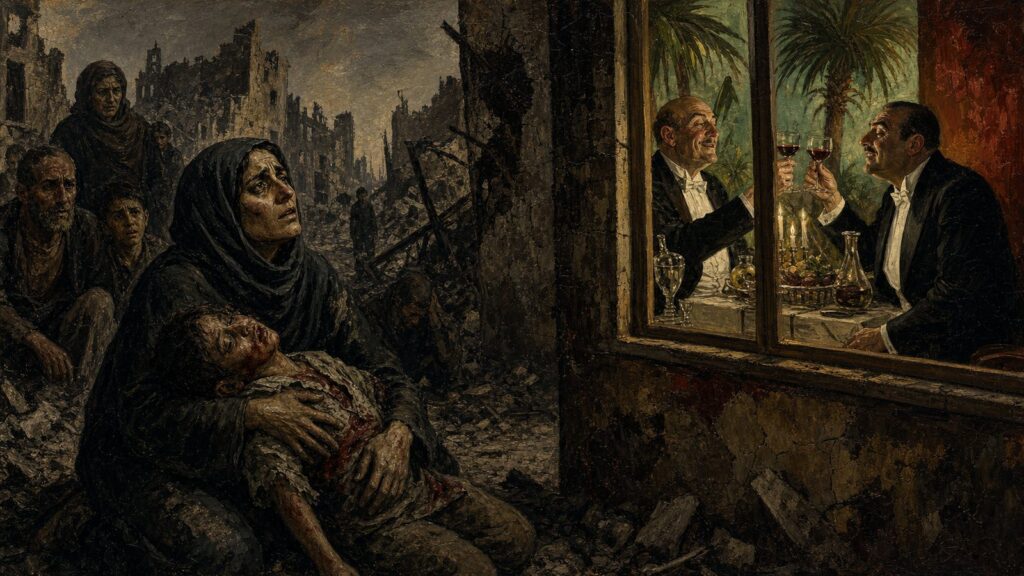
You think you know hurt. You don’t. Just questioning things. Just thinking that your life can’t be understood. What would happen if you truly faced an existential threat? If all the trappings of civilization disappeared. Bombs fell. You were one of 92 million Iranians living your life. This Armada arrives. Jets overhead. There is no normalcy. Fear. Bridges, schools and hospitals were destroyed. A corpulent lunatic screaming at you over the airwaves. You don’t know him. He doesn’t know you. You are as removed from your government as his people are from him.
The Plan Was Made in December
Before a single Iranian threw a rock, before a single bazaar merchant pulled down his shutters, before any of the events that would be called by those who needed a justification a “popular uprising,” the plan had already been made.
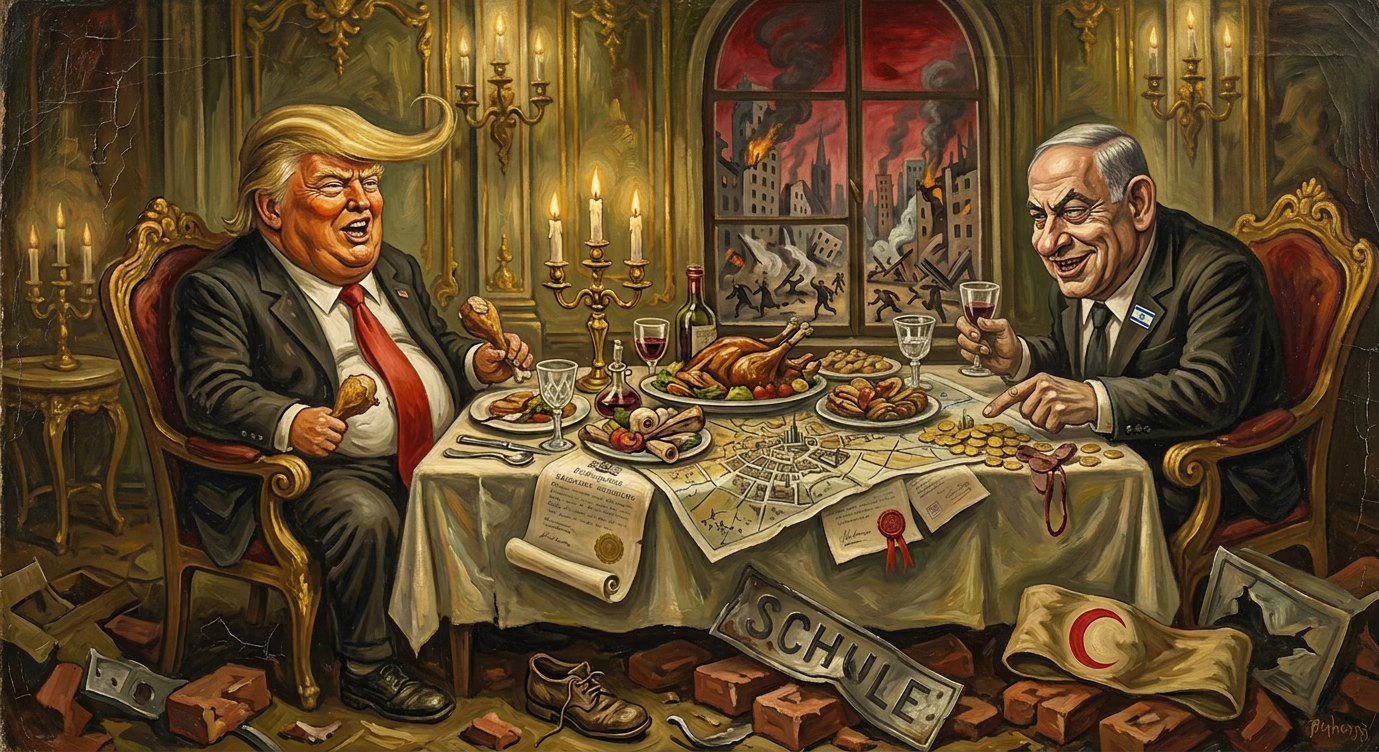
On December 29, 2025, Israeli Prime Minister Benjamin Netanyahu flew to Mar-a-Lago and sat with Donald Trump. According to Axios, Netanyahu initiated a conversation about a follow-up to the June 2025 twelve-day “Operation Rising Lion” strikes. A tentative date was set. May, at first. Then circumstances would adjust the timeline. The attack that would be sold to the world as a response to an imminent Iranian threat, as a war of necessity, as the only remaining option after diplomacy had failed, was scheduled in a Florida resort, over dinner, seven weeks before the bombs fell.
The Pentagon itself confirmed the lie. In private briefings to congressional staff that lasted more than ninety minutes, administration officials conceded that there was no intelligence indicating Iran intended to launch a preemptive attack on US forces. No imminent nuclear threat. No evidence Iran was preparing to strike first. The Arms Control Association was unambiguous: “The absence of an imminent military threat and failure to follow through on diplomatic efforts to address concerns about Iran’s sensitive nuclear activities demonstrates that this is a war of choice, waged in violation of international law and without the necessary approval from Congress.”
A war of choice. Planned in December. Executed in February. Sold as self-defense.
The Diplomacy Was the Trap
In the weeks before February 28, 2026, the United States sent envoys to meet with Iranian negotiators. Jared Kushner and Steve Witkoff flew to Geneva. To the world, and critically to the Iranians, this appeared to be a genuine attempt at diplomacy. It was not.
According to reporting by Axios, the two American envoys attended the Geneva talks with little expectation that a deal would take place. Their presence served a critical operational function: it ensured that Ayatollah Khamenei, believing negotiations were still active, would remain at his office rather than retreat to a protected location. Khamenei attended a meeting of his top aides at his Tehran compound on the morning of Saturday, February 28. He was not hiding. He was working. He had no reason to believe that the men talking peace in Geneva were running a parallel operation to locate and kill him.
The CIA had been tracking Khamenei for months. Israeli intelligence Unit 8200 had hacked nearly every traffic camera in Tehran to map his movements, disrupted mobile phone towers near his compound to blind his security detail, and used cell tower data and signals intelligence to build a pattern-of-life profile of the Supreme Leader. When CIA intelligence confirmed Khamenei would be at the meeting, the timeline was accelerated. The strikes, originally planned for nighttime, were moved to daylight to exploit the opportunity.
At approximately 9:40 a.m. Tehran time, Israeli missiles struck the compound. Khamenei was killed. Forty senior Iranian officials died with him, including the Minister of Defense, the Head of Intelligence, and the Supreme Leader’s Security Advisor. The negotiations in Geneva had served their purpose.
Tehran and Washington had been in the middle of nuclear talks when this happened, not for the first time. The same thing had occurred in June 2025, when Israel launched “Operation Rising Lion” while nuclear negotiations were ongoing. Iran’s conclusion, that “efforts to negotiate and convey messages from the United States to Tehran are a deceptive scheme,” was not paranoia. It was the documented record.
Operation Rising Lion: The First Act
To understand February 28, you have to understand June 13, 2025.
That morning, the Israeli Defense Forces launched Operation Rising Lion, a massive air campaign against Iran’s nuclear infrastructure, missile production capacity, and air defense networks. Israel struck nuclear facilities, killed nuclear scientists, destroyed missile launchers and storage sites across Tabriz, Kermanshah, and Tehran, and eliminated Iran’s air defense batteries in Isfahan. US forces participated directly, striking nuclear sites with American bombers. Netanyahu declared afterward that the operation had achieved “all of Israel’s war aims, and much more.”
Iran had not fired a weapon at Israel or the United States. It had not invaded anyone. It had not crossed any border. The attack was launched against a sovereign nation that had not initiated hostilities, justified on the grounds of a theoretical future nuclear capability, without any UN Security Council authorization and without a congressional vote.
Alastair Crooke, former MI6 officer and founder of Conflicts Forum, one of the most credentialed Western analysts of Middle Eastern affairs, describes what Operation Rising Lion was actually designed to do beyond its stated objectives. It was engineered, he argues, to create the psychological precondition for revolt: to hollow out the IRGC’s perceived invincibility, to demonstrate that Iran’s military could not protect the country, and to prime the Iranian population for the manufactured insurrection that would follow in January.
Mossad badly misread the Iranian public. They assumed, because it was what they wanted to believe, that the whole of Iran was waiting to erupt against the state, ready to replace it with a pro-Western, Pahlavist government. “How I mean, do they not do due diligence on their analysis?” Crooke asks. “It was so obvious. I don’t think you experienced the sort of vicious anger against the Supreme Leader while you were there. I certainly didn’t over the years I’ve been in Iran. In fact, mostly they love him, and he’s a highly respected person.”
The intelligence services that had cracked pagers and assassinated scientists had completely failed to understand the country they were operating inside.
The January Trap: How Real Rage Was Weaponized
The economic misery in Iran was real. It did not need to be manufactured. By late December 2025, the Iranian rial had collapsed to more than 1.4 million per US dollar, half its value from a year earlier. Food prices were 72 percent higher than the year before. Forty percent annual inflation. A currency that changed value faster than merchants could reprice their goods. Truck drivers, bazaar merchants, university students, they had decades of legitimate reasons to be enraged.
But according to Crooke, what happened in January 2026 was not an organic escalation of that rage into revolution. It was a foreign intelligence operation that inserted trained operatives into the protest movement to create the appearance of a collapsing state. The goal was to give Trump and Netanyahu the political cover they needed, a population in revolt, a regime on the verge of collapse, to launch the military strikes that had already been scheduled in December.
Mossad was explicit. Its official social media accounts posted instructions directly to Iranians: “Go out together into the streets. The time has come. We are with you. Not only from a distance and verbally. We are with you in the field.” Former CIA Director Mike Pompeo greeted “every Mossad agent walking alongside” the protesters. The CIA was running active human intelligence recruitment inside Iran, explicitly leveraging social media to solicit informants. Channel 13 in Israel reported that Mossad had shifted from passive observation to active technical facilitation, providing encrypted communications and cyber support to bypass IRGC internet blackouts.
The Islamic Republic, for its own criminal purposes, was handed exactly what it needed. On January 8 and 9, 2026, security forces and IRGC units carried out massacres so vast that Amnesty International called them the deadliest period of state repression in decades of its research. The internet was shut down entirely, not to restore order, but to hide the bodies. The regime’s argument, that the protesters were foreign agents rather than citizens, was false as applied to the overwhelming majority in the streets. But the presence of actual foreign operatives gave the regime its legal fiction, its blank check.
The ordinary Iranians who were furious about a collapsed currency and forty years of misrule paid with their lives. The foreign intelligence services that lit the fuse retreated behind the data and watched.
What Has Been Destroyed
Since February 28, 2026, US-Israeli strikes have damaged 322 medical centers, 763 schools, and 55 libraries across 12 Iranian provinces. The Iranian Red Crescent reports three helicopters, 46 ambulances, and 48 operational vehicles destroyed or damaged. Four Red Crescent relief workers have been killed alongside two pregnant women in medical facilities. The WHO confirmed at least 13 hospitals and healthcare facilities struck in a single week during the first wave of attacks. Universities have been hit. The B-1 suspension bridge, an Iranian-built modern infrastructure project, was bombed twice on April 2, just days before its inauguration, killing at least eight people eating together beneath it on Nowruz, the Iranian New Year.
BBC Verify has confirmed strikes on steel production facilities, three bridges, and a pharmaceutical plant. ATM withdrawals have been capped at the equivalent of three US dollars a day. Banks operate on restricted hours. Iran’s Deputy Health Minister reports 159 public health units damaged or destroyed.
President Trump threatened publicly to “blow up every bridge and every power plant” unless the Strait of Hormuz was reopened by 8 p.m. Eastern Time. On April 7, he posted on Truth Social: “A whole civilization will die tonight, never to be brought back again.” Amnesty International called it “a display of staggering cruelty and disregard for human life,” and noted that the explicit threat to demolish civilian power and water infrastructure would terrorize tens of millions of people. Multiple international law experts, including Harold Hongju Koh, former State Department Legal Adviser, and Yale Law’s Asli Bali, stated directly that these threats and the strikes constituting them could meet the legal definition of war crimes.
Trump bypassed Congress entirely. No declaration of war. No congressional authorization. No UN Security Council resolution. A War Powers Resolution to force congressional consent was rejected by the Senate 47-53 and failed in the House the following day.
The Voice on the Airwaves
He doesn’t know her. She doesn’t know him.
Zohreh is a 41-year-old teacher in Tehran who double-locks her door at night and wakes up breathing gunpowder. She did not elect the Supreme Leader of Iran. She did not design the nuclear program. She did not vote on the missile inventory. She is as removed from the decisions of the Islamic Republic as the voter in rural Ohio is from the decision made at Mar-a-Lago on December 29, 2025.
Her government didn’t ask her. His government didn’t ask him.
But she is the one sleeping on cushions arranged against the kitchen wall, the room statistically farthest from the outer blast radius, bags packed, listening for planes. She is the one whose phone goes dead when the strikes begin, cut off from her sister abroad who is waiting to know if she is still alive. She is the one watching the sky above a city that has been turned, methodically, deliberately, according to a plan made in Florida, into a target.
“They are turning the country into ruins,” said Hoda, a Tehran businesswoman, to NBC News. Not collateral damage. Not a regrettable necessity. Ruins. The word she chose.
The 92 Million
Crooke is precise about the scale of the intelligence failure and its moral weight. The assumption that regime change was imminent, that Iranians would greet the bombs as liberators, was not merely wrong. It was the third time the same assumption had failed. First, the June decapitation strikes were supposed to trigger collapse. They didn’t. Then the January insurrection was supposed to finish the job. It didn’t. Then the killing of Khamenei was supposed to produce a pro-Western scramble for power. Instead, it produced something that American strategists, sealed inside their own certainties, had genuinely not anticipated: rage.
Not the regime’s rage. The people’s rage.
There are 92 million Iranians. Their median age is 32. They were born after the revolution. They inherited a government they did not choose. Many of them despised it, stood in the streets against it in January at enormous personal cost, knowing what the IRGC does to protesters. And now the same foreign governments that claimed to be on their side have bombed their hospitals, destroyed their bridges, threatened to end their civilization, and killed the Shia religious scholar who, whatever his politics, was for millions of ordinary Shia Muslims one of the most revered figures alive.
Crooke describes watching the reaction in Baghdad, in Bahrain, in Pakistan, the fury that swept not just Iran but the entire Shia world when Khamenei was killed. The Green Zone in Baghdad stormed. Protests at the US consulate in Pakistan. Bahrain, 70 to 80 percent Shia, governed by a Sunni ruling family propped up by American bases, teetering on the edge of the first regime change of this entire war, and it would not be the one anyone planned.
“How badly they have done,” Crooke says of Mossad’s strategic failures. “Three times in this last period they assumed that the whole of Iran was just waiting to erupt and to turn it into a pro-Western, Pahlavist government. Really, it’s unbelievable.”
The Oldest Obscenity
This is what needs to be understood. Not the geopolitics. Not the legal arguments, as damning as they are. Not even the casualty counts, as staggering as they are.
This: the plan was made by men in a resort in Florida. The price is being paid by a woman breathing gunpowder in her kitchen in Tehran. The gap between those two facts, the distance between the decision and the devastation, is the oldest, most reliable architecture of modern warfare. Governments make the calculations. Civilians absorb the blast radius. It was true in Iraq. It was true in Gaza. It is true now, again, with 92 million people who did not plan this war, did not want this war, and who have no meaningful way to stop it.
You think you know hurt. You don’t.
But you could try to understand it. And if you govern, you could try to remember it before you make the plan.
Scott Ortkiese is an independent geopolitical analyst and journalist. He publishes at Throughline Synthesis and on Substack. This article draws on operational planning data from Axios, Times of Israel, and CBS/NYT reporting; legal analysis from the Arms Control Association, Common Cause, and constitutional law scholars at Duke University and Yale Law School; intelligence operation details from the New York Times, CBS News, and Iran International; civilian damage figures from the Iranian Red Crescent Society, WHO, Amnesty International, BBC Verify, and on-the-ground reporting from Le Monde, The Guardian, Al Jazeera, and NBC News; and strategic analysis from the March 2, 2026 transcript of Alastair Crooke in conversation with Glenn Diesen.
Related reading
- American Empire in Ruins: The Unprovoked, Unconstitutional, and Catastrophic US-Israeli War on Iran
- What American Media Won’t Tell You About the Iran War and the End of the American Century in Asia
- Trump’s Iran War, China Trip and the Vanishing Empire
- The Iran War’s Hidden Toll on Asia-Pacific: A War of Choice, a Region in Collapse, and a Bill Every American Will Pay